W. Joseph Campbell

Archive for the ‘Debunking’ Category

Final thoughts on a flawed PBS documentary

In Debunking, Error, Media myths, Media myths and radio, Newspapers, War of the Worlds on November 9, 2013 at 1:51 pm

It’s testimony to the program’s flaws and tedium that public discussion about the PBS “American Experience” documentary largely faded away within days if not hours after it was broadcast. The documentary revisited the famous radio dramatization of The War of the Worlds which aired 75 years ago and told of Martians mounting lethal attack on the United States.
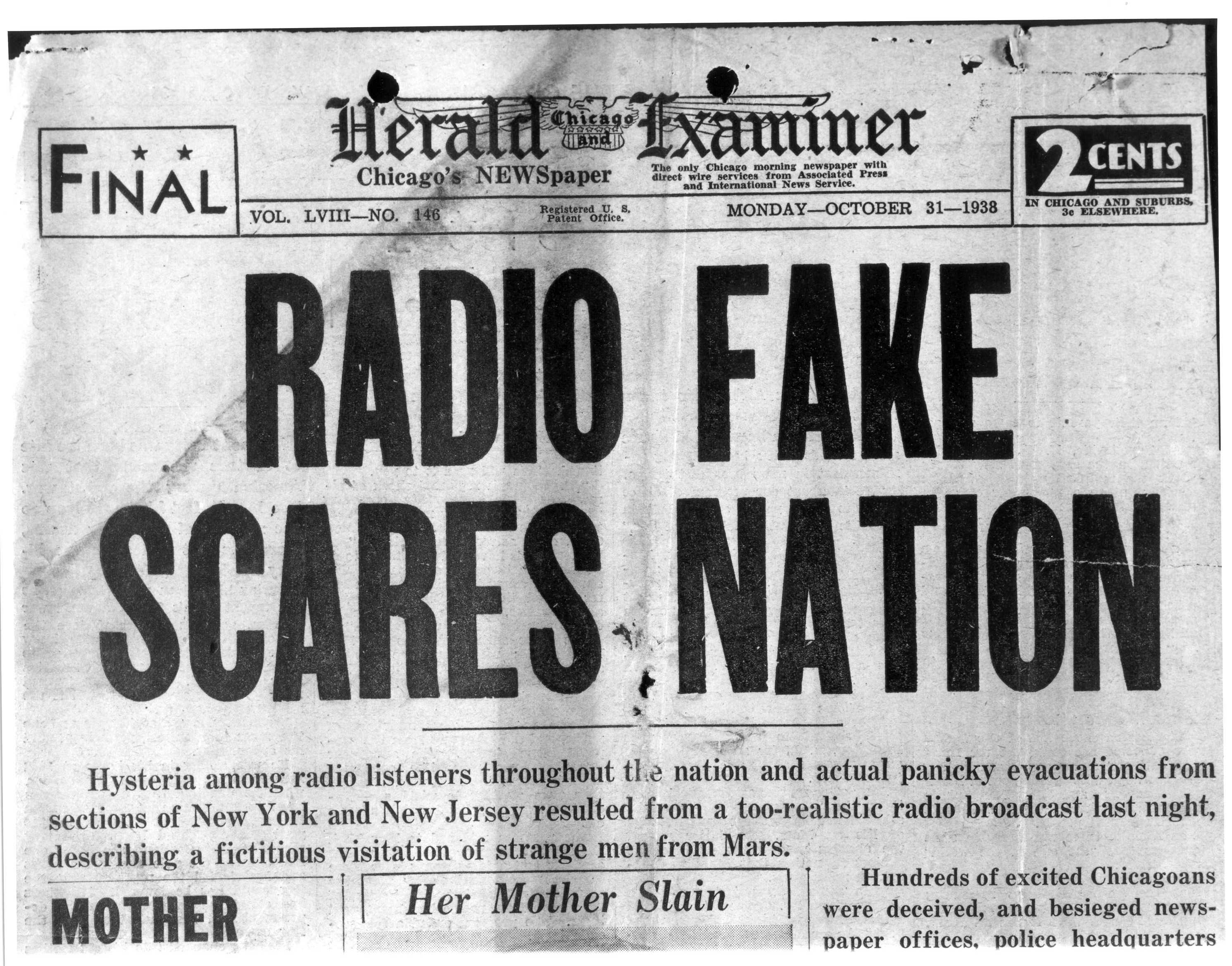
Hyping the reaction

Did not

So realistic was the radio show that it supposedly pitched tens of thousands of listeners into panic and mass hysteria.

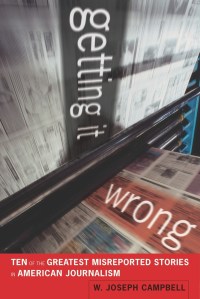
That, of course, makes for a timeless story, and  is a critical reason why the program is recalled and discussed unlike any other radio show. But the reports of panic and hysteria loosed by the radio show were grossly exaggerated by the newspapers of the day. As I discuss in my mythbusting book, Getting It Wrong, whatever fear the program may have stirred, it did not rise to the level of nationwide panic and hysteria.

Eleven days ago, PBS revisited The War of the Worlds dramatization in a documentary notable for failing to confront the most important and intriguing questions about radio program: Did it set off panicked reactions across the country when it aired on October 30, 1938? If not, why is it so widely believed that it had such powerful and immediate effects?

In ducking those central questions, the documentary was an opportunity lost.

The PBS ombudsman, Michael Getler, said as much in a column last week, saying he was “in agreement with the judgment of W. Joseph Campbell, the well-known critic and author of ‘Getting It Wrong: Ten of the Greatest Misreported Stories in American Journalism’ who headlined his comment:  ‘PBS squanders opportunity to offer “content that educates” in “War of the Worlds” doc.’”

The PBS documentary prompted other criticism, too — including its use of cheesy recreated dialog spoken by actors clad in period clothing.

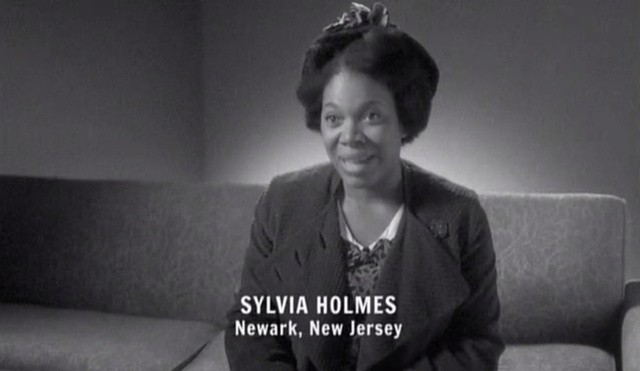
One of the actors played the part of a “Sylvia Holmes” from Newark, New Jersey, who supposedly was pitched into panic by The War of the Worlds radio show. The documentary, however, did not disclose that “Sylvia Holmes” was a pseudonymous character, whose “remarks” were taken from The Invasion From Mars, a flawed book about the radio show published in 1940. (That book intentionally obscured the identities of “Holmes” and other interview subjects.)

As I pointed out at Media Myth Alert last week, PBS editorial standards say that its programming content “should embrace the highest commitment to excellence, professionalism, intellectual honesty and transparency. In its news and information content, accuracy should be the cornerstone.”

Offering up a pseudonymous character and failing to identify her as such seemed to skirt those standards.
'Sylvia Holmes'

The pseudonymous ‘Sylvia Holmes’

Getler in a column yesterday said he didn’t think so. “The producers could have somehow pointed out that Sylvia Holmes was not a real name,” he wrote, adding:

“But I don’t view this as a war crime or as a spiritual violation of PBS standards. Whatever her real name, she was a real person.”

It’s sloppy, though. It’s slyly misleading, and it’s hardly in keeping with a commitment to transparency. As such, it’s another dent in a documentary that was full of them.

Getler reiterated in his column yesterday that the documentary’s “biggest flaw was failing to deal more thoroughly with the role that the press played after the broadcast in suggesting there was more panic than was actually the case. That, in my view, would have contributed to a more contextual public understanding of what actually happened in 1938.”

That’s quite true. But the documentary was more deeply flawed than that. Its makers, after all, ignored recent research that has impugned the notion The War of the Worlds program stirred mass panic.

And in dodging the central questions of The War of the Worlds program, the documentary ended up confused and meandering, not knowing for sure what it was supposed to do. So it turned out to be part tribute to the radio program; part tribute to the radio show’s director and star, Orson Welles;  part rumination about America of the late 1930s, and part digression about life on Mars.

At least it won’t be regarded as a definitive treatment about what was a clever, memorable, and mythical radio dramatization.

WJC

More from Media Myth Alert:

The ombudsman agrees: PBS ‘War of the Worlds’ doc was missed opportunity

In Anniversaries, Debunking, Error, Jessica Lynch, Media myths, Media myths and radio, Newspapers, War of the Worlds, Washington Post on November 1, 2013 at 4:00 pm
Getler

Getler

Not many news organizations these days have internal critics, usually known as ombudsmen or “reader representatives.” Michael Getler, the ombudsman for PBS, is the best of them.

He’s a straightshooter, tough but fairminded.

Getler was often outstanding in five years as ombudsman at the Washington Post, notably calling out the newspaper’s botched reporting about Jessica Lynch’s mythical battlefield exploits early in the Iraq War.

Lynch was a 19-year-old Army private whom the Post catapulted to international fame in a story in April 2003 that claimed she fought fiercely in an ambush in Iraq, firing at her attackers despite being shot and stabbed and seeing comrades “die around her.” Lynch was taken prisoner, the Post, reported, only after running out of ammunition.

The electrifying story, which the Post based on otherwise unidentified “U.S. officials,” was wrong in every important detail. In his analyses, Getler was withering and incisive.

The hero-warrior story about Lynch, he wrote, “had an odor to it almost from the beginning, and other news organizations blew holes in it well before The Post did….”

Why, he asked in one of his columns, did the information in the Post’s hero-warrior story “remain unchallenged for so long?

“What were the motivations (and even the identities) of the leakers and sustainers of this myth, and why didn’t reporters dig deeper into it more quickly?” Getler asked.

Excellent questions, which the Post never has deigned to address.

In 2005, Getler became the first ombudsman at PBS, to help ensure “that PBS upholds its own rigorous standards of journalistic ethics for both online and on-air content.”

I was in touch with Getler by email weeks before PBS aired its recent turgid documentary about the famous radio dramatization in 1938 of The War of the Worlds, which told of a Martian invasion of the United States.

I described to Getler my concerns that the documentary would embrace the media myth that The War of the Worlds program set off mass panic and nationwide hysteria on the night it was aired. I also asked about how the documentary would present or characterize recent scholarship that has impugned the panic-and-hysteria interpretation.

My concerns were heightened because pre-broadcast material that PBS posted online said “perhaps a million [people] or more” were  “plunged into panic, convinced that America was under a deadly Martian attack.”

Getler forwarded my queries to Mark Samels, executive producer of the PBS “American Experience” series. Soon after, Getler told me that Samels said he was “not going to respond to someone who has not seen the program.” This was seven weeks before the documentary aired.

(Getler also noted that he did not speak for PBS and has no “pre-broadcast role” at the organization.)

I subsequently sent an email directly to Samels, reiterating my concerns.

Samels never replied.

Immediately after the documentary was shown Tuesday evening, I posted a commentary at Media Myth Alert saying the program represented a squandered opportunity to revisit The War of the Worlds dramatization in a searching and educational way.

PBS,  I wrote, “could have confronted head-on the question of whether the radio show … really did provoke hysteria and mass panic in the United States. That’s the conventional wisdom, and it makes for a deliciously good yarn — that Americans back then were so skittish or doltish or unaccustomed to electronic media that they readily believed the story of the lethal Martian invasion of Earth, as described in The War of the Worlds broadcast.”

But PBS failed to raise searching questions or offer revealing insight about the famous radio show; instead, it presented a tedious program that claimed upwards “of a million people” were convinced, “if only briefly, that the United States was being laid waste by alien invaders.”

No explanation was offered during the program as to how the makers of the documentary arrived at such a dubious figure.

Getler yesterday posted a thoughtful and insightful critique about the documentary. Notably, he pointed out that shortly before the program ended, “the narrator, just casually in his final summing up, includes this sentence:  ‘Ultimately, the very extent of the panic would come to be seen as having been exaggerated by the press.'”

“Really!” Getler wrote. “Is that not part of the real story? Is that not worth more than a sentence at the end of an hour-long program? Could that be described by some as burying the lead?”

“Burying the lead” is journalese for failing to assign prominence to the most important information of a news report.

And he’s right: PBS buried the lead in its War of the Worlds documentary.

Big time.

Getler also wrote:

“I find myself in agreement with the judgment of W. Joseph Campbell, the well-known critic and author of ‘Getting It Wrong: Ten of the Greatest Misreported Stories in American Journalism’ who headlined his comment:  ‘PBS squanders opportunity to offer “content that educates” in “War of the Worlds” doc.'”

Getler’s column closed with comments — at long last — from Samels, who stated:

“Our film does not say that people panicked, nor does the script include the phrase ‘mass hysteria.'”

Ah, but the documentary invoked “chaos” to describe reactions to The War of the Worlds radio program. And as Getler noted in his critique, the documentary displayed “several banner newspaper headlines” published the day after 1938 dramatization. The effect was to suggest that the radio show had spread panic across the country.

Which assuredly it had not.

Those headlines made such declarations as:

  • “Radio Listeners in Panic, Taking War Drama as Fact”
  • “Radio ‘Martian Attack’ Terrorizes U.S. Hearers, Thousands in Panic”WOW Newspaper
  • “Radio Fake Scares Nation”

And of course, PBS did claim in the documentary that “upwards of a million people” were convinced, if briefly, the country was under Martian attack — an estimate Samels in his comments said was taken from Hadley Cantril’s 1940 book, The Invasion From Mars.

But Cantril estimated that 1 million to 1.2 million people may have been “frightened” or “disturbed” or “excited” by what they heard. He did not exactly say those listeners were “convinced” the country was under Martian attack. And as I point out in Getting It Wrong, Cantril did not estimate how many listeners acted on their fear or excitement.

Being “frightened” or “disturbed” is hardly synonymous with being “panic-stricken.”

In any event, there are more recent and more discerning sources than Cantril’s problematic, 73-year-old book about The War of the Worlds program. But Samels and the documentary’s producer ignored those sources.

Another matter about the PBS documentary awaits Getler’s consideration.

This has to do with the program’s recreated dialog, in which actors dressed in period clothing gave voice to reactions that contemporaneous listeners of the radio program had described in letters.

One of the actors spoke the words of a “Sylvia Holmes” of Newark, New Jersey.

'Sylvia Holmes'

‘Sylvia Holmes’

“Holmes” was presented in the documentary as someone deeply frightened by the radio show.

But her remarks on the PBS documentary were drawn from Cantril’s 1940 book. As media historian Michael Socolow has pointed out, Cantril did not use real names in the book. Indeed, Cantril wrote:

“All names of respondents used in the text, are fictitious and identifying characteristics are disguised, but the true flavor of the case studies is preserved.”

So “Sylvia Holmes” is a pseudonym. And in a posting at Twitter that addressed Socolow’s point, PBS seemed to say it knew that. Left unclear, though, is why the documentary presented a fictitious name as if it were real.

PBS editorial standards say that programming “content should embrace the highest commitment to excellence, professionalism, intellectual honesty and transparency. In its news and information content, accuracy should be the cornerstone.”

In offering viewers the comments of the pseudonymous “Sylvia Holmes,” PBS may have skirted its cornerstone guidance.

WJC

More from Media Myth Alert:

PBS squanders opportunity to offer ‘content that educates’ in ‘War of the Worlds’ doc

In Debunking, Error, Media myths, Media myths and radio, War of the Worlds on October 29, 2013 at 10:02 pm
Orson Welles

Orson Welles

Tonight’s snoozy PBS documentary about the 1938 radio dramatization of The War of the Worlds not only was tedious fare — it represented a missed opportunity to revisit the famous but much-misunderstood program in fresh and searching ways.

PBS could have confronted head-on the question of whether the radio show, which aired 75 years ago tomorrow night on CBS, really did provoke hysteria and mass panic in the United States. That’s the conventional wisdom, and it makes for a deliciously good yarn — that Americans back then were so skittish or doltish or unaccustomed to electronic media that they readily believed the story of the lethal Martian invasion of Earth, as described in The War of the Worlds broadcast.

The PBS documentary embraced the conventional wisdom.

But a growing body of scholarship — which the documentary utterly ignored — has impugned the conventional wisdom and has offered a compelling counter narrative: The War of the Worlds program sowed no widespread chaos and alarm. Instead, listeners in overwhelming numbers recognized the program for what it was: A clever radio show that aired in its scheduled Sunday time slot and featured the not-unfamiliar voice of the program’s 23-year-old star, Orson Welles.

This scholarship is neither obscure nor inaccessible.

Jeffrey Sconce, for example, pointed out in 2000 in his book, Haunted Media: Electronic Presence from Telegraphy to Television: “Direct evidence that thousands of Americans were in actual panic over the [War of the Worlds] broadcast is … limited at best. … And yet the legend of paralyzing ‘mass panic’ lives on.”

Edward Jay Epstein has dismissed as a “fictoid” the notion that the radio program touched off mass hysteria. “The accounts of suicides, heart attacks, traffic collisions and flights all proved to be unfounded,” Epstein wrote, adding:

“The program itself of course was a fiction. So was the ‘Mass Hysteria,’ which became part of American folklore about the power of the media.”

Michael Socolow, a journalism historian at the University of Maine, said this about The War of the Worlds broadcast in a thoughtful commentary for the Chronicle of Higher Education five years ago:

“Nobody died of fright or was killed in the panic, nor could any suicides be traced to the broadcast. Hospital emergency-room visits did not spike, nor, surprisingly, did calls to the police outside of a select few jurisdictions. The streets were never flooded with a terrified citizenry.”

Socolow more recently has written a superb assessment of the broadcast, which was posted today at Slate.com. In it, he wrote:

“The supposed panic was so tiny as to be practically immeasurable on the night of the broadcast.”

Fifteen years ago, at the 60th anniversary of The War of the Worlds dramatization, Robert E. Bartholomew, an international expert on mass panic, pointed to a “growing consensus among sociologists that the extent of the panic” created by Welles’ program, “was greatly exaggerated.

“The irony here,” Bartholomew wrote, “is that for the better part of the past sixty years many people may have been misled by the media to believe that the panic was far more extensive and intense than it apparently was.”

The panic, to be sure, was overstated. Exaggerated. And has become the stuff of a tenacious media-driven myth.

As I wrote in my 2010 mythbusting book, Getting It Wrong, “the notion that The War of the Worlds program sent untold thousands of people into the streets in panic, is a media-driven myth that offers a deceptive message about the influence radio wielded over listeners in its early days and, more broadly, about the media’s potential to sow fright, panic, and alarm.”

I also discuss in Getting It Wrong a little-studied secondary phenomenon associated with The War of the Worlds broadcast, that “a false-alarm contagion took hold that night” in which well-intentioned people possessing little more than an incomplete understanding of Welles’ program set out on their own to warn others about a sudden and terrible threat.Getting It Wrong_cover

These would-be Paul Reveres, I wrote, “burst into churches, theaters, taverns, and other public places, shouting that the country was being invaded or bombed, or that the end of the world was near.

“It had to have been a cruel and unnerving way of receiving word of a supposedly calamitous event — to be abruptly disturbed in familiar settings by a vague reports offered by people who themselves clearly were terror-stricken. … In more than a few cases, a contagion took hold: Many non-listeners became quite frightened, thus compounding for a short time the commotion and confusion stemming from The World of the Worlds program.”

PBS might well have examined that effect. It might have more seriously considered the broader counter-narrative that has taken shape about the radio dramatization.

PBS might have examined, in ways revealing to its audience, how media influences are not transmitted like a narcotic injected by hypodermic needle. News and entertainment media exert influences in ways that typically are far more subtle, nuanced, complex, and uneven.

But to believe The War of the Worlds radio program stirred chaos, mass panic, and widespread hysteria is effectively to embrace the hypodermic needle theory of media influence — a theory discredited long ago .

The age, class, wealth, education, political views, and life experiences of media audiences all are factors as to how media messages are absorbed and interpreted — if they are absorbed at all.

Socolow in his Chronicle article in 2008 noted the uneven and often-limited effects of media messages, writing:

“If we really know how to control people through the media, then why isn’t every advertising campaign a success? Why do advertisements sometimes backfire? If persuasive technique can be scientifically devised, then why do political campaigns pursue different strategies? Why does the candidate with the most media access sometimes lose?”

PBS — which says its mission is “to create content that educates, informs and inspires” — might have seized the opportunity of the 75th anniversary of The War of the Worlds broadcast to address such questions.

But, no: The documentary’s makers settled for a turgid program that was far less educational, informative, and inspiring than it could have been.

WJC

Many thanks to Instapundit
Glenn Reynolds for linking to this post

More from Media Myth Alert:

Good call: WaPo building no landmark

In Debunking, Media myths, Scandal, Washington Post, Watergate myth on September 19, 2013 at 10:59 am
A landmark?

Not a landmark

A leading preservation group in Washington, DC, has quietly decided against seeking landmark status for the Washington Post building, saying the structure isn’t distinctive enough, architecturally.

And that’s a good call.

I had suspected that landmark status would be proposed for the building because of the newspaper’s reporting of the Watergate scandal, which over the years has become a subject of a towering media myth.

The myth has it that the Post’s dogged reporting on Watergate forced Richard M. Nixon to resign the presidency.

That, of course, is a simplistic and superficial interpretation of Watergate — an interpretation not even embraced by the sometimes-arrogant Post. One of the newspaper’s lead reporters on Watergate, Bob Woodward, has declared, for example:

To say that the press brought down Nixon, that’s horseshit.”

Had the Post building been designated a landmark, a likely upshot would have to deepen the heroic-journalist myth of Watergate. Landmark status could have further entrenched the erroneous notion that the Post was the place where Woodward and his colleague Carl Bernstein wrote the stories that exposed and ended a corrupt presidency.

As I discuss in my mythbusting book, Getting It Wrong, the Post’s contributions to unraveling Watergate were very modest and not at all decisive.

To roll up a scandal of the complexity of Watergate, I write in Getting It Wrong, “required the collective if not always the coordinated forces of special prosecutors, federal judges, both houses of Congress, the Supreme Court, as well as the Justice Department and the FBI.”

And even then, Nixon likely would have served out his term if not for the forced disclosures about the audiotape recordings he secretly made of his conversations in the Oval Office of the White House.

Only when compelled by a Supreme Court ruling did Nixon surrender those recordings, which captured him plotting to cover up the signal crime of Watergate, the break-in in June 1972 at headquarters of the Democratic National Committee.

The Post reported this week that the non-profit DC Preservation League has decided that the building’s design “did not rise to a level worth preserving, despite the fact it served as the workplace for journalists who pursued stories such as the Watergate scandal that brought down President Richard Nixon.”

The Post building is pretty bland.  Without landmark status, it may be easier to sell to a developer. The Post said early this year that it was exploring the building’s sale.

Over the summer, the Post was sold to Jeff Bezos, founder of Amazon.com, who agreed to pay $250 million for the newspaper, a deal that’s expected to close in a few weeks. Bezos did not acquire the building.

Meantime, the garage in suburban Virginia where Woodward occasionally met a secret Watergate source, codenamed “Deep Throat,” may be torn down in the next few years and an office building put up in its place.

If that happens, then the historical marker next to the garage ought to be removed, too.

The marker, which was put up a little more than two years ago, errs in describing the information Woodward received from his “Deep Throat” source, who in 2005 revealed himself as W. Mark Felt, formerly the FBI’s second in command.

The marker says: “Felt provided Woodward information that exposed the Nixon administration’s obstruction of the FBI’s Watergate investigation.”

Not so.

As I’ve pointed out, such evidence “would have been so damaging and explosive that it surely would have forced Nixon to resign the presidency well before he did, in August 1974.”

Felt didn’t have that sort of information — or (less likely) he didn’t share it with Woodward.

Given the historical inaccuracy the marker ought to go.

WJC

More from Media Myth Alert:

Upcoming PBS show on ‘War of Worlds’ may reinforce media myth — in cheesy fashion

In Anniversaries, Debunking, Error, Media myths, Media myths and radio, War of the Worlds on August 29, 2013 at 11:05 am

An upcoming PBS documentary about the famous War of the Worlds radio dramatization seems certain to embrace the media myth that the show provoked panic across the United States when it aired nearly 75 years ago.

Welles and 'War of Worlds'

Orson Welles and ‘War of Worlds’

The PBS program is to be shown October 29, on the eve of the anniversary of the radio play that starred Orson Welles and cleverly told of the invasion of America by Martians wielding deadly heat rays.

A description PBS has posted online signals that its documentary, as suspected, will buy into the panic myth. The description says, in part, that “perhaps a million or more” listeners that night in 1938 were “plunged into panic, convinced that America was under a deadly Martian attack.”

PBS also says The War of the Worlds program created “one of the biggest mass hysteria events in U.S. history.” As if there have been many such events.

The ever-appealing tale of radio-inducted hysteria is one of the 10 prominent media-driven myths that I addressed and debunked in my latest book, Getting It Wrong. Simply put, the notion that The War of the Worlds convulsed America in panic and mass hysteria is Halloween’s greatest media myth.

I note in Getting It Wrong that pockets of Americans may have been frightened by the program. But there is scant evidence that many listeners acted on their fears. And being frightened is hardly synonymous with being pitched into panic and hysteria.

In overwhelming numbers, listeners to the program recognized it for what it was: An imaginative and entertaining show that aired on CBS Radio in its usual Sunday evening time slot.

I also note that had panic and mass hysteria  swept the country that night, the resulting trauma and turmoil surely would have led to many deaths and serious injuries.

But newspaper reports of the time were notably silent about extensive casualties. No deaths were attributed to The War of the Worlds broadcast.

And as Michael J. Socolow wrote in a fine essay about the program, no suicides could “be traced to the broadcast,” either.

Nonetheless, the panic myth probably is too well-known, and too entrenched in American culture, ever to be thoroughly cast aside. And the PBS program in late October may well serve to reinforce an already-tenacious media myth.

It could be a cheesy show, too. The PBS description suggests as much, saying the program will make use of “letters written to CBS, the Federal Communications Commission and Mr. Welles himself” to dramatize “the public’s reaction … with on-camera interviews, bringing to life the people who listened that night to the broadcast and thought it was rip-roaring entertainment… or the end of the world.”

(The actor outtakes posted online undeniably are cheesy.)

The PBS program, should it promote the media myth, would run counter to a substantial body of research that has dismissed or cast serious doubt on the notion Welles’ radio program caused panic and mass hysteria. In addition to my research and Socolow’s work, Robert E. Bartholomew, an authority on the phenomenon of panics, has written that many people wrongly “believe a panic took place” during and immediately after the airing of The War of the Worlds radio show.

Moreover, this month has brought publication of The United States of Paranoia, a sophisticated study of conspiracy theories in the United States. The book, written by Jesse Walker, an editor at  Reason magazine, addresses The War of the Worlds radio show and notes:

“There were indeed listeners who, apparently missing the initial announcement that the story was fiction, took the show at face value and believed a real invasion was under way. It is not clear, though, that they were any more common than the people today who mistake satires in The Onion for real newspaper reports.”

That’s very good. The producers of the PBS documentary would do well to give thought to such a telling observation.

WJC

Many thanks to Instapundit
Glenn Reynolds for linking to this post

More from Media Myth Alert:

Arrogance: WaPo won’t correct dubious claim about Nixon ‘secret plan’ for Vietnam

In Debunking, Error, Media myths, Newspapers, Washington Post on August 13, 2013 at 8:44 am
A landmark?

Arrogant

Finally, after more than 2½ weeks, the Washington Post’s reader representative” replied to my email pointing to a dubious claim in the newspaper’s front-page obituary last month about journalist Helen Thomas.

The Post said in the obituary that Thomas once “asked President Richard M. Nixon point-blank” about “his secret plan to end the Vietnam War.”

I asked the obituary’s author, Patricia Sullivan, and the newspaper’s reader representative, Doug Feaver, to identify when Thomas posed such a question.

Neither has done so.

Instead, Feaver asserted in his recent email to me: “I see nothing here that deserves a correction.”

Talk about arrogance.

At issue here are two related matters.

One is the Post’s assertion in the obituary published July 21 that Thomas once asked Nixon about his “secret plan” for Vietnam.

The other is the broader notion that Nixon in 1968 ran for president saying he had a “secret plan.”

To the first point: There is no question about what the Post wrote. And there is no evidence that Thomas ever posed such a question.

The nearest approximation came at a news conference in late January 1969, when Thomas asked Nixon  about his “peace plan” for Vietnam. She did not ask about a “secret plan.”

Feaver in his email to me noted that the obituary did not place the phrase “secret plan” inside quotation marks.

As if that matters at all.

With or without quotation marks, the Post made a claim in the obituary that it hasn’t been able to back up.

Moreover, in asserting the dubious claim about a “secret plan,” the Post effectively has embraced the persistent but historically inaccurate notion about the 1968 election campaign.

That notion is that Nixon said he had a plan to end the war but wouldn’t disclose what he had in mind. Sullivan, the author of the Thomas obituary, has embraced this notion, stating in an email to me in late July:

“I recall the Nixon years and his promise during his candidacy that he had a plan to end the Vietnam War, which he would not explain in detail. Hence it was dubbed his ‘secret plan’ to end the war, and is widely referenced as such in the news articles of the time, many of which I reviewed while writing this obit (in 2008).”

But that’s just not so: News reports of the time did not “widely” refer to Nixon’s having a “secret plan,” as a search of a full-content database of historical newspapers reveals.

The database covers 1968 and includes content of the Post and several other leading U.S. dailies. Searching the database for “Nixon” and “secret plan” or “secret plans” produces no evidence at all to support the notion that Nixon in 1968 touted or otherwise campaigned on a “secret plan.”

Likewise, the leading book-length treatments of the 1968 presidential campaign — Theodore White’s The Making of a President, 1968, and Joe McGinniss’ The Selling of the President say nothing about Nixon’s “secret plan.” (Searching the books’ contents through Amazon.com turned up no reference to “secret plan.”)

Had the purported “secret plan” been an issue of any consequence during the 1968 campaign, the country’s leading newspapers and those books about the election surely would have discussed it.

It should be noted that Nixon was asked publicly in late March 1968 about a “secret plan” for Vietnam. He replied that he had “no gimmicks or secret plans.”

He also said: “If I had any way to end the war, I would pass it on to President [Lyndon] Johnson.” (Nixon’s comments were made a few days before Johnson announced he would not seek reelection.)

So the challenge to the Post remains: If it can identify an occasion when Thomas asked Nixon about a “secret plan,” please do so. That would represent a modest but interesting contribution to historians’ understanding of Nixon’s 1968 campaign pledges about the Vietnam War. It would suggest that journalists at the time were openly suspicious about his prospective war policy.

If, on the other, the Post cannot back up the “secret plan” claim — a claim clearly stated in its obituary — then a correction should be made.

WJC

Many thanks to Instapundit
Glenn Reynolds for linking to this post

More from Media Myth Alert:

WaPo, Bezos, and owning up to errors ‘quickly and completely’

In Debunking, Error, Jessica Lynch, Media myths, Newspapers, Washington Post on August 6, 2013 at 7:02 am

Yesterday’s stunning news that billionaire Jeff Bezos is buying the Washington Post for $250 million came with a sidebar of sorts — his smoothly written and reassuring letter to the newspaper’s employees.

Jeff_Bezos_2005

Jeff Bezos, buying WaPo

Among other sentiments, Bezos, who has never been a journalist, wrote:

“We will continue to follow the truth wherever it leads, and we’ll work hard not to make mistakes. When we do, we will own up to them quickly and completely.”

In seeking to fulfill the objective of owning up to errors, the Post can make a start by correcting, or clarifying, a suspect claim embedded in its obituary last month about longtime White House reporter Helen Thomas.

The Post said in the obituary that Thomas had once “asked President Richard M. Nixon point-blank” about “his secret plan to end the Vietnam War.”

No sourcing was given for that assertion, which was intended to suggest how Thomas and her “pointed queries often agitated the powerful.”

In fact, there appears to be no evidence that Thomas ever asked Nixon about “his secret plan to end the Vietnam War.”

The nearest approximation to Thomas’s having posed such a question came on January 27, 1969, when she asked Nixon at a White House news conference:

“Mr. President, what is your peace plan for Vietnam?” She did not ask about a secret plan.

This is more than hair-splitting. It matters because a fairly tenacious media myth has grown up around the notion that Nixon in 1968 campaigned for the presidency while touting a “secret plan” to end the Vietnam War.

That claim is made rather often, despite its being historically inaccurate.

As I’ve noted at Media Myth Alert, leading newspapers in 1968 made almost no reference at all to Nixon and a “secret plan.” In an article published in the Los Angeles Times in late March 1968, Nixon was quoted as saying he had “no gimmicks or secret plans” for ending the war.

The article further quoted Nixon as saying:

“If I had any way to end the war, I would pass it on to President [Lyndon] Johnson.” (Nixon’s comments came a few days before Johnson’s surprise announcement that he would not seek reelection.)

I’ve pointed all this out to the author of the obituary, Patricia Sullivan, and to the newspaper’s “reader’s representative,” Doug Feaver, but neither correction nor clarification has been forthcoming.

In fact, Feaver has made no reply to separate email I sent to him on July 24 and July 31.

As I told Feaver, if the Post can point to an occasion when Thomas asked Nixon “point-blank” about having a “secret plan” on Vietnam, then that would represent an intriguing though modest contribution to the understanding about Nixon’s campaign in 1968. More specifically, it would indicate that journalists at the time suspected Nixon was less than forthcoming about his intended war policy.

But if, on the other hand, the Post cannot identify such an occasion, then a correction seems in order.

Instead of responding, or writing a correction, the Post has been stonewalling.

That’s not at all the sort of response that Bezos has encouraged at Amazon.com, the online retailer he founded in the mid-1990s. Bezos has long sought to position Amazon as “the world’s most consumer-centric company.”

Bezos’ letter to Post employees hinted at the importance he attaches to customer-centrism. The letter said in part that the newspaper’s “touchstone will be readers, understanding what they care about … and working backwards from there.”

I’d be surprised if Bezos, who as owner will not run the paper, did not seek to instill a greater sense of customer service at the Post. I’d be even more surprised if the Post’s famously arrogant newsroom eagerly embraced such an objective.

WJC

More from Media Myth Alert:

Correction or clarification needed in WaPo reference to Nixon’s ‘secret plan’ on Vietnam

In Debunking, Error, Media myths, Washington Post on July 27, 2013 at 1:57 pm
WaPo_HThomas obit_2013

Portion of WaPo’s front-page obit about Thomas

The Washington Post needs to correct or clarify a questionable claim in its recent glowing obituary about journalist Helen Thomas.

The obituary stated that Thomas once “asked President Richard M. Nixon point-blank” about “his secret plan to end the Vietnam War.”

I have asked the obituary’ author, Patricia Sullivan, when and where Thomas posed such a question, but Sullivan has not offered a direct reply.

As noted in a Media Myth Alert post on Sunday, the nearest reference I could find to Thomas’ having raised such a question was at a White House news conference on January 27, 1969. According to a transcript the Post published the following day, Thomas asked:

“Mr. President, what is your peace plan for Vietnam?” She did not ask about a secret plan.

The issue here is larger than a likely error in a front-page obituary.

The more important issue centers around the notion that Nixon campaigned for the presidency in 1968 saying he had a “secret plan” to end the Vietnam War. That notion is historically imprecise. Yet it circulates still, as evidence supposedly of Nixon’s duplicity.

There’s better evidence of his duplicity than the “secret plan” chestnut. Simply put, Nixon did not tout a “secret plan” for Vietnam during his 1968 campaign.

I sent Sullivan an email a week ago (when the obituary was posted online), asking when and where Thomas had questioned Nixon about a “secret plan.” Five days later, Sullivan replied by email, saying:

“I recall the Nixon years and his promise during his candidacy that he had a plan to end the Vietnam War, which he would not explain in detail. Hence it was dubbed his ‘secret plan’ to end the war, and is widely referenced as such in the news articles of the time, many of which I reviewed while writing this obit (in 2008).”

I sent Sullivan a follow-up email, asking again when and where Thomas questioned Nixon about a “secret plan.” She has not replied to that query.

Meantime, I consulted a database containing full-text content of leading U.S. daily newspapers, and found almost no reporting in 1968 and early 1969 about Nixon’s having, or claiming to have, a “secret plan.”

The combined search terms “Nixon,” “secret plan” and “Vietnam” produced only three returns — an advertisement taken out by Democrats,  an article about Nelson Rockefeller’s plans to run for president, and a brief wire service item in the Post that quoted a Democratic congressman as urging Nixon to discuss his “secret plan” on Vietnam. The search period was January  1, 1968, through February 1, 1969, a time span covering the 1968 campaign, Nixon’s inauguration, and his news conference in late January 1969. Newspapers in the database include the New York TimesLos Angeles Times, Baltimore Sun, Chicago Tribune, Wall Street  Journal, and the Washington Post.

Searching the same period for “Nixon,” “secret plans” and “Vietnam” produced one return, an article published in the Los Angeles Times in which Nixon insisted he had “no gimmicks or secret plans” for ending the war.

The article further quoted Nixon as saying:

“If I had any way to end the war, I would pass it on to President [Lyndon] Johnson.” (Nixon’s comments came a few days before Johnson announced he would not seek reelection.).

The database search makes clear that Nixon’s having a “secret plan” was not, contrary to Sullivan’s claim in her email, “widely referenced” in news articles at that time.

Additionally, neither The Making of the President 1968  nor The Selling of the President — major book-length treatments about the 1968 presidential election — contain the phrase “secret plan” or “secret plans.” (Neither phrase turned up in applying the Amazon.com “search inside” feature to those books.)

If Sullivan can point to an occasion when Thomas asked Nixon “point-blank” about having a “secret plan” on Vietnam, then that would represent an interesting if modest contribution to our understanding about Nixon’s campaign in 1968. It would indicate that journalists then suspected he was less than candid and forthcoming about his intended war policy.

If, on the other hand, Sullivan cannot identify such an occasion, then a correction seems in order.

As I say, the Post’s obituary was glowing, so glowing it took until the 12th paragraph to mention Thomas’ anti-Semitic remarks in 2010 — hateful words that effectively ended her career.

A far more searching and clear-eyed assessment of Thomas and her journalism was offered in Jonathan S. Tobin’s essay for Commentary magazine.

“Thomas’s prejudice was not a minor flaw,” Tobin wrote, referring to her anti-Semitic comments. “It was a symptom not only of her Jew-hatred but also of a style of journalism that was brutally partisan and confrontational.”

Thomas, he wrote, deserves a “share of the credit for the creation of an ugly spirit of partisanship that characterizes much of the press.”

Indeed.

WJC

More from Media Myth Alert:

WaPo, Helen Thomas, and Nixon’s ‘secret plan’

In Debunking, Error, Media myths, Newspapers, Washington Post on July 21, 2013 at 11:55 am

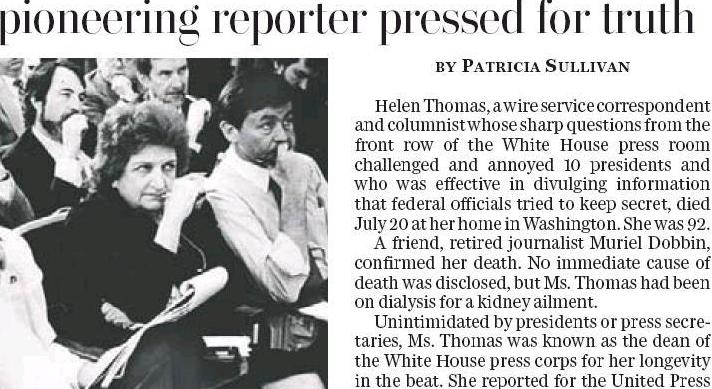
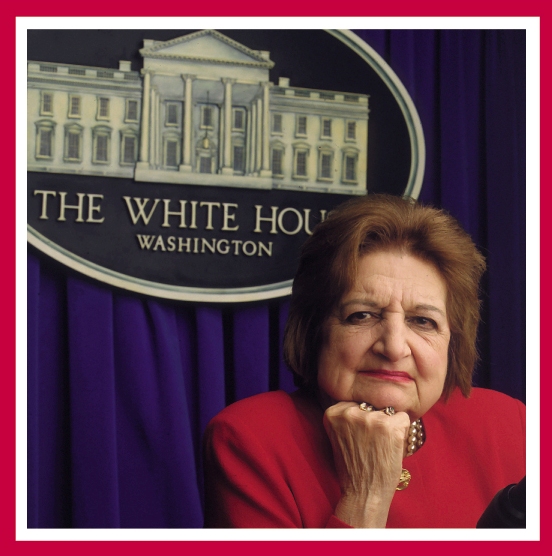
Today’s Washington Post carries a lengthy obituary about Helen Thomas, lauding the 92-year-old former White House reporter who died yesterday for her “unparalleled experience covering the presidency.”

A glowing tribute to Helen Thomas

WaPo’s glowing tribute to Helen Thomas

What caught the eye of Media Myth Alert was the Post’s unsourced claim that Thomas had once asked President Richard M. Nixon “point-blank what his secret plan to end the Vietnam War was.” I sent an email yesterday to Patricia Sullivan, author of Thomas obituary, asking about the unsourced claim; she has not replied.

The only proximate reference I could find to Thomas’s having posed such a question was at a White House news conference on January 27, 1969. Given her seniority, Thomas was granted the first question.

“Mr. President,” she asked, “what is your peace plan for Vietnam?” Peace plan, not secret plan.

According to a transcript of the news conference that the Washington Post published the following day, Nixon focused his response on the Vietnam peace talks then underway in Paris.

The issue here is greater than a possible error in a glowing tribute — so glowing that the obituary waits until the 12th paragraph to mention Thomas’ ugly remarks about Jews, which ended her career in 2010.

The notion that Nixon campaigned for the presidency in 1968 on a “secret plan” to end the Vietnam War is a hoary assertion that circulates still, often invoked as telling evidence of Nixon’s duplicity. The claim is of thin grounding.

Helen Thomas embraced the tale, though, writing in her wretched 2006 book, Watchdogs of Democracy?:

“Throughout that campaign in 1968 … Nixon said he had a ‘secret’ plan to end the war. Reporters never got to ask him what it was. Not until he got into the White House did we learn it was Vietnamization — to try to turn the fighting over to the South Vietnamese.”

But Nixon was asked during the campaign whether he had a secret plan to end the war.  According to a report published by the Los Angeles Times on March 28, 1968, Nixon replied that he had “no gimmicks or secret plans.”

He also said: “If I had any way to end the war, I would pass it on to President [Lyndon] Johnson.” (Nixon’s comments were made a few days before Johnson announced he would not seek reelection.)

A fairly detailed assessment of the “secret war” tale was published in 2000 by William Safire, a columnist for the New York Times and a former Nixon speechwriter. Safire wrote:

“That sinister phrase — secret plan — has resonance to veteran rhetoricians and students of presidential campaigns. In the 1968 primaries, candidate Richard Nixon was searching for a way to promise he would extricate the U.S. from its increasingly unpopular involvement in Vietnam. The key verb to be used was end, though it would be nice to get the verb win in some proximity to it.

“One speechwriter came up with the formulation that ‘new leadership will end the war and win the peace in the Pacific.’ Nixon made it part of his stump speech, and the juxtaposition of end and win — though it did not claim to intend to win the war, but only the peace ….

“When a U.P.I. reporter pressed Nixon for specifics, the candidate demurred; the reporter wrote that it seemed Nixon was determined to keep his plan secret, though he did not quote Nixon as having said either secret or plan. But …  it became widely accepted that Nixon had said, ‘I have a secret plan to end the war.'”

The lead paragraph of the United Press International report to which Safire referred stated:

“Former Vice President Richard M. Nixon vowed Tuesday [March 5, 1968] that if elected president, he would ‘end the war’ in Vietnam. He did not spell out how.”

It does sound a bit slippery, a bit Nixonian. But it’s no claim of a “secret plan.” So there seems little substance to the notion, which Thomas embraced in her book, that Nixon campaigned in 1968 on a “secret plan” to end the war.

WJC

More from Media Myth Alert:

Vomit humor and scandal: Inane ‘Drunk History’ TV show promotes Watergate media myth

In Cinematic treatments, Debunking, Media myths, Scandal, Washington Post, Watergate myth on July 8, 2013 at 8:10 am

Drunk History, a new cable TV show based on the inane premise that history is entertaining when told by inebriated narrators, isn’t meant to be taken seriously.

Obviously.

Drunk History, which  debuts tomorrow night on DrunkHistory_logoComedy Central (the pilot is available online), features what the show’s  Web site says is an “often incoherent narration of our nation’s history.”

If the first episode is an indication, incoherent history makes for faint humor. Even worse, the inaugural show promotes a notably tenacious media myth in offering a chaotic look at the Watergate scandal of 1972-74.

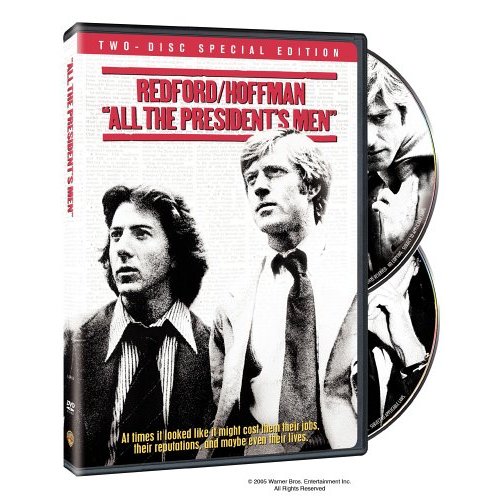
In doing so, Drunk History draws heavily, if erratically, on the 1976 film, All the President’s Men. The movie focused on Bob Woodward and Carl Bernstein’s Watergate reporting for the Washington Post — and was central to the rise of the myth that Woodward and Bernstein brought down the corrupt presidency of Richard Nixon.

The movie as inspiration

The media myth of Watergate has helped make accessible to contemporary audiences a complex scandal that unfolded 40 years ago. But it’s an inaccurate interpretation; not even the Washington Post embraces it, as I point out in my mythbusting book, Getting It Wrong.

As Woodward said in an interview several years ago with American Journalism Review:

To say the press brought down Nixon, that’s horseshit.”

But back to the blurry first episode of Drunk History: Woodward is shown meeting “Deep Throat,” his secret Watergate source, in an underground garage in suburban Virginia. And he throws up on the source’s shoes.

Vomit humor: Now that’s inspired.

Woodward then asks “Deep Throat” — who was a senior FBI official named W. Mark Felt — for help in understanding the scandal.

“Put the pieces together, you dumbass,” Felt snaps. “It’s all in front of you. Do the work. Just be careful. Watergate is the tip of the iceberg.”

In the compressed Drunk History version of Watergate, Nixon soon realizes he has no choice but to resign.

“And in the end,” the narrator says, “you can toss aside Richard Nixon for all his cynicism, you can toss aside Mark Felt for all his cynicism, but you can’t toss aside Robert Woodward, and to a lesser extent, Carl Bernstein, for the truth that they exposed for America.”

That’s really not a bad touch, tweaking the pompous Bernstein for having had a “lesser” role in Watergate. Which is not entirely inaccurate, given that Felt was Woodward’s source. Bernstein first met Felt in 2008, shortly before Felt’s death.

“Well,” the narrator says, “we told the story of Watergate. There’s no way I could possibly misconstrue it as not the greatest journalistic endeavor ever told. Robert Woodward would be proud.”

Watergate was scarcely that.

Unraveling the scandal, as I write in Getting It Wrong, “required the collective if not always the coordinated forces of special prosecutors, federal judges, both houses of Congress, the Supreme Court, as well as the Justice Department and the FBI.

“Even then, Nixon likely would have served out his term if not for the audiotape recordings he secretly made of most conversations in the Oval Office of the White House. Only when compelled by the Supreme Court did Nixon surrender those recordings,” which captured him plotting to cover up the seminal crime of Watergate, the breakin in June 1972 at the headquarters in Washington of the Democratic National Committee.

So against the complex tableau of special prosecutors, federal investigations, and bipartisan congressional panels, Woodward and Bernstein’s contributions in unraveling the scandal were modest at best, and certainly not decisive to Watergate’s outcome.

In its tipsy way, Drunk History pokes at the conventions of documentary history, as the New Yorker has noted. Otherwise, there’s little to cheer about the show, which was a Web-based series before moving to cable. Whatever humor Drunk History projects isn’t likely to be sustaining.

A far more humorous send-up of Watergate — and of Woodward and Bernstein — is the underappreciated 1999 film, Dick. Although Woodward and Bernstein are not the central characters, the movie depicts them as antagonistic incompetents who bungle their way to a Pulitzer Prize.

WJC

Many thanks to Instapundit
Glenn Reynolds for linking to this post

More from Media Myth Alert: