W. Joseph Campbell

Archive for the ‘Debunking’ Category

Cronkite biographer on the ‘Cronkite Moment’: A bit muddled

In Cronkite Moment, Debunking, Media myths on May 20, 2012 at 8:53 am

Historian Douglas Brinkley will be out soon with an 800-page biography of Walter Cronkite, the prominent CBS News anchorman from 1962-1981.

In a cover story in the latest issue of American Heritage, Brinkley indicates how his biography will treat the mythical “Cronkite Moment” of 1968, when the anchorman’s televised “mired in stalemate” assessment about the Vietnam War supposedly sent shock waves through the administration of President Lyndon Johnson.

Judging from the American Heritage article, Brinkley’s take on the “Cronkite Moment” is a bit muddled.

And even somewhat misleading.

Brinkley writes, for example, that Cronkite’s opinion about the war “was widely quoted in the press …. Even the conservative Wall Street Journal’s editorial page said, ‘The whole Vietnam effort may be doomed.'”

But the Journal took no leads from Cronkite. It published its “may be doomed” editorial four days before the Cronkite program.

The editorial appeared February 23, 1968, and said “everyone had better be prepared for the bitter taste of a defeat beyond America’s power to prevent.”

Strong stuff.

Far stronger than the fairly tepid “Cronkite Moment” commentary, which the anchorman offered on February 27, 1968, near the close of a 30-minute special program, “Report from Vietnam.”

Cronkite declared that night: “To say that we are closer to victory today is to believe, in the face of the evidence, the optimists who have been wrong in the past. To suggest we are on the edge of defeat is to yield to unreasonable pessimism.

“To say that we are mired in stalemate seems the only realistic, yet unsatisfactory, conclusion.”

Brinkley’s article notes that Cronkite’s “calling the war a ‘stalemate’ was a middling position in 1968.” Indeed, it was hardly novel. As I point out in my latest book, Getting It Wrong:

“By late February 1968 … Cronkite’s ‘mired in stalemate’ assessment was neither notable nor extraordinary.” I point out that “nearly seven months before the program, the New York Times correspondent R.W. Apple Jr. had cited ‘disinterested observers’ in reporting that the war in Vietnam ‘is not going well.’ Victory, Apple wrote, ‘is not close at hand. It may be beyond reach.’

“Apple’s analysis was published on the Times’ front page, beneath the headline: ‘Vietnam: The Signs of Stalemate.'”

The Times’ analysis also noted: “‘Stalemate’ is a fighting word in Washington. President Johnson rejects it as a description of the situation in Vietnam. But it is the word used by almost all Americans here, except the top officials, to characterize what is happening” in the war.

While Brinkley concedes the unremarkable character of “mired in stalemate,” he nonetheless writes that “Cronkite’s ‘Report from Vietnam’ represented a turning point.”

To support that claim, Brinkley turns to the exaggerated assertion in David Halberstam’s The Powers That Be, that the Cronkite program marked “the first time in American history that a war had been declared over by a commentator.” (In my edition of Halberstam’s book, the closing portion of that sentence reads: “the first time in American history a war had been declared over by an anchorman.”)

Of course, though, the war dragged on for years.

In no way was the “Cronkite Moment” anything approaching a turning point. American public opinion notably had clearly begun shifting against the war by fall 1967, months before the Cronkite report on Vietnam.

And as journalist Don Oberdorfer noted in December 1967, the “summer and fall of 1967 [had] been a time of switching, when millions of American voters — along with many religious leaders, editorial writers and elected officials — appeared to be changing their views about the war.”

So if anything, Cronkite’s program trailed the shifts in American public opinion.

It is often said that Cronkite’s “stalemate” assessment exerted a powerful effect on Johnson, that the president exclaimed upon hearing the anchorman’s interpretation:

“If I’ve lost Cronkite, I’ve lost Middle America” (or, “If I’ve lost Cronkite, I’ve lost the war”; or, “If I’ve lost Cronkite, I’ve lost the country”; or something to that effect).

But it’s quite clear Johnson did not see the Cronkite report when it was shown on CBS and there is no certain evidence that he ever saw it later, on videotape.

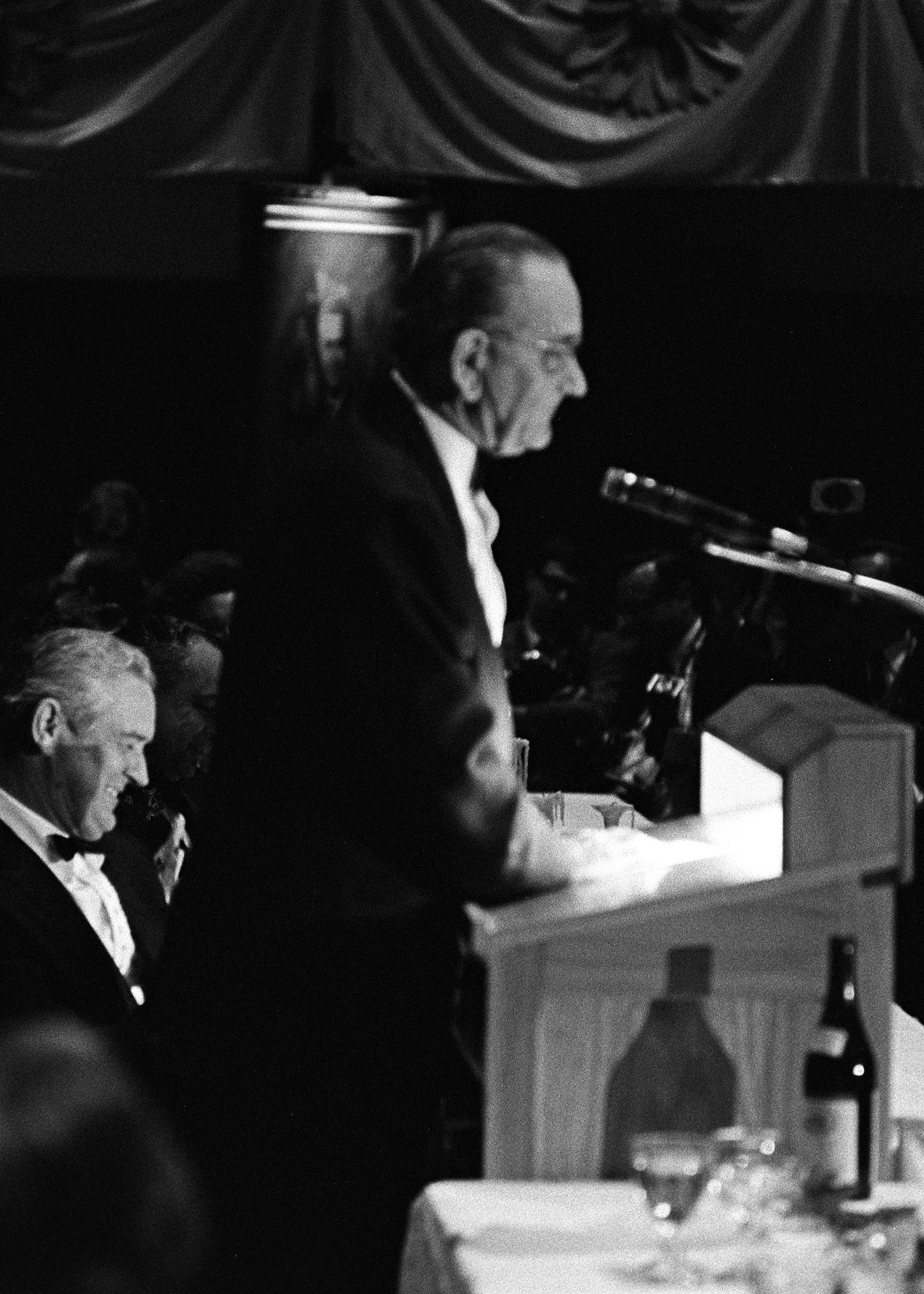
The night of the Cronkite program, the president was on the campus of the University of Texas at Austin, at birthday party for Governor John Connally, a longtime political ally.

About the time Cronkite was intoning his “mired in stalemate” assessment, Johnson was offering light-hearted remarks about Connally’s age, saying: “Today you are 51, John. That is the magic number that every man of politics prays for — a simple majority.”

Even so, Brinkley’s article speculates that “Johnson must have known that the Cronkite broadcast — while stating the obvious — had done him major political damage.”

But Cronkite for many years rejected the notion that his “Report from Vietnam” had had much effect on Johnson. Indeed, Brinkley’s article quotes Cronkite as saying as much:

“‘No one has claimed, and I certainly don’t believe, that our broadcast changed his mind about anything. I do believe it may have been the back-breaking piece of straw that was heaped on the heavy load he was already carrying.'”

But even the “piece of straw” metaphor seems to overstate the effects of a program the president did not see, and never discussed with Cronkite.

Brinkley’s article does include intriguing references to Cronkite’s having
“given speeches promoting Johnson’s Great Society domestic policies, including Medicaid-Medicare, wilderness preservation, civil rights, and a hopper full of antipoverty measures.”

I was unaware that Cronkite had been such an open advocate of Johnson’s domestic policy initiatives.

WJC

Recent and related:

Two weeks on: Still waiting for WaPo on missing Jessica Lynch online content

In Debunking, Jessica Lynch, Media myths, Newspapers, Washington Post on May 11, 2012 at 9:41 am

Lynch photo at WaPo’s Iraq archive

Two weeks ago, the Washington Post ombudsman promised to look into questions I had posed about the unavailable digital versions of the newspaper’s embarrassingly wrong reports about Jessica Lynch’s supposed heroics during the Iraq War.

I’m still waiting a response from the ombudsman, Patrick Pexton.

At issue are empty links for at least three articles and commentaries about Lynch that appeared in the Post in 2003 — all of which are keenly embarrassing to the newspaper. Among them is the Post’s infamous “Fighting to the Death” story of April 3, 2003, which is at the heart of the bogus hero-warrior tale about Lynch.

That story — which isn’t available at the Post’s online site — described Lynch’s purported derring-do on the battlefield, saying she fought fiercely in an ambush in Nasiriyah and was captured only after running out of ammunition.

As it turned out, the story was utterly wrong in all important details. Lynch never fired a shot in Iraq; she was neither shot nor stabbed, as the Post had reported, but badly injured in the crash of a Humvee as it fled the ambush. (I discuss the Post’s handling of the Lynch case in a chapter in my latest book, Getting It Wrong.)

Another element of the Post’s narrative about Lynch that’s missing online is a column written several days later by Michael Getler, then the newspaper’s ombudsman. Getler criticized the hero-warrior story, noting that readers thought it suspicious.

In mid-June 2003, the Post grudgingly walked back from aspects of its hero-warrior tale — an embarrassment that media critic Christopher Hansen characterized as “the journalistic equivalent of Napoleon’s retreat from Moscow.”

The Post’s walk-back article also is unavailable online.

But at least one of the Post’s  stories about Lynch in 2003 is freely available online, as I’ve noted in email messages to Pexton.

That article — which is decidedly non-embarrassing to the Post — was published April 4, 2003; there’s a functioning link to it at the newspaper’s link-rich digital archive about the Iraq War. Interestingly, the only U.S. soldier identified by name and image at the archive site is Jessica Lynch.

So why aren’t the Post’s other reports about Lynch available at that online archive? If some Lynch-related content from 2003 is freely available, why not the rest? Wouldn’t restoring all Lynch content make the digital archive richer, more comprehensive, and more balanced?

I believe it would.

I’ve asked Pexton: “Does the embarrassment quotient explain this apparent inconsistency?” In other words, is the Post too embarrassed by its botched reporting about Lynch to make the links freely available online?

I suspect so.

Pexton did say in an email 14 days ago that his looking into my questions “will take some considerable time to research, but I’ll check into it. It’s very hard to trace some of this back when The Post has gone through several computer systems since that time, but I’ll make an effort.”

In reply, I suggested that the matter could be readily distilled by focusing on this question:

“Why is some Lynch-related content from 2003 freely available online (see here), while other and more embarrassing content (see empty links here, here, and here) not available?”

I sent Pexton follow-up email messages on May 1 and May 7. In those email, I asked why the empty links about the Lynch case couldn’t be restored and added to the digital archive about the Iraq War.

I have received no reply.

And that’s a bit odd because Pexton, in a column in March, pointedly urged Post staffers to be responsive to inquiries, writing:

“Return the blessed phone calls and e-mails from readers! And do it with courtesy, respect and politeness, even when the caller, or writer, is persistent or even unpleasant. Please.”

That’s advice too good to be ignored.

WJC

Recent and related:

Those ‘warmongering’ papers of William Randolph Hearst

In 1897, Debunking, Furnish the war, Media myths, Spanish-American War, Yellow Journalism on May 1, 2012 at 5:35 am

The first major engagement of the Spanish-American War took place 114 years ago today — in the Philippines, where U.S. warships attacked and destroyed a Spanish naval squadron in Manila Bay.

Warmonger?

The battle was a thoroughly unexpected development in a conflict fought over Spain’s harsh rule of Cuba, a conflict often but inaccurately blamed on the yellow press of William Randolph Hearst.

A commentary in the Tennessean newspaper took up that hoary myth the other day and added for good measure the apocryphal tale of Hearst’s having vowed to bring on the war.

The commentary said of Hearst:

“His most infamous manipulation was the warmongering his papers did in pushing the U.S. into war with Spain in 1898. He sent artist Frederick Remington to Cuba to cover the native uprising against Spain. Remington reportedly cabled Hearst that there was no war in Cuba. Hearst responded, ‘You get me the pictures; I’ll get you the war.’ He was true to his word.”

No serious historian embraces the notion that Hearst’s newspapers were decisive or much of a factor at all in the U.S. declaration of war against Spain in April 1898. That is a simplistic explanation about a war that was fought largely on humanitarian grounds — those of ending Spain’s long and harsh rule of Cuba.

As often is the case when such mediacentric claims are advanced, the commentary in the Tennessean left wholly unaddressed the method or mechanism by which the content of Hearst’s newspapers — he published three in 1898 —  was transformed into military action.

Three was, in fact, no such mechanism.

As I pointed out in my 2001 book, Yellow Journalism: Puncturing the Myths, Defining the Legacies, top officials in the administration of President William McKinley largely disregarded the content of the Hearst press. They certainly didn’t turn to it for policy guidance.

“If the yellow press did foment the war,” I wrote in Yellow Journalism, “researchers should be able to find some hint of, some reference to, that influence in the personal papers and the reminiscences of policymakers of the time.

“But neither the diary entries of Cabinet officers nor the contemporaneous private exchanges among American diplomats indicate that the yellow newspapers exerted any influence at all. When it was discussed within the McKinley administration, the yellow press was dismissed as a nuisance or scoffed at as a complicating factor.”

Advocates of the mediacentric interpretation of the Spanish-American War invariably cite — as the Tennessean did — the tale about Hearst’s vowing to furnish the war. It’s their Exhibit A.

While colorful, the tale of the purported Hearstian vow is a media-driven myth, one of the hardiest in American journalism.

It’s more than 110-years-old; during that time, no compelling evidence has ever emerged to support or document the tale.

Hearst denied making such a vow, which he purportedly sent in a telegram to Remington, an artist on assignment to Spanish-ruled Cuba in early 1897 for Hearst’s New York Journal.

The telegram to Remington has never surfaced. And Remington apparently never discussed the tale, which was first recounted in 1901, in a brief, unsourced passage in memoir by James Creelman, a blowhard journalist known for frequent exaggeration.

Creelman

Perhaps the most compelling reason for doubting Creelman’s undocumented account rests on an irreconcilable internal inconsistency.

As I write in my latest book, Getting It Wrong, it “would have been absurd for Hearst to vow to ‘furnish the war’ because war — specifically, the Cuban rebellion against Spain’s colonial rule — was the very reason Hearst sent Remington to Cuba in the first place.

“Anyone reading U.S. newspapers in early 1897 would have been well aware that Cuba was a theater of a nasty war.”

WJC

Recent and related:

Digitally scrubbing WaPo’s embarrassment on Jessica Lynch?

In Debunking, Jessica Lynch, Media myths, Washington Post on April 27, 2012 at 2:15 pm

The Washington Post carried a fine story yesterday about Vogue magazine’s apparent removal from its online site of an unaccountably flattering profile of Asma al-Assad, wife of Syrian dictator Bashar al-Assad.

Where's the digital version?

The Post said the 3,200-word puff piece in Vogue “apparently proved so embarrassing to the magazine that it scrubbed it from its Web site, an almost-unheard-of step for a mainstream media organization and a generally acknowledged violation of digital etiquette.”

That observation — “violation of digital etiquette” — evoked for me the unavailability online of the Post’s embarrassingly wrong-headed reports in 2003 about Jessica Lynch and her supposed heroism early in the Iraq War.

In an electrifying account published on its front page April 3, 2003, the Post reported that Lynch, then a 19-year-old Army private, had fought fiercely in the ambush of her unit in Nasiriyah, in southern Iraq.

Lynch, according to the Post,  “continued firing at the Iraqis even after she sustained multiple gunshot wounds and watched several other soldiers in her unit die around her in the fighting,” which took place March 23, 2003.

The hero-warrior tale about Lynch turned out to be utterly wrong in all crucial details. She was neither shot nor stabbed, as the Post reported; she suffered shattering injuries in the crash of a Humvee fleeing the ambush.

Lynch was taken prisoner and moved to an Iraqi hospital where she lingered near death until her rescue by U.S. special forces on April 1, 2003.

The Post’s hero-warrior tale appeared two days later.

But try finding the Post’s digitized version of that story. Here’s the link; but clicking through turns up the article’s headline, byline, date of publication, and page placement. But no text.

(The Post’s story is available in full at the online site of the Pittsburgh Post-Gazette.)

Later in April 2003, the Post’s then-ombudsman, Michael Getler, published a critical column about the hero-warrior story, noting that “several readers wrote to complain, saying they did not doubt ‘the gravity of Lynch’s situation,’ as one put it, but that The Post, ‘using unnamed sources,’ was ‘creating a sensationalist story riddled with inaccuracies.’ ‘I smell an agenda,’ said one reader, suspecting wartime ‘propaganda.’ Another was suspicious of the ‘Hollywood-like telling of the story.'”

Try finding Getler’s column online.

Here’s the link; but in this case, too, just the headline, byline, publication date, and page reference are available.

In mid-June 2003, the Post revisited and grudgingly walked back from aspects of its hero-warrior story about Lynch. One media critic characterized the article as “the journalistic equivalent of Napoleon’s retreat from Moscow.”

(And as I point out in my latest book, Getting It Wrong, the walk-back story “included a nervy attempt by the Post to deflect blame from its central role in spreading the hero-warrior myth of Jessica Lynch.”

(The Post, I note, “faulted the U.S. military and the administration of President George Bush for failing to correct an error for which the Post was responsible. ‘Neither the Pentagon nor the White House publicly dispelled the more romanticized initial version of her capture,’ the Post said, ‘helping to foster the myth surrounding Lynch and fuel accusations that the Bush administration stage-managed parts of Lynch’s story.’  It was an astounding assertion: The Post, alone, was responsible for propagating the ‘romanticized initial version’ that created the hero-warrior myth. To claim the Pentagon and the White House should have done more to dispel that report was, in short, exceedingly brazen.”)

Well, good luck in finding the Post’s walk-back story online.

Here’s the link; but, again, only the headline, byline, publication date, and page reference show up.

So has the Post excised the digital reminders of an embarrassing misstep, of a dramatic story that it thoroughly and singularly botched? Has it, at a minimum, committed a “violation of digital etiquette”?

Rather looks like it. (The Post’s ombudsman, Patrick Pexton, promised to “check into” my questions. He also said in an email today: “It’s very hard to trace some of this back when The Post has gone through several computer systems since that time, but I’ll make an effort.”)

Separately, I’ve been told that Post stories published before 2005 have largely been placed behind a paywall. For the most part, that is, they’re not freely available online.

But some special sections are accessible online without payment — and they include the Post’s link-rich “War in Iraq” digital archive.

And in a box at the lower right corner of the digital archive is an Army photograph of none other than Jessica Lynch.

Lynch photo at WaPo's Iraq War archive

The box carries the headline, “Saving Pfc Lynch,” and offers a link to an article published in the Post April 4, 2003, a day after the botched hero-warrior tale.

The April 4 article ran to 1,500 words in discussing the Iraqi lawyer who helped set in motion Lynch’s rescue.

And that article is available in full.

WJC

Recent and related:

CBS marks a Cronkite anniversary, invokes a tenacious media myth

In Anniversaries, Cronkite Moment, Debunking, Media myths on April 17, 2012 at 3:23 pm

CBS News yesterday marked what has to be among the more obscure anniversaries in broadcast journalism — the 50th anniversary of the debut of Walter Cronkite’s old evening news show.

Cronkite in Vietnam, 1968

And in a flattering writeup recalling the occasion, CBS invoked a prominent media-driven myth — the notion that Cronkite’s on-air assessment in 1968 about the war in Vietnam exerted enormous influence. Until late in his life, not even Cronkite believed that was the case.

Even so, the CBS article declared:

“Cronkite’s intense focus on objectivity gave his rare dose of opinion — especially his 1968 assessment of the war in Vietnam — an enormous weight.”

The writeup quoted an executive producer, Susan Zirinsky, as saying:

“Lyndon Johnson remarked, because he looked at that broadcast, and he said, ‘If I’ve lost Walter Cronkite, I’ve lost the country.'”

President Lyndon Johnson’s purported comment lies at the heart of this tenacious media myth — one of the 10 I address and debunk in my latest book, Getting It Wrong.

Interestingly, the comment so often attributed to Johnson has been described in so many ways. That is, there is no single version of what the president supposedly said in reacting to Cronkite’s assessment that the war was stalemated.

There’s the version Zirinsky invoked: “‘If I’ve lost Walter Cronkite, I’ve lost the country.”

More common is: “If I’ve lost Walter Cronkite, I’ve lost Middle America.”

Another variant has the president saying: “If I’ve lost Cronkite, I’ve lost the war.”

And so on.

As I point out in Getting It Wrong, “Version variability of that magnitude signals of implausibility. It is a marker of a media-driven myth.”

And it’s highly likely that Johnson said nothing of the sort.

He did not, after all, not see Cronkite’s report about Vietnam when it aired on CBS on February 27, 1968. The president that night was not in front of a television set when, near the close of the program, Cronkite declared that the U.S. military was “mired in stalemate” in Vietnam.

Johnson: Not in front of a TV

Johnson at that moment was at a black-tie birthday party for Texas Governor John Connally. The president poked fun at Connally, who was marking his 51st birthday.

“Today you are 51, John,” the president said. “That is the magic number that every man of politics prays for — a simple majority.”

It is difficult to fathom how Johnson could have been much moved by a program he did not see. And the power of what often is called the “Cronkite Moment” stems from the supposedly immediate and visceral effect the anchorman’s assessment had on the president.

But what Cronkite had to say on air that night was hardly earth-shaking, hardly stunning or novel.

If anything, Cronkite’s observation about “stalemate” was a rehash of what other news organizations, such as the New York Times, had been saying for months.

For example in August 1967, the Times inserted “stalemate” into the headline over a front-page news analysis about the war. The Times headline read:

Vietnam: The Signs of Stalemate.”

The newspaper’s analysis was filed from the South Vietnamese capital, Saigon, and noted:

“‘Stalemate’ is a fighting word in Washington. President Johnson rejects it as a description of the situation in Vietnam. But it is the word used by almost all Americans here, except the top officials, to characterize what is happening” in the war.

Before that, on July 4, 1967, the Times published a news analysis that said of the war effort:

“Many officers believe that despite the commitment of 466,000 United States troops now in South Vietnam … the military situation there has developed into a virtual stalemate.”

So in the context of the war in Vietnam, “stalemate” was hardly new by the time Cronkite turned to the word.

WJC

Recent and related:

Woodward and Bernstein: The ‘only superstars newspapers ever produced’?

In Cinematic treatments, Debunking, Media myths, Newspapers, Washington Post, Watergate myth on April 16, 2012 at 5:11 am

The 40th anniversary of the debut of the Watergate scandal falls in two months and we’re certain read many effusive tributes to the Washington Post’s reporters who often —  but wrongly — are said to have exposed the scandal and brought down Richard Nixon’s corrupt presidency.

It’s a safe bet that many of the tributes to the Post and its Watergate reporting team of Bob Woodward and Carl Bernstein will be exaggerated and erroneous.

Take, for example, this passage, which appeared over the weekend in a column in the Toronto Sun:

“The only superstars newspapers ever produced were Woodward and Bernstein, the Washington Post investigative team who broke the Watergate story that led to the downfall of U.S. president Richard Nixon.”

Maybe they were the only superstars of newspaperdom, although that claim might provoke an argument from the committee at New York University that recently selected 100 outstanding U.S. journalists of the past 100 years. (The list included several dubious entries, such as the self-important Christiane Amanpour of CNN; photojournalist and probable fraud Robert Capa; mythmaking writer David Halberstam, and broadcast journalism’s flawed saint, Edward R. Murrow.)

Woodward and Bernstein made NYU’s rather predictable list, too.

If they are newspapering’s lone superstars, their self-promotion had a lot to do with it.  Woodward and Bernstein’s book about their Watergate reporting, All the President’s Men, came out in June 1974, about two months before Nixon’s resignation.

The book, a months-long best-seller, had been written with the movies in mind; the cinematic version of All the President’s Men came out in April 1976 and starred Robert Redford as Woodward and Dustin Hoffman as Bernstein.

But more important than Woodward and Bernstein’s superstar status is the claim in the Sun’s column that they “broke the Watergate story.”

They did no such thing.

The signal crime of Watergate — the June 1972 burglary at Democratic National Committee headquarters — wasn’t broken by the Post. The break-in was interrupted by police and within hours, news was circulating of the arrest of five burglars at the Watergate complex.

The story in the Post about the break-in appeared beneath the byline of Alfred E. Lewis, a veteran police reporter, and its opening paragraph made quite clear that details were from investigators:

“Five men, one of whom said he is a former employee of the Central Intelligence Agency, were arrested at 2:30 a.m. yesterday in what authorities described as an elaborate plot to bug the offices of the Democratic National Committee here.”

Watergate reporting by the Post did not expose the cover-up of crimes linked to the break-in or the payment of hush money to the burglars, either.

As I note in my latest book, Getting It Wrong, which includes a chapter about the media myths of Watergate, Woodward was quoted in 1973 as saying that those crucial aspects of the scandal were “held too close. Too few people knew. We couldn’t get that high.”

Woodward: 'held too close'

Nor did Woodward and Bernstein uncover or disclose the existence of the White House audiotaping system, which was decisive to the outcome of Watergate.

The tapes secretly made by President Richard Nixon captured him approving a plan in June 1972 intended to thwart the FBI’s investigation of the Watergate break-in.

That contents of that tape — the so-called “smoking gun” of Watergate — sealed Nixon’s fate and directly led to his resignation in August 1974.

The White House taping system had been disclosed 11 months before, not by Woodward and Bernstein but by investigators of the Senate select committee on Watergate.

As I point out in Getting It Wrong, Woodward and Bernstein later claimed to have had a solid lead about the taping system.

In All the President’s Men, the book, Woodward recalled having spoken with Post Executive Editor Ben Bradlee about the lead.

Bradlee advised:

“I wouldn’t bust one” in checking it out.

Had they followed the lead, Woodward and Bernstein may well have broken a pivotal story about Watergate.

But they didn’t.

WJC

Recent and related:

Did Watergate’s ‘Deep Throat’ know he was ‘Deep Throat’?

In Anniversaries, Debunking, Scandal, Washington Post, Watergate myth on April 15, 2012 at 11:48 am

Felt: Did he know he was 'Deep Throat'?

Barry Sussman, the Washington Post’s Watergate editor in the early 1970s, raises a provocative question about the newspaper’s famous high-level source, W. Mark Felt, a senior FBI official when the Watergate scandal was unfolding.

Did Felt realize that the Post regarded him as “Deep Throat,” as a vital source in reporting the unfolding Watergate scandal? Sussman asks.

The question is pertinent and intriguing, Sussman writes in a recent commentary at the Nieman Watchdog blog, because Felt as a source offered “so little” to Bob Woodward, one of the Post’s lead reporters on Watergate.

And yet it is widely believed Felt offered vital information to Woodward about the emergent scandal.

Although Sussman doesn’t specifically address it, the implication of his observation is that “Deep Throat” may have been more composite than a single source — a literary device to infuse drama in All the President’s Men, the book Woodward wrote with Post colleague Carl Bernstein about their Watergate reporting.

It has long been suspected, though never confirmed, that “Deep Throat” was a composite.

Adrian Havill, the author of Deep Truth, a deliciously scathing biography of Woodward and Bernstein, speculated that “Deep Throat” was “a hybrid of three or four main sources.”

Edward Jay Epstein, in his fine 1976 essay about the Post and Watergate, stated he believed “Deep Throat” was “a composite character.”

More recently, James Rosen, chief Washington correspondent for Fox News, speculated in a book review that “‘Deep Throat’ was more than just Mark Felt.”

Prodded by his family, Felt came forward in 2005 and pronounced himself the source who had been “Deep Throat.” Woodward soon confirmed Felt’s self-disclosure.

But Felt was frail and suffering from dementia. He was forgetful and seldom able to carry on prolonged interviews. (Woodward quoted Felt’s daughter as saying in 2002 that Felt “goes in and out of lucidity.”)

Sussman, as he has on other occasions, asserts that “Deep Throat wasn’t an important source at all” to the Post.

“He was nice to have around, helpful on occasion,” Sussman writes, adding that Woodward and Bernstein “have blown up Felt’s importance for almost four decades or nodded in assent when others did….”

Sussman acknowledges he didn’t know that Felt was supposedly “Deep Throat” before 2005. He also notes that Felt, who died in 2008, often denied having been “Deep Throat.”

And that’s true. In a memoir published in 1979, Felt insisted: “I never leaked information to Woodward and Bernstein or to anyone else!”

Years later, Felt told a Connecticut newspaper that had he been “Deep Throat,” he “would have done it better.”

Felt may have been a liar. Or, as Sussman says, he may not have fully understood that he was considered the source whom the Post referred to as “Deep Throat.”

Sussman’s commentary was prompted by a recent book titled Leak, which claims that Felt was a crucial if sometimes duplicitous source for Woodward on Watergate. (Bernstein, by the way, met Felt only weeks Felt’s death.)

Sussman asserts that Leak “is way off base when it comes to the Post.”

The author of Leak, Max Holland, “accepts a key part of the Watergate myth that really is hokum – that Deep Throat was an important, sine qua non source for the Washington Post,” Sussman writes.

“He not only accepts it; it is his basic premise. This is where his book runs into trouble.”

So why does all this matter now, nearly 40 years after the Watergate scandal began unfolding?

It matters because the mystery of “Deep Throat” was central to establishing the heroic-journalist myth of Watergate, the enduring if misleading notion that Woodward and Bernstein, through their dogged reporting, brought down Richard Nixon’s corrupt presidency.

The identity of “Deep Throat,” as I write in my latest book, Getting It Wrong, was the subject of a 30-year, post-Watergate guessing game — a guessing game that “provided periodic and powerful reminders about the Post and its Watergate coverage, serving to keep Woodward and Bernstein in the public eye far longer than they otherwise would have been.”

Those reminders helped solidify the heroic-journalist myth of Watergate, which to this day endures as the dominant thought misleading narrative about the country’s greatest political scandal.

Recent and related:

Why WaPo should reveal sources on bogus Jessica Lynch tale

In Debunking, Jessica Lynch, Media myths, Washington Post on April 3, 2012 at 12:36 pm

On this date in 2003, the Washington Post published on its front page the electrifying but stunningly wrong hero-warrior tale about Pfc. Jessica Lynch, a botched report that carried the headline:

She was fighting to the death

Lynch, then a 19-year-old Army supply clerk, had fought fiercely in the attack of her unit in Nasiriyah, in southern Iraq, according to the Post, which cited anonymous “U.S. officials” as its sources.

One of them told the Post that Lynch had suffered gunshot and stab wounds “and watched several other soldiers in her unit die around her” in the ambush March 23, 2003.

It was exhilarating stuff and the Post’s report was picked up by news organizations around the world.

But it was wrong in almost all important details. Lynch was neither shot nor stabbed. She did not fire a shot in the ambush. She suffered crushing injuries in the crash of a Humvee as it attempted to flee the ambush.

She was taken prisoner and treated at an Iraqi hospital, from where she was rescued April 1, 2003, by a U.S. special operations team.

As Lynch herself insists, she was no hero (although she has said she could have embraced the hero-warrior tale and no one would’ve been the wiser).

Years later, it’s time for the Post to disclose just who it was that led it astray. It’s time to reveal the sources on the bogus story about Lynch.

It may be akin to sacrilege to argue that a newspaper should lift the veil of anonymity. But reasons  for making something of an exception in the Lynch case are several and compelling.

For one, news organizations owe little to anonymous sources that provide bad information. The grant of confidentiality isn’t meant to be a vehicle for diffusing falsehood.

In this case, the embarrassment quotient remains high enough for the Post to identify its Lynch sources — if not by name, then by affiliation.

Another compelling reason to lift the veil of anonymity is that the veil has been partly lifted already. One of the reporters on the botched story, Vernon Loeb, is on record as saying who the sources were not.

So it should be a small step to saying who they were.

Loeb, in an interview on NPR’s “Fresh Air” program in December 2003, stated unequivocally:

“Our sources for that story were not Pentagon sources.”

He also said he “could never get anybody from the Pentagon to talk about” the Lynch case.

“They wouldn’t say anything about Jessica Lynch,” Loeb said, adding:

“I just didn’t see the Pentagon trying to create a hero where there was none,” he added. “I mean …they never showed any interest in doing that, to me.”

Loeb also described them as “some really good intelligence sources” in Washington.

Despite Loeb’s insistence that the sources weren’t Pentagon sources, the narrative has taken hold that the military made up the story about Lynch’s heroics and somehow persuaded the Post to buy it.

This has become the dominant narrative of the Lynch case, as I point out in my book, Getting It Wrong.

By identifying its sources on the Lynch story, the Post could demolish the military-made-it-up narrative and, by doing so, strike a blow for accuracy and truth-telling.

There’s another compelling reason for the Post to lift anonymity in this case: The newspaper’s long silence on its sourcing has allowed twisted and erroneous claims to circulate as factual.

Notable in this regard are the claims Jon Krakauer made in his 2009 book Where Men Win Glory about Jim Wilkinson, an aide to the commander of U.S. forces in Iraq in 2003, General Tommy Franks.

Krakauer wrote that Wilkinson “duped reporters and editors at the Washington Post” by giving them exclusive access to the bogus tale about Lynch’s battlefield heroics.

Krakauer in the book also called Wilkinson a “master propagandist” and said he was “the guy who deserved top billing for creating the myth of Jessica Lynch.”

Wilkinson denied Krakauer’s allegations and met with the author to discuss a retraction.

Krakauer quietly retreated from his unattributed charges about Wilkinson, removing the unflattering passages from a recent paperback edition of Where Men Win Glory. That edition also contains a footnote, saying:

“Earlier editions of this book stated that it was Jim Wilkinson ‘who arranged to give the Washington Post exclusive access’ to this leaked intelligence [about Jessica Lynch]. This is incorrect. Wilkinson had nothing to do with the leak.”

Had the Post been transparent about the sourcing on its Lynch story,  Krakauer’s unsubstantiated allegations likely never would have been raised.

WJC

Many thanks to Instapundit
Glenn Reynolds for linking to this post.

Recent and related:

On bra-burning, Erica Jong is wrong

In Bra-burning, Debunking, Media myths, Photographs on March 28, 2012 at 4:25 pm

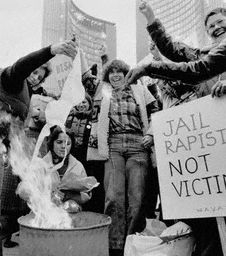
Bra-burning in Toronto, 1979 (Bettmann/Corbis)

The writer Erica Jong asserts in a rambling commentary posted yesterday at the Daily Beast that bra-burning “never actually occurred.”

The mischaracterization of bra-burning was an element of Jong’s defense of feminism and the sexual revolution of the 1960s and 1970s.

Jong wrote in the commentary:

“The fact that the so-called mainstream press reduced our valid struggles to sex, drugs, rock and roll, and bra burning (which, btw, never actually occurred) was their attempt to further disempower us. And they surely prevailed.”

It’s not an infrequent claim, that feminist bra-burning was a media trope, a media myth. That it “never actually occurred.”

But there were at least a couple of documented occasions when feminist protesters set fire to bras.

One occasion came 33 years ago this month, when members of Women Against Violence Against Women demonstrated outside Toronto City Hall. As the demonstration neared its end, a protester named Pat Murphy dropped a white bra into the hungry flames of a burn barrel (see photo, above).

The demonstration in Toronto on March 8, 1979, coincided with International Women’s Day and was aimed at denouncing a report on rape prepared by the Ontario Provincial Police.

The police report said “promiscuity” was a factor in many rapes.

The Women Against Violence Against Women group assailed the report as outrageous and “dazzling in its illogic.” Protesters carried signs saying: “Take a Rapist to Lunch — Charcoal Broiled” and “Hookers Who Wink Go to the Clink! Men Who Rape Escape.”

The Globe and Mail newspaper reported that the protesters lighted “a fire in a garbage can, to the obvious annoyance of about a dozen watchful constables, [and] shouted: ‘Burn the rapists, burn the city, burn the OPP,’” acronym for Ontario Provincial Police.

The newspaper’s account did not specifically mention bra-burning which, one participant has told me, “wasn’t a focal point” of the protest.

But bra-burning did happen there.

Another participant has recalled that “weighing in on the stereotype of ‘feminist bra-burners’ was actually an effective way [for protesters] to say: Women will control our own bodies, thank you!

“The bra burning,” she said, “was a way to entice the media as well as [offer] a critique of the police report.”

A little more than 10 years before the demonstration in Toronto, some 100 women gathered on the boardwalk at Atlantic City, New Jersey, to protest the 1968 Miss America pageant. The demonstration was organized by a small group called New York Radical Women and was an early manifestation of the women’s liberation movement.

In Getting It Wrong, my mythbusting book that came out in 2010, I offer evidence that bras were set afire, briefly, during the demonstration at Atlantic City.

The evidence is from two witness accounts, one of which was published in the local newspaper, the Press of Atlantic City, on September 8, 1968, the day after the protest.

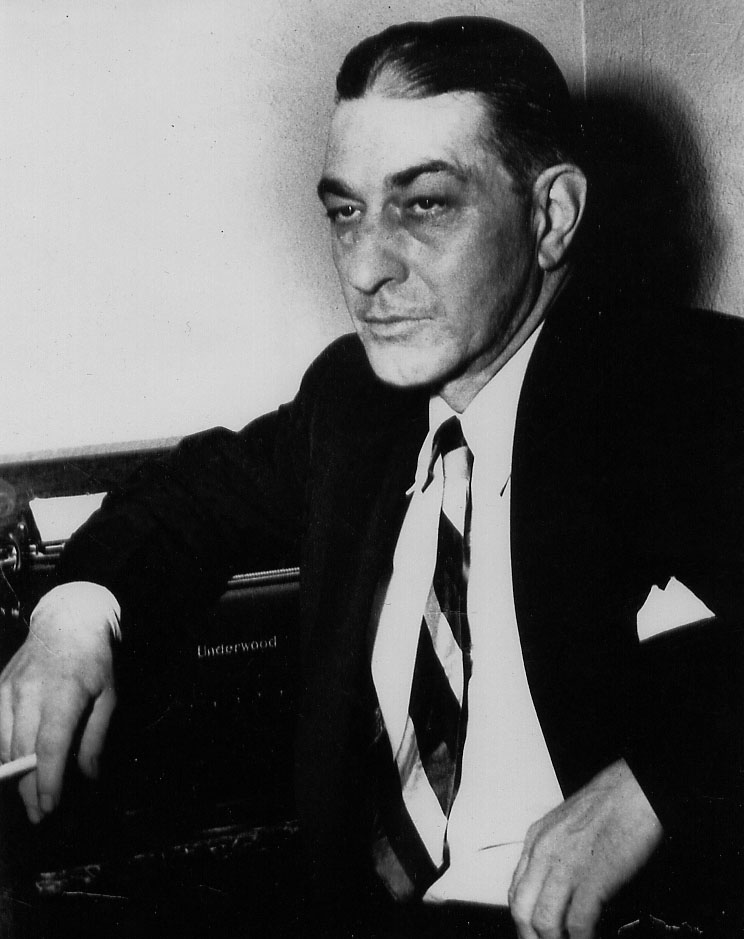
Boucher (1949 photo)

That account appeared beneath the byline of a veteran reporter named John L. Boucher and carried the headline:

“Bra-burners blitz boardwalk.”

Boucher’s article referred to the burn barrel that demonstrators dubbed the “Freedom Trash Can” and stated:

“As the bras, girdles, falsies, curlers, and copies of popular women’s magazines burned in the ‘Freedom Trash Can,’ the demonstration reached the pinnacle of ridicule when the participants paraded a small lamb wearing a gold banner worded ‘Miss America.’”

That published account was buttressed by recollections of the writer Jon Katz, who in 1968 was a young reporter for the Atlantic City newspaper. Katz was on the Atlantic City boardwalk the day of the protest, gathering material for a sidebar article about reactions to the demonstration.

Katz’s sidebar didn’t mention the fire in the “Freedom Trash Can.”

But in correspondence with me, Katz stated:

“I quite clearly remember the ‘Freedom Trash Can,’ and also remember some protestors putting their bras into it along with other articles of clothing, and some Pageant brochures, and setting the can on fire.

“I am quite certain of this.”

WJC

Many thanks to Instapundit
Glenn Reynolds for linking to this post.

Recent and related:

The ‘seismic cultural shifts’ of the 1960s: Protests, assassination — and bra-burning?

In Bra-burning, Debunking, Media myths, Washington Post on March 25, 2012 at 9:59 am

Feminist “bra-burning” of the late 1960s was more media myth than sustained reality.

But a commentary in today’s Washington Post places “bra-burning” among the “[s]eismic cultural shifts” of the late 1960s.

A column that promoted a media trope

Yes, “bra burning.”

This bizarre and baseless claim appears in a commentary that ruminates about the Mad Men television series.

The opening paragraph says:

“On ‘Mad Men,’ the AMC television show that returns for its fifth season Sunday night, booze, cigarettes, unprotected sex, cholesterol-rich foods and negligent parenting play starring roles in a surprisingly accurate and yet idealized picture of a New York ad agency in the mid-1960s. Seismic cultural shifts — Vietnam War protests, bra-burning and the assassination of Martin Luther King Jr. — are just over the horizon.”

The show, the Post’s commentary avers, “gives us a window into the mind-sets of our parents and grandparents.”

Oh, sure it does.

But even frivolous ruminations can bring opportunities for myth-busting, and bra-burning was hardly a “seismic” event of the late 1960s.

It hardly signaled “cultural shift.”

In fact, feminist “bra-burning” was mostly a non-event.

I call it a “nuanced myth” in my latest book, Getting It Wrong, which debunks 10 prominent media-driven myths.

The derivation of the nuanced myth can be traced to September 7, 1968, and the women’s liberation protest against the Miss America pageant at Atlantic City, N.J. The protest was organized by a small group called New York Radical Women.

The demonstrators included about 100 women who traveled to the Atlantic City boardwalk to denounce the pageant as a “degrading Mindless-Boob-Girlie symbol” that placed “women on a pedestal/auction block to compete for male approval” and promoted a “Madonna Whore image of womanhood.”

The harsh rhetoric notwithstanding, the daylong protest on the boardwalk wasn’t very raucous. A centerpiece was what the demonstrators called the “Freedom Trash Can,” into which they tossed “instruments of torture” such as brassieres, girdles, high-heeled shoes, and copies of Playboy and Cosmopolitan.”

One demonstrator held a girdle over the Freedom Trash Can, according to the New York Times, and chanted:

“No more girdles, no more pain. No more trying to hold the fat in vain.”

The protest’s organizers had let it be known in advance of the demonstration that they planned to set fire to bras and other items at Atlantic City. But once there, plans supposedly were abandoned in favor of what of was called a “symbolic bra-burning.”

And through the years, the demonstration’s organizers have been adamant that no bras were burned during the protest.

Nonetheless, newspaper columnists writing in the demonstration’s aftermath offered highly imaginative accounts of “bra-burning” at Atlantic City.

Notably, Harriet Van Horne wrote in the New York Post that a highlight of the demonstration “was a bonfire in a Freedom Trash Can.”

Van Horne, who was not at the Atlantic City protest, also wrote:

“With screams of delight they consigned to the flames such shackling, demeaning items as girdles, bras, high-heeled slippers, hair curlers and false eyelashes.”

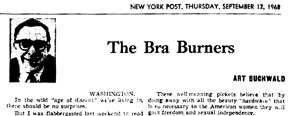
Nationally syndicated humor columnist Art Buchwald also picked up on the bra-burning meme, writing with tongue in cheek that he was “flabbergasted to read that about 100 women had picketed the Miss America pageant in Atlantic City against ‘ludicrous beauty standards’ that had enslaved the American woman.’”

Buchwald also wrote: “The final and most tragic part of the protest took place when several of the women publicly burned their brassieres.”

And a media myth took hold.

What nuances the myth are witness accounts, discussed in Getting It Wrong, that bras were set afire, if briefly, during the protest.

Boucher, 1949 photo

One witness account appeared in the Press of Atlantic City the day after the protest. The newspaper’s first-hand report, written by a veteran reporter named John L. Boucher, included this passage:

“As the bras, girdles, falsies, curlers, and copies of popular women’s magazines burned in the ‘Freedom Trash Can,’ the demonstration reached the pinnacle of ridicule when the participants paraded a small lamb wearing a gold banner worded ‘Miss America.’”

Also covering the demonstration was Jon Katz, then a young reporter for the Atlantic City Press. In my research into bra-burning, Katz told me:

“I quite clearly remember the ‘Freedom Trash Can,’ and also remember some protestors putting their bras into it along with other articles of clothing, and some Pageant brochures, and setting the can on fire. I am quite certain of this.”

As I point out in Getting It Wrong, these accounts that bras were burned in the “Freedom Trash Can” cannot be “taken lightly, dismissed or ignored.”

At the same time,  I write, the witness accounts “offer no evidence to corroborate a widely held image of angry feminists demonstratively setting fire to their bras and tossing the flaming undergarments into a spectacular bonfire.”

There was no mass bra-burning at Atlantic City, no feminists twirling flaming bras over the heads. Fire at most was a modest and fleeting aspect of the protest on that long ago September day.

It was, to be sure, no seismic event.

WJC

Recent and related: