W. Joseph Campbell

Archive for the ‘Debunking’ Category

How’s that? ‘Bra-burning’ influenced mid-1960s fashion?

In Bra-burning, Debunking, Media myths on March 22, 2012 at 4:50 am

The notion that “bra-burning” was a widespread element of feminist protest is a media myth that’s probably too engrained, and euphonic, ever to be thoroughly debunked.
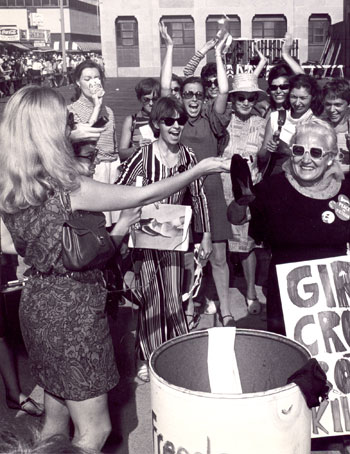
Fashion statement? (Press of Atlantic City)

It’s a notion that’s given rise to much hyperbole since the late 1960s. An Associated Press report yesterday added to the overstatement reflex with this astounding and wrong-headed passage about “bra-burning“:

“Culturally, beatniks were becoming mods, rock ‘n’ roll was taking hold, and the move from stockings to pantyhose — and eventual bra-burning — all influenced mid-’60s fashion.”

The AP report was about how the Mad Men television series has reflected “the evolution of fashion” during the 1960s.

But it wasn’t such froth that caught the attention of Media Myth Alert: It was the absurd claim that “bra burning … influenced mid-1960s fashion.”

Left unsaid by the AP report was how — how “bra-burning,” even if it were a frequent manifestation (which it wasn’t), could have  influenced fashion of that time.

The AP claim was especially puzzling because the “bra burning” meme did not even emerge until the late 1960s, when it came to be associated with the Miss America protest at Atlantic City on September 7, 1968.

A centerpiece of the 1968 protest was the “Freedom Trash Can,” into which demonstrators deposited so-called “instruments of torture” — including brassieres, girdles, high-heeled shoes, false eyelashes, and copies of magazines such as Playboy and Cosmopolitan.

Organizers of the demonstration have long insisted that no bras were set afire that day — that there was only a “symbolic bra burning” at Atlantic City.

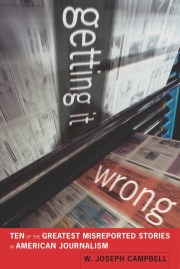
But “bra-burning” is a nuanced media myth — as I describe in my latest book, Getting It Wrong.

I discuss in the book two previously overlooked witness accounts that bras were burned, briefly, during the protest at Atlantic City, which often is credited with marking the rise of the feminist movement of the late 20th century.

One of the witness accounts was published the day after the protest in the Press of Atlantic City, beneath the headline:

Bra-burners Blitz Boardwalk.”

The newspaper report, written by a veteran reporter named John L. Boucher, included this passage:

“As the bras, girdles, falsies, curlers, and copies of popular women’s magazines burned in the ‘Freedom Trash Can,’ the demonstration reached the pinnacle of ridicule when the participants paraded a small lamb wearing a gold banner worded ‘Miss America.’”

The other witness account discussed in Getting It Wrong was that of Jon Katz, a writer who covered the 1968 protest as a young reporter for the Atlantic City newspaper.

“I recall and remember noting at the time that the fire was small, and quickly was extinguished, and didn’t pose a credible threat to the Boardwalk. I noted this as a reporter in case a fire did erupt,” Katz told me, adding:

“It is my recollection that this burning was planned, and that a number of demonstrators brought bras and other articles of clothing to burn, including, I believe some underwear.”

These witness accounts offer fresh dimension to the legend of bra-burning: They represent evidence that bras and other items were set afire, if briefly, at the 1968 protest in Atlantic City.

“This evidence,” I write in Getting It Wrong, “cannot be taken lightly, dismissed or ignored.”

I also point out, though, that neither witness account lends  “support to the far more vivid and popular imagery that many bras went up in flames in flamboyant protest that September day. [The] accounts offer no evidence to corroborate a widely held image of angry feminists demonstratively setting fire to their bras and tossing the flaming undergarments into a spectacular bonfire.”

The reference in the AP report to “bra burning” as a fashion-molder is not only wrong; it suggest the insidious nature of media myths — how they can be invoked so readily and casually, without reference to any supporting evidence or detail.

They’re often treated as if they’re common knowledge, widely accepted.

And “bra-burning” is a media myth with a sting. The term often has been employed casually, as derogatory epithet, to ridicule feminists and dismiss their objectives as trivial and insignificant. As such, “bra-burning” underscores the potential of media myths to feed and promote stereotypes.

Not to mention misleading impressions of fashion history of the 1960s.

WJC

Recent and related:

NYTimes blog embraces ‘March Madness’ myth, claims ‘Zero Productivity Zone’

In Debunking, Media myths, New York Times on March 15, 2012 at 2:22 pm

The productivity myth of March Madness has kicked around for years, apparently immune to the most thorough of debunkings.

As the NCAA men’s basketball tournament opened today, the New York Times college sports blog, “The Quad,” embraced the myth with a headline warning that U.S. workplaces were entering the “Zero Productivity Zone.”

“It is officially time to celebrate the two days a year when American productivity goes in the toilet and it’s a good thing,” a post at the blog declared, adding:

“Thursday and Friday are like a little escape hatch from the usual grind, with N.C.A.A. tournament games going non-stop and while the Puritans of the business world can wring their bony hands over paying people who are suddenly obsessed with the fate of Virginia Commonwealth, the proper response is: tough noogies.”

Sure, some of that’s meant tongue in cheek. Or faintly snarky.

But, still: Media Myth Alert is tempted to say “tough noogies” in calling out a blog post that so blithely repeats the dubious claim and contributes to perpetuating a hardy seasonal myth. And one that does so without data or documentation.

A quick LexisNexis search finds other media outlets indulging in the productivity myth, too.

The Christian Science Monitor, for example, reported the other day:

“According some employment specialists, the next two or three weeks often rank low for productivity, as employees either keep one eye on the scoreboard or just try to cope with less sleep. Even leading up to the second round, which starts Thursday, many employees spend a lot of company time ‘researching’ teams to compete in their office pools or in ‘bracketology’ showdowns online.”

To support such assertions the Monitor article turned to estimates by the Chicago outplacement firm, Challenger, Gray & Christmas, which over the years has propelled the myth with outlandish claims about productivity loss.

This year, the firm is a bit coy about projecting productivity losses. It claims in a news release that U.S. employers today and Friday may end up paying $175 million in wages to workers distracted by the games.

But Challenger proceeds to dismiss its own estimate, saying it’s not to be taken seriously.

On the second page of its news release, Challengers advises taking the estimate “with a grain of salt, as it is meant to be a tongue-in-cheek look at how technology continues to blur the line between our professional and personal lives.

“Ultimately,” the statement says, “March Madness will not even register a blip on the nation’s economic radar and even the smallest company will survive the month without any impact on their bottom line.”

Not even a blip.

Which makes one wonder why the company offers such outlandish estimates in the first place, given that they inject fresh life into a myth that deserves disposal on the slag heap of statistical imprecision. Is it so eager for free publicity?

And as Carl Bialik, the Wall Street Journal’s Numbers Guy, asked in a column seven years ago, “why does the press report studies whose authors don’t take them that seriously?”

Why, indeed?

No doubt because they’re simplistic and easily accessible. As I point out in my latest book, Getting It Wrong, among the most tenacious media myths are those that “minimize or negate complexity” and “offer simplistic and misleading interpretations instead.”

WJC

Recent and related:

Assessing the propellant effect: Was Watergate a powerful stimulant to journalism?

In Anniversaries, Debunking, Scandal, Washington Post, Watergate myth on March 10, 2012 at 4:34 am

The April number of Vanity Fair brushes against an entrenched media myth in declaring that the cinematic depiction of the Washington Post’s Watergate reporting stimulated great interest in careers in journalism.

Vanity Fair, April 2012

Alas,Vanity Fair offered no data or documentation to support its claim.

Instead, the magazine referred broadly to “the noble, sleeves-rolled sleuthing of Robert Redford and Dustin Hoffman as [Bob] Woodward and [Carl] Bernstein in All the President’s Men,” saying the movie which came out in 1976 “prompted legions of baby-boomers to dream of careers in journalism.”

Legions?

Anecdotally, it’s not uncommon to hear that the movie, or Woodward and Bernstein’s award-winning reporting for the Post, did inspire boomers to become journalists.

But beyond impression and anecdote, what supports the claim that Watergate reporting — or All the President’s Men — was a powerful stimulant for career-seeking in journalism?

Not much, as it turns out.

As I discuss in my latest book, Getting It Wrong (which includes a chapter on what I call the heroic-journalist myth of Watergate), two scholarly studies about enrollments in collegiate journalism programs found no evidence that Watergate was a propellant.

Enrollment data are reasonably good proxies, in that they would have captured heightened interest in careers in the profession. If Watergate and All the President’s Men inspired broad interest in careers in journalism, evidence of the stimulus should be apparent in surging in college enrollments.

But the evidence is not there.

A study conducted for the Freedom Forum media foundation and released in 1995 found that “growth in journalism education result[ed] not from specific events as Watergate … but rather to a larger extent from the appeal of the field to women, who ha[d] been attending universities in record numbers. The growth also in part reflect[ed] the applied nature of the field and its link to specific job skills.”

The study’s author, Lee Becker and Joseph Graf, stated flatly:

“There is no evidence … that Watergate had any effect on enrollments.”

A separate study, conducted by veteran journalism scholar Maxwell E. McCombs and published in 1988, reported that “the boom in journalism education was underway at least five years before” the Watergate break-in in 1972.

McCombs also wrote:

“It is frequently, and wrongly, asserted that the investigative reporting of Woodward and Bernstein provided popular role models for students, and led to a boom in journalism school enrollments. The data … reveal, however, that enrollments already had doubled between 1967 and 1972….”

I write in Getting It Wrong that the notion that Watergate reporting made journalism appealing and sexy endures “because it seems irresistibly logical and straightforward— too obvious, almost, not to be true.”

The presumed stimulus on journalism is an appealing yet simplistic story, easy to grasp and easy to understand.

And such characteristics — easy to grasp, easy to understand — often are propellants. Propellants of media-driven myths.

WJC

Recent and related:

James Fallows and ‘furnish the war’: Indulging in a media myth

In 1897, Debunking, Furnish the war, Media myths, Spanish-American War on March 3, 2012 at 11:00 am

Young Hearst

In deploring “carefree talk” about pre-emptively bombing Iran’s nuclear installations, Atlantic correspondent James Fallows invokes the mythical tale about William Randolph Hearst’s vow to “furnish the war” with Spain in the late 1890s.

The “furnish the war” anecdote can be just too delicious to resist, as Fallows demonstrates in a rambling commentary posted yesterday at the Atlantic online site.

In it, Fallows writes that “only twice before in my memory, and maybe thrice in American history, has there been as much carefree talk about war and unprovoked strikes as we’ve had concerning Iran in recent months ….

“The twice in my experience were: during the runup to the invasion of Iraq in 2002, and in the ‘bomb ’em back to the stone age’ moments of the early Vietnam era.

“The time that even I don’t remember was the ‘you furnish the pictures, I’ll furnish the war’ yellow journalism drumbeat before the war with Spain in 1898. This is not good company for today’s fevered discussion to join.”

The line, “you furnish the pictures, and I’ll furnish the war,” was attributed to Hearst more than 110 years ago. But as decades passed, no compelling evidence ever emerged to support or document the tale.

Indeed, it’s often overlooked that Hearst denied making such vow, which he purportedly included in a telegram to the artist Frederic Remington, who was on assignment to Spanish-ruled Cuba in early 1897 for Hearst’s New York Journal.

The telegram to Remington has never surfaced. And Remington apparently never discussed the anecdote, which was recounted first in 1901, in a brief passage in memoir by James Creelman, a blowhard journalist known for frequent exaggeration.

Creelman did not explain how he learned of the “furnish the war” tale which, as I describe in my latest book, Getting It Wrong, is almost surely apocryphal.

Not only does story live on despite the absence of supporting documentation; it lives on despite an irreconcilable internal inconsistency.

That is, it would have been absurd for Hearst to have vowed to “furnish the war” because war — specifically, the Cuban rebellion against Spain’s colonial rule — was the reason he sent Remington to Cuba in the first place.

Cuba in early 1897 was the theater of a nasty war. By then, Spain had dispatched nearly 200,000 troops in a failed attempt to put down the rebellion, which gave rise in 1898 to the Spanish-American War.

Spanish authorities controlled and censured international cable traffic to and from Cuba. They surely would have intercepted — and called attention to — Hearst’s bellicose message, had it been sent. There is little chance the cable would have moved unimpeded from Hearst in New York to Remington in Cuba.

But despite the compelling evidence arrayed against it, the vow attributed to Hearst lives on, and on.

That’s because it has, as I write in Getting It Wrong, “achieved unique status as an adaptable, hardy, all-purpose anecdote, useful in illustrating any number of media sins and shortcomings.

“It has been invoked to illustrate the media’s willingness to compromise impartiality, promote political agendas, and indulge in sensationalism. It has been used, more broadly, to suggest the media’s capacity to inject malign influence into international affairs.”

Which is what Fallows does.

WJC

Recent and related:

Wasn’t so special: Revisiting the ‘Cronkite Moment,’ 44 years on

In Anniversaries, Cronkite Moment, Debunking, Media myths on February 27, 2012 at 12:59 am

A legendary moment in network news came 44 years ago tonight, when CBS News anchorman Walter Cronkite pronounced at the close of special report that the U.S. military was “mired in stalemate” in Vietnam and said negotiations might offer a way out.

Johnson: Not in front of a TV

Cronkite’s report aired February 27, 1968, and examined the Tet offensive that communist forces had launched across South Vietnam four weeks earlier.

At the White House that night, President Lyndon B. Johnson supposedly watched the Cronkite report. Upon hearing the popular anchorman’s downbeat assessment, Johnson realized his war policy was a shambles. The report was, the story goes, an epiphany for the president.

Johnson snapped off the television set and said to an aide or aides:

“If I’ve lost Cronkite, I’ve lost Middle America.”

Or something to that effect.

The report was so singularly and unexpectedly decisive that it has come to be celebrated as the “Cronkite Moment,” a totem of courage and insight, a revered model for broadcast journalism.

Except the “Cronkite Moment” wasn’t so special. Cronkite’s assessment about the war wasn’t novel or particularly insightful.

It was, if anything, a rehash of what other news organizations had been saying for weeks and months. “Stalemate” was much in the news back then.

The New York Times, for example, wrote “stalemate” into the headline over a news analysis about the war that was published on its front page in August 1967 — nearly seven months before Cronkite’s televised report. The Times headline read:

Vietnam: The Signs of Stalemate.”

The Times analysis, which was filed from the South Vietnamese capital, Saigon, noted:

“‘Stalemate’ is a fighting word in Washington. President Johnson rejects it as a description of the situation in Vietnam. But it is the word used by almost all Americans here, except the top officials, to characterize what is happening” in the war.

So “stalemate” had been often invoked, and much-debated, by the time Cronkite turned to the word.

Even more damaging to the purported exceptionality of the “Cronkite Moment” was that Johnson did not see the Cronkite report when it aired.

As such, the president could not have had the abrupt, visceral reaction that endows the purported “Cronkite Moment” with special power and resonance.

As I discuss in my latest book, Getting It Wrong, Johnson wasn’t at the White House on February 27, 1968; he wasn’t in front of a television set, either, when Cronkite intoned his “mired in stalemate” assessment.

The president was in Austin, Texas, attending the 51st birthday party of a political ally, Governor John Connally. About the time Cronkite made his on-air editorial comment, Johnson was making light of Connally’s age, saying:

“Today you are 51, John. That is the magic number that every man of politics prays for— a simple majority.”

As I also discuss in Getting It Wrong, there is no persuasive evidence that Johnson later saw Cronkite’s report on videotape.

Even if he had, it would have made no difference to his thinking about Vietnam.

Not long after the Cronkite report, Johnson delivered a rousing speech in Minneapolis, urging “a total national effort” to win the war in Vietnam. The speech was given March 18, 1968, and in it, the president declared:

“We love nothing more than peace, but we hate nothing worse than surrender and cowardice.”

Johnson, who died in 1973, did not mention the purported “Cronkite Moment” in his memoir, The Vantage Point.

For his part, Cronkite often described the program in modest terms, likening its effect on U.S. policy to a straw on a camel’s back. He turned to that analogy in writing his memoir, for example.

But in the years immediately before his death in 2009, Cronkite began to interpret the program in a somewhat grander light. He came to embrace the presumptive power of the “Cronkite Moment.”

In an interview with Esquire in 2006, for example, he said:

“To be honest, I was rather amazed that my reporting from Vietnam had such an effect on history.”

Interestingly, Cronkite also said he had never discussed the program and his famous editorial comment with Johnson.

According to a report in the Austin American-Statesman, Cronkite said in a teleconference call with a journalism class at Southwest Texas State University in 1997 that Johnson “never brought it up and I certainly never did.”

WJC

Many thanks to Instapundit
Glenn Reynolds for linking to this post.

Recent and related:

Liz Trotta mangles Jessica Lynch ‘fairy tale’

In Debunking, Jessica Lynch, Media myths, Washington Post on February 20, 2012 at 10:12 am

Veteran broadcast journalist Liz Trotta went on Fox News yesterday to condemn plans to ease restrictions on women in Army combat positions.

In doing so, Trotta referred to — and mangled — key elements of the saga of Jessica Lynch, the Army private thrust into an international spotlight by a newspaper’s botched report about her battlefield heroics in Iraq in March 2003.

Trotta said in an appearance on the Fox program “America’s News HQ” that “the political correctness infecting the Pentagon has resulted in silly and dishonest fairy tales about female heroism. Has anyone forgotten the Jessica Lynch story?

“A PFC captured by the Iraqis and by all accounts, including her own, not mistreated. Yet the Pentagon saw fit to send in the SEALs to rescue her from a hospital in a videotaped operation that seemed headed straight to Hollywood.”

Whoa.

Let’s call out the errors there: Lynch was mistreated, and videotaping her rescue was routine practice in high-priority military operations —  not done with Hollywood in mind.

By Lynch’s own account — contained in a book by Rick Bragg and titled I Am a Soldier, Too — she was knocked out in the crash of a Humvee in attempting to escape an ambush in Nasiriyah, in southern Iraq. While unconscious, Lynch “was a victim of anal sexual assault,” the book says, adding:

“The records do not tell whether her captors assaulted her almost lifeless, broken body after she was lifted from the wreckage [of the Humvee], or if they assaulted her and then broke her bones into splinters until she was almost dead.”

She was rescued from an Iraqi hospital on April 1, 2003, in an operation that included not only Navy SEALS but Marines and Army Rangers as well.

It was the first rescue of a captured American solder from behind enemy lines since World War II.

I discuss the mythology of the Lynch case in my latest book, Getting It Wrong, noting that the Defense Department’s inspector general found no evidence to support the notion Lynch’s rescue “was a staged media event.”

The then-acting inspector general, Thomas F. Gimble, said in a report to Congress in 2007 that the rescue operation was determined to have been “a valid mission” to recover a prisoner of war “under combat conditions.”

That the rescue was videotaped was not unusual, Gimble said, noting that combat cameramen routinely filmed high-priority operations. In the Lynch case, he said, there was “no indication that any service member was acting for the camera during the rescue mission.”

Gimble also said the extrication team “fully expected to meet stiff resistance” in mounting the rescue.

Trotta’s mangled account was the latest in a succession of erroneous characterizations about the Lynch case, which burst into prominence April 3, 2003, in a sensational, front-page report in the Washington Post.

The newspaper cited otherwise unidentified “U.S. officials” and said Lynch, a supply clerk, had fought fiercely in the ambush at Nasiriyah, that she had “continued firing at the Iraqis even after she sustained multiple gunshot wounds and watched several other soldiers in her unit die around her ….”

The Post quoted one of the anonymous officials as saying: “She was fighting to the death. She did not want to be taken alive.”

But the report was bogus. Little of it was true.

Lynch, who was not in a combat unit, never fired a shot in the ambush; her weapon jammed.

Not was she shot, as the Post reported. She suffered shattering injuries in the crash of the Humvee.

The Post, moreover, has never adequately explained how it erred so utterly in its hero-warrior story about Lynch, a story that was picked up by news organizations around the world.

More recently, in an interview with Lynch last month, Fox News anchorman Shepard Smith claimed without providing evidence that “the government” had made up the tale about Lynch’s battlefield heroics in Iraq.

He ignored the singular role of the Washington Post in placing the hero-warrior tale about Lynch into the public domain.

WJC

Recent and related:

Carl Bernstein, naive and over the top

In Debunking, Media myths, Washington Post, Watergate myth on February 17, 2012 at 2:20 pm

Rupert Murdoch, the global media mogul beset by scandal at his British tabloids, may be the greatest menace to press freedom in world.

So says Carl Bernstein, the former Watergate reporter for the Washington Post, in an over-the-top characterization of Murdoch and what he calls Murdoch’s “gutter instincts.”

Bernstein: Murdoch a press freedom threat

Bernstein was referring to the police and parliamentary investigations into practices at Murdoch’s London tabloids, inquiries that have led to the arrests of numerous employes and the closure last summer of the Sunday News of the World.

The suspected misconduct in Britain also may have consequences for Murdoch’s News Corp. under U.S. anti-corruption laws.

Bernstein, a frequent and frankly sanctimonious critic of Murdoch since the scandals broke in London last year, declared in a recent interview on CNN:

“It’s really ironic that the greatest threat to freedom of the press in Great Britain today, and around the world today perhaps, has come from Rupert Murdoch because of his own excesses.”

What a foolish, misleading, and naive statement: The “greatest threat to freedom of the press …  around the world today perhaps” is Rupert Murdoch.

Sure, Murdoch’s hard-ball tactics and raunchy media outlets are offensive to polite company.

But the 80-year-old mogul is scarcely the world’s leading menace to press freedom. To suggest that he is is to insult the nearly 180 journalists who are in jail because of their work in Africa, Asia, and the Middle East.

The true contenders for the epithet of the world’s leading press-freedom menace are many, and include the ayatollahs in Iran.

According to the New York-based Committee to Protect Journalists, Iran is the world’s leading jailer of journalists: Forty-two of the 179 journalists behind bars in late 2011 were imprisoned in Iran.

Journalists are in jail typically because their reporting in traditional or online media offended power-wielding authorities or violated censorship laws.

In Iran, CPJ points out, the “authorities seem intent on silencing any independent or critical voices.”

Bernstein’s naive remark also ignores Eritrea and China, where, respectively, 28 and 27 journalists were in jail in late 2011, according to CPJ.

The organization notes that other journalists “may languish” in Chinese jails “without coming to the notice of news organizations or advocacy groups.”

Bernstein’s comment about Murdoch likewise ignores the Castro regime in Cuba, which long has been a jailer of journalists. As many as 29 dissident journalists were arrested in 2003 in a sweeping crackdown on dissent. The last of them was released in April last year.

While CPJ counted no Cuban journalists in jail in late 2011, the organization says authorities there “continue to detain reporters and editors on a short-term basis as a form of harassment.”

Bernstein’s comment also ignored the Stalinist regime in North Korea, which ranks dead last in the annual Freedom House ranking of press freedom in the world.

Freedom House, a New York-based organization that promotes democratic governance, assesses levels of press freedom in more than 190 countries and territories on a scale of zero to 100 points. The more points, the worse the ranking.

Finland ranked first, with 10 points. The United States and Britain were rated “free,” with 17 points and 19 points, respectively.

North Korea ranked last, with 97 points.

The regime in Pyongyang “owns all media, attempts to regulate all communication, and rigorously limits the ability of North Koreans to access information,” Freedom House noted, adding that all journalists “are members of the ruling party, and all media outlets are mouthpieces for the regime.”

His recent remarks about Murdoch’s threat to press freedom were the latest of Bernstein’s over-the-top characterizations of the mogul whose media and entertainment company has holdings around the globe.

As the tabloid scandal in Britain exploded last summer, prompting the closure of the News of the World, Bernstein likened the misconduct to Watergate, the  unprecedented U.S. constitutional crisis that led to Nixon’s departure from office in disgrace in 1974.

But Watergate was sui generis. The scandal not only toppled Nixon but sent to jail 19 men associated with his presidency or his 1972 reelection campaign.

What’s more, as I discuss in my latest book, Getting It Wrong, the Watergate reporting by Bernstein and Washington Post colleague Bob Woodward was neither central to, nor decisive in, bringing down Nixon’s corrupt presidency.

WJC

Recent and related:

‘Accurately, it turned out’? Hardly, in the Jefferson-Hemings allegations

In Debunking, Media myths, Scandal on February 13, 2012 at 9:30 am

Media critic Jonathan Alter treated as settled history the other day the disputed and probably dubious claim that President Thomas Jefferson took as a mistress a slave named Sally Hemings.

In a  column for Bloomberg News, Alter wrote:

“Politics has been a contact sport since at least the election of 1804, when President Thomas Jefferson was accused (accurately, it turned out) of having an affair with ‘Dusky Sally’ Hemings, a slave.”

Accurately, it turned out?

That may hew to the dominant narrative about the purported Jefferson-Hemings liaison. But it’s far from proven, far from “accurate.”

Indeed, it’s quite unlikely.

Key evidence in the controversy centers around DNA testing conducted in 1998. The evidence indicated that the former president was among more than two dozen Jefferson men who were in Virginia at the time Hemings’ youngest child, Eston, was conceived in 1807.

Thomas Jefferson then was 64-years-old, making him an unlikely paternity candidate.

The DNA results were widely misreported when released, giving rise to the mistaken notion that the tests had confirmed Jefferson’s paternity.

However, as a detailed scholarly study published last year points out:

“The problem [in misinterpreting the DNA evidence] lies not only with a news media prone to over simplifying and sensationalizing complex stories.  Numerous prominent scholars have contributed to the misunderstanding by characterizing the DNA study as ‘confirming’ or ‘clinching’ the case for Thomas Jefferson’s paternity.”

The scholarly study, an impressive work titled The Jefferson-Hemings Controversy: Report of the Scholars Commission, further notes that the DNA tests “were never designed to prove, and in fact could not have proven, that Thomas Jefferson was the father of any of Sally Hemings’ children.”

The book — which has received scant attention from mainstream American media — presents a circumstantial case pointing to Jefferson’s younger brother, Randolph (or his sons), in the question of Eston Hemings’ paternity.

Randolph Jefferson, the book says, was known to have socialized with the slaves at Monticello, Thomas Jefferson’s home in Virginia.

Randolph Jefferson was a dozen years younger than the president, and the available record offers no evidence that Thomas Jefferson “enjoyed socializing at night with Monticello slaves,” the book says.

The scholars commission that compiled the volume describes the case as closed by no means.

Indeed, the scholars commission writes in The Jefferson-Hemings Controversy that a “more rational conclusion, from the totality of the evidence before us, is that Sally Hemings was not Thomas Jefferson’s lover, and her children were not his children.”

To assert otherwise — to insist on the accuracy of claims about Jefferson’s purported sexual relationship with a slave — is to indulge in a sort of sloppy, take-it-for-granted kind of reporting.

Sloppy, take-it-for-granted reporting can be a factor in the emergence and durability of media-driven myths, the subject of my latest book, Getting It Wrong.

I note in Getting It Wrong, for example, that hurried and sloppy reporting propelled the media myth of “crack babies,” in which journalists in the 1980s and 1990s “pushed too hard and eagerly on preliminary and inconclusive research. And the horrors they predicted, that ‘crack babies‘ would grow up to be a vast, permanently dependent class — a ‘bio-underclass’ of staggering dimension — proved quite wrong.”

Decidedly wrong.

WJC

Recent and related:

Just what we need: Barbra Streisand, media critic

In Cronkite Moment, Debunking, Media myths, Murrow-McCarthy myth on February 5, 2012 at 9:25 am

Celebrities and movie stars rarely make thoughtful, searching media critics, as Barbra Streisand demonstrated in a tedious and predictable essay the other day at Huffington Post.

The actress indulged a bit in the golden age fallacy, recalling broadcast journalists Edward R. Murrow and Walter Cronkite as exemplary newsmen whose talents these days are sorely missed.

“Americans,” Streisand wrote, “are busy, working hard to support and provide for their families. They don’t have time to parcel out fact from fiction. They depend on the Fourth Estate to guide them and to hold individuals running for office, especially the highest office in our country, accountable.”

The claim that Americans “depend on the Fourth Estate to guide them” is surely overstated, given evidence that many Americans go newsless and ignore media content altogether.

Streisand went on, extolling media icons of the past:

Murrow

“Journalists like Walter Cronkite and Edward R. Murrow knew it was their duty to know the facts and disseminate them to the public. That responsibility in today’s media world seems to be diminishing.”

Murrow, who came to fame on CBS radio in the 1940s and on CBS television in 1950s, was no white knight, though. He hardly was above the political fray.

As I note in my media mythbusting book, Getting It Wrong, Murrow privately donated time and expertise in acquainting Adlai Stevenson, the 1956 Democratic presidential candidate, with television.

I cite A.M. Sperber, one of Murrow’s leading biographers, who wrote that Murrow agreed “to help the Democrats” in offering Stevenson tips on “the finer points of speaking to the camera.”

Sperber, who characterized Murrow’s move “a radical departure from his usual practice,” said Stevenson “barely endured” the tutoring.

What’s more, Murrow is the subject of one of American journalism’s more savory and tenacious myths — that he stood up to the red-baiting senator, Joseph R. McCarthy, when no other journalist would, or dared.

Which is nonsense.

As I discuss in Getting It Wrong, Murrow was quite late in confronting McCarthy, doing so long after a number of journalists – including the muckraking columnist Drew Pearson– had become persistent and searching critics of the senator, his record, and his tactics.

Cronkite, the famous CBS News anchorman from 1963 to 1981, likewise is the subject of a durable media-driven myth — that his editorializing about the war in Vietnam in February 1968 forced President Lyndon B. Johnson to realize the folly of his policy.

Legend has it that Johnson was watching at the White House when Cronkite pronounced the U.S. military “mired in stalemate” in Vietnam. Cronkite also suggested the negotiations might offer a way out of the morass.

Upon hearing Cronkite’s downbeat assessment, Johnson supposedly leaned over and snapped off the television set, telling an aide or aides, “If I’ve lost Cronkite, I’ve lost Middle America.”

Or something to that effect. Versions vary, markedly.

But as I discuss in Getting It Wrong, Johnson did not see the program in which Cronkite made his editorial comment.

Johnson in Austin: Didn't see Cronkite show

Johnson at the time was in Austin, Texas, attending the 51st birthday party of Governor John Connally, a longtime political ally. About the time Cronkite was intoning “mired in stalemate,” Johnson was joking about Connally’s age, saying:

“Today you are 51, John. That is the magic number that every man of politics prays for—a simple majority.”

It’s illogical to argue that Johnson could have been much moved by a television report he hadn’t seen.

Granted, Cronkite’s editorial comment about Vietnam — tepid though it was — represented something of a departure for the avuncular anchorman. He usually tried to play it straight, because he had to.

As media critic Jack Shafer pointed out shortly after Cronkite’s death in 2009, the anchorman’s impartiality was partly a function of the federal “Fairness Doctrine,” which sought to encourage balanced reporting on the air.

Shafer wrote that “between 1949 and 1987 — which come pretty close to bookending Cronkite’s TV career — news broadcasters were governed by the federal ‘Fairness Doctrine.’ The doctrine required broadcast station licensees to address controversial issues of public importance but also to allow contrasting points of view to be included in the discussion.

“One way around the Fairness Doctrine was to tamp down controversy,” which he notes, the three U.S. television networks of the time “often did.”

So, no: Murrow and Cronkite weren’t exactly paragons of play-it-straight journalism. Pining for them while deploring today’s freewheeling media landscape is neither very sophisticated nor very useful.

Nor even fair to the historical record.

WJC

Recent and related:

Bill Clinton: Overstating social media influence in regime change

In Debunking, Media myths on January 28, 2012 at 12:30 pm

Bill Clinton went to the American University campus last night to accept an award for wonkiness. In remarks accepting the award, Clinton made the outsize assertion that “whole governments have now been brought down by social media sites.”

It’s a tempting claim of new media triumphalism that begs a one-word question: Where?

Where have social media taken down repressive governments?

Certainly not in Iran, where anti-regime protests sparked by a rigged presidential election in June 2009 gave rise to the misnomer, “Twitter Revolution.”

Twitter surely helped in organizing the demonstrations in Tehran. But social media proved no match for the Islamic government’s brutal crackdown that snuffed out the protests and shut down the threat to the regime.

Besides, Twitter became a channel for erroneous information — and disinformation — during the Iranian protests. Media critic Jack Shafer wrote at the time that Twitter was “more noise than signal in understanding the Iranian upheaval.”

So where else?

Egypt? A somewhat stronger case can be made there, that new media platforms contributed to the downfall nearly a year ago of Hosni Mubarak’s corrupt, 29-year authoritarian regime.

But even there, social media cannot be seen as decisive. They acted more as propellants in Egypt than as causal or precipitating agents.

Evgeny Morozov, writing last year in the Wall Street Journal, observed that the “Egyptian experience suggests that social media can greatly accelerate the death of already dying authoritarian regimes.”

Morozov, author of the insightful book The Net Delusion: The Dark Side of Internet Freedom, also noted that the anti-regime protesters in Egypt “were blessed with a government that didn’t know a tweet from a poke.”

In other words, the regime was mostly clueless about online countermeasures, how to turn social media to perverse use as instruments for identifying, spying on, and sidelining malcontents and regime foes.

Morozov wrote that “dictators learn fast and are perfectly capable of mastering the Internet” in countering populist threats to their regimes. He also noted that some authoritarian governments “have turned mostly to Western companies and consultants for advice about the technology of repression.”

A recent, searching study about social media and political upheaval across the Middle East notes:

“There can be no doubt that online activism is a significant phenomenon that has had a major impact on the Arab Spring.

“Yet, we would be wise not to exaggerate its influence.”

Mubarak’s fall, the study adds, wasn’t “the result of online activism alone. This would ignore the major roles played by those [in Egypt] who had likely not even heard of Facebook or Twitter.”

The study, written by Tim Eaton and posted online this month at New Diplomacy Platform, says social media helped mobilize opposition to Mubarak’s unpopular regime.

But Eaton adds that “events in Tunisia … appear to have been the game-changer. The success of Tunisian activists in ousting President [Zine el-Abidine] Ben Ali motivated many Egyptians to seek to replicate their feat.”

That phenomenon is known as a demonstration effect, in which tactics and events in one context serve as a model or inspiration elsewhere.

Mubarak’s regime did shut down the Internet in Egypt last year, from January 28 to February 1, in a bungled attempt to cut off the flow of online information to anti-regime activists. But the move backfired.

“It wasn’t the Internet that destroyed Mr. Mubarak,” Morozov wrote, ” it was Mr. Mubarak’s ignorance of the Internet that destroyed Mr. Mubarak.”

To assert, as Clinton did last night, that social media can take down repressive governments is to offer a simplistic message of media triumphalism, one thinly supported by empirical evidence.

It is, moreover, an explanation that shortchanges understanding of the complex mechanics of regime change.

And embracing simplistic explanations is an important way in which media-driven myths — those false, dubious, improbable stories about the news media that masquerade as factual — can take hold.

As I write in my latest book, Getting It Wrong, more than a few media-driven myths have emerged “from an impulse to offer easy answers to complex issues, to abridge and simplify topics that are thorny and intricate.”

Social media are not inherently democratic. Nor have they proved decisive in bringing down authoritarian regimes.

WJC

Recent and related: