W. Joseph Campbell

Archive for the ‘Debunking’ Category

Inflating the exploits of WaPo’s Watergate reporters

In Debunking, Media myths, Washington Post, Watergate myth on July 21, 2011 at 2:51 am

As it has receded in time and memory, the Watergate scandal of 1972-74 has become ever more prone to myth and misleading interpretation.

Bernstein in 2009 (Newseum photo)

That helps explain why Watergate’s dominant narrative centers on the reporting exploits of Carl Bernstein and Bob Woodward, two then-young reporters for the Washington Post.

It’s far simpler to focus on two star reporters — and to inflate their accomplishments — than it is to wrestle with the forbidding complexity of a scandal that sent 19 men to jail and forced the resignation of a sitting U.S. president, Richard Nixon.

That’s a point I make in my media myth-busting book, Getting It Wrong, which came out last year. “How the Post and its reporters uncovered Watergate,” I write, “is deeply ingrained in American journalism as one of the field’s most important and self-reverential stories.”

It’s a narrative that commands considerable appeal abroad as well.

Just yesterday, Britain’s Sky News channel became the latest news outlet to indulge in the heroic-journalist interpretation of Watergate, declaring in a report posted online that “Bernstein was one of two reporters who revealed US president Richard Nixon’s efforts to cover up a break-in at the Democratic National Committee headquarters.

“It led to the conviction of a number of White House officials and Mr Nixon’s eventual resignation,” Sky’s report said.

Well, no: Neither Bernstein nor Woodward “revealed” Nixon’s attempts to cover up the burglary at the Watergate complex in Washington, the scandal’s signal crime. And their reporting didn’t bring about Nixon’s downfall, either.

Nixon’s authorization of a cover-up — to obstruct justice by attempting to divert the FBI’s investigation of the break-in — wasn’t clearly demonstrated until July 1974.

That was when Nixon complied with the U.S. Supreme Court’s decision and surrendered audiotapes of key, Watergate-related conversations that he had secretly recorded in the Oval Office of the White House.

The tapes clearly showed the president had engaged in a cover-up, a revelation that led directly to his resigning in August 1974.

Bernstein and Woodward’s reporting had nothing to do with the forced disclosure of the incriminating audiotapes.

Nor did Bernstein and Woodward’s reporting disclose that the tapes existed.

That Nixon had made such recordings emerged in July 1973, during the Watergate investigation by a select committee of the U.S. Senate.

To call out the erroneous Sky News report about Bernstein and Woodward is not to pick nits.

Rather, it’s to insist on a more precise understanding of the Washington Post’s modest role in Watergate — and to note how routinely that role is exaggerated.

In other words, to call out the Sky News report is to insist on what Bernstein says is journalism’s fundamental objective — that of seeking “the best obtainable version of the truth.”

And the truth is, the Post’s reporting did not disclose the cover-up Nixon ordered; nor did the newspaper’s reporting force the president’s resignation.

To roll up a scandal of the dimension of Watergate, I point out in Getting It Wrong, “required the collective if not always the coordinated forces of special prosecutors, federal judges, both houses of Congress, the Supreme Court, as well as the Justice Department and the FBI.

“Even then,” I add, “Nixon likely would have served out his term if not for the audiotape recordings he secretly made of most conversations in the Oval Office of the White House.”

WJC

Recent and related:

Tarring Murdoch with Hearst’s evil ‘vow’ to ‘furnish the war’

In 1897, Debunking, Furnish the war, Media myths, Spanish-American War on July 20, 2011 at 8:28 am

Rupert Murdoch’s much-anticipated hearing yesterday before a Parliament committee was hardly very dramatic — save for the assault on the tough old media mogul by a chucklehead wielding a shaving cream-pie.

The hearing, which centered around the misconduct of journalists formerly in Murdoch’s employ, was more farce and tedium than high-noon encounter that threatened Murdoch’s far-reaching media empire.

Murdoch, who is 80 and clearly doddering, even won a measure of sympathy as victim of the none-too-bright shaving cream-pie attack.

What was fairly remarkable was that in the hearing’s aftermath at least a couple of U.S. commentators turned credulously to a hoary media myth to make points about Murdoch’s supposedly evil ways.

Hearst: Made no vow

The media myth is the tale that press baron William Randolph Hearst, in an exchange of telegrams with the artist Frederic Remington, vowed to “furnish the war” with Spain in the late 19th century.

I describe in my latest book, Getting It Wrong, why that tale is almost surely apocryphal for reasons that include Hearst’s denial and the improbable context in which his message supposedly was sent.

One of the pundits invoking the media myth was Milos Stehlik, a commentator on WBEZ, an FM radio station in Chicago.

Stehlik likened Murdoch to Hearst and Charles Foster Kane, the fictional media baron in Citizen Kane, the 1941 movie loosely based on Hearst’s life.

“Kane, Hearst and Murdoch … share a political activism which pretends to help the media-consuming masses while, in reality, mostly helped their own privileged class,” Stehlik declared, before invoking the “furnish the war” myth as if it were genuine.

“Hearst,” he said, “told artist Frederic Remington, who was in Cuba, to send dispatches about the war. Remington sent Hearst a telegram saying there was no war in Cuba. Hearst famously told Remington to just provide him the pictures, and he would furnish the war.”

Meanwhile in Seattle, Jon Talton, a newspaper columnist on economic issues, posted a commentary that began this way:

“Press lord Rupert Murdoch isn’t accused of doing anything some of his notorious forebears wouldn’t have attempted given the technology. ‘You supply the pictures and I’ll supply the war,’ William Randolph Hearst is said to have instructed his Cuba correspondents as he ginned up circulation on the eve of the Spanish-American War.”

If Hearst had made the vow, it wouldn’t have been “on the eve of the Spanish-American War,” as Talton wrote in his column for the Seattle Times. It would have been in January 1897 — 15 months before the war began.

That was when Remington arrived in Havana, on a brief assignment for Hearst’s New York Journal to draw sketches of the Cuban rebellion against Spanish colonial rule.

Remington soon tired of the assignment and, the myth has it, cabled Hearst, stating:

“Everything is quiet. There will be no war. I wish to return.”

Hearst, in New York, supposedly replied by stating:

“Please remain. You furnish the pictures, and I’ll furnish the war.”

The anecdote’s sole original source was a blustering, cigar-chomping journalist named James Creelman, who recounted the tale in his 1901 memoir, On the Great Highway.

Creelman, though, did not explain how he heard about the Remington-Hearst exchange. It couldn’t have been first hand because at the time Remington was in Cuba, Creelman was in Spain, on assignment for the Journal.

That means Creelman could only have learned about the tale second-hand or, as is more likely, just made it up.

Significantly, the context of the supposed Remington-Hearst exchange makes no sense.

I write in Getting It Wrong that “it would have been absurd for Hearst to vow to ‘furnish the war’ because war — specifically, the Cuban rebellion against Spain’s colonial rule — was the very reason Hearst sent Remington to Cuba in the first place.”

The rebellion was a vicious conflict that began in early 1895; by early 1897, it had reached islandwide proportion. As such, the rebellion attracted much attention in U.S. newspapers, including those published by Hearst.

So what may prompt pundits to turn credulously and not infrequently to the anecdote about Hearst and his supposed wickedness?

Because it’s arguably the most deliciously evil tale in journalism history, a tale that reveals Hearst’s ruthlessness and his warmongering. It’s a tale about journalism at its most sinister and malign, a tale wrapped in a dark and arrogant pledge to bring on a war the country otherwise wouldn’t have fought.

And these days, it’s a handy if indirect way of tarring Murdoch, by associating him with Hearst in the exclusive club of vile and villainous media magnates.

WJC

Many thanks to Instapundit
Glenn Reynolds for linking to this post

Recent and related:

A ‘fascinating and detailed exploration’

In Debunking, Media myths, War of the Worlds, Washington Post, Watergate myth on July 19, 2011 at 9:04 am

My media myth-busting book, Getting It Wrong,was reviewed recently by the Idaho Statesman, which called the work a “fascinating and detailed exploration.”

Getting It Wrong addresses and debunks 10 prominent media-driven myths, those dubious tales about the news media that masquerade as factual.

The Statesman’s review discusses in some detail the myths about the War of the Worlds radio broadcast in October 1938, which supposedly set off nationwide panic and mass hysteria, and about the Watergate scandal of 1972-74 which brought down Richard Nixon’s corrupt presidency.

The reviewer was Bob Kustra, president of Boise State University and the engaging host of the  Reader’s Corner, a weekly radio program about books and their authors. I was interviewed on Kustra’s show last month.

About the media myth of Watergate — the notion that intrepid reporters for the Washington Post broke or exposed the scandal and brought about Nixon’s resignation — Kustra writes:

“While Campbell acknowledges that most people believe two young and ambitious Washington Post reporters brought down a corrupt president, he deftly shows how journalism’s contribution to Nixon’s fall was modest at best.

“The president’s decline, he explains, was the consequence of his criminal conduct, which was exposed in the convergence of many forces. But it’s far easier to focus on two heroic journalists, says Campbell, than it is to grapple with the complexities of the Watergate scandal.

Nixon resigns: Not WaPo's doing

“Therein,” Kustra adds, “lies one of the reasons we are so likely to believe media myths — they offer simplistic answers to complex issues. They also lead us to believe the news media are very powerful and sometimes even dangerous forces in society.”

He also writes that the myths debunked in Getting It Wrong “are worth revisiting, and not just to set the record straight.

“Doing so offers important lessons on being discerning consumers of what we read and hear in the news.”

WJC

Recent and related:

Recalling Hearst to bash Murdoch: Superficial and off-target

In Debunking, Hurricane Katrina, Media myths, Spanish-American War, Yellow Journalism on July 18, 2011 at 12:26 am

Hearst: Murdoch's model?

The fallout from the phone-hacking scandal rocking Rupert Murdoch’s media holdings in Britain has prompted unflattering comparisons that the tough old media mogul is but a latter-day reincarnation of William Randolph Hearst, American press lord of the late 19th and early 20th centuries.

Trouble is, such comparisons are facile and no better than superficial. Hearst, for example, hardly established the international presence that Murdoch commands.

And these off-target comparisons have become an occasion to indulge in the hoary media myth that Hearst and his yellow press fomented the Spanish-American War in 1898.

The Sun Herald newspaper of Mississippi, a winner of the Pulitzer Prize for public service in 2006 for coverage of the Hurricane Katrina disaster on the Gulf Coast, did just that in an editorial published over the weekend.

“Not since William Randolph Hearst’s newspaper empire sensationalized news and gave a distinctive yellow tinge to journalism has the world seen the likes of Rupert Murdoch, the Australian/American media lord whose News Corporation has spread its tabloid brand in print and on the airwaves to so many corners of the globe,” the Sun Herald harrumphed in its editorial.

Of Hearst, the Sun Herald further stated:

“His newspapers were so powerful in molding public opinion that they were credited with pushing the United States into war with Spain in 1898.”

Really?

No.

As I pointed out in my 2001 book, Yellow Journalism: Puncturing the Myths, Defining the Legacies, critics who blame the yellow press of Hearst (and his rival, Joseph Pulitzer) for bringing on the war invariably fail to explain how the contents of those newspapers came to be transformed into policy and military action.

How did that work? What was the mechanism? Why was the yellow press so singularly powerful at that moment in American history?

In truth, as I’ve noted previously at Media Myth Alert, there was no mechanism by which the newspapers’ contents were translated into policy and a decision to go to war. They were not that powerful.

Had the newspapers of Hearst and Pulitzer brought about the war with Spain, then “researchers should be able to find some hint of, some reference to, that influence in the personal papers and the reminiscences of policymakers of the time,” I wrote in Yellow Journalism, adding:

“But neither the diary entries of Cabinet officers nor the contemporaneous private exchanges among American diplomats indicate that the yellow newspapers exerted any influence at all. When it was discussed within the McKinley administration, the yellow press was dismissed as a nuisance or scoffed at as a complicating factor.”

In short, senior officials in the administration of President William McKinley largely disregarded the content of what was called the yellow press. They did not turn to it for guidance or insight in policymaking.

Their thinking was not shaped by yellow journalism.

A variation of the Murdoch-Hearst criticism is to assail Murdoch — as a commentary  posted yesterday at Huffington Post put it — “the latest prime purveyor of so-called ‘yellow journalism’.”

The author, novelist Terence Clarke, declared that yellow journalism as practiced by Hearst and Pulitzer “sacrificed truth in favor of sensationalism in order simply to sell more papers.

“It was a business ploy, not an example of high journalistic ideals. Now, with Murdoch leading the way, journalism in many instances has fallen victim to the same wish for sales, and has descended, again, from the high ground it should occupy.”

Oh, spare us such superficiality.

The yellow press of Hearst and Pulitzer was much more than merely sensational.

Anyone who has spent much time reading through their newspapers of the late 19th century invariably comes away impressed with the aggressive and news-oriented approaches they took.

David Nasaw, author of a commendably even-handed biography of Hearst, pointed this out notably well, writing:

“Day after day, Hearst and his staff improved on their product. Their headlines were more provocative than anyone else’s, their drawings more lifelike … the writing throughout the paper outstanding, if, at times, a bit long-winded.”

Not only that, but Hearst was willing to spend lavishly to get the news. He, much more so than Pulitzer, was inclined to tap prominent writers, such as Mark Twain, and pay them well to cover important events for his New York Journal.

Hearst paid $3,000 to the novelist, playwright, and foreign correspondent Richard Harding Davis to spend a month for the Journal in Cuba in early 1897, writing reports about the Cuban rebellion that was the proximate cause of the Spanish-American War.

That sum is the equivalent today of more than $50,000.

Moreover, the yellow press of the late 19th century exerted a lasting and profound influence on American journalism history.

As I wrote in Yellow Journalism, the genre “was much decried but its salient features often were emulated.”

Yellow journalism “was appealing and distinctive in its typography, in its lavish use of illustrations, in its aggressive newsgathering techniques,” I noted, adding:

“To a striking degree, features characteristic of the yellow press live on in American journalism, notably in the colorful layouts that characterize the formerly staid titles that used to disparage the yellow press—titles such as the New York Times and Washington Post.”

WJC

Recent and related:

Imprecise, overwrought Watergate analogies emerge in Murdoch scandal

In Cinematic treatments, Debunking, Media myths, Washington Post, Watergate myth on July 17, 2011 at 3:00 am

Meeting his Watergate?

Watergate has become a frequent though imprecise point of reference for the reporting scandal that has battered Rupert Murdoch’s media holdings in Britain, prompting the closure of a leading Sunday tabloid, the resignation of two executives prominent in his news empire, and groveling apologies in print.

The scandal, which centers on illegal hacking of cell phone voicemail, has come to called Murdoch’s Watergate, a characterization embraced especially by Murdoch’s  enemies in America, hoping that this imbroglio may finally brings down the tough old media mogul.

The phone-hacking scandal is “a debacle that features Murdoch starring in the eerily similar role as the one Dick Nixon played,” declared Eric Boehlert in an essay posted the other day at Huffington Post.

Carl Bernstein, who teamed with Bob Woodward in covering Watergate for the Washington Post, has notably promoted the Murdoch-Watergate comparison.

In an essay titled “Murdoch’s Watergate?” and published recently in Newsweek, Bernstein wrote, not surprisingly:

“For this reporter, it is impossible not to consider these facts through the prism of Watergate. … The circumstances of the alleged lawbreaking within [Murdoch’s] News Corp. suggest more than a passing resemblance to Richard Nixon presiding over a criminal conspiracy in which he insulated himself from specific knowledge of numerous individual criminal acts while being himself responsible for and authorizing general policies that routinely resulted in lawbreaking and unconstitutional conduct.”

But it’s imprecise, premature, and a bit overwrought to liken the phone-hacking scandal to Watergate.

It’s no Watergate. Not yet, anyway. And it’s certainly not clear that Murdoch authorized policies that “routinely resulted in lawbreaking and unconstitutional conduct.”

Watergate was sui generis, an unprecedented constitutional crisis that led in to Nixon’s departure from office in disgrace in 1974. He was the first U.S. president ever to resign.

In addition, 19 men associated with Nixon’s presidency or his 1972 reelection campaign went to jail for Watergate-related crimes. (Woodward once called Watergate “an immensely complicated scandal with a cast of characters as varied as a Tolstoy novel.”)

Rolling up a scandal of such dimension required, as I note in my latest book, Getting It Wrong, “the collective if not always the coordinated forces of special prosecutors, federal judges, both houses of Congress, the Supreme Court, as well as the Justice Department and the FBI.”

Even then, Nixon likely would have survived and served out his term if not for the audiotape recordings he secretly made of most private conversations in the Oval Office of the White House. (Woodward has endorsed that interpretation as well. He said in an online chat at washingtonpost.com in 1997 that “if the tapes had never been discovered, or [Nixon] had burned them, he almost surely would not have had to resign, in my view.”)

Toppling Nixon was no certain outcome of Watergate, at least not in the first year or so of the slowly unfolding scandal. And bringing down Nixon wasn’t a consequence of the reporting of Woodward and Bernstein, hoary media myth notwithstanding.

The phone-hacking scandal — in which reporters and private investigators for Murdoch’s now-shuttered News of the World tabloid broke into the voicemail of scores of people — has been an occasion to conjure Watergate in another way. In a romanticized, glowing way that recalls Watergate as a golden age in American journalism.

The Houston Chronicle has given expression to the golden-age sentiment.

The newspaper declared in a tut-tutting editorial the other day that the phone-hacking scandal “is a very long way from the saga of All the President’s Men, the uplifting account of how two dogged young reporters, Bob Woodward and Carl Bernstein, with the backing of ethically responsible Washington Post management, broke the Watergate scandal in 1972 that led to the resignation of President Richard Nixon. It inspired a generation of new journalists to their mission and exhibited the finest aspects of the profession.”

All the President’s Men was Woodward and Bernstein’s 1974 book about their Watergate reporting. The book’s cinematic version came out in 1976 and helped solidify the mythical notion that the Post brought down Nixon.

It deserves noting that the Chronicle’s editorial errs in at least three respects.

One, the Post management was not always so “ethically responsible” during Watergate.

For example, top editors approved an ethically suspect scheme allowing Woodward and Bernstein to approach federal grand jurors hearing Watergate testimony and ask them to break their vows of secrecy. As the reporters wrote in All the President’s Men, the ill-advised overtures to grand jurors nearly landed them in jail.

Two, the Post did not break the Watergate scandal.

The signal crime of Watergate — the burglary in June 1972 at Democratic National Committee headquarters — was interrupted by police. Within hours, news was circulating of the arrest of five burglars at the Watergate complex in Washington, D.C.

The Post’s article about the break-in appeared beneath the byline of Alfred E. Lewis, a veteran police reporter, and it drew heavily on information from investigators.

In subsequent Watergate reporting, moreover, the Post exposed  neither the cover-up of crimes linked to the break-in, nor the payment of hush money to the burglars. Nor did it break the news about Nixon’s secret audiotapes.

Three, the claim that coverage of Watergate “inspired a generation of new journalists to their mission” is exaggerated.

Watergate produced no enrollment surge in journalism programs at American colleges and university. Enrollment growth in fact had begun well before Woodward and Bernstein wrote their first Watergate-related story in 1972.

Still, as I note in Getting It Wrong, the notion that Woodward and Bernstein inspired a generation of students to take up journalism “lives on despite its thorough repudiation in scholarly research.”

Like many media-driven myths, the tale of inspiration is almost too good not to be true.

WJC

Many thanks to Instapundit
Glenn Reynolds for linking to this post.

Recent and related:

BBC calls Hearst vow apocryphal, quotes it anyway

In 1897, Debunking, Furnish the war, Media myths, Spanish-American War, Yellow Journalism on July 15, 2011 at 10:28 am

Apocryphal but still quotable.

That’s how Britain’s venerable broadcaster, the BBC, treated the mythical anecdote about media titan William Randolph Hearst and his purported vow to “furnish the war” with Spain in the late 19th century.

In an article posted online yesterday, the BBC described Hearst as the “definitive [news] baron” and declared:

“He’s credited with the invention of tabloid journalism in the 1890s when his New York Journal began a bitter circulation war with Joseph Pulitzer’s New York World. He also had a reputation as a warmonger.

“‘You furnish the pictures and I’ll furnish the war,’ goes an apocryphal instruction he was supposed to have sent in a telegram to an illustrator in Havana.”

That’s right, the line is apocryphal. What, then, is the point in using it? As a none-too-clever, back-handed way of buttressing the dubious notion that Hearst and his newspapers were capable of fomenting a war?

That’s sloppy journalism from a leading international news organization.

As I discuss in my latest book, Getting It Wrong, Hearst’s purported vow to “furnish the war” with Spain is a particularly tenacious media-driven myth — a prominent but dubious tale about journalism that masquerades as factual.

I note that the tale about Hearst’s vow “has achieved unique status as an adaptable, hardy, all-purpose anecdote, useful in illustrating any number of media sins and shortcomings.

“It has been invoked to illustrate the media’s willingness to compromise impartiality, promote political agendas, and indulge in sensationalism. It has been used, more broadly, to suggest the media’s capacity to inject malign influence into international affairs.”

Hearst: Didn't say it

Reasons for doubting the presumptive Hearstian vow are many, I point out in Getting It Wrong, and include the fact that the telegram in which Hearst supposedly made the statement — in an exchange with the artist Frederic Remington, on assignment to Cuba — has never turned up.

Plus, Hearst denied making such a vow.

Not only that, but the anecdote lives on lives on despite what I call “an irreconcilable internal inconsistency.” That is, it would have been absurd for Hearst to vow to “furnish the war” because war— specifically, the Cuban rebellion against Spanish colonial rule— was the reason he sent Remington to Cuba in the first place.

The artist was in Cuba for just six days in January 1897. By that time, the Cuban rebellion — a war for political independence — had reached islandwide proportions. “Anyone reading U.S. newspapers in early 1897 would have been well aware that Cuba was a theater of a nasty war,” I write in Getting It Wrong.

Given the context, Hearst’s purported vow is utterly illogical.

And to invoke the anecdote knowing that it’s apocryphal is little short of disingenuous.

The BBC’s reference to Hearst’s being “credited with the invention of tabloid journalism in the 1890s” also is questionable.

Hearst’s style of flamboyant journalism certainly helped inspire the epithetyellow journalism,” but he was no father of tabloid journalism.

If anything, Hearst was a latecomer to that genre.

As David Nasaw wrote in The Chief, his admirably even-handed biography of Hearst, the press baron didn’t embrace the tabloid until the 1920s “because he was not comfortable with the format.

“He  had no interest in publishing a picture newspaper that had little room for political coverage, columns, cartoons, and the editorials he cared so much about.”

WJC

Many thanks to Instapundit
Glenn Reynolds for linking to this post.

Recent and related:

Scandalously wrong: AP roundup on media scandals errs on yellow press

In Debunking, Media myths, Spanish-American War, Yellow Journalism on July 14, 2011 at 7:37 am

The Associated Press wire service cobbled together a superficial roundup about scandals in American journalism — and in doing so exaggerated the role of the yellow press in bringing on war with Spain in 1898.

The roundup, posted yesterday, was pegged to Rupert Murdoch’s troubles in Britain and the recent demise of the media mogul’s scandal-ridden Sunday tabloid, News of the World.

“Before the technology existed for Rupert Murdoch’s journalists to hack into phone records,” the roundup began, “past generations of dubious reporters have given readers 4-foot-tall furry creatures living on the moon, a bogus 8-year-old heroin addict and a nonexistent interview with a sick president that won a Pulitzer Prize.”

All sounds interesting.

But the roundup soon turned listy, bouncing from case to case with scant detail or analysis — a failing common to hurriedly prepared wire service compilations.

And the roundup was scandalously wrong in stating unsubstantiated claims about the yellow press and the Spanish-American War.

“During the ‘yellow journalism’ era of the 1890s,” AP’s roundup declared, “powerful publishers Joseph Pulitzer of the New York World and William Randolph Hearst of the New York Journal whipped up a frenzy with false or exaggerated stories about Spanish rulers in Cuba, leading to the Spanish-American War.”

Let’s unpack that paragraph.

First, there’s little to no evidence that the content of the Hearst and Pulitzer’s newspapers “whipped up” any kind of frenzy related to Spain’s rule of Cuba. Second, the yellow press wasn’t much exaggerating in reporting about the effects of Spain’s harsh policies on the Cuban people.

Hearst and Pulitzer’s newspapers certainly were advocates of Cuban self-rule. But even at their most egregious — in the days following the destruction in February 1898 of the U.S. battleship Maine in Havana harbor — the content of those newspapers stirred little frenzy among Americans.

As I wrote in my 2001 work, Yellow Journalism: Puncturing the Myths, Defining the Legacies, Hearst’s Journal and Pulitzer’s World “were undeniably extreme in their reporting, especially in the aftermath of the Maine’s destruction.

“But their excesses,” I noted, “were not widely shared in the U.S. press; the excesses in fact were roundly deplored and even ridiculed. That they influenced many people, or whipped Americans ‘to a white heat’ is doubtful: Several contemporaneous sources describe the sober calm with which the American public and many newspapers awaited the official U.S. report about the cause of the Maine’s destruction.”

The Nation, for example, observed in March 1898: “Nothing could be more curious than the contrast between the wild aspect of the first pages of our [yellow journals] and the calm of the persons who are seen reading them.”

Nor was the yellow press exaggerating the deplorable conditions in Spanish-ruled Cuba, where a rebellion begun in 1895 had soon reached islandwide proportions.

Humanitarian disaster

Spain not only sent 200,000 troops in an attempt to put down the rising; senior Spanish leaders in Cuba imposed what they called a policy of reconcentración, or reconcentration, in which old men, women, and children — non-combattants — were herded into garrison towns.

The policy was intended to deprive Cuban rebels of food, supplies, and logistical support.

But the consequences were disastrous.

The Cuban non-combattants suffered enormously under reconcentración; tens of thousands of them died from hunger, disease, and malnutrition.

The effects of reconcentración drew the frequent attention of U.S. newspapers of all kinds — yellow and otherwise.

It was the humanitarian crisis on Cuba — and Spain’s inability to resolve the crisis — that weighed significantly in the U.S. decision to go to war in April 1898. The often-flamboyant yellow press was a non-factor.

WJC

Recent and related:

Yellow journalism ‘brought about Spanish-American War’? But how?

In Debunking, Media myths, Spanish-American War, Yellow Journalism on July 13, 2011 at 8:03 am

Not to blame: Hearst’s ‘Evening Journal’

The hoary claim that the yellow journalism of William Randolph Hearst and Joseph Pulitzer brought on the Spanish-American War is often asserted but never persuasively substantiated.

It’s a notion that suggests the worst tendencies of the news media — that in extreme cases, they media can plunge the country into war, as Hearst and Pulitzer supposedly did with the sometimes-inflammatory content of their New York City newspapers.

Although the claim was long ago demolished as a media-driven myth, it remains too good not to be true, too delicious to resist.

It was asserted without substantiation the other day in a commentary posted online by the Scripps Howard news service.

“In fact,” wrote the commentary’s author, Dan K. Thomasson, “yellow journalism was founded in New York by Joseph Pulitzer and William Randolph Hearst and even brought about the Spanish-American War. But as the competition began to thin and more truth-smitten journalists took over, respectability began making inroads and ultimately won the day — with an exception or two.”

Left unaddressed was just how the yellow journalism of Hearst and Pulitzer managed to accomplish that trick: By what mechanism was the content of their newspapers transformed into policy and military action?

In fact, there was no such mechanism.

As I noted in my 2001 book, Yellow Journalism: Puncturing the Myths, Defining the Legacies, top officials in the administration of President William McKinley largely disregarded the content of the yellow press. They certainly didn’t turn to it for guidance in policymaking.

“There is,” I wrote, “almost no evidence that the content of the yellow press, especially during the decisive weeks following the Maine’s destruction [in Havana harbor in February 1898], shaped the thinking, influenced the policy formulation, or informed the conduct of key White House officials.

“If the yellow press did foment the war,” I added, “researchers should be able to find some hint of, some reference to, that influence in the personal papers and the reminiscences of policymakers of the time.

“But neither the diary entries of Cabinet officers nor the contemporaneous private exchanges among American diplomats indicate that the yellow newspapers exerted any influence at all. When it was discussed within the McKinley administration, the yellow press was dismissed as a nuisance or scoffed at as a complicating factor.”

The content of the yellow press, I wrote, was “regarded neither as a source of insight into popular thinking in the United States nor as a useful guide in pursuing the delicate and ultimately futile negotiations with Spain” that preceded the declaration of war in April 1898.

So why is the myth so enduring that the yellow press fomented the war?

In part because it’s simplistic tale that’s often taught in high schools and colleges.

It’s also a ready way to excoriate 19th century yellow journalism, to summarize its flamboyant excesses and to point to its supposedly malign potential.

But to indict the yellow press for bringing on the Spanish-American War is, I wrote in Yellow Journalism, “to misread the evidence and thus do disservice to the broader understanding of a much-misunderstood conflict.

“It does disservice as well to keener appreciation of the much-maligned genre of yellow journalism.”

WJC

Recent and related:


Carl Bernstein, disingenuous

In Debunking, Washington Post, Watergate myth on July 11, 2011 at 8:56 am

Carl Bernstein, he of Watergate fame, writes scathingly and at length in the latest Newsweek about the phone-hacking scandal that has shaken Rupert Murdoch’s media operations in Britain and prompted the closing of London’s largest Sunday tabloid, the News of the World.

Bernstein (Newseum photo)

Inevitably, Bernstein invokes the Watergate scandal of 1972-74– but conveniently skips over the borderline illegal conduct he and his Washington Post colleague, Bob Woodward, engaged in, in asking federal grand jurors to break their oaths of secrecy and discuss Watergate testimony.

Bernstein writes in Newsweek that “it is impossible not to consider” the News of the World phone-hacking scandal “through the prism of Watergate.”

He adds:

“When Bob Woodward and I came up against difficult ethical questions, such as whether to approach grand jurors for information (which we did, and perhaps shouldn’t have), we sought executive editor Ben Bradlee’s counsel, and he in turn called in the company lawyers, who gave the go-ahead and outlined the legal issues in full.”

That story’s a lot messier than Bernstein lets on: The private entreaties to Watergate grand jurors in December 1972 angered the federal judge hearing the Watergate cases and nearly landed the reporters in jail.

As described in All the President’s Men, Bernstein and Woodward’s book about their Watergate reporting, none of the grand jurors was cooperative but the reporters’ overtures were reported to the federal prosecutors, who informed the chief judge of U.S. District Court in the District of Columbia, John J. Sirica.

The judge was livid.

According to All the President’s Men, Edward Bennett Williams, the Post’s top lawyer, went to lengths to persuade Sirica — known as “Maximum John” for the stern sentences he imposed — not to throw the book at the wayward reporters.

“John Sirica is some kind of pissed at you fellas,” Williams was quoted as saying in the book. “We had to do a lot of convincing to keep your asses out of jail.”

Being sent to jail would have interrupted and may well have ended their reporting on Watergate. (The myths surrounding Bernstein and Woodward’s work are discussed in my latest book, Getting It Wrong.)

It wasn’t as if Bernstein and Woodward and their editors at the Post were oblivious to the hazards of inviting grand jurors to violate their secrecy vows. They were well aware of the risks of what they described in All the President’s Men as “a seedy venture.”

The Post’s editors consulted on the scheme — among them Bradlee, Managing Editor Howard Simons, Metropolitan Editor Harry M. Rosenfeld — all entertained “private doubts” about approaching grand jurors.

The Post city editor, Barry Sussman, was described in All the President’s Men as fearing “that one of them, probably Bernstein, would push too hard and find a way to violate the law.

“Woodward wondered whether there was ever justification for a reporter to entice someone across the line of legality while standing safely on the right side himself. Bernstein, who vaguely approved of selective civil disobedience, was not concerned about breaking the law in the abstract. It was a question of which law, and he believed that grand-jury proceedings should be inviolate.”

But they went ahead anyway, desperate for leads in the slowly unfolding scandal.

Their overtures to the grand jurors drew a tongue-lashing from Sirica in open court on December 19, 1972.

“I want it understood by the person who approached members of the grand jury that the court regards this matter as extremely serious” and “at least potentially” contempt of court, Sirica said.

The judge, though, did not mention the reporters by name, saying only that the entreaties to grand jurors had been made by “a news media representative.”

Reporters covering the hearing buzzed with speculation as to whom Sirica was referring.

Bernstein and Woodward deflected suggestions that they had made the improper overtures. “We … engaged in our own cover-up,” Woodward was quoted as saying in Alicia Shepard’s Woodward and Bernstein: Life in the Shadow of Watergate.

The reporters wrote in All the President’s Men, which came out in 1974 just as Watergate was nearing its climax, that in seeking out the grand jurors, they “had chosen expediency over principle and, caught in the act, their role had been covered up.”

To be sure, their dubious conduct was not in the same league as the rank illegality of News of the World’s phone-hacking.

But Bernstein was more than a little disingenuous in soft-pedaling how he and Woodward solicited information from Watergate grand jurors.

WJC

Many thanks to Instapundit
Glenn Reynolds for linking to this post.

Recent and related:

‘News of World’ closure breaks link to 19th century yellow journalism

In 1897, Debunking, Year studies on July 10, 2011 at 12:04 am

The abrupt closure of Britain’s largest Sunday tabloid, Rupert Murdoch’s raunchy, scandal-ridden News of the World, breaks a link to the yellow journalism that flared in urban America at the end of the 19th century.

Jail-breaking journalism

I’m not referring to the News of the World’s tabloid flamboyance, which certainly evoked the typographic boldness of William Randolph Hearst’s New York Journal, a broadsheet that was the leading exemplar of American yellow journalism.

The link went deeper than appearances.

The News of the World was an heir to Hearst’s activist-oriented, participatory journalism — a self-engaging, self-promoting style of newspapering unheard of these days in the United States.

As I note in my book The Year That Defined American Journalism: 1897 and the Clash of Paradigms, Hearst’s Journal at the end of the 19th century sought to set a standard for the American press, insisting, I write, “that newspapers were obliged to inject themselves, conspicuously and vigorously, in righting the wrongs of public life, and in filling the void of government inaction and incompetence.”

The year 1897 brought memorable evidence of Hearst’s style of activist journalism.

In the summer that year, Hearst deployed a phalanx of Journal reporters to solve the grisly case of headless torso murder in New York.

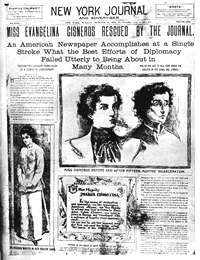
Later that year, a reporter for the Journal broke from jail in Havana a 19-year-old political prisoner named Evangelina Cisneros. The Journal — and more than a few other U.S. newspapers — celebrated the breathtaking breach of international law.

For the Journal, the Cisneros jailbreak (see image, above) was “epochal” and represented the “supreme achievement” of its paradigm of activist journalism.

It acknowledged that freeing Cisneros had violated Spanish law and flouted international convention — and the Journal seemed delighted to have done so, saying:

“The Journal is quite aware of the rank illegality of its action. It knows very well that the whole proceeding is lawlessly out of tune with the prosaic and commercial nineteenth century. We shall not be surprised at international complications, nor at solemn and rebuking assurances that the age of knight errantry is dead. To that it can be answered that if innocent maidens are still imprisoned by tyrants, the knight errant is yet needed.”

That sort of willingness to wink at illegality was demonstrated by the News of the World well before it became swept up in a cellphone-voicemail hacking scandal that brought about its demise.

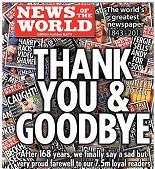
Final edition

The News of the World, which published its final issue today, had been for years one of the world’s most controversial titles, due in part to its activist-oriented undercover operations, ostensibly undertaken to bring drug dealers, fugitive financiers, and other criminals to justice.

As I noted in my 2001 book, Yellow Journalism: Puncturing the Myths, Defining the Legacies, the targets of the News of the World often were “small-time celebrities and wayward sports figures dabbling in modest quantities of illegal drugs. The undercover methods were criticized as entrapment and dismissed as ‘a kind of investigative reporting without much investigating.'”

I also described a notorious case in 1999, in which reporters for News of the World “posed as wealthy Arabs and enticed a British earl to buy cocaine and share the drug with them. A detailed report about the peer’s conduct — he was depicted as drunkenly snorting cocaine with a £5 note — soon after was splashed across News of the World. He was arrested and convicted of selling drugs.

“But the presiding judge declined to send the peer to jail, citing the subterfuge of the News of the World. If not for the journalists’ sting, the judge observed, the crimes likely would not have been committed.”

Such outlandishness hinted at the tabloid’s more recent and more egregious misconduct of breaking into the cellular phone voicemail of hundreds of people, including members of Britain’s royal family and perhaps victims of the terror attack on London’s subway system July 2005.

Phone-hacking, of course, wasn’t an element in the repertoire of the yellow press of Hearst or of his mean-spirited rival, Joseph Pulitzer. Nor did they did bring on the war with Spain in 1898, as is often alleged.

But on occasion they turned to deception, misrepresentation, and self-motivated activism in pursuit of their lusty brand of big-time journalism.

WJC

Recent and related: