W. Joseph Campbell

Archive for the ‘Debunking’ Category

Books and Banter club discusses ‘Getting It Wrong’

In Debunking, Furnish the war, Hurricane Katrina, Media myths, Washington Post, Watergate myth on October 19, 2010 at 6:46 pm

I was honored that the Books and Banter club in Washington, D.C., selected Getting It Wrong for discussion at its October meeting.

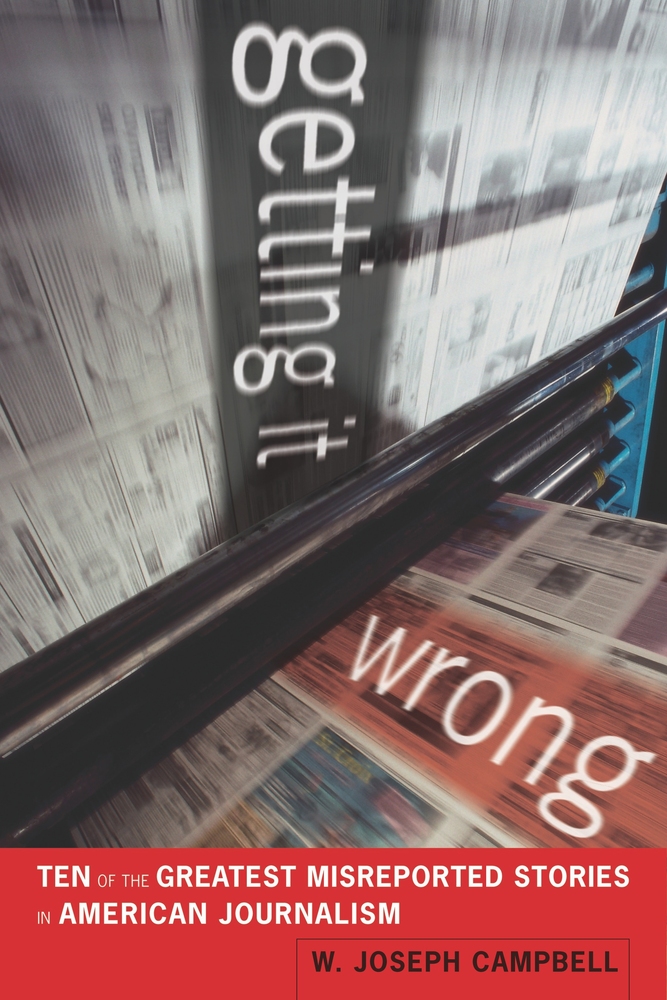
Getting It Wrong is my latest book; it debunks 10 prominent media-driven myths–dubious or improbable stories about the news media that masquerade as factual.

Sixteen members of the club met last night at a restaurant in the Rosslyn section of Arlington, Virginia–within a block or two of the underground parking garage where during the Watergate investigation Washington Post reporter Bob Woodward sometimes met his high-level federal source known as “Deep Throat.”

At the request of club member Paige Gold, who led the discussion, I dropped in for the closing half of the discussion about Getting It Wrong.

I told the club members that I didn’t consider Getting It Wrong as an exercise in media-bashing.

Rather, I said, I like to think of the book as aligned with a fundamental imperative in journalism–that of getting it right.

I had a great time fielding the club members’ very thoughtful, engaging, and intriguing questions.

Among those questions was whether media audiences bear any responsibility for the tenacity of media myths.

Not directly or significantly, I replied.

The myths addressed in Getting It Wrong are, in one way or another, all media-driven. Journalists and news organizations have been the primary culprits in pushing them. Their doing so is more than a little self-serving: After all, media myths serve to reinforce the notion that, for good or bad, the news media are central and decisive forces in American life.

So at one end of the scale, I said, “we have William Randolph Hearst, journalist-as-war-monger, who famously vowed to ‘furnish the war‘ with Spain” in the late 19th century.

At the other, I added, we have the heroic journalists of Watergate, Woodward and his colleague Carl Bernstein, whose investigative reporting brought down a corrupt presidency.

Myths such as those can be used to identify the media as malevolent forces or as indispensable guardians of truth and democratic values. And variety of that kind helps explain why media myths can be so tenacious.

I also was asked what should readers be sure to take away from the book.

In jest, I replied that I thought they should take away the recognition that Getting It Wrong is such a good book they should offer it as gifts to friends and family, especially at the year-end holidays.

Seriously, I added, the takeaway for readers may well be to treat media content with a healthy measure of skepticism, to realize that news reports often are tentative, incomplete, prone to error and revision.

This is especially the case in coverage of disasters, such as the aftermath of Hurricane Katrina a little more than five years ago.

Almost certainly, the early reports about a disaster will prove to be exaggerated in some fashion. The coverage of Katrina’s aftermath in New Orleans offers a telling reminder, I said.

As I write in Getting It Wrong, Katrina’s aftermath represented “no high, heroic moment in American journalism.

“The coverage was in important respects flawed and exaggerated. On crucial details, journalists erred badly, and got it wrong. In the days following Katrina’s landfall, news reports described apocalyptic horror that the hurricane supposedly had unleashed.”

The flawed coverage–the erroneous reports of snipers firing at medical personnel and relief helicopters, of bodies being stacked like cordwood in the New Orleans convention center, of roving gangs raping and killing, of children with their throats slashed, of sharks plying the city’s flood waters–was not without consequences.

As I write in Getting It Wrong, the over-the-top reporting “had the very real and serious effects of delaying the arrival of aid to New Orleans, of diverting and distorting the deployment of resources and capabilities, of heightening the anxiety of [storm] evacuees at the Superdome and Convention Center, and of broadly stigmatizing a city and its people.”

WJC

Recent and related:

Hearst pushed country into war? But how?

In Debunking, Media myths, Newspapers, Spanish-American War, Yellow Journalism on October 18, 2010 at 7:37 am

Hearst's 'Evening Journal'

That William Randolph Hearst was a war-monger, a feckless newspaper publisher who fomented the conflict with Spain in 1898, can be an irresistible notion.

It’s also a classic media-driven myth, one that ignores the failure of diplomacy that led to the Spanish-American War and offers a simplistic and misleading explanation instead.

The claim that Hearst brought on the war appeared the other day in a commentary published in the Press Gazette of Green Bay, Wisconsin. The commentary flatly asserted:

“William Randolph Hearst wielded tremendous power with his chain of newspapers, up to and including getting the United States involved in a war with Spain beginning in 1898.”

As is often the case, the claim about Hearst’s war-mongering is backed by no documentation, no supporting evidence. It’s as if the matter is settled, as if there’s no disputing that Hearst and his yellow press possessed such power.

It’s assumed Hearst was capable of thrusting the country into war.

But no recent biographer of Hearst, and no serious historian of the Spanish-American War, supports such an interpretation.

I addressed and knocked down such claims in my 2001 book Yellow Journalism: Puncturing the Myths, Defining the Legacies, in which I wrote:

“The yellow press is not to blame for the Spanish-American-War. It did not force—it could not have forced—the United States into hostilities with Spain over Cuba in 1898. The conflict was, rather, the result of a convergence of forces far beyond the control or direct influence of even the most aggressive of the yellow newspapers, William Randolph Hearst’s New York Journal.”

Hearst’s newspapers–which in 1898 included the Journal, the New York Evening Journal, and the San Francisco Examiner–wielded at best modest agenda-setting influence.

I wrote in Yellow Journalism:

“There is little evidence that the press beyond New York City, especially in small-town and rural America, was influenced by the content of the yellow journals, including their demands for war after the destruction of the Maine,” an American battleship that blew up in Havana harbor in February 1898.

The destruction of the Maine in a harbor under Spanish control was a trigger for war, which began in April 1898, after the United States and Spain reached an impasse in negotiations about extending self-rule to Cuba.

Conspicuously absent in argument that Hearst fomented the conflict are adequate or persuasive explanations as to how the often-erroneous, often-exaggerated contents of Hearst’s newspapers were transformed into policy and military action.

As I wrote in Yellow Journalism, if Hearst’s yellow press did bring on the war, then researchers should be able to find unambiguous references to such influence in the personal papers and the reminiscences of policymakers of the time.

“But neither the diary entries of cabinet officers nor the contemporaneous private exchanges among American diplomats indicate that the yellow newspapers exerted any influence at all,” I wrote in the book.

When the yellow press was discussed within the administration of President William McKinley it tended to be dismissed as a nuisance or scoffed at as a complicating factor.

Its content was regarded “neither as a source of insight into popular thinking in the United States nor as a useful guide in pursuing the delicate and ultimately futile negotiations with Spain,” I added.

So there is “almost no evidence that the demands of the yellow journals—especially during the critical weeks after the Maine’s destruction—penetrated the thinking of key White House officials, let alone influenced the Cuban policy of the McKinley administration,” I wrote.

So why is the notion so tenacious that Hearst’s yellow press brought on the war?

Blaming Hearst’s newspapers for the war is a convenient way to excoriate yellow journalism, a ready way of summarizing its excesses and defining its malevolent potential.

WJC

Recent and related:

Sniffing out media myths

In Cronkite Moment, Debunking, Furnish the war, Media myths, Washington Post, Watergate myth on October 17, 2010 at 8:19 am

I had a fine interview about Getting It Wrong the other day with Eric Deggans of the St. Petersburg Times, the fruits of which appear in his column today.

He writes that Getting It Wrong, my latest book, “picks apart some of journalism’s key moments, from the notion that Bob Woodward and Carl Bernstein’s Watergate reporting brought down Richard Nixon’s White House (action by the FBI, U.S. Congress and Supreme Court actually did that), to the myth of babies born to crack-addicted moms swamping the country and the idea that CBS anchorman Walter Cronkite turned public opinion on the Vietnam War with a single critical broadcast (public opinion had been souring on the war for months).”

Deggans cleverly structured the column as a series of “clues to spot myths in the making.”

Tip-offs mentioned in his column are:

  • Myths can seem too good to be true.
  • Myths tend to support the notion of media power.
  • Myths simplify complex issues and historical events.

Those factors certainly do characterize media-driven myths, which are prominent stories about and/or by the news media that are widely believed and often retold but which, under scrutiny, dissolve as apocryphal or wildly exaggerated. Media myths can be thought of as the junk food of journalism–tasty and alluring, perhaps, but not terribly nutritious or healthy.

The media myths addressed and debunked in Getting It Wrong include some of American journalism’s best-known stories. “Most of them are savory tales,” I write in the book. “And at least some of them seem almost too good to be false.”

Media myths, I point out in Getting It Wrong, do “tend to distort understanding about the role and function of journalism in American society, conferring on the news media far more power and influence than they necessarily wield.”

They are media-centric. Self-flattering.

As I further write in Getting It Wrong:

“Media myths often emerge from an eagerness to find influence and lasting significance in what journalists do and tend to extend credit where credit is not entirely due.”

What I call the heroic-journalist myth of Watergate is an example of such hero-seeking.

The myth has it that the investigative reporting of Woodward and Bernstein in the Washington Post brought down Nixon’s corrupt presidency.

“In reality,” I write in Getting It Wrong, “the Post and other news organizations were marginal factors in unraveling the Watergate scandal. Nixon’s fall was the consequence of his criminal conduct, which was exposed in the convergence of many forces, newspaper reporting being among the least decisive.”

And yet the Watergate myth lives on, as an example of the news media exerting power in an effective and beneficial manner.

Media myths also endure, I write, because they tend to be reductive. That is,  they simplify, they “offer unambiguous, easily remembered explanations about complex historic events.”

It is, after all, far easier to place Woodward and Bernstein at the center of unraveling Watergate than it is to grapple with and understand the sprawling complexity of the scandal.

Media myths also invite indulgence in the “golden age fallacy,” a flawed but enticing belief that there really was a time when journalism and its practitioners were respected and inspiring—the time, say, of Woodward and Bernstein.

Interestingly, Woodward has scoffed at the notion that he and Bernstein took down Nixon. Woodward said in an interview in 2005:

“To say that the press brought down Nixon, that’s horseshit.”

To the list of tip-offs that Deggans discusses, I would add: “Myths often fail the sniff test.” Tales that are quite neat and tidy do tend to emit a whiff of phoniness.

Pithy quotes such as William Randolph Hearst’s vow to “furnish the war” with Spain fail the sniff test. They invite suspicion because they seem almost too perfect, too neat and tidy.

Hearst’s famous vow is examined in Chapter One in Getting It Wrong.

In closing, I note another newspaper reference to Getting It Wrong.

Leo Morris, editorial page editor at the News-Sentinel in Fort Wayne, Indiana, wrote the other day that he the book “sounded so intriguing” that he was prompted to download its Kindle edition.

Morris’ brief piece carried the headline: “Journalism’s mythtakes.”

Clever. “Mythtakes.” I like it.

WJC

Recent and related:

Was ‘jailbreaking journalism’ a hoax? Evidence points the other way

In 1897, Anniversaries, Debunking, Media myths, Spanish-American War, Yellow Journalism on October 15, 2010 at 6:42 am

The sensational case of “jail-breaking journalism” reached a conclusion 113 years ago this week, when the passenger steamer Seneca reached in New York harbor, en route from Havana.

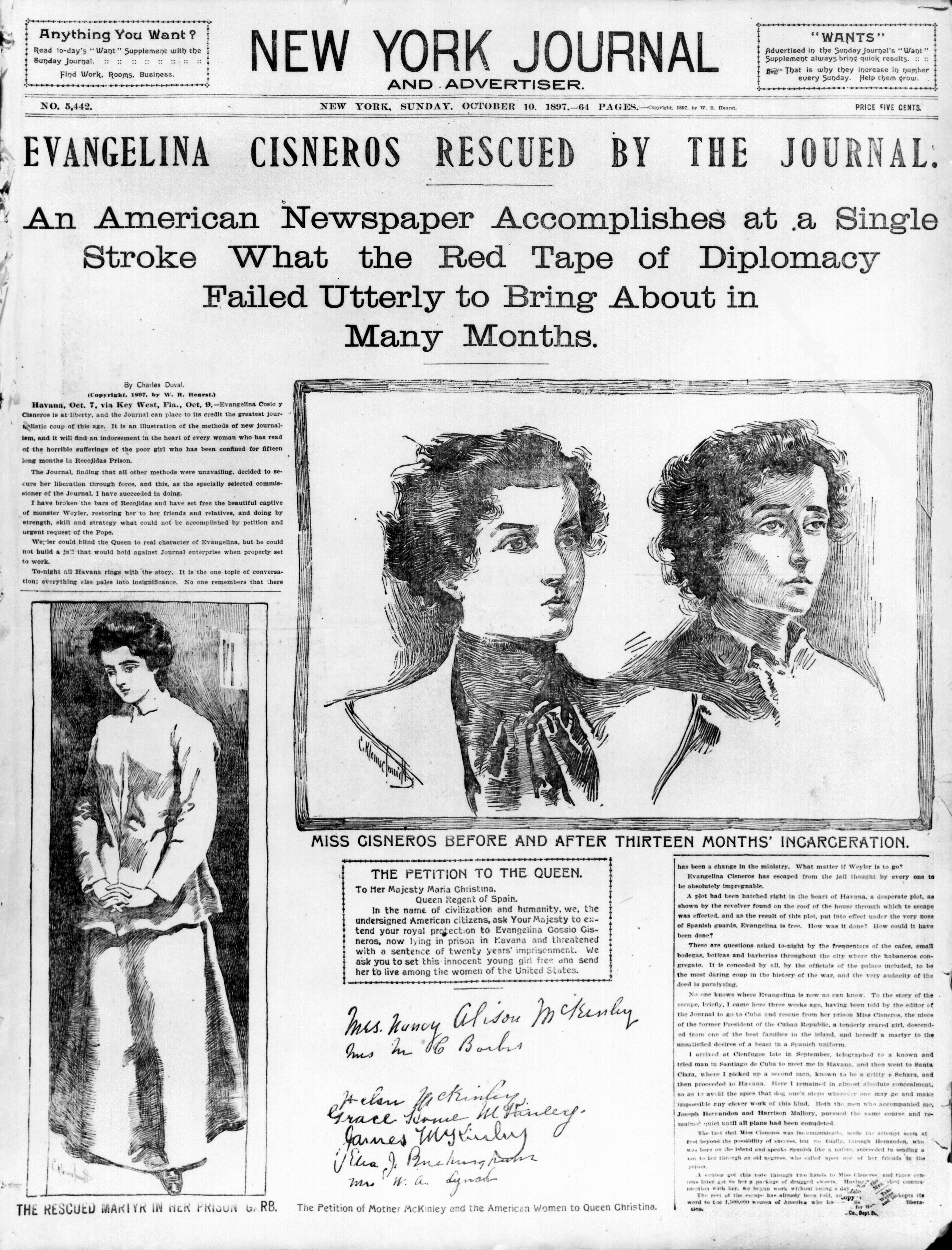
Among the passengers was 19-year-old Evangelina Cisneros, a petite Cuban woman who, a few days before, had been the world’s most famous political prisoner.

She had been broken out of jail in Havana in the early hours of October 7, 1897. Her rescuers included Karl Decker, a reporter for William Randolph Hearst‘s New York Journal who had been assigned to Havana to secure her freedom.

Once out of jail, Cisneros was hidden at the home of a bachelor Cuban banker for nearly three days. She was smuggled aboard the Seneca just before it left Havana.

The steamer reached New York on October 13, 1897, and the Journal lodged Cisneros in a palatial room at the Waldorf Hotel. Four days later, she and Decker were feted at Madison Square, at a thunderous outdoor reception organized by Hearst.

More than 75,000 people turned out at what was reported to have been the largest public gathering in New York since the Civil War.

I wrote about the case of “jail-breaking journalism” in my 2006 book, The Year That Defined American Journalism: 1897 and the Clash of Paradigms, noting:

“Cisneros was rapturously received [in New York] not because she was a daring and clever prison escapee, but because she was a frail and wily embodiment of the Cuban struggle for political independence from Spain.”

At the time, Cuba was in open rebellion against Spanish colonial rule, and Evangelina had been swept up in the tumult on the island. She was accused of plotting to kill a senior Spanish military officer; she said she was defending herself from the officer’s sexual advances.

To the Journal, her jailing stood as irrefutable evidence of Spain’s routine mistreatment of Cuban women. Cisneros, the Journal said, was guilty only of “having in her veins the best blood in Cuba.”

As that claim suggests, the Journal devoted impassioned and intensive coverage to Cisneros’ plight, turning her jailing into an international cause célèbre.

By the time of her escape, Cisneros had been in Spanish custody nearly 15 months without trial.

The jailbreak was breathtakingly illegal–and one of the most astonishing episodes in American journalism. The Journal declared it “epochal,” a stunning success of its activist brand of yellow journalism.

But the case long has been dogged by suspicions that the whole thing was a hoax, that Decker paid bribes to win Cisneros’ release and then concocted an elaborate tale about a jailbreak.

Such suspicions emerged almost as soon as Cisneros reached New York.  As I note in The Year That Defined American Journalism, Hearst’s leading rival newspaper, the New York World of Joseph Pulitzer, was particularly eager to denounce the Cisneros rescue as fraudulent.

“Gold did it,” the World declared. “The Spanish could not withstand its glitter. It oiled the palms of turnkeys and guards, of officers and civilians. Miss Cisneros’s friends had it a-plenty. And so she got out of her cell while her jailers looked the other way.”

But as I note in The Year That Defined American Journalism, such claims “have never been supported by any direct evidence. No one has identified to whom bribes were paid, how much, by what method, and how the purported payoffs secured the enduring silence of the authorities.”

Besides, a conspiracy of silence that included senior Spanish authorities in Cuba would have had to have been so improbably extensive—so many people would have known—that “concealment could not possibly have lasted for long, certainly not 100 years and more,” I wrote.

Allegations or suspicions of bribery, I noted, “rest more on assertion—and newspaper rivals’ contempt for the Journal—than on specific, persuasive documentation. They are supported more by argument than evidence.”

Decker–who denied that bribes had been paid–succeeded in the jailbreak because he tapped into a clandestine network in Havana, the operatives of which had become adept in smuggling arms, ammunition, and medicine into Cuba and, occasionally, people out.

Among those operatives was Carlos F. Carbonell, a bachelor banker in whose home Cisneros was hidden. They also included William B. MacDonald, an American national in Havana who was the agent for a steamship line. He was with Decker when the jailbreak took place.

It is simply implausible that Carbonell, MacDonald, and Decker’s other accomplices would have taken the risks they took had the Cisneros rescue been nothing more than hoax, farce, or sham.

WJC

Recent and related:

Ignoring WaPo role in pushing Lynch hero-warrior tale

In Debunking, Jessica Lynch, Media myths, Washington Post on October 13, 2010 at 8:12 am

It’s more than a mildly astonishing how the Washington Post‘s singular role in propelling the erroneous hero-warrior tale about Private Jessica Lynch is rarely noted when the case is recalled these days.

The dominant narrative about the Lynch case–one of 10  media-driven myths I examine in my new book, Getting It Wrong–has shifted decidedly away from the Post to focus on the Pentagon‘s purported role in concocting the story about Lynch’s battlefield heroics in Iraq.

London’s Daily Telegraph was the latest to buy into that misleading narrative, stating in an article posted online yesterday:

“The Pentagon was … accused of exaggerating the heroism of Private Jessica Lynch, who was rescued from an Iraqi prisoner of war hospital in 2003 after being captured and injured in an ambush.

“Government sources claimed she had tried to fight off her captors, but she later said her gun had jammed before she could fire a shot.”

It’s scarcely surprising that the Telegraph account makes no mention of the Post and its sensational, front-page report of April 3, 2003–the report that thrust Lynch into unwitting and undeserved international fame.

Lynch then was a 19-year-old Army private, a supply clerk with the 507th Maintenance Company. Elements of her unit were ambushed in Nasiriyah, in southern Iraq, on March 23, 2003, a few days into the war.

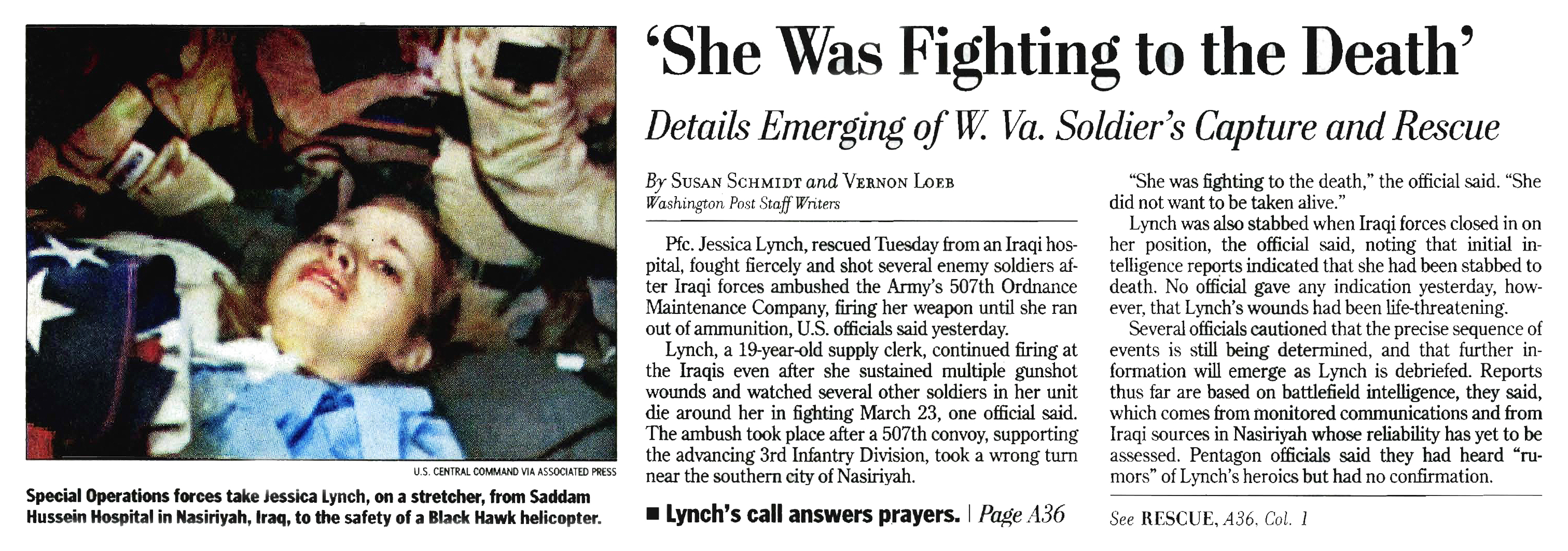
The Post‘s article of April 3 appeared beneath the headline: “‘She was fighting to the death.’” And it described how Lynch had fought fiercely in an ambush in southern Iraq in the early days of the Iraq War, that she had been shot and stabbed before taken prisoner.

But the story wasn’t true.

Lynch never fired her weapon in Iraq. Her gun jammed during the ambush, she later said. She was neither shot nor stabbed; she suffered serious injuries in the crash of a Humvee as it tried to flee. And she was sexually assaulted after the ambush.

Lynch lingered near death at a hospital in Nasiriyah before a U.S. special forces team rescued her, on April 1, 2003, two days before the Post‘s botched hero-warrior tale was published–and was promptly picked up by news organizations around the world.

The Post account vaguely cited “U.S. officials” as sources for the tale about Lynch’s derring-do.

But who those sources were has never been revealed.

As I mention in Getting It Wrong, Vernon Loeb, who shared a byline on the “fighting to the death” report about Lynch, made clear the Pentagon was not the source.

Speaking in what I called “a little-noted interview” on National Public Radio’s Fresh Air interview program in late 2003, Loeb said flatly :

“Our sources for that story were not Pentagon sources.

“And, in fact, I could never get anybody from the Pentagon to talk about those reports [about Lynch’s battlefield heroics] at all. I got indications that they had, in fact, received those intelligence reports, but the Pentagon was completely unwilling to comment on those reports at all. They wouldn’t say anything about Jessica Lynch.”

Loeb said in the interview that the Post had been “told by some really good intelligence sources here in Washington that, you know, there were indications that she had, you know, fired back and resisted her capture and actually been shot and possibly stabbed doing so.”

He added that the Post on April 3, 2003, “basically told our readers that day what the U.S. intelligence community was telling senior members of the U.S. government.”

Loeb, then the Post defense correspondent, dismissed the interviewer’s suggestion that the  “fighting to the death” report was the upshot of clever manipulation by the Pentagon.

“I just didn’t see the Pentagon trying to create a hero where there was none,” Loeb said. “I mean …they never showed any interest in doing that, to me.”

Why the Post escapes responsibility for the botched hero-warrior tale is intriguing, if not baffling.

It certainly makes for juicy story to claim the Pentagon for ginned up the tale about Lynch’s heroics. That story line fits well with the public’s curdled view of the war in Iraq: A bogus hero seems appropriate for a war fought on a supposedly dubious premise.

But that story line is deceptive: The bogus hero-warrior tale was a direct consequence of the bungled, credulous, and inadequately sourced reporting by the Washington Post.

WJC

Recent and related:

Hearst, agenda-setting, and war

In Debunking, Furnish the war, Media myths, Spanish-American War, Yellow Journalism on October 12, 2010 at 9:26 am

William Randolph Hearst is the bogeyman of American journalism, a timeless representation of what’s malign and dubious about the news media.

HearstAt their worst, the media can even force a country into war–just as Hearst did with his sensational and irresponsible newspapers in 1898.

It’s an easy meme: Juicy, delicious, easy to remember. It’s also a classic media-driven myth, a tall tale about the news media that dissolves under scrutiny.

The latest to repeat the myth was London’s Daily Telegraph, which usually ranks among Britain’s “quality” newspapers. (Unlike, that is, the raunchy and outlandish London tabloids of Rupert Murdoch.)

In an article yesterday that discussed the Hearst Corp.’s magazine holdings, the Telegraph said of William Randolph, who died in 1951:

“Through Hearst’s newspapers and magazines, he had enormous political influence and is sometimes credited with pushing opinion in the US into a war with Spain in 1898.”

Few serious historians of late 19th century America, and no recent biographers of Hearst credit (or blame) him and his publications with “pushing” the country into the war with Spain.

It just didn’t happen that way.

Like many media myths, Hearst-the-war-monger offers a simplistic explanation for a complex subject. It is far easier to blame Hearst’s yellow press for fomenting the conflict than it is to sort through the failed diplomacy that led the United States and Spain to go to war over Cuba in April 1898.

As I wrote in my 2001 book, Yellow Journalism: Puncturing the Myths, Defining the Legacies, the New York newspapers of Hearst and his rival Joseph Pulitzer exerted at best limited agenda-setting influence on the U.S. press in the run-up to the war.

As I wrote in Yellow Journalism:

“A significant body of research indicates that newspapers in small-town and rural America scoffed at, condemned, and ignored the exaggerated and fanciful reports appearing in New York City’s yellow journals….”

Often cited as Exhibit A in the lineup of evidence that supposedly fingers Hearst as a war-monger is his own vow to “furnish the war” with Spain.

The pledge supposedly was sent by telegram to the artist Frederic Remington, who in January 1897 was on assignment to Cuba for Hearst’s New York Journal. Cuba at the time was in open rebellion against Spanish colonial rule–a rebellion that gave rise in 1898 to the Spanish-American War.

But the “furnish the war” tale is almost certainly apocryphal, as I discuss in Getting It Wrong, my new book debunking 10 prominent media-driven myths.

Reasons for doubting the anecdote are many, and include the fact that the purported telegram containing Hearst’s vow has never surfaced. Hearst, himself, denied having sent such a message, and Remington apparently never discussed the matter.

The purported vow, moreover, is illogical: It would have made no sense for Hearst to have pledged to “furnish the war” because war–the Cuban rebellion against Spanish rule–was the very reason he sent Remington to Cuba in the first place.

What’s more, Spanish authorities would have intercepted a telegram that contained a passage vowing to “furnish the war.” The Spanish controlled all incoming and outgoing cable traffic in Cuba in 1897 and they surely would have called attention to Hearst’s vow as a clear-cut example of Yankee meddling.

Which it would have been, had it been sent.

WJC

Recent and related:

‘Getting It Wrong’ goes on ‘PJM Political’

In Cronkite Moment, Debunking, Furnish the war, Hurricane Katrina, Media myths on October 10, 2010 at 10:24 am

I had a fine interview recently with Silicon Valley blogger Ed Driscoll for the Pajamas Media radio show, PJM Political.

The interview aired yesterday on Sirus-XM radio’s POTUS channel.

Topic: My new book, Getting It Wrong, which debunks 10 prominent media-driven myths, those dubious and improbable tales about the news media that masquerade as factual.

Driscoll, who conducts a thoughtful and well-prepared interview, led me through a discussion of several myths addressed in Getting It Wrong, including the Cronkite Moment” of 1968.

That was when, supposedly, the on-air analysis of CBS anchorman Walter Cronkite prompted President Lyndon Johnson to change his thinking about the Vietnam War and led him to decide against seeking reelection.

“That’s simply not true,” I pointed out. “Lyndon Johnson didn’t even see the [Cronkite] program when it aired in February 1968. And his decision not to seek reelection was driven by other forces and factors. Cronkite really was irrelevant to that equation, to that decision.

“But yet it lives on, as an example of media power, the media telling truth to power. And it’s a misleading interpretation, it’s a misreading of history.”

Driscoll said that the chapters of Getting It Wrong “have a sort of curious” set of bookends, in that they begin with a discussion of William Randolph Hearst’s famous vow to “furnish the war” with Spain and end with a look at the exaggerated, over-the-top coverage of Hurricane Katrina’s aftermath.

“Was this sort of book-ending intentional?” Driscoll asked.

It was an insightful question–and the first time an interviewer had asked about the book’s conceptual component.

I noted that the “original framework of the book had it organized more thematically, by ‘media and war’ and ‘media and government,'” and so on.

That framework was discarded, I said, “for a more chronological approach. So the bookends were driven more by chronology than anything else.”

We discussed how Orson Welles‘ cinematic masterpiece, Citizen Kane, helped cement the “furnish the war” myth in the public’s consciousness. Kane includes a scene that paraphrases Hearst’s purported vow.

The “furnish-the-war” anecdote about Hearst is dubious in many respects, I said, adding:

“Yet it lives on as an example of Hearst as the war-monger, as an example of the media–at its most malignant, in an extreme–can bring about a war that the country otherwise wouldn’t have fought.”

I mentioned how media-driven myths can be thought of as the “junk food of journalism,” which prompted Driscoll to ask:

What’s wrong with the American people being fed a little junk food? What’s wrong with being fed a few media myths?

There are several reasons, I replied.

Notably, “these myths tend to misrepresent the role of the news media in American society. They tend to grant the news media far more power and far more influence than they really do exert in American life.”

I added:

“Most people believe the media are powerful agents and powerful entities and often refer to some of the myths that I address, and debunk, in Getting It Wrong. They refer to them in support of this mistaken notion.”

In wrapping up the interview, Driscoll referred to Media Myth Alert as “a nifty blog.”

It was a generous plug that was much appreciated.

WJC

Recent and related:

Doing more than casting ‘doubt’ on Hearst’s famous vow

In 1897, Cinematic treatments, Debunking, Furnish the war, Media myths, Newspapers, Spanish-American War, Yellow Journalism on October 9, 2010 at 7:15 am

In a thoughtful essay posted the other day about “Hollywood and the Power of Myth,” the director of new media at the Wharton School invoked my research into William Randolph Hearst’s purported vow to “furnish the war” with Spain, saying that I’ve cast “doubt” on the often-repeated anecdote.

I like to think that I’ve pretty much demolished that tale.

The Wharton new media director is Kendall Whitehouse, who referred in his essay to my 2000 article in Journalism and Mass Communication Quarterly that challenges the Hearstian vow as improbable. In that article, I wrote that the anecdote deserved “relegation to the closet of historical imprecision.”

I revisited the tale in my latest book, Getting It Wrong, which debunks 10 prominent media-driven myths–dubious and improbable stories about the news media that masquerade as factual.

Chapter One in Getting It Wrong is devoted to the Hearstian tale, which I flatly describe as a media-driven myth, calling it “perhaps the hardiest myth in American journalism.”

I note:

“Hearst’s famous vow to ‘furnish the war’ has achieved unique status as an adaptable, hardy, all-purpose anecdote, useful in illustrating any number of media sins and shortcomings. It has been invoked to illustrate the media’s willingness to compromise impartiality, promote political agendas, and indulge in sensationalism. It has been used, more broadly, to suggest the media’s capacity to inject malign influence into international affairs.”

Its versatility and its pithiness are two of the reasons the Hearstian myth has lived on.

The anecdote stems from Hearst’s assigning Frederic Remington, the famous artist of the American West, to Cuba, to draw illustrations for the New York Journal of the island-wide rebellion against Spanish colonial rule. Remington and the writer Richard Harding Davis, who also was on Hearst’s payroll, reached Cuba in January 1897. (Both are shown in the front-page image above.)

Remington was in Cuba six days before returning to New York. He suffered in the tropical heat and didn’t along with the self-important Davis, who called the rotund Remington “a large, blundering bear.”

Before returning, the media myth has it, Remington sent Hearst a telegram stating:

“Everything is quiet. There is no trouble here. There will be no war. I wish to return.”

Hearst supposedly cabled the artist reply: “Please remain. You furnish the pictures, and I’ll furnish the war.”

In most tellings of the anecdote, Hearst supposedly made good on his promise and brought on the war with Spain, which was declared 15 months later.

The Remington-Hearst anecdote is riven with flaw and incongruity. For starters, Hearst at least twice denied ever having sent such a message. And Remington apparently never discussed the anecdote.

Moreover, as I write in Getting It Wrong, “the anecdote lives on despite a nearly complete absence of supporting documentation. It lives on even though telegrams supposedly exchanged by Remington and Hearst have never turned up.”

And it lives on despite what I call “an irreconcilable internal inconsistency.” That is, it would have been absurd for Hearst to have vowed to “furnish the war” because war—specifically, the Cuban rebellion against Spain’s colonial rule—was the very reason Hearst sent Remington and Davis to Cuba in the first place.

“Anyone reading U.S. newspapers in early 1897 would have been well aware that Cuba was a theater of a nasty war,” I write in Getting It Wrong. “By then, the Cuban rebellion had reached islandwide proportions and not a single province had been pacified by Spain’s armed forces.”

Despite those and other flaws, the tale lives on as too good to check out, too good not to be true.

And as I note in Getting It Wrong:

“What firmly and finally pressed Hearst’s purported vow to ‘furnish the war’ into the public’s consciousness was Citizen Kane, the 1941 motion picture that was based loosely on Hearst’s life and times.”

In a scene early in the film, Orson Welles in the role of Charles Foster Kane, a newspaper tycoon who readily invites comparisons to Hearst, paraphrases the purported Remington-Hearst exchange.

Whitehouse noted in his essay: “Rightly or wrongly, Orson Welles’s … Citizen Kane has largely shaped our popular perception of William Randolph Hearst.” True enough.

Kane certainly helped solidify a robust media-driven myth.

WJC

Recent and related:

Mythical ‘War of the Worlds’ radio show adapted to stage

In Debunking, Media myths, Media myths and radio, War of the Worlds on October 8, 2010 at 9:15 am

Orson Welles’ famous radio dramatization in 1938 of the War of the Worlds was an adaptation of the 1898 novel of the same title by H.G. Wells.

And Welles’ radio show–the source for what has become a delicious and tenacious media-driven myth, one debunked in my new book, Getting It Wrong–has been adapted to the stage. A run of the World of Wars, based on Welles’  radio adaptation, opened last night at a theater in Tampa. (The Tampa production, to be clear, is not the first stage adaptation of Welles’ version of War of the Worlds. There have been others.)

In publicizing the stage production, Tampa’s alternative newspaper, Creative Loafing, offered up the myth that Welles’ program in 1938 created mass panic and nationwide hysteria.

The Creative Loafing write-up said:

“Welles presented the first two-thirds of 1938 radio broadcast as a series of fake news bulletins, which listeners believed and in turn incited mass hysteria.

“People really thought that an alien invasion by Martians was really in progress.”

Both paragraphs are in error.

The War of the Worlds show, which aired on CBS radio on October 30, 1938, made clever and effective use of simulated news bulletins about an invasion of Earth by Martians wielding deadly heat rays. But “fake news bulletins” comprised nothing close to two-thirds of Welles’ hour-long program.

The program’s use of simulated bulletins was intermittent, and largely confined to the opening 20 minutes, by which time it sounded as if the Earth were under alien attack.

But as I write in Getting It Wrong, “Listeners who followed closely would have easily recognized that events moved far too quickly to be plausible.” It took the invaders less than a half an hour to blast off from Mars, crash-land on Earth, and launch their deadly onslaught.

Most listeners–in overwhelming numbers–recognized the show for what it was: Great entertainment on the eve of Halloween. Surveys taken in the days following the show found that a fraction of the radio audience was “frightened,” “disturbed,” or “excited” by what they heard.

The terms were those of Hadley Cantril, a Princeton University psychologist who investigated the aftermath of the War of the Worlds program. In his 1940 book, The Invasion From Mars, Cantril estimated the program attracted no fewer than 6 million listeners, of whom at least 1.2 million were “frightened,” “disturbed,” or “excited.”

Cantril did not explain what the terms meant; nor did he offer estimates about how many people acted on their fears.

In any case, being “frightened,” “disturbed,” or “excited” was far from being convulsed in panic or driven to hysteria.

Cantril’s estimates signal that most listeners were neither panic-stricken nor fear-struck. Even though his data indicate that comparatively few listeners were upset by the show, Cantril offered the inconsistent view that “[l]ong before the broadcast had ended people all over the United States were praying, crying, fleeing frantically to escape death from Martians.”

The Invasion From Mars became the cornerstone study of audience reaction to the War of the Worlds program. It has been recognized as something of an early landmark in mass communication research.

But over the past 20 years or so, Cantril’s findings about the War of the Worlds “have been challenged by sociologists and others who point out that mass hysteria and panic are rare and, given their transient nature, difficult to study,” as I note in Getting It Wrong. “Cantril, they say, failed to demonstrate that panicked reactions and flight were widespread among listeners to the show.”

I point out that Robert E. Bartholomew, “an authority on mass hysteria and social delusions, has said that ‘a growing consensus among sociologists that the extent of the panic, as described by Cantril, was greatly exaggerated.'”

Bartholomew also wrote that only “scant anecdotal evidence” exists “to suggest that many listeners actually took some action—such as packing belongings, grabbing guns, or fleeing in cars after hearing the broadcast.”

I also write in Getting It Wrong:

“Had mass panic and hysteria indeed swept the country that night, the trauma and turmoil surely would have resulted in many deaths and injuries. But the newspaper reports were notably silent on casualties.” Those reports, I write, “contained few references to injury or adverse health effects linked to the program.”

WJC

Recent and related:

Myth appeal runs deep abroad; Watergate a case in point

In 1897, Debunking, Furnish the war, Media myths, Spanish-American War, Washington Post, Watergate myth, Yellow Journalism on October 7, 2010 at 10:20 am

I  spoke about my new book, Getting It Wrong, at a superbly organized American University alumni event last night, at a venue commanding spectacular views of Seattle, Puget Sound, and the Olympic Mountains.

Following my talk, which focused on three of the 10 media-driven myths debunked in Getting It Wrong, I was asked by one of the people in attendance whether myths have similarly emerged about the media in other countries.

A very good question, I replied: I really don’t think so.

Maybe in Britain, I suggested, given the robust media scene there. But I couldn’t say for sure.

While I had to hedge a bit on the question, there’s no doubt that myth appeal runs deep from the United States to other countries. That is, news organizations outside the United States not infrequently repeat what are American media myths.

Media-driven myths, I have noted, can and do travel far, and well.  Take, for example, the heroic-journalist myth of Watergate.

The notion is often embraced in news media in the United States and overseas that the investigative reporting of Bob Woodward and Carl Bernstein, then-young reporters for the Washington Post, took down Richard Nixon and his corrupt presidency.

A measure of the myth’s international appeal can found in a report that aired today on Australia’s ABC radio network, which described Woodward as “one of the Washington Post journalists who brought down a U.S. President.”

Not even Woodward embraces that claim. He said in an interview in 2005:

“To say the press brought down Nixon, that’s horseshit.”

And he’s right. Earthy, perhaps, but right.

I discuss the heroic-journalist myth in Getting It Wrong, noting that it’s a simplistic and misleading interpretation of what was a sprawling and complex scandal. Watergate’s web of misconduct forced Nixon from office and landed nearly 20 of his top aides, associates, and cabinet officers in jail.

To roll up a scandal of such dimension, I write,  required the collective, if not always the coordinated, efforts of special prosecutors, bipartisan congressional panels, federal judges, the FBI, and, ultimately, the U.S. Supreme Court, which ordered Nixon to surrender audiotapes that proved his complicity in the Watergate cover-up.

Against that tableau, journalism’s contributions to unraveling Watergate were modest—certainly not decisive.

But because the heroic-journalist interpretation is such an unambiguous assertion of the media’s presumed power, it tends to travel well.

The same holds for the purported vow of William Randolph Hearst to “furnish the war” with Spain.

Hearst supposedly made the pledge in a cable to the artist Frederic Remington, who was in Cuba in early 1897, on assignment for Hearst’s New York Journal to draw illustrations of the rebellion against Spanish colonial rule.

The anecdote lives on as one of the most famous and delicious in American journalism—even though it is buttressed by no supporting documentation. And Hearst denied ever having made such statement.

It is, however, a tale almost too good to be disbelieved, given that it so effectively represents Hearst as warmonger. The tale’s sheer deliciousness is another reason why the anecdote turns up more than infrequently in news outlets abroad, especially in Spanish-language media.

The media myths associated with Watergate, the so-called “Cronkite Moment” of 1968, and the War of the Worlds radio dramatization of 1938 were the principal elements of my talk last night.

Those myths live on, I said, in part because “they are appealing reductive, in that they minimize the complexity of historical events and offer simplistic and misleading interpretations instead. The Washington Post no more brought down Nixon that Walter Cronkite swayed [Lyndon] Johnson’s views about Vietnam.

“Yet those and other media myths endure because they present unambiguous, easy-to-remember explanations for complex historic events.”

WJC

Recent and related: