W. Joseph Campbell

Archive for the ‘Media myths and radio’ Category

Discussing ‘Getting It Wrong’ with AU alums

In Cinematic treatments, Cronkite Moment, Debunking, Media myths, Media myths and radio, War of the Worlds, Washington Post, Watergate myth on June 30, 2010 at 10:35 pm

I met in Cleveland’s Little Italy neighborhood last night with a terrific group of American University alumni, at a program that featured a discussion of Getting It Wrong, my new book about media-driven myths.
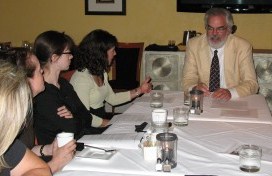
With AU alums in Cleveland

The gathering was the second of the Cleveland area alumni chapter, which is ably led by Neil T. Young, Anthony Vacanti, and Antoinette Bacon. I was privileged to talk with the group about the book, which addresses and debunks 10 prominent media myths–those false, dubious, improbable stories about the news media that masquerade as factual.

We met at Michaelangelo’s, a fine Italian restaurant where the service is superb. Our discussion about Getting It Wrong was conducted seminar style and featured my fairly lengthy review of the heroic-journalist myth of Watergate–the notion that the intrepid investigative reporting by the Washington Post brought down Richard Nixon’s corrupt presidency.

I described how the book All the President’s Men and the cinematic version by the same title helped solidify the notion that the Post and its reporters Bob Woodward and Carl Bernstein were central to unraveling the Watergate scandal.

The book and the movie have had the effect of focusing on the Post reporters while ignoring or overlooking the far more significant contributions of federal prosecutors, federal judges, bipartisan congressional panels, and ultimately the U.S. Supreme Court in identifying Nixon’s efforts to obstruct justice in the scandal.

“Against that backdrop,” I said, “the news media were decidedly modest factors” in Watergate’s outcome.

Orson Welles

We also discussed the War of the Worlds myth–that Orson Welles’ 1938 radio dramatization of an invasion from Mars was so realistic that tens of thousands of Americans were convulsed in panic and fled their homes in hysteria. The program was imaginative entertainment–and was recognized as such by listeners in overwhelming numbers, I pointed out.

In addition, we talked about the so-called “Cronkite Moment” of February 1968, when CBS anchorman Walter Cronkite offered a downbeat analysis of the U.S. war effort in Vietnam, saying the military was “mired in stalemate.”

Supposedly, Cronkite’s assessment came as an epiphany to President Lyndon Johnson who, it is said, snapped off the television set upon hearing the anchorman’s “mired in stalemate” characterization and said, “If I’ve lost Cronkite, I’ve lost Middle America.”

Or words to that effect.

In reality, I pointed out, the president wasn’t in front of a television set that night.

He was in Austin, Texas, at the 51st birthday party of Governor John Connally. And even if Johnson had seen the Cronkite report on videotape, the anchorman’s assessment really was no epiphany, because the president in the days and weeks immediately afterward hewed to a hawkish line on Vietnam.

Questions from the alums were quite thoughtful. Among them was a query about the common threads may be found in the myths debunked in Getting It Wrong.

A thoughtful and perceptive question, that.

And indeed there are some shared characteristics of media myths.

Many myths are reductive, in that they offer simplistic explanations for complex historical events. That factor certainly helps explains the tenacity of the heroic-journalist myth of Watergate and the “Cronkite Moment.” It is far easier to characterize the news media as prime movers in the outcomes of Watergate and Vietnam than it is to grapple with the complexities and nuances of those landmark events, I said.

Additionally, media myths tend to be delicious stories–stories almost too good to be disbelieved. And that certainly holds for Watergate, the “Cronkite Moment,” and the War of the Worlds dramatization.

And media myths tend to be ways to assert the notion that the news media are powerful and influential forces in American society.

But as I write in Getting It Wrong, media power “tends to be modest, nuanced, diffused, and situational” and altogether “too often the ubiquitous presence of the news media is mistaken for power and influence.”

Moreover, I write, “The American media these days are far too splintered and diverse—print, broadcast, cable, satellite, online—to exert much in the way of collective and sustained influence on policymakers or media audiences.”

WJC

Related:

‘Junk food of jornalismo’: Diário writes up ‘Getting It Wrong’

In Bay of Pigs, Cronkite Moment, Debunking, Furnish the war, Media myths, Media myths and radio, Murrow-McCarthy myth, Reviews, Watergate myth on June 28, 2010 at 2:49 pm

Today’s edition of the venerable  Portuguese newspaper Diário de Notícias includes a write up about Getting It Wrong, my new book about prominent media-driven myths–those false, dubious, improbable stories about the news media that masquerade as factual.

With the help of the online translation site Babelfish, I was able to make out a good deal of the Diário review, which says in part:

“W. Joseph Campbell in Getting it Wrong: Ten of the Greatest Misreported Stories in American Journalism, published the University of California Press, [says] these ‘myths can be thought as junk food of jornalismo.'”

The Diário article mentions several media myths addressed and debunked in Getting It Wrong, including those of William Randolph Hearst’s purported vow to “furnish the war” with Spain; the 1938 radio dramatization of the War of the Worlds which supposedly sowed panic across the United States; the notion that Edward R. Murrow’s 1954 See It Now television program abruptly halted Senator Joseph McCarthy’s communists-in-government witch-hunt, and the myth that the New York Times suppressed its coverage of the run-up to the Bay of Pigs invasion in 1961.

Diário characterizes as one of the book’s “more concrete” examples “the Watergate case,” in which reporters for the Washington Post are credited with having toppled the corrupt presidency of Richard Nixon.

Media myths, the articles notes, are not innocuous; ” they can distort the perception of the power and function of jornalismo” because “they tend to give the media” more power and influence than they rightly deserve. It also says that myths can “minimize the complexity of the historical events for simplistic interpretations.” Both of those are important points raised in Getting It Wrong.

The review closes by taking up the suggestion I offer in the conclusion of Getting It Wrong, namely that there are more media myths to debunk.

“By no means do the media myths examined on these pages represent a closed universe,” I write in the book’s closing passage. “Others surely will assert themselves. They may tell of great deeds by journalists, or of their woeful failings. They may well hold appeal across the political spectrum, offering something for almost everyone. They may be about war, or politics, or biomedical research.

“Predictably, they will be delicious tales, easy to remember, and perhaps immodest and self-congratulatory. They probably will offer vastly simplified accounts of history, and may be propelled by cinematic treatment.  They will be media-driven myths, all rich candidates for debunking.”

WJC

Related:

‘Getting It Wrong’ goes ‘On Point’

In Cinematic treatments, Cronkite Moment, Debunking, Furnish the war, Media myths, Media myths and radio, Spanish-American War, Washington Post, Watergate myth on June 3, 2010 at 8:52 pm

I was interviewed today by Tom Ashbrook, the engaging host of NPR’s On Point program, which is produced by WBUR in Boston.

We discussed Getting It Wrong, my new book about media-driven myths, and it was a fine show. (Audio is available here.)

As Ashbrook promised in his introduction, the conversation ranged over a variety of topics–or what he called “iconic media tales from the Spanish-American War to Hurricane Katrina.”

We were joined by Jack Beatty, the program’s news analyst, and discussed at some length the myth of the so-called “Cronkite Moment” of 1968, in which CBS News anchorman Walter Cronkite characterized the war in Vietnam as a stalemate, supposedly prompting President Lyndon Johnson to alter his policy on the conflict.

We also took up myth surrounding the famous anecdote about William Randolph Hearst’s purported vow to “furnish the war” with Spain at the end of the 19th century, the dubious notion that Orson Welles’ 1938 radio dramatization of the War of the Worlds set off nationwide panic and mass hysteria, and what I call the heroic-journalist myth of Watergate, in which Bob Woodward and Carl Bernstein of the Washington Post supposedly brought down Richard Nixon’s corrupt presidency.

On the latter topic, I mentioned how the cinematic version of All the President’s Men, Woodward and Bernstein’s book about their Watergate reporting, has become the vehicle by which people learn about and remember the scandal.

Watergate was, I noted, “so complex that people these days, many years removed from it, find it hard to keep it all straight. … The high-quality, cinematic treatment of the Watergate scandal, featuring Woodward and Bernstein and the Washington Post in All the President’s Men, does happen to be the way that many people remember the Watergate scandal. …

“The movie’s a great movie,” I added. “But it helped to solidify the notion that the Post, the Washington Post, and Woodward and Bernstein were at the center, were at the heart, of uncovering the scandal.”

On Point featured questions and comments from a few callers–including a guy named Phil in Bowling Green, Kentucky, who said about me:

“I think the professor has got too much time on his hands. ” I chuckled.

He added: “I lived through most of that–the Watergate and Vietnam War.  I think he’s underestimating the persuasive attitude that Walter Cronkite had on this country. … Everybody’s opinion turned on what Walter Cronkite thought.”

But another caller, Gary from Nashville, Tennessee, weighed in, saying he disagreed with Phil from Bowling Green, offered the thought that public opinion about Vietnam turned not on the views of one journalist but on “the unrelenting reporting on the war by the media.”

It was a lively, substantive program that has generated a few dozen or so comments at the On Point online site.

The discussion made me recognize anew how deeply embedded and tenaciously held some media-driven myths really are, and how an hour-long program is hardly enough to encourage people even to think about giving them up. As Jack Shafer noted in his review of Getting It Wrong, “a debunker’s work is never done.”

But perhaps the show’s content will entice some listeners to buy and read the book. Even then, though, I suspect some media myths will prove resistant to thorough debunking.

WJC

Related:

NPR revisits ‘crack baby’ panic, ignores media role

In Debunking, Media myths, Media myths and radio, Washington Post on May 4, 2010 at 1:21 pm

NPR’s “Tell Me More” program yesterday became the latest national news outlet to revisit the “crack baby” scare of the late 1980s and 1990s, and pronounce it all had been overblown.

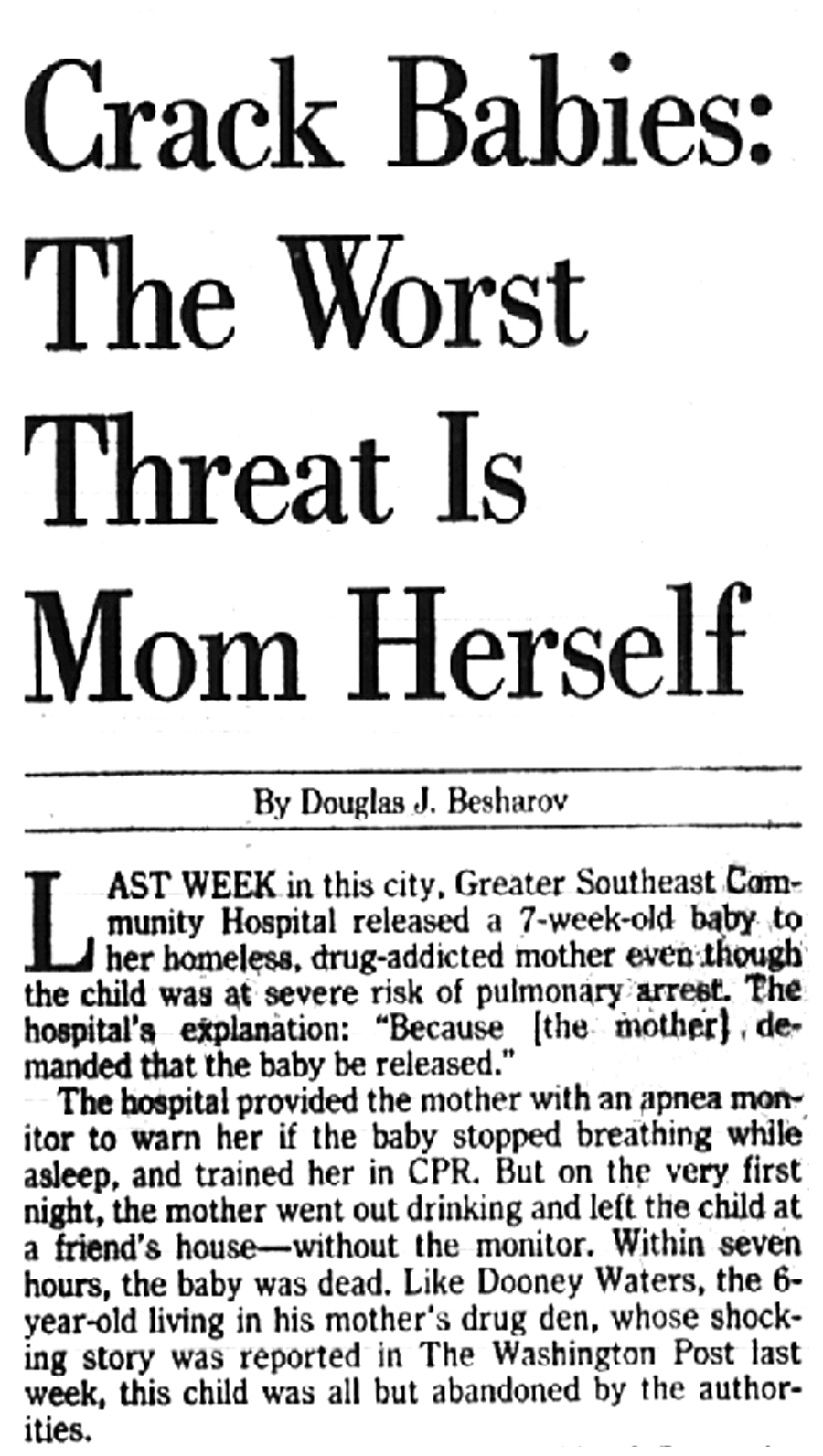
As in the recent Washington Post retrospective about “crack babies,” NPR failed to confront the news media’s central role in promoting and spreading what one leading researcher has called a “fantasy panic.”

Washington Post, 1989

That turn of phrase inspired the title of the chapter about “crack babies” in Getting It Wrong, my forthcoming book that confronts and debunks 10 media-driven myths.

Getting It Wrong is being published this summer by University of California Press.

The crack-baby myth centers around the notion that women who took cocaine during pregnancy would give birth to children so mentally and physically deficient that they would constitute a helpless, dependent “bio-underclass,” as syndicated columnist Charles Krauthammer put it in 1989.

In Getting It Wrong,  I call attention “to the risks of anecdote-driven reporting, which characterized news coverage of the crack baby phenomenon.

“Disturbing images and heart-wrenching descriptions of helpless newborns supposedly damaged by their mothers’ toxic indulgence were,” I write, “frequent and irresistible elements of the coverage. Anecdotes were fuel for a powerful but misleading storyline.”

Yesterday’s “Tell Me More” segment on “crack babies” overlooked all that, referring vaguely to “all manner of pronouncements about how children who were exposed to crack in utero were destined to a life of physical and mental disability.”

The program’s description at the “Tell Me More” online site ignored the news coverage, saying instead that “the nation’s health specialists panicked over the growing number of so-called ‘crack babies’—children exposed to crack cocaine in utero. These children were said to be doomed to lives of physical and mental disability.”

The panic, though, was largely media-driven, as I discuss in Getting It Wrong.

The “Tell Me More” segment–which noted that “children who [had been] exposed to crack cocaine before birth are proving these worst case scenarios were all wrong”–did include an intriguing, media-related passage.

That came late in the show, when Dr. Carl Bell, a clinical professor of psychiatry and public health at the University of Illinois-Chicago, spoke of “media epidemiology.”

He said:

“I think it’s important for society to move away from what I refer to as media epidemiology and media hypotheses and making all these generalizations about things because frequently they’re flat out wrong, as it shows.”

I asked Bell by email to elaborate on “media epidemiology.”

He replied, stating:

“‘Media epidemiology’ is a term I began using about two years ago to describe how the public gets its understanding about epidemiology of various public health issues from the media, which of course is the absolutely wrong place to get such information as the media does not report on the common but on the uncommon which is defined as news.

“For example, ten years ago the homicide rates in Chicago were 1,000 but because of a lot of work done in public health in the city the homicide rates are down to 500, but the media keeps referring to the ‘homicide epidemic’ in Chicago; thereby misleading the public with their ‘media epidemiology.'”

It, too, is’ an interesting turn-of-phrase–and may help explain why the news media sometimes get it wrong in reporting on issues of science and public health.

WJC

A War of the Worlds reminisence

In Media myths, Media myths and radio on November 1, 2009 at 7:07 pm

NPR’s “Morning Edition” on Friday included a faintly humorous segment featuring a Mississippi’s man story of his family’s frightened reactions to the War of the Worlds radio dramatization in 1938.

A tip of the chapeau to my AU faculty colleague, Angie Chuang, for alerting me to the segment.

A clever show it was

In Media myths, Media myths and radio on October 31, 2009 at 3:31 pm

The War of the Worlds dramatization  holds appeal to this day.

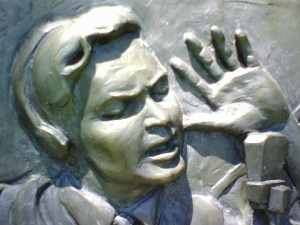
Orson Welles monument in Grovers Mill, N.J.

A monument in Grovers Mill, N.J., commemorates Welles and his adaptation of War of the Worlds

The show was work of Orson Welles and his Mercury Theatre on the Air troupe who cleverly used signature elements of radio of the 1930s to create a splendidly clever program. Most listeners recognized it for what it was: An ingenious radio play about a Martian invasion on the eve of Halloween.

The Mercury Theatre on the Air version was set in New Jersey and New York City. The vanguard of the invading Martians landed in Grovers Mill, N.J., still a rural community near Princeton. The War of the Worlds dramatization is commemorated in Grovers Mill by a monument that depicts scenes from the program — including young Orson Welles at the microphone.

Welles was 23 when he made the program. He went on to greater fame as director and star of 1941 motion picture Citizen Kane.

War of the Worlds

In Media myths, Media myths and radio on October 31, 2009 at 3:09 pm
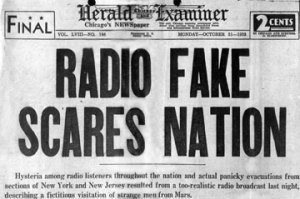
Chicago Herald Examiner about War of the Worlds broadcast

Front page of the Chicago Herald Examiner on Halloween, 1938

The famous radio dramatization of The War of Worlds in October 1938 supposedly set off panic and hysteria across the United States. Tens of thousands of panic-stricken Americans were said to have taken to the streets or headed for the hills during the radio show, which was a clever adaptation of H. G. Wells’ novel about an invasion by Martians wielding  deadly heat rays.

The supposed panic that night in 1938 is a delicious story, one almost too good to be false.

But it is. There is scant evidence to believe that The War of Worlds dramatization had such an effect.

Getting It Wrong describes how newspapers of the time got it badly wrong.

Listen to the broadcast here.