W. Joseph Campbell

Archive for the ‘Media myths’ Category

Recalling the hero of Nasiriyah: It wasn’t Jessica Lynch

In Anniversaries, Debunking, Jessica Lynch, Media myths, Washington Post on March 22, 2011 at 8:05 am

Tomorrow marks the anniversary of the deadly ambush at Nasiriyah in southern Iraq, an engagement so poorly reported by the Washington Post that it catapulted Jessica Lynch to undeserved international fame – and obscured the heroism of an Army sergeant who was captured, then killed.
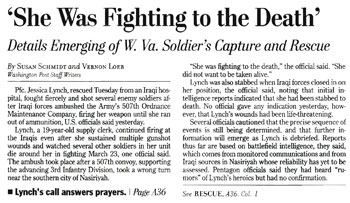
The Post published an electrifying, front-page account of Lynch’s supposed heroics in the battle of March 23, 2003. The report appeared beneath the headline, “‘She was fighting to the death,'” and said Lynch had fought fiercely before being overwhelmed and captured by Iraqi attackers.

But the Post hero-warrior tale about Lynch was erroneous.

Botched.

Because of the apparent mistranslation of battlefield radio intercepts, the deeds the Post misattributed to Lynch, then a 19-year-old Army private, most likely were those of a 33-year-old cook-sergeant named Donald Walters.

Like Lynch, Walters was assigned to the Army’s 507th Maintenance Company, elements of which came under attack at Nasiriyah in March 2003, during the first days of the Iraq War.

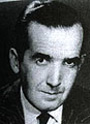
Walters (right), a veteran of the Gulf War in 1991, either was left behind or stayed behind as his fellow soldiers tried to escape.

Perhaps the most detailed account of the ambush at Nasiriyah appears in Richard Lowry’s masterful work, Marines in the Garden of Eden.

In the book, Lowry wrote:

“We will never really know the details of Walters’ horrible ordeal. We do know that he risked his life to save his comrades and was separated from the rest of the convoy, deep in enemy territory. We know that he fought until he could no longer resist.”

Walters is believed to have fired 201 M-16 rounds at his attackers.

He was captured and executed by Iraqi irregulars.

His killers, so far as is known, have never been caught.

But how did Walters’ heroism come to confounded with the actions of Lynch — who later said she never fired a shot during the ambush? (Lynch cowered in the back seat of a Humvee as it tried to escape the Iraqi attack.)

As I write in Getting It Wrong, my media-mythbusting book:

“The probable sources of confusion were Iraqi radio communications that the U.S. forces intercepted. These communications reportedly included references to a blond American soldier’s fierce resistance in the fighting at Nasiriyah.

“In translating the intercepted reports to English, the pronoun ‘he’ was mistaken for ‘she.’ As Lynch was the only blonde woman in the 507th, the battlefield heroics were initially attributed to her, not Walters.”

And drawing on information sources it has never revealed, the Post published its erroneous account of Lynch’s derring-do.

I further note in Getting It Wrong that a brigade commander named Colonel Heidi Brown offered the explanation about the mistranslation, in an interview broadcast in 2004 on National Public Radio’s All Things Considered program.

Brown said on the program: “What I was told was that it was just a faulty translation, but it made for everyone … to make a huge assumption that it was Jessica Lynch, when, in fact it probably — but you know, no one knows for sure. It probably was Sergeant Walters.”

I also note in Getting It Wrong that Walters’ actions, “when they became known, attracted little more than passing interest from the American news media — certainly nothing akin to the intensity of the Lynch coverage after the Post’s ‘fighting to the death’ story appeared.”

The Post article about Lynch’s supposed heroism, which appeared April 3, 2003, set off an avalanche of similar news coverage in news outlets across the United States and around the world. It was an irresistible, cinematic tale — a waiflike teenager pouring lead into attacking Iraqis, much like a female Rambo.

The Post never fully explained how it got the story so badly wrong, and offered but scant interest in the real hero at Nasiriyah.

A database search of Post articles published since April 2003 revealed just three stories in which Walters’ name was mentioned. None of those articles discussed in any detail his bravery at Nasiriyah.

The Army eventually acknowledged that Walters’ conduct “likely prevented his unit from suffering additional casualties and loss of life” and posthumously awarded him the Silver Star — the military’s third-highest decoration for valor.

WJC

Recent and related:

But how was it that Lynch came to be confused with Walters, who was slim, ruddy, and 33-years-old? The probable sources of confusion were Iraqi radio communications that the U.S. forces intercepted. These communications reportedly included references to a blond American soldier’s fierce resistance in the fighting at Nasiriyah. In translating the intercepted reports to English, the pronoun “he” was mistaken for “she.” As Lynch was the only blonde woman in the 507th, the battlefield heroics were initially attributed to her, not Walters.[i] A brigade commander, Colonel Heidi Brown, offered that explanation in an interview broadcast in 2004 on National Public Radio’s All Things Considered program. “What I was told,” Brown said, “was that it was just a faulty translation, but it made for everyone … to make a huge assumption that it was Jessica Lynch, when, in fact it probably—but you know, no one knows for sure. It probably was Sergeant Walters


[i] Lowry, Marines in the Garden of Eden, 134. Lowry wrote that Walters “was left in a situation that could have easily turned into the Iraqi radio report.”


‘Follow the money,’ again and again

In Anniversaries, Cinematic treatments, Debunking, Media myths, Washington Post, Watergate myth on March 21, 2011 at 7:24 am

“Follow the money.

“That advice from Watergate informant ‘Deep Throat’ led Washington Post reporter Bob Woodward to the truth that uncovered corruption in the nation’s public office. The concept applies to situations beyond the Oval Office, though. The commitment of a significant amount of money reveals the motivation (and the identity) of the spender.”

So read the opening lines of a commentary posted yesterday at the online site of the Terre Haute Tribune-Star in Indiana — yet another news outlet to indulge in the most famous made-up line of Watergate, “follow the money.”

The guidance to “follow the moneywasn’t offered by Woodward’s stealthy “Deep Throat” source during the Watergate scandal, which broke in 1972 with the break-in at headquarters of the Democratic National Committee in Washington, D.C. (“Deep Throat” was revealed in 2005 to have been W. Mark Felt, the second-ranking FBI official in the early days of Watergate.)

What’s more, the line “follow the money” didn’t appear in any Watergate-related article or commentary published by the Post until 1981 — years after the scandal had brought about the resignation of President Richard Nixon.

As I’ve noted at Media Myth Alert, the line was written into the screenplay of All the President’s Men, the cinematic version of the book Woodward and his colleague, Carl Bernstein, wrote about their Watergate reporting.

The line was spoken by the actor Hal Holbrook, who turned in a marvelous performance as the “Deep Throat” source in All the President’s Men, the movie.

Holbrook, who recently turned 86, delivered his lines about “follow the money” with such quiet assurance and knowing insistence that it sounded for all the world as if it really were guidance vital to rolling up Watergate and identifying Nixon’s misconduct.

Except that in real life, such advice wouldn’t have taken Woodward very far — certainly not to the point of determining Nixon’s guilty role in the crimes of Watergate, certainly not “to the truth” about the scandal.

As I write in Getting It Wrong, my mythbusting book that came out last year, some 20 men associated with Nixon’s administration or his 1972 reelection campaign went to jail for crimes linked to Watergate.

Rolling up a scandal of such dimension, I write in Getting It Wrong, “required the collective if not always the coordinated forces of special prosecutors, federal judges, both houses of Congress, the Supreme Court, as well as the Justice Department and the FBI.

“Even then,” I add, “Nixon likely would have served out his [second] term if not for the audiotape recordings he secretly made of most conversations in the Oval Office of the White House. Only when compelled by the Supreme Court did Nixon surrender those recordings, which captured him plotting the cover-up and authorizing payments of thousands of dollars in hush money.”

What cost Nixon the presidency wasn’t of the improper use of campaign funds but his efforts to obstruct justice in the FBI’s investigation of the break-in and related crimes.

It’s likely we’ll encounter many other references in weeks ahead to “follow the money.” After all, the 35th anniversary of the release of All the President’s Men falls next month.

And already, the University of Texas at Austin — repository for Woodward and Bernstein’s Watergate papers — has scheduled three programs related to All the President’s Men, the movie.

WJC

Recent and related:

Talking media myths at the alma mater

In 1897, Cronkite Moment, Debunking, Furnish the war, Media myths, Spanish-American War, Washington Post, Watergate myth on March 19, 2011 at 9:06 am

I gave a talk about media-driven myths yesterday on the campus of Ohio Wesleyan University, where years ago I earned my undergraduate degree in journalism and history.

The talk focused on three of the media myths debunked in my latest book, Getting It Wrong, which is dedicated to Verne E. Edwards Jr., my journalism professor at Ohio Wesleyan.

I was delighted that Edwards and his wife attended yesterday’s talk, during which I discussed the myths of Watergate, of the “Cronkite Moment,” of William Randolph Hearst’s purported vow to “furnish the war” with Spain.

These, I said, all are well-known tales about the power of the news media that often are taught in schools, colleges, and universities. All of them are delicious stories that purport to offer lessons about the news media’s power to bring about change, for good or ill.

I described media-driven myths as I often do — as “the junk food of journalism, meaning that they’re tasty and alluring, but in the end, not terribly healthy or nutritious.”

Because it debunks prominent media myths, Getting It Wrong, I said, should not be considered “yet another media-bashing book.”

Rather, I said, Getting It Wrong is aligned with a fundamental objective of American journalism — that of getting it right.

I noted that the book is provocative and edgy — inevitably so, given that it dismantles several of the most-cherished stories in American journalism.

Among them is the notion that the Watergate reporting of the Washington Post exposed the crimes of the administration of President Richard Nixon and forced his resignation in 1974.

I noted that the Post and its reporting “was really peripheral to the outcome” of Watergate, pointing out that even senior officials at the newspaper have insisted as much over the years.

Among them was Katharine Graham, publisher of the Post during Watergate, who said on the scandal’s 25th anniversary in 1997:

“Sometimes people accuse us of bringing down a president, which of course we didn’t do. The processes that caused [Nixon’s] resignation were constitutional.”

I also pointed out that Bob Woodward, one the lead reporters for the Post on Watergate, has expressed much the same sentiment, only in earthier terms. In an interview in 2004 with American Journalism Review, Woodward declared:

To say the press brought down Nixon, that’s horseshit.”

I also reviewed the “Cronkite Moment” of February 27, 1968 — that legendary occasion when the on-air assessment of CBS News anchorman Walter Cronkite supposedly altered American policy on the Vietnam War. At the end of a special report about Vietnam, Cronkite asserted that the U.S. war effort was “mired in stalemate.”

President Lyndon Johnson supposedly watched Cronkite’s program and, upon hearing the anchorman’s “mired in stalemate” analysis, snapped off the television set and declared:

“If I’ve lost Cronkite, I’ve lost Middle America.”

Or something to that effect.

I pointed out that Johnson did not see the Cronkite program when it aired, that the president then was in Austin, Texas, at the 51st birthday party of Governor John Connally.

“About the time Cronkite was intoning his ‘mired in stalemate’ commentary,” I told the audience at Ohio Wesleyan, “Johnson was at the podium at Connally’s birthday party, saying: ‘Today, you are 51, John. That is the magic number that every man of politics prays for — a simple majority.’

“Now that may not have been the greatest presidential joke ever told,” I said, “but it is clear that Johnson at that time wasn’t lamenting his fate, wasn’t lamenting the supposed loss of Cronkite’s support” for the war in Vietnam.

Clearly, I added, the so-called “‘Cronkite Moment’ was of little importance or significance for Johnson. Especially since he didn’t even see the show when it aired.”

I described how Hearst’s purported vow to “furnish the war” lives on despite Hearst’s denial and despite an array of reasons that point to the anecdote’s falsity.

Hearst supposedly made the vow in an exchange of telegrams with the artist Frederic Remington, whom Hearst had sent to Cuba in early 1897 to draw sketches of the Cuban rebellion against Spanish colonial rule — the nasty conflict that gave rise in 1898 to the Spanish-American War.

The tale “lives on despite an irreconcilable internal inconsistency,” I said. “It would have been absurd for  Hearst to have vowed to ‘furnish the war’ because war — the Cuban rebellion against Spanish rule — was the very reasons he sent Remington to Cuba in the first place.”

Still, that anecdote and other media myths live on because they are “deliciously good stories — too good, almost, to be disbelieved,” I said. Too good, almost, to check out.

The university president, Rock Jones, introduced my talk, which was organized by Lesley Olson, general manager of the OWU bookstore, and by Cole E. Hatcher, the university’s director of media and community relations.

Two college buddies of mine, Hugh D. Pace and Tom Jenkins, also attended the talk.

WJC

Recent and related:

‘So to Speak’ about ‘Getting It Wrong’

In Debunking, Furnish the war, Media myths, Newspapers, Washington Post, Watergate myth on March 18, 2011 at 6:32 am

My mythbusting book, Getting It Wrong, made the Columbus Dispatch yesterday as the subject of a cleverly written column that opened this way:

“After interviewing W. Joseph Campbell, I checked the Dispatch archives to see whether I had ever committed any of the journalistic exaggerations he likes to skewer.

“I did write in 2005 that Mark Felt, the ‘Deep Throat‘ of Watergate fame, ‘rid the world of Richard Nixon.’ But I was overstating for effect, so I plead not guilty by reason of humor.”

Heh, heh. Nice touch.

The author was Joe Blundo, a veteran reporter who writes the “So to Speak” column for the “Life and Arts” section of the Dispatch.

The column was pegged to my book talk this afternoon at Ohio Wesleyan University, where I earned my undergraduate degree in journalism and history in the mid-1970s.

Blundo in his column offered overviews of some of the 10 media-driven myths dismantled in Getting It Wrong, including the notion that “Bob Woodward and Carl Bernstein of The Washington Post brought down Nixon with their Watergate reporting.

“Certainly Woodward and Bernstein (and Woodward’s source Deep Throat) had a role in the drama,” Blundo wrote, “but it took investigators, Congress and the Supreme Court to ultimately force the president to resign, Campbell, 58, said by phone.”

He further quoted me as saying that against the backdrop of subpoena-wielding authorities who dug into the crimes of Watergate, “the contributions of The Washington Post really recede into near insignificance.”

The newspaper’s contributions weren’t decisive, that’s for sure. Even officials at the Post have attempted over the years to distance the newspaper from the popular narrative that its reporting forced Nixon to resign.

As I note in Getting It Wrong, Katharine Graham, the newspaper’s publisher during and after the Watergate scandal, was among the senior figures at the  Post who dismissed that mediacentric link. She said in 1997, at a program marking the scandal’s 25th anniversary:

“Sometimes people accuse us of bringing down a president, which of course we didn’t do. The processes that caused [Nixon’s] resignation were constitutional.”

Also that year, Ben Bradlee,the executive editor at the Post during Watergate, said on the “Meet the Press” interview show:

“[I]t must be remembered that Nixon got Nixon. The Post didn’t get Nixon.”

Blundo also quoted me about some of the reasons media-driven myths are so tenacious and appealing — that they place the news media decisively at the center of important events and that they offer simplistic explanations for complex issues and developments of the past.

“Yet the myths won’t die,” he wrote.

I’m afraid he’s right. Media myths die hard, if they die at all.

The only way to counter them is to call them out, to pound away at them when they appear in the news media. Even then, utter and thorough debunking is rare. These stories, after all, often are too good not to be true.

And often too good to check out.

WJC

Recent and related:

WaPo ‘broke the Watergate scandal’? No way

In Debunking, Media myths, Washington Post, Watergate myth on March 17, 2011 at 7:04 am

I like to see blogs calling out the Washington Post, an unevenly edited shell of its former self.

The “Texas on the Potomac” blog did just that the other day, calling out the Post for misidentifying two Houston congressmen named Green.

But in adding a snarky dig of its own, the blog committed a more notable lapse, declaring that the Post “broke the Watergate scandal.”

Here’s what the blog post said:

”Oops! The Washington Post has apologized to Houston congressmen Al Green and Gene Green for mixing them up in its coverage of last week’s controversial House hearing on Muslim extremism. At the hearing, you’ll recall, Al Green criticized Republicans for focusing on Islamic terrorism while ignoring other forms of terrorism such as the Ku Klux Klan.

“But the newspaper that broke the Watergate scandal identified the Houston congressman as Gene Green.”

Oops, indeed. Flubbing the identities of the congressmen Green was unfortunate; more troubling was declaring that the Post “broke the Watergate scandal.”

It did no such thing.

The signal crime of Watergate — the June 1972 burglary at Democratic National Committee headquarters — wasn’t broken by the Post. The break-in was interrupted by police and, within hours, news was circulating of the arrest of five burglars at the Watergate complex in Washington, D.C.

The story in the Post about the break-in appeared beneath the byline of Alfred E. Lewis, a veteran police reporter, and its opening paragraph made clear that the information came from investigators:

“Five men, one of whom said he is a former employee of the Central Intelligence Agency, were arrested at 2:30 a.m. yesterday in what authorities described as an elaborate plot to bug the offices of the Democratic National Committee here.”

Watergate reporting by the Post did not expose the cover-up of crimes linked to the break-in or the payment of hush money to the burglars, either.

As I note in my latest book, Getting It Wrong, which includes a chapter about the media myths of Watergate, Post reporter Bob Woodward was quoted as saying in 1973 that those crucial aspects of the scandal were “held too close. Too few people knew. We couldn’t get that high.”

Nor did Woodward and his Watergate reporting colleague Carl Bernstein uncover or disclose the existence of the White House audiotaping system, which was decisive to the outcome of Watergate.

Audiotapes secretly made by President Richard Nixon captured him approving a plan in June 1972 to impede the FBI in its investigation of the Watergate break-in.

That contents of that tape — the so-called “smoking gun” of Watergate — sealed Nixon’s fate and led to his resignation in August 1974.

The White House taping system had been disclosed 11 months before, by investigators of the Senate select committee on Watergate, which convened hearing in spring and summer 1973.

As I point out in Getting It Wrong, Woodward and Bernstein later claimed to have had a solid lead about the existence of the taping system.

In All the President’s Men, the book he wrote with Bernstein, Woodward recalled having spoken with Post Executive Editor Ben Bradlee about the lead. Bradlee advised, “I wouldn’t bust one on it.”

Had they followed that lead, Woodward and Bernstein may well have broken a pivotal story about Watergate.

But they didn’t.

So, clearly, the disclosures about the pivotal events that led to Nixon’s resignation in Watergate weren’t the work of the Post.

As I’ve noted in previous postings at Media Myth Alert, it’s intriguing to note how the Post from time to time has sought to emphasize that its reporting was not decisive in Nixon’s resignation.

In 2005, for example, Michael Getler, then the newspaper’s ombudsman, wrote:

“Ultimately, it was not The Post, but the FBI, a Congress acting in bipartisan fashion and the courts that brought down the Nixon administration. They saw Watergate and the attempt to cover it up as a vast abuse of power and attempted corruption of U.S. institutions.”

And Bradlee, the executive editor during Watergate, said on a “Meet the Press” interview show in 1997, 25 years after the break-in:

“[I]t must be remembered that Nixon got Nixon. The Post didn’t get Nixon.”

WJC

Recent and related:

Counterpunching that made-up line, ‘follow the money’

In Cinematic treatments, Debunking, Media myths, Washington Post, Watergate myth on March 15, 2011 at 9:45 am

Watergate’s most famous invented line showed up yesterday at the online site of CounterPunch, which touts itself as “America’s best political newsletter.”

That most famous invented line of Watergate is: “Follow the money.”

It was written into the script of All the President’s Men, the 1976 movie about the Watergate reporting of the Washington Post, and has since made a smooth, seamless transition to the vernacular.

Indeed, “follow the money” has become the passage most commonly associated with the Watergate scandal, which culminated in 1974 in the resignation of President Richard Nixon.

A commentary at the CounterPunch site referred to “follow the money” in a lengthy discussion of the perjury trial in Texas of a former CIA operative, Luis Posada Carriles, stating:

“During the investigation into the 1972 Watergate scandal, Washington Post reporter Bob Woodward found a source, whom he referred to only as ‘Deep Throat,’ who told him to ‘follow the money.’ Woodward and fellow journalist Carl Bernstein followed the money trail and unraveled the mysteries behind the crimes and subsequent cover-ups of President Richard M. Nixon and his White House staff.”

Simple as all that, eh? “Follow the money” was key to unraveling “the mysteries behind the crimes” of America’s greatest political scandal?

Hardly.

As is the case with all media-driven myths, there are elements of accuracy in that narrative. Woodward did periodically discuss Watergate with a high-level government source to whom the Post referred as “Deep Throat.”

But in real life, “Deep Throat” never counseled Woodward to “follow the money.”

Nor does “follow the money” doesn’t appear in All the President’s Men, the book Woodward and Bernstein wrote about Watergate.

Nor does the line appear in any Post article or editorial published during the Watergate period.

Nor was unraveling Watergate a simple matter of pursuing a money trail.

Far from it.

As I note in my latest book, Getting It Wrong, which debunks 10 prominent media-driven myths, rolling up a scandal of the dimension and complexity of Watergate “required the collective if not always the coordinated forces of special prosecutors, federal judges, both houses of Congress, the Supreme Court, as well as the Justice Department and the FBI.

“Even then,” I added, “Nixon likely would have served out his term if not for the audiotape recordings he secretly made of most conversations in the Oval Office of the White House. Only when compelled by the Supreme Court did Nixon surrender those recordings, which captured him plotting the cover-up and authorizing payments of thousands of dollars in hush money.”

The popularity of “follow the money” — a line for which screenwriter William Goldman has taken credit — highlights another characteristic of media myths: Their tendency to minimize complexity and offer simplistic and misleading interpretations instead.

I note in Getting It Wrong that high-quality cinematic treatments — and All the President’s Men is a telling example — can contribute significantly to solidifying and making believable mythical accounts of historical events.

“Follow the money” is just one of the distortions presented in All the President’s Men, the movie.

More broadly, the film promotes what I call the “heroic-journalist” interpretation” of Watergate.

The heroic-journalist meme is a trope that knows few bounds. It is the most familiar storyline of Watergate — the mediacentric version that Woodward and Bernstein, through their dogged and courageous reporting, brought down Nixon and his corrupt presidency.

It is one of American journalism’s most self-reverential stories — one propelled by the movie version of All the President’s Men.

As I point out in Getting It Wrong, the film placed Woodward and Bernstein “at the center of Watergate’s unraveling while denigrating the efforts of investigative agencies such as the FBI.

“The effect was to solidify and elevate the heroic-journalist myth, giving it dramatic power, and sustaining it in the collective memory.”

All the President’s Men offers no version of Watergate other than Woodward and Bernstein, with the help of “Deep Throat,” brought about the first-ever resignation of a U.S. president.

That’s an abridged and misleading interpretation, a misreading of history that deserves serious counterpunching.

WJC

Many thanks to Instapundit Glenn Reynolds for linking to this post

Recent and related:

Of media myths and false lessons abroad: Biden’s Moscow gaffe

In Bay of Pigs, Debunking, Media myths, New York Times, Newspapers, Washington Post, Watergate myth on March 14, 2011 at 7:57 am

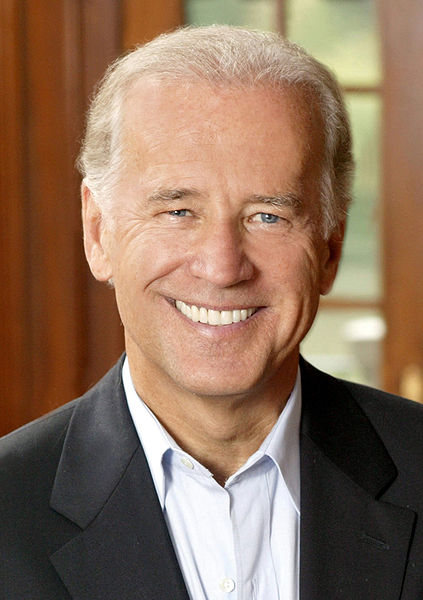
Biden shows the way (White House photo)

Vice President Joe Biden embraced in Moscow last week one of American journalism’s most tenacious myths — the notion that reporting by the Washington Post brought down” Richard Nixon’s corrupt presidency in the Watergate scandal.

Unwittingly or otherwise, Biden offered up the Watergate myth as a telling example of the values and virtues of a free press. The vice president said in remarks at Moscow State University:

“Journalists must be able to publish without fear of retribution. In my country it was a newspaper, not the FBI, or the Justice Department, it was a newspaper, the Washington Post that brought down a President for illegal actions.”

As I’ve noted, not even the Post endorses that superficial and misleading reading of Watergate history. (Ben Bradlee, the newspaper’s executive editor during Watergate, has said for example: “[I]t must be remembered that Nixon got Nixon. The Post didn’t get Nixon.”)

The significance of Biden’s mischaracterization of Watergate goes beyond being merely curious; it’s more than just another example of the gaffe-prone vice president slipping up again.

His remarks demonstrated anew that media myths are not just intriguing curiosities of history. They showed how false lessons can worm their way into diplomacy and policymaking.

Biden’s speech represented pointed criticism of — and recommendations for — Russia and its legal and political systems.  Biden offered a laundry list of democratic reforms that autocratic Russia ought to undertake, stating that courts “must be empowered to uphold the rule of law and protect those playing by the rules.

“Non-governmental watchdogs should be applauded as patriots, not traitors. …

“Journalists,” he added, “must be able to publish without fear of retribution.” To buttress his point about a robust free press, he invoked the claim that “the Washington Post … brought down a President for illegal actions.”

Biden offered that anecdote as an example of the benefits of press freedom, which he called “the greatest guarantee of freedom there is….”

Invoking the myth that the Post “brought down” Nixon is to offer an international audience a false lesson about the power of the news media. Invoking the myth is to suggest, wrongly, that that news media can, when circumstances are right, force a sitting president from office.

As I note in my latest book, Getting It Wrong, rolling up a scandal of the sweep and dimension of Watergate “required the collective if not always the coordinated forces of special prosecutors, federal judges, both houses of Congress, the Supreme Court, as well as the Justice Department and the FBI.”

Even then, I write, “Nixon likely would have served out his term if not for the audiotape recordings he secretly made of most conversations in the Oval Office of the White House.

“Only when compelled by the Supreme Court did Nixon surrender those recordings, which captured him plotting the cover-up” of Watergate’s signal crime — the break-in at the headquarters of the Democratic National Committee in June 1972.

Considered against the tableau of subpoena-wielding investigators and special prosecutors, the Watergate reporting of the Post recedes in significance.

As Michael Getler, the newspaper’s ombudsman wrote in 2005: “Ultimately, it was not The Post, but the FBI, a Congress acting in bipartisan fashion and the courts that brought down the Nixon administration.”

I also note in Getting It Wrong that “media-driven myths are neither trivial nor innocuous. They can and do have adverse consequences.”

They tend to offer simplistic and misleading interpretations of important historical events, and they “can blur lines of responsibility and deflect blame away from makers and sponsors of flawed public policy,” I write, citing as a case in point the New York Times-Bay of Pigs suppression myth.

Had the New York Times had reported all it knew 50 years ago about the run-up to the pending Bay of Pigs invasion of Cuba, the administration of President John F. Kennedy likely would have scuttled the operation–thus sparing the country a stunning foreign policy reversal.

Or so the media myth has it.

As I discuss in Getting It Wrong, that interpretation is not only misleading but it diverts responsibility away from Kennedy and his flawed decision to go ahead with the invasion.

The Times, after all, published a number detailed, front-page reports about the anticipated invasion in the days before the ill-fated assault. And there is no evidence that the newspaper censored itself under White House pressure in the run-up to the Bay of Pigs invasion.

And in the final analysis, I note, ” it was Kennedy, not American journalists, who gave the go-ahead in April 1961, sending a brigade of Cuban exiles to a disastrous rendezvous in the swamps of southwestern Cuba.”

The cause of independent-minded journalism in Russia would have been better served had Biden skipped the myth and urged the Kremlin to pursue serious investigations into unresolved cases of journalists who’ve been killed because of their work.

The New York-based Committee to Protect Journalists says 19 journalists have been killed in Russia since 2000.

The country, CPJ says, has a “record of rampant impunity in resolving the killings of journalists.”

WJC

Recent and related:

Mythmaking in Moscow: Biden says WaPo brought down Nixon

In Debunking, Media myths, Newspapers, Washington Post, Watergate myth on March 12, 2011 at 7:23 am

Gaffe-prone Joe Biden offered Russians this week a mythical and distorted version of American history,  declaring at Moscow State University that the Washington Post “brought down” Richard Nixon’s corrupt presidency in the Watergate scandal.

It’s an interpretation of Watergate that few serious historians embrace.

Gaffe-prone

And yet, according to the transcript of the vice president’s remarks posted online by the White House, Biden told his audience:

“In my country it was a newspaper, not the FBI, or the Justice Department, it was a newspaper, the Washington Post that brought down a President for illegal actions.”

Not even the Washington Post buys into that myth-encrusted version of history. Principals at the Post have from time to time over the years sought to distance the newspaper from such a misleading assessment.

For example, Katharine Graham, the newspaper’s doughty publisher during and after the Watergate scandal, said in 1997, at a program marking the 25th anniversary of the scandal:

“Sometimes people accuse us of bringing down a president, which of course we didn’t do. The processes that caused [Nixon’s] resignation were constitutional.”

Ben Bradlee,who was executive editor at the Post during Watergate, said on the “Meet the Press” interview show in 1997:

“[I]t must be remembered that Nixon got Nixon. The Post didn’t get Nixon.”

More recently, Michael Getler, then the newspaper’s ombudsman, wrote in 2005:

“Ultimately, it was not The Post, but the FBI, a Congress acting in bipartisan fashion and the courts that brought down the Nixon administration.”

Their comments are not the representations of false modesty: They speak to a more accurate reading of the history of Watergate than Biden offered his audience in Moscow.

Watergate-related reporting in the Post — even though it won a Pulitzer Prize in 1973 — was scarcely enough to turn from office a sitting president.

As I write in my latest book, Getting It Wrong, rolling up a scandal of the dimension and magnitude of Watergate “required the collective if not always the coordinated forces of special prosecutors, federal judges, both houses of Congress, the Supreme Court, as well as the Justice Department and the FBI.”

And even then, I write, “Nixon likely would have served out his term if not for the audiotape recordings he secretly made of most conversations in the Oval Office of the White House.

“Only when compelled by the Supreme Court did Nixon surrender those recordings, which captured him plotting the cover-up” of Watergate’s signal crime — the break-in at the headquarters of the Democratic National Committee in June 1972.

Biden’s remarks reflect an endorsement of I call the “heroic-journalist” myth of Watergate — the simplified and misleading interpretation that the reporting of  Post reporters Bob Woodward and Carl Bernstein uncovered evidence that forced Nixon’s resignation in 1974.

But not even Woodward endorses that interpretation. He said in 2004 in an interview with American Journalism Review:

To say the press brought down Nixon, that’s horseshit.”

But as I note in Getting It Wrong, the heroic-journalist meme has nonetheless “become the most familiar storyline of Watergate: ready short-hand for understanding Watergate and its denouement, a proxy for grasping the scandal’s essence while avoiding its forbidding complexity.

“How the Post and its reporters uncovered Watergate is deeply ingrained in American journalism as one of the field’s most important and self-reverential stories,” I write.

But being deeply ingrained and popular doesn’t mean it’s accurate. Far from it.

I note in Getting It Wrong that “to explain Watergate through the lens of the heroic-journalist is to abridge and misunderstand the scandal and to indulge in a particularly beguiling media-driven myth.

“The heroic-journalist interpretation minimizes the far more decisive forces that unraveled the scandal and forced Nixon from office.” And they included the very forces Biden dismissed in his remarks in Moscow –the FBI and the Justice Department.

The transcript of Biden’s speech, delivered Thursday, also shows that he flubbed the characterization of the news media, which sometimes are collectively referred to as the “Fourth Estate.”

According to Biden, they’re the “Third Estate.”

WJC

Recent and related:

Pumping up Watergate’s heroic-journalist myth

In Debunking, Media myths, Washington Post, Watergate myth on March 10, 2011 at 8:42 am

Bob Woodward of Watergate fame has been on the lecture circuit of late and his talks have stirred reference to the myth that his reporting for the Washington Post brought down Richard Nixon’s corrupt presidency in 1974.

'Nixon got Nixon'

It’s not that Woodward has been making such mythical claims. Rather, they pop up in fawning news reports about his talks.

For notable example, consider the article posted yesterday at the online site of the Indianapolis Star. The article, a preview of Woodward’s talk in that city Friday, declared glowingly:

“For 40 years, Bob Woodward has pried open some of the toughest secrets in government, from the Watergate scandal to the secret war in Pakistan.

“His reporting has exposed corruption, helped to send people to jail and pressured a president to resign.”

The writeup continued much in that frothy vein, declaring:

“As a young reporter at The Post, Woodward teamed up with Carl Bernstein to dig into a ‘third-rate burglary’ of the Democratic National Committee’s headquarters at the Watergate complex. Over many months, through hundreds of stories, the two exposed political dirty tricks and abuse of power in the Nixon White House that eventually forced Nixon from office.”

Let’s address and untangle the myths invoked here.

For starters, the reporting of Woodward and Bernstein did not pressure or force Nixon to resign.

While their reporting won a Pulitzer Prize for the Post in 1973, it did not break open the Watergate scandal. It did not uncover the evidence that led or contributed to Nixon’s resignation.

To argue otherwise it did is to indulge in the beguiling “heroic-journalist myth,”  which, as I write in my latest book,  Getting It Wrong, has become “the most familiar storyline of Watergate.”

The heroic-journalist meme, I note, offers “ready short-hand for understanding Watergate and its denouement, a proxy for grasping the scandal’s essence while avoiding its forbidding complexity.

“How the Post and its reporters uncovered Watergate is deeply ingrained in American journalism as one of the field’s most important and self-reverential stories.”

To roll up a scandal of the dimensions of Watergate, I write, “required the collective if not always the coordinated forces of special prosecutors, federal judges, both houses of Congress, the Supreme Court, as well as the Justice Department and the FBI.”

And even then, Nixon likely would have served out his term if not for disclosures about the audiotape recordings he secretly made of his conversations in the Oval Office of the White House.

“Only when compelled by the Supreme Court did Nixon surrender those recordings, which captured him plotting the cover-up” of the Watergate break-in, I write in Getting It Wrong.

So against the tableau of prosecutors, courts, federal investigations, and bipartisan congressional panels, and the Supreme Court, the contributions of Woodward and Bernstein recede in importance.

Their contributions were modest, I write, “and certainly not decisive” to the outcome of Watergate.

This is not to say their reporting on Watergate was without distinction.

I note in Getting It Wrong that the Post was the first news organization to report a connection between the Watergate burglars and the White House, the first to demonstrate that campaign money was diverted to fund the break-in, the first to tie former Attorney General John Mitchell to the scandal, the first to link top Nixon aide H.R. Haldeman to Watergate.

But those reports were scarcely enough to unseat a president.

Put another way, Woodward and Bernstein did not uncover the evidence vital to understanding and unraveling the scandal.

They did not disclose the White House-led cover-up and payment of hush money to the Watergate burglars. Nor did they reveal the existence of Nixon’s secret White House tapes, which proved decisive to Watergate’s outcome.

No, Woodward and Bernstein and the Post did not force Nixon from office. As Ben Bradlee, the newspaper’s executive editor during the Watergate period, said in 1997:

“[I]t must be remembered that Nixon got Nixon. The Post didn’t get Nixon.”

Or as Woodward put it in an interview with American Journalism Review in 2004:

To say that the press brought down Nixon, that’s horseshit.”

Now there’s an emphatic line that Woodward might consider working into his speeches.

WJC

Recent and related:

57 years on: Was it really TV’s ‘finest half hour’?

In Anniversaries, Debunking, Media myths, Murrow-McCarthy myth on March 9, 2011 at 12:07 am

Murrow

Today’s the 57th anniversary of what has been called the “finest half hour” in television history — when Edward R. Murrow took to the small screen to confront Joseph R. McCarthy and the senator’s red-baiting ways.

Murrow’s on-air analysis of McCarthy and his tactics was so powerful, so revealing, that it marked an abrupt end to the senator’s witch-hunt for communists in government.

Or so the media myth has it.

The occasion was Murrow’s 30-minute See It Now program that aired on CBS on March 9, 1954.

As I write in my mythbusting book, Getting It Wrong, the program supposedly affirmed the potential power of television and confirmed the courage of Murrow.

I also write:

“The never-ending accolades notwithstanding, the evidence is overwhelming that Murrow’s famous program on McCarthy had no such decisive effect, that Murrow in fact was very late in confronting McCarthy, that he did so only after other journalists had challenged the senator and his tactics for months, even years.”

Indeed, the legendary status accorded the Murrow program has effectively “obscured and diminished the contributions of journalists who took on McCarthy years earlier, at a time when doing so was quite risky,” I point out in Getting It Wrong.

These journalists deserve more credit than Murrow for courage in confronting the McCarthy menace when it was most virulent.

One of them was James A. Wechsler, editor of the New York Post, which in 1951 published a bare-knuckle, 17-part series about McCarthy.

The closing installment characterized McCarthy as “a drunk at a party who was funny half an hour ago but now won’t go home. McCarthy is camped in America’s front room trying to impress everybody by singing all the dirty songs and using all the four-letter words he knows. The jokes are pointless, the songs unfunny, the profanity a bore.”

The series appeared in the Post 2½ years before Murrow’s program on McCarthy.

Wechsler was called before McCarthy’s investigative subcommittee and grilled about having been a member before in the Communist Youth League.

Wechsler said his being summoned to the closed-door hearing was “a reprisal against a newspaper and its editor for their opposition to the methods of this committee’s chairman.”

He sparred effectively with McCarthy, telling the senator at one point that the New York Post “is as bitterly opposed to Joe Stalin as it is to Joe McCarthy, and we believe that a free society can combat both.”

But in the end, Wechsler complied, reluctantly, with the subcommittee’s demand for names of people he had known to be communists during his time in the Youth League.

During McCarthy’s communists-in-government campaign, which lasted from 1950 to 1954, the senator had no more relentless or scathing foe in the news media than muckraking columnist Drew Pearson.

He wrote the widely published “Washington Merry-Go-Round” column — and was quick off the dime, taking on McCarthy soon after the senator first raised his reckless claims about communists in high places in the U.S. government and military.

Pearson wrote in February 1950, in one of his first columns about McCarthy’s charges, that “the alleged communists which he claims are sheltered in the State Department just aren’t.”

Pearson noted that he had covered the State Department for years and had been “the career boys’ severest critic.

“However,” he added, “knowing something about State Department personnel, it is my opinion that Senator McCarthy is way off base.”

And he was.

Pearson’s frequent challenges angered McCarthy who in December 1950, physically assaulted the columnist after a dinner at the hush-hush Sulgrave Club on DuPont Circle in Washington, D.C.

McCarthy confronted Pearson in the Sulgrave’s coat check room and either slapped, kneed, or punched the columnist. Accounts vary.

Richard Nixon, who recently had been sworn in as a U.S. Senator, intervened to break up the encounter. In his memoir RN, Nixon wrote that Pearson “grabbed his coat and ran from the room” and “McCarthy said, ‘You shouldn’t have stopped me, Dick.’”

So by the time Murrow took on McCarthy 57 years ago tonight, Americans really weren’t “waiting for a white knight like Murrow to tell them about the toxic threat the senator posed,” I write in Getting It Wrong, adding:

“By then, McCarthy and his tactics were well-known and he had become a target of withering ridicule — a sign of diminished capacity to inspire dread. On the day the See It Now program aired, former president Harry Truman reacted to reports of an anonymous threat against McCarthy’s life by saying:

“‘We’d have no entertainment at all if they killed him.'”

The notion that Murrow and his television program brought down McCarthy is a delicious story of presumptive media power:  More accurately, it is a tenacious media-driven myth.

WJC

Recent and related: