W. Joseph Campbell

Archive for the ‘Media myths’ Category

Puncturing the Times-suppression myth

In Bay of Pigs, Debunking, Media myths, New York Times on June 9, 2010 at 4:42 pm

In early April 1961, the New York Times supposedly bowed to pressure from the White House of President John F. Kennedy and “spiked,” or suppressed, its detailed report about the pending Bay of Pigs invasion of Cuba.

The Times’ purported self-censorship took place a little more than a week before the invasion, which failed utterly in its objective of toppling the Cuban revolutionary leader, Fidel Castro.

The invasion force of CIA-trained Cuban exiles gave up in less than three days and the Kennedy presidency, as well as U.S. standing in the Caribbean and the world, suffered a humiliating setback.

Had the Times not censored itself, had the Times gone ahead and reported all that it knew, the ill-fated invasion may well have been scuttled and a national embarrassment avoided.

Or so the story goes.

Before the invasion: Front page, NYTimes

The tale of the Times’ purported self-censorship has been recounted in many books, journals, newspapers, and other periodicals over the years. The episode offers supposedly timeless lessons about the perils of self-censorship, about the risks of yielding to pressure to withhold sensitive information on national security grounds.

The anecdote about the Times’ self-censorship is potent, compelling, delicious and timeless.

But as I describe in my forthcoming book, Getting It Wrong, it is also a media-driven myth.

The Times did not suppress its reports about the pending invasion of Cuba. It did not censor itself.  As is discussed in Getting It Wrong, the Times’ reports about preparations for the invasion were fairly detailed, not to mention prominently displayed on the front page in the days before the Bay of Pigs invasion was launched.

Given the widely held notion that the Times censored itself, it was fairly surprising to find in my research just how much reporting there was in advance of the invasion. The run-up to the Bay of Pigs was no one-day story.

Not all pre-invasion news reports were accurate or on-target. Much of it was piecemeal.

But there was ample coverage in the Times and other U.S. newspapers so that readers knew something was afoot in the Caribbean, that an assault on Castro was in the works.

The coverage supposedly reached a point where Kennedy told his press secretary, Pierre Salinger, a week before the invasion:

“I can’t believe what I’m reading! Castro doesn’t need agents over here. All he has to do is read our papers. It’s all laid out for him.”

The notion that Kennedy asked or persuaded the Times to suppress, hold back, or dilute any of its reports about the pending Bay of Pigs invasion is utter fancy.

As I discuss in Getting It Wrong, there is no evidence that Kennedy or his administration knew in advance about the content of the Times’ reporting about the pending invasion. There is no evidence that Kennedy or anyone in his administration lobbied or persuaded the Times to hold back or spike that story, as is so often said.

So what accounts for what I call the “suppression myth”?

I write in Getting It Wrong that the myth “stems from confusion with a separate episode during the Cuban Missile Crisis in October 1962, when Kennedy did ask the Times to postpone publication of a report about the Soviets having deployed nuclear-tipped weapons in Cuba. On that occasion, when the prospect of a nuclear exchange seemed to be in the balance, the Times complied.”

As for the significance of debunking the suppression  myth, I write:

“Exposing the myth demonstrates how the Kennedy administration sought to deflect blame for the Bay of Pigs and make a scapegoat of the Times. On separate occasions in 1961 and 1962, Kennedy told the senior executives of the Times that had the newspaper published more about the pending assault on Cuba, the invasion might have been scuttled.

“Such an interpretation of course shifts responsibility away from the authorities who possessed the power to order an invasion of a sovereign state,” I write. “Puncturing the Timessuppression myth, then, allows blame for the Bay of Pigs fiasco to be more properly apportioned.”

WJC

A version of this post first appeared at the University of California Press blog.
The wobbly components of the ‘Cronkite moment’

In Cronkite Moment, Debunking, Media myths on June 7, 2010 at 5:23 am

It’s often claimed that Walter Cronkite’s analysis in February 1968 that the U.S. military effort in Vietnam was “mired in stalemate” helped swing public opinion against the war.

Not to mention that Cronkite’s penetrating assessment brought President Lyndon Johnson face-to-face with the realization his war policy was a shambles.

And so incisive was Cronkite’s assessment that it supposedly was a factor in Johnson’s decision, announced a month later, not to seek reelection to the presidency.

Those are three components of an especially tenacious and popular media-driven myth, all of which I address in a chapter in my new book, Getting It Wrong.

The wide circulation of what I call the mythical “Cronkite moment” was evident in a commentary aired the other day on Vermont Public Radio, which asserted:

“In 1968, when CBS anchorman Walter Cronkite delivered a downbeat report on American progress in Vietnam, public opinion rapidly soured on the war. President Lyndon Johnson lamented, ‘If I’ve lost Cronkite, I’ve lost the country.’  Several weeks later, Johnson decided not to run for re-election.”

In fact, as I discuss in Getting It Wrong, public opinion had begun shifting against the war weeks and months before Cronkite’s special report about Vietnam, which aired February 27, 1968.

By October 1967, 47 percent of Americans, a plurality, maintained that U.S. military presence in Vietnam was a mistake, according to Gallup surveys.

Moreover, Cronkite’s “mired in stalemate” assessment was, I write in Getting It Wrong, “neither notable nor extraordinary,” pointing out that Mark Kurlansky in his study of the year 1968 stated that Cronkite’s view was “hardly a radical position” for the time.

Indeed, nearly seven months before the “Cronkite moment,” the New York Times published on its front page as analysis that said victory in Vietnam “is not close at hand. It may be beyond reach.” The analysis was published in August 1967 beneath the headline:

“Vietnam: The Signs of Stalemate.”

As has been noted many times at MediaMythAlert, Johnson did not see the Cronkite program when it aired. The president at the time was in Austin, Texas, at the 51st birthday party of Governor John Connally.

So he could not have had “the abrupt yet resigned reaction that so often has been attributed to him,” I write in the book.

There is, moreover, no evidence that Johnson ever watched the Cronkite program on videotape.

And as I note in Getting It Wrong:

“The power of the ‘Cronkite moment’ resides in the sudden, unexpected, and decisive effect it supposedly had on the president. Such an effect would have been absent, or greatly diminished, had Johnson had seen the program on videotape at some later date.”

As for Johnson’s decision not to seek reelection, which he announced at the end of March 1968: The “Cronkite moment” certainly was a non-factor.

There’s evidence that Johnson never intended to seek reelection, that he had privately decided in 1967 against another campaign.

Also important in Johnson’s decision was Senator Eugene McCarthy’s surprisingly potent bid for the Democratic nomination for president in early 1968.

Under scrutiny, then, the components of the “Cronkite moment” prove to be wobbly: They don’t hold up to inspection. And that’s “not so surprising,” I write in Getting It Wrong, adding:

“Seldom, if ever, do the news media exert truly decisive influences in decisions to go to war or to seek negotiated peace. Such decisions typically are driven by forces and factors well beyond the news media’s ability to shape, alter, or significantly influence.”

So it was with the often-misinterpreted “Cronkite moment” of 1968.

WJC

Related:

On Hearst, yellow journalism, and war

In Debunking, Furnish the war, Media myths, Newspapers, Spanish-American War, Yellow Journalism on June 5, 2010 at 10:04 am

The dubious linkage of William Randolph Hearst, late 19th century yellow journalism,  and the Spanish-American War was invoked yesterday in a post at the Breaking Media online site.

The item discussed the latest deal by Hearst Corp., noting the reported acquisition was “not a newspaper, a magazine or even a website, but [iCrossing Inc.,] a company specializing in buying search keywords and performing social media“—and suggested that William Randolph, the company’s founder who died in 1951, would have approved.

Hearst before the war

Inevitably, perhaps, the Breaking Media item offered an historically flabby slice of context, asserting that “the Hearst name will forever be associated with yellow journalism techniques that led to a war and mainstream acceptance of all kinds of crazy pseudoscience.”

I don’t know about the last bit, the “acceptance of all kinds of crazy pseudoscience.”

But the claim about Hearst, yellow journalism, and war is an exaggeration, a media-driven myth.

The reference to “war” is, of course, to the Spanish-American War of 1898, the 114-day conflict in which the United States routed Spanish forces in Cuba, Puerto Rico, and the Philippines. The myth is that Hearst and his flamboyant yellow journalism whipped American public opinion to such an extent that war with Spain (over its harsh colonial rule of Cuba) became inevitable.

The myth is addressed, and debunked, in my 2001 book, Yellow Journalism: Puncturing the Myths, Defining the Legacies. A slice of the myth–that notion that Hearst vowed to “furnish the war” with Spain–is discussed in a chapter my new book, Getting It Wrong.

In Yellow Journalism, I noted that the argument that Hearst fomented the war with Spain over Cuba rests on a decidedly narrow, media-centric interpretation of the conflict’s causes.

That interpretation ignores, I noted, the “more relevant and immediate factors that give rise to armed conflict.

“In the case of the Spanish-American War,” I wrote, “the policy objectives between the United States and Spain ultimately proved irreconcilable. Months of intricate diplomatic efforts ultimately failed to resolve what had become an intolerable state of affairs in Cuba, dramatized by the destruction of the [U.S. warship] Maine in a harbor under Spanish control and supervision.

“To indict the yellow press for causing the Spanish-American War is to misread the evidence and to ignore the intricacies of the diplomatic quandary that culminated in the spring of 1898 in an impasse that led to war.”

Failed diplomacy gave rise to the Spanish-American War, not the content of Hearst’s newspapers in New York and San Francisco.

I also pointed out in Yellow Journalism:

“The notion that the yellow press incited or fomented the Spanish-American War stands, moreover, as testimony to the supposedly powerful, even malevolent effects of the news media—that they can and sometimes do act in dangerous, devious, and manipulative ways.”

And that’s an important reason why the myth about Hearst, yellow journalism, and war has proved so tenacious. It offers a lesson, however misleading, about the extreme hazards of unchecked media power: Unscrupulous media moguls can take us into wars that otherwise we would not fight.

WJC

Related:

‘Getting It Wrong’ goes ‘On Point’

In Cinematic treatments, Cronkite Moment, Debunking, Furnish the war, Media myths, Media myths and radio, Spanish-American War, Washington Post, Watergate myth on June 3, 2010 at 8:52 pm

I was interviewed today by Tom Ashbrook, the engaging host of NPR’s On Point program, which is produced by WBUR in Boston.

We discussed Getting It Wrong, my new book about media-driven myths, and it was a fine show. (Audio is available here.)

As Ashbrook promised in his introduction, the conversation ranged over a variety of topics–or what he called “iconic media tales from the Spanish-American War to Hurricane Katrina.”

We were joined by Jack Beatty, the program’s news analyst, and discussed at some length the myth of the so-called “Cronkite Moment” of 1968, in which CBS News anchorman Walter Cronkite characterized the war in Vietnam as a stalemate, supposedly prompting President Lyndon Johnson to alter his policy on the conflict.

We also took up myth surrounding the famous anecdote about William Randolph Hearst’s purported vow to “furnish the war” with Spain at the end of the 19th century, the dubious notion that Orson Welles’ 1938 radio dramatization of the War of the Worlds set off nationwide panic and mass hysteria, and what I call the heroic-journalist myth of Watergate, in which Bob Woodward and Carl Bernstein of the Washington Post supposedly brought down Richard Nixon’s corrupt presidency.

On the latter topic, I mentioned how the cinematic version of All the President’s Men, Woodward and Bernstein’s book about their Watergate reporting, has become the vehicle by which people learn about and remember the scandal.

Watergate was, I noted, “so complex that people these days, many years removed from it, find it hard to keep it all straight. … The high-quality, cinematic treatment of the Watergate scandal, featuring Woodward and Bernstein and the Washington Post in All the President’s Men, does happen to be the way that many people remember the Watergate scandal. …

“The movie’s a great movie,” I added. “But it helped to solidify the notion that the Post, the Washington Post, and Woodward and Bernstein were at the center, were at the heart, of uncovering the scandal.”

On Point featured questions and comments from a few callers–including a guy named Phil in Bowling Green, Kentucky, who said about me:

“I think the professor has got too much time on his hands. ” I chuckled.

He added: “I lived through most of that–the Watergate and Vietnam War.  I think he’s underestimating the persuasive attitude that Walter Cronkite had on this country. … Everybody’s opinion turned on what Walter Cronkite thought.”

But another caller, Gary from Nashville, Tennessee, weighed in, saying he disagreed with Phil from Bowling Green, offered the thought that public opinion about Vietnam turned not on the views of one journalist but on “the unrelenting reporting on the war by the media.”

It was a lively, substantive program that has generated a few dozen or so comments at the On Point online site.

The discussion made me recognize anew how deeply embedded and tenaciously held some media-driven myths really are, and how an hour-long program is hardly enough to encourage people even to think about giving them up. As Jack Shafer noted in his review of Getting It Wrong, “a debunker’s work is never done.”

But perhaps the show’s content will entice some listeners to buy and read the book. Even then, though, I suspect some media myths will prove resistant to thorough debunking.

WJC

Related:

A funny thing about media myths

In Cronkite Moment, Debunking, Media myths, Washington Post, Watergate myth on June 2, 2010 at 6:03 pm

Media-driven myths are prominent tales of doubtful authenticity—false, dubious, or improbable stories about the news media that masquerade as factual.

A funny thing about media-driven myths is that some of them live on despite having been pooh-poohed by figures who were central to the story.

The heroic-journalist myth of Watergate offers a telling example of this peculiar feature of some media myths.

The Watergate myth—one of 10 that I debunk in my soon-to-be-published book, Getting It Wrong—maintains that the intrepid investigative reporting of Bob Woodward and Carl Bernstein of the Washington Post brought down Richard Nixon’s corrupt presidency in the Watergate scandal.

“That Woodward and Bernstein exposed Nixon’s corruption is a favored theme in textbooks of journalism and mass communication,” I write in Getting It Wrong, noting how the tale has become “deeply ingrained in American journalism as one of the field’s most important and self-reverential stories.”

But leading figures at the Washington Post have sought periodically over the years to dismiss the notion that their newspaper took down a president.

Katharine Graham, the newspaper’s publisher during the Watergate years, insisted the Post did not topple Nixon. “Sometimes people accuse us of bringing down a president, which of course we didn’t do,” Graham said in 1997, at a program marking the scandal’s twenty-fifth anniversary. “The processes that caused [Nixon’s] resignation were constitutional.”

And Woodward has been quoted as saying, “To say that the press brought down Nixon, that’s horseshit.”

As I note in Getting It Wrong, to roll up a scandal of Watergate’s dimension and complexity “required the collective if not always the coordinated forces of special prosecutors, federal judges, both houses of Congress, the Supreme Court, as well as the Justice Department and the FBI.

“Even then,” I write, “Nixon likely would have served out his term if not for the audiotape recordings he secretly made of most conversations in the Oval Office of the White House. Only when compelled by the Supreme Court did Nixon surrender those recordings, which captured him plotting the cover-up and authorizing payments of thousands of dollars in hush money.”

Similarly, Walter Cronkite long dismissed claims that his televised report in February 1968 about the Vietnam War had a powerful influence on President Lyndon Johnson.

In an editorial comment at the close of that report, Cronkite said the war effort in Vietnam was “mired in stalemate” and suggested that negotiations eventually might offer a way out for the United States.

Upon hearing Cronkite’s dire assessment, Johnson supposedly snapped off the television set and exclaimed: “If I’ve lost Cronkite, I’ve lost Middle America.”

Or something to that effect. Versions vary.

The program and Johnson’s despairing response have become the stuff of legend—another media-driven myth.

Interestingly, Cronkite scoffed at the suggestion his report on Vietnam had a great effect on Johnson. For years, he characterized the program in modest terms, writing in his 1997 memoir that the “mired in stalemate” assessment was for Johnson “just one more straw in the increasing burden of Vietnam.”

But in what may have been tacit acknowledgement of the appeal of media-driven myths, Cronkite late in his life came to embrace the view that the program on Vietnam was a significant moment.

For example, he told Esquire magazine in 2006, about three years before his death:

“To be honest, I was rather amazed that my reporting from Vietnam had such an effect on history.”

But as is discussed in Getting It Wrong, Johnson did not see the Cronkite program when it aired. The president at the time was in Austin, Texas, making an appearance at the 51st birthday of a longtime political ally, Governor John Connally.

“Today you are 51, John,” the president said at about the time Cronkite was offering his “mired in stalemate” commentary. “That,” Johnson said, “is the magic number that every man of politics prays for—a simple majority.”

WJC

An earlier version of this post first appeared at the University of California Press blog.

Twain’s famous 1897 quote: The back story

In 1897, Anniversaries, Debunking, Media myths on June 1, 2010 at 5:26 am

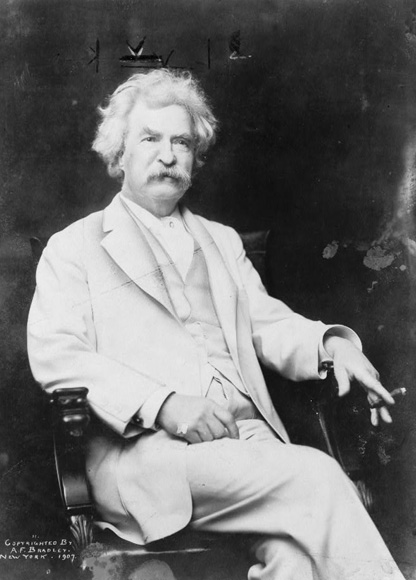
Tomorrow is the anniversary of Mark Twain’s famous and often-distorted observation, “The report of my death was an exaggeration.”

As I described in my 2006 book, The Year That Defined American Journalism, Twain’s comment was prompted by an article published June 1, 1897, in the New York Herald.

Mark Twain, 1907

The Herald, which at the time was one of the best newspapers in America, reported Twain to be “grievously ill and possibly dying. Worse still, we are told that his brilliant intellect is shattered and that he is sorely in need of money.”

Twain then was in London, about to cover Queen Victoria’s Diamond Jubilee for William Randolph Hearst’s New York Journal. That association allowed the Journal to promptly puncture the Herald‘s story.

In an article published June 2, 1897, beneath the headline, “Mark Twain Amused,” the Journal skewered the Herald‘s account as false and offered Twain’s denial: “The report of my death was an exaggeration.”

Twain’s line is often and erroneously quoted as “the news of my death has been greatly exaggerated” and sometimes the Journal is said to have been the source for the erroneous report, not its swift and thorough debunking.

Twain told the Journal that the likely source of the Herald‘s mistake was the serious illness a few weeks before of a cousin, J.R. Clemens, who had been in London.

Ever eager to indulge in self-promotion, the Journal enthusiastically embraced its brief association with Twain. Still, it could not have been terribly pleased with what the humorist filed about the Diamond Jubilee.

As I wrote in The Year That Defined American Journalism, “Twain’s reporting about Victoria’s jubilee seemed half-hearted and hardly inspired. The spectacle was easily the most regal international story of 1897, and came at a time when the British empire was at or near its height. But Twain found the celebration overwhelming,” calling it “a spectacle for the kodak [camera], not the pen.”

Twain’s dispatch to the Journal included this strange observation:

“I was not dreaming of so stunning a show. All the nations seemed to be filing by. They all seemed to be represented. It was a sort of allegorical suggestion of the Last Day, and some who live to see that day will probably recall this one if they are not too much disturbed in the mind at the time.”

WJC

Related:

<!–[if !mso]> Twain’s reporting about Victoria’s jubilee seemed half-hearted and hardly inspired. The spectacle was easily the most regal international story of 1897, and came at a time when the British empire at or near its height. But Twain found the celebration overwhelming—“a spectacle for the kodak [camera], not the pen.”[i] His dispatch included this strange observation: “I was not dreaming of so stunning a show. All the nations seemed to be filing by. They all seemed to be represented. It was a sort of allegorical suggestion of the Last Day, and some who live to see that day will probably recall this one if they are not too much disturbed in mind at the time.”


[i]. Mark Twain, “The Great Jubilee As Described by the Journal’s Special Writers: Mark Twain’s Pen Picture of the Great Pageant in Honor of Victoria’s Sixtieth Anniversary,” New York Journal (23 June 1897): 1.

‘Deep Throat’ outed self, five years ago today

In Anniversaries, Debunking, Media myths, Washington Post, Watergate myth on May 31, 2010 at 3:39 pm

It’s been five years since W. Mark Felt outed himself as the shadowy “Deep Throat” source of the Watergate scandal, the former No. 2 official at the FBI who in places like parking garages periodically passed information to Bob Woodward of the Washington Post.

Remarkably, Felt’s identity as the elusive “Deep Throat” had remained a secret (and was the subject of often-intense speculation) for more than 30 years, until Vanity Fair published an article on May 31, 2005, disclosing Felt’s “Deep Throat” role.

Felt was then 91 and in declining health. He died in 2008.

As I write in Getting It Wrong, my forthcoming book about media-driven myths, the prolonged guessing game about the identity of “Deep Throat” helped solidify the notion that the Washington Post was central to uncovering Watergate scandal. (Stanley I. Kutler, the leading historian of Watergate, once wrote that the “endless, pointless game of trying to identify Deep Throat” was a distraction from the lessons of Watergate.)

Getting It Wrong includes a chapter addressing and debunking what I call the heroic-journalist myth of Watergate–that the reporting of Woodward and his Post colleague, Carl Bernstein, brought down Richard Nixon’s corrupt presidency.

I write that the “guessing game about the identity of the ‘Deep Throat’ source provided periodic and powerful reminders about the Post and its Watergate coverage, serving to keep Woodward and Bernstein in the public eye far longer than they otherwise would have been.”

I also note:

“They and the mysterious ‘Deep Throat’ source became central figures” in what the Philadelphia Inquirer described as “the parlor game that would not die. … With each passing year, as ‘Deep Throat’s’ cloak of anonymity remained securely in place, his perceived role in Watergate gained gravitas.”

“And so,” I write, “… did the roles of Woodward and Bernstein.”

Although many people were named in the guessing game about “Deep Throat,” Felt always ranked high on the roster of likely candidates. As I note in Getting It Wrong, speculation about who was “Deep Throat” began in June 1974, with a front-page article in the Wall Street Journal, and continued periodically for the next 31 years.

The Journal article appeared soon after publication of All the President’s Men, Woodward and Bernstein’s best-selling book about Watergate in which they introduced the furtive source they called “Deep Throat.” The Journal article described Felt as the top suspect.

But Felt repeatedly denied having been “Deep Throat.” He was quoted as saying in the Journal article in 1974:

“I’m just not that kind of person.”

He told the Hartford Courant newspaper in 1999 that he “would have been more effective” had he indeed been Woodward’s secretive source, adding:

“Deep Throat didn’t exactly bring the White House crashing down, did he?”

On the day Felt was confirmed to have been “Deep Throat,” his family issued a statement calling him “a great American hero who went well above and beyond the call of duty at much risk to himself to save his country from a horrible injustice. We all sincerely hope the country will see him this way as well.”

But Felt hardly was such a noble character.

In his senior position at the FBI, Felt had authorized illegal burglaries as part of FBI investigations into leftists associated with the radical Weather Underground in the early 1970s.

Felt was convicted in 1980 on felony charges related to the break-ins but pardoned by President Ronald Reagan.

WJC

Related:


Recalling Mansfield’s contribution to unraveling Watergate

In Debunking, Media myths, Washington Post, Watergate myth on May 29, 2010 at 1:22 pm

Politics Daily posted yesterday an admiring piece–make that a hagiographic piece–about former U.S. Senate leader Mike Mansfield, saying his “savvy and sensibilities … are what our politics need on Memorial Day 2010.”

Well, maybe.

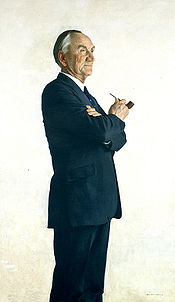
Mansfield (left), who died in 2001, was a Democrat from Montana and the Senate’s longest-serving majority leader, holding the position from 1961-1977.

In its most interesting passage, the Politics Daily commentary recalled Mansfield’s seldom-remembered contribution to unraveling the Watergate scandal, which culminated with President Richard Nixon’s resignation in 1974.

The commentary noted:

“He insisted on a special Senate committee to investigate the unfolding sins of the Nixon era … Because of Mike’s strategic decision to make the Senate investigation open, fair and bipartisan, the country supported a constitutional political process that, for the first time in history, forced a crook out of the White House.”

While that’s a bit over the top, it is clear that Mansfield’s efforts as majority leader to empanel a bipartisan select committee was crucial to the outcome of the scandal, which broke in June 1972 with the arrest of burglars inside Democratic National headquarters at the Watergate complex in Washington, D.C.

As Stanley I. Kutler, the leading historian of the scandal, wrote in his fine book, The Wars of Watergate:

“Watergate might have remained as the story-that-never-was had it not been for the determination of Mike Mansfield and Sam Ervin.”

Ervin, a Democrat from North Carolina, “played a crucial role in securing Senate passage of a resolution calling for the creation of a Select Committee to investigate illegal and unethical conduct in the 1972 presidential campaign,” Kutler wrote. “Mansfield, meanwhile, worked behind the scenes to marshal Democratic support for the resolution. He kept Ervin in the forefront, shrewdly using Ervin’s political capital among Southern Democrats and Republican senators.”

Ervin presided over the hearing of the select committee, which riveted much of the country during the summer of 1973. Its investigation led to the disclosure that Nixon had secretly tape-recorded most Oval Office conversations. Those tapes were crucial to revealing Nixon’s complicity in the scandal and forcing his resignation.

So why is this of interest, and pertinent, to Media Myth Alert?

Recalling Mansfield’s role illustrates anew how a variety of forces were needed to bring down Nixon’s corrupt presidency–a point raised in Getting It Wrong, my soon-to-be-published book that debunks prominent media-driven myths, those false, dubious, or improbable stories about the news media that masquerade as factual.

As I write in Getting It Wrong, rolling up a scandal of Watergate’s complexity required “the collective if not always the coordinated forces of special prosecutors, federal judges, both houses of Congress, the Supreme Court, as well as the Justice Department and the FBI.”

Even then, I argue, “Nixon likely would have served out his term if not for the audiotape recordings.”

The media-centric interpretation of Watergate is that the investigative reporting of the Washington Post was what brought down Nixon. A related claim is that if its reporting didn’t exactly take Nixon down, the Post alone kept the story alive in the summer and fall of 1972, when few people and institutions were much interested in Watergate.

Such claims are mistaken.

The Post didn’t take down Nixon; as leading figures at the newspaper have insisted as much from time to time over the years.

Nor was the Post alone in digging into Watergate during the summer and fall 1972. As I note in Getting It Wrong, rival news organizations such as Los Angeles Times and New York Times also pursued the scandal during those months.

Despite some revealing reporting by the Post and other news organizations, the dimensions of the Watergate scandal were hardly certain by May 1973, when the Senate select committee convened. It was “like an unassembled picture puzzle with crucial pieces missing,” Ervin recalled in his memoir of Watergate.

But with the committee’s hearings during summer of 1973, the scope of the scandal became clearer, leading relentlessly to Nixon and his closest aides.

WJC

Related:

‘Good narrative trumps good history’

In 1897, Cinematic treatments, Furnish the war, Media myths, Reviews, Yellow Journalism on May 28, 2010 at 1:53 pm

The Shotgun Blog today quotes an excerpt from my recent review of Evan Thomas’ disappointing new book, The War Lovers, and offers this telling observation:

“A good narrative trumps good history about nine times out of ten.”

The Shotgun Blog excerpt carries the headline, “You Furnish the Myth, We’ll Furnish the History,” and includes this passage from my review of War Lovers:

“Thomas embraced the media-driven myth of William Randolph Hearst’s purported vow to furnish the war with Spain–a vow supposedly contained in a telegram to the artist Frederic Remington, on assignment in Cuba” in 1897.

The Remingt0n-Hearst anecdote almost certainly is apocryphal, as I discuss in my 2001 book, Yellow Journalism: Puncturing the Myths, Defining the Legacies.

I revisit the anecdote in the first chapter of my soon-to-be-published book, Getting It Wrong, which debunks 10 prominent media-driven myths—false, dubious, or improbable stories about the news media that masquerade as factual.

The Shotgun Blog’s observation about good narrative routinely trumping good history is worthy of rumination, as it does often seem to be the case. It is a topic that I address in Getting It Wrong.

A reason narratives like the Remington-Hearst anecdote triumph is that they are succinct, savory, and easily remembered–as are many media-driven myths.

The Remington-Hearst anecdote is almost too good to be false, a narrative so delicious that it deserves to be true.

The anecdote lives on “despite a nearly complete absence of supporting documentation,” I note in Getting It Wrong, adding:

“It lives on even though telegrams supposedly exchanged by Remington and Hearst have never turned up. It lives on even though Hearst denied ever sending such a message.

“It lives on despite an irreconcilable internal inconsistency: It would have been absurd for Hearst to vow to ‘furnish the war’ because war—specifically, the Cuban rebellion against Spain’s colonial rule—was the very reason Hearst sent Remington to Cuba in the first place.

“Anyone reading U.S. newspapers in early 1897 would have been well aware that Cuba was a theater of a nasty war. By then, the Cuban rebellion had reached island-wide proportion and not a single province had been pacified by Spain’s armed forces.”

What pressed the “furnish the war” anecdote unequivocally into the public consciousness–what sealed the narrative’s triumph over history, if you will–was Citizen Kane, the 1941 motion picture based loosely on Hearst’s life and times.

Kane was not a commercial success, in part because of Hearst’s attempts to block its release, but the film is consistently ranked by critics among the finest ever made, as I note in Getting It Wrong.

A scene early in the film shows Charles Foster Kane, the newspaper tycoon who invites comparisons to Hearst, at his desk, tie untied, quarreling with his former guardian. They are interrupted by Kane’s business manager, “Mr. Bernstein,” who reports that a cable a just arrived from a correspondent in Cuba.

Bernstein reads the contents and Kane, who is played superbly by Orson Welles, dictates a reply that paraphrases Hearst’s purported vow.

Orson Welles

“You provide the prose poems,” Kane says, “and I’ll provide the war.”

Bernstein congratulates Kane on a splendid and witty reply.

Saying he rather likes it himself, Kane instructs Bernstein to send it at once.

WJC

Related:

On version variability and the ‘Cronkite moment’

In Cronkite Moment, Debunking, Media myths on May 25, 2010 at 10:34 am

As I note in my soon-to-be-published book, Getting It Wrong, version variability–the imprecision that alters or distorts an anecdote in its retelling–can be a marker of media-driven myths.

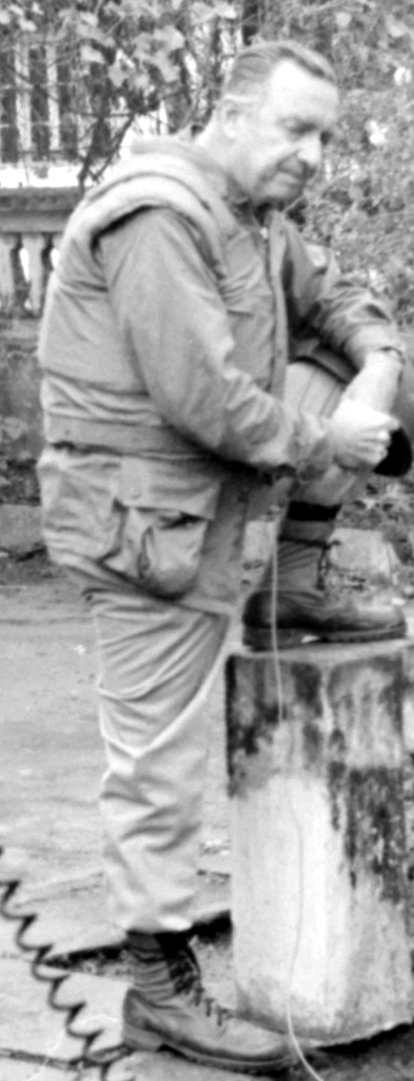
Cronkite in Vietnam, 1968

So it is with the purported “Cronkite moment” of 1968, when CBS anchorman Walter Cronkite asserted in a special televised report that the U.S. military was “mired in stalemate” in Vietnam. President Lyndon Johnson supposedly saw the Cronkite program and promptly realized the war effort was doomed.

“If I’ve lost Cronkite,” the president is reputed to have said in reaction to Cronkite’s pronouncement, “I’ve lost Middle America.”

Or, as a columnist for Townhall.com wrote yesterday, Johnson “said to an aide, ‘If we’ve lost Walter, then we’ve lost the war.'”

Those are just two of many variations of Johnson’s supposed response to Cronkite’s downbeat assessment.

Other versions include:

“I’ve lost Cronkite, I’ve lost the country.”

“If I’ve lost Cronkite, I’ve lost the American people.”

“If I’ve lost Cronkite, I’ve lost the war.”

“If we lose Cronkite, we lose America.”

As I write in Getting It Wrong, “Version variability of that magnitude signals implausibility.”

I also note that version variability “suggests more than sloppiness in journalistic research or a reluctance to take time to trace the derivation of the popular anecdote. The varying accounts of Johnson’s purported reactions represent another, compelling reason for regarding the ‘Cronkite moment’ with doubt and skepticism.”

Moreover, as I write in Getting It Wrong, Johnson did not see the Cronkite program when it aired February 27, 1968. At the time, Johnson was in Austin, Texas, at the 51st birthday party of his longtime political ally, Governor John Connally.

Johnson teased Connally about his age, saying: “Today you are 51, John. That is the magic number that every man of politics prays for—a simple majority. Throughout the years we have worked long and hard—and I might say late—trying to maintain it, too.”

And even if Johnson later heard—or heard about—Cronkite’s assessment, it represented no epiphany for the president, no burst of clarity about a policy gone sour.

A few weeks after the Cronkite program, Johnson gave a rousing, lectern-thumping speech in Minneapolis, in which he urged a “total national effort” to win the war in Vietnam.

The speech was delivered March 18, 1968, and in it, the president declared:

“We love nothing more than peace, but we hate nothing worse than surrender and cowardice.”

So in the weeks immediately following the purported “Cronkite moment,” Johnson maintained an aggressive public stance on the war. He clearly wasn’t swayed by Cronkite’s “mired in stalemate” analysis.

WJC

Related: