W. Joseph Campbell

Archive for the ‘New York Times’ Category

‘Persuasive and entertaining’: WSJ reviews ‘Getting It Wrong’

In Cronkite Moment, Debunking, Furnish the war, Jessica Lynch, Media myths, Murrow-McCarthy myth, New York Times, Reviews, Spanish-American War, War of the Worlds, Washington Post, Watergate myth on July 12, 2010 at 6:05 am

Today’s Wall Street Journal reviews Getting It Wrong, characterizing as “persuasive and entertaining” my new book debunking 10 prominent media-driven myths.

The review–which appears beneath the headline “Too good to check”–is clever and engaging, and opens this way:

“Hello, city desk, get me rewrite. Here’s the lead: Many of the landmark moments in American journalism are carefully nurtured myths—or, worse, outright fabrications.

“William Randolph Hearst never said, ‘You furnish the pictures, and I’ll furnish the war.’ Orson Welles’s ‘War of the Worlds’ radio broadcast didn’t panic America. Ed Murrow’s ‘See It Now’ TV show didn’t destroy Sen. Joseph McCarthy. JFK didn’t talk the New York Times into spiking its scoop on the Bay of Pigs invasion. Far from being the first hero of the Iraq War, captured Army Pvt. Jessica Lynch was caught sobbing ‘Oh, God help us’ and never fired a shot.

“These fables and more are lovingly undressed in W. Joseph Campbell’s persuasive and entertaining ‘Getting It Wrong.’ With old-school academic detachment, Mr. Campbell, a communications professor at American University, shows how the fog of war, the warp of ideology and muffled skepticism can transmute base journalism into golden legend.”

The reviewer, Edward Kosner, author of the memoir It’s News to Me, also discusses the myth of the “Cronkite Moment,” writing, “Television icons are central to two of Mr. Campbell’s dubious cases: Murrow and his successor as the patron saint of TV news, Walter Cronkite.”

Kosner notes–as I do in Getting It Wrong–that at least some of the myths confronted in the book will likely survive their debunking.

“For all Mr. Campbell’s earnest scholarship,” Kosner writes, “these media myths are certain to survive his efforts to slay them. Journalism can’t help itself—it loves and perpetuates its sacred legends of evil power-mongers, courageous underdogs, dread plagues and human folly.”

Well said.

And, alas, he may be right. Some of the myths almost certainly will live on. As I write in the introduction to Getting It Wrong, they “may prove resistant to debunking. They may still be widely believed despite the contrary evidence marshaled against them.

“The most resilient myths,” I further write, “may be those that can be distilled to a catchy, pithy phrase like: ‘If I’ve lost Cronkite, I’ve lost Middle America.’ Such quotations are neat, tidy, and easily remembered. Cinematic treatments influence how historical events are collectively remembered and can harden media-driven myths against debunking. The motion picture All the President’s Men, which cast Robert Redford and Dustin Hoffman in the lead roles of Washington Post reporters [B0b] Woodward and [Carl] Bernstein, has helped ensure that the journalists and their newspaper would be regarded as central to cracking the Watergate scandal.”

Kosner closes the review with a humorous observation, writing:

“At the end of the book, Mr. Campbell offers some remedies for media mythologizing, urging journalists, among other things, ‘to deepen their appreciation of complexity and ambiguity.’ Good luck with that, professor.'”

Heh, heh. Nice touch.

WJC

Related:

‘Getting It Wrong’ goes Majic

In Bay of Pigs, Bra-burning, Debunking, Furnish the war, Jessica Lynch, Media myths, Media myths and radio, New York Times, War of the Worlds, Washington Post, Watergate myth on July 1, 2010 at 11:34 am

I did an engaging and entertaining in-studio interview yesterday on the Lanigan & Malone show, one of the most popular radio programs in Cleveland, the gritty city where I cut my teeth, journalistically, years ago.

On the air with Lanigan (center) and Malone

The show airs on WMJI, Majic 105.7 FM, and I spoke with hosts John Lanigan and Jimmy Malone about several media-driven myths addressed and debunked in my new book, Getting It Wrong.

They included the case of Jessica Lynch, the waiflike Army private whom the Washington Post elevated to hero status in a sensational but utterly erroneous report early in the Iraq War in 2003.

The Post depicted Lynch as having “fought fiercely” in the Iraqi ambush at Nasiriyah of the Army’s 507th Maintenance Company. The newspaper said Lynch had “shot several enemy soldiers” and kept “firing her weapon until she ran out of ammunition.”

Walters

The Lynch case, I said during the Lanigan & Malone interview, appears to have centered around a case of mistaken identity. It wasn’t Lynch who had fought heroically at Nasiriyah. It was most likely Donald Walters, a cook-sergeant in Lynch’s unit who, after running out of ammunition, was captured by Iraqi irregulars and executed.

I pointed out during the interview how war and conflict can readily give rise to myth and misunderstanding. Indeed, half the chapters in Getting It Wrong are related to warfare, including the book’s first chapter, the myth of William Randolph Hearst’s infamous vow to “furnish the war” with Spain.

We moved on to discuss the myth that widespread panic and mass hysteria characterized the reactions to the 1938 radio dramatization of The War of the Worlds, then jumped to a discussion of the myth of superlative reporting of Hurricane Katrina’s aftermath in September 2005, and considered at some length about what I call the “nuanced myth” of bra-burning.

“Bra-smoldering,” I said, would be a more accurate characterization of what happened during the women’s liberation protest at Atlantic City in September 1968. My research shows that bras and other items were set afire, if briefly, during the demonstration against that year’s Miss America pageant.

“All these are ruined,” Lanigan said at one point about the myths debunked in Getting It Wrong.

We also discussed the Bay of Pigs-New York Times suppression myth. That myth centers around a telephone call President John F. Kennedy supposedly placed to the Times publisher or top editors in April 1961, asking that the newspaper hold off on reporting about the pending CIA-supported invasion of Cuba.

There is no evidence, I said, that Kennedy ever placed such a call. (Or even had time to place such a call.)

What appears to have happened is that the Bay of Pigs-suppression myth has become confounded with the 1962 Cuban missile crisis, during which Kennedy did call the Times to request a delay on a report about nuclear-tipped missiles the Soviets had deployed on the island.

As the interview wrapped up, Lanigan said he’s “sure there will be another” volume, a sequel, to Getting It Wrong.

“It’s a good book,” he said afterward. “I’m glad he did it.”

WJC

Related:

Newspapers ‘not dead yet’: But a slow death, still

In New York Times, Newspapers on June 12, 2010 at 10:03 am

The venerable and often-contrarian Economist magazine this week offers an intriguing if superficial defense of the newspaper, declaring in an editorial that they’re “not dead yet.”

Indeed, the Economist asks with a hint of snark, “Whatever happened to the death of newspapers? A year ago the end seemed near.”

It adds:

“The recession threatened to remove the advertising and readers that had not already fled to the internet. Newspapers like the San Francisco Chronicle were chronicling their own doom. America’s Federal Trade Commission launched a round of talks about how to save newspapers. Should they become charitable corporations? Should the state subsidise them? It will hold another meeting on June 15th. But the discussions now seem out of date.”

The Economist notes that U.S. newspapers, “which inhabit the most troubled corner of the global industry, have not only survived but often returned to profit.”

But the data the Economist invokes point to another interpretation: Newspapers are still dying, albeit a slower death.

The pressures on American newspapers have scarcely abated. And I’m hardly ready to retreat from my view that their predicament “is as bleak as it is unprecedented.”

Despite the snark–“whatever happened to the death of newspapers?”–they are in peril still.

The Economist cites recent estimates of the American Society of News Editors that 13,500 newsroom jobs have been eliminated since 2007. (The Economist didn’t mention it, but ASNE also says that American newsrooms since 2001 have lost more than 25 per cent of their fulltime staff.)

“Car and film reviewers have gone,” the Economist notes. “So have science and general business reporters. Foreign bureaus have been savagely pruned. Newspapers are less complete as a result.”

Indeed, many U.S. dailies are mere husks of their former fat selves. They offer fewer pages, publish fewer articles, have fewer reporters–all of which often adds up to an uninteresting product little able to compete in the digital century.

To that point, the Economist says:

“It is grim to forecast still more writers losing their jobs. But whether newspapers are thrown onto doorsteps or distributed digitally, they need to deliver something that is distinctive.”

Readers, it says, invoking a familiar bromide, “will pay for news if they think it has value. Newspapers need to focus relentlessly on that.”

But there are great numbers of Americans who find the news routinely irrelevant.

Nearly 20 percent of adult Americans go without news during a typical day, according to a Pew Research Center’s media-use survey in 2008. (Ten years earlier, the percentage of American adults who went newsless was 14 percent.)

Among adults 18-to-24-years-old these days, 34 percent say they go newsless, according to Pew Research–data I cite in my new book, Getting It Wrong.

This declining constituency for news offers no encouragement for newspapers.

And newspapers have been complicit in their decline. Their credibility—the notion that they play it straight in reporting the news—is deeply doubted among Americans.

Slightly more than 20 percent of adult Americans believe all or most of what they read in their local newspaper, Pew data say. For the  New York Times, the believability quotient is 18 percent. It’s 16 percent for USA Today.

On top of all that, the worst recession in years has made it nearly impossible for prominent newspaper companies, such as the New York Times and the Chicago-based Tribune Co., to dig out from staggering loads of debt.

Another factor contributing to the long decline of newspapers is the fractured business model in which newspapers conveniently and effectively brought together buyers and sellers through advertising. For years, advertising has been deserting the press for the Internet, where bringing together buyers and sellers is cheaper and far more timely and efficient.

The Internet also has unbundled media content, meaning there’s no need for anyone to buy a newspaper just for sports news. Or international news. It’s all online, in discrete packages and in unmatched variety. News à la carte is irresistible in its appeal–and can’t be matched by printed newspapers.

None of these powerful trends has been reversed.

Alas, discussions about the death of newspapers scarcely are “out of date.”

WJC

Related:

Puncturing the Times-suppression myth

In Bay of Pigs, Debunking, Media myths, New York Times on June 9, 2010 at 4:42 pm

In early April 1961, the New York Times supposedly bowed to pressure from the White House of President John F. Kennedy and “spiked,” or suppressed, its detailed report about the pending Bay of Pigs invasion of Cuba.

The Times’ purported self-censorship took place a little more than a week before the invasion, which failed utterly in its objective of toppling the Cuban revolutionary leader, Fidel Castro.

The invasion force of CIA-trained Cuban exiles gave up in less than three days and the Kennedy presidency, as well as U.S. standing in the Caribbean and the world, suffered a humiliating setback.

Had the Times not censored itself, had the Times gone ahead and reported all that it knew, the ill-fated invasion may well have been scuttled and a national embarrassment avoided.

Or so the story goes.

Before the invasion: Front page, NYTimes

The tale of the Times’ purported self-censorship has been recounted in many books, journals, newspapers, and other periodicals over the years. The episode offers supposedly timeless lessons about the perils of self-censorship, about the risks of yielding to pressure to withhold sensitive information on national security grounds.

The anecdote about the Times’ self-censorship is potent, compelling, delicious and timeless.

But as I describe in my forthcoming book, Getting It Wrong, it is also a media-driven myth.

The Times did not suppress its reports about the pending invasion of Cuba. It did not censor itself.  As is discussed in Getting It Wrong, the Times’ reports about preparations for the invasion were fairly detailed, not to mention prominently displayed on the front page in the days before the Bay of Pigs invasion was launched.

Given the widely held notion that the Times censored itself, it was fairly surprising to find in my research just how much reporting there was in advance of the invasion. The run-up to the Bay of Pigs was no one-day story.

Not all pre-invasion news reports were accurate or on-target. Much of it was piecemeal.

But there was ample coverage in the Times and other U.S. newspapers so that readers knew something was afoot in the Caribbean, that an assault on Castro was in the works.

The coverage supposedly reached a point where Kennedy told his press secretary, Pierre Salinger, a week before the invasion:

“I can’t believe what I’m reading! Castro doesn’t need agents over here. All he has to do is read our papers. It’s all laid out for him.”

The notion that Kennedy asked or persuaded the Times to suppress, hold back, or dilute any of its reports about the pending Bay of Pigs invasion is utter fancy.

As I discuss in Getting It Wrong, there is no evidence that Kennedy or his administration knew in advance about the content of the Times’ reporting about the pending invasion. There is no evidence that Kennedy or anyone in his administration lobbied or persuaded the Times to hold back or spike that story, as is so often said.

So what accounts for what I call the “suppression myth”?

I write in Getting It Wrong that the myth “stems from confusion with a separate episode during the Cuban Missile Crisis in October 1962, when Kennedy did ask the Times to postpone publication of a report about the Soviets having deployed nuclear-tipped weapons in Cuba. On that occasion, when the prospect of a nuclear exchange seemed to be in the balance, the Times complied.”

As for the significance of debunking the suppression  myth, I write:

“Exposing the myth demonstrates how the Kennedy administration sought to deflect blame for the Bay of Pigs and make a scapegoat of the Times. On separate occasions in 1961 and 1962, Kennedy told the senior executives of the Times that had the newspaper published more about the pending assault on Cuba, the invasion might have been scuttled.

“Such an interpretation of course shifts responsibility away from the authorities who possessed the power to order an invasion of a sovereign state,” I write. “Puncturing the Timessuppression myth, then, allows blame for the Bay of Pigs fiasco to be more properly apportioned.”

WJC

A version of this post first appeared at the University of California Press blog.

Bra-burning and home luxuries lost: Whoa

In Bra-burning, Debunking, Media myths, New York Times on May 23, 2010 at 11:40 am

If I read this article correctly, bra-burning contributed to a decline in the late 20th century of a taste for small luxuries around the home.

Media-driven myths have been mistakenly credited with bringing on wars and bringing down presidents. But bringing about a decline in household luxuries?

This is a first.

The article recalls with praise Mrs. Beeton’s Book of Household Management, which came out in 1861 and offered hundreds of pointers on cooking, supervising servants, and choosing decor.

Says the article, which appeared the other day in the Seattle Times and elsewhere:

“The dang thing had 2,751 entries—from how to cut a side of lamb, to just when to put away the white summer curtains—spelled out across more than 1,680 pages. And back in 1861, millions of copies were sold. Millions.

“Then,” the article says, “came the bra-burning latter half of the 20th century, and along with it permanent-press sheets, the paper napkin, and Hamburger Helper served up on melamine plates.

“We say, Whoa. We might have ditched too much. Lost all hints of luxury in the household department.”

I say, Whoa.

What did bra-burning supposedly have to do with lost “hints of luxury” at home? The article doesn’t say. Nor does it say explain how bra-burning helped to define the “latter half of the 20th century.”

Bra-burning in fact was a dramatically overstated phenomenon, as I discuss in a chapter in Getting It Wrong, my forthcoming book about media-driven myths–well-known and often-told stories about the news media that are dubious, apocryphal, or wildly exaggerated.

As I write in Getting It Wrong, the notion of bra-burning took hold in the days after the Miss America pageant at Atlantic City, N.J., on September 7, 1968, and was promoted, probably unwittingly, by two syndicated columnists.

On that September afternoon, “about 100 women from New York City, New Jersey, Boston, Washington, D.C., and elsewhere arrived by bus at the Atlantic City boardwalk,” I write, adding:

“They were, according to the New York Times, ‘mostly middle-aged careerists and housewives’ and they set up a picket line … across from the Convention Center. They were there, as one participant declared, ‘to protest the degrading image of women perpetuated by the Miss America pageant,’ which took place that night inside the Convention Center.”

A highlight of their protest came when the demonstrators tossed into a barrel what they termed “instruments of torture,” including brassieres, girdles, high-heeled shoes, and magazines such as Playboy and Cosmopolitan.

The protesters dubbed the barrel the Freedom Trash Can.

The organizers of the daylong protest, who included the activist and former child actor Robin Morgan, have long insisted that bras and other contents of the Freedom Trash Can were not set afire during the protest.

But the notion that bra-burning was a dramatic element of the demonstration at Atlantic City was encouraged by syndicated columnists, including Harriett Van Horne.

Soon after the protest, Van Horne wrote that the demonstrators surely were frustrated– “scarred by consorting with the wrong men. Men who do not understand the way to a woman’s heart, i.e., to make her feel utterly feminine, desirable and almost too delicate for this hard world. … No wonder she goes to Atlantic City and burns her bra.”

Van Horne was not at the protest, however. Nor was Art Buchwald, then American journalism’s leading humorist, who nonetheless played on the bra-burning trope in a column published in the Washington Post and other newspapers.

With tongue firmly in cheek, Buchwald wrote that he had been “flabbergasted to read that about 100 women had picketed the Miss America pageant in Atlantic City against ‘ludicrous beauty standards that had enslaved the American woman.’”

He added: “The final and most tragic part of the protest took place when several of the women publicly burned their brassieres.”

As I note in Getting It Wrong, Buchwald’s slyly humorous “characterization of the protest at Atlantic City introduced the notion of flamboyant bra-burning to a national audience, conjuring as it did a powerful mental image of angry women setting fire to bras and twirling them, defiantly, for all … to see.”

But the dramatic burning of bras as a form of feminist protest wasn’t a defining feature of the second half of the 20th century. More than anything, it was an effect of a humor columnist’s satiric riff.

WJC

‘A debunker’s work is never done’

In Bay of Pigs, Bra-burning, Cronkite Moment, Debunking, Furnish the war, Media myths, Murrow-McCarthy myth, New York Times, Reviews, War of the Worlds, Washington Post, Watergate myth, Yellow Journalism on May 21, 2010 at 6:14 pm

So notes the inestimable media critic Jack Shafer in his review of my forthcoming book, Getting It Wrong, posted today at slate.com.

And what a generous, engaging, and insightful review it is.

Under the headline “The Master of Debunk,” Shafer notes that “the only way to debunk an enshrined falsehood is with maximum reportorial firepower.

“Toting big guns and an itchy trigger-finger is American University professor W. Joseph Campbell, whose new book Getting It Wrong: Ten of the Greatest Misreported Stories in American Journalism flattens established myths that you were brought up to believe were true.”

Shafer’s review specifically discusses a variety of media-driven myths, including William Randolph Hearst’s purported vow to “furnish the war” with Spain; the so-called “Cronkite moment” that supposedly altered President Lyndon Johnson’s Vietnam policy; the Bay of Pigs suppression myth that erroneously says President John F. Kennedy persuaded the New York Times to spike a story about the pending U.S.-backed invasion of Cuba, and the heroic-journalist myth of Watergate.

Shafer rightly points out that “a debunker’s work is never done” and to that end notes my recent post at Media Myth Alert about Evan Thomas’ new book, The War Lovers. The book embraces myths of the yellow press period in American journalism, including the Hearst vow.

Shafer thoughtfully considers the tenacity of media-driven myths, writing:

“Some myths endure because the stories are so compelling, like the Hearst tale and the alleged mayhem caused by Orson Welles’ [War of the Worlds] broadcast. Others survive because our prejudices nourish them (“crack babies,” bra burners) or because pure repetition has drummed them into our heads, smothering the truth in the process.

“The best tonic for the brain fever caused by media myths is an open mind and a free inquiry,” he writes.

Shafer wraps up the review by invoking this observation, by Jonathan Rauch:

“It is the error we punish, not the errant.”

Shafers adds:

“Of course when you do such a good job punishing the error, as Campbell does, you don’t need to bother with the errant.”

WJC

Related:

Just go, Rambo

In Debunking, New York Times on May 21, 2010 at 6:56 am

At least one Connecticut newspaper is having some fun with the dissembling of U.S. Senate candidate Richard Blumenthal about what he did during the Vietnam War.

The Republican American of Waterbury has taken to calling the brittle, strikingly thin Blumenthal “Rambo,” after the beefy fictional hero of cinematic treatments of the war.

And the newspaper has, with tongue undeniably in cheek, has taken to calling Rambogate” the furor that has erupted over Blumenthal’s periodic false claims to have served in Vietnam.

Blumenthal, the state’s attorney general, received at least five deferments that kept him out of the war before landing a coveted place in the Marine Reserve, which was not deployed to Vietnam.

As the New York Times first reported this week, Blumenthal from time to time  has dissembled about his wartime service. The Stamford Advocate in Connecticut added to the controversy yesterday, recalling that Blumenthal in 2008 falsely and publicly claimed:

“I wore the uniform in Vietnam and many came back to all kinds of disrespect. Whatever we think of war, we owe the men and women of the armed forces our unconditional support.”

The occasion was a Veterans Day parade in November 2008, the newspaper said.

It’s hard to envision how Blumenthal’s candidacy and credibility can survive the damage accompanying such disclosures. The attorney general has acknowledged that he inadvertently “misspoke” on a few occasions about his wartime service.

But these false claims clearly are more serious than an occasional slip of the tongue.

Although he probably won’t, it’s time for Blumenthal to pack it in.

Just go, Rambo.

I remain surprised that more attention hasn’t been devoted to Blumenthal’s  subsidiary fictional claims of having faced abuse and indignities upon his fictional “return” from Vietnam.

As I’ve noted, the news reports quoting Blumenthal as having said veterans were spat upon as they came back from Vietnam should prompt further questions about the senate candidate’s truthfulness.

Serious doubts have been raised over the years about such accounts. And yet, Blumenthal has invoked such claims more than a couple of times.

Perhaps the most thoughtful commentary about the Blumenthal mess appeared in yesterday’s Washington Post. It was written by veteran journalist Henry Allen, himself a former Marine.

Allen wrote:

“Blumenthal didn’t get in trouble for confessing he had ducked Vietnam but for lying that he hadn’t, for saying that he’d served there.

“What demon haunts him and others like him? What inconsolable regret provoked these desperate lies?

“He didn’t have to claim he’d been in Vietnam. He already had the résumé to be a shoo-in candidate. Rich kid, Harvard (editor of the Crimson), reporter at The Washington Post, Yale Law School (editor of the law journal), almost two decades as attorney general, the perfect knowledge-class candidate of the kind favored by modern Democrats. (In looks, however, he does bear an unsettling resemblance to disgraced former New York governor Eliot Spitzer.)”

Yes, more Spitzer than Rambo.

But Rambo ought to go.

WJC

Republican American

Blumenthal and his spat-upon claim: More myth?

In Debunking, Media myths, New York Times on May 19, 2010 at 4:43 pm

The New York Times articles this week about the Richard Blumenthal, the Connecticut attorney general who falsely stated he served in Vietnam, mentioned but didn’t explore Blumenthal’s reference to having been spat upon by antiwar protestors.

The Times report Tuesday quoted Jean Risley, chairwoman of the Connecticut Vietnam Veterans Memorial Inc., as saying Blumenthal, a Democrat running for the U.S. Senate, once described indignities he and other veterans faced upon returning from Vietnam.

“It was a sad moment,” the Times quoted Risley as saying. “He said, ‘When we came back, we were spat on; we couldn’t wear our uniforms.’ It looked like he was sad to me when he said it.”

In a follow-up report today, the Times indirectly quoted former Congressman Christopher H. Shays as saying that at a recent event in Bridgeport, Connecticut, Blumenthal “brought up the subject of his military service and lamented that when ‘we returned from Vietnam’ Americans had spit on soldiers.”

The separate reports of Blumenthal’s recollections about veterans having been spat upon should prompt additional questions about the Senate candidate’s truthfulness–questions that go beyond his false claim of having served in Vietnam during the war. (Blumenthal, the Times has reported, secured “at least five military deferments from 1965 to 1970 and took repeated steps that enabled him to avoid going to war, according to records” the newspaper reviewed.)

Doubts have been raised over the years about accounts of soldiers being spat upon as they returned from Vietnam. Jerry Lembcke notably challenged such claims in his 1998 study, The Spitting Image: Myth, Memory, and the Legacy of Vietnam.

Lembcke noted “that stories of veterans being abused by anti-war activists only surfaced years after the abuses were alleged to have happened.”

He also wrote that his “search through news stories and polls … revealed no basis for the widespread belief that the alleged spitting incidents actually occurred.”

Lembcke, a Vietnam veteran who became an opponent of the war, returned to the topic in 2005, writing in a commentary in the Boston Globe:

“Stories about spat-upon Vietnam veterans are like mercury: Smash one and six more appear. It’s hard to say where they come from. For a book I wrote in 1998 I looked back to the time when the spit was supposedly flying, the late 1960s and early 1970s. I found nothing. No news reports or even claims that someone was being spat on.”

He also noted:

“GIs [returning from Vietnam] landed at military airbases, not civilian airports, and protesters could not have gotten onto the bases and anywhere near deplaning troops. There may have been exceptions, of course, but in those cases how would protesters have known in advance that a plane was being diverted to a civilian site?”

Now, I haven’t studied the spat-upon claims to be in a position to embrace Lembcke’s findings, independently. It is a touchy and disputed topic. But I am impressed with the earnest quality of Lembcke’s research.

Moreover, I incorporate in Getting It Wrong, my forthcoming book about media-driven myths, a telling observation in Lembcke’s book about the tenacity of myths.

It appears as a chapter-opening quotation in the discussion in Getting It Wrong about the heroic-journalist myth of Watergate:

“Unlike a society with a strong oral tradition, American today remembers its history through visual imagery.”

True enough: The cinema can be a powerful force in pressing media-driven myths into the collective memory.

I also was impressed with Lembcke’s point that myths “help people come to terms with difficult periods of their past. They provide explanations for why things happened. Often, the explanations offered by myths help reconcile disparities between a group’s self-image and the historical record of a group’s behavior.”

Or, as might be paraphrased in the matter of Blumenthal’s dissembling, myths can help reconcile disparities between an individual’s self-image and the record of his behavior.

WJC

Mythologizing military service in Vietnam

In Debunking, New York Times on May 18, 2010 at 8:48 am

Today’s New York Times carries a potentially devastating piece about Connecticut Attorney General Richard Blumenthal’s dissembling about his military service during the Vietnam War.

Blumenthal, an odds-on favorite to win election this year to the U.S. Senate, told at least one audience in Connecticut, in 2008, that he had served in Vietnam.

“There was one problem,” the Times article says. “Mr. Blumenthal, a Democrat now running for the United States Senate, never served in Vietnam. He obtained at least five military deferments from 1965 to 1970 and took repeated steps that enabled him to avoid going to war, according to records.”

Blumenthal in Marine Reserve (NYTimes)

The Times has posted at its online site a video in which Blumenthal refers to “the days that I served in Vietnam.” Moreover, the Times reported, Blumenthal in 1970 “landed a coveted spot in the Marine Reserve, which virtually guaranteed that he would not be sent to Vietnam.”

Whether the disclosures are enough to ruin Blumenthal’s candidacy is uncertain.

But I wonder whether Blumenthal–who in nearly 20 years as attorney general seemed ever-eager to go before the television cameras to announce state-sponsored litigation–will be able to stand up to the scrutiny, which is sure to be intense over the next several days.

I knew Blumenthal, vaguely, during my time years ago in Connecticut, reporting for the Hartford Courant–which has to be keenly embarrassed that the Times scored this scoop, debunking Blumenthal’s claim.

Blumenthal always struck me in public as slick-haired, brittle, and ill at ease. Surprisingly so, given his frequent appearances on television.

My guess is that he’ll acknowledge a lamentable slip of the tongue and muddle on, a damaged and perhaps vulnerable candidate for a Senate seat that Democrats have held for 46 years. But I wouldn’t be surprised at all were Blumenthal to find the scrutiny too intense to bear, and step aside.

And with further disclosures about his mythologizing his wartime record, Blumenthal’s candidacy will be toast.

Many thanks to Jim Romenesko for linking to this post.

WJC

Halberstam the ‘unimpeachable’? Try myth-promoter

In Bay of Pigs, Cronkite Moment, Debunking, Furnish the war, Media myths, New York Times, Spanish-American War on April 24, 2010 at 9:02 am

A book review in the New York Times the other day referred to David Halberstam, the legendary author and journalist, as an “unimpeachable” source.

Halberstam, who died in an automobile accident three years ago, certainly built an outsize reputation. But unimpeachable?

I’d say no way.

Halberstam, in his hefty and still-popular 1979 study of the news media, The Powers That Be, encouraged the rise of two prominent media-driven myths and endorsed a third.

As I note in Getting It Wrong, my forthcoming book about media-driven myths, Halberstam’s Powers That Be was an important source, perhaps the original source, for the so-called “Cronkite Moment” of February 27, 1968.

That was when CBS anchorman Walter Cronkite asserted in a special report that the U.S. war effort in Vietnam was “mired in stalemate.”

In Halberstam’s telling, Cronkite’s report represented “the first time in American history a war had been declared over by an anchorman.”

Halberstam wrote that President Lyndon Johnson was in Washington and watched the Cronkite special that night. Upon hearing Cronkite’s dire assessment about Vietnam, the president said that if he had lost Cronkite, he had lost Mr. Average Citizen.

Interestingly, Halberstam did not place Johnson’s purported lament inside quotation marks. He paraphrased the remarks and said Johnson had directed  them to presidential press secretary George Christian.

But as I write in Getting It Wrong, Johnson was not in Washington that night. He did not see the Cronkite program when it aired. Thus, he could not have had the abrupt, dramatic, yet resigned reaction that Halberstam, and others, have attributed to him.

Johnson that night was in Austin, Texas, at the 51st birthday party of a political ally, Governor John Connally.

About the time Johnson supposedly made the comment about losing Cronkite, he was offering light-hearted banter about Connally’s age, saying:

“That is the magic number that every man of politics prays for—a simple majority. Throughout the years we have worked long and hard—and I might say late—trying to maintain it, too.”

The “Cronkite Moment,” I write in Getting It Wrong, “is a media-driven myth. It did not have the effects that Halberstam and many others have attributed to it.”

Halberstam’s Powers That Be also offered a graphic, if exaggerated, account that President John Kennedy supposedly called James Reston of the New York Times in April 1961 and urged him not to publish a report about the pending Bay of Pigs invasion.

Kennedy “argued strongly and passionately,” Halberstam wrote, that the Times by reporting the story would damage his policy. Halberstam also wrote that in his call to Reston, Kennedy said the Times risked having blood on its hands were the article published and the invasion failed.

Such a conversation never happened, according to Reston and others quoted in Harrison Salisbury’s insider’s account of the Times, Without Fear or Favor.

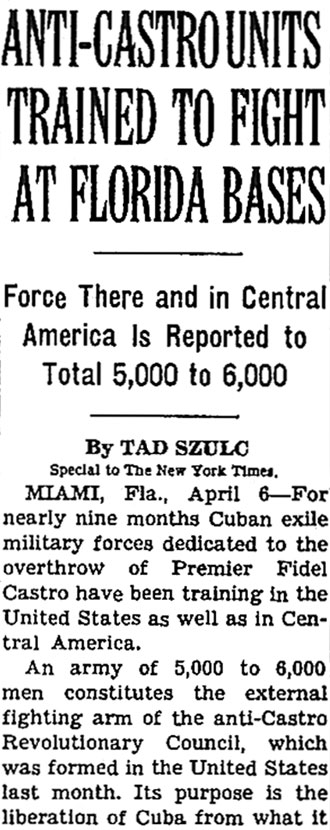
Indeed, there is no evidence that Kennedy called anyone at the Times in advance of the report–which was written by Tad Szulc and published April 7, 1961, on the Times front page (see right).

As I note in Getting It Wrong:

“The Kennedy Library in Boston says that the White House telephone logs reveal no calls were placed to Reston” or other Times executives on April 6, 1961, the day the story was prepared for publication.

“Moreover,” I note, “Kennedy had almost no chance to speak with those executives during the interval from when Szulc’s story arrived at the Times building in midtown Manhattan and when it was set in type. … During that time, Kennedy was otherwise preoccupied. He spent the last half of the afternoon of April 6, 1961, playing host to Harold Macmillan, the British prime minister, on a lengthy cruise down the Potomac River to Mount Vernon.”

In addition, Halberstam’s Powers That Be invoked one of the most enduring media myths–the anecdote about William Randolph Hearst’s purported vow to “furnish the war” with Spain at the end of the 19th century.

That anecdote is revisited, and dismantled, in the first chapter of Getting It Wrong.

The Powers That Be was a popular success, reaching the second spot on the New York Times best-selling list in May 1979. But the book wasn’t without persuasive critics.

Among them was David Culbert, an historian at Louisiana State University who years ago raised questions about the “Cronkite Moment,” noting that Johnson was in Texas when the program aired.

In a devastating review published in the American Historical Review, Culbert called The Powers That Be overlong and declared:

“The absence of a developed thesis, lack of proper documentation, and numerous errors of fact for events before the 1960s suggest that historians will have to use this book with caution. There is much here that might be true and, if true, valuable, but there is also no certainty that sloppy research does not undermine the very parts that seem most interesting.”

WJC