W. Joseph Campbell

Archive for the ‘New York Times’ Category

Taking stock: Top mythbusting posts of 2012

In Anniversaries, Cronkite Moment, Debunking, Error, Jessica Lynch, Media myths, New York Times, New Yorker, Photographs, Television, Washington Post on December 30, 2012 at 6:25 am

Media Myth Alert reported in 2012 on the appearance of many prominent media-driven myths and errors. Here are the year’s five top writeups, followed by a roster of other mythbusting posts of note.

Calling out the New York Times on ‘napalm girl’ photo error (posted June 3): The 40th anniversary of the famous “napalm girl” photograph — one of the most memorable images of the Vietnam War — fell in early June.

NapalmGirl photo_AP

Nick Ut/Associated Press

In an obituary a few weeks before, the New York Times had referred to the photograph of terror-stricken Vietnamese children and claimed, erroneously, that it showed “the aftermath of one of the thousands of bombings in the countryside by American planes.”

That passage suggested U.S. forces were responsible for the aerial napalm attack that gave rise to the photograph, taken by Nick Ut of the Associated Press. I pointed this out in an email to the Times, noting that the bombing was a misdirected attack by the South Vietnamese Air Force, as news reports at the time had made clear.

The newspaper’s assistant obituary editor, Peter Keepnews, replied, and offered some baffling logic in doing so:

“You are correct that the bombing in question was conducted by the South Vietnamese Air Force. However, the obituary referred only to ‘American planes,’ and there does not seem to be any doubt that this plane was American –- a Douglas A-1 Skyraider, to be precise.”

As if the aircraft’s manufacturer was at all relevant in the attack.

Independent of my efforts, two former Associated Press journalists also called on the Times to correct its error about “American planes.”

The Times resisted doing so until late August, when it issued a sort-of correction that embraced Keepnews’ tortured reasoning and stated:

“While the planes that carried out that attack were ‘American planes’ in the sense that they were made in the United States, they were flown by the South Vietnamese Air Force, not by American forces.”

It was, I noted, a begrudging and less-than-forthright acknowledgement of error. It hardly was in keeping with the declaration by the newspaper’s then-executive editor, Bill Keller. He asserted in a column in 2011 that “when we get it wrong, we correct ourselves as quickly and forthrightly as possible.”

hagiographic treatment of the “Cronkite Moment” (posted May 31): Few media-driven myths are as tenacious and desperately held as the so-called “Cronkite Moment” of 1968, when CBS News anchorman Walter Cronkite declared on air that the U.S. military was “mired in stalemate” in Vietnam.

Cronkite in Vietnam, 1968

Cronkite in Vietnam, 1968

For years, journalists have sought to attach great significance to Cronkite’s assessment, even though it was thoroughly unoriginal and was, as I discuss in my latest book, Getting It Wrong, of little demonstrable impact. Even Cronkite, until late in his life, pooh-poohed its importance.

But all that scarcely deterred Douglas Brinkley from presenting in a hefty biography about Cronkite a decidedly hagiographic — and misleading — interpretation of the “Cronkite Moment.”

Brinkley offered little persuasive evidence in asserting that the “aftershock” of Cronkite’s report about Vietnam, which aired February 27, 1968, “was seismic” and “signaled a major shift in the public’s view of the war.”

In discussing the supposed “seismic” effects of Cronkite’s assessment, Brinkley wrote:

“Even the conservative Wall Street Journal editorial page said, ‘The whole Vietnam effort may be doomed.’”

But the Journal editorial that  said so was published four days before Cronkite’s broadcast. To cite the editorial as evidence of a “seismic” effect of the “Cronkite Moment” was certainly misleading.

What’s more, Cronkite’s characterization of stalemate in Vietnam hardly “signaled a major shift in the public’s view of the war.”  Public opinion polls indicated that the shift had begun several months earlier.

If anything, Cronkite followed rather than led public opinion on Vietnam.

Uneven availability of WaPo’s online content about Jessica Lynch (posted April 27): On April 4, 2003, the Washington Post published a front-page report about an Iraqi lawyer who helped set in motion the rescue from captivity of Jessica Lynch, a wounded, 19-year-old Army private.

That report ran to 1,500 words and is freely available at the Post’s online site.

The day before that article appeared, the Post published an electrifying but far more problematic story about Jessica Lynch — an account that claimed she had fought fiercely against Iraqi attackers and had suffered gunshot and stab wounds before running out of ammunition and being taken prisoner.

Lynch_headline_Post

That article was published on the Post’s front page beneath the headline:

“‘She was fighting to the death.'”

It was a stunning report that proved wrong in all important details: Lynch was neither shot nor stabbed; she did not fire a shot in the attack in Iraq. She was badly injured in the crash of her Humvee in attempting to flee.

But try finding the “fighting to the death” story at the Post’s online site.

Unlike the far less embarrassing report of April 4, 2003, the “fighting to the death” story is not freely available online. Clicking on the story’s URL opens what essentially is an empty link.

Also unavailable online are the scathing reviews of the hero-warrior tale published by the newspaper’s then-ombudsman in April and June 2003.

Such inconsistencies suggest a digital scrubbing of embarrassing content. I asked the newspaper’s incumbent ombudsman, Patrick Pexton, about this matter.

He took several weeks to reply, finally stating in an email in August that he had found “nothing nefarious about this.” He added that the Post since 2003 “has gone through several changes of content management systems,” by which articles are posted online.

He further noted that the “fighting to the death” story about Lynch and related content are available in the Post’s fee-based archive.

So why not make the “fighting to the death” story freely available? Why not remove the fee to access a singularly memorable article about the Iraq War, a mistaken report that made Jessica Lynch something of a celebrity and gave rise to misguided suspicions that the U.S. military concocted the hero-warrior tale and somehow fed it to the Post?

“Restoring the digital version of the article of April 3, 2003, would represent a contribution to the record about the case of Jessica Lynch, which the Post is solely responsible for having placed in the public domain,” I wrote in an email to Pexton in mid-August.

He has not replied.

Kennedy-Nixon debate myth lives on (posted September 30): The run-up to the televised presidential campaign debates in October prompted numerous references to the purported lesson of the first such encounter, between John F. Kennedy and Richard M. Nixon in late September 1960.

That lesson is about the presumptive power of the televised image: Supposedly, television viewers thought Kennedy won the first debate in 1960 while radio listeners felt Nixon got the better of it.

This notion of viewer-listener disagreement has become an enduring media myth, even though it was thoroughly dismantled 25 years ago by scholars David L. Vancil and Sue D. Pendell.

Dismantling, though, hasn’t destroyed the myth. The notion of viewer-listener disagreement remains hardy and irresistible.

For example, in the runup to the debates in October between President Barack Obama and his Republican challenger, Mitt Romney, the founder of USA Today, Al Neuharth, wrote a column that recalled the first Kennedy-Nixon debate.

“Listeners,” Neuharth said, “generally gave Nixon the nod. But TV viewers strongly favored Kennedy.”

And the Chicago Tribune declared that “not everyone thought Kennedy had won the debate. Pollsters found that those who heard the radio broadcast thought Nixon won. … Television viewers experienced a different debate from radio listeners.”

Only one polling organization, Sindlinger & Company, had conducted a survey of any size that included a sub-sample of radio listeners. The Sindlinger survey, taken the day after the first Kennedy-Nixon debate, indicated that radio listeners felt Nixon prevailed, by a margin of 2-to-1.

But Vancil and Pendell, in their article in Central States Speech Journal in 1987, noted that the Sindlinger survey included more than 2,100 respondents, of whom just 282 had listened to the debate on radio.

They noted that “a subordinate group of 282 interviews is below the threshold normally required for a national sample.” Not only that, but only 178 of the 282 respondents “expressed an opinion on the debate winner,” Vancil and Pendell wrote.

Given the shortcomings of the unrepresentative Sindlinger sample, Nixon’s supposedly decisive margin among radio listeners dissolves as meaningless — and renders viewer-listener disagreement a media myth.

George Romney’s “brainwashing” — and Gene McCarthy’s retort (posted September 4): Mitt Romney’s ill-fated run for the presidency prompted reminders of his father’s failed presidential campaign in 1968 — a campaign done in by a memorably clumsy gaffe.

The gaffe, in turn, is said to have inspired one of the most devastating putdowns in American political history. But as my research has found, the context of the supposed putdown is unclear at best.

The gaffe was committed in late August 1967 by George Romney, then governor of Michigan and a presumptive leading candidate for the Republican presidential nomination in 1968.

In an interview with a Detroit television reporter, Romney referred to his visit to South Vietnam in 1965 and said:

“You know, when I came back from Vietnam, I’d just had the greatest brainwashing that anybody could get. … Well, not only by the generals but by the diplomatic corps over there. They do a very thorough job.”

Romney’s claim that he had been duped into supporting America’s war effort in Vietnam suggested muddled thinking, gullibility, and an uncertain command of foreign policy. His abbreviated presidential campaign never recovered from the self-inflicted wound; he ended his  run for the presidency at the end of February 1968.

Sealing the gaffe’s unforgettable quality was the supposed witty putdown by Democratic Senator Eugene McCarthy. Rather than a “brainwashing,” McCarthy supposedly said, a “light rinse” would have sufficed for Romney.

So telling was McCarthy’s “light rinse” quip that it “essentially finished Romney.”

But when, or even whether, McCarthy made the “light rinse” comment is unclear.

A database search of leading U.S. newspapers — including the New York Times, the Washington PostChicago Tribune, Los Angeles Times, and Baltimore Sun — turned up no published reference to the “light rinse” quip in 1967 or 1968. Or for years afterward.

The first reference was in 1983, a column in the Baltimore Sun that did not say when, where, or to whom McCarthy uttered the remark.

It seems improbable that journalists in 1967 or 1968 would have failed to report a retort as delicious as McCarthy’s.

But that’s what An American Melodrama: The Presidential Campaign of 1968, a hefty book published in 1969 would have us believe.

American Melodrama described McCarthy’s remark as off-handed and said the senator’s aides persuaded reporters to hush it up.

While intriguing, American Melodrama doesn’t say when McCarthy made the comment, where, or specifically to whom.

WJC

Many thanks to Instapundit
Glenn Reynolds for linking to this post

Other memorable posts of 2012:

Little sustained media reflection two weeks after botched massacre coverage

In Error, New York Times on December 28, 2012 at 11:29 am

The news media are notorious for seldom looking back in any sustained way to understand and explain their missteps when coverage of a prominent story has been botched.

This tendency was quite apparent in the aftermath of the exaggerated reporting of the mayhem Hurricane Katrina supposedly unleashed in New Orleans in 2005.

No media_cropped

Newtown, Connecticut

It also has been apparent in the two weeks since the schoolhouse massacre in Newtown, Connecticut.

There can be little dispute that the news media stumbled badly in reporting Adam Lanza’s lethal attack at Sandy Hook Elementary School in Newtown, an assault in which 26 people were killed, including 20 first-grade pupils.

As Andrew Beaujon of Poynter Online noted in an impressively succinct summary of the news media’s most glaring reporting errors:

“Adam Lanza was not buzzed in to Sandy Hook Elementary School …. His mother, Nancy, did not work at the school. He didn’t have an altercation with school officials the day before. He used a Bushmaster rifle, not the Glock and SIG Sauer pistols he was carrying, to carry out his massacre. The children he killed were first-graders, not mostly kindergarteners.

“Adam Lanza’s name was not Ryan.”

Ryan Lanza is the shooter’s brother.

Mistaking the assailant’s name may well endure as the single most memorable of the media’s errors in reporting the Newtown shootings. Just as Brian Ross’ egregious lapse last summer in tying the Colorado-movie theater shooter to the Tea Party movement stands as the most-remembered error in the coverage of that massacre.

Two weeks after the shootings in Connecticut, just how and why the news media failed so often has not been adequately dissected or explained. Not in any sustained or granular way.

When journalists and media critics have paused to consider the flawed reporting, they’ve tended to cite competitive pressures or have shifted blame to anonymous sources, especially those vaguely identified as “law enforcement” officials who provided bum information.

Blaming sources isn’t exculpatory, however. It doesn’t let journalists off the hook, despite an inclination to do so.

In a blog post the day after the shootings, Erik Wemple of the Washington Post wrote:

“The media can do many things; one thing they cannot do is on-the-spot fact-checking of the cops.”

But of course they can. Reporters have an obligation to press the cops for details about how they developed the information they’re passing along.

Journalists aren’t stenographers for the authorities;  they need not be timid or credulous.

Reporters covering unfolding disasters would be well-served to remember Eddie Compass, formerly the police commissioner in New Orleans, who offered graphic accounts of lawlessness in his city following Katrina’s landfall.

Little of Compass’ extravagance proved true.

As I note in my media-mythbusting book, Getting It Wrong, “Compass was asked months afterward why he had depicted New Orleans as swept by mayhem in Katrina’s aftermath. He offered a baffling reply. ‘I didn’t want people to think we were trying to cover anything up,’ he said. ‘So I repeated things without being substantiated, and it caused a lot of problems.'”

It sure did.

In the misreporting at Newtown, it’s not entirely clear that cops were the sources for the media’s most stunning error.

In the hours after the shootings on December 14, CNN correspondent Susan Candiotti went on the air and to say the shooter’s name was “Ryan” Lanza.

According to a transcript of CNN’s coverage available at the LexisNexis database, Candiotti said:

“The shooter has been identified to me by a source as Ryan Lanza, Ryan Lanza, in his 20s, apparently, we are told from the source, from this area.”

The identification, she said, was “by a source,” a most lazy and opaque sort of attribution. A “source” could be almost anyone, and not necessarily a “law enforcement” official.

In any case, the error about the shooter’s name soon was compounded.

The misidentification was reported by other news organizations in a revealing example of what Av Westin, formerly of ABC News, has called the “out there” syndrome. That is, if other news organizations are “out there” reporting what seems to be an important element of a disaster-related story, pressures mount on rival news outlets to match that information.

The New York Times repeated the misidentification in a report posted online — a report that said:

“Various news outlets identified the shooter as Ryan Lanza.”

The Times’ public editor (or in-house critic), Margaret Sullivan, noted that error in a blog post three days after the shootings.

But Sullivan did not consider the implications of the Times’ having joined in the “out there” syndrome. She offered neither criticism nor rebuke.

She wrote that “some mistakes may be inevitable on a major, fast-moving story, working against brutally demanding deadlines. That’s not an excuse, just a reality.”

Sullivan in a subsequent column seemed to modify that interpretation, writing that the Times “has to stand apart from those news sources that are getting information out in a fast, piecemeal and frequently inaccurate way.”

Fair enough.

Given that early disaster coverage does tend to be accompanied by missteps and error, journalists are well-advised to proceed cautiously. The challenges of filing on “brutally demanding deadlines” should give reporters, and their editors, pause: It should leave them more wary about what they are told and more cautious about what they report.

Greater restraint at such times — coupled with a broader inclination to study and learn from the missteps of disaster coverage — would leave journalists less likely to traffic in claims that prove exaggerated or unfounded.

WJC

Recent or related:

A sort-of correction from the NYTimes

In Debunking, Error, New York Times, Photographs on August 28, 2012 at 9:09 pm

‘Napalm girl,’ 1972 (Nick Ut/AP)

It has taken more than three months, but the New York Times today published a sort-of correction of its erroneous description about the napalm attack in Vietnam in June 1972 that preceded the famous photograph of children terrified and wounded by the bombing.

The photograph, taken by Nick Ut of the Associated Press, won a Pulitzer Prize in 1973. It is colloquially known as the “napalm girl” image.

The Times’ error appeared in an obituary, published May 14, about Horst Faas, an award-winning AP photographer and editor who spent years in Vietnam.

The obituary said the photograph showed “the aftermath of one of the thousands of bombings in the countryside by American planes: a group of terror-stricken children fleeing the scene, a girl in the middle of the group screaming and naked, her clothes incinerated by burning napalm.”

But as I, and others, pointed out to the Times, the napalm was not dropped by the American military but by the South Vietnamese Air Force.

In response to my email sent in May about that lapse, the Times’ correction expert on its obituary staff, Peter Keepnews, wrote:

“You are correct that the bombing in question was conducted by the South Vietnamese Air Force. However, the obituary referred only to ‘American planes,’ and there does not seem to be any doubt that this plane was American –- a Douglas A-1 Skyraider, to be precise.”

Of course, the aircraft’s manufacturer was hardly at issue. And in the sort-of correction published today, the Times removed the reference to “American planes” in the digital version of the obituary but otherwise embraced Keepnews’ convoluted reasoning, stating:

“While the planes that carried out that attack were ‘American planes’ in the sense that they were made in the United States, they were flown by the South Vietnamese Air Force, not by American forces.”

Which makes for a less-than-clean correction.

Indeed, the correction seems begrudging, half-hearted.

And less than sincere.

It’s as if the Times were saying the South Vietnamese Air Force was doing the dirty work for the American military — which by June 1972 was decidedly winding down its war effort in Vietnam.

Richard Pyle, a retired veteran AP correspondent who was the news agency’s Saigon bureau chief from 1970-73, characterized the Times’ correction this way:

“[T]he phrasing — ‘while the planes that carried out the attack were “American planes” in the sense that they were made in the United States, they were flown by the South Vietnamese Air Force, not American forces’ — makes it sound like a bunch of teenagers borrowing daddy’s car.”

Indeed.

Pyle, who retired from AP in 2009, also had petitioned the Times for a correction in the Faas obituary. So had Hal Buell, a retired AP vice president who for years directed the news agency’s photo service.

In July, they sent a joint letter by email to the Times, pointing to the very real prospect that the error, if left uncorrected, could solidify into wide acceptance.

They wrote: “Our larger concern, beyond amending the immediate record, is that if left standing, this error will be repeated in future by the Times and any publications that might rely on it as a source, in effect causing a significant piece of misinformation to be cast in journalistic stone.”

The Times’ sort-of correction muddies rather than clarifies or fully corrects. The concerns that Pyle and Buell addressed are hardly set to rest.

The sort-of correction is disappointing, too, in light of the praise that the Times’ outgoing public editor, Arthur Brisbane, offered Sunday about the newspaper’s corrections staff.

Brisbane extolled the Times’ corrections desk as “a powerful engine of accountability” unmatched by similar operations at other U.S. news organizations.

The sort-of correction published today mocks such extravagant praise.

WJC

Many thanks to Instapundit
Glenn Reynolds for linking to this post

Recent or related:

Pardon the scoffing: NYT corrections desk is ‘a powerful engine of accountability’?

In Error, New York Times, Photographs on August 26, 2012 at 11:49 am

The swan song column of Arthur Brisbane, the New York Times public editor, salutes the newspaper’s corrections desk as “a powerful engine of accountability” unmatched by similar operations elsewhere.

Brisbane salutes ‘powerful engine of accountability’ (NYTimes photo)

Pardon my scoffing: A “powerful engine of accountability”?

The Times has been often and rightly lampooned for obsessing over trivial lapses while ignoring far more consequential missteps — as suggested by its ignoring repeated recent requests to correct its unambiguous error about the context of the famous “napalm girl” photograph taken in Vietnam in June 1972.

The image, taken by Associated Press photographer Nick Ut, shows a naked child, screaming in pain as she fled an aerial napalm attack near a village in South Vietnam. The photograph won a Pulitzer Prize and remains one of the most memorable images of the Vietnam War.

In an obituary published in May, the Times referred to the image as showing “the aftermath of one of the thousands of bombings in the countryside by American planes: a group of terror-stricken children fleeing the scene, a girl in the middle of the group screaming and naked, her clothes incinerated by burning napalm.”

But as has been repeatedly pointed out to the Times, the plane that dropped the napalm wasn’t American; it was South Vietnamese.

Among those who’ve called attention to the Times’ error are two senior former Associated Press journalists, Richard Pyle, the news agency’s Saigon bureau chief from 1970-73, and Hal Buell, a retired AP vice president.

Both men have petitioned the Times for a correction, stating in a joint letter sent last month by email:

“Our larger concern, beyond amending the immediate record, is that if left standing, this error will be repeated in future by the Times and any publications that might rely on it as a source, in effect causing a significant piece of misinformation to be cast in journalistic stone.”

Pyle and Buell also pointed to the Times’ inclination to police its minor errors, writing:

“Given the Times’ demonstrated commitment to correcting middle initials, transposed letters and other Lilliputian errata, it shouldn’t be asking too much for it to repair a factual error of greater magnitude.”

But the “powerful engine of accountability” hasn’t deigned to address the error, which insinuates that the U.S. military was responsible for the attack that preceded Ut’s “napalm girl” photograph.

By June 1972, however, most U.S. combat units had been removed from South Vietnam. For the American military, the war then was winding down.

Pyle and Buell, jointly and individually, have sought a correction, addressing email to Brisbane’s desk and elsewhere at the Times. I, too, have pointed out the Times’ lapse and in May received this frankly illogical reply from the newspaper’s assistant obituary editor, Peter Keepnews:

“You are correct that the bombing in question was conducted by the South Vietnamese Air Force. However, the obituary referred only to ‘American planes,’ and there does not seem to be any doubt that this plane was American –- a Douglas A-1 Skyraider, to be precise.”

As if the aircraft’s manufacturer were vital to the napalm strike by the South Vietnamese.

The Times’ failure to address the error hints at limited viewpoint diversity in the newsroom, a topic that Brisbane points to in his swan song.

He writes:

“Across the paper’s many departments … so many share a kind of political and cultural progressivism — for lack of a better term — that this worldview virtually bleeds through the fabric of The Times.

“As a result,” Brisbane states, “developments like the Occupy movement and gay marriage seem almost to erupt in The Times, overloved and undermanaged, more like causes than news subjects.”

That description prompted a rebuke from the Times’ executive editor, Jill Abramson. But it’s a telling and doubtless accurate observation that Brisbane ought to have made more often during his two-year tenure as “public editor,” or internal critic.

Brisbane’s comment about “political and cultural progressivism” evokes an observation by the Times’ first ombudsman, Daniel Okrent. In a column in 2004, Okrent addressed what he called “the flammable stuff that ignites the [political] right. These are the social issues: gay rights, gun control, abortion and environmental regulation, among others.

“And if you think The Times plays it down the middle on any of them, you’ve been reading the paper with your eyes closed.”

Brisbane’s comment also is evocative of one of the final columns that Deborah Howell wrote as ombudsman at the Washington Post.

She acknowledged in mid-November 2008 that “some of the conservatives’ complaints about a liberal tilt [in mainstream journalism] are valid. Journalism naturally draws liberals; we like to change the world. I’ll bet that most Post journalists voted for Obama. I did.”

She also wrote:

“There are centrists at The Post as well. But the conservatives I know here feel so outnumbered that they don’t even want to be quoted by name in a memo.”

Howell’s column quoted the director of the Project for Excellence in Journalism, Tom Rosenstiel, as saying:

“The perception of liberal bias is a problem by itself for the news media. It’s not okay to dismiss it. Conservatives who think the press is deliberately trying to help Democrats are wrong. But conservatives are right that journalism has too many liberals and not enough conservatives. It’s inconceivable that that is irrelevant.”

I argue in my latest book, Getting It Wrong, that viewpoint diversity and contrarian thinking should be vigorously promoted in American newsrooms.

But the ideological imbalance of mainstream American journalism never receives much more than passing attention in mainstream American journalism.

It’s little wonder, then, that the believability quotient of leading U.S. news media continues to ebb: There’s a keen sense that they’re not dealing it straight.

According to a recent survey by the Pew Research Center, 14 percent of respondents said they said believed “all or most” of what the Times has to say.

WJC

Recent or related:

NYTimes ignores senior former AP journalists seeking correction on ‘napalm girl’ context

In Debunking, New York Times, Photographs on August 17, 2012 at 10:35 am

‘Napalm girl,’ 1972 (Nick Ut/AP)

The New York Times has ignored written requests by two senior former Associated Press journalists seeking the correction of an unambiguous error published in a Times obituary three months ago.

The journalists are Richard Pyle, a Vietnam War correspondent for nearly five years and the news agency’s Saigon bureau chief from 1970-73, and Hal Buell, a retired AP vice president who for years directed the agency’s photo service.

At issue is the Times’  mischaracterization of the attack that gave rise to one of the Vietnam War’s most memorable photographs — the “napalm girl” image of June 1972.

Update: The Times publishes a sort-of correction.

The centerpiece of the photograph, taken by AP photographer Nick Ut, shows a naked child, screaming in pain as she fled an aerial napalm attack near a village in South Vietnam.

In an obituary published in May about Horst Faas — an award-winning AP photographer and editor who helped make sure Ut’s photograph moved across the agency’s wires — the Times described the image as “the aftermath of one of the thousands of bombings in the countryside by American planes: a group of terror-stricken children fleeing the scene, a girl in the middle of the group screaming and naked, her clothes incinerated by burning napalm.”

But as I pointed out in an email sent to the Times soon after the obituary was published, the aircraft that dropped the napalm wasn’t American; it was South Vietnamese.

The newspaper’s assistant obituary editor, Peter Keepnews, replied to me on May 22, stating in an email:

“You are correct that the bombing in question was conducted by the South Vietnamese Air Force. However, the obituary referred only to ‘American planes,’ and there does not seem to be any doubt that this plane was American –- a Douglas A-1 Skyraider, to be precise.”

As if the aircraft’s manufacturer were a crucial element in the napalm strike by the South Vietnamese.

I wrote about the Times’ error — and Keepnews’ illogical response — in a post in early June at Media Myth Alert.

Quite independently of my efforts, Pyle and Buell also called the Times’ attention to the error about the napalm attack.

Their requests for a correction have been ignored, Pyle said.

Pyle shared the contents of a letter he sent by email to the Times in mid-June, in which he noted that the Faas obituary “included a serious error, asserting … that the napalm bombs were dropped by U.S. aircraft.  In fact the planes were A-1 Skyraiders of the South Vietnamese Air Force (VNAF), supporting a ground operation by South Vietnamese troops, in which there was no U.S. involvement.”

Pyle, a correspondent for AP from 1960 until retiring in 2009, also wrote that he was “dismayed to see the inclusion of an error that had first cropped up in a report about Nick Ut’s photo more than a decade ago, and which has required correction on several occasions since.

“It’s a classic example of how an error in print can be ‘killed’ repeatedly but never die.”

In a joint letter sent by email to the Times on July 22 and subsequently shared with me, Pyle and Buell reiterated that the error, if left uncorrected, may harden into wide acceptance.

They wrote:

“Our larger concern, beyond amending the immediate record, is that if left standing, this error will be repeated in future by the Times and any publications that might rely on it as a source, in effect causing a significant piece of misinformation to be cast in journalistic stone.”

They pointed out that they had separately sent letters by email to the Times but those letters “were simply ignored.” (The Times has not replied to an email I sent Wednesday, seeking comment about this matter.)

In their letter, Pyle and Buell also noted the Times’ earnest efforts to correct even minor errors and trivial lapses that creep into its columns, stating:

“Given the Times’ demonstrated commitment to correcting middle initials, transposed letters and other Lilliputian errata, it shouldn’t be asking too much for it to repair a factual error of greater magnitude.

“By clarifying this for the current record, you can also assure that it won’t be mindlessly recycled in future references to one of the Vietnam’s war’s most oft-published photo images.”

“Napalm girl” won the Pulitzer Prize in 1973 for spot news photography.

(Full disclosure: I reported from Europe and West Africa for the Associated Press in the early 1980s but have never met Pyle or Buell.)

The Times’reluctance to address and correct this error evokes a couple of telling observations offered by media critic Jack Shafer, in a column for Slate in 2004.

Shafer wrote: “The rotten truth is that media organizations are better at correcting trivial errors of fact — proper spellings of last names, for example — than they are at fixing a botched story.”

He further stated:

“Individual journalists are a lot like doctors, lawyers, and pilots in that they hate to admit they were wrong no matter what the facts are.”

The Times’ unwillingness to acknowledge and correct its error about the context of the “napalm girl” image also brings to mind a sanctimonious pledge last year by the newspaper’s then-executive editor, Bill Keller.

He declared in a column in March 2011 that at the Times, “[w]e put a higher premium on accuracy than on speed or sensation. When we report information, we look hard to see if it stands up to scrutiny.”

Keller further declared that “when we get it wrong, we correct ourselves as quickly and forthrightly as possible.”

That sure sounds good. Admirable, even.

But in fulfilling those high-sounding virtues, the Times fails utterly, at least in this case. And it is arrogant and dismissive in its failure.

WJC

Many thanks to Instapundit
Glenn Reynolds for linking to this post

Recent or related:

Chris Matthews invokes the ‘if I’ve lost Cronkite’ myth in NYT review

In Cronkite Moment, Debunking, Media myths, New York Times, Quotes, Reviews on July 9, 2012 at 7:29 am

The New York Times lined up Chris Matthews, voluble host of cable television’s Hardball program, to review Douglas Brinkley’s Cronkite, the new biography about legendary CBS News anchorman Walter Cronkite.

LBJ wasn’t watching Cronkite’s report

Matthews turned in a fluffy review, published yesterday, that invoked one the American journalism’s best-known media myths — the claim that President Lyndon B. Johnson was dramatically moved by Cronkite’s on-air assessment about the war in  Vietnam.

“Cronkite never shied away from telling hard truths,” Matthews writes in his review. “Recall his half-hour ‘Report From Vietnam’ on Feb. 27, 1968, in which he declared the Vietnam War a ‘stalemate.’ It was a verdict the veteran war correspondent didn’t relish delivering, but Cronkite, who had recently returned from reporting on the Tet offensive, now believed that the war was unwinnable and indefensible.”

Matthews then repeats Brinkley’s thinly supported claim that Cronkite’s “stalemate” pronouncement had “seismic” effects.

Matthews adds, presumably as evidence of such an effect: “President Johnson reportedly said, ‘If I’ve lost Cronkite, I’ve lost the country.'”

But as I discuss in my latest book, Getting It Wrong, there’s no persuasive evidence that Johnson ever uttered such a remark.

Indeed, the president’s purported comment is defined by what I call acute version variability. That is, there is no agreed-upon version of what Johnson supposedly said in reacting to Cronkite’s “stalemate” assessment.

Other versions include:

“If I’ve lost Cronkite, I’ve lost Middle America.”

“If I’ve lost Cronkite, I’ve lost the war.”

“If I’ve lost Cronkite, I’ve lost the American people.”

“If I’ve lost Cronkite, I’ve lost the nation.”

And so on. (The Richmond Dispatch in a review published yesterday of Cronkite said Johnson exclaimed: “My God, if I’ve lost Cronkite, I’ve lost the country.”)

As I’ve noted previously at Media Myth Alert, if anyone’s words should be captured with precision, they ought to be the president’s. Especially on matters as critical as support for war policy. The wide variance as to what Johnson supposedly said is, then, a marker of a media myth.

Even more injurious to the case that Cronkite’s pronouncement was of great significance is that Johnson didn’t see the program when it was broadcast.

The president was not at the White House on February 27, 1968; nor was he in front of a television set when Cronkite’s program aired.

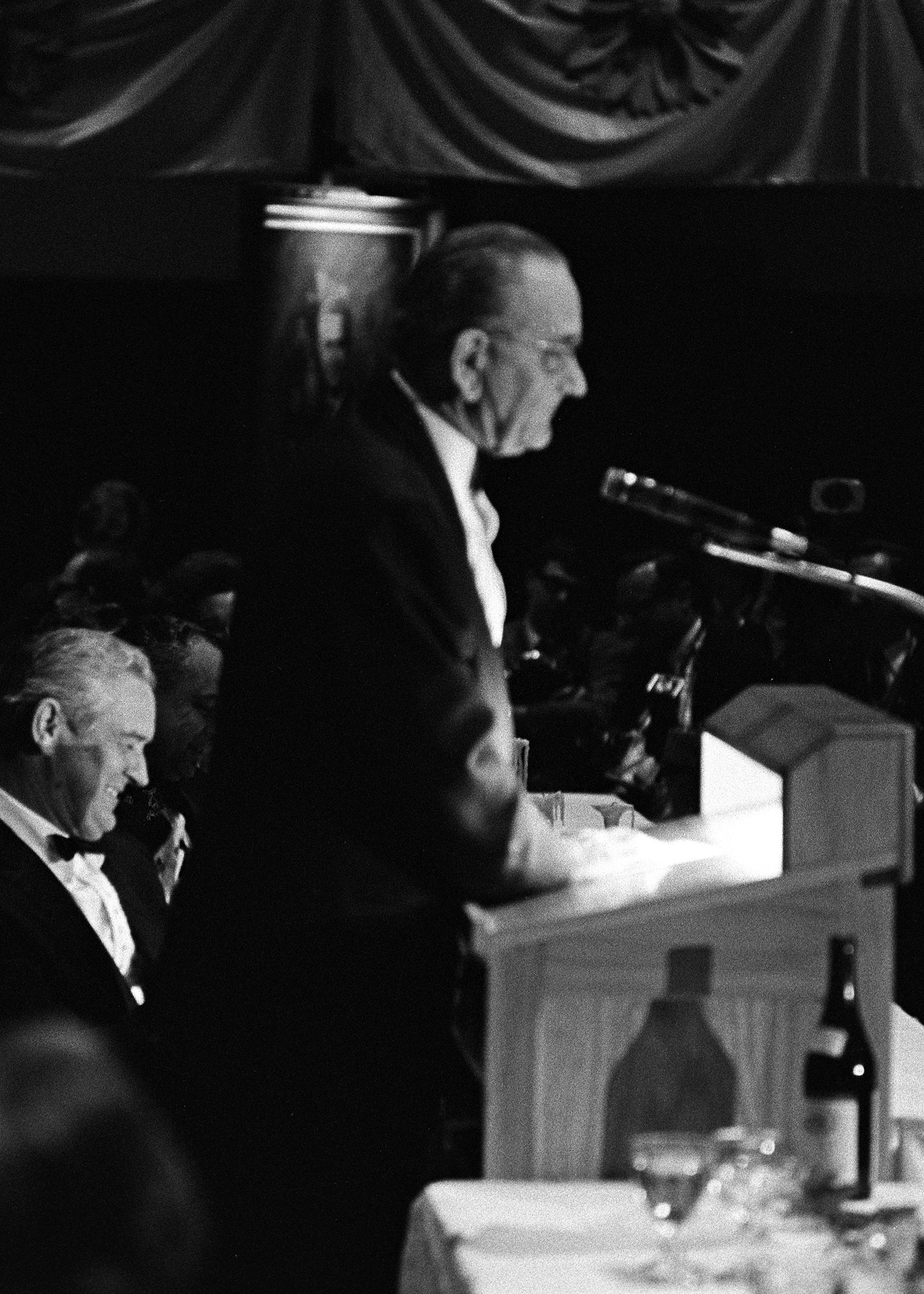
And about the time Cronkite intoned his “stalemate” assessment, Johnson was offering light-hearted remarks in Austin, Texas, at the 51st birthday party of Texas Governor John Connally (see photo, above).

“Today you are 51, John,” the president said. “That is the magic number that every man of politics prays for — a simple majority.”

I further note in Getting It Wrong that there is no compelling evidence that Johnson saw the Cronkite program later, on videotape.

Even if he had, Cronkite’s characterization of the was as a “stalemate” would have come as old news to the president. What Cronkite said about Vietnam on February 27, 1968, hardly earth-shaking, stunning, or original.

In no way did it alter the course of the war or influence American policy.

If anything, Cronkite’s observation about a “stalemate” was a rehash of what other news organizations, such as the New York Times, had been saying for months.

For example, the Times said in a news analysis published July 4, 1967:

“Many officers believe that despite the commitment of 466,000 United States troops now in South Vietnam … the military situation there has developed into a virtual stalemate.”

And in a report from Saigon that appeared on August 7, 1967, the Times noted:

“‘Stalemate’ is a fighting word in Washington. President Johnson rejects it as a description of the situation in Vietnam. But it is the word used by almost all Americans here, except the top officials, to characterize what is happening.”

So why bother calling out Matthews for casually invoking the central component of the mythical “Cronkite Moment”?

Doing so serves to highlight how insidious the myth has become, how blithely it is marshalled to support the notion that courageous and motivated journalists can do marvelous things.

Doing so also demonstrates anew that not even prominent and presumably fact-checked news organizations such as the Times are resistant to the intrusion of hoary media myths.

And doing so indicates that at least some high-profile contemporary journalists possess a shaky command of the history of their field.

WJC

Many thanks to Instapundit
Glenn Reynolds for linking to this post

Recent or related:

40 years on: The ‘napalm girl’ photo and its associated errors

In Anniversaries, Debunking, New York Times, Photographs on June 3, 2012 at 8:47 am

‘Napalm Girl’ image (Nick Ut/AP)

Nearly 40 years have passed since an Associated Press photographer, Nick Ut, took one of the most memorable photographs of the Vietnam War — the image of a 9-year-old girl screaming in terror as she fled, naked, from a misdirected napalm attack.

In a recent retrospective article, the AP said the famous photo, taken June 8, 1972, “communicated the horrors of the Vietnam War in a way words could never describe, helping to end one of the most divisive wars in American history.”

There’s no denying the stunning quality of what often is called the “napalm girl” image. But whether it helped “end” the Vietnam War is improbable: That’s an exaggeration, a case of locating far too much significance in a single image.

By mid-June 1972, after all, most U.S. combat units had been removed from South Vietnam. For American forces, the ground war was quickly winding down.

The “napalm girl” image figured in a recent New York Times obituary about Horst Faas, a gruff, German-born photographer who spent years in Vietnam, covering the conflict for the AP.

Faas won two Pulitzer Prizes for his work in Vietnam and, later, in Bangladesh. And he was instrumental in making sure the AP moved the “napalm girl” photograph across its wires.

The Times quoted Faas as saying in an AP oral history: “The girl was obviously nude, and one of the rules was we don’t — at the A.P. — we don’t present nude pictures, especially of girls in puberty age.” Even so, the Times wrote, Faas “set his mind on ‘getting the thing published and out.'”

Ut’s photograph won a Pulitzer Prize in 1973.

The Times’ obituary described the photograph as showing “the aftermath of one of the thousands of bombings in the countryside by American planes: a group of terror-stricken children fleeing the scene, a girl in the middle of the group screaming and naked, her clothes incinerated by burning napalm.”

Except that the plane that dropped the napalm wasn’t American.

It was South Vietnamese (as the AP correctly notes in its recent retrospective, stating: “As the South Vietnamese Skyraider plane grew fatter and louder, it swooped down toward her, dropping canisters like tumbling eggs flipping end over end”).

By referring to “American planes,” the Times‘ obituary insinuates that U.S. forces were responsible for the napalm attack that preceded Ut’s photograph — and I pointed this out in an email to the Times.

The newspaper’s assistant obituary editor, Peter Keepnews, replied by email, saying:

“You are correct that the bombing in question was conducted by the South Vietnamese Air Force. However, the obituary referred only to ‘American planes,’ and there does not seem to be any doubt that this plane was American –- a Douglas A-1 Skyraider, to be precise.”

As if the aircraft’s manufacturer was at all central or relevant.

I said as much in replying to Keepnews.

“I think you’re too eager to avoid a correction, or a clarification,” I wrote. “The manufacturer (or ownership) of the aircraft is inconsequential; far more important is who was flying the planes. And the obit’s wording (‘bombings in the countryside by American planes’) clearly suggests the aerial attacks were carried out [by] Americans, and that Americans caused the deaths and injuries. And that wasn’t the case. The aircraft were American-made, but flown by South Vietnamese pilots.

“A clarification seems in order,” I wrote, “to make the distinction clear.”

Keepnews sent this brief, dismissive response:

“Thank you for your feedback.”

In reply, I pointed out to Keepnews that the brief bios the Times published of the Pulitzer winners in 1973 correctly said that Ut had taken the photo “after South Vietnamese dropped napalm on own people by mistake.”

Keepnews sent no response, and the Times has neither corrected nor clarified the erroneous reference in the Faas obit to the aircraft that dropped the napalm.

The Times should.

After all, Bill Keller, then the newspaper’s executive editor, asserted in a column last year that “when we get it wrong, we correct ourselves as quickly and forthrightly as possible.”

It’s advice worth following.

WJC

Recent or related:

NYTimes blog embraces ‘March Madness’ myth, claims ‘Zero Productivity Zone’

In Debunking, Media myths, New York Times on March 15, 2012 at 2:22 pm

The productivity myth of March Madness has kicked around for years, apparently immune to the most thorough of debunkings.

As the NCAA men’s basketball tournament opened today, the New York Times college sports blog, “The Quad,” embraced the myth with a headline warning that U.S. workplaces were entering the “Zero Productivity Zone.”

“It is officially time to celebrate the two days a year when American productivity goes in the toilet and it’s a good thing,” a post at the blog declared, adding:

“Thursday and Friday are like a little escape hatch from the usual grind, with N.C.A.A. tournament games going non-stop and while the Puritans of the business world can wring their bony hands over paying people who are suddenly obsessed with the fate of Virginia Commonwealth, the proper response is: tough noogies.”

Sure, some of that’s meant tongue in cheek. Or faintly snarky.

But, still: Media Myth Alert is tempted to say “tough noogies” in calling out a blog post that so blithely repeats the dubious claim and contributes to perpetuating a hardy seasonal myth. And one that does so without data or documentation.

A quick LexisNexis search finds other media outlets indulging in the productivity myth, too.

The Christian Science Monitor, for example, reported the other day:

“According some employment specialists, the next two or three weeks often rank low for productivity, as employees either keep one eye on the scoreboard or just try to cope with less sleep. Even leading up to the second round, which starts Thursday, many employees spend a lot of company time ‘researching’ teams to compete in their office pools or in ‘bracketology’ showdowns online.”

To support such assertions the Monitor article turned to estimates by the Chicago outplacement firm, Challenger, Gray & Christmas, which over the years has propelled the myth with outlandish claims about productivity loss.

This year, the firm is a bit coy about projecting productivity losses. It claims in a news release that U.S. employers today and Friday may end up paying $175 million in wages to workers distracted by the games.

But Challenger proceeds to dismiss its own estimate, saying it’s not to be taken seriously.

On the second page of its news release, Challengers advises taking the estimate “with a grain of salt, as it is meant to be a tongue-in-cheek look at how technology continues to blur the line between our professional and personal lives.

“Ultimately,” the statement says, “March Madness will not even register a blip on the nation’s economic radar and even the smallest company will survive the month without any impact on their bottom line.”

Not even a blip.

Which makes one wonder why the company offers such outlandish estimates in the first place, given that they inject fresh life into a myth that deserves disposal on the slag heap of statistical imprecision. Is it so eager for free publicity?

And as Carl Bialik, the Wall Street Journal’s Numbers Guy, asked in a column seven years ago, “why does the press report studies whose authors don’t take them that seriously?”

Why, indeed?

No doubt because they’re simplistic and easily accessible. As I point out in my latest book, Getting It Wrong, among the most tenacious media myths are those that “minimize or negate complexity” and “offer simplistic and misleading interpretations instead.”

WJC

Recent and related:

Online at BBC News: Recalling the derivation of ‘All the news that’s fit to print’

In 1897, Anniversaries, New York Times, Newspapers, Yellow Journalism on February 11, 2012 at 12:10 am

The most famous seven words in American journalism — “All the news that’s fit to print” — took a permanent place 115 years ago yesterday in the upper left corner, or left “ear,” of the New York Times masthead.

On front page for 115 years

And I recalled that occasion in a piece for the BBC News online site, writing:

“The motto appeared on the Times’ front page without notice, commentary, or fanfare. In the years since, the phrase has been admired as a timeless statement of purpose, interpreted as a ‘war cry’ for honest journalism, and scoffed at as pretentious, overweening, and impossibly vague.

“Even the Times hasn’t been entirely consistent in its embrace and interpretation of those seven words. In 1901, at the 50th anniversary of its founding, the Times referred to ‘All the news that’s fit to print’ as its ‘covenant. In 2001, a Times article commemorating the newspaper’s 150th anniversary said of the motto:

“’What, exactly, does it mean? You decide. The phrase has been debated, and endlessly parodied, both inside and outside the Times for more than a century.’

“On occasion, the motto has been taken far too seriously, as in 1960 when Wright Patman, a U.S. congressman from Texas, asked the Federal Trade Commission to investigate whether ‘All the news that’s fit to print’ amounted to false and misleading advertising.

“’Surely this questionable claim has a tendency to make the public believe, and probably does make the public believe, that the New York Times is superior to other newspapers,’ Patman wrote.

“The Trade Commission declined to investigate, saying: ‘We do not believe there are any apparent objective standards by which to measure whether “news” is or is not “fit to print.”’

“No matter how it’s interpreted, the motto certainly is remarkable in its permanence. One-hundred fifteen years on the front page has invested the motto with a certain gravitas. It often has been associated with fairness, restraint, and impartiality — objectives that nominally define mainstream American journalism.

“A commentary in the Wall Street Journal in 2001 addressed those sentiments, describing the motto as the ‘leitmotif not merely for the Times, but also, by a process of osmosis and emulation, for most other general-interest papers in the country, as well as for much of the broadcast media.

“Interestingly, the ‘leitmotif’ of American journalism had its origins in marketing and advertising.

“’All the news that’s fit to print’ first appeared on an illuminated advertising sign, spelled out in red lights above New York’s Madison Square in early October 1896. That was about six weeks after Adolph S. Ochs had acquired the newspaper in bankruptcy court.

“Ochs, patriarch of the family that still controls and publishes the Times, had come to New York from Tennessee. His task was to differentiate the Times from its larger, aggressive, and wealthier rivals — notably the yellow press of William Randolph Hearst and Joseph Pulitzer. It was a tall order, given the beleaguered status of the Times in New York’s crowded newspaper market.

“Ochs possessed a keen sense of promotion and turned to a number of techniques to call attention to the Times. The illuminated sign at Madison Square was one. An even more successful promotion was a contest inviting readers to propose a better motto.

“In late October 1896, the Times announced it was offering $100 for the phrase of ten words or fewer that ‘more aptly’ captured the newspaper’s ‘distinguishing characteristics’ than ‘All the news that’s fit to print.’

“Hundreds of entries poured in. …  As the contest unfolded in the fall of 1896, the Times amended the rules, making clear it would not abandon ‘All the news that’s fit to print’ but would still pay $100 for the best suggestion. And entries kept coming in.

“A committee of Times staff narrowed the field to 150, which in turn was winnowed to four by the motto contest judge, Richard W. Gilder, editor of The Century magazine. The finalists were:

  • “Always decent; never dull”
  • “The news of the day; not the rubbish”
  • “A decent newspaper for decent people”
  • “All the world’s news, but not a School for Scandal”

“The latter entry, Gilder determined, was the best of the lot, and the Times paid the prize money to the author of the phrase, D.M. Redfield of New Haven, Connecticut.

“What exactly prompted Ochs to move ‘All the news that’s fit to print’ to the front page 115 years ago is not entirely clear. But his intent was unmistakable — to throw down a challenge to the yellow press, a challenge that Ochs ultimately won. The Times has long outlived the New York newspapers of Hearst and Pulitzer.

“So the motto lives on as a reminder, as a daily rebuke to the flamboyant extremes of fin-de-siècle American journalism that helped inspire ‘All the news that’s fit to print.'”

WJC

Recent and related:

Public opinion, Vietnam, and Cronkite’s ‘untouchable aura of authority’

In Cronkite Moment, Debunking, New York Times on November 5, 2011 at 8:58 am

The fantasy that Walter Cronkite represented an ideal of dispassionate, authoritative news reporting is so alluring that even the anchorman’s long-ago birthday has become an occasion for honoring his “untouchable aura of authority.”

The Smithsonian Institution’s “Around the Mall” blog did just that yesterday, in a post that recalled Cronkite, who was born November 4, 1916, as “an anchor who [spoke] with the authority of a religious leader or founding father.”

A “religious leader or founding father”?

Oh, spare us the hyperbole.

Cronkite read the news for 19 news as anchor of the CBS Evening News program. And his purported trustworthiness was more likely than not a function of a relic of mid-20th century broadcasting called the “Fairness Doctrine.”

Media critic Jack Shafer called attention to this linkage in a fine column written shortly after Cronkite’s death in 2009.

Shafer wrote:

“Accepting for the moment the argument the public trusted Cronkite because he practiced trustworthy journalism, it’s worth mentioning that between 1949 and 1987 — which come pretty close to bookending Cronkite’s TV career — news broadcasters were governed by the federal ‘Fairness Doctrine.’

“The doctrine required broadcast station licensees to address controversial issues of public importance but also to allow contrasting points of view to be included in the discussion. One way around the Fairness Doctrine was to tamp down controversy, which all three networks often did.”

Not often did Cronkite court controversy on the air.

The hagiographic “Around the Mall” piece hints at one of those few occasions — in late February 1968 when Cronkite, after a visit to Vietnam, declared the U.S. military effort there was “mired in stalemate.”

“Around the Mall” asserted that “Cronkite’s untouchable aura of authority led droves of viewers to change their opinions on Vietnam.”

And what evidence did the blog post produce?

A comment by David Ward, an historian at the National Portrait Gallery who is the biographer of Charles Willson Peale. Ward was quoted as saying about Cronkite’s reporting:

“He comes back [from Vietnam] and raises real questions about what our aims are, and whether the aims are being accurately reported to the American people. In 1968, there were plenty of people who were protesting the war in Vietnam. It’s the fact that he’s a firmly established, mainstream, church-going, centrist, respectable person that matters.”

Well, maybe. But the historian’s remark is hardly evidence that Cronkite’s views “led droves of viewers to change their opinions on Vietnam.”

More precisely, it was the other way round: Cronkite followed rather than led public opinion on the war.

As I discuss in my latest book, Getting It Wrong, public support for the war in Vietnam had begun declining months before Cronkite went on the air to say the conflict was “mired in stalemate.”

A Gallup poll conducted in October 1967 found for the first time that a plurality of Americans — 47 percent — felt sending troops to fight in Vietnam had been a mistake.

A little more than two years earlier, only 24 percent of respondents said they thought sending American forces to Vietnam had been a mistake.

I also point out in Getting It Wrong that print journalists detected a softening in support of the war long before Cronkite’s “mired in stalemate” assessment.

In December 1967, for example, Don Oberdorfer, a national correspondent for the Knight newspapers, noted that the “summer and fall of 1967 [had] been a time of switching, when millions of American voters — along with many religious leaders, editorial writers and elected officials — appeared to be changing their views about the war.”

What’s more, Cronkite’s “mired in stalemate” observation was hardly a novel or stunning characterization.

Journalists had been using the term “stalemate” for months in commentaries, analysis, and news reports about the war.

For example, syndicated columnist James J. Kilpatrick wrote in August 1967:

“So long as the present ground rules obtain in Vietnam, this war will drag along its indecisive way. … [T]he condition is stalemate.”

Also in August 1967, the New York Times said in a news analysis that the war in Vietnam “is not going well.”

U.S. victory, the Times said, “is not close at hand. It may be beyond reach.”

The analysis was published on the front page, beneath the headline:

“Vietnam: The Signs of Stalemate.”

So not only did he trail public opinion, Cronkite followed news media interpretations of the war as well.

WJC

Recent and related: