W. Joseph Campbell

Archive for the ‘Spanish-American War’ Category

Wikileaks and the Spanish-American War?

In Debunking, Media myths, Spanish-American War, Yellow Journalism on December 3, 2010 at 7:41 am

The recent Wikileaks disclosure of more than 250,000 U.S. diplomatic cables has prompted commentators to look for parallels, however rough, in American history.

Going to war with Spain

The Watergate scandal has been invoked, but the equivalents are neither especially clear nor convincing.

Now, the blustering conservative commentator Pat Buchanan has found Wiki-like resonance in a diplomatic faux pas in 1898, when the chief Spanish diplomat in Washington wrote disparagingly of President William McKinley in a private letter.

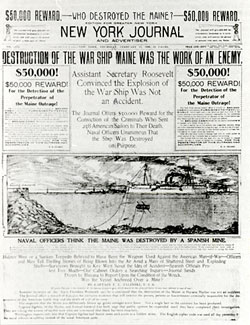
The letter was purloined and given to William Randolph Hearst‘s New York Journal, which splashed the  contents across its front page, beneath a hyperbolic headline that declared:

“The Worst Insult to the United States in its History.”

It’s an intriguing case, about which Buchanan said in a blog post yesterday:

“The Spanish minister in Washington, Enrique Dupuy De Lome, had written an indiscreet letter that was stolen by a sympathizer of the Cuban revolution and leaked to William Randolph Hearst’s warmongering New York Journal. In the De Lome letter, the minister had said of McKinley that he is ‘weak, and a bidder for the admiration of the crowd, besides being a … politician who tries to leave a door open behind himself while keeping on good terms with the jingoes of his party.’

“Six days later, the battleship Maine blew up in Havana harbor. Hearst’s Journal screamed Spanish ‘treachery.’ And the war was on.”

Just like that?

Well, no.

The Maine blew up in mid-February 1898. The United States and Spain did not declare war until late April 1898, during which time a U.S. Naval Court of Inquiry investigated the battleship’s destruction. The Inquiry found that the Maine most likely had been destroyed by an underwater mine. Who set the device couldn’t be determined.

The de Lome letter and the destruction of the Maine weren’t related and they weren’t decisive factors in the U.S. decision to declare war in 1898. (And the overheated content of Hearst’s New York Journal wasn’t much of a factor at all in the march to war.)

As I wrote in my 2005 book, The Spanish-American War: American War and the Media in Primary Documents:

“The United States went to war in April 1898 to fulfill a moral and humanitarian imperative—that of ending the abuses created by Spain’s failed attempt to quell an island-wide rebellion in Cuba,” its last important colonial possession in the Western hemisphere.

The Spanish-American War, in broad terms, was the upshot of a prolonged, three-sided diplomatic impasse: Cubans, who in 1895 launched what became an island-wide rebellion against Spanish rule, would settle for nothing short of political independence. Spain, for reasons of political stability at home, would not agree to grant Cuba its independence. And the United States could tolerate no longer the disruptions caused by turmoil in Cuba.

Spain sent nearly 200,000 soldiers to the island in a mostly failed attempt to put down the rebellion. But by early 1898, the military situation in Cuba was a stalemate.

A particularly disastrous element of Spain’s strategy was to seek to deprive Cuban rebels of support in the hinterland through a policy called “reconcentration,” under which Cuban non-combatants–old men, women, and children–were forced into garrison towns. There, by the tens of thousands, the Cubans fell victim to disease and starvation.

A humanitarian disaster had taken hold in Cuba by early 1898, and the harsh effects of Spain’s “reconcentration” policy were often described in U.S. newspapers, including Hearst’s yellow press.

In many respects, the U.S. entry into the rebellion in Cuba was a humanitarian crusade to end to the abuses caused by Spain’s “reconcentration” policy.

Buchanan’s telescoping of late 19th century history lends a mistaken impression that de Lome’s diplomatic faux pas help precipitate a war. It didn’t.

At best, it was a mild contributing factor.

WJC

Recent and related:

My thanks to FiveFeetofFury for linking to this post.
He may be arrogant, but he’s right about presentism

In Debunking, Media myths, Spanish-American War, Watergate myth on November 29, 2010 at 6:57 am

Edmund Morris, the Pulitzer Prize-winning biographer of Theodore Roosevelt, is a bit of an arrogant twit. But he was absolutely on-target in dismissing as “presentist” an inane question raised yesterday by host Bob Schieffer on the Face the Nation interview program.

Morris on 'Face the Nation'

Schieffer asked Morris, who recently completed the third of three volumes about Roosevelt’s life and times:

“What would Teddy Roosevelt think of today’s politics, Edmund?”

To which the Kenya-born Morris, who has lived in the United States since 1968, replied:

“You keep asking these presentist questions, Bob. As the immortal Marisa Tomei said in [the movie] My Cousin Vinny, that’s a bullshit question. Because you cannot pluck people out of the past and expect them to comment on what’s happening today.

“I can only say that what he represented in his time was that what we look for in our presidents now, what we hope for in our presidents now and we’re increasingly disappointed. He was somebody who understood foreign cultures. He represented the dignity of the United States. He was forceful but at the same time civilized.

“And what I really feel these days is we’ve become such an insular people … I see an insular people who are insensitive to foreign sensibilities, who are lazy, obese, complacent, and increasingly perplexed as to why we are losing our place in the world to people who are more dynamic than us and more disciplined.”

Morris’ comments–especially his profanity and his condescending swipes at Americans–quickly drew flak in the blogosphere.

And it’s true enough, as Matt Schneider of mediate.com observed with tongue in check, that “nothing compares to the thrilling unpredictability of an uninhibited guest like Morris who in one breath idolizes America’s ‘immortal’ movie stars, but in the next laments the rest of America as fat and lazy.”

Still, Morris was quite right to challenge Schieffer’s question. He was quite right to say that “you cannot pluck people out of the past and expect them to comment on what’s happening today.” It was a useful lesson.

Morris in effect was calling attention to the fallacy of presentism–that of applying contemporary standards and ideals to events and characters of the past. In other words, reading the present into the past.

Earlier in the show, Schieffer had asked Morris:

“What would T.R. have thought about what’s going on today? … Is there any correlation that you see between what he thought about and his vision for the country and, say, the rise of the Tea Party movement?”

To which Morris replied: “Well, I’m not going to pluck him out of the past because you can’t do that. He lived in his time. And he represented his time.”

Presentism is one of the fallacies David Hackett Fischer discussed 40 years ago in his superb study, Historians’ Fallacies.

Fischer noted: “The fallacy of presentism is a common failing in historical writing by men who have never been trained in the discipline of history.” He also wrote: “Academic historians are not exempt from the same error.”

Morris, whose Colonel Roosevelt has just been published, appeared on Face the Nation with three other authors of recent historical or political books. Among them was Bob Woodward, he of the Washington Post Watergate fame and author most recently of Obama’s Wars.

I’ve previously discussed at Media Myth Alert another, even more common fallacy of history–the “golden age” fallacy.The fallacy also is addressed in my latest book, Getting It Wrong, which debunks 10 prominent myths about the news media. Among them is the heroic-journalist myth of Watergate–the notion that the tireless reporting by Woodward and his colleague Carl Bernstein brought down Richard Nixon’s corrupt presidency.

I note in Getting It Wrong that the “golden age” fallacy is a “flawed but enticing belief that there really was a time when journalism and its practitioners were respected and inspiring”—the time, say, of Woodward and Bernstein.

WJC

Recent and related:

Some snarky history from WaPo

In Debunking, Spanish-American War on November 28, 2010 at 4:27 pm

Today’s Washington Post offers up a snarky commentary about the USS Olympia, the famous 19th century warship that helped launched an American empire.

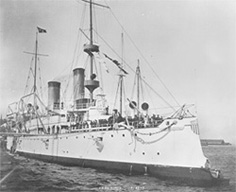
The Olympia in 1899

The Olympia was Commodore George Dewey’s flagship in the Battle of Manila Bay that opened the Spanish-American War in May 1898. In recent years, the old warship has been a floating museum, docked at the Independence Seaport Museum on the Delaware River in Philadelphia.

The Post commentary says the Olympia, which was launched in 1892, is at risk of falling apart, and if it millions of dollars aren’t raised to save it, the vessel “will be dismantled for scrap or sunk to build an artificial reef off Cape May, N.J.

“And with it will go a symbol of America’s age of empire. When the Olympia was built, the United States was redefining itself as a global power, taking on expensive, elective wars in ever-more-distant places.”

Just what were those “expensive, elective wars” of the 1890s is left unsaid. The authors seem to be referring to the Spanish-American War, which marked the first time the United States projected its military power in a sustained way beyond the Western Hemisphere.

But the Spanish-American War was the consequence of no imperialist design. Rather, the conflict stemmed from an impasse over Spain’s reluctance to grant political independence to Cuba.

More specifically, as I wrote in my 2005 book, The Spanish-American War: American War and the Media in Primary Documents:

“The United States went to war in April 1898 to fulfill a moral and humanitarian imperative—that of ending the abuses created by Spain’s failed attempt to quell an island-wide rebellion in Cuba.”

I further wrote:

“While conditions [in Cuba] were the primary cause of the Spanish-American War, the conflict’s first and the last important military engagements were fought not in the Caribbean but in the distant Philippines.

“When the two-front war ended in August 1898, the United States had in effect become an imperial power, with new dependencies in the West Indies, Asia and the Pacific—an outcome wholly unanticipated four months before.”

Indeed, the outcome was unimagined at the war’s outset.

The commentary about the Olympia invokes one of the more misunderstood moments in the run-up to the Spanish-American War–an episode that in a snarky way might be called Teddy Roosevelt’s busy afternoon. Roosevelt then was an assistant secretary of the Navy.

The commentary says that when Navy Secretary John Long took “the day off” in late February 1898, Roosevelt “seized the opportunity to put the Navy on war footing.

“Roosevelt,” the commentary adds, “ordered Commodore George Dewey, aboard the Olympia in Hong Kong, to attack Spanish ships at their port in Manila, capital of the Philippines. That April, the Spanish-American War began.”

Teddy Roosevelt’s agency that day does make for a delicious story–but it didn’t happen quite the way the commentary recounts it. Roosevelt ordered no immediate attack.

Long, the navy secretary, took an afternoon off in late February 1898, not long after the explosion that destroyed the USS Maine in Havana harbor. And Roosevelt took it upon himself to dash off secret instructions to Dewey, telling him to concentrate the U.S. Asiatic squadron at Hong Kong and to be at the ready with coal bunkers topped off.

Roosevelt’s instructions said that “in the event of [a] declaration of war” with Spain, Dewey was to make sure the Spanish fleet at Manila did “not leave the Asiatic coast” and then undertake “offensive operations in the Philippines.”

The instructions were clearly conditional on war being declared, as it was several weeks later.

But the instructions represented no dramatic departure. They were much in keeping with U.S. planning.

As Ivan Musicant wrote in Empire by Default, his splendid history of the Spanish-American War:

“Revisionists to the contrary, Roosevelt’s orders to Dewey were not part of an imperialist cabal to get a jump on … American expansion. A naval attack on the Philippines in a war with Spain had been contemplated at least since the previous summer in the Naval War College scenarios. Long was aware of it and had endorsed the operation should it come.

“Roosevelt’s action in triggering the movement, though certainly beyond the scope of his nominal duties, was a sensible act of military preparedness.”

While impetuous perhaps, Roosevelt’s conduct that long ago afternoon hardly bore the sinister implications suggested by the Post commentary.

So not only was the commentary snarky. It was misleading and flabby.

WJC

Recent and related:

Media myths send ‘misleading’ message of media power

In Cronkite Moment, Debunking, Hurricane Katrina, Media myths, Murrow-McCarthy myth, Newspapers, Spanish-American War, Washington Post, Watergate myth on November 13, 2010 at 9:42 am

In this, the second of three installments drawn from Newsbusters‘ lengthy interview about Getting It Wrong, I discuss why it’s vital to debunk media-driven myths, those dubious tales about the news media that masquerade as factual.

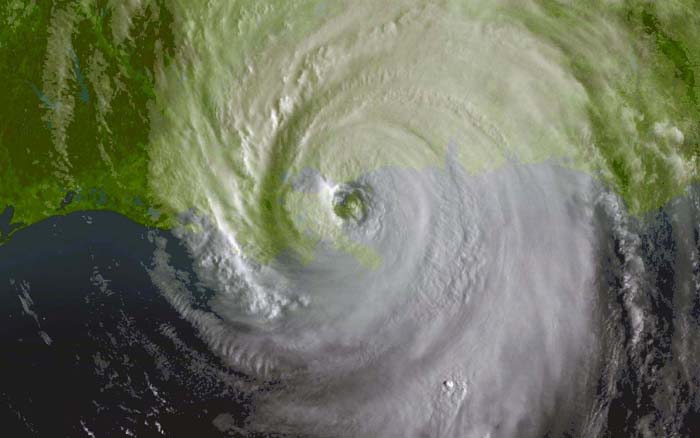
This installment also includes a discussion about the flawed and over-the-top news coverage of Hurricane Katrina‘s aftermath in 2005.

The Newsbusters interview was conducted by Lachlan Markay, who described Getting It Wrong as “exhaustively researched and painstakingly even-handed.”

The third and final excerpt from the interview will be posted tomorrow at Media Myth Alert . The interview transcript is accessible here.

NEWSBUSTERS: So why, personally, do you feel that–you obviously feel it’s very important that these myths be exposed as myths. What’s the damage that these myths do if they carry on unquestioned?

CAMPBELL: I think one of the drawbacks [of media-driven myths] is that they … suggest power that the news media typically do not have. Media power in my view tends to be episodic, tends to be situational, nuanced, and it’s typically trumped by other forces and other factors. Government power, police power tend to overwhelm media power on an average basis in most circumstances.

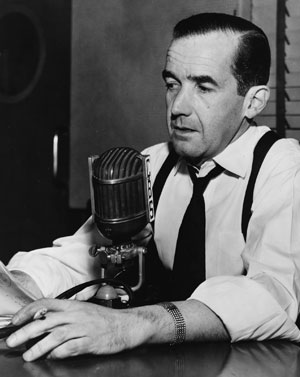
But these stories–about [Walter] Cronkite, about [Edward] Murrow, about Watergate, about [William Randolph] Hearst, and some of the others in the book–typically send a message that the media have great power, to do good or to do harm.

They can start a war, they can end a war, they can alter the political landscape, they can even bring down a president–they’re that powerful. That’s absolutely a misleading message. It’s not how media power is applied or exerted, and that’s an important reason to debunk these myths.

There’s also some inherent importance too in trying to set the record straight to the extent you can. And in that regard, the book is aligned with the fundamental objective of journalism as practiced in this country, of getting it right, getting the story correct. …

NB: And some of the–the Katrina example comes to mind–some of the myths actually have to do with the media–not just a flawed or misleading understanding of events, but a completely fabricated, and made up and very destructive events sometimes. And I say Katrina because there were all these reports of gunfire in New Orleans, of dead bodies being piled up in the Superdome, none of which was true.

CAMPBELL: That’s right. …  Not only that, but the collective sense that those kinds of media reports gave about New Orleans–the place had just collapsed, the city and its people had collapsed into this sort of apocalyptic, Mad Max-like, nightmarish scene–and it served to besmirch the city and its citizens at the time of their direst need.

And that, I think, is just absolutely reprehensible. And that’s the message that we were getting [from the coverage of Katrina’s aftermath in early September 2005]. …

To the credit of the news media, they did go back –many of them, many of these news organizations–and took a look at how they got it wrong. But that tended to be a one-off kind of thing, and placed … inside the papers.

Broadcast media didn’t do much of this at all. … So even to this day, five years on, I still don’t believe the news media have taken full measure of the mistakes they made in the coverage of Hurricane Katrina.

The tendency is still to blame government–local, state, and certainly federal government–for an inept response. But the story was deeper than that, and it was more complex than that, and that’s the part that the news media got wrong.

NB: And of course one of the consequences of that misreporting was that, as you mention, the federal government especially bore a lot of the blame for what was happening there. And then you also have Murrow taking down perhaps the most notorious cold warrior in our country’s history, you have Cronkite as the standard-bearer for the left’s main cause during the 1960s, you have Woodward and Bernstein taking down a Republican president. Are there political factors at work here, do you think?

CAMPBELL: I think that some of the more enduring myths are those that have appeal across the political spectrum.

The Cronkite moment is one of them–it appeals because this is, for folks on the right, this is a real clear-cut example of how “the news media screwed us in Vietnam, and how they prevented us from winning the war there.” And on the left it’s an example of telling truth to power, and how Walter Cronkite was able to pierce … the nonsense, and make it clear to the Johnson administration that the policy in Vietnam was bankrupt.

Something for everyone.

End of part two

‘Exhaustively researched and painstakingly even-handed’

In Cronkite Moment, Debunking, Media myths, Murrow-McCarthy myth, Newspapers, Spanish-American War, Washington Post, Watergate myth on November 12, 2010 at 10:15 pm

Getting It Wrong is exhaustively researched and painstakingly even-handed,” writes Lachlan Markay in introducing his detailed interview with me about my latest book.

He writes that W. Joseph Campbell “makes sure to stress at the outset that it is not a ‘media-bashing book.’ Rather, the volume stays true to journalism’s real mission: not myth-making, but fact-finding. Campbell seeks to set the record straight where often journalists themselves have obscured it.”

Excerpts of the interview–posted at the lively Newsbusters online site–follow. The transcript of the interview, which runs to 4,200 words, is accessible here. Other excerpts  will be posted at Media Myth Alert tomorrow and Sunday .

NEWSBUSTERS: We as a society, and as a culture, seem to have this iconic image, collective image, of a journalist in the good old days of journalism, of course, as sort of a shadowy figure with a little press label in his hat hammering away at his typewriter all night to make deadline. Is that a media driven myth, and do we have a sort of false nostalgia about the bygone days of journalism, when reporters were hardworking and honest and could really make a difference and affect positive change?

CAMPBELL: I mean, we can look back in those days, and I think very we’re very susceptible in journalism in general, to what I call in the book the Golden Age fallacy. It’s not my construction, others have identified it, but I think its very applicable to journalism to look back and say, “oh, yes, there really was a time when journalism mattered, when [Walter] Cronkite could shift the direction of a war, or [Bob] Woodward and [Carl] Bernstein, two young reporters could bring down a president.”

That’s emblematic of the Golden Age fallacy. …

NB: So how are these media-driven myths created?

CAMPBELL: They come from lots of different sources. Sometimes these are stores that are just too good to be checked out. Like, William Randolph Hearst [and his famous vow], “You furnish the pictures, and I’ll furnish the war.” That sums up not only Hearst and his malignant, toxic personality pretty well, but it also suggests the news media can, at the worst … even bring about a war that the country otherwise wouldn’t have fought.

NB: You open the book with the example of the New York Sun, and mere months before it closes shop, it offers Cronkite and [Edward] Murrow as the paragons of the power of journalism and journalistic integrity and honesty and speaking truth to power. Those are both myths?

CAMPBELL: Yeah, both of ’em. And Murrow–although he’s held up as the white knight of broadcast journalism–was very much a compromised character. Even his own biographers have identified what we would see today as disqualifying ethical lapses in his background. He claimed degrees that he did not earn, he coached Adlai Stevenson on the finer techniques of using television during the 1956 presidential campaign. Privately, he did this, but if that was known, and a well-known broadcast journalist was doing that today–well, I don’t know, but I suspect there would be considerable controversy about that kind of conduct.

Murrow, no white knight

No, Murrow was no white knight. …

NB: Going back to the New York Sun example, these are very self-serving myths sometimes, and today, when traditional journalism, especially print journalism, seems to be on the decline in terms of its influence, are these myths being promoted more than they have traditionally in an attempt by the old guard to convince people of–to make people nostalgic for the time when these honest journalists with integrity spoke truth to power?

CAMPBELL: There is no doubt part of that. That’s one of the factors.

I think that these stories, though, many of them–the Murrow story, the Cronkite story, Watergate, Hearst–are just too good to resist … and they [have] become ingrained as part of the accepted conventional wisdom.

The Watergate story–the dominant narrative of Watergate–really is that Woodward and Bernstein brought down a corrupt president. Now there’s no doubt in my mind that Nixon was corrupt and deserved to be removed from office, but the forces that brought him down were not Woodward and Bernstein. In fact, Woodward and Bernstein and the Washington Post were really marginal to that [outcome]. But it’s become part of the story, part of the dominant narrative, it’s an intriguing story and it lives on that way.

It’s also a very simplistic explanation for a complex historical event, and that’s another reason these myths take hold and live on. Watergate was not–the outcome of Watergate was not due to the Washington Post so much as it was to the combined, collective, if not always coordinated efforts of subpoena-wielding authorities. The FBI, federal prosecutors, special prosecutors, both houses of Congress, ultimately the Supreme Court, which got Nixon to surrender the tapes the prosecutors had wanted, and those tapes quite clearly showed his active role in covering up the seminal crimes of Watergate.

So it took that kind of collective effort over a sustained period of time by people who could compel testimony and could compel the disclosure of evidence in ways that reporters can’t.

End of part one

Inaugurating the Parker-Qualls lecture

In Debunking, Media myths, Spanish-American War, War of the Worlds, Washington Post, Watergate myth, Yellow Journalism on November 11, 2010 at 10:55 pm

I inaugurated last night the Parker-Qualls lecture in communications at the University of North Alabama with an audience of some 300 students, faculty, staff, administrators, and townspeople in attendance.

My talk centered on three of the 10 prominent media-driven myths debunked in  my latest book, Getting It Wrong.

I discussed the heroic-journalist myth that has become the dominant narrative of the Watergate scandal, which ended Richard Nixon’s presidency in 1974; the mythical  “Cronkite Moment” of 1968 that supposedly forced President Lyndon Johnson to realize the futility of the war effort in Vietnam, and The War of the Worlds radio dramatization that reputedly pitched Americans into panic and mass hysteria in 1938.

During the Q-and-A that followed my presentation, I was asked how media audiences can better identify potential media-driven myths, those dubious stories about or by the news media that masquerade as factual. It’s a fine question, with no easy answer.

I advised being wary about media-related stories that just sound too neat and too tidy. The famous vow attributed to William Randolph Hearst–“you furnish the pictures, and I’ll furnish the war”–is a telling example, I said. The quote just seems too good, too perfect to be true.  It deftly captures Hearst as war-monger, but it’s supported by almost no evidence. It’s almost certainly apocryphal.

Media audiences also should apply logic and healthy skepticism to stories about or by the news media and their power, I said, citing The War of the Worlds dramatization as an example. It it really plausible that a radio show–even one as  clever and imaginative as that–really could send tens of thousands, or hundreds of thousands of Americans into the streets in sheer panic and hysteria? It doesn’t seem logical to me.

I also recommended consulting online sources: Some, like Media Myth Alert, are devoted to mythbusting. Even a simple Google search will readily turn skeptical accounts of popular, mediacentric stories.

I also was asked whether there were candidate-media myths that proved to true. Another good question and I couldn’t recall any immediately.

Then I remembered having had suspicions about Joe Namath’s guarantee that the New York Jets would defeat the heavily favored Baltimore Colts in the 1969 Super Bowl. That Namath guaranteed victory sounded to me almost too neat and tidy to be true.  (I privately congratulated myself on remembering being suspicious of that quote,  as it enabled me to mention a football legend who starred at the University of Alabama, a team much followed in Northern Alabama.)

Anyway, it turned out that Namath had indeed made such a guarantee–which I quickly determined in a check of a database of historical newspapers. So that was a candidate myth that proved to be true.

I also was asked what prompted me to write Getting It Wrong. In some ways, I replied, the book built upon previous research. I mentioned my 2001 book, Yellow Journalism: Puncturing the Myths, Defining the Legacies, in which I addressed the myth of Hearst’s famous vow.

I noted that I returned to that topic in the first chapter of Getting It Wrong, offering additional detail about how the often-retold tale about Hearst’s vow took hold and was diffused.

Another inspiration for the book stemmed from my classes at American University. I’ve often included in my courses references to the “Cronkite Moment,” I noted for example, adding that the more I read about and thought about such anecdotes, the more dubious they seemed to be.

And under scrutiny–in researching them–they dissolved as apocryphal or wildly exaggerated.

My hosts at the University of North Alabama have been Greg Pitts, chair of the department of communications, and Jim R. Martin, a journalism historian and editor of the scholarly journal American Journalism.

WJC

Recent and related:

Hearst ‘pushed us into war’? How’d he do that?

In Debunking, Media myths, Newspapers, Spanish-American War on November 3, 2010 at 2:44 pm

'Maine' destroyed

So powerful was William Randolph Hearst, the favorite bogeyman of American journalism, that he and his flamboyant yellow press brought on the Spanish-American War in 1898.

It’s a popular but dubious claim–a media myth, really–that lives on as a cautionary tale about the dark potential of media power.

This enduring myth about Hearst and the war was invoked yesterday, in a post at the Atlantic online site. The item–which took a few pokes at another bogeyman of journalism, global media mogul Rupert Murdoch–declared:

“Murdoch has displayed an absolute genius for pouring gasoline on fires. It’s an old tabloid technique, of course, as William Randolph Hearst well knew as he pushed us into war with Spain a century ago.”

Left quite unsaid is how Hearst accomplished that, how specifically “he pushed us into war with Spain.” It’s a topic we’ve explored previously at Media Myth Alert.

And the answer is, he didn’t.

He couldn’t have.

As I wrote in my 2001 book, Yellow Journalism: Puncturing the Myths, Defining the Legacies:

“The yellow press is not to blame for the Spanish-American-War. It did not force—it could not have forced—the United States into hostilities with Spain over Cuba in 1898. The conflict was, rather, the result of a convergence of forces far beyond the control or direct influence of even the most aggressive of the yellow newspapers, William Randolph Hearst’s New York Journal.”

In 1898, Hearst’s newspapers were the Journal, the New York Evening Journal, and the San Francisco Examiner. These three titles wielded what was at very best modest agenda-setting influence on the rest of the American press, which numbered more than 2,200 daily newspapers.

Indeed, as I noted in Yellow Journalism:

“There is little evidence that the press beyond New York City, especially in small-town and rural America, was influenced by the content of the yellow journals, including their demands for war after the destruction of the Maine,” an American battleship that blew up in Havana harbor in February 1898, killing 266 officers and sailors. (See front-page image, above.)

The destruction of the Maine–in a harbor under Spanish control–was a trigger for the war that began in April 1898, amid a diplomatic impasse between the United States and Spain over extending self-rule to Cuba.

That impasse was the central cause of the conflict.

Invariably absent in the claims that Hearst “pushed us into war” are persuasive explanations about how the often-exaggerated contents of his newspapers were transformed into U.S. policy, and how specifically those contents were decisive in the decisionmaking the led to the United States to declare war on Spain.

If Hearst and his yellow press had indeed “pushed us into war,” researchers surely should be able to find evidence of such influence in the personal papers and in the reminiscences of policymakers of the time.

But nothing of the like can be found in the private letters, diary entries, and diplomatic correspondence of top members of the administration of President William McKinley.

Those papers contain “almost no evidence that the demands of the yellow journals—especially during the critical weeks after the Maine’s destruction—penetrated the thinking of key White House officials, let alone influenced the Cuban policy of the McKinley administration,” I wrote in Yellow Journalism.

And the few occasions when McKinley administration officials did refer to the yellow press in the run-up to the war, they tended to dismiss it as an annoyance or scoff it at as a complicating factor.

WJC

Recent and related:

Getting it right about Hearst, his newspapers, and war

In Debunking, Media myths, Newspapers, Spanish-American War, Yellow Journalism on October 27, 2010 at 7:30 am

It’s rather remarkable how William Randolph Hearst, the timeless bogeyman of American journalism, serves so readily as an exemplar of how awful the news media can be.

Hearst

Hearst and his newspapers, for example, are often blamed for having fomented the war with Spain over Cuba in 1898. They didn’t.

He’s also accused of having vowed to “furnish the war,” in an incendiary telegram to the artist Frederic Remington in 1897. I debunk that popular but thinly documented tale  in my new mythbusting book, Getting It Wrong.

A column yesterday in the Philadelphia Inquirer offered another charge against Hearst’s character and journalism. He was accused of having played on anti-Catholic sentiment to whip up popular sentiment against Spain at the end of the 19th century.

Here’s what the column said:

“Fox News and [Fox talk show host Bill] O’Reilly have been the leading TV gathering point for anti-Muslim sentiment following the attack on New York’s World Trade Center, most recently providing viewers with a rallying point against the so-called ground zero mosque.

“This sort of journalism is even older than what some people characterize as political correctness and others call public respect for minorities. In 1890, William Randolph Hearst helped boost profits for his New York Journal newspaper, stirring public sentiment to start the Spanish-American War, by exploiting antipathy for the Roman Catholic Spanish Empire.”

Let’s see: In 1890 Hearst wasn’t even in New York; he was in San Francisco, running the Examiner newspaper. He didn’t take control of the New York Journal until 1895.

And war was not profitable for Hearst’s newspapers .

As I wrote in my 2001 book, Yellow Journalism: Puncturing the Myths, Defining the Legacies, the Spanish-American War in 1898 generally boosted newspaper circulation. But advertising revenues fell, as advertisers feared the conflict would undercut a halting recovery from hard economic times of the 1890s.

Moreover, newsprint costs soared, as did news-gathering expenditures.

In 1899, the trade journal Fourth Estate estimated that Hearst’s New York Journal had spent $50,000 a week—the equivalent these days of more than $1 million—on cable tolls, reporters’ salaries, and dispatch boats that ferried correspondents’ reports from the war’s principal theater in Cuba to Jamaica and elsewhere for transmission to New York.

Hearst’s Journal scoffed at claims that it helped bring on the war as part of a cynical scheme to build circulation and boost profits.

Hearst's Evening Journal

“Would you like to know what effect the war had on the money-making feature of this particular newspaper? The wholesale price of paper was greatly increased. Advertising diminished, expenses increased enormously,” the Journal said, adding that its expenses related to covering the conflict exceeded $750,000—the equivalent these days of more than $20 million.

Close reading of the Journal in the run-up to the Spanish-American War makes it clear that Catholicism wasn’t much of a preoccupation for the newspaper. The Cubans, after all, were overwhelmingly Catholic, too, and the Journal sided unequivocally with their bid for political self-rule.

The human rights disaster that took hold in Cuba by 1898 was far more important to the Journal and to other newspapers in New York than “antipathy” to Spain’s Catholicism.

Spain, in a clumsy attempt to put down an island-wide rebellion against its colonial governance, forced thousands of Cubans, mostly old men, women, and children, into garrison towns where they could offer neither support nor supplies to the rebels, who controlled much of the countryside.

This policy was called “reconcentration,” and it gave rise to widespread malnutrition and disease: Unknown tens of thousands of Cuban non-combatants died from starvation and illness.

The human rights disaster on Cuba “inevitably stirred outrage and condemnation in the United States,” I wrote in Yellow Journalism . And conditions on Cuba were a frequent topic of reporting in the Journal and other newspapers.

A leading historian of that period, Ivan Musicant, has quite correctly observed that the reconcentration policy “did more to bring on the Spanish-American War than anything else the Spanish could have done.”

Hearst’s newspapers reported about, but certainly did not create, the devastating effects of Spain’s ill-considered and destructive policy.

WJC

Recent and related:

IBD invokes Hearst myth of ‘furnish the war’

In 1897, Debunking, Furnish the war, Media myths, Spanish-American War, Yellow Journalism on October 21, 2010 at 5:19 pm

Remington, Davis in Cuba

In Getting It Wrong, my new mythbusting book, I point out that the most resilient media-driven myths often are those that are distilled “to a catchy, pithy phrase.”

A telling case in point is the line often attributed to William Randolph Hearst: “You furnish the pictures, I’ll furnish the war.” He supposedly was referring to war with Spain in the late 19th century.

Testimony to the tenacity of Hearst’s reputed comment–which I address and debunk in Getting It Wrong–appeared the other day in a commentary in Investor’s Business Daily. The commentary asserted:

“The media have a history of offering more heat than light on many issues. Recall publisher William Randolph Hearst’s telegram to a photographer on assignment to document the supposed conflict in Cuba in 1897: ‘You furnish the pictures, and I’ll furnish the war.'”

Let’s unpack that error-fraught paragraph.

For starters, the story goes that Hearst purportedly sent the telegram to Frederic Remington, a prominent artist (not a photographer), who arrived in Cuba in January 1897 on assignment for Hearst’s New York Journal (see image, above).

Remington was sent there to illustrate the island-wide rebellion against Spanish colonial rule. The artist later recalled that at the time of his brief visit, the Cuban countryside “was a pall of smoke” from homes of Cubans that had been set afire.

Davis

Remington traveled to Cuba with Richard Harding Davis, a prominent writer and correspondent. Davis’ correspondence from that time stated flatly: “There is war here and no mistake.”

So a “supposed conflict” the rebellion was not. In fact, the Cuban rebellion gave rise in 1898 to the Spanish-American War.

As I also point out in Getting It Wrong, the “furnish the war” anecdote lives on despite a nearly complete absence of supporting documentation.

“It lives on,” I write, “even though telegrams supposedly exchanged by Remington and Hearst have never turned up.

“It lives on even though Hearst denied ever sending such a message.”

Moreover, I write, the myth “lives on despite an irreconcilable internal inconsistency: It would have been absurd for Hearst to vow to ‘furnish the war’ because war—specifically, the Cuban rebellion against Spain’s colonial rule—was the very reason Hearst sent Remington to Cuba in the first place.”

A further reason for doubting that Hearst sent such a message is that Spanish authorities closely controlled cable traffic into and out of Cuba. They surely would have intercepted–and would have called attention to–such an inflammatory message, had it been sent.

Despite those and other factors, the Remington-Hearst anecdote is a media myth that refuses to die. One reason for its tenacity, I point out in Getting It Wrong, is that the tale “has achieved unique status as an adaptable, hardy, all-purpose anecdote, useful in illustrating any number of media sins and shortcomings.

“It has been invoked to illustrate the media’s willingness to compromise impartiality, promote political agendas, and indulge in sensationalism. It has been used, more broadly, to suggest the media’s capacity to inject malign influence into international affairs.”

Like many media-driven myths, the “furnish the war” anecdote is succinct, savory, and easily remembered. It is indeed “a catchy, pithy phrase,” one almost too good not to be true.

WJC

Recent and related:

Hearst pushed country into war? But how?

In Debunking, Media myths, Newspapers, Spanish-American War, Yellow Journalism on October 18, 2010 at 7:37 am

Hearst's 'Evening Journal'

That William Randolph Hearst was a war-monger, a feckless newspaper publisher who fomented the conflict with Spain in 1898, can be an irresistible notion.

It’s also a classic media-driven myth, one that ignores the failure of diplomacy that led to the Spanish-American War and offers a simplistic and misleading explanation instead.

The claim that Hearst brought on the war appeared the other day in a commentary published in the Press Gazette of Green Bay, Wisconsin. The commentary flatly asserted:

“William Randolph Hearst wielded tremendous power with his chain of newspapers, up to and including getting the United States involved in a war with Spain beginning in 1898.”

As is often the case, the claim about Hearst’s war-mongering is backed by no documentation, no supporting evidence. It’s as if the matter is settled, as if there’s no disputing that Hearst and his yellow press possessed such power.

It’s assumed Hearst was capable of thrusting the country into war.

But no recent biographer of Hearst, and no serious historian of the Spanish-American War, supports such an interpretation.

I addressed and knocked down such claims in my 2001 book Yellow Journalism: Puncturing the Myths, Defining the Legacies, in which I wrote:

“The yellow press is not to blame for the Spanish-American-War. It did not force—it could not have forced—the United States into hostilities with Spain over Cuba in 1898. The conflict was, rather, the result of a convergence of forces far beyond the control or direct influence of even the most aggressive of the yellow newspapers, William Randolph Hearst’s New York Journal.”

Hearst’s newspapers–which in 1898 included the Journal, the New York Evening Journal, and the San Francisco Examiner–wielded at best modest agenda-setting influence.

I wrote in Yellow Journalism:

“There is little evidence that the press beyond New York City, especially in small-town and rural America, was influenced by the content of the yellow journals, including their demands for war after the destruction of the Maine,” an American battleship that blew up in Havana harbor in February 1898.

The destruction of the Maine in a harbor under Spanish control was a trigger for war, which began in April 1898, after the United States and Spain reached an impasse in negotiations about extending self-rule to Cuba.

Conspicuously absent in argument that Hearst fomented the conflict are adequate or persuasive explanations as to how the often-erroneous, often-exaggerated contents of Hearst’s newspapers were transformed into policy and military action.

As I wrote in Yellow Journalism, if Hearst’s yellow press did bring on the war, then researchers should be able to find unambiguous references to such influence in the personal papers and the reminiscences of policymakers of the time.

“But neither the diary entries of cabinet officers nor the contemporaneous private exchanges among American diplomats indicate that the yellow newspapers exerted any influence at all,” I wrote in the book.

When the yellow press was discussed within the administration of President William McKinley it tended to be dismissed as a nuisance or scoffed at as a complicating factor.

Its content was regarded “neither as a source of insight into popular thinking in the United States nor as a useful guide in pursuing the delicate and ultimately futile negotiations with Spain,” I added.

So there is “almost no evidence that the demands of the yellow journals—especially during the critical weeks after the Maine’s destruction—penetrated the thinking of key White House officials, let alone influenced the Cuban policy of the McKinley administration,” I wrote.

So why is the notion so tenacious that Hearst’s yellow press brought on the war?

Blaming Hearst’s newspapers for the war is a convenient way to excoriate yellow journalism, a ready way of summarizing its excesses and defining its malevolent potential.

WJC

Recent and related: