W. Joseph Campbell

Archive for the ‘War of the Worlds’ Category

Launching ‘Getting It Wrong’ at Newseum

In Bay of Pigs, Bra-burning, Cronkite Moment, Debunking, Furnish the war, Jessica Lynch, Media myths, Murrow-McCarthy myth, War of the Worlds, Washington Post, Watergate myth on June 14, 2010 at 6:28 am

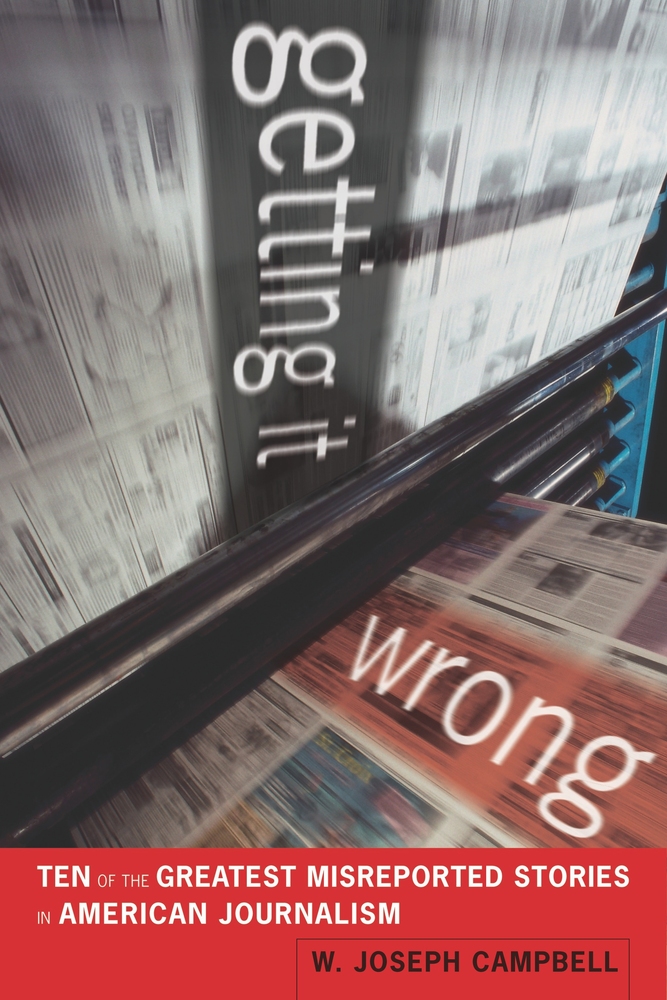
My new book, Getting It Wrong, will be launched Saturday, June 19, at an “Inside Media” program at the Newseum, the $450 million museum of news in downtown Washington, D.C.

The program will begin at 2:30 p.m. in the Knight TV Studio on the third level and will feature a discussion with the Newseum’s John Maynard, followed by audience Q-and-A.

I’ll be signing copies of Getting It Wrong afterward.

The book addresses, and debunks, 10 prominent media-driven myths–stories about and/or by the news media that are widely believed and often retold but which, on close inspection, proved to be apocryphal or wildly exaggerated.

Here is a brief description about each of the 10 myths:

  1. Remington-Hearst: William Randolph Hearst’s famous vow, “you furnish the pictures, I’ll furnish the war,” is almost certainly apocryphal.
  2. War of Worlds: The notion that the War of Worlds radio dramatization in 1938 caused nationwide panic and mass hysteria is exaggerated.
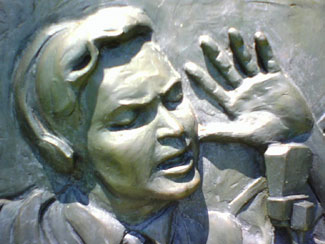
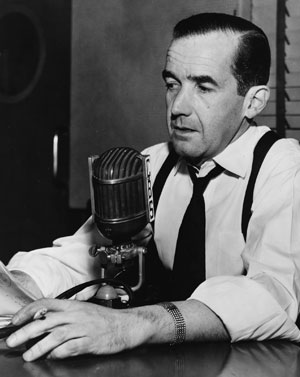
  3. Murrow-McCarthy: Edward R. Murrow’s famous See It Now program in March 1954 did not end Senator Joseph McCarthy’s communists-in-government witch-hunt; Murrow in fact was very late to take on McCarthy.

    Murrow in 1954

  4. Bay of Pigs: The New York Times did not suppress its reporting in the run-up to the ill-fated Bay of Pigs invasion in April 1961.
  5. Cronkite-Johnson: Walter Cronkite’s special report on Vietnam in February 1968 did not prompt an immediate reassessment of U.S. war policy.
  6. Bra-burning: Humor columnist Art Buchwald helped spread the notion that feminist demonstrators dramatically burned their bras at a Miss America protest in September 1968.
  7. Watergate: The Washington Post’s intrepid reporters, Carl Bernstein and Bob Woodward, did not bring down Richard Nixon’s corrupt presidency. That they did is a trope that knows few bounds.
  8. Crack babies: The much-feared “bio-underclass” of children born to women who smoked crack cocaine during their pregnancies never materialized.
  9. Jessica Lynch: The Washington Post’s erroneous reporting about Jessica Lynch early in the Iraq War gave rise to several myths about her capture and rescue.
  10. Hurricane Katrina: News coverage of Katrina’s aftermath in New Orleans in early September 2005 was marred by wild exaggerations of extreme, Mad Max-like violence.
As I write in Getting It Wrong, the myths debunked “are among American journalism’s best-known stories. Most of them are savory tales. And at least some of them seem almost too good to be false.”

I further write that because it “takes on some of the most treasured stories in American journalism,” Getting It Wrong is “a work with a provocative edge. It could not be otherwise.”

WJC

Related:

‘A debunker’s work is never done’

In Bay of Pigs, Bra-burning, Cronkite Moment, Debunking, Furnish the war, Media myths, Murrow-McCarthy myth, New York Times, Reviews, War of the Worlds, Washington Post, Watergate myth, Yellow Journalism on May 21, 2010 at 6:14 pm

So notes the inestimable media critic Jack Shafer in his review of my forthcoming book, Getting It Wrong, posted today at slate.com.

And what a generous, engaging, and insightful review it is.

Under the headline “The Master of Debunk,” Shafer notes that “the only way to debunk an enshrined falsehood is with maximum reportorial firepower.

“Toting big guns and an itchy trigger-finger is American University professor W. Joseph Campbell, whose new book Getting It Wrong: Ten of the Greatest Misreported Stories in American Journalism flattens established myths that you were brought up to believe were true.”

Shafer’s review specifically discusses a variety of media-driven myths, including William Randolph Hearst’s purported vow to “furnish the war” with Spain; the so-called “Cronkite moment” that supposedly altered President Lyndon Johnson’s Vietnam policy; the Bay of Pigs suppression myth that erroneously says President John F. Kennedy persuaded the New York Times to spike a story about the pending U.S.-backed invasion of Cuba, and the heroic-journalist myth of Watergate.

Shafer rightly points out that “a debunker’s work is never done” and to that end notes my recent post at Media Myth Alert about Evan Thomas’ new book, The War Lovers. The book embraces myths of the yellow press period in American journalism, including the Hearst vow.

Shafer thoughtfully considers the tenacity of media-driven myths, writing:

“Some myths endure because the stories are so compelling, like the Hearst tale and the alleged mayhem caused by Orson Welles’ [War of the Worlds] broadcast. Others survive because our prejudices nourish them (“crack babies,” bra burners) or because pure repetition has drummed them into our heads, smothering the truth in the process.

“The best tonic for the brain fever caused by media myths is an open mind and a free inquiry,” he writes.

Shafer wraps up the review by invoking this observation, by Jonathan Rauch:

“It is the error we punish, not the errant.”

Shafers adds:

“Of course when you do such a good job punishing the error, as Campbell does, you don’t need to bother with the errant.”

WJC

Related:

Check out new trailer for ‘Getting It Wrong’

In 1897, Debunking, Furnish the war, Media myths, Spanish-American War, War of the Worlds, Yellow Journalism on May 8, 2010 at 3:45 pm

Here’s the book trailer for Getting It Wrong, my forthcoming book that addresses, and debunks, 10 prominent media-driven myths.

Getting It Wrong will be published this summer by University of California Press.

WJC

Advance pub for ‘Getting It Wrong’

In 1897, Cronkite Moment, Debunking, Media myths, War of the Worlds, Washington Post on April 28, 2010 at 3:47 pm

The online site of the School of Communication here at American University posts today a Q-and-A with me about Getting It Wrong, my forthcoming book that debunks 10 prominent media-driven myths.

Topics addressed include the Remington-Hearst/furnish the war anecdote; the War of the Worlds/mass hysteria myth, and the “Cronkite moment“/”I’ve lost Middle America” meme.

And while the topic is not considered in Getting It Wrong, I also mention the “pharm parties” myth, in which young people are said to take pills of any kind from their parents’ medicine cabinets. They supposedly show up at a party and dump the purloined pills into a large, common bowl. Then they are purported to take turns scooping out and swallowing handfuls of the medications, not knowing what they’re taking, in the supposed pursuit of a drug-induced high.

Jack Shafer, media critic for slate.com, has done fine work in knocking down the “pharm party” meme.

Here are excerpts from the Q-and-A:

Q: “Myth busting” can upset people who have accepted, or even benefited from, the myth. Have you gotten any negative feedback?

A:  Not really. Not so far. I do know that some people wonder “who cares?” about some of the myths debunked in Getting It Wrong. The Hearst—”furnish the war” myth, after all, is more than 100 years old. But I emphasize in the book that media-driven myths are neither innocuous nor trivial. They can, and do, promote stereotypes. They can deflect attention or blame away from the makers of flawed policies. They can, and often do, offer an exaggerated sense of the power and influence of the news media. Plus, debunking myths is a pursuit that’s aligned with a fundamental objective of mainstream American journalism—that of getting it right.

Q: What’s next?

A: I’d like to think there’s a sequel to Getting It Wrong. The universe of media-driven myths isn’t confined to 10, after all. There are more to confront. Also, in fall 2010, I’ll be teaching a “wild card” course in the University’s General Education program titled “Media Myth and Power.” The course will consider several of the myths debunked in Getting It Wrong.

A tip of the chapeau to Michael Wargo of the School of Communication for putting together the Q-and-A, which follows the writeup about the book that appeared April 11 in the “Outlook” section of the Washington Post.

WJC

The spoof in Georgia: Evocative of the ‘War of the Worlds’?

In Media myths, War of the Worlds on March 16, 2010 at 10:17 am

A mock newscast reporting that Russia was invading the former Soviet republic of Georgia stirred frightened reactions that have been likened to the panic and hysteria supposedly caused by Orson Welles’ famous War of the Worlds radio dramatization in 1938.

Welles

The televised spoof in Georgia “was evidently intended as political satire, but the depiction was sufficiently realistic—and memories of the brief war between Russia and Georgia in August 2008 still sufficiently vivid—that viewers headed for the doors before they could absorb the point,” the New York Times said over the weekend.

The anchorman on privately owned Imedi television was shown fumbling papers during the videotaped fake newscast Saturday night,  “as if juggling the chaos of a breaking news story,” the Times reported.

The anchor said fighting had broken out on the streets of Tbilisi, the capital, and that “Russian bombers were airborne and heading for Georgia, that troops were skirmishing to the west and that a tank battalion was reported to be on the move,” according to the Times.

The program was identified as fictitious before the broadcast, the Times said, adding that “viewers who tuned in later would have had to rely on [visual] clues. The fighting in the video was taking place in the summer, for example, not in March.”

The report stirred frenzied reactions, not unlike the War of the Worlds radio broadcast in 1938, in which listeners who tuned in late were prone to believing the dramatization was a real-time Martian invasion.

As it became clear the televised spoof had disturbed and frightened its viewers, Imedi placed a disclaimer on the screen, alerting viewers that the program was a simulation.

The panic lasted about 15 minutes, the Times reported.

Afterward, a knot of demonstrators gathered outside the television station to protest the fake newscast.

A Georgia news outlet in a report posted online today quoted Imedi’s general director, a former political associate of the country’s president, as saying the spoof was intended to underscore the external threats that Georgia face.

Russian forces invaded Georgia in August 2008 and seemed for a time poised to topple the elected government of President Mikheil Saakashvili.

The long-ago War of the Worlds program, which aired over CBS radio on Halloween eve, supposedly was so realistic in its accounts of invading Martians wielding deadly heat rays that newspapers said Americans by the tens of thousands—even the hundreds of thousands—were convulsed in panic.

But as I write in Getting It Wrong, my forthcoming book about media-driven myths, “the panic and mass hysteria so readily associated with The War of The Worlds program did not occur on anything approaching nationwide dimension.

“While many Americans were frightened by the program, most listeners, overwhelmingly, were not.”

But the reaction in Georgia may not have been overstated, given the undeniable threat posed by Russia.

Even so, the TV satire appears to have been as misguided as it was crude and unprofessional. An inexcusably thoughtless use of the airwaves.

WJC