W. Joseph Campbell

Archive for the ‘Washington Post’ Category

Myth appeal runs deep abroad; Watergate a case in point

In 1897, Debunking, Furnish the war, Media myths, Spanish-American War, Washington Post, Watergate myth, Yellow Journalism on October 7, 2010 at 10:20 am

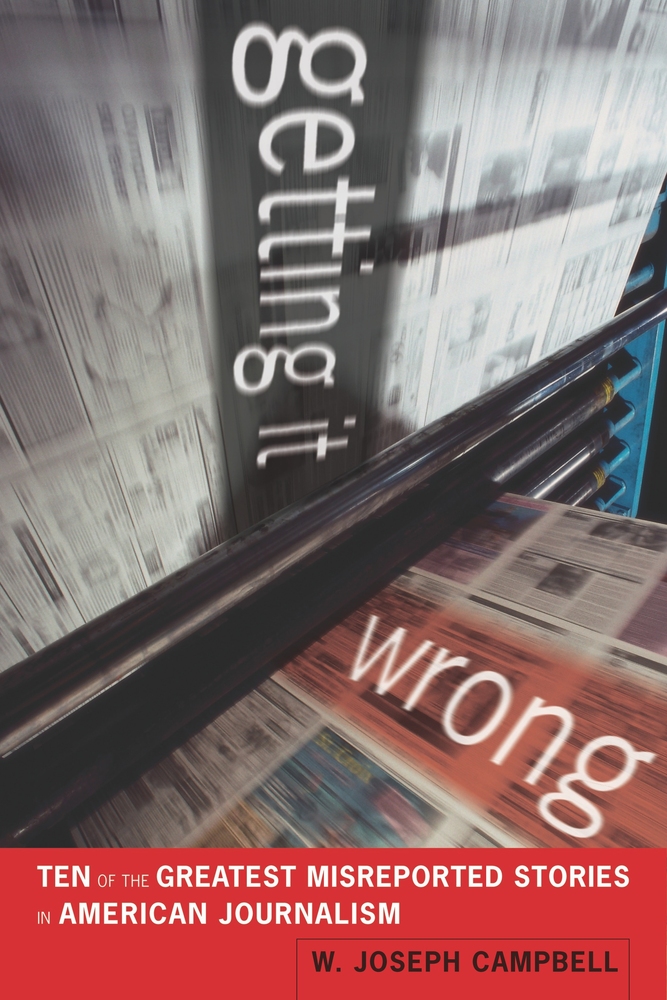
I  spoke about my new book, Getting It Wrong, at a superbly organized American University alumni event last night, at a venue commanding spectacular views of Seattle, Puget Sound, and the Olympic Mountains.

Following my talk, which focused on three of the 10 media-driven myths debunked in Getting It Wrong, I was asked by one of the people in attendance whether myths have similarly emerged about the media in other countries.

A very good question, I replied: I really don’t think so.

Maybe in Britain, I suggested, given the robust media scene there. But I couldn’t say for sure.

While I had to hedge a bit on the question, there’s no doubt that myth appeal runs deep from the United States to other countries. That is, news organizations outside the United States not infrequently repeat what are American media myths.

Media-driven myths, I have noted, can and do travel far, and well.  Take, for example, the heroic-journalist myth of Watergate.

The notion is often embraced in news media in the United States and overseas that the investigative reporting of Bob Woodward and Carl Bernstein, then-young reporters for the Washington Post, took down Richard Nixon and his corrupt presidency.

A measure of the myth’s international appeal can found in a report that aired today on Australia’s ABC radio network, which described Woodward as “one of the Washington Post journalists who brought down a U.S. President.”

Not even Woodward embraces that claim. He said in an interview in 2005:

“To say the press brought down Nixon, that’s horseshit.”

And he’s right. Earthy, perhaps, but right.

I discuss the heroic-journalist myth in Getting It Wrong, noting that it’s a simplistic and misleading interpretation of what was a sprawling and complex scandal. Watergate’s web of misconduct forced Nixon from office and landed nearly 20 of his top aides, associates, and cabinet officers in jail.

To roll up a scandal of such dimension, I write,  required the collective, if not always the coordinated, efforts of special prosecutors, bipartisan congressional panels, federal judges, the FBI, and, ultimately, the U.S. Supreme Court, which ordered Nixon to surrender audiotapes that proved his complicity in the Watergate cover-up.

Against that tableau, journalism’s contributions to unraveling Watergate were modest—certainly not decisive.

But because the heroic-journalist interpretation is such an unambiguous assertion of the media’s presumed power, it tends to travel well.

The same holds for the purported vow of William Randolph Hearst to “furnish the war” with Spain.

Hearst supposedly made the pledge in a cable to the artist Frederic Remington, who was in Cuba in early 1897, on assignment for Hearst’s New York Journal to draw illustrations of the rebellion against Spanish colonial rule.

The anecdote lives on as one of the most famous and delicious in American journalism—even though it is buttressed by no supporting documentation. And Hearst denied ever having made such statement.

It is, however, a tale almost too good to be disbelieved, given that it so effectively represents Hearst as warmonger. The tale’s sheer deliciousness is another reason why the anecdote turns up more than infrequently in news outlets abroad, especially in Spanish-language media.

The media myths associated with Watergate, the so-called “Cronkite Moment” of 1968, and the War of the Worlds radio dramatization of 1938 were the principal elements of my talk last night.

Those myths live on, I said, in part because “they are appealing reductive, in that they minimize the complexity of historical events and offer simplistic and misleading interpretations instead. The Washington Post no more brought down Nixon that Walter Cronkite swayed [Lyndon] Johnson’s views about Vietnam.

“Yet those and other media myths endure because they present unambiguous, easy-to-remember explanations for complex historic events.”

WJC

Recent and related:

Pentagon ‘caught creating false narrative’ about Lynch? How so?

In Debunking, Jessica Lynch, Media myths, Washington Post on October 6, 2010 at 10:51 am

The Los Angeles Times indulged the other day in the tenacious media myth about the Pentagon’s concocting the hero-warrior tale about Jessica Lynch early in the Iraq War.

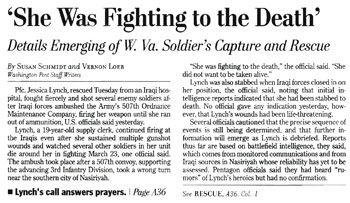
It was in fact the Washington Post that thrust the erroneous account about Lynch’s supposed battlefield heroics into the public domain, in a sensational front-page report published April 3, 2003. The article appeared beneath the headline: “‘She was fighting to the death.'”

The hero-warrior tale offered by the Post–which said Lynch had fought fiercely in an ambush in southern Iraq before being shot, stabbed, and taken prisoner–was picked up by news organizations around the world and turned Lynch into the best-known Army private of the war.

But the story wasn’t true.

Lynch never fired a shot in the ambush in Nasiriyah on March 23, 2003. Her gun jammed, she later said. She was neither shot nor stabbed; she suffered shattering injuries in the crash of a Humvee as it tried to flee the attack.

A U.S. special forces team rescued Lynch from a hospital in Iraq two days before the Post‘s erroneous hero-warrior tale was published.

In invoking the Lynch case, in an article examining why few Medals of Honor have been awarded in the Iraq and Afghan wars, the Los Angeles Times said:

“The medals process was tarnished when the Pentagon was caught creating false narratives to justify medals awarded in the high-profile cases of Army Ranger Pat Tillman and Army Pfc. Jessica Lynch.”

The matter of “false narratives” in the Tillman case is murky. The unrelated Lynch case is more clear-cut.

As I discuss in Getting It Wrong, my new book debunking 10 prominent media-driven myths, the Pentagon was not the source for the Post‘s botched hero-warrior report. Vernon Loeb, one of the authors of the “fighting to the death” story, was quite explicit on that point.

Loeb, who then was the Washington-based defense correspondent for the Post, said in an interview on NPR’s Fresh Air program in December 2003:

“I could never get anybody from the Pentagon to talk about those reports at all.”

He added that “the Pentagon was completely unwilling to comment on those reports at all. They wouldn’t say anything about Jessica Lynch.”

Loeb also said that the Post had been “told by some really good intelligence sources here in Washington that, you know, there were indications that she had, you know, fired back and resisted her capture and actually been shot and possibly stabbed doing so.”

Those sources have never been identified. But Loeb, who now is a senior editor for the Philadelphia Inquirer, scoffed at the interviewer’s suggestion that the Post‘s erroneous “fighting to the death” report was the result of clever manipulation by the Pentagon.

“I just didn’t see the Pentagon trying to create a hero where there was none,” Loeb said. “I mean …they never showed any interest in doing that, to me.”

On another occasion, Loeb was quoted in a commentary in the New York Times as saying:

“Far from promoting stories about Lynch, the military didn’t like the story.”

Lynch, who still struggles with the effects of injuries suffered in the Humvee crash, never claimed to have fought heroically in Iraq. She has suggested, though,  that “it would have been easy for me” to have adopted the hero’s mantle and embraced the  accounts about her supposed derring-do.

She was honorably discharged from the military in 2003–and was awarded the bronze star (see photo) for meritorious combat service, a decision that prompted low-level controversy.

The Lynch case–and the Post‘s hero-warrior tale–gave rise to another dispute about medals for valor.

According to Michael DeLong, a Marine lieutenant general who was deputy commander of U.S. Central Command in 2003, “politicians from her home state, West Virginia,” pressed the military “to award her the Medal of Honor.”

The requests were based on the Post‘s hero-warrior tale and “rose up the ladder until finally it reached me,” DeLong recalled in 2007 in a commentary in the New York Times, adding:

“In the case of Private Lynch, additional time was needed, since she was suffering from combat shock and loss of memory; facts, therefore, had to be gathered from other sources. The military simply didn’t know at that point whether her actions merited a medal.

“This is why, when the request landed on my desk, I told the politicians that we’d need to wait. I made it clear that no one would be awarded anything until all of the evidence was reviewed.

“The politicians did not like this,” DeLong added. “They called repeatedly, through their Congressional liaison, and pressured us to recommend her for the medal, even before all the evidence had been analyzed. I would not relent and we had many heated discussions.”

DeLong did not identify the politicians who lobbied for Lynch to be awarded the Medal of Honor but he wrote that they “repeatedly said that a medal would be good for women in the military; I responded that the paramount issue was finding out what had really happened.”

WJC

Recent and related:

Pew: Woodward, Bernstein ‘unraveled Watergate cover-up’

In Debunking, Media myths, Washington Post, Watergate myth on October 1, 2010 at 8:27 am

Bob  Woodward’s new book, Obama’s Wars, was the single most-discussed topic in news links posted at Web logs Monday through Friday last week,  the Pew Research Center’s Project for Excellence in Journalism said yesterday.

Woodward (Library of Congress)

Pew said that 35 percent of news links at blogs during the period September 20-24 were about the book, which has received mostly so-so reviews. (For example, the Wall Street Journal said in its critique yesterday, “To read ‘Obama’s Wars’ is to feel trapped in a daylong meeting in an airless room. That’s because much of the book consists of a near-verbatim account of meetings—specifically the National Security Council meetings last fall where the administration hashed out its Afghanistan policy.”)

The book and blog posts about it are of mild interest to Media Myth Alert.

What caught this blog’s attention was assertion in Pew’s news release–duplicated in a separate release by the Project for Excellence in Journalism–that referred to Woodward as “a Washington Post associate editor and half of the famous reporting duo that unraveled the Watergate cover-up.”

That last bit, about having “unraveled the Watergate cover-up,” is in error.

As I discuss in Getting It Wrong, my new book that debunks 10 prominent media-driven myths, Woodward and his Post colleague Carl Bernstein, “did not uncover defining and decisive elements” of Watergate—including the cover-up of the break-in at offices of the Democratic National Committee, the scandal’s signal crime.

The Watergate cover-up was exposed incrementally in 1973 and 1974 by the combined forces of such subpoena-wielding entities as federal prosecutors, federal grand juries, and U.S. Senate investigators. Ultimately the U.S. Supreme Court ordered President Richard Nixon to hand over audiotapes of secretly recorded conversations at the White House that unequivocally demonstrated Nixon’s guilty role in the cover-up.

The Supreme Court decision was handed down in July 1974. Nixon resigned soon after.

Woodward and Bernstein’s award-winning reporting on Watergate was published in summer and fall 1972, as the scandal slowly unfolded during the weeks and months following the break-in at Democratic headquarters.

By late October 1972, I note in Getting It Wrong, “the Post’s investigation into Watergate ‘ran out of gas,’ as Barry Sussman, then the newspaper’s city editor, acknowledged.”

Edward Jay Epstein pointed out in his classic essay about the press and Watergate that “it was not because of the reporting of Woodward and Bernstein, but because of the pressures put on the conspirators by Judge John Sirica, the grand jury, and Congressional committees that the cover-up was unraveled.”

Sirica, a federal judge, presided at the trial of the Watergate burglars that ended in guilty pleas in January 1973. Afterward, the judge “made it abundantly clear,” Epstein wrote, that the convicted burglars “could expect long prison sentences unless they cooperated with the investigation” of the Senate select committee on Watergate.

One of the burglars, James McCord, soon wrote to Sirica, saying that “perjury had been committed at the trial and the defendants had been induced by ‘higher-ups’ to remain silent,” Epstein pointed out.

McCord’s letter thus began the unraveling of the Watergate cover-up.

I discuss in Getting It Wrong factors that help account for the tenacity of the “heroic-journalist” interpretation of Watergate–the erroneous notion that the reporting of Woodward and Bernstein brought down Nixon’s corrupt presidency.

“Media myths,” I write, “often emerge from an eagerness to find influence and lasting significance in what journalists do and tend to extend credit where credit is not entirely due.

“The heroic-journalist myth of Watergate is a telling example. The myth holds that the reporting of Bob Woodward and Carl Bernstein in the Washington Post brought down Richard Nixon. In reality, the Post and other news organizations were marginal factors in unraveling the Watergate scandal.”

Media myths thus can be self-flattering; they offer heroes like Woodward and Bernstein to a profession that is more used to criticism than applause.

Besides, claiming that Woodward and Bernstein brought down Nixon, or that they “unraveled the Watergate cover-up,” long ago became a ready if misleading way for journalists to distill what was a sprawling scandal.

WJC

Recent and related:

Indulging in myth on debate’s 50th anniversary

In Anniversaries, Debunking, Media myths, Washington Post, Watergate myth on September 27, 2010 at 7:12 am

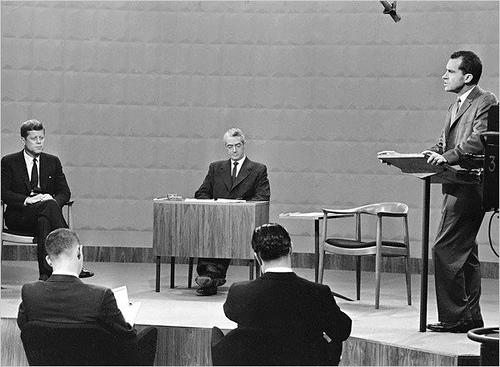
News outlets indulged in the myth of viewer-listener disagreement right through the 50th anniversary yesterday of the first Kennedy-Nixon debate.

The myth holds that people who watched the debate on television thought that Senator John F. Kennedy won; those who listened on radio thought Vice President Richard Nixon had the best of it.

The myth was long ago debunked by scholars David L. Vancil and Sue D. Pendell, in an article in Central States Speech Journal. They noted that reports of viewer-listener disagreement typically were anecdotal, and the few surveys that hinted at a viewer-listener disconnect were too small and unrepresentative by which to make confident judgments.

While it has been thoroughly dismantled, the myth lives on as irresistible testimony about the power of television and the importance of image in presidential politics.

An item posted yesterday at Andrew Breitbart’s Big Journalism online site said as much, declaring:

“The face of TV and politics changed forever on this date in history. …

“Those who watched the broadcast of the first ever televised presidential debate declared Kennedy the winner, those who listened on the radio gave the nod to Nixon. Thus, the political world changed forever.”

WLS-TV in Chicago, the city where the debate took place on September 26, 1960, said at its online site yesterday: “Most of the 70 million people who watched the event on television were convinced Kennedy won, and they voted for him in the presidential election of 1960.

“Surveys showed, though, that most of the people who listened on the radio thought Nixon won. It was the first time a nominee’s appearance may have affected voters.”

In addition, CBS Channel 2 in Chicago declared at its online site:

“Some listening on radio said it seemed like Nixon won. But as many as 74 million Americans were watching on television, and the medium became an overnight unexpected game-changer in our political system.”

As I’ve noted, specific evidence almost never is cited to support such claims about the debate. It’s as if the notion of viewer-listener disagreement is just too good, too delicious to check out–a factor that often characterizes the telling of media-driven myths. It’s a point I make in Getting it Wrong, my new book that debunks 10 prominent media myths. (While certainly prominent, the 1960 debate myth is not included in Getting It Wrong.)

There is evidence that a plurality of registered voters thought Kennedy fared better than Nixon in the debate 50 years ago.

But such impressions did not alter the campaign’s dynamic: The race remained a toss-up to Election Day.

Here’s what the evidence shows: A Gallup poll released in October 1960 reported that 43 percent of voters thought Kennedy “did the better job” in the first debate (of four debates during the campaign). Twenty-three percent thought Nixon was better; 29 percent said both candidates were about the same. Five percent offered no opinion.

The same survey reported Kennedy was narrowly ahead in the race, by 49 percent to 46 percent, with 5 percent undecided.

That result represented a slight change from Gallup’s survey taken just before the debate, which reported Nixon leading narrowly, by 47 percent to 46 percent.

Gallup called the post-debate shift too slight to be meaningful.

“The prudent reader can see,” George Gallup, head of the polling organization, wrote in reporting the results, “that polling accuracy has not reached the degree of accuracy required to say with certainty which candidate is ahead in a close race such as the present one.”

So, no: The debate 50 years ago didn’t change the “political world … forever.” Television wasn’t an “overnight … game-changer” in presidential campaigns. Nothing of the sort.

Media-driven myths are known to give rise to spin-off or subsidiary myths, a phenomenon I discuss in Getting It Wrong.

An example is the heroic-journalist myth of Watergate, which holds that the investigative reporting of Washington Post reporters Bob Woodward and Carl Bernstein brought down Nixon’s presidency in the 1970s. The spin-off or subsidiary myth is that Woodward and Bernstein’s work was so widely appealing that it prompted a surge in college students majoring in journalism.

But that wasn’t so: The surge in enrollments in journalism programs predated the Watergate scandal and was due in measure to young women entering the field.

A spin-off of the Kennedy-Nixon debate myth is that the widely watched televised encounter helped Kennedy become better known among Americans. Before then, the argument goes, Kennedy lacked much national recognition. Nixon, on the other hand, was well-known, having been vice president for almost eight years.

But in fact Kennedy had become nationally prominent long before the first debate.

So well-known that he ran well ahead of Nixon in many of the presidential trial heats that Gallup conducted nationally in late 1958 and 1959.

These matchups, while volatile, were seen by Gallup as early tests of a prospective candidate’s political strength.

The Gallup trial heat in December 1958 had Kennedy leading Nixon by 59 percent to 41 percent.

Kennedy was favored over Nixon by a larger margin, 61 percent to 39 percent, in the trial heat reported in July 1959.

To have polled as well as he did so long before the 1960 campaign, Kennedy simply could not have been an unknown in national politics.

WJC

Recent and related:

My many thanks to fivefeetoffury and Ed Driscoll for linking to this post.

Woodward’s new book stirs retelling of Watergate myth

In Debunking, Media myths, Newspapers, Washington Post, Watergate myth on September 25, 2010 at 10:33 am

The pre-publication publicity and reviews about Bob Woodward‘s new book, Obama’s Wars, have inevitably stirred fresh retellings of the heroic-journalist myth of Watergate, in which Woodward figures prominently.

Nixon resigns, 1974

The heroic-journalist meme can be distilled to a single sentence–as CNN commentator Jack Cafferty demonstrated in a blog post the other day.

“In 1974,” Cafferty wrote, “Bob Woodward and Carl Bernstein brought down the presidency of Richard Nixon with their reporting on Watergate.”

And demonstrating anew that media-driven myths can travel far and well, the Daily Telegraph in London declared the other day in a profile of Woodward that his collaboration with Bernstein brought them “global fame” for “breaking the Watergate scandal and forcing Richard Nixon’s resignation in the early 1970s.”

The venerable BBC, in its profile, said of Woodward:

“The veteran journalist was at the heart of the scandal that rocked the White House and brought down U.S. President Richard Nixon in 1974.

“Along with Carl Bernstein, his colleague at the Washington Post, Woodward was instrumental in uncovering a series of abuses of power that reached the highest level of the administration.”

I address, and debunk, the heroic-journalist myth of Watergate in my new book, Getting It Wrong.

Among the many elements of the myth’s debunking, I note that principals at the Washington Post have sought periodically over the years to dismiss the notion the newspaper was central to Nixon’s fall.

Katharine Graham, the newspaper’s publisher during the Watergate period and beyond, said in 1997, at the 25th anniversary of the scandal’s seminal crime, the foiled burglary at Democratic national headquarters at the Watergate complex in Washington, D.C.:

“Sometimes people accuse us of bringing down a president, which of course we didn’t do. The processes that caused [Nixon’s] resignation were constitutional.”

And Woodward, himself, has concurred, albeit in earthier terms.  “To say that the press brought down Nixon, that’s horseshit,” he said in 2004 in an interview with American Journalism Review.

Complexity-avoidance, I write in Getting It Wrong, also helps explain the tenacity of the heroic-journalist interpretation of Watergate. Like many media myths, the heroic-journalist meme minimizes the intricacy of historical events in favor of simplistic and misleading interpretations.

In the case of Watergate, it is far easier to focus on the purported exploits of Woodward and Bernstein than it is to try to grapple with the intricacies and complexities of what was a sprawling scandal.

Far more significant and decisive to Watergate’s outcome were the contributions of federal prosecutors, federal judges, bipartisan congressional panels, and, ultimately, the U.S. Supreme Court. They were the forces in that succeeded in identifying Nixon’s criminal attempt to obstruct justice in the Watergate scandal–the misconduct that led to his resignation.

Against the tableau of prosecutors, courts, and bipartisan congressional panels, I write in Getting It Wrong, “the contributions of Woodward and Bernstein were modest, and certainly not decisive.”

I further write:

“This is not to say the Post’s reporting on Watergate was without distinction.” Indeed, the newspaper won the Pulitzer Prize for public service in 1973, for its reporting about the scandal in the summer and fall of 1972–during the four months following the foiled breakin at the Watergate.

But by late October 1972, the Post’s investigation into Watergate had run “out of gas,” as Barry Sussman, then the newspaper’s city editor, later acknowledged.

As earnest as their reporting was, “Woodward and Bernstein did not uncover defining and decisive elements of the Watergate scandal—the cover-up and the payment of hush money to the Watergate burglars,” I note in Getting It Wrong.

Nor did they disclose the existence of the White House audiotaping system that proved so critical to Nixon’s fate.

Nixon, I write, “likely would have served out his term if not for the audiotape recordings he secretly made of most conversations in the Oval Office of the White House.

“Only when compelled by the Supreme Court did Nixon surrender those recordings, which captured him plotting the cover-up and authorizing payments of thousands of dollars in hush money.”

Now that’s what “brought down the presidency of Richard Nixon.”

Related:

‘Getting It Wrong’ goes on WTIC talk radio

In Anniversaries, Debunking, Hurricane Katrina, Media myths, Media myths and radio, Washington Post, Watergate myth on September 12, 2010 at 11:38 am

I was interviewed about Getting It Wrong the other day by Ray Dunaway on WTIC AM radio in Hartford, where years ago I was a reporter for the Hartford Courant newspaper.

The interview was live, brisk, and wide-ranging, covering a number of topics discussed in Getting It Wrong, my new book which debunks 10 prominent media-driven myths–those dubious and improbable stories about the media that masquerade as factual.

Topics that Dunaway and I discussed included the media myths associated with the Washington Post and the Watergate scandal, with Edward R. Murrow and his 1954 program on Senator Joseph McCarthy, and with coverage of Hurricane Katrina’s aftermath in 2005.

Dunaway, a veteran talk-shown host in Connecticut (with whom I had never previously spoken), said in introducing the segment:

“There are a lot of things we believe growing up and some of these are very near and dear to my heart. One would be–and I think this is absolutely true–when I was in graduate school, everybody, especially on the print side, everybody wanted to be the next Carl Bernstein and Bob Woodward [of Watergate fame] and, you know, bring down a president. That was kind of their dream.”

He added:

“Anyhow, there’s a great book out now. And what you believe ain’t necessarily so. W. Joseph Campbell has written a book … called Getting It Wrong

“First of all,” Dunaway said in launching into the interview, “I must tell you how much I enjoyed the book. It was a trip down memory lane, but maybe in a different direction than I originally thought.”

He asked whether I wrote the book to “set the record straight a bit.”

“That’s exactly right,” I replied. “The book is not really a media-bashing book but really aligns itself with a central objective of news-gathering, which is to try to get it right. And the book does seek to set the record straight by offering reappraisals of some of the best-known stories in American journalism.”

I added:

“I think these stories live on because they do offer simplistic explanations and simplistic answers to very complex historical events. So it’s a way of distilling what went on in the past [in] a very digestible and understandable way.

“In the process of simplification, though, there are exaggerations made–and myths are born. And I think that’s a recurring theme in this book. … These stories are appealing stories. They’re delicious stories. They’re almost too good to be checked out, and I think that’s another reason why these have lived on.”

We spent some time discussing the heroic-journalist interpretation of Watergate–that the investigative reporting of Woodward and Bernstein in the Washington Post brought about President Richard Nixon’s resignation in 1974.

“Woodward and Bernstein–the Watergate story–is another example of the David-and-Goliath encounter,” another thread that runs through Getting It Wrong, I said, adding that Nixon’s fall in the Watergate scandal “was the consequence of his own criminal conduct and that was exposed through the convergence of many forces and factors.

“And the Washington Post, although it did some good reporting in the aftermath of the Watergate breakin in 1972–it wasn’t the decisive factor.

“Its reporting did not bring down Richard Nixon.”

Dunaway, who described Getting It Wrong as “well worth reading,” turned the interview to Hurricane Katrina and what I call “the myth of superlative reporting.”

The coverage of Katrina’s aftermath was highly exaggerated and represented “no high heroic moment for American journalism,” I pointed out.

We spoke about exaggerated estimated death tolls in New Orleans in Katrina’s wake–estimates of 10,000 fatalities or more that were offered by public officials including the city’s then-mayor, Ray Nagin.

I noted:

“Nagin’s estimate is another example of why journalists and reporters have an obligation to themselves and to their audiences to question sources closely. ‘How did you find that information, Mr. Mayor? Could we talk to people who came up with that estimate?’ I mean, not being credulous but being searching, and a bit skeptical.

“I think skepticism was absent in the aftermath of Hurricane Katrina, and the apocalyptic horror that the hurricane supposedly unleashed was absolutely untrue.”

Dunaway wrapped up the interview by calling the book “more of a learning experience than a critique.”

That was an interesting characterization with which to close an engaging and thoughtful interview.

WJC

Related:

WaPo ‘didn’t like Nixon’–and that’s how ‘we got Watergate’? Huh?

In Debunking, Media myths, New York Times, Newspapers, Washington Post, Watergate myth on September 9, 2010 at 7:06 am

Wolff

Michael Wolff, the media critic and biographer of Rupert Murdoch, has been sharply criticized for his column this week that presented a strange, Machiavellian assessment of the New York Times magazine article about how Murdoch’s Sunday tabloid News of the World apparently hacked the voicemail of Britain’s royals, and many others.

Murdoch

Wolff noted the Times is “locked in a ferocious battle with Murdoch. He’s trying to use the Wall Street Journal to undermine the Times—to lessen it as a competitor or, even, weaken it so much that he can buy it.”

OK, so far.

But Wolff also claimed that the article about the News of the World signaled that the Times “is striking back” at Murdoch, albeit “a little oddly (the Times can be brutal, but it likes to pretend it is much less brutal than it can be). Instead of using the paper to make its attack, it’s using the magazine—this is a clear choice for the Times.”

And in a passage holding relevance and particular interest to Media Myth Alert, Wolff (who surely ought to know better) wrote:

“Still, just because you have ulterior motives (and some worry and guilt about your motives), doesn’t mean the story won’t stick. The Washington Post didn’t like Nixon—and because of that bad blood we got Watergate.”

That’s how “we got Watergate”?

That’s just absurd.

The Watergate scandal was not the upshot of “bad blood” between the Nixon and the Post, even though neither was particularly fond of the other.

Nixon resigns, 1974

The scandal unfolded, deepened, and ultimately claimed Richard Nixon’s presidency because of broad criminal misconduct by Nixon, his close associates, some cabinet officers, as well as senior officials of his 1972 reelection campaign.

Likewise absurd is asserting that the Post‘s investigative reporting on Watergate was decisive in Nixon’s fall.

As I write in Getting It Wrong, my new book debunking prominent media-driven myths, to explain Watergate as a case of media revelation “is to abridge and misunderstand the scandal and to indulge in a particularly beguiling media-driven myth.”

It is an interpretation, I write, that minimizes and obscures “the far more decisive forces that unraveled the scandal and forced Nixon from office”–notably, special prosecutors, federal judges, both houses of Congress, the U.S. Supreme Court, as well as the Justice Department and the FBI.

Even then, I argue, “Nixon likely would have served out his term if not for the audiotape recordings he secretly made of most conversations in the Oval Office of the White House.

“Only when compelled by the Supreme Court did Nixon surrender those recordings, which captured him plotting the cover-up and authorizing payments of thousands of dollars in hush money.”

It’s understandable to seek to distill Watergate, as Wolff did, to something simple, manageable.

After all, the complexity of Watergate–the multiple lines of inquiry that slowly unwound the scandal, and the drama of an exceptional constitutional crisis—”are not routinely recalled these days,” I write in Getting It Wrong. “The epic scandal has grown so distant that few Americans can accurately describe what took place.”

I also write:

“What does stand out amid the scandal’s many tangles is the heroic-journalist version of Watergate—the endlessly appealing notion that the dogged reporting of two young, hungry, and tireless Washington Post journalists, Bob Woodward and Carl Bernstein, brought down Nixon and his corrupt presidency.”

In the years since Nixon resigned in 1974, the heroic-journalist meme has become embedded and solidified as the dominant narrative of Watergate–as a short-hand way of vaguely understanding the scandal and its outcome while sidestepping its forbidding complexity.

But it is an interpretation that rests upon a serious misreading of the historical record.

WJC

Related:

Investigative reporting’s ‘golden era’ lasted 25 years? Think again

In Debunking, Media myths, Newspapers, Washington Post, Watergate myth on September 5, 2010 at 6:43 am

In a lengthy, hand-wringing look at the state of investigative reporting, the September issue of American Journalism Review indulges in the “golden age” fallacy while hinting broadly at the heroic-journalist myth of Watergate.

The article, funded by a grant from the Open Society Institute and titled “Investigative Shortfall,” contains this passage:

“Elevated to hero status after two Washington Post reporters helped bring down a corrupt U.S. president and his cronies, investigative reporters enjoyed a golden era from the late 1970s into the 2000s.”

In other words, about 25 years.

However, the article presents scant corroboration for its 25-year “golden era” claim, beyond offering generalization such as:

“In cities blessed with activist media, reporters took aim at corruption, waste, incompetence and injustice in politics, government, charities and corporations. Cameras confronted culprits. An aroused populace demanded change. People went to jail; old laws were rewritten and new ones passed. Competition for investigative prizes swelled; others came into being.”

I think Carl Bernstein, he of Watergate fame, had it right when he said recently: “There’s a little too much nostalgia about maybe a golden age of ‘investigative journalism’ that never really existed.”

I address the “golden age” fallacy in Getting It Wrong, my new book that debunks 10 prominent media-driven myths–dubious tales about the news media that masquerade as factual.

I note in Getting It Wrong how  “media myths invite indulgence in the ‘golden age fallacy,’ the flawed but enticing belief that there really was a time when journalism and its practitioners were respected and inspiring—the time, say, of … [Bob] Woodward and Bernstein.”

They’re the “two Washington Post reporters” to whom American Journalism Review refers, claiming they “helped bring down a corrupt U.S. president and his cronies,” a reference to Richard Nixon and the Watergate scandal.

But as I write in Getting It Wrong, “the contributions of Woodward and Bernstein were modest, and certainly not decisive” to the outcome of Watergate.

I further write:

“… to explain Watergate through the lens of the heroic-journalist is to abridge and misunderstand the scandal and to indulge in a particularly beguiling media-driven myth. The heroic-journalist interpretation minimizes the far more decisive forces that unraveled the scandal and forced Nixon from office.”

Those forces included special prosecutors, federal judges, both houses of Congress, the Supreme Court, as well as the Justice Department and the FBI.

“Even then,” I write, “Nixon likely would have served out his term if not for the audiotape recordings he secretly made of most conversations in the Oval Office of the White House. Only when compelled by the Supreme Court did Nixon surrender those recordings, which captured him plotting the cover-up and authorizing payments of thousands of dollars in hush money.”

So against the tableau of federal prosecutors, judges, Congress, and the Supreme Court, the contributions of the Woodward and Bernstein were marginal. To say they “helped bring down” Nixon’s corrupt presidency is to indulge in overstatement.

The article’s woe-is-us tone about investigative reporting is hardly novel.

Brant Houston, formerly of the non-profit Investigation Reporters and Editors organization, noted this year in an article in Daedalus magazine:

“Each year that I served as executive director of IRE, from 1997 to 2007, journalists interviewed me (as they had my predecessors) about the pending death of investigative journalism.”

Those years would embrace a substantial portion of the supposed “golden era” of investigative reporting.

Undeniably, the decline of traditional, mainstream media-based investigative journalism has accelerated in recent years, given the layoffs and buyouts that have swept American newspapers.

But as Jack Shafer, media critic for slate.com pointed out a number of years ago, “newspapers aren’t the only organizations trolling for investigative news. The nonprofit Center for Public Integrity has broken as many stories as almost any big-city daily in the last couple of decades ….

“Activist organizations have similarly collected countless investigative scoops about human rights abuses, environmental crimes, consumer rip-offs, and more,” Shafer wrote, adding:

“Long before today’s newsroom budget crunch, newspapers were de facto outsourcing a good share of investigative reporting to the nonprofits, whose findings they trumpeted on their front pages.”

True enough.

It’s premature to write off investigative journalism in America, even given the deep cuts in newsroom staffs. That’d be as wrong as believing investigative reporting once enjoyed a 25-year golden age.

WJC

Related:

Washington Post ignores its singular role in Lynch hero-warrior story

In Cinematic treatments, Debunking, Jessica Lynch, Media myths, Washington Post on September 3, 2010 at 9:47 am

In its review today of the new movie about Pat Tillman, the Army Ranger killed by friendly fire in Afghanistan, the Washington Post invokes the Jessica Lynch case–but disingenuously shifts blame to the Pentagon for thrusting the former Army private into unsought and undeserved fame early in the Iraq War.

In fact it was the Post that gave the world the erroneous story about Lynch and her supposed battlefield heroics in 2003. The hero-warrior tale about Lynch was an embarrassment that the Post still seems eager to sidestep.

The Post's report on Lynch, April 3, 2003

Not surprisingly, today’s review fails to mention the Post and its electrifying, but inaccurate, front-page report of April 3, 2003. The Post said Lynch had been shot and stabbed but yet “was fighting to the death” when captured by Iraqis.

Lynch then was a 19-year-old Army private, a supply clerk with the 507th Maintenance Company. Elements of her unit were ambushed in Nasiriyah, in southern Iraq, on March 23, 2003, a few days after the war began.

Lynch never fired a shot during the attack; her gun had jammed, she later said. She was neither shot nor stabbed; she suffered shattering injuries in the crash of a Humvee as it tried to flee the ambush.

Lynch was taken prisoner and hospitalized. She was rescued by a U.S. special forces team on April 1, 2003.

Two days later, the Post published its sensational account of Lynch’s supposed heroism, an account “unlike any to emerge from the war,” I write in Getting It Wrong, my new book debunking 10 prominent media-driven myths.

I note that the Post’s story about Lynch “quickly became a classic illustration of intermedia agenda-setting: News organizations around the world followed the Post’s lead by prominently reporting the supposed heroics of young Jessica Lynch and contemplating their significance.”

It was “all quite remarkable, fascinating, and irresistible,” I write in Getting It Wrong. “The petite, shy clerk who, in the Post’s telling, had fought her attackers with Rambo-like ferocity. But little of it proved true.”

Private Lynch

There’s no hint of any of that in the Post‘s review of the Tillman movie. Instead, the review serves up the dubious interpretation that the Pentagon concocted the hero-warrior story about Lynch.

“In a surreal coincidence,” the review says, “Tillman’s first Army tour was in Iraq, where he helped provide perimeter support for the stage-managed rescue of Pfc. Jessica Lynch. Lynch later debunked the Pentagon’s account of her own actions before being captured by Iraqi forces, accusing the military of using her in their propaganda efforts.” (Emphasis added.)

The Pentagon treated the hero-warrior story as if it were radioactive. And Vernon Loeb, who shared a byline on the Post‘s report about Lynch, later said the military was not the source.

I point out in Getting It Wrong that in “a little-noted interview on National Public Radio’s Fresh Air interview program in late 2003, Loeb made it clear the Post’s sources were not Pentagon officials.”

Loeb, then the Post‘s defense correspondent, said on the radio program:

“Our sources for that story were not Pentagon sources.

“And, in fact, I could never get anybody from the Pentagon to talk about those reports [about Lynch’s battlefield heroics] at all. I got indications that they had, in fact, received those intelligence reports, but the Pentagon was completely unwilling to comment on those reports at all. They wouldn’t say anything about Jessica Lynch.”

Loeb said in the interview that the Post had been “told by some really good intelligence sources here in Washington that, you know, there were indications that she had, you know, fired back and resisted her capture and actually been shot and possibly stabbed doing so.”

He added that the Post on April 3, 2003, “basically told our readers that day what the U.S. intelligence community was telling senior members of the U.S. government.”

Loeb dismissed at the interviewer’s suggestion that the Post‘s “fighting to the death” report was the upshot of clever manipulation by the Pentagon.

“I just didn’t see the Pentagon trying to create a hero where there was none,” Loeb said. “I mean …they never showed any interest in doing that, to me.”

The Post‘s movie review today refers to Lynch’s rescue as having been “stage-managed.”

That notion, I write in Getting It Wrong, represents a spinoff, or subsidiary, myth of the Lynch case.

The BBC was among the first to claim the rescue was a put-up job, calling it one  of the most stunning pieces of news management ever conceived.”

The Pentagon dismissed the BBC’s claims as “void of all facts and absolutely ridiculous.”

Later, at the request of three Democratic members of Congress, the Defense Department’s inspector general investigated the BBC’s allegations and found them baseless.

In testimony to Congress in April 2007, Thomas F. Gimble, then the acting inspector general, said no evidence had been uncovered to support claims that Lynch’s rescue “was a staged media event.”

Instead, Gimble said, the rescue operation was found to have been “a valid mission” to recover a prisoner of war “under combat conditions.”

More than 30 witnesses were interviewed in the inspector general’s inquiry, including members of the special operations team that had rescued Lynch, Gimble stated in written testimony.

Few if any of those witnesses, he noted, had been interviewed by news organizations.

WJC

Related:

The Washington Post ‘wrecked’ Nixon’s life? Sure it did

In Debunking, Media myths, Washington Post, Watergate myth on August 25, 2010 at 2:29 pm

I’m tough on the Washington Post in a couple of chapters in Getting It Wrong, my new book that addresses and debunks prominent media-driven myths.

I call out the newspaper for its singular role in publicizing the erroneous hero-warrior tale about Jessica Lynch who, because of botched reporting by the Post, unwittingly became the best-known Army private of the Iraq War.

I also challenge the hero-journalist myth of the Watergate scandal, asserting in Getting It Wrong that (contrary to the dominant popular narrative) the Post and its reporters did not topple Richard Nixon’s corrupt presidency. (The Post, to its credit, also has challenged that narrative from time to time over the years.)

While I’m no apologist for the Post and consider it far weaker than its reputation,  I have no patience for such off-handed and outlandish characterizations as those appearing in a post yesterday at the Felsenthal Files, a blog of Chicago Magazine.

The blog post was titled “Blago: The View from Washington” and addressed the Post‘s editorial last week about retrying Rod Blagojevich, the former Illinois governor, on federal corruption charges. A jury in Chicago this month convicted Blagojevich on one charge of lying to federal investigators but failed to return verdicts on 23 other counts.

The Post in the editorial said Blagojevich’s prosecutor, U.S. Attorney Patrick J. Fitzgerald, “took his shot and lost. He should stand down before crossing another fine line–the one that separates prosecution from persecution.”

The Felsenthal Files found towering irony in that view, stating:

“If Rod Blagojevich has one hero in life besides Elvis, it’s Richard Nixon, and if there’s one newspaper that wrecked Nixon’s life and legacy it’s the Washington Post. How ironic, then, that the Washington Post is trumpeting almost the same line as Blago himself.”

Putting aside the wisdom of retrying Blagojevich, the Felsenthal Files’ flippant passage, alluding to the Watergate scandal, cries out for comment: “… if there’s one newspaper that wrecked Nixon’s life and legacy it’s the Washington Post.”

Wrecked?

Oh, c’mon.

The Washington Post didn’t wreck Richard Nixon.

It was Nixon’s criminal misconduct that defined the Watergate scandal and ultimately led to his resigning the presidency in disgrace in August 1974.

It wasn’t the Post‘s doing.

To regard Nixon’s fall as an effect of the Post‘s investigative reporting is, I write in Getting It Wrong, “to abridge and misunderstand the scandal and to indulge in a particularly beguiling media-driven myth.”

I further write that the “heroic-journalist interpretation [of Watergate] minimizes the far more decisive forces that unraveled the scandal and forced Nixon from office”–the special prosecutors, the federal judges, bipartisan congressional panels, the Justice Department, the FBI, and the Supreme Court.

Even then, Nixon probably would have served out his term–if as a wounded and weakened chief executive–had it not been for the existence of the audiotapes he made of many of his conversations in the Oval Office.

Only when ordered by the Supreme Court in July 1974 did Nixon surrender those recordings that captured him plotting to cover up the crimes of Watergate and authorizing payments of thousands of dollars in hush money.

The wreckage of Watergate undeniably was of Nixon’s own doing.

WJC

Related: