Media Myth Alert directed attention periodically in 2020 to the appearance of well-known media-driven myths, those prominent tales about and/or by the news media that are widely believed and often retold but which, under scrutiny, dissolve as apocryphal or wildly exaggerated.
Here’s a look at the year’s five top writeups at Media Myth Alert, a year in which corporate media’s woeful coverage of the presidential election figured prominently.
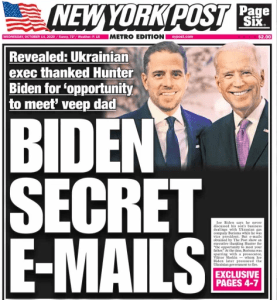
■ The shame of the press (posted October 31): As the 2020 presidential election neared, much of U.S. corporate media indulged in what I called “willful blindness on an extraordinary scale.”
They ignored, suppressed, or risibly dismissed as Russian disinformation credible allegations of international influence-peddling by the son of Democratic presidential nominee, Joe Biden. The effect was to shield Biden, an undeniably flawed and feeble candidate, from scrutiny and thus help him defeat President Donald Trump, whom they so deeply detest.
This conduct by corporate media, I wrote, represented “an abdication of fundamental journalistic values of detachment, and impartiality. A defining ethos of American journalism that emerged during the second half of the Twentieth Century emphasized even-handed treatment of the news and an avoidance of overt, blatant partisanship.
“Rank-and-file journalists tended to regard politicians of both major parties with a mixture of suspicion and mild contempt. It was a kind of ‘fie on both houses’ attitude. Running interference for a politician was considered more than a little unsavory.
 “Not so much anymore.”
Biden’s son is suspected of arranging lucrative, pay-for-play business arrangements in Ukraine — supposedly without the candidate’s knowledge. But reporting in the New York Post — based on emails retrieved from a laptop computer the son abandoned at a repair shop — undercut Joe Biden’s claims of ignorance. The Bidens have not disputed the authenticity of the emails. Nor have they seriously or substantively addressed the allegations.
Subsequent reporting suggested that Joe Biden had a secret financial involvement in his son’s efforts to arrange a lucrative deal with a Chinese energy company tied to the country’s communist regime.
“The narratives are detailed, with many dimensions and potential implications — all which make media scrutiny all the more urgent,” I wrote.
Didn’t happen.
After the election, corporate media briefly lifted their blackout to report that the FBI for two years had been looking into the son’s accepting payments from international sources. The federal inquiry centers around suspected violations of tax laws.
But corporate media of course offered no apologies for their shameful rejection of journalistic curiosity in the run-up to the election.
■ New York Times commentary offers up that hoary 1960 debate myth (posted August 5): Some media-centric tall tales, I noted, “are just too good to die away.”
A telling example is the exaggerated claim of viewer-listener disagreement during and immediately after the first presidential debate in 1960 between Richard M. Nixon and John F. Kennedy. The myth has it that Nixon “won” the debate among radio listeners but because he perspired noticeably and looked bad on television, “lost” the debate among TV viewers.
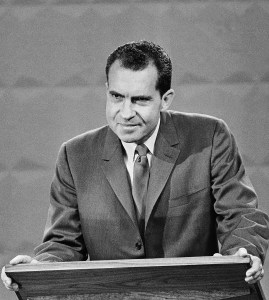
Nixon on debate stage, 1960
The notion of viewer-listener disagreement was impressively demolished 33 years ago, by scholars David Vancil and Sue D. Pendell. Their article, I wrote, “remains a fine example of thorough, evidence-based debunking.”
And yet the myth of viewer-listener disagreement lives on, as an the New York Times made clear in an essay published in early August.
The essay’s author, veteran Washington journalist Elizabeth Drew, unreservedly invoked the hoary myth, writing that “Nixon was considered to have won on substance on the radio, while the cooler and more appealing Kennedy won on television.”
As I noted in the second edition of my media-mythbusting book, Getting It Wrong, “the myth of viewer-listener disagreement [is] one of the most resilient, popular, and delectable memes about the media and American politics. Despite a feeble base of supporting documentation, it is a robust trope” that rests more on assertion, and repetition, than on evidence.
Had television and radio audiences differed so strikingly and sharply about the debate’s winner, journalists in 1960 were well-positioned to identify and report on such disparate reactions — especially soon after the first Kennedy-Nixon encounter when interest in the debate and its novelty ran high.
But of the scores of newspaper articles, editorials, and commentaries I examined in my research about the Nixon-Kennedy debate, none made specific reference to such an audience effect. Even oblique hints about viewer-listener disagreement were few, vague, and fleeting.
■ Woodward’s latest book prompts myth-telling about Watergate (posted September 22): “It was predictable,” I wrote. “Inevitable, even.”
It was all but certain that news reports and reviews of Rage, Bob Woodward‘s latest book about Trump and his presidency, would credulously recite the media myth that Woodward’s Watergate reporting brought down Richard Nixon’s corrupt presidency.
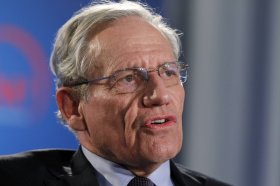
He didn’t bring down Nixon
And sure enough, news outlets in the United States and abroad summoned the mythical trope — a trope that even Woodward has on occasion attempted to dismiss.
An editorial in the Detroit Free Press, for example, described Woodward as “famed for having brought down former President Richard Nixon.”
The New York Post stated that Woodward and his Watergate reporting partner at the Washington Post, Carl Bernstein, had together “brought down the presidency of Richard Nixon.”
The Toronto Sun likewise asserted that the Woodward and Bernstein‘s “1970s Watergate reporting … brought down Richard Nixon.”
The Guardian of London declared in its review that Nixon was “the president Woodward and Carl Bernstein brought down with their reporting on Watergate nearly a half-century ago.”
What explains this inclination to embrace so blithely what long ago was debunked as a media myth?
As I wrote in Getting It Wrong, the heroic-journalist interpretation of the Watergate scandal — “that the dogged reporting of two young, hungry, and tireless Washington Post journalists, Bob Woodward and Carl Bernstein, brought down Nixon and his corrupt presidency” — is deeply appealing. The trope offers reassurance to contemporary journalists that their reporting, too, just might have powerful effects.
The trope also represents “ready shorthand,” I noted, “for understanding Watergate and its denouement, a proxy for grasping the scandal’s essence while avoiding its forbidding complexity.” Watergate after all was a tangle of lies, deceit, and criminality, and popular understanding of the details has faded considerably since Nixon resigned in August 1974.
To explain Watergate “through the lens of the heroic journalist,” I wrote, “is to abridge and misunderstand the scandal and to indulge in a particularly beguiling media-driven myth” — one that even Woodward has disputed.
He memorably told an interviewer in 2004:
“To say that the press brought down Nixon, that’s horseshit.”
■ Flawed PBS ‘McCarthy’ doc notable for what it left out (posted January 26): Early in the year, PBS aired an “American Experience” documentary about Joseph R. McCarthy, the notorious red-baiting U.S. senator of the early Cold War.
The timing of the program was puzzling: Why revisit the McCarthy story in January 2020? Anniversaries can be a convenient peg for such retrospective programs. But nothing in January was memorably associated with the McCarthy saga.
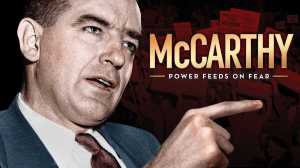 The producers most likely wanted to suggest that President Trump, in his bluster, exaggerations, and combative demeanor, is reminiscent of Joe McCarthy.
If that were the intent, I wrote, “the allusion was muddled. And under-developed.” And unpersuasive. Trump is a far more complicated character than McCarthy, an obscure, hard-drinking Republican senator from Wisconsin who seized on his communists-in-government campaign as a ticket to prominence in the early 1950s.
The documentary also presented a conventional — and misleading interpretation — that the American press was unwilling to stand up to McCarthy, reluctant to challenge his thinly sourced charges about communist infiltration of the federal government.
As I’ve often noted at Media Myth Alert, not all prominent journalists of the early 1950s were inclined to excuse or ignore McCarthy’s excesses or soft-pedal his allegations.
Foremost among McCarthy’s foes in American journalism was Drew Pearson, a Washington-based muckraking columnist who took on the senator just days after he began his communists-in-government campaign in 1950.
Pearson was persistent in challenging McCarthy, disputing not only the senator’s red-baiting claims but calling attention to other misdeeds, such as McCarthy’s tax troubles in Wisconsin and the suspicious financial contributions to his campaign for senate.
Pearson deserved more recognition than PBS granted.
The documentary’s lone reference to the columnist came in a passing mention about his physical confrontation with McCarthy in December 1950 when the senator cornered him in the cloak room of the fashionable Sulgrave Club in Washington, D.C. McCarthy was the aggressor and either kneed, slugged, or slapped Pearson. Contemporaneous accounts about the assault differed.
The broader point about Pearson’s reporting is that journalists were challenging McCarthy in the early days of his communists-in-government crusade. And Pearson was not alone.
Richard Rovere of the New Yorker also was an early critic of McCarthy.
But the documentary made no mention of Rovere at all.
■ Our incurious press (posted November 30): The 2020 presidential election gave rise to many curious turns in Georgia, Pennsylvania, Michigan, and Wisconsin, where the election turned. These included atypical voting patterns, statistical anomalies, and extreme spikes in vote counts in Biden’s favor that took place in pre-dawn hours in key states.
These and other oddities of the election deserved corporate media’s scrutiny.
Instead, they were indifferent and dismissive, eager to wave off what may be called “the strange details” of the election — and do so without much independent inquiry. “Baseless” quickly became a favored characterization.
They seemed not to realize that the suspicions about the conduct of the election are certain to persist, clouding the putative victory of the 78-year-old Biden, who seldom strayed from his basement during the Fall campaign and whose gaffes and incoherence suggest he’s not up to the job of president.
The election’s oddities and anomalies warranted dispassionate investigation, especially as a large numbers of Americans — and more than a few Democrats among them — suspect the election was marred by tampering and suspicious conduct like the delaying and interrupting of vote-counts.
It was not as if corporate media lacked the will or interest to investigate suspicions of election anomalies and fraud. After all, the New York Times and Washington Post did share a Pulitzer Prize for their reporting on vague suspicions that Trump somehow conspired with Russia to win the 2016 presidential election — suspicions that proved exaggerated, over-wrought and, in a word, baseless.
And it was not as if corporate media were chastened that their investigations of the 2016 election came a cropper. Rather, they have become so predictably partisan as to be disinclined to do anything that could bolster Trump, or damage Biden.
WJC
Other memorable posts of 2020:
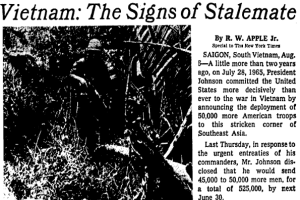 The New York Times, in an analysis published August 7, 1967, declared “the war is not going well. Victory is not close at hand.”


 Media Myth Alert