W. Joseph Campbell

Posts Tagged ‘Bay of Pigs’

‘Junk food of jornalismo’: Diário writes up ‘Getting It Wrong’

In Bay of Pigs, Cronkite Moment, Debunking, Furnish the war, Media myths, Media myths and radio, Murrow-McCarthy myth, Reviews, Watergate myth on June 28, 2010 at 2:49 pm

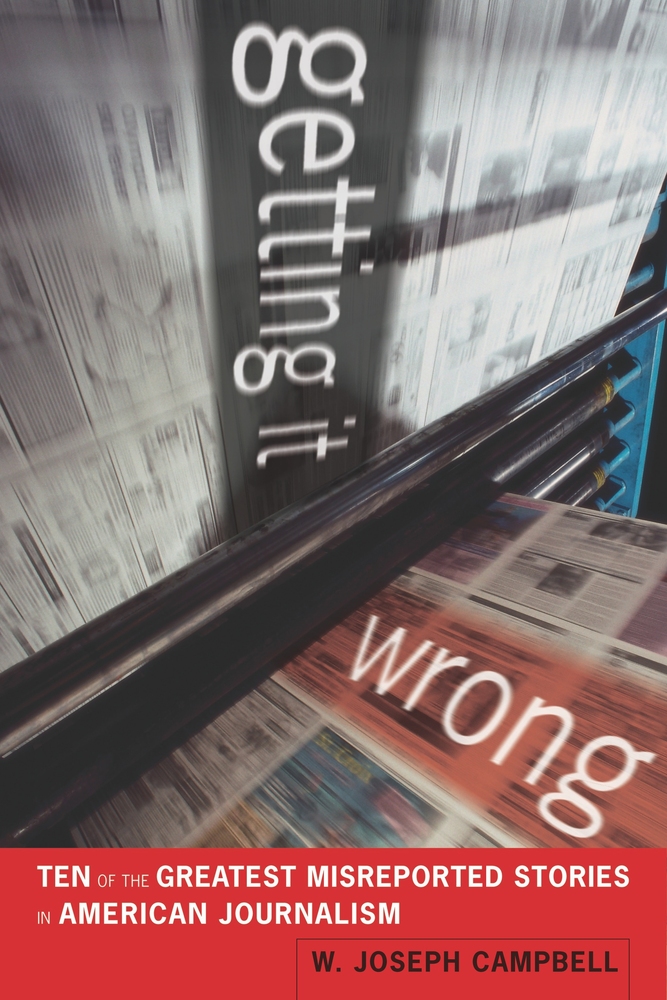
Today’s edition of the venerable  Portuguese newspaper Diário de Notícias includes a write up about Getting It Wrong, my new book about prominent media-driven myths–those false, dubious, improbable stories about the news media that masquerade as factual.

With the help of the online translation site Babelfish, I was able to make out a good deal of the Diário review, which says in part:

“W. Joseph Campbell in Getting it Wrong: Ten of the Greatest Misreported Stories in American Journalism, published the University of California Press, [says] these ‘myths can be thought as junk food of jornalismo.'”

The Diário article mentions several media myths addressed and debunked in Getting It Wrong, including those of William Randolph Hearst’s purported vow to “furnish the war” with Spain; the 1938 radio dramatization of the War of the Worlds which supposedly sowed panic across the United States; the notion that Edward R. Murrow’s 1954 See It Now television program abruptly halted Senator Joseph McCarthy’s communists-in-government witch-hunt, and the myth that the New York Times suppressed its coverage of the run-up to the Bay of Pigs invasion in 1961.

Diário characterizes as one of the book’s “more concrete” examples “the Watergate case,” in which reporters for the Washington Post are credited with having toppled the corrupt presidency of Richard Nixon.

Media myths, the articles notes, are not innocuous; ” they can distort the perception of the power and function of jornalismo” because “they tend to give the media” more power and influence than they rightly deserve. It also says that myths can “minimize the complexity of the historical events for simplistic interpretations.” Both of those are important points raised in Getting It Wrong.

The review closes by taking up the suggestion I offer in the conclusion of Getting It Wrong, namely that there are more media myths to debunk.

“By no means do the media myths examined on these pages represent a closed universe,” I write in the book’s closing passage. “Others surely will assert themselves. They may tell of great deeds by journalists, or of their woeful failings. They may well hold appeal across the political spectrum, offering something for almost everyone. They may be about war, or politics, or biomedical research.

“Predictably, they will be delicious tales, easy to remember, and perhaps immodest and self-congratulatory. They probably will offer vastly simplified accounts of history, and may be propelled by cinematic treatment.  They will be media-driven myths, all rich candidates for debunking.”

WJC

Related:

Puncturing the Times-suppression myth

In Bay of Pigs, Debunking, Media myths, New York Times on June 9, 2010 at 4:42 pm

In early April 1961, the New York Times supposedly bowed to pressure from the White House of President John F. Kennedy and “spiked,” or suppressed, its detailed report about the pending Bay of Pigs invasion of Cuba.

The Times’ purported self-censorship took place a little more than a week before the invasion, which failed utterly in its objective of toppling the Cuban revolutionary leader, Fidel Castro.

The invasion force of CIA-trained Cuban exiles gave up in less than three days and the Kennedy presidency, as well as U.S. standing in the Caribbean and the world, suffered a humiliating setback.

Had the Times not censored itself, had the Times gone ahead and reported all that it knew, the ill-fated invasion may well have been scuttled and a national embarrassment avoided.

Or so the story goes.

Before the invasion: Front page, NYTimes

The tale of the Times’ purported self-censorship has been recounted in many books, journals, newspapers, and other periodicals over the years. The episode offers supposedly timeless lessons about the perils of self-censorship, about the risks of yielding to pressure to withhold sensitive information on national security grounds.

The anecdote about the Times’ self-censorship is potent, compelling, delicious and timeless.

But as I describe in my forthcoming book, Getting It Wrong, it is also a media-driven myth.

The Times did not suppress its reports about the pending invasion of Cuba. It did not censor itself.  As is discussed in Getting It Wrong, the Times’ reports about preparations for the invasion were fairly detailed, not to mention prominently displayed on the front page in the days before the Bay of Pigs invasion was launched.

Given the widely held notion that the Times censored itself, it was fairly surprising to find in my research just how much reporting there was in advance of the invasion. The run-up to the Bay of Pigs was no one-day story.

Not all pre-invasion news reports were accurate or on-target. Much of it was piecemeal.

But there was ample coverage in the Times and other U.S. newspapers so that readers knew something was afoot in the Caribbean, that an assault on Castro was in the works.

The coverage supposedly reached a point where Kennedy told his press secretary, Pierre Salinger, a week before the invasion:

“I can’t believe what I’m reading! Castro doesn’t need agents over here. All he has to do is read our papers. It’s all laid out for him.”

The notion that Kennedy asked or persuaded the Times to suppress, hold back, or dilute any of its reports about the pending Bay of Pigs invasion is utter fancy.

As I discuss in Getting It Wrong, there is no evidence that Kennedy or his administration knew in advance about the content of the Times’ reporting about the pending invasion. There is no evidence that Kennedy or anyone in his administration lobbied or persuaded the Times to hold back or spike that story, as is so often said.

So what accounts for what I call the “suppression myth”?

I write in Getting It Wrong that the myth “stems from confusion with a separate episode during the Cuban Missile Crisis in October 1962, when Kennedy did ask the Times to postpone publication of a report about the Soviets having deployed nuclear-tipped weapons in Cuba. On that occasion, when the prospect of a nuclear exchange seemed to be in the balance, the Times complied.”

As for the significance of debunking the suppression  myth, I write:

“Exposing the myth demonstrates how the Kennedy administration sought to deflect blame for the Bay of Pigs and make a scapegoat of the Times. On separate occasions in 1961 and 1962, Kennedy told the senior executives of the Times that had the newspaper published more about the pending assault on Cuba, the invasion might have been scuttled.

“Such an interpretation of course shifts responsibility away from the authorities who possessed the power to order an invasion of a sovereign state,” I write. “Puncturing the Timessuppression myth, then, allows blame for the Bay of Pigs fiasco to be more properly apportioned.”

WJC

A version of this post first appeared at the University of California Press blog.

‘A debunker’s work is never done’

In Bay of Pigs, Bra-burning, Cronkite Moment, Debunking, Furnish the war, Media myths, Murrow-McCarthy myth, New York Times, Reviews, War of the Worlds, Washington Post, Watergate myth, Yellow Journalism on May 21, 2010 at 6:14 pm

So notes the inestimable media critic Jack Shafer in his review of my forthcoming book, Getting It Wrong, posted today at slate.com.

And what a generous, engaging, and insightful review it is.

Under the headline “The Master of Debunk,” Shafer notes that “the only way to debunk an enshrined falsehood is with maximum reportorial firepower.

“Toting big guns and an itchy trigger-finger is American University professor W. Joseph Campbell, whose new book Getting It Wrong: Ten of the Greatest Misreported Stories in American Journalism flattens established myths that you were brought up to believe were true.”

Shafer’s review specifically discusses a variety of media-driven myths, including William Randolph Hearst’s purported vow to “furnish the war” with Spain; the so-called “Cronkite moment” that supposedly altered President Lyndon Johnson’s Vietnam policy; the Bay of Pigs suppression myth that erroneously says President John F. Kennedy persuaded the New York Times to spike a story about the pending U.S.-backed invasion of Cuba, and the heroic-journalist myth of Watergate.

Shafer rightly points out that “a debunker’s work is never done” and to that end notes my recent post at Media Myth Alert about Evan Thomas’ new book, The War Lovers. The book embraces myths of the yellow press period in American journalism, including the Hearst vow.

Shafer thoughtfully considers the tenacity of media-driven myths, writing:

“Some myths endure because the stories are so compelling, like the Hearst tale and the alleged mayhem caused by Orson Welles’ [War of the Worlds] broadcast. Others survive because our prejudices nourish them (“crack babies,” bra burners) or because pure repetition has drummed them into our heads, smothering the truth in the process.

“The best tonic for the brain fever caused by media myths is an open mind and a free inquiry,” he writes.

Shafer wraps up the review by invoking this observation, by Jonathan Rauch:

“It is the error we punish, not the errant.”

Shafers adds:

“Of course when you do such a good job punishing the error, as Campbell does, you don’t need to bother with the errant.”

WJC

Related:

The murky derivation of ‘All the News That’s Fit to Print’

In 1897, Media myths, New York Times, Year studies on February 11, 2010 at 8:39 am

Prominent and famous though it is, the derivation of “All the News That’s Fit to Print,” the New York Times’ famous motto, is shrouded in a bit of media myth.

The version the Times advanced at its centenary in 1951, in a house newsletter called Times Talk, described the motto as “a hybrid.” Times Talk said Adolph Ochs, who acquired the then-beleaguered Times in 1896, borrowed a key portion of the slogan from the Philadelphia Times.

The Times Talk account was cited by Susan E. Tifft and Alex S. Jones in their prodigious study, The Trust: The Private and Powerful Family Behind The New York Times.

Supposedly, Ochs borrowed “All the News,” the motto of the Philadelphia Times, appended “That’s Fit to Print,” and thus concocted the most famous seven-word phrase in American journalism.

The account, however, is incorrect.

The Philadelphia Times never used “All the News” as its motto during the summer and fall of 1896, when Ochs acquired control of the Times and began using “All the News That’s Fit to Print” as a marketing and advertising slogan.

A thorough review of issues of the Philadelphia Times published in the summer and fall of 1896 showed that the newspaper carried a number of promotional statements, none of which was particularly pithy, or memorable.

As I wrote in my 2006 book, a year study titled The Year That Defined American Journalism: 1897 and the Clash of Paradigms, the nearest approximation to “All the News” was this rambling assertion, which appeared a few times beneath the front page nameplate of the Philadelphia Times:

“If You Want All the News of Every Description Attractively Presented You Will Read the Times.”

That clunky phrase appeared in the Philadelphia Times on August 4, 11, and 17, 1896. Ochs, according to Tifft and Jones, was installed as the New York Times publisher on August 18, 1896.

“All the News That’s Fit to Print” did not makes its début until early October 1896, spelled out in a row of red lights on an advertising sign above New York’s Madison Square.

Later that month, “All The News That’s Fit to Print” appeared in New York Times advertisements published in the trade journal Fourth Estate. By the end of October 1896, the phrase had taken a place in a corner of the Times’ editorial page.

And 113 years ago yesterday, on February 10, 1897, the Times moved the phrase without notice or fanfare to the upper left corner, the left “ear,” of its front page—a place of prominence that it has occupied ever since.

What prompted the motto’s move to the front page is not entirely clear. But the intent seems undeniable: To offer a rebuke to the bold, self-promoting yellow journalism of William Randolph Hearst and Joseph Pulitzer.

But it appears that “All the News That’s Fit to Print” was Ochs’ creation, as Harrison E. Salisbury maintained in Without Fear or Favor: The New York Times and Its Times, an impressive insider’s study of the Times. (Salisbury cited as his source an Ochs manuscript in the Times archives.)

By the way, I quote Salisbury’s Without Fear or Favor in Getting It Wrong, my forthcoming book about media-driven myths.

Without Fear or Favor was a useful source in the chapter in Getting It Wrong that addresses the myth surrounding the Times’ reporting in the run-up to the Bay of Pigs invasion in April 1961.

WJC

Kennedy took responsibility?

In Bay of Pigs, Media myths on November 28, 2009 at 11:09 am

Leslie Gelb, a former columnist for the New York Times and president emeritus of the Council on Foreign Relations, says President Obama’s recent Asia trip was so thin on accomplishment that it revealed a “disturbing amateurishness in managing America’s power.”

Gelb, writing at the Daily Beast blog, also says Obama “should stare hard at the skills of his foreign-policy team and, more so, at his own dominant role in decision-making.” He further suggests that “Obama might take responsibility himself, as President Kennedy did after the Bay of Pigs fiasco in 1961.”

There’s no argument here with Gelb’s assessment about Obama’s foreign policy. It projects a decided whiff of amateurishness, indeed.

But on the point about Kennedy’s having taken responsibility for the Bay of Pigs debacle: Well, there’s a whiff of media myth in that claim.

As I write in my forthcoming book, Getting It Wrong, Kennedy in the aftermath of the failed Bay of Pigs invasion of Cuba, sought to spread the blame to the U.S. news media, particularly the New York Times. On separate occasions in 1961 and 1962, Kennedy told the Times publisher and its managing editor that had the newspaper printed all it knew about the pending invasion, the country and his administration would have been spared a major foreign policy embarrassment. That is, the pre-invasion publicity would have made an assault untenable.

But as James (Scotty) Reston, the veteran Times columnist and correspondent in Washington, correctly noted, Kennedy’s comments were “a cop-out.”

The decision to press ahead with the attempt to topple Fidel Castro rested squarely with the Kennedy administration.

Kennedy’s comments, made to Publisher Orvil E. Dryfoos and Managing Editor Turner Catledge, had the effect of solidifying the media-driven myth that the Times had censored itself in reporting about the run-up to the invasion.

The purported self-censorship took place in the days before the invasion, which failed utterly in its objective of toppling Castro.

But close reading of the newspaper in early April 1961 makes it clear that the Times did not spike it reports about the pending invasion of Cuba. The newspaper did not censor itself. The Times’ coverage about preparations for the assault was in fact fairly detailed and prominently displayed on front pages in the days before the invasion force of Cuban exiles hit the beaches.

The related notion that Kennedy asked or persuaded the Times to suppress, hold back, or dilute any of its reports about the pending Bay of Pigs invasion also is utter fancy.

But the anecdote about the Times’ self-censorship lives on as a timeless lesson about why the news media should not bow or defer to power. It’s a potent, durable, and compelling tale.

It’s also apocryphal.

WJC