Craig Silverman, author of Regret the Error, posted an intriguing column yesterday about appealing but dubious quotations that journalists seem especially prone to cite, noting that such famous lines “often turn out to be manufactured or inexact representations.”
It’s an important reminder, given the endless popularity of quotations that are neat, tidy, and irresistibly delicious. As I note in my latest book, Getting It Wrong, “Turns of phrase that sound too neat and tidy often are too perfect to be true.”
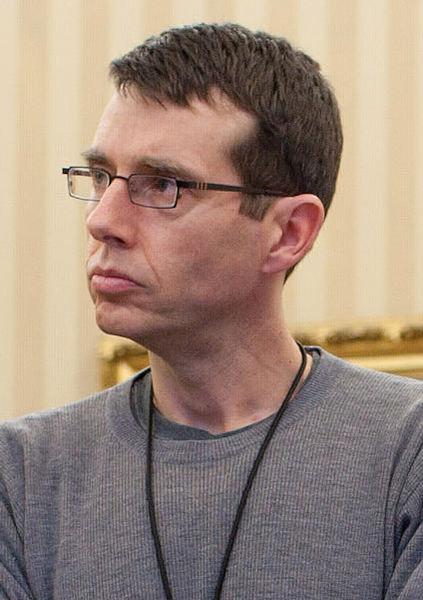
Plouffe: Not so 'queasy'?
Silverman’s column, titled “Misquotes that refuse to die,” was centered around a comment attributed in 2009 to David Plouffe, Barrack Obama’s campaign manager in 2008.
Plouffe supposedly said he felt a bit “queasy” about the prospect of Obama’s facing Jon Huntsman, the Republican former Utah governor, in the presidential election in 2012.
“Plouffe never said it,” Silverman wrote, describing how the queasy line took on life of its own.
Journalists can be particularly susceptible to such succinct “little gems,” as Silverman put it, because the gems are so effective in making a point or in distilling complexity.
Silverman’s column noted two famous, dubious quotes that I dismantle in Getting It Wrong.
One of them is the comment misattributed to President Lyndon Johnson who, in reaction to Walter Cronkite’s on-air assessment that the war in Vietnam was “mired in stalemate,” supposedly said:
“If I’ve lost Cronkite, I’ve lost Middle America.”
Versions as to what Johnson supposedly said vary quite a lot — which can be a marker of a media myth. I also point out in Getting It Wrong that Johnson did not see the Cronkite report when it aired on CBS on February 27, 1968.
The other dubious quote discussed in Getting It Wrong and mentioned by Silverman is William Randolph Hearst’s purported vow to “furnish the war” with Spain.
Reasons for doubting the Hearstian vow are many, I write, and include the fact that the telegram in which Hearst supposedly made the statement has never turned up. Plus, Hearst denied making such a vow.
A number of other famous and delicious quotes favored by journalists likewise have proven to be false, made-up, or of mythical dimension; among them:
- “Follow the money.” It is, I argue, the most famous made-up line about the Watergate reporting of the Washington Post. The comment, often attributed to the stealthy “Deep Throat” source cultivated by Bob Woodward of the Washington Post, was written into the screenplay of All the President’s Men, the movie about the work of Woodward and his Post colleague, Carl Bernstein. “Follow the money” doesn’t appear in Woodward and Bernstein’s book about Watergate, nor was it uttered in real life by “Deep Throat.”
- “We must not confuse dissent with disloyalty. When the loyal opposition dies, I think the soul of America dies with it.” The entire quote often is attributed to Edward R. Murrow, the legendary CBS newsman. Murrow spoke the first sentence, during his mythical, 1954 See It Now program about Senator Joseph R. McCarthy. The second portion — “When the loyal opposition dies…” — was appended many years later by persons unknown, probably around 2000. The full quotation has become so popular that it appeared for a time at the online welcome page of the dean of Edward R. Murrow College of Communication at Washington State University.
- “Too early to say.” It’s often said that Chinese premier Zhou Enlai offered the observation in 1972, as sage, far-sighted analysis about the effects of the French Revolution of 1789. But according to a retired American diplomat, Charles W. (Chas) Freeman Jr., Zhou’s comment, which came during President Richard Nixon’s visit to China in February 1972, was about political turmoil in France in 1968. “I cannot explain the confusion about Zhou’s comment, except in terms of the extent to which it conveniently bolstered a stereotype” about Chinese leaders taking an exceptionally long and patient view of history, Freeman said recently. Freeman was Nixon’s interpreter on the trip.
So what to do about these delicious but dubious and phony quotations?
Keep pounding away at them, calling them out for what they are, whenever they appear. That’s the only effective way of debunking.
But even then, thorough and utter debunking can be rare.
Recent and related:
- ‘Too early to say’: Zhou was speaking about 1968, not 1789
- The ‘anniversary’ of a media myth: ‘I’ll furnish the war’
- ‘Furnish the war’ lives on, and on
- Did he say it? A curious Murrow quote
- Suspect Murrow quote pulled at Murrow School
- ‘Follow the money,’ again and again
- Scoring political points with ‘follow the money,’ that made-up line
- ‘Mired in stalemate’? How unoriginal of Cronkite
- ‘When I lost Cronkite’ — or ‘something to that effect’
- Noting the anniversary of Twain’s ‘report of my death’ comment
- Too bad it’s only in French: A neat little book of impressive debunking
- Why history is badly taught, poorly learned
- Getting It Wrong wins SPJ award for Research about Journalism

 Media Myth Alert