W. Joseph Campbell

Posts Tagged ‘Cuba’

BBC calls Hearst vow apocryphal, quotes it anyway

In 1897, Debunking, Furnish the war, Media myths, Spanish-American War, Yellow Journalism on July 15, 2011 at 10:28 am

Apocryphal but still quotable.

That’s how Britain’s venerable broadcaster, the BBC, treated the mythical anecdote about media titan William Randolph Hearst and his purported vow to “furnish the war” with Spain in the late 19th century.

In an article posted online yesterday, the BBC described Hearst as the “definitive [news] baron” and declared:

“He’s credited with the invention of tabloid journalism in the 1890s when his New York Journal began a bitter circulation war with Joseph Pulitzer’s New York World. He also had a reputation as a warmonger.

“‘You furnish the pictures and I’ll furnish the war,’ goes an apocryphal instruction he was supposed to have sent in a telegram to an illustrator in Havana.”

That’s right, the line is apocryphal. What, then, is the point in using it? As a none-too-clever, back-handed way of buttressing the dubious notion that Hearst and his newspapers were capable of fomenting a war?

That’s sloppy journalism from a leading international news organization.

As I discuss in my latest book, Getting It Wrong, Hearst’s purported vow to “furnish the war” with Spain is a particularly tenacious media-driven myth — a prominent but dubious tale about journalism that masquerades as factual.

I note that the tale about Hearst’s vow “has achieved unique status as an adaptable, hardy, all-purpose anecdote, useful in illustrating any number of media sins and shortcomings.

“It has been invoked to illustrate the media’s willingness to compromise impartiality, promote political agendas, and indulge in sensationalism. It has been used, more broadly, to suggest the media’s capacity to inject malign influence into international affairs.”

Hearst: Didn't say it

Reasons for doubting the presumptive Hearstian vow are many, I point out in Getting It Wrong, and include the fact that the telegram in which Hearst supposedly made the statement — in an exchange with the artist Frederic Remington, on assignment to Cuba — has never turned up.

Plus, Hearst denied making such a vow.

Not only that, but the anecdote lives on lives on despite what I call “an irreconcilable internal inconsistency.” That is, it would have been absurd for Hearst to vow to “furnish the war” because war— specifically, the Cuban rebellion against Spanish colonial rule— was the reason he sent Remington to Cuba in the first place.

The artist was in Cuba for just six days in January 1897. By that time, the Cuban rebellion — a war for political independence — had reached islandwide proportions. “Anyone reading U.S. newspapers in early 1897 would have been well aware that Cuba was a theater of a nasty war,” I write in Getting It Wrong.

Given the context, Hearst’s purported vow is utterly illogical.

And to invoke the anecdote knowing that it’s apocryphal is little short of disingenuous.

The BBC’s reference to Hearst’s being “credited with the invention of tabloid journalism in the 1890s” also is questionable.

Hearst’s style of flamboyant journalism certainly helped inspire the epithetyellow journalism,” but he was no father of tabloid journalism.

If anything, Hearst was a latecomer to that genre.

As David Nasaw wrote in The Chief, his admirably even-handed biography of Hearst, the press baron didn’t embrace the tabloid until the 1920s “because he was not comfortable with the format.

“He  had no interest in publishing a picture newspaper that had little room for political coverage, columns, cartoons, and the editorials he cared so much about.”

WJC

Many thanks to Instapundit
Glenn Reynolds for linking to this post.

Recent and related:

Scandalously wrong: AP roundup on media scandals errs on yellow press

In Debunking, Media myths, Spanish-American War, Yellow Journalism on July 14, 2011 at 7:37 am

The Associated Press wire service cobbled together a superficial roundup about scandals in American journalism — and in doing so exaggerated the role of the yellow press in bringing on war with Spain in 1898.

The roundup, posted yesterday, was pegged to Rupert Murdoch’s troubles in Britain and the recent demise of the media mogul’s scandal-ridden Sunday tabloid, News of the World.

“Before the technology existed for Rupert Murdoch’s journalists to hack into phone records,” the roundup began, “past generations of dubious reporters have given readers 4-foot-tall furry creatures living on the moon, a bogus 8-year-old heroin addict and a nonexistent interview with a sick president that won a Pulitzer Prize.”

All sounds interesting.

But the roundup soon turned listy, bouncing from case to case with scant detail or analysis — a failing common to hurriedly prepared wire service compilations.

And the roundup was scandalously wrong in stating unsubstantiated claims about the yellow press and the Spanish-American War.

“During the ‘yellow journalism’ era of the 1890s,” AP’s roundup declared, “powerful publishers Joseph Pulitzer of the New York World and William Randolph Hearst of the New York Journal whipped up a frenzy with false or exaggerated stories about Spanish rulers in Cuba, leading to the Spanish-American War.”

Let’s unpack that paragraph.

First, there’s little to no evidence that the content of the Hearst and Pulitzer’s newspapers “whipped up” any kind of frenzy related to Spain’s rule of Cuba. Second, the yellow press wasn’t much exaggerating in reporting about the effects of Spain’s harsh policies on the Cuban people.

Hearst and Pulitzer’s newspapers certainly were advocates of Cuban self-rule. But even at their most egregious — in the days following the destruction in February 1898 of the U.S. battleship Maine in Havana harbor — the content of those newspapers stirred little frenzy among Americans.

As I wrote in my 2001 work, Yellow Journalism: Puncturing the Myths, Defining the Legacies, Hearst’s Journal and Pulitzer’s World “were undeniably extreme in their reporting, especially in the aftermath of the Maine’s destruction.

“But their excesses,” I noted, “were not widely shared in the U.S. press; the excesses in fact were roundly deplored and even ridiculed. That they influenced many people, or whipped Americans ‘to a white heat’ is doubtful: Several contemporaneous sources describe the sober calm with which the American public and many newspapers awaited the official U.S. report about the cause of the Maine’s destruction.”

The Nation, for example, observed in March 1898: “Nothing could be more curious than the contrast between the wild aspect of the first pages of our [yellow journals] and the calm of the persons who are seen reading them.”

Nor was the yellow press exaggerating the deplorable conditions in Spanish-ruled Cuba, where a rebellion begun in 1895 had soon reached islandwide proportions.

Humanitarian disaster

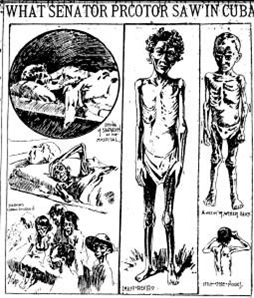
Spain not only sent 200,000 troops in an attempt to put down the rising; senior Spanish leaders in Cuba imposed what they called a policy of reconcentración, or reconcentration, in which old men, women, and children — non-combattants — were herded into garrison towns.

The policy was intended to deprive Cuban rebels of food, supplies, and logistical support.

But the consequences were disastrous.

The Cuban non-combattants suffered enormously under reconcentración; tens of thousands of them died from hunger, disease, and malnutrition.

The effects of reconcentración drew the frequent attention of U.S. newspapers of all kinds — yellow and otherwise.

It was the humanitarian crisis on Cuba — and Spain’s inability to resolve the crisis — that weighed significantly in the U.S. decision to go to war in April 1898. The often-flamboyant yellow press was a non-factor.

WJC

Recent and related:

‘News of World’ closure breaks link to 19th century yellow journalism

In 1897, Debunking, Year studies on July 10, 2011 at 12:04 am

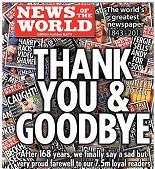
The abrupt closure of Britain’s largest Sunday tabloid, Rupert Murdoch’s raunchy, scandal-ridden News of the World, breaks a link to the yellow journalism that flared in urban America at the end of the 19th century.

Jail-breaking journalism

I’m not referring to the News of the World’s tabloid flamboyance, which certainly evoked the typographic boldness of William Randolph Hearst’s New York Journal, a broadsheet that was the leading exemplar of American yellow journalism.

The link went deeper than appearances.

The News of the World was an heir to Hearst’s activist-oriented, participatory journalism — a self-engaging, self-promoting style of newspapering unheard of these days in the United States.

As I note in my book The Year That Defined American Journalism: 1897 and the Clash of Paradigms, Hearst’s Journal at the end of the 19th century sought to set a standard for the American press, insisting, I write, “that newspapers were obliged to inject themselves, conspicuously and vigorously, in righting the wrongs of public life, and in filling the void of government inaction and incompetence.”

The year 1897 brought memorable evidence of Hearst’s style of activist journalism.

In the summer that year, Hearst deployed a phalanx of Journal reporters to solve the grisly case of headless torso murder in New York.

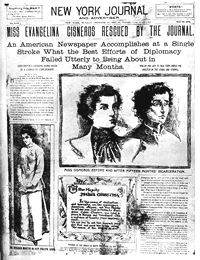
Later that year, a reporter for the Journal broke from jail in Havana a 19-year-old political prisoner named Evangelina Cisneros. The Journal — and more than a few other U.S. newspapers — celebrated the breathtaking breach of international law.

For the Journal, the Cisneros jailbreak (see image, above) was “epochal” and represented the “supreme achievement” of its paradigm of activist journalism.

It acknowledged that freeing Cisneros had violated Spanish law and flouted international convention — and the Journal seemed delighted to have done so, saying:

“The Journal is quite aware of the rank illegality of its action. It knows very well that the whole proceeding is lawlessly out of tune with the prosaic and commercial nineteenth century. We shall not be surprised at international complications, nor at solemn and rebuking assurances that the age of knight errantry is dead. To that it can be answered that if innocent maidens are still imprisoned by tyrants, the knight errant is yet needed.”

That sort of willingness to wink at illegality was demonstrated by the News of the World well before it became swept up in a cellphone-voicemail hacking scandal that brought about its demise.

Final edition

The News of the World, which published its final issue today, had been for years one of the world’s most controversial titles, due in part to its activist-oriented undercover operations, ostensibly undertaken to bring drug dealers, fugitive financiers, and other criminals to justice.

As I noted in my 2001 book, Yellow Journalism: Puncturing the Myths, Defining the Legacies, the targets of the News of the World often were “small-time celebrities and wayward sports figures dabbling in modest quantities of illegal drugs. The undercover methods were criticized as entrapment and dismissed as ‘a kind of investigative reporting without much investigating.'”

I also described a notorious case in 1999, in which reporters for News of the World “posed as wealthy Arabs and enticed a British earl to buy cocaine and share the drug with them. A detailed report about the peer’s conduct — he was depicted as drunkenly snorting cocaine with a £5 note — soon after was splashed across News of the World. He was arrested and convicted of selling drugs.

“But the presiding judge declined to send the peer to jail, citing the subterfuge of the News of the World. If not for the journalists’ sting, the judge observed, the crimes likely would not have been committed.”

Such outlandishness hinted at the tabloid’s more recent and more egregious misconduct of breaking into the cellular phone voicemail of hundreds of people, including members of Britain’s royal family and perhaps victims of the terror attack on London’s subway system July 2005.

Phone-hacking, of course, wasn’t an element in the repertoire of the yellow press of Hearst or of his mean-spirited rival, Joseph Pulitzer. Nor did they did bring on the war with Spain in 1898, as is often alleged.

But on occasion they turned to deception, misrepresentation, and self-motivated activism in pursuit of their lusty brand of big-time journalism.

WJC

Recent and related:

Wrong-headed history: Yellow press stampeded U.S. to war

In Debunking, Media myths, Spanish-American War, Yellow Journalism on June 21, 2011 at 9:13 am

Glib but thinly substantiated.

Hearst: War-monger?

That characterizes the not-infrequent claims about William Randolph Hearst, Joseph Pulitzer, and the war-mongering ways of their yellow newspapers. The claims are readily offered but rarely documented.

Take, for example, an essay published yesterday at Huffington Post which addressed the farcical campaign of the satiric newspaper, the Onion, to seek a Pulitzer Prize.

The HuffPo essay was headlined, “Why not give The Onion a Pulitzer?” and offered this dollop of wrong-headed history:

“Pulitzer and William Randolph Hearst used their newspapers to stampede the country into the Spanish-American War. A century later, the publications most often honored by Pulitzer Prizes went along for the ride of our Iraqi adventure in the same fashion — which makes the point that today’s regular Pulitzer honorees haven’t come very far from the journalism practiced in Pulitzer’s day.”

The latter claim — “today’s regular Pulitzer honorees haven’t come very far” — is risible. The preceding claim about the yellow press and a “stampede” to war with Spain is utterly false.

As I discussed in my 2001 book, Yellow Journalism: Puncturing the Myths, Defining the Legacies:

“The yellow press is not to blame for the Spanish-American-War. It did not force — it could not have forced — the United States into hostilities with Spain over Cuba in 1898. The conflict was, rather, the result of a convergence of forces far beyond the control or direct influence of even the most aggressive of the yellow newspapers, William Randolph Hearst’s New York Journal. ”

In 1898, Pulitzer and Hearst published six newspapers between them. Pulitzer’s were the World and the Evening World in New York, and the Post-Dispatch in St. Louis. Hearst’s were the Journal, the New York Evening Journal, and the San Francisco Examiner.

Those half-dozen titles wielded no more than modest agenda-setting influence on the rest of the American press, which then numbered more than 2,200 daily newspapers.

As I pointed out in Yellow Journalism:

“There is little evidence that the press beyond New York City, especially in small-town and rural America, was influenced by the content of the yellow journals, including their demands for war after the destruction of the Maine,” the American battleship that blew up in Havana harbor in February 1898, killing 266 officers and sailors.

The destruction of the Maine was a triggering event of the war with Spain for the future of Cuba. But it was not the sole factor, or even necessarily the decisive factor.

Effects of 'reconcentration'

What more than anything led America to war in 1898 were Spain’s brutal efforts to suppress the rebellion on Cuba, a vicious conflict that began in February 1895.

Spain sought to crush the rebellion by forcing Cuban non-combattants – old men, women, and children– into were called “reconcentration centers,” to prevent the non-combattants from giving aid, succor, and supplies to the Cuban rebels.

Spain’s “reconcentration” policy was a disaster. Tens of thousands of Cubans fell victim to disease and starvation. U.S. newspapers — including but certainly not limited to the dailies of Pulitzer and Hearst — were aware of, and reported extensively about, the humanitarian crisis that had taken hold on Cuba by early 1898.

That crisis — and not the often-flamboyant contents of the yellow press — was what precipitated the conflict with Spain.

As the historian David Trask has written, Americans in 1898 “went to war convinced that they had embarked upon an entirely selfless mission for humanity,” to end Spain’s brutal rule of Cuba.

It’s important to note that the fierce Pulitzer-Hearst competition for readers in New York undercut whatever power their respective newspapers may have wielded in shaping U.S. public opinion and U.S. policy toward Spain.

As I noted in Yellow Journalism, the newspapers of Pulitzer and Hearst “were not in lockstep but sought instead to denigrate, undercut, or minimize the other’s coverage during the months before and after the United States declared war on Spain.”

The broader effect of the Pulitzer-Hearst rivalry, I noted, “likely was to diminish the integrity and, in turn, the credibility and  presumed influence” of their newspapers, further weakening their agenda-setting capacity.

WJC

Recent and related:

Why they get it wrong

In Bay of Pigs, Cronkite Moment, Debunking, Furnish the war, Jessica Lynch, Media myths, New York Times, Newspapers, Washington Post, Watergate myth on June 3, 2011 at 6:49 am

It’s striking how several well-known journalists and news outlets have indulged over last six months in media-driven myths, those dubious tales about the news media that masquerade as factual.

The lineup of myth-indulgers is impressive and, among others, includes:

  • Bill Keller, executive editor of the New York Times, who rubbed shoulders with the Bay of Pigs suppression myth in a column in the Times in January. The suppression myth holds that at the behest of President John F. Kennedy, the Times killed or emasculated its report about the pending Bay of Pigs invasion in 1961. That tale is unfounded, as I discuss in my latest book, Getting It Wrong.
  • Mother Jones magazine which, in its May/June cover story by Rick Perlstein, offered up a rare two-fer — two media myths discussed in a single article. One of the myths was the hoary and surely apocryphal tale about William Randolph Hearst and his reputed vow to “furnish the war” with Spain. The other was about the so-called the “Cronkite Moment” of 1968, in which Walter Cronkite’s on-air assessment that the U.S. military was “mired in stalemate” in Vietnam was so powerful as to alter U.S. policy.
  • Keith Olbermann, the acerbic cable television commentator who, as he quit his prime-time Countdown show in January, referred to the  “exaggerated rescue” of Army private Jessica Lynch in the early days of the Iraq War. Such claims, raised as long ago as 2003, were unsubstantiated by an inquiry of the Defense Department’s inspector general who found the rescue operation was found to have been “a valid mission” to recover Lynch, a prisoner of war, “under combat conditions.”

What accounts for such lapses by prominent journalists and their outlets? Why do these and other media-driven myths often find their way into news reports and commentaries?

Some media myths are just too good not to be true; they almost are too good to take time to check out. The tale about Hearst’s vowing to “furnish the war” certainly falls into this category. It shouldn’t be at all difficult to locate references to the dubious character of the anecdote, which has been the subject of repeated debunking over the years.

Likewise, it can be far easier to invoke a media myths that to commit to the tedium of research and legwork. Media myths are convenient, readily at hand. Poking into their details takes time, and a willingness to challenge what are accepted as consensus narratives.

As I noted in discussing Keller’s column that invoked the Bay of Pigs suppression myth:

“Had Keller consulted the newspaper’s database of reporting about the run-up to the Bay of Pigs invasion in April 1961, he would have found that the Times reported in detail, if not always accurately, about the preparations to infiltrate a U.S.-trained brigade of Cuban exiles in an attempt to topple Fidel Castro.”

Similarly, some media myths (such as the illusory “Cronkite Moment“) may be too ingrained, too dearly held by journalists, ever to be uprooted or thoroughly repudiated.

Unlearning such tales is no small challenge, after all. The conundrum of unlearning was addressed a few months ago in a Wall Street Journal column, which noted:

“For adults, one of the most important lessons to learn in life is the necessity of unlearning. We all think that we know certain things to be true beyond doubt, but these things often turn out to be false and, until we unlearn them, they get in the way of new understanding.”

Media myths also can be convenient means of scoring political points. The two-fer in Mother Jones magazine, for example, were presented as part of a sneering attack about “fact-free” Republicans.

Moreover, media myths — the most prominent of them, anyway — resonate in contemporary contexts.

History, it has been said, is “what we decide to remember,” and journalism history is not an exception. Recalling and celebrating the memory of Cronkite’s supposedly telling truth to power about Vietnam — or of Bob Woodward and Carl Bernstein’s bringing down a corrupt presidency — is to offer reassurance to contemporary journalists at a time of confusion and upheaval in their field.

Deciding to remember such mythical tales is understandable if not justifiable, given that those tales bring solace and reassurance amid sweeping uncertainty.

WJC

Recent and related:

As if Hearst were ‘back with us,’ vowing to ‘furnish the war’

In 1897, Debunking, Furnish the war, Media myths, Spanish-American War, Yellow Journalism on May 10, 2011 at 2:26 am

Nieman Watchdog, a blog that “seeks to encourage more informed reporting,” indulged yesterday in the mythical tale of William Randolph Hearst‘s famous vow to “furnish the war” with Spain in the late 19th century.

Remington in Cuba for Hearst

It was a case of the blog’s turning to a fiction about Hearst and treating it as if it were fact.

The occasion for invoking “furnish the war” was to call attention to inaccuracies in news graphics accompanying reports last week about the slaying of terror mastermind Osama bin Laden.

“Journalism is a serious business where credibility is paramount,” the blog post asserted. “Editors need, first and foremost, to get the facts right, in graphics as well as text and video.”

The post further noted that “some publications presented as facts what was just fiction. Sometimes there was no factual support whatsoever. It’s as though William Randolph Hearst was back with us, saying once again, ‘You furnish the pictures and I’ll furnish the war.'”

As I discuss in my latest book, Getting It Wrong, the tale about Hearst’s vow to “furnish the war” is a hardy media-driven myth that lives on despite concerted attempts to discredit and dismantle it.

The vow supposedly was contained in a telegram sent to the famous artist, Frederic Remington, who was on assignment in Cuba for Hearst’s flamboyant New York Journal (see image, above). Remington and the correspondent Richard Harding Davis were assigned there to cover the insurrection against Spanish colonial rule — the conflict that gave rise in 1898 to the Spanish-American War.

They arrived in Havana in early January 1897; Remington stayed only six days.

Before leaving by passenger steamer for New York, Remington supposedly sent Hearst a cable, stating:

“Everything is quiet. There will be no war. I wish to return.”

Hearst replied with his famous vow:

Please remain. You furnish the pictures, and I’ll furnish the war.”

But Remington didn’t stay.

He promptly returned to New York, where his sketches were given prominent display in Hearst’s Journal. They appeared with such flattering headlines as: “Cuban War Sketches Gathered in the Field by Frederic Remington; The Gifted Artist, Visiting Cuba Especially for the Journal.”

That’s hardly the sort of tribute Hearst would have granted a wayward artist who ignored specific instructions to “remain” in Cuba.

I further note in Getting It Wrong that the anecdote about Hearst’s vow “lives on despite an irreconcilable internal inconsistency: It would have been absurd for Hearst to vow to ‘furnish the war’ because war — specifically, the Cuban rebellion against Spain’s colonial rule — was the very reason Hearst sent Remington to Cuba in the first place.”

Anyone reading U.S. newspapers in early 1897 “would have been well aware,” I write, “that Cuba was a theater of a nasty war,” which gave rise in April 1898 to the Spanish-American War.

Not only that, but the artifacts themselves — the telegrams reputedly sent by Remington and Hearst — have never surfaced. And Spanish censors monitored incoming and outgoing telegraphic traffic in Havana, and they surely would have intercepted Hearst’s incendiary message — had it been sent.

For those and other reasons, the tale about the Remington-Hearst exchange is surely apocryphal — fiction that too often masquerades as fact.

WJC

Recent and related:

Bay of Pigs suppression myth too rich and delicious to die away

In Anniversaries, Bay of Pigs, Debunking, Media myths, New York Times on May 7, 2011 at 5:31 am

The tale of the New York Times censoring itself in the runup to the Bay of Pigs invasion 50 years ago supposedly offers timeless lessons about the perils of journalists surrendering to the agenda of government.

That anecdote, I write in my latest book, Getting It Wrong, is “often cited as an object lesson … about what can happen when independent news media give in to power-wielding authorities.”

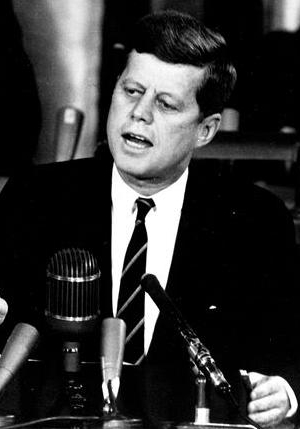
Supposedly, in early April 1961, the Times spiked or emasculated a detailed report about the invasion preparations — and did so at the urging of President John F. Kennedy.

But as I discuss in detail in Getting It Wrong, neither Kennedy nor anyone in his administration asked or lobbied the Times to kill or tone down that report — which was written by a veteran correspondents named Tad Szulc, ran to more than 1,000 words, and was published April 7, 1961, above the fold on the newspaper’s front page.

Like many consensus narratives and media-driven myths, though, the Times-Bay of Pigs suppression tale is too neat and tidy, too rich and delicious, ever to die away.

A hint of that came yesterday at the online site of CounterPunch, which touts itself as “America’s best political newsletter.”

CounterPunch posted an essay that referred to the Times’ purported act of self-censorship, stating:

“Back in April 1961, the Times deleted from Tad Szulc’s story the time and place of landing of the CIA-backed Bay of Pigs invasion because President Kennedy told the Times’ publisher it would not serve U.S. National Security interests. (David Halberstam, The Powers That Be, p. 448).”

It’s neat the passage was cited. But the citation doesn’t render it accurate.

Halberstam‘s Powers That Be, after all, is no authoritative source on the tale of the Times‘ self-censorship. Far from it.

Halberstam’s account claimed that Kennedy called James (“Scotty”) Reston, the Times’ Washington bureau chief, “and tried to get him to kill” the Szulc story.

Szulc of the Times

According to Halberstam, Kennedy “argued strongly and passionately about what the Szulc story would do to his policy” and president warned that the Times would risk having blood on its hands were the article published and the invasion a failure.

Heady stuff, but it never happened.

As I note in Getting It Wrong, there is “no evidence that Kennedy spoke with anyone at the Times” on April 6, 1961, the day Szulc’s dispatch was written, edited, and prepared for publication.

“The Kennedy Library in Boston says that the White House telephone logs reveal no calls were placed to Reston” or other Times executives that day, I write, adding:

“Kennedy had almost no chance to speak with those executives during the interval from when Szulc’s story arrived at the Times building in midtown Manhattan and when it was set in type.”

That’s because the president spent the last half of the afternoon of April 6, 1961, playing host to Harold Macmillan, the British prime minister, on a lengthy cruise down the Potomac River to Mount Vernon.

The outing ended around 6:30 p.m., leaving Kennedy only a tiny window of opportunity to call Times executives before the first edition of the newspaper hit the streets.

Harrison Salisbury, a Pulitzer-winning Times correspondent and editor, offered in his book, Without Fear of Favor the most detailed account of the Times’ deliberations on the Szulc article. And Salisbury was unequivocal:

“The government in April 1961,” he wrote, “did not … know that The Times was going to publish the Szulc story, although it was aware that The Times and other newsmen were probing in Miami. Nor did President Kennedy telephone [Times President Orvil] Dryfoos, Scotty Reston or [Managing Editor] Turner Catledge about the story.”

The editing that Szulc’s story received served to improve its accuracy. The reference to the invasion’s imminence was removed, as it represented “a prediction and not a fact,” as Reston wrote years later.

(The story Szulc submitted included no reference to “place of landing.”)

The invasion at the Bay of  Pigs was launched April 17, 1961, or 10 days after Szulc’s story appeared.

In the interim, as I point out in Getting It Wrong, the Times “did not abandon the Cuba-invasion story ….  Subsequent reporting in the Times, by Szulc and others, kept expanding the realm of what was publicly known about a coming assault against Castro.”

So Szulc’s article of April 7, 1961, was no one-off effort. And it wasn’t sanitized at the request of the Kennedy administration, either.

WJC

Many thanks to Little Miss Attila
for linking to this post

Recent and related:

CBC modifies its Bay of Pigs claim — but still has it wrong

In Anniversaries, Bay of Pigs, Debunking, Media myths, New York Times on April 19, 2011 at 2:03 pm

After my post Sunday that called attention to its erroneous characterization of  the New York Times reporting in the run-up to the Bay of Pigs invasion, CBC News in Canada modified its claim that at “the direct request” of the President John F. Kennedy, the Times “played down” its story about the pending invasion of 50 years ago.

The CBC now says the Times “played down their story at the direct request of the Kennedy administration.” It’s a slight modification, but a significant shift in storyline, away from Kennedy to an unnamed person or persons in his administration.

Even so, the CBC offered no compelling evidence about who in the Kennedy administration made such a request to the Times, when, to whom, or how.

The modification does little more than muddy matters.

And the CBC still doesn’t have it right about Kennedy, the Times, and the run-up to the ill-fated Bay of Pigs invasion.

As I point out in Getting It Wrong, my media-mythbusting book that devotes a chapter to the New York Times-Bay of Pigs suppression myth, there is no compelling evidence that Kennedy or anyone in his administration pressured, lobbied, or persuaded the Times to modify, emasculate, or sanitize the article it published April 7, 1961, which lies at the heart of this media-driven myth.

Szulc of the Times

That article was written by a veteran correspondent named Tad Szulc, who reported that a force of Cuban exiles had been training in the United States and Central America, preparing to launch an armed assault on the regime of Fidel Castro.

I point out in Getting It Wrong that the recollections of none of the principal figures in the Times-suppression episode say that Kennedy pressured the newspaper’s editors about the Szulc story.

These recollections, I write, “include the memoirs of Turner Catledge, then the managing editor of the Times; of James (Scotty) Reston, then the chief of the Times’ Washington bureau; of Pierre Salinger, Kennedy’s press secretary, and of Arthur M. Schlesinger Jr., an award-winning Harvard historian who was a White House adviser to Kennedy.”

It’s highly improbable that a such juicy detail as Kennedy’s purported interference with the Times’ news judgment would have been so thoroughly ignored by such a disparate cast.

Moreover, the compelling insider’s account written by Harrison E. Salisbury, a former Times senior editor and Pulitzer Prize-winning correspondent, asserted that the Kennedy White House neither knew about, nor meddled in, the newspaper’s deliberations about its pre-invasion coverage.

Salisbury was unequivocal about that, writing in his 1980 work, Without Fear or Favor:

“The government in April 1961, did not … know that The Times was going to publish the Szulc story, although it was aware that The Times and other newsmen were probing in Miami. Nor did President Kennedy telephone Dryfoos, Scotty Reston or Turner Catledge about the story…. The action which The Times took [in editing Szulc’s report] was on its own responsibility,” the result of its internal discussions and deliberations.

“Most important,” Salisbury added, “The Times had not killed Szulc’s story.” The newspaper, he wrote, “believed it was more important to publish than to withhold. Publish it did.”

Even with the modification of its article about the Bay of Pigs, the CBC was not inclined to abandon entirely the notion that Kennedy, somehow, took a direct role in meddling with the Times. In a sidebar article posted Sunday, the CBC asserted:

“Numerous sources say that President Kennedy spoke with someone at the New York Times about their reporting there was going to be an invasion of Cuba.”

Many sources may have made such a claim. But assertion is not evidence. And none of the sources mentioned by the CBC offered documentation for their claims.

The CBC sidebar referred specifically to David Halberstam, who wrote The Powers That Be, and Peter Wyden, author of Bay of Pigs: The Untold Story.

Halberstam offered a highly colorful  yet uncorroborated claim that Kennedy called Reston “and tried to get him to kill” Szulc’s article.

Kennedy “argued strongly and passionately about what the Szulc story would do to his policy,” Halberstam wrote, adding that the president warned that the Times would risk having blood on its hands were the article published and the invasion a failure.

Wyden claimed that Orvil Dryfoos, then the Times president, “was in touch with” Kennedy, and the president “was upset” by plans to publish the report.

In a footnote, Wyden added: “It can no longer be determined whether Dryfoos contacted the President or whether Kennedy was told about the story and took the initiative.”

The CBC sidebar referred to yet another version, offered in a history of the Times titled The Trust: The Private and Powerful Family Behind the New York Times. According to that account, Reston took the initiative to call the CIA director, Allen Dulles, to speak with him about Szulc’s story as it was being prepared for publication.

“Dulles advised Scotty [Reston] that, for national security reasons, it would be best not to publish the story,” according to The Trust’s version. “However, if the Times decided it absolutely must publish, it should keep [references to] the CIA out of it.”

Such a conversation, however, was neither mentioned nor hinted at by Reston in his memoir, Deadline, which discussed in some detail the Times’ handling of the Szulc story.

And if it Dulles did offer such pre-invasion advice, the suggestions were made in response to Reston’s inquiry — which is quite apart from the Kennedy administration’s calling on, and lobbying, the Times.

Significantly, the versions of Halberstam, Weyden, and The Trust do not agree on who called whom, or what was discussed. Collectively, they offer a great deal of version variability — shifting accounts of what Kennedy supposedly said, and with whom at the Times he supposedly spoke.

Version variability of such magnitude can be a marker of a media-driven myth, as I point out in Getting It Wrong.

That Kennedy took the initiative and called on the Times to encourage the newspaper to tread lightly in its pre-invasion reporting is at the heart of this media myth. And there’s no evidence to support that claim — as the CBC’s modification indicates.

WJC

Recent and related:

Canada’s CBC invokes Bay of Pigs suppression myth

In Anniversaries, Bay of Pigs, Debunking, Media myths, New York Times, Newspapers on April 17, 2011 at 2:38 am

CBC News in Canada invoked the hardy New York Times-Bay of Pigs suppression myth this weekend in a lengthy online article recapping the failed invasion of Cuba, which was launched 50 years ago today.

The suppression myth has it that the Times, at the behest of President John F. Kennedy, spiked or emasculated its detailed report about invasion preparations.

But as I discuss in Getting It Wrong, my media-mythbusting book that came out last year, neither Kennedy nor anyone in his administration asked or lobbied the Times to kill or tone down the pre-invasion report, which was published on the newspaper’s front page on April 7, 1961.

Moreover, the Times coverage of the pending invasion was not confined to that article.

As I point out in Getting It Wrong: “The suppression myth … ignores that several follow-up stories and commentaries appeared in the Times during the run-up to the invasion.”

The CBC, however, invoked the hoary suppression myth as if it were genuine. It declared, in reference to the Times report of April 7, 1961:

“The Times had actually played down their story at the direct request of Kennedy, something both he and The Times’ editors later regretted. Shortly after the invasion, Kennedy reportedly told a Times editor, ‘if you had printed more about the operation, you would have saved us from a colossal mistake.'”

No call to the Times

While Kennedy did not call on Times editors before the invasion, he did say on separate occasions in the months afterward that had the newspaper printed more details about the pending invasion, it “would have saved us from a colossal mistake.”

Of course, such comments were quite self-serving. I note in Getting It Wrong that they “represented an attempt to deflect blame for the debacle” at the Bay of Pigs, where the invasion force of CIA-trained exiles was rolled up within three days.

James (“Scotty”) Reston of the Times later characterized Kennedy’s comments as “a cop-out,” adding:

“It is ridiculous to think that publishing the fact that the invasion was imminent would have avoided this disaster. I am sure the operation would have gone forward” nonetheless.

I note in Getting It Wrong that the Times’ pre-invasion coverage cited no prospective date for the invasion. But the newspaper’s front-page reports in April 1961 unmistakably signaled that something was afoot, that an attempt to oust Castro by arms was forthcoming. And on April 17, 1961, at the Bay of Pigs in southern Cuba, the invasion force of some 1,400 exiles launched their ill-fated attack.

The Times wasn’t alone, either, in reporting about the pending invasion. Its competition on the pre-invasion story included the Miami Herald, the New York Herald Tribune, and Time magazine.

According to a critique published in May 1961 in The Reporter, a journalists’ trade publication, the pre-invasion story “was covered heavily if not always well” by the U.S. news media.

So what, then, accounts for the emergence and tenacity of the Times-Bay of Pigs suppression myth?

I write in Getting It Wrong that the myth’s most likely derivation lies in confusion with a separate episode during the Cuban Missile Crisis in October 1962, when Kennedy did ask the Times to hold off publishing a report about the Soviets having deployed nuclear-tipped weapons in Cuba.

On that occasion, when the prospect of a nuclear exchange seemed in the balance, the Times complied, holding off publication 24 hours.

“What likely has happened is that, over the years, distinctions between the separate incidents surrounding the Times and Cuba became blurred,” I write. “That is, it was mistakenly thought that Kennedy had called the Times executives about the newspaper’s coverage in the days before the Bay of Pigs invasion when, in fact, his call came on an entirely different matter in 1962.”

WJC

Recent and related:

A fiasco for the press, too: Error, hype marked Bay of Pigs reporting

In Anniversaries, Bay of Pigs, Debunking, New York Times, Newspapers, Washington Post on April 15, 2011 at 3:17 am

The Wall Street Journal told of at least three landings in “a land, air and sea struggle” to topple Fidel Castro’s regime in Cuba.

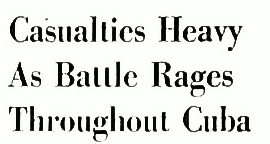
Miami Herald headline

The Miami Herald spoke of battles raging “throughout” the island.

The United Press International wire service said invading “revolutionaries … appeared to have knocked back Fidel Castro’s forces in the initial assault.”

Thus, a sampling of some of the erroneous first U.S. news reports about the ill-fated invasion of Cuba, launched 50 years ago this weekend at the Bay of Pigs.

Castro’s military overwhelmed the assault in less than three days; the CIA-trained invasion force of some 1,400 Cuban exiles never gained much more than a bitterly contested beachhead.

The thwarted invasion entrenched Castro’s dictatorship and represented a major foreign policy setback for the United States and the three-month-old administration of President John F. Kennedy.

It was something of a fiasco for the U.S. news media as well.

Raul Castro: Not captured

No correspondents were with the invading forces and Castro’s regime imposed a blackout on U.S. correspondents assigned to Cuba. The first news accounts of the invasion of April 17, 1961, as a result were wildly inaccurate and, in some cases, highly colorful and imaginative.

Those initial reports, while still interesting on their face, offer timeless testimony to the extraordinary difficulties of covering conflict from afar.

They also offer a lesson the U.S. news media seem intent on never remembering: First reports from the battlefield, or from the scene of a disaster, almost reliably will be in error. Cautious reporting and scrutiny of sources are thus always advisable amid uncertain and shifting conditions.

Such lessons tend to remain unlearned, however — as was apparent in the highly exaggerated news reports about violence and mayhem that supposedly swept New Orleans in the immediate aftermath of Hurricane Katrina’s landfall in 2005.

As I note in my media-mythbusting book, Getting It Wrong, “the erroneous and exaggerated reporting [about post-Katrina New Orleans] had the cumulative the effect of painting for America and the rest of the world a scene of surreal violence and terror, something straight out of Mad Max or Lord of the Flies.”

I further note that “initial and worst-case estimates of disaster casualties almost always are exaggerated. … Recognition of this tendency may well have helped to temper or curb the exaggerated reports of lawlessness and violence” in Katrina’s wake.

Revisiting the Bay of Pigs coverage also demonstrates how wished-for outcomes can color and distort news coverage.

The Miami Herald, which clearly wanted Castro gone, was eager to report imagined gains by the undermanned exile force, while offering no sources at all in its breathless accounts.

Beneath a banner headline that read, “Invaders Slug Into Interior,” the Herald reported on April 18, 1961, that the anti-Castro rebels “were pushing into the interior of Cuba” after launching assaults “at several key points” on the island.

“It was brother against brother,” the Herald said of the fighting, adding, “A virtual blackout was stretched across Cuba since the first shot of the civil war was fired.”

The newspaper further reported — while citing no sources — that it had “learned that the rebel troops are paying heavily for every mile gained.”

The Herald also attempted to divine the invaders’ strategy, asserting: “Rebels pouring in from Las Villas in the soft underbelly of Cuba were headed towards Central Highway in an apparent attempt to control the strategic road and cut the island in two.”

While somewhat more cautious than the colorful account in the Miami Herald, the Wall Street Journal of April 18, 1961, reported that at “least three widely scattered landings” had “brought an immediate state of emergency and brisk fighting inside Cuba and rapid repercussions around the globe.”

The Journal noted that the “cutoff of telephone and cable communications by the Castro government and conflicting battle reports made the tide of fighting difficult to assess,” but added:

“The invaders seem bent on cutting Cuba in half, then wheeling westward to Havana, about 100 miles from their original beachhead.”

The Journal didn’t hold back from publishing what it acknowledged were unverified reports that anti-Castro forces had captured the Isle of Pines and freed 10,000 political prisoners; had taken Santiago de Cuba, the country’s second-largest city, and had seized Raul Castro, Fidel’s brother.

“None of these reports were confirmed, however,” the Journal added — as if such a disclaimer were of much value after having offered up what proved to be wild and fanciful rumors.

The Washington Post of April 18, 1961, turned to wire service dispatches in compiling its first account of the invasion. It led with a United Press International report that breathlessly declared:

“Invading Cuban revolutionary troops, landed from the sea and dropped from planes, fought a bloody battle yesterday in the swamps 90 miles southeast of Havana and appeared to have knocked back Fidel Castro’s forces in the initial assault.

“There were reports that segments of the Cuban Navy had revolted.

“The revolutionary front directed by former Castro Premier Jose Miro Cardona in a secret United States headquarters was estimated to have thrown 5,000 anti-Castro Cubans into action in 48 hours on the east and south coasts.”

The Post’s report incorporated an Associated Press dispatch that said “the invaders hit the beaches in four of Cuba’s six provinces.”

Within weeks of the failed invasion, one of the leading journalists in America, James (“Scotty”) Reston of the New York Times, charged in a column that U.S. government officials and the CIA had fed reporters erroneous information about the assault on Cuba.

“When the landings started,” Reston wrote, “American reporters in Miami were told that this was an ‘invasion’ of around 5,000 men — this for the purpose of creating the impression among the Cuban people that they should rise up to support a sizable invasion force.

“When the landing … began to get in trouble, however,” Reston added, “officials here in Washington put out the story — this time to minimize the defeat in the minds of the American people — that there was no ‘invasion’ at all, but merely a landing of some 200-400 men to deliver supplies to anti-Castro guerrillas already in Cuba.

“Both times the press was debased for the Government’s purpose.”

Could be, but journalists amply demonstrated in their reporting that they were inclined to be gullible accomplices — eager at least to embrace wishful scenarios about the invasion. Official disinformation only partly explains the media credulity in reporting the Bay of Pigs.

News outlets bear a far heavier burden for botching the coverage.

WJC

Recent and related: