W. Joseph Campbell

Posts Tagged ‘Debunking’

WaPo still dodging responsibility in Jessica Lynch case

In Debunking, Jessica Lynch, Washington Post on December 14, 2011 at 2:01 pm

Lynch in 2003

The Washington Post — the newspaper that brought the world the bogus hero-warrior tale about Jessica Lynch early in the Iraq War — placed at its Web site today a wire service report about Lynch’s completing an education degree at the University of West Virginia at Parkersburg.

The 900-word report made no mention about the Post’s singular role in pressing the hero-warrior tale into the public domain but instead invoked the false narrative that the U.S. military made up the account about Lynch’s battlefield heroics to bolster support at home for the war.

“To make her seem more heroic and rally public support for the war,” said the report by the Associated Press, which the Post placed online, “the military claimed she’d gone down firing — when, in fact, her rifle had jammed.”

How arrogant: It was the Post that reported Lynch had “gone down firing,” that she had fought ferociously in the ambush of her unit, the 507th Maintenance Company, at Nasariyah in March 2003.
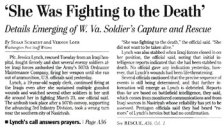
It was the Post — citing otherwise unnamed “U.S. officials” — that presented the electrifying tale that Lynch had “shot several enemy soldiers” in the ambush.

It was the Post that reported Lynch “continued firing at the Iraqis even after she sustained multiple gunshot wounds and watched several other soldiers in her unit die around her” in the fighting.

It was the Post that said Lynch also suffered stab wounds in the ambush.

But none of it was true.

Lynch never fired a shot in Iraq. Her weapon jammed during the ambush.

She suffered shattering injuries not in battling Iraqi soldiers but in the crash of a Humvee as it fled the ambush.

As I discuss in a chapter in my latest book, Getting It Wrong, the Post has never fully explained how it got the Lynch story so badly wrong.

It has never disclosed the anonymous sources it cited in presenting the bogus hero-warrior tale.

Indeed, the Post has largely sidestepped accountability for the bogus hero-warrior narrative, which has allowed the false narrative about the military’s concocting the Lynch story to take hold and proliferate.

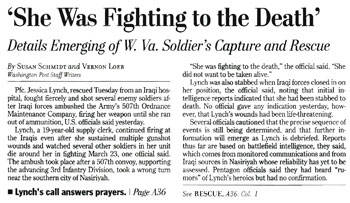
We know it’s a false narrative from one of the Post reporters whose byline appeared on the botched Lynch story, which was published April 3, 2003, beneath the headline:

“‘She was fighting to the death.'”

Vernon Loeb, a veteran journalist whose byline appeared on that report, said in an interview on NPR’s Fresh Air program in December 2003:

“Our sources for that story were not Pentagon sources.”

He also said in the interview:

“They wouldn’t say anything about Jessica Lynch.”

Loeb added: “I just didn’t see the Pentagon trying to create a hero where there was none. I mean …they never showed any interest in doing that, to me.”

Loeb said the Post based its story on the accounts of “some really good intelligence sources” in Washington, D.C., adding:

“We wrote a story that turned out to be wrong because intelligence information we were given was wrong. That happens quite often.”

As I note in Getting It Wrong, Loeb on another occasion was quoted in a commentary in the New York Times as saying:

“Far from promoting stories about Lynch, the military didn’t like the story.”

Loeb also was quoted in the commentary as saying that “the sources for this information [about Lynch’s derring-do] were apparently Iraqis, both Iraqi informants and intercepts.”

Loeb’s disclaimers notwithstanding, the notion that the Pentagon’s made up the story to bolster domestic U.S. support for the war makes little sense. The American public, after all, supported the Iraq War in overwhelming numbers in its early days and weeks, as I point out in Getting It Wrong.

But it’s clear that if not for the Post’s erroneous reporting, the bogus tale of Lynch’s battlefield heroism never would have circulated as widely and as profoundly as it did.

WJC

Recent and related:

‘Yes, Virginia’: History does trump TV animation

In 1897, Debunking, Media myths on December 9, 2011 at 11:28 am

CBS is to air tonight its vapid Christmas season special, “Yes Virginia,” which is based on the old New York Sun’s timeless editorial reply to an 8-year-old girl, who in 1897 inquired about the existence of Santa Claus.

The charmless, animated CBS program takes great liberties with the real back story to the “Yes, Virginia” editorial, which was published in the Sun on September 21, 1897, in the third of three columns on editorials.

The Sun’s editorial was a response to young Virginia O’Hanlon who shortly after her 8th birthday in July 1897 wrote to the newspaper, imploring:

“Please tell me the truth; is there a Santa Claus?”

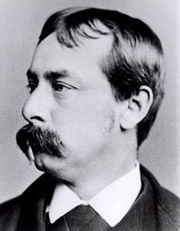
Francis P. Church

The Sun’s reply, written by a retiring editorial writer named Francis P. Church, said in part:

“Yes, Virginia, there is a Santa Claus. He exists as certainly as love and generosity and devotion exist, and you know that they abound and give to your life its highest beauty and joy. Alas! how dreary would be the world if there were no Santa Claus. It would be as dreary as if there were no Virginias.”

In the CBS interpretation, Virginia is waddling, round-headed, and strangely obsessed with the existence of Santa Claus.

Church, the editorial’s author, is depicted as scowling, abrupt, hard-hearted.

Neither portrayal is convincing, neither is realistic.

Church is cast as the editor of the Sun, which is shown as a tabloid newspaper. Church wasn’t editor; he was an editorial writer. And the Sun of 1897 was no tabloid.

What’s more, the CBS show had Virginia writing her letter, and the Sun publishing its reply, in December, as Christmas approached.

Not so.

As I discussed in my 2006 book, The Year That Defined American Journalism: 1897 and the Clash of Paradigms, Virginia wrote the letter in the summer of 1897. The Sun published its editorial-reply on page 6 of its issue of September 21, 1897.

What became the famous essay in American journalism was, in its first appearance, inconspicuous and obscure: It certainly was not introduced with large headlines on the front page, as the CBS show has it.

Its headline posted a timeless question:

“Is There A Santa Claus?”

The editorial was no instant sensation. It was not an immediate hit. And the Sun did not reprint the editorial every year at Christmastime, as is commonly believed.

Indeed, it took years for the newspaper to embrace “Is There A Santa Claus?”

As I noted in The Year That Defined American Journalism, it wasn’t until the mid-1920s when the Sun began routinely publishing the essay in its editorial columns at Christmastime.

What helped kept the editorial alive were the newspaper’s readers.

They found it memorable. They found joy, solace, and inspiration in the passages of “Is There A Santa Claus?”

In untold numbers over the years, readers asked the Sun to reprint the essay.

A letter-writer told the newspaper in 1926 that the editorial offered “fine relief from the commercialism and unsentimental greed” of the Christmas season.

In 1940, a writer to the Sun likened the essay to “a ray of hope on the path to human understanding in our troubled times.”

The CBS program hints at none of that. It offers no indication that the editorial’s fame rests at least in part on generations of readers who, collectively, proved to be far more perceptive than editors of the Sun in identifying the essay’s significance and enduring appeal.

If anything, the tedious CBS show demonstrates anew that history’s back story is often far richer, and far more interesting, than TV fare.

There’s of course little surprise in that observation. As Richard Bernstein wrote in 1989 in a terrific essay about movies and history:

“There are, after all, times when the facts speak far more dramatically than any fictionalized account of them ever could.”

WJC

Recent and related:

Cronkite, Johnson, and the deceptive ‘yardstick’

In Cronkite Moment, Debunking, Media myths on December 7, 2011 at 11:25 am

Cronkite: Wasn't watching Cronkite

The Huffington Post blog bit on the mythical “Cronkite Moment” yesterday, declaring it “a yardstick for how much things have changed.”

That is, how news media once were trusted and respected and influential. Nowadays, not so much.

But if the “Cronkite Moment” is a yardstick of any kind, it’s a measure of how profoundly the media myth has become embedded in the lore of American journalism.

The purported “Cronkite Moment” was on February 27, 1968, when CBS News anchorman Walter Cronkite declared the U.S. military was “mired in stalemate” in Vietnam and suggested that negotiations ultimately might offer a way out.

President Lyndon B. Johnson, as the myth has it, watched the Cronkite report at the White House and, upon hearing the “mired in stalemate” assessment, declared:

“If I’ve lost Cronkite, I’ve lost Middle America.” (Or something to that effect.)

The Huffington Post essay invoked the president’s purported comment in referring to the presumptive “Cronkite Moment,” asserting:

“LBJ famously commented, ‘If I’ve lost Cronkite, I’ve lost Middle America,’ after the beloved journalist called the war ‘unwinnable.’ Several weeks later, Johnson announced that he would not seek reelection as president.”

That paragraph embraces some of the most prominent myths and misunderstandings that have grown up around the presumptive “Cronkite Moment.” Let’s peel them back.

First, Cronkite did not declare the war in Vietnam “unwinnable.” He said the U.S. military was “mired in stalemate” — which hardly was a novel or stunning assessment in early 1968. Many news organizations in fact had used “stalemate” months before Cronkite’s program to characterize the war.

Second, Johnson’s decision not to seek reelection in 1968 had nothing to do with Cronkite’s program. Indeed, there’s strong evidence that Johnson never intended to seek another term, that in 1967, or even earlier, he had decided against another campaign for the presidency.

Johnson wrote in his memoir, The Vantage Point: “Long before I settled on the proper forum to make my announcement, I had told a number of people of my intention not to run again.”

Third, and perhaps most important, is that Johnson did not see Cronkite’s report about Vietnam when it aired.

As I discuss in my latest book, Getting It Wrong, Johnson at the time wasn’t at the White House but at a black-tie party in Austin, Texas, marking the 51st birthday of Governor John Connally.

The president wasn’t agonizing that night over the supposed loss of Cronkite’s support; he wasn’t lamenting having “lost Cronkite.”

Instead, Johnson was offering light-hearted comments about Connally’s age, saying:

“Today you are 51, John. That is the magic number that every man of politics prays for—a simple majority. Throughout the years we have worked long and hard—and I might say late—trying to maintain it, too.”

As I note in Getting It Wrong, there’s no evidence Johnson saw the Cronkite program at a later date, on videotape.

Even if he had, it made no difference to his thinking about Vietnam.

Not long after Cronkite’s program, Johnson delivered a rousing speech in Minneapolis, where he urged “a total national effort” to win the war in Vietnam. That speech was given March 18, 1968, and in it, the president declared:

“We love nothing more than peace, but we hate nothing worse than surrender and cowardice.”

Under scrutiny, then, the presumptive “Cronkite Moment” dissolves as illusory. And not  surprisingly so.

As I point out in Getting It Wrong:

“Seldom, if ever, do the news media exert truly decisive influences in decisions to go to war or to seek negotiated peace. Such decisions typically are driven by forces and factors well beyond the news media’s ability to shape, alter, or significantly influence. So it was in Vietnam, where the war ground on for years after the “Cronkite moment.”

WJC

Recent and related:

So it begins: Woodward, Bernstein, and excess in run-up to Watergate’s 40th

In Anniversaries, Debunking, Washington Post, Watergate myth on December 4, 2011 at 12:48 am

American journalists love anniversaries, so expect excess next year at the 40th anniversary of the Watergate break-in, which gave rise to the greatest scandal in U.S. politics — and to the media-driven myth that Washington Post journalists toppled a president.

Woodward: 40th anniversary honor

In fact, Watergate commemorative excess is already scheduled.

The Los Angeles Press Club announced the other day that it plans to recognize the Watergate reporting of Bob Woodward and Carl Bernstein at next year’s Southern California Journalism Awards program.

“Woodward and Bernstein’s series of articles for The Washington Post unraveled the biggest American political scandal to date, culminating in President Richard Nixon’s resignation in 1974. Four decades later, the stories still stand as a bellwether of investigative journalism,” the press club said in a news release.  “To mark the occasion, the Los Angeles Press Club will honor Woodward and Bernstein with the 2012 President’s Award.”

Woodward and Bernstein’s Watergate reporting won a Pulitzer Prize for the Post in 1973. But to say they “unraveled” Watergate is an exaggeration, a misreading of history.

As I discuss in my latest book, Getting It Wrong, the reporting of Woodward and Bernstein was at best a minor factor in bringing down Richard Nixon.

What ended Nixon’s presidency was the incontrovertible evidence of the president’s culpability in the crimes of Watergate — evidence captured on audiotapes that he secretly made of his conversations at the White House.

The decisive evidence — known as the “Smoking Gun” tape — revealed that Nixon at a meeting with his top aide, H.R. Haldemann, on June 23, 1972, sought to deflect or derail the FBI investigation into the break-in several days before at Democratic National headquarters  at the Watergate complex in Washington, DC.

The reporting of Woodward and Bernstein didn’t reveal the contents of that tape, which Watergate prosecutors had subpoenaed and which Nixon had refused to surrender until 1974, after the U.S. Supreme Court ordered him to do so.

Their reporting didn’t disclose the existence of Nixon’s taping system, either. It was revealed in July 1973, during hearings of the U.S. Senate Select Committee on Watergate.

In All the President’s Men, their book about their Watergate reporting, Woodward and Bernstein said they had received a tip about the taping system a few days before its existence was made public.

According to All the President’s Men, Ben Bradlee, then the Post‘s executive editor, suggested not expending much energy pursuing the tip. And Woodward and Bernstein didn’t.

What really “unraveled” Watergate, I write in Getting It Wrong, “was the collective if not always the coordinated forces of special prosecutors, federal judges, both houses of Congress, the Supreme Court, as well as the Justice Department and the FBI.

Even then, despite all that scrutiny and pressure, Nixon, I argue, “likely would have served out his term if not for the audiotape recordings he secretly made of most conversations in the Oval Office of the White House.”

Far more important the reporting of Woodward and Bernstein to the outcome of Watergate was the federal judge who presided at Watergate-related trials, John J. Sirica.

The Post acknowledged Sirica’s decisive role in unraveling Watergate in its obituary of the judge, published in 1992, shortly after his death.

The newspaper said Sirica’s “persistence in searching for the facts while presiding over the Watergate cases led to President Nixon’s resignation,” adding:

“Sirica’s order that tape recordings of White House conversations about the Watergate break-in be made available to prosecutors precipitated Nixon’s resignation in 1974. The tapes revealed that Nixon had approved plans for the Watergate coverup six days after the break-in at the Democratic National Committee’s headquarters in the Watergate complex by men who were working for the Committee to Reelect the President.

“In directing the White House to produce the tapes, Sirica set himself on a constitutional collision course with Nixon, who tried to invoke executive privilege and argue that the tapes were not subject to judicial scrutiny. But in a historic ruling, the U.S. Supreme Court upheld Sirica, ruling unanimously that the judiciary must have the last word in an orderly constitutional system.”

WJC

Recent and related:

A thumbsucker commentary and the Zhou misinterpretation

In Cronkite Moment, Debunking, Furnish the war on December 2, 2011 at 12:49 am

A thumbsucker is what some American journalists call a self-indulgent article or commentary that tends to go on and on, usually about an obscure or time-worn topic.

At its online site yesterday, Britain’s Guardian newspaper posted a thumbsucker that ruminated about the close of historical periods, offering observations such as this:

“Bloodied soldiers didn’t stand around on the battlefield at Bosworth and immediately reflect that, though it had been a hard-fought day, at least the later Middle Ages had now ended.”

Obscure, perhaps, but not altogether uninteresting.

But what caught the eye of Media Myth Alert was the reference to the conventional but erroneous version of Zhou Enlai’s famous and often-quoted comment in 1972, that it was “too early” to assess the implications of the French Revolution.

That version is frequently offered as evidence of China’s sage, patient, and far-sighted ways. That’s rather how the Guardian thumbsucker-commentary referred to it, saying:

“If, as Zhou Enlai said, it is too soon to have a view of the French Revolution, then it is probably too soon to say if the [governing] coalition [in Britain] is a failed government.”

But Zhou was not referring to the French Revolution that began in 1789.

He was speaking about the political turmoil in France of 1968.

We know this from a retired U.S. diplomat, Charles W.  (Chas) Freeman Jr., who was present when Zhou made the comment during President Richard Nixon’s visit to China in 1972.

Freeman, who was Nixon’s interpreter during the historic, weeklong trip, offered the revised interpretation almost six months ago at a panel discussion in Washington.  The discussion’s moderator was Richard McGregor, a journalist and China expert who wrote about Freeman’s comments for the Financial Times of London.

In a subsequent interview with me, Freeman elaborated on his recollection about Zhou’s comment, saying it probably was made over lunch or dinner, during a conversation about revolutions that had succeeded and failed. The discussion, Freeman said, touched on the Prague Spring of 1968 and the Hungarian uprising of 1956, both of which the Soviet Union crushed.

Freeman said it was “absolutely clear” from the context of the discussion that Zhou was speaking about 1968.

Just how Zhou’s remark came to be so dramatically misinterpreted, Freeman was unable to say.

“I cannot explain the confusion about Zhou’s comment except in terms of the extent to which it conveniently bolstered a stereotype (as usual with all stereotypes, partly perceptive) about Chinese statesmen as far-sighted individuals who think in longer terms than their Western counterparts,” Freeman said. “It was what people wanted to hear and believe, so it took” hold.

Stereotyping is but one hazard of dubious quotes like Zhou’s.

Dubious and misinterpreted quotes tend to are falsehoods masquerading as the truth — as suggested by the delicious but apocryphal tale about William Randolph Hearst and his purported vow to “furnish the war” with Spain at the end of the 19th century.

Dubious quotes also dishonor their purported authors — as in the comment often attributed to President Lyndon B. Johnson. Upon hearing newsman Walter Cronkite’s downbeat assessment about the war in Vietnam, Johnson supposedly said:

“If I’ve lost Cronkite, I’ve lost Middle America.”

Or something to that effect.

But as I note in my latest book, Getting It Wrong, there’s no persuasive evidence that Johnson ever made such a comment.

Besides, he didn’t see Cronkite’s report about Vietnam when it aired in late February 1968.

So it’s very difficult to believe the president could have been much moved by a show he didn’t see.

Or that he would have uttered such a comment, if he had seen the program.

WJC

Recent and related:

USAT evokes mythical ‘crack baby’ scare in report on drug-dependent newborns

In Debunking, Media myths on November 15, 2011 at 7:56 am

USA Today evoked the media-hyped crack baby scare yesterday in a front page report telling of “explosive growth” in numbers of newborns supposedly hooked on prescription drugs.

The report, which appeared with the headline “Surge in babies addicted to drugs,” offered scant hard data and over-the-top word choice, not unlike news accounts of the supposed crack baby epidemic in the 1980s and 1990s.

As I note in my latest book, Getting It Wrong, the crack baby scare “was a media-driven myth based more on anecdote than solid, sustained research.” It turned out to be, as the New York Times put it in 2009, “the epidemic that wasn’t.”

The USA Today article opened with alarming-sounding news that medical authorities “are witnessing explosive growth in the number of newborn babies hooked on prescription painkillers, innocent victims of their mothers’ addictions.

“The trend,” the newspaper declared, “reflects how deeply rooted abuse of powerful narcotics, such as OxyContin and Vicodin, has become.”

To support the claim of “explosive growth,” USA Today turned to a lawyer-politician, the Florida attorney general, who was quoted as saying:

“I’m scared to death this will become the crack-baby epidemic.”

Which, of course, proved mostly an epidemic of media hype.

It didn’t take long for the USA Today account to turn squishy, acknowledging in the fourth paragraph a lack of hard data on this “explosive” topic.

“National statistics on the number of babies who go through withdrawal are not available,” we’re told, “and states with the worst problems have only begun to collect data.”

So USA Today really doesn’t know whether, or just where, the “explosive growth” in drug-dependent newborns is taking place.

The article offered data from Florida, stating that “the number of babies with withdrawal syndrome soared from 354 in 2006 to 1,374 in 2010,” without explaining how the data were collected, or for how long. Or without saying how many children were born those years in Florida.

Lamely, the article stated:

“Scattered reports show the number of addicted newborns has doubled, tripled or more over the past decade.” Which hardly supports the assertion of “explosive growth” in addicted newborns.

Readers also were told of a range of symptoms that drug-hooked newborns exhibit: “They scream, twitch and vomit. They have trouble breathing and eating. They rub their noses with their fists so much their skin bleeds.”

It’s all evocative of the news media’s crack-baby hype, especially in what Jane Brody of the New York Times called “a wide spectrum of ill effects that can result from fetal exposure to cocaine.”

Those effects, Brody wrote in 1988, “include retarded growth in the womb and subtle neurological abnormalities, which may afflict a majority of exposed newborns. In more extreme cases, cocaine can cause loss of the small intestine and brain-damaging strokes. … The litany of threats to newborns is long and growing.”

Indeed, Brody declared, so powerful was the drug that “research suggests that a single cocaine ‘hit’ during pregnancy can cause lasting fetal damage.”

Which was an extraordinary overstatement.

The much-predicted social catastrophe of crack babies, I write in Getting It Wrong, “never materialized.”

Fears that American society “would be overwhelmed by a lost generation of crack-damaged misfits proved wildly exaggerated, a ‘grotesque media stereotype,’ in the words of Deborah A. Frank, one of the country’s leading authorities on prenatal drug exposure.”

I also note:

“The adverse effects that journalists so often attributed in the late 1980s and early 1990s to prenatal exposure to crack turned out to be associated with a variety of factors — such as use during pregnancy of tobacco, alcohol, or marijuana — as well as the quality of the newborn’s environment and the quality of the mother’s prenatal care.”

The crack-baby myth was buoyed, I write, by a tendency among journalists “to neglect or disregard the tentativeness that characterizes serious scientific and biomedical research, and to reach for certainty and definitiveness that are not often found in preliminary findings.”

Journalists pushed too hard on thin, preliminary, and sketchy data, and extrapolated rather extravagantly from small numbers of anecdotes.

It’s a pattern that tends to repeat itself, as journalists fail to take lessons from misreported drug scares of the past.

“What reporters need to do,” the inestimable media critic Jack Shafer has written,  “is challenge their sources in criminal justice, medicine, drug treatment, legislatures, and the user community when they make assertions of fact.

“Among the great failings of the press corps during the crack panic was its enthusiastic endorsement of the trend of ‘crack babies.’ Experts of all stripes lectured the press about these infants, whose chances at normal, healthy lives had been destroyed because their mothers were habituated to cocaine or crack.

“It was all lies.”

None of this is intended to endorse, advocate, or excuse the misuse of prescription drugs.

It is, rather, to underscore and call out the easy temptations of drug-scare stories.

WJC

Many thanks to Instapundit
Glenn Reynolds for linking to this post

Recent and related:

Jon Krakauer rolls back claims about WaPo ‘source’ in Jessica Lynch case

In Debunking, Jessica Lynch, Media myths, Washington Post on November 11, 2011 at 12:05 am

Author Jon Krakauer has quietly retreated from claims in a 2009 book that a former White House official, Jim Wilkinson, was the source for the Washington Post’s botched report about Jessica Lynch and her supposed battlefield heroics early in the Iraq War.

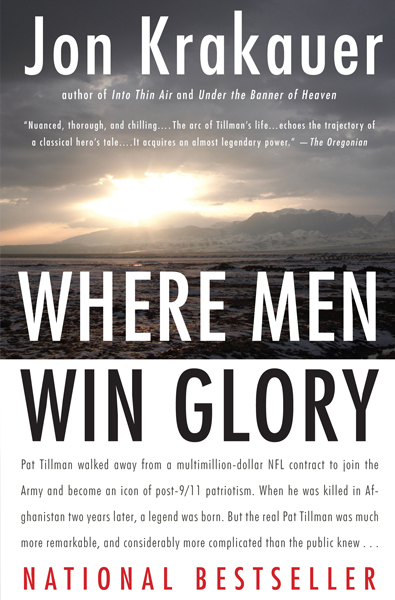
The unattributed assertions about Wilkinson — who was said to have “duped reporters and editors at the Washington Post” — were included in Krakauer’s Where Men Win Glory: The Odyssey of Pat Tillman.

The claims were removed in a recent printing of the book’s paperback edition, which now contains a footnote, saying:

“Earlier editions of this book stated that it was Jim Wilkinson ‘who arranged to give the Washington Post exclusive access’ to this leaked intelligence [about Jessica Lynch]. This is incorrect. Wilkinson had nothing to do with the leak.”

The Post has never identified the sources for its report, published on its front page April 3, 2003, that said Lynch had fought fiercely in the ambush of the 507th Maintenance Company at Nasiriyah in southern Iraq on March 23, 2003.

The Post’s account cited “U.S. officials” in saying that Lynch, a 19-year-old supply clerk, had kept “firing at the Iraqis even after she sustained multiple gunshot wounds and watched several other soldiers in her unit die around her in fighting” at Nasiriyah.

The Post’s electrifying report about the waif-like Army private was picked up by news organizations around the world.

But none of it was true.

As I discuss in my latest book, Getting It Wrong, Lynch never fired a shot at Nasiriyah; her rifle jammed during the attack. She suffered shattering injuries when a rocket-propelled grenade struck her Humvee, causing the vehicle to crash. But Lynch was not shot.

She was taken prisoner and treated at an Iraqi hospital, from where she was rescued April 1, 2003, by a U.S. special operations team.

In the years since, the Post has never adequately explained how it so thoroughly erred on the hero-warrior story about Lynch; nor has it disclosed the identities of the “U.S. officials” who led the newspaper awry.

The Post’s silence about its sources has contributed to the rise to a false narrative that the Pentagon concocted the hero-warrior tale in a cynical effort to bolster public support for the war.

Vernon Loeb, one of the reporters who shared the byline on the botched Lynch story, has said that the Pentagon was not the source for the report.

“I could never get anybody from the Pentagon to talk about those reports at all,” Loeb said on an NPR program in mid-December 2003, adding:

“They wouldn’t say anything about Jessica Lynch.”

Even so, the false narrative about Lynch and the Pentagon persists and has deflected attention from the Army sergeant who apparently did fight to the death at Nasiriyah. He was Donald Walters, who laid down covering fire as elements of the 507th tried to flee the ambush.

Walters was captured when his ammunition ran out and was executed by his captors soon afterward.

At the time of the battle at Nasiriyah, Wilkinson was director of strategic communications for General Tommy Franks, the commander of U.S. forces in Iraq. Among his prior positions, Wilkinson was deputy director of communications at the White House.

Wilkinson, who had vigorously denied the claims about him in Where Men Win Glory, said he met with Krakauer nearly a year ago in Colorado to discuss corrections.

At that meeting, Wilkinson said, the author told him that his source recanted claims about Wilkinson.

Wilkinson told Media Myth Alert that he was grateful to Krakauer for correcting the record, adding that he feels “100 times better” that the book’s extensive and unflattering assertions about him have been removed. “I greatly appreciate his willingness to meet with me and then issue a corrected version of the book that clears my name,” Wilkinson said.

The unflattering assertions were dropped in June, in what was the 17th printing of the Anchor Books soft-cover edition of Where Men Win Glory. Anchor, an imprint of Random House, issued no announcement about the revisions.

In earlier editions of Where Men Win Glory, Krakauer called Wilkinson a “master propagandist” and identified him as “the guy who deserved top billing for creating the myth of Jessica Lynch.”

Wilkinson, Krakauer also wrote, “duped reporters and editors at the Washington Post … and other media outlets into running wildly hyperbolic stories about Lynch.”

It remains unclear how Krakauer erred so badly in accusing Wilkinson. The author did not reply to an email sent to him yesterday and attempts this week to reach him through his publisher were unavailing.

“Unfortunately, he’s not talking questions at this time,” Russell Perreault, a spokesman for Random House, said by email. “He’s working on a new project.”

Krakauer’s most recent work, Three Cups of Deceit, seeks to puncture the humanitarian reputation of Greg Mortensen, whose charitable organization builds schools in Afghanistan and Pakistan.

“The image of Mortensen that has been created for public consumption,” Krakauer wrote in Three Cups of Deceit, “is an artifact born of fantasy, audacity, and an apparently insatiable hunger for esteem. Mortensen has lied about the noble deeds he has done, the risks he has taken, the people he has met, the number of schools he has built.”

WJC

Many thanks to Instapundit
Glenn Reynolds for linking to this post.

Recent and related:

Public opinion, Vietnam, and Cronkite’s ‘untouchable aura of authority’

In Cronkite Moment, Debunking, New York Times on November 5, 2011 at 8:58 am

The fantasy that Walter Cronkite represented an ideal of dispassionate, authoritative news reporting is so alluring that even the anchorman’s long-ago birthday has become an occasion for honoring his “untouchable aura of authority.”

The Smithsonian Institution’s “Around the Mall” blog did just that yesterday, in a post that recalled Cronkite, who was born November 4, 1916, as “an anchor who [spoke] with the authority of a religious leader or founding father.”

A “religious leader or founding father”?

Oh, spare us the hyperbole.

Cronkite read the news for 19 news as anchor of the CBS Evening News program. And his purported trustworthiness was more likely than not a function of a relic of mid-20th century broadcasting called the “Fairness Doctrine.”

Media critic Jack Shafer called attention to this linkage in a fine column written shortly after Cronkite’s death in 2009.

Shafer wrote:

“Accepting for the moment the argument the public trusted Cronkite because he practiced trustworthy journalism, it’s worth mentioning that between 1949 and 1987 — which come pretty close to bookending Cronkite’s TV career — news broadcasters were governed by the federal ‘Fairness Doctrine.’

“The doctrine required broadcast station licensees to address controversial issues of public importance but also to allow contrasting points of view to be included in the discussion. One way around the Fairness Doctrine was to tamp down controversy, which all three networks often did.”

Not often did Cronkite court controversy on the air.

The hagiographic “Around the Mall” piece hints at one of those few occasions — in late February 1968 when Cronkite, after a visit to Vietnam, declared the U.S. military effort there was “mired in stalemate.”

“Around the Mall” asserted that “Cronkite’s untouchable aura of authority led droves of viewers to change their opinions on Vietnam.”

And what evidence did the blog post produce?

A comment by David Ward, an historian at the National Portrait Gallery who is the biographer of Charles Willson Peale. Ward was quoted as saying about Cronkite’s reporting:

“He comes back [from Vietnam] and raises real questions about what our aims are, and whether the aims are being accurately reported to the American people. In 1968, there were plenty of people who were protesting the war in Vietnam. It’s the fact that he’s a firmly established, mainstream, church-going, centrist, respectable person that matters.”

Well, maybe. But the historian’s remark is hardly evidence that Cronkite’s views “led droves of viewers to change their opinions on Vietnam.”

More precisely, it was the other way round: Cronkite followed rather than led public opinion on the war.

As I discuss in my latest book, Getting It Wrong, public support for the war in Vietnam had begun declining months before Cronkite went on the air to say the conflict was “mired in stalemate.”

A Gallup poll conducted in October 1967 found for the first time that a plurality of Americans — 47 percent — felt sending troops to fight in Vietnam had been a mistake.

A little more than two years earlier, only 24 percent of respondents said they thought sending American forces to Vietnam had been a mistake.

I also point out in Getting It Wrong that print journalists detected a softening in support of the war long before Cronkite’s “mired in stalemate” assessment.

In December 1967, for example, Don Oberdorfer, a national correspondent for the Knight newspapers, noted that the “summer and fall of 1967 [had] been a time of switching, when millions of American voters — along with many religious leaders, editorial writers and elected officials — appeared to be changing their views about the war.”

What’s more, Cronkite’s “mired in stalemate” observation was hardly a novel or stunning characterization.

Journalists had been using the term “stalemate” for months in commentaries, analysis, and news reports about the war.

For example, syndicated columnist James J. Kilpatrick wrote in August 1967:

“So long as the present ground rules obtain in Vietnam, this war will drag along its indecisive way. … [T]he condition is stalemate.”

Also in August 1967, the New York Times said in a news analysis that the war in Vietnam “is not going well.”

U.S. victory, the Times said, “is not close at hand. It may be beyond reach.”

The analysis was published on the front page, beneath the headline:

“Vietnam: The Signs of Stalemate.”

So not only did he trail public opinion, Cronkite followed news media interpretations of the war as well.

WJC

Recent and related:

The ‘War of the Worlds’ radio show produced a ‘Paul Revere effect’

In Anniversaries, Debunking, Media myths, Media myths and radio on October 31, 2011 at 5:15 pm

I call it the “Paul Revere” effect, and it helps explain the many reports of fright associated with the radio dramatization 73 years ago of The War of the Worlds, a clever program that told of a lethal Martian invasion of Earth.

The radio show aired October 30, 1938, and supposedly stirred panic and hysteria across the United States — a delicious narrative that I debunk in my latest book, Getting It Wrong, as a media-driven myth.

I also discuss in Getting It Wrong the seldom-examined “Paul Revere effect” associated with The War of the Worlds program, which was the work of Orson Welles and his “Mercury Theatre on the Air” troupe.

This effect occurred when well-intentioned people who had little more than an incomplete understanding of The War of the Worlds broadcast decided individually and on their own to warn others about what they thought was a sudden and terrible threat.

These self-motivated Paul Reveres, I write in Getting It Wrong, “burst into churches, theaters, taverns, and other public places, shouting that the country was being invaded or bombed, or that the end of the world was near.”

I note that it must “have been a cruel and unnerving way of receiving word of a supposedly calamitous event — to be abruptly disturbed in familiar settings by a vague reports offered by people who themselves clearly were terror-stricken.”

The unsuspecting recipients of these invariably garbled, second- and third-hand accounts of calamity had no immediate way of verifying the wrenching news they had heard. Unlike the audiences of Welles’ dramatization, they could not spin the radio dial to find out whether other networks were reporting an invasion from Mars.

Scrutiny of contemporaneous newspaper accounts reveals numerous cases of this false-alarm contagion. This meant that people who had not heard not a word of The War of the Worlds show were themselves fearstricken, if only briefly.

In New York, for example, some apartment houses “were hurriedly emptied by frantic listeners to the program and by those who heard second- and third-hand accounts multiplying the supposed peril,” the Newark Star-Eagle reported.

“Many of the panic-stricken did not hear the original broadcast but got their misinformation from others,” the newspaper said.

A Methodist church service in Indianapolis was disrupted that night “when an hysterical woman member of the congregation entered shortly after worship had begun,” the Indianapolis Star reported.

The woman rushed to the pulpit, telling the pastor, “Something so terrible has happened that I must interfere.”

She told worshippers that “New York has been destroyed” and added: “I believe the end of the world has come. I heard it over the radio.”

The pastor offered a short prayer and excused anyone who wanted to return home. Several members of the choir “doffed robes and went from the church, followed by a portion of the congregation,” the Star reported. But the service continued.

Soon, several members of the congregation returned, explaining sheepishly that the alarm had been caused by nothing more than a misunderstood radio show.

As I note in Getting It Wrong, it is impossible to estimate the cumulative effect of the false-alarm contagion that night. But the second- and third-hand accounts, spread Paul Revere-like, stirred some measure of evanescent apprehension among untold thousands of people who had not listened to the program.

It is tempting to suggest, I write, “that what radio-induced fear there was that night was mostly spread by credulous people who heard muddled and fragmentary accounts about the program and set about to alert others,” on their own.

WJC

Recent and related:

Why the ‘panic broadcast’ myth lives on

In Debunking, Media myths, Media myths and radio, War of the Worlds on October 29, 2011 at 9:55 am

It’s a delicious media myth that The War of the Worlds radio dramatization 73 years ago set off nationwide panic and mass hysteria — a media myth that lives on for an impressive variety of reasons.

Welles and 'War of the Worlds'

What has been called the “panic broadcast” aired on CBS radio on Sunday evening, October 30, 1938. The War of the Worlds dramatization starred and was directed by Orson Welles, a 23-year-old prodigy. He was supported by actors of his “Mercury Theatre on the Air” troupe.

As I discuss in my media mythbusting book, Getting It Wrong, the dramatization supposedly was so alarming and realistic in its accounts of invading Martians wielding deadly heat rays, that listeners by the tens of thousands — or perhaps the hundreds of thousands — were convulsed in panic.

That, at least, is how American newspapers reported the reaction to the broadcast.

“A wave of mass hysteria seized thousands of radio listeners throughout the nation,” the New York Times said on its front page of October 31, 1938.

“For an hour,” the Washington Post declared, “hysterical pandemonium gripped the Nation’s Capital and the Nation itself.”

But the panic and hysteria so commonly associated with The War of the Worlds show was hyped. Exaggerated. It did not on anything approaching nationwide scale, as I discuss in Getting It Wrong.

Sure, some listeners may have been frightened or disturbed by what they heard. But that’s hardly synonymous with being panicked or pitched into mass hysteria.

Most listeners of the show, overwhelmingly, were not frightened. They recognized it for what it was, a clever and imaginative radio play on the eve of Halloween.

Nonetheless, the “panic broadcast” occupies an extraordinary place in American media history; it lives on as the radio show that caused fright and terror beyond measure.

A prominent reason is that the tale of panic and hysteria is almost too good, too delicious not to be true.

In that way, the “panic broadcast” is like many media myths — a savory, intriguing tale that never loses appeal. The War of the Worlds radio myth, of course, is especially popular this time of year.

Moreover, the “panic broadcast” myth endures because it evokes the latent power of media content:  Media messages have the potential to produce effects that are unpredictable, wide-ranging, and even dangerous.

The myth also lives on because it offers implicit reassurance for contemporary media audiences: It reminds and reassures them of their comparative sophistication. Back then, back in the 1930s, media audiences were pretty gullible, as the panicked reactions to The War of the Worlds suggest. But that’s not so much the case today, this line of thinking goes (which overlooks such recent stunts as the Colorado balloon boy and the TV report of the breakup of Belgium).

Another powerful explanation for the tenacity of The War of the Worlds myth is found in its link to the legend and bad-boy image of Orson Welles, who gained lasting fame and acclaim with his 1941 cinematic masterpiece, Citizen Kane.

The “panic broadcast” helped confirm the talent and reputation of Welles, who did his most memorable work before he was 30.

Interestingly, Welles appeared at what he called “a terrifying mass press interview” the day after the “panic broadcast” to say he regretted “any misapprehension which our broadcast last night created among some listeners.”

Welles, who was unshaven and acted a bit contrite, insisted it was unfathomable anyone really could have mistaken The War of the Worlds radio dramatization for an alien invasion.

Welles told reporters that he was “extremely surprised to learn that a story which has become familiar to children through the medium of comic strips and many succeeding novels and adventure stories should have had such an immediate and profound effect upon radio listeners.”

Years later, however, Welles was only too eager to endorse the notion that the broadcast had stirred wide panic. He gleefully told an interviewer:

“Houses were emptying, churches were filling up; from Nashville to Minneapolis, there was wailing in the street and the rending of garments.”

WJC

Recent and related: