W. Joseph Campbell

Posts Tagged ‘Getting It Wrong’

PBS set to embrace ‘mass hysteria’ myth in anniversary show on ‘War of Worlds’?

In Anniversaries, Debunking, Error, Media myths, Media myths and radio, Newspapers, Television, War of the Worlds on May 13, 2013 at 12:20 pm
Welles and 'War of the Worlds'

Orson Welles and ‘War of the Worlds’: No panic

PBS plans to air an “American Experience” program in October about the famous War of the Worlds radio adaptation, which starred Orson Welles and cleverly told of Earth’s invasion by Martians wielding deadly heat rays.

The PBS description sounds as if the program will embrace a hoary media-driven myth — that The War of the Worlds show of October 30, 1938, set off widespread panic and mass hysteria.

As I discuss in my media-mythbusting book, Getting It Wrong, “the panic and mass hysteria so readily associated with The War of The Worlds program did not occur on anything approaching nationwide dimension.”

In overwhelming numbers, I write in referring to contemporaneous polling data, most listeners “recognized it for what it was — an imaginative and entertaining show on the night before Halloween.”

But here’s the PBS summary of an hour-long “American Experience” program, to be aired October 29, on the eve of the radio show’s 75th anniversary:

“AMERICAN EXPERIENCE ‘War of the Worlds’ Orson Welles’ infamous radio dramatization of H.G. Wells’ War of the Worlds set off one of the biggest mass hysteria events in U.S. history 75 years ago. The film examines the elements that made America ripe for the hoax. Tuesday, October 29, 9:00-10:00 p.m. ET.”

The reference to “one of the biggest mass hysteria events in U.S. history” raises eyebrows — and commanded the attention of Media Myth Alert.

(Asked for details about the content of the “American Experience” show, Cara White, a spokeswoman, said by email: “We don’t have additional information at this time since the program isn’t premiering until October. But we should have more information closer to the broadcast.”)

The 1938 radio adaptation of The War of the Worlds may have produced fleeting, localized fright and confusion. But there’s no persuasive evidence that it stirred anything approaching panic of nationwide dimension.

This is more than an academic argument: Listener reaction to The War of the Worlds program in 1938 speaks to whether the media have the capacity to create powerful, immediate, and unnerving effects.

I point out in Getting It Wrong that “the notion that The War of the Worlds program sent untold thousands of people into the streets in panic, is a media-driven myth that offers a deceptive message about the influence radio wielded over listeners in its early days and, more broadly, about the media’s potential to sow fright, panic, and alarm.”

I’m not alone in my conclusions about The War of the Worlds program, an hour-long adaptation that aired on CBS radio.

Robert E. Bartholomew, an authority on mass hysteria and social delusions, has noted there is scant evidence that many frightened listeners acted on their fears that night in 1938.

Michael J. Socolow wrote in a fine essay in 2008 that “panic was neither as widespread nor as serious as many have believed at the time or since.”

Socolow also noted:

“The streets were never flooded with a terrified citizenry” during or after the radio program.

Moreover, had Welles’ show “set off one of the biggest mass hysteria events in U.S. history,” the resulting turmoil and trauma certainly would have resulted in serious injuries and deaths, including suicides.

But none were linked to the program.

The erroneous notion that The War of the Worlds dramatization had convulsed the country in panic and mass hysteria certainly was afoot in 1938 — and for U.S. newspapers of the time, that misleading interpretation offered a delicious opportunity to assail an upstart rival medium, radio.

By the late 1930s, radio had become an important source for news and advertising, and American newspapers had, as I write in Getting It Wrong, “competitive incentives to denounce radio, and characterize it as irresponsible and unreliable.

“Many newspapers seized the chance to do with enthusiasm,” I note. “It was as an opportunity they could not fail to let pass.”

The New York Times, for example, declared in an editorial titled “Terror by Radio”:

“Radio is new but it has adult responsibilities. It has not mastered itself or the material it uses.”

The Times and other American newspapers in 1938 seemed eager to chastise radio. And their overwhelmingly negative commentary helped seal the lingering and erroneous view that The War of the Worlds dramatization set off panic and hysteria across the country.

Judging from its news release, PBS seems ready to embrace that media myth.

WJC

More from Media Myth Alert:

A ‘Cronkite Moment’ in the war on terror? There never was a ‘Cronkite Moment’

In Cronkite Moment, Debunking, Error, Media myths, Quotes, Television, Year studies on April 27, 2013 at 12:56 pm

When Walter Cronkite of CBS News called the Vietnam War a stalemate in 1968, he supposedly set a standard of courage that some journalists yearn desperately to find in contemporary practice.

Did he inspire a 'Brokaw Moment'?

Did he inspire a ‘Brokaw Moment’?

The latest example of such nostalgic longing appeared yesterday, in a column praising Tom Brokaw’s remarks during Sunday’s Meet the Press program about the terrorist bombings at this month’s Boston Marathon.

The surviving of the two suspected bombers reportedly has said the attack was motivated by U.S.-led wars in Afghanistan and Iraq.

To David Sirota, that signals retributive blowback in America’s war on terror. And in a column posted at the In These Times site (also posted at Salon.com), Sirota lavished praise on Brokaw for having said on Meet the Press:

“But we’ve got to look at the roots of all of this. Because it exists across the whole [Asian] subcontinent and the Islamic world around the world. And I think we also have to examine the use of drones that the United States is involved in. And there are a lot of civilians who are innocently killed in a drone attack in Pakistan, in Afghanistan, and in Iraq.

“And I can tell you, having spent a lot of time over there, young people will come up to me on the streets and say, ‘We love America. But if you harm one hair on the head of my sister, I will fight you forever.’ And there is this enormous rage against what they see in that part of the world as a presumptuousness of the United States.”

While not particularly pithy or eloquent, such sentiments qualify Brokaw as “a Walter Cronkite of his age,” Sirota wrote in his column, adding that Brokaw’s “declaration recalls Cronkite’s seminal moment 45 years ago.

“Back in 1968,” Sirota went on, “opponents of the Vietnam War were being marginalized in much the same way critics of today’s wars now are. But when such a revered voice as Cronkite took to television to declare the conflict an unwinnable ‘stalemate,’ he helped create a tipping point whereby Americans began to reconsider their assumptions.

“In similarly making such an assumption-challenging statement, Brokaw has followed in Cronkite’s heroic footsteps,” Sirota declared. His commentary carried the headline, “A Cronkite Moment for the War on Terror.”

Whether media historians one day will refer to the “Brokaw Moment” in the war on terror is questionable: I doubt whether Brokaw’s remarks on Meet the Press will prove very memorable.

But what most interests Media Myth Alert is embellishing the so-called “Cronkite Moment” as a kind of lofty and inspiring standard of journalistic conduct, as a singular moment of memorable courage.

It wasn’t.

Now, there is no doubt that Walter Cronkite declared that the U.S. military was “mired in stalemate” in Vietnam. He said so on February 27, 1968, in a special report that aired on CBS television.

But over time, the effects of Cronkite’s “stalemate” observation have been inflated out of proportion to the decidedly modest impact it had in 1968. Sirota’s column is emblematic of that tendency to inflate.

After all, it was scarcely original or provocative to describe the Vietnam War as a “stalemate” in early 1968. In his well-regarded study of that year, Mark Kurlansky wrote that Cronkite’s view was “hardly a radical position” at the time.

News organizations such as the New York Times had invoked “stalemate” as early as the summer of 1967 in reporting and commenting about Vietnam.

Indeed, a front-page new analysis about the war, published in the Times in August 1967,  carried the headline:

Vietnam: The Signs of Stalemate.”

The evidence is scant, moreover, that Cronkite’s “mired in stalemate” comment “helped create a tipping point” in U.S. public opinion about the war.

The “tipping point” had been reached months before.

As I point out in my media-mythbusting book, Getting It Wrong, opinion polling had detected shifts in views about the war long before Cronkite’s program. In a very real sense, Cronkite followed rather than precipitated deepening popular doubts about the wisdom of the war.

For example, a Gallup Poll conducted in early October 1967 — 4½ months before Cronkite’s “mired in stalemate” observation — reported that 47 percent of respondents, a plurality, said it was a mistake to have sent U.S. troops to fight in Vietnam. A little more that two years earlier, Gallup had reported that only 24 percent of respondents felt that way.

Journalists detected other evidence in late 1967 of a shift in views about the war. Don Oberdorfer, then a national correspondent for the Knight newspapers, wrote in December 1967 that the previous five or six months had been “a time of switching, when millions of American voters — along with many religious leaders, editorial writers and elected officials — appeared to be changing their views about the war.”

Opponents of the war hardly “were being marginalized” in early 1968. They were increasingly outspoken, and prominent.

As for Cronkite, he pooh-poohed for years the notion his “mired in stalemate” observation was of much consequence.

In his 1997 memoir, Cronkite said his “stalemate” assessment was for President Lyndon Johnson “just one more straw in the increasing burden of Vietnam.” Cronkite repeated the analogy in the years immediately afterward, saying on a CNN program in 1999:

“I think our broadcast simply was another straw on the back of a crippled camel.”

The presumed power of the “Cronkite Moment” lies in the immediate and visceral effects Cronkite’s “stalemate” comment supposedly had on Johnson.

It often has been said that Johnson watched the Cronkite program at the White House and, upon hearing the “mired in stalemate” remark, turned to an aide or aides and said something along these lines:

“If I’ve lost Cronkite, I’ve lost Middle America.”

Johnson: Not in front of a TV

Johnson: Not in front of a television set

But as I discuss in Getting It Wrong, Johnson wasn’t at the White House when the Cronkite program aired. He wasn’t in front of a television set, either.

Johnson was in Austin, Texas, at the 51st birthday party of Governor John Connally.

About the time Cronkite was uttering his “mired in stalemate” opinion, Johnson wasn’t bemoaning the loss of Cronkite. He was making light of Connally’s age.

“Today, you are 51, John,” the president said. “That is the magic number that every man of politics prays for — a simple majority.”

WJC

Many thanks to Instapundit
Glenn Reynolds
for linking to this post.

More from Media Myth Alert:

‘All the President’s Men Revisited’: A mediacentric rehash, with some insight

In Anniversaries, Cinematic treatments, Debunking, Media myths, Scandal, Washington Post, Watergate myth on April 22, 2013 at 2:49 pm

The much-ballyhooed documentary, All the President’s Men Revisited, was mostly a mediacentric rehash of the Watergate scandal 40 years ago. Even so, the show, which aired last night on the Discovery channel, managed to present insight into the forces that really uncovered the criminality of what was America’s gravest political scandal.

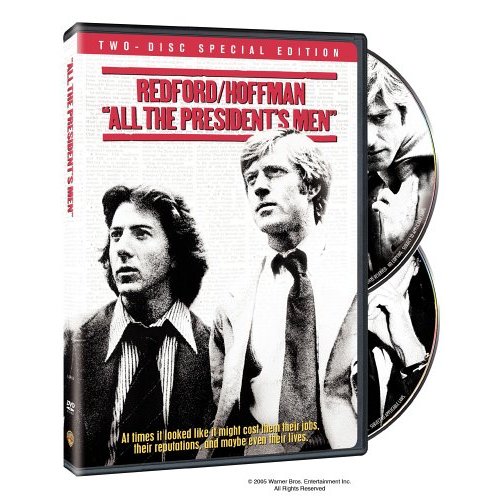
The two-hour program took a look back at Watergate often through the context of All the President’s Men, the 1976 cinematic adaptation of Bob Woodward and Carl Bernstein’s eponymous book about their Watergate reporting for the Washington Post.

The movie, which starred Robert Redford and Dustin Hoffman, idealized Woodward and Bernstein, identifying their reporting as central to uncovering the scandal that toppled Richard Nixon’s corrupt presidency. The first hour of the Discovery program similarly emphasized that misleading interpretation, mostly through frequent snippets of interviews with the aging Woodward and Bernstein.

The inescapable impression was that their reporting was essential to spurring the federal and congressional investigations that ultimately produced tape-recorded evidence that showed Nixon conspired to cover up the signal crime of Watergate — the break-in in June 1972 at the headquarters of the Democratic National Committee.

That interpretation — that Woodward and Bernstein’s reporting set the table for the crucial official inquiries — is favored by the Post (its Web site explains Watergate that way).

But  it is utterly misleading.

As serious historians of Watergate have demonstrated, federal investigators were far ahead of Woodward and Bernstein in their piecemeal reporting about the unfolding scandal in the summer and fall of 1972.

For example, Max Holland, author of Leak, a book about Watergate published last year, has aptly noted:

“Federal prosecutors and agents never truly learned anything germane from The Washington Posts [Watergate] stories — although they were certainly mortified to see the fruits of their investigation appear in print. … The government was always ahead of the press in its investigation of Watergate; it just wasn’t publishing its findings.”

What’s more, the Post’s investigation into Watergate “ran out of gas” by late October 1972, Barry Sussman, then the newspaper’s city editor, acknowledged in an interview in 1974.

The most interesting segments of All the President’s Men Revisited were during the program’s second hour, when the federal and congressional investigations of Watergate figured prominently. At the same time, Woodward and Bernstein receded noticeably from the limelight, replaced by the likes of Alexander Butterfield, the former White House aide who disclosed that Nixon recorded his conversations in the Oval Office.

Butterfield’s revelation about the tapes came during a U.S. Senate select committee’s investigation into Watergate — and represented a decisive pivot in the unfolding the scandal. Nixon ultimately was compelled to surrender audiotapes that demonstrated his role in attempting to coverup the Watergate breakin. He resigned soon afterward.

Interestingly, All the President’s Men Revisited  made clear that Woodward and Bernstein did not break the story about the existence of the tapes — and pinned the blame on the Post’s executive editor, Ben Bradlee.

Woodward recounted in the program (as he did in the book All the President’s Men) that he had heard about the tapes and asked Bradlee about pursuing a story along those lines. Bradlee, according to Woodward’s recollections, rated a prospective story about the tapes a B-plus: Not good enough for Woodward to pursue immediately.

(In the book, Bradlee is quoted as saying: “See what more you can find out, but I wouldn’t bust one on it.” And the reporters didn’t, thus failing to report a pivotal story about the scandal.)

The program’s second-half focus on the federal and congressional inquiries in a way addresses a major flaw of All the President’s Men, the movie, which was criticized for ignoring the contributions of federal investigators, special prosecutors, and congressional panels in ripping away the coverup of the Watergate break-in.

The movie’s narrow focus, I wrote in my media-mythbusting book Getting It Wrong, served “to solidify and elevate the heroic-journalist myth” of Watergate — the notion that the dogged work of Woodward and Bernstein brought down Nixon.

While the program did not challenge the deeply entrenched heroic-journalist myth, All the President’s Men Revisited did offer an historically accurate interpretation about how the scandal unspooled: As such, it rather succeeded where the movie had clearly failed.

WJC

More from Media Myth Alert:

Both left, right embrace media myth about WaPo and Watergate

In Debunking, Error, Media myths, Washington Post, Watergate myth on April 8, 2013 at 1:10 pm

Curious thing about the media myth of Watergate: The notion that the Washington Post’s dogged reporting toppled Richard Nixon’s corrupt presidency is readily embraced both by liberals and conservatives.

FoxNewsSunday_logoThe most recent example of this tendency  came yesterday, on the “Power Player of the Week” segment of the Fox News Sunday program.

The “Power Player” segment featured Martin Baron, who’s been executive editor of the Washington Post for a little more than three months. It was a fair-minded look at a respected, veteran journalist; Baron was a top editor at the Miami Herald and the Boston Globe before joining the Post at the start of the year.

But whether Baron truly is a “power player” in Washington is speculative. What most interests Media Myth Alert was how the Watergate myth was blithely injected into the Fox News Sunday segment.

In his voice-over introducing the segment, the show’s host, Chris Wallace flatly and inaccurately asserted that the Post is “the paper that brought down Richard Nixon.”

It’s a not uncommon characterization. But it’s utterly exaggerated — and thoroughly undeserved.

As I note in my media-mythbusting book, Getting It Wrong, it’s an interpretation of Watergate that not even the Post embraces.

Some of the Post’s leading figures over the years have openly dismissed the notion that the newspaper’s reporting of Watergate ended Nixon’s presidency. (He resigned in 1974.)

For example, Katharine Graham, the Post’s publisher during Watergate, said in 1997:

Not the Post's doing

Not the Post’s doing

“Sometimes people accuse us of bringing down a president, which of course we didn’t do. The processes that caused [Nixon’s] resignation were constitutional.”

In addition, the newspaper’s then-media writer, Howard Kurtz, asserted in 2005:

“Despite the mythology, The Post didn’t force Richard Nixon from office — there were also two special prosecutors, a determined judge, bipartisan House and Senate committees … and those infamous White House tapes.”

If not for the tapes — the secret audio recordings Nixon made of many of his conversations in the Oval Office — Nixon likely would have survived the scandal.

The Post, by the way, did not disclose the existence of the tapes, which demonstrated that Nixon had sought to derail the FBI’s investigation of Watergate’ signal crime — the burglary in June 1972 at the headquarters of the Democratic National Committee.

The existence of the tapes — evidence that was so pivotal to the scandal’s outcome — was made known in July 1973 by Alexander Butterfield, under questioning by investigators of a Senate select committee.

There’s more to deplore here than a Sunday TV show’s puffing up one of its segments by declaring the Post “brought down Richard Nixon.” The Watergate myth is more insidious than that.

It is a disservice to history: The Watergate myth distorts and dumbs down what was the most significant American political scandal of the 20th century.

And it extends to journalists the unmerited status of having been heroic central actors in exposing the crimes of Watergate.

WJC

More from Media Myth Alert:

10 years on: WaPo, Jessica Lynch, and the battle at Nasiriyah

In Anniversaries, Debunking, Error, Jessica Lynch, Media myths, Washington Post on March 23, 2013 at 5:45 am

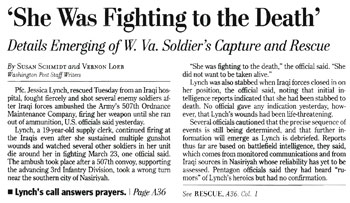
Lynch_headline_PostThe first major battle of the Iraq War, the ambush 10 years ago today of an U.S. support unit, gave rise to one the most woeful moments in recent war correspondence — the Washington Post’s thoroughly inaccurate front-page report about a 19-year-old U.S. Army private named Jessica Lynch.

The Post claimed that Lynch, a waif-like supply clerk who never expected to see combat, had fought fiercely in the ambush at Nasiriyah, firing at attacking Iraqis until her ammunition ran out.

It was an electrifying report, conjuring as it did cinematic images of an improbable female Rambo.

Private Lynch

Private Lynch

As it turned out, it was one of those remarkably rare news stories that’s spectacularly wrong but reverberates long after its initial publication.

The Post’s article had the effect of:

  • turning Lynch, through no exceptional effort of her own, into the best-known U.S. enlisted soldier of the Iraq War
  • obscuring the heroics of an Army cook-sergeant who was captured, then killed, by Iraqis
  • prompting the rise of media myths that continue to distort understanding about what happened at Nasiriyah.

Ten years on and the Post has never fully accounted for its botched reporting. It has never disclosed the identities of the anonymous sources who provided the salient details for a story so stunning that was picked up by news organizations around the world.

That story was published April 3, 2003, beneath the headline:

“‘She was fighting to the death.’”

The Post said Lynch was shot and stabbed “when Iraqi forces closed in on her position,” and based its account on otherwise anonymous “U.S. officials.”

The story was reported from Washington, D.C.: No journalists were with Lynch’s unit, the 507th Maintenance Company, when its convoy of trucks and support vehicles made a wrong turn and mistakenly entered Nasiriyah on March 23, 2003.

The convoy fell under attack and 11 U.S. soldiers were killed in the fighting. Among them was Sgt. Donald Walters, who had put down covering fire as his comrades tried to flee the ambush.

Walters was taken prisoner and soon after was executed by his Iraqi captors. So far as is known, his killers have never been captured.

It emerged months later that Walters most likely performed the battlefield heroics misattributed to Lynch, who never embraced the Post’s account.

The mistaken identity stemmed apparently from mistranslation of Iraqi battlefield transmissions.

The Post, though, never showed any interest in that aspect of the story — or in Walters’ bravery.

Sgt. Donald Walters

Sgt. Donald Walters

His name has appeared in only four news reports published by the Post, the most recent of which was an Associated Press dispatch in May 2004 which said “details of [Walters’] actions remarkably resemble a story circulated in The Washington Post and other news media, based on anonymous sources, describing how Lynch had fought until her ammunition ran out.”

The reference to “other news media” was misleading, though. It was the Post, alone, that thrust the hero-warrior about Lynch’s battlefield heroics into worldwide circulation.

It was the Post that said Lynch “continued firing at the Iraqis even after she sustained multiple gunshot wounds and watched several other soldiers in her unit die around her” at Nasiriyah.

And none of it was true: Lynch was neither shot nor stabbed.

She never fired a shot in Iraq. Her weapon jammed during the fighting.

She tried to escape the attack in the back of a Humvee, her head lowered to her knees in prayer. The fleeing Humvee was struck by a rocket-propelled grenade, sending the vehicle hurtling into a disabled tractor-trailer.

Lynch suffered shattering injuries to her arms, legs, and back in the crash. Four fellow soldiers were killed.

The Post’s hero-warrior story about Lynch began unraveling in the spring of 2003. As it did, a toxic narrative arose that the Pentagon (or, more broadly, the “military“) had concocted the story and somehow fed it to the Post in a crude and cynical attempt to boost public support for the war.

The narrative is perversely appealing — and utterly false.

Mythical, even.

As I discuss in my latest book, Getting It Wrong, one of the authors of the Post’s botched hero-warrior story, Vernon Loeb, has stated unequivocally that the anonymous sources were not Pentagon officials.

In an interview on NPR in December 2003, Loeb said:

“Our sources for that story were not Pentagon sources.”

Loeb said they were “some really good intelligence sources” in Washington, D.C. , and added:

“We wrote a story that turned out to be wrong because intelligence information we were given was wrong. That happens quite often.”

Loeb made clear he that “could never get anybody from the Pentagon to talk about” the Lynch case.

“They wouldn’t say anything about Jessica Lynch,” Loeb declared, adding:

“I just didn’t see the Pentagon trying to create a hero where there was none. I mean … they never showed any interest in doing that, to me.”

Loeb’s remarks have long been in the public domain. But they’ve been mostly ignored.

We know from Loeb who the Post’s sources weren’t.

On the 10th anniversary of the battle of Nasiriyah, it’s high time for the Post to say who they were, to set the record straight and clarify at long last how one of the most memorable yet twisted narratives of the Iraq War came to be.

WJC

More from Media Myth Alert:

Confused and illogical: WaPo commentary on effects of ‘Cronkite Moment’

In Cronkite Moment, Debunking, Error, Media myths, Quotes, Television, Washington Post on March 3, 2013 at 8:20 am

The Washington Post today offers one of the more baffling and illogical characterizations of the supposed effects of Walter Cronkite’s mythical report about Vietnam, which aired in February 1968.

Cronkite in Vietnam, 1968

Cronkite in Vietnam, 1968

Cronkite’s assessment supposedly was so exceptional, so influential on American policy and politics, that it has come to be call the “Cronkite Moment.”

A commentary in today’s Post addresses that occasion in a broader discussion of hostility between the news media and the White House. In referring to President Lyndon B. Johnson, the commentary says:

“Walter Cronkite’s on-air report from Vietnam — which the president did not see — supposedly elicited his famous lament: ‘If I’ve lost Cronkite, I’ve lost middle America.’ Shortly thereafter, Johnson would make his most memorable television appearance, announcing that he would not run for president in 1968.”

How’s that? Johnson “did not see” the Cronkite report; even so, it packed such wallop that Johnson knew without watching that he had “lost Cronkite”?

Who’s editing this stuff?

Not only is that passage confused and illogical: It’s historically inaccurate.

Let’s unpack the passage:

  • Cronkite’s report was aired February 27, 1968, on CBS television. In closing, the anchorman offered the comparatively mild assessment that U.S. forces were “mired in stalemate” in Vietnam — an assessment reflecting the conventional wisdom that had been circulating for months among the news media in Washington and Saigon, the South Vietnamese capital.
  • Johnson did not see Cronkite’s report: When it aired, the president was in Austin, Texas, attending a black-tie birthday party for Governor John B. Connally, a long-time political ally.
  • There’s no persuasive evidence or documentation that Johnson ever said, “If I’ve lost Cronkite, I’ve lost middle America.” Or anything close to that statement.  Indeed, versions of what Johnson purportedly said vary markedly — and such variability can be a marker of a media-driven myth.
  • Nearly five weeks after Cronkite’s report about Vietnam, Johnson announced that he would neither seek nor accept the Democratic party’s nomination for president. But Cronkite’s downbeat assessment about the war had nothing to do with Johnson’s decision not to stand for reelection (see below).

In the days following Cronkite’s “mired in stalemate” commentary, Johnson remained outwardly hawkish about the war in Vietnam. In mid-March 1968, for example, he traveled Minnesota to deliver a rousing speech in which he urged “a total national effort to win the war” in Vietnam.

Johnson punctuated his remarks in Minnesota by pounding the lectern and jabbing his finger in the air. “We love nothing more than peace,” he declared, “but we hate nothing worse than surrender and cowardice.” The president disparaged critics of the war as being inclined to “tuck our tail and violate our commitments.”

Johnson’s decision not to seek reelection stemmed from at least two sources: his health and his rivals for the Democratic nomination for president.

There’s evidence that Johnson never intended to seek another term, that in 1967 or before, he had decided against another campaign for the presidency in part because of concerns about his health. “Long before I settled on the proper forum to make my announcement,” Johnson wrote in his memoir, The Vantage Point, “I had told a number of people of my intention not to run again.”

Johnson’s announcement not to seek another term came after insurgent Democratic candidate Eugene McCarthy had won more than 40 percent of the vote in the New Hampshire presidential primary on March 12, 1968, and after had Johnson nemesis Robert F. Kennedy had entered the race for the Democratic nomination on March 16.

Johnson, moreover, was facing near-certain defeat in the Wisconsin primary, on April 2, 1968.

Those were considerations weighing on Johnson on March 31, 1968, when he said he would not seek reelection. Cronkite’s remarks about Vietnam on February 27, 1968, were not a factor.

As I discuss in my media-mythbusting book, Getting It Wrong, the purported “Cronkite Moment,” when scrutinized, “dissolves as illusory—a chimera, a media-driven myth.”

WJC

Many thanks to Instapundit
Glenn Reynolds for linking to this post

More from Media Myth Alert:

Woodward ‘destroyed the Nixon presidency’: More dubious history from Rush Limbaugh

In Cinematic treatments, Debunking, Error, Media myths, Scandal, Washington Post, Watergate myth on March 1, 2013 at 7:21 am

Talk-radio host Rush Limbaugh was at it again yesterday, offering up the dubious interpretation that Bob Woodward’s Watergate reporting “destroyed the Nixon presidency.”

That’s a seriously exaggerated version of the Watergate scandal, which led to Nixon’s resignation in 1974. Not even Woodward embraces that interpretation, once telling an interviewer: “To say the press brought down Nixon, that’s horse shit.”

(Woodward(Jim Wallace/Smithsonian)

Woodward
(Jim Wallace/Smithsonian)

Limbaugh’s remark about Woodward’s having “destroyed the Nixon presidency” came during a lengthy commentary about Woodward’s recent criticism about the administration of President Barack Obama.

Woodward has asserted that Obama proposed the controversial sequester plan — the automatic federal spending cuts that are to begin taking effect today.

What most intrigues Media Myth Alert is Limbaugh’s repeated claim that Woodward’s reporting was decisive in ending Nixon’s presidency. The talk-show host’s remark yesterday about Woodward and Nixon marked the second time this week he has made such an assertion.

On his show Monday, Limbaugh said flatly that “Woodward brought down Nixon” in the Watergate scandal.

The record, though,  is far more nuanced and complex than that: Woodward and his Washington Post reporting colleague Carl Bernstein played rather modest roles in unraveling the scandal.

Their reporting in the summer and fall 1972 progressively linked White House officials to a secret fund used to finance the foiled burglary at the headquarters of the Democratic National Committee — the signal crime of Watergate.

But by late October 1972, the Post’s investigation into Watergate “ran out of gas,” as Barry Sussman, then the newspaper’s city editor, later acknowledged.

Significantly, Woodward and Bernstein did not break such crucial stories as the existence of Nixon’s audiotaping system at the White House. The tapes ultimately provided evidence that the president had obstructed justice by approving a scheme to deflect the FBI’s inquiry into the burglary.

The disclosure about the taping system came in July 1973, during a Senate select committee’s investigation into the unfolding Watergate scandal.

Nor did Woodward and Bernstein disclose the payment of hush money to operatives arrested in the burglary — a key development in tying the White House to the Watergate scandal.

I discuss the media myth of Watergate in my latest book, Getting It Wrong, and write that the scandal demanded “the collective if not always the coordinated forces of special prosecutors, federal judges, both houses of Congress, the Supreme Court, as well as the Justice Department and the FBI.”

What I call the hero-journalist myth of Watergate — the notion that Woodward and Bernstein’s dogged reporting brought down Nixon — stems in large measure from the 1976 motion picture, All the President’s Men.

The movie, an adaptation of Woodward and Bernstein’s book by the same title, concentrated on the  reporters and ignored the far more decisive contributions of subpoena-wielding investigators and special prosecutors.Getting It Wrong_cover

The movie was critically acclaimed and widely seen. Its effect, I write in Getting It Wrong, was “to solidify and elevate the heroic-journalist myth, giving it dramatic power, and sustaining it in the collective memory.”

All the President’s Men, the movie, promoted a simplistic yet readily accessible interpretation of the Watergate scandal that is often invoked — as Limbaugh’s recent comments suggest. But it is an interpretation that nonetheless is utterly wrong.

WJC

More from Media Myth Alert:

If Obama loses AP: Rush Limbaugh embraces media myths two days running

In Anniversaries, Cronkite Moment, Debunking, Error, Media myths, Media myths and radio, Washington Post, Watergate myth on February 26, 2013 at 6:53 pm

Rush Limbaugh attracts the largest talk-show audiences on radio. Which is why it’s troubling when he indulges in media myths, as he’s done the past two days.

THUMB_RushLimbaugh

Limbaugh

Program transcripts show that Limbaugh made clear if passing references to the “Cronkite Moment,” the 45th anniversary of which falls tomorrow, and to the hero-journalist myth that the Washington Post’s reporting of the Watergate scandal brought down Richard Nixon’s presidency.

Limbaugh on today’s program called attention to an Associated Press report that skeptically considered President Barack Obama’s claims of great disruption should federal government spending cuts, collectively known as the sequester, take effect beginning Friday.

Limbaugh, according to the program transcript, declared that “if Obama is losing AP on this, it’d be like Lyndon Johnson losing Cronkite on the war in Vietnam.”

The reference was to President Lyndon Johnson’s purported reaction to Walter Cronkite’s on-air assessment, delivered February 27, 1968, that the U.S. military was “mired in stalemate” in Vietnam.

Cronkite

Cronkite

Upon hearing Cronkite’s comment, Johnson supposedly understood that his war policy was in tatters and declared: “If I’ve lost Cronkite, I’ve lost Middle America.”

Or something to that effect. Versions of what the president supposedly said vary markedly.

But as I discuss in my media-mythbusting book, Getting It Wrong, Johnson didn’t see Cronkite’s program when it aired.

Johnson at the time was in Austin, Texas, attending the 51st birthday party of a long-time political ally, Governor John Connally. And at the time Cronkite intoned his “mired in stalemate” assessment, the president was making light-hearted remarks about Connally’s age.

“Today you are 51, John,” he said. “That is the magic number that every man of politics prays for—a simple majority.”

So it’s hard to believe that the president could have been much moved by a program he did not see.

The importance of the debunking the “Cronkite Moment” goes beyond whether Johnson saw the program; far more significant is the anecdote’s deceptive message that a prominent journalist can profoundly alter policy.

Altering war policy certainly wasn’t the effect of Cronkite’s program 45 years ago. Even Cronkite likened the program’s influence to that of a straw placed on the back of a crippled camel.

Johnson did announce at the end of March 1968 that he was not seeking reelection to the presidency. But that decision had far more to do with his health and the prospect that Democrats would not renominate him than with Cronkite’s fairly tame and unoriginal commentary about Vietnam.

Limbaugh invoked Watergate’s hero-journalist trope in discussing the sequester during his program yesterday, stating flatly:

“Woodward brought down Nixon.”

He was referring to the supposed effects of the Watergate reporting of Bob Woodward of the Washington Post.

But that’s a myth not even Woodward embraces.

Woodward: 'Horseshit'

Woodward

In 2004, for example, Woodward told American Journalism Review, “To say the press brought down Nixon, that’s horse shit.”

And on another occasion, in an interview with the PBS “Frontline” program, Woodward said “the mythologizing of our role in Watergate has gone to the point of absurdity, where journalists write … that I, single-handedly, brought down Richard Nixon. Totally absurd.”

Other principals at the Post have over the years similarly dismissed such outsize claims.

If not Woodward and his reporting sidekick Carl Bernstein, then who, or what, brought down Richard Nixon?

The best answer is that unraveling a scandal of the reach and complexity of Watergate “required the collective if not always the coordinated forces of special prosecutors, federal judges, both houses of Congress, the Supreme Court, as well as the Justice Department and the FBI,” as I write in Getting It Wrong.

“Even then,” I add, “Nixon likely would have served out his term if not for the audiotape recordings he secretly made of most conversations in the Oval Office of the White House. Only when compelled by the Supreme Court did Nixon surrender those recordings” in 1974, making inevitable an early end to his presidency.

In the end, the reporting of Woodward and Bernstein was of faint consequence to Watergate’s dramatic outcome.

It merits mentioning that there’s no small irony in Limbaugh’s giving voice to these media myths.

He is, after all, a prominent conservative commentator and the “Cronkite Moment” and the Watergate myth center around journalists and news organizations commonly associated with liberal views.

WJC

More from Media Myth Alert:

Runup to the Oscars: ‘Politically inspired movies’ and the myth of Watergate

In Cinematic treatments, Debunking, Error, Media myths, Scandal, Washington Post, Watergate myth on February 22, 2013 at 2:51 pm

The runup to the Academy Awards ceremony brings inevitable bursts of nostalgia — as well as the almost-predictable appearance of hoary media myths.

CNN logoCNN.com today offered a gauzy look back at “politically inspired movies that have been nominated [for] or won” an Oscar. In doing so, CNN bought into the media myth of the Watergate scandal.

The retrospective discussed the 1976 film All The President’s Men, noting that it “won four Oscars and was nominated for four more.”

The movie was an adaptation of a book by the Washington Post’s lead Watergate reporters, Bob Woodward and Carl Bernstein, who, according to CNN, were “responsible for uncovering the Watergate scandal and forcing the resignation of President Richard Nixon.”

All the President’s Men, CNN added, “provided context and drama about how the reporters brought down the most powerful man on Earth.”

That’s an expansive claim. It’s also glib, and totally mythical.

As I discuss in my media mythbusting book, Getting It Wrong, Woodward and Bernstein’s reporting did not bring down Nixon. They didn’t uncover the scandal, either.

All President's Men

The movie

Far from it.

Woodward and Bernstein and the Post were at best modest contributors in unraveling an intricate scandal that sent to jail nearly 20 men associated with Nixon’s presidency or his 1972 reelection campaign.

Indeed, when considered against the far more decisive forces and factors that uncovered Watergate, Woodward and Bernstein’s contributions recede into near insignificance.

The decisive forces included special prosecutors, federal judges, the FBI, panels of both houses of Congress, and the Supreme Court.

Even in the face of such an array of forces, I write in Getting It Wrong, “Nixon likely would have served out his term if not for the audiotape recordings he secretly made of most conversations in the Oval Office of the White House. Only when compelled by the Supreme Court did Nixon surrender those recordings, which captured him plotting the cover-up” of the signal crime of Watergate — the breakin in June 1972 at the headquarters of the Democratic National Committee.

Notably, Woodward and Bernstein didn’t reveal existence of Nixon’s secret tapes, the contents of which proved vital in Watergate’s outcome. Nor did Woodward and Bernstein disclose the extent of the attempted coverup of the crimes of Watergate.

What’s more, principals at the Washington Post have from time to time over the years dismissed the notion that the newspaper was central in forcing Nixon’s resignation.

For example, the Post’s publisher during and after the Watergate scandal, Katharine Graham, said in 1997 at a program marking the scandal’s 25th anniversary:

“Sometimes people accuse us of bringing down a president, which of course we didn’t do. The processes that caused [Nixon’s] resignation were constitutional.”

Even Woodward has scoffed at the notion, telling American Journalism Review in 2004:

To say the press brought down Nixon, that’s horse shit.”

The cinematic version of All the President’s Men contains few references to the subpoena-wielding authorities who really did break open the scandal. Instead, the movie leads audiences to just one, misleading conclusion — that the tireless reporting of Woodward and Bernstein was vital to Watergate’s ultimate outcome.

WJC

More from Media Myth Alert:

Media myth outbreak abroad; ‘Cronkite Moment’ goes viral

In Cronkite Moment, Debunking, Media myths, Newspapers, Quotes, Television on February 9, 2013 at 8:38 am

It’s well-known that media myths — those tall tales about the purported feats of American journalists — can go viral, internationally.

Seldom, though, has there been an outbreak as such yesterday’s, when leading newspapers in Canada, Britain, and Belgium separately indulged in the  “Cronkite Moment” media myth.

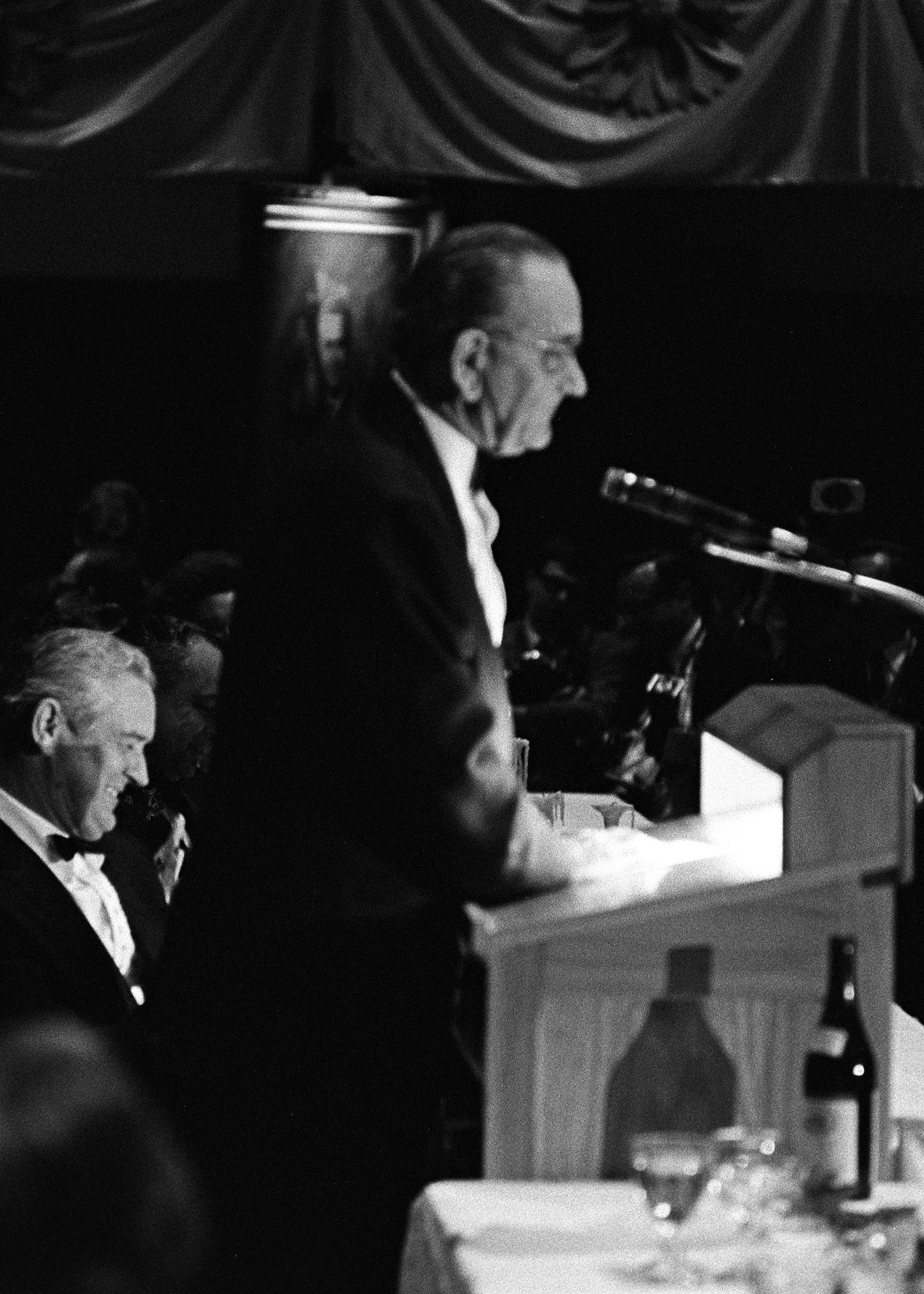
Johnson: Not in front of a TV

Johnson on February 27, 1968: Not watching Cronkite

The “Cronkite Moment” was in 1968, when on-air editorializing by CBS News anchorman Walter Cronkite supposedly produced a moment of stunning clarity and insight for President Lyndon B. Johnson and altered the course of the war in Vietnam.

Such effects are wildly overstated, but they make for an irresistible tale of powerful media influence, and that’s like so much catnip to contemporary journalists and columnists.

It helps explains yesterday’s outbreak, which was abundantly seasoned with hagiographic praise for Cronkite, who died in 2009:

  • Rick Salutin, in a column for the Toronto Star about a Canadian news anchor, wrote that Cronkite set the “gold standard for anchors” and “was solid as the bronze statue of the American revolutionary minuteman” at Concord, Massachusetts. Salutin further wrote: “When president Lyndon Johnson heard Cronkite turn against the Vietnam War, he said, ‘If I’ve lost Cronkite, I’ve lost the country.'”
  • Michael McCarthy, the environment editor for London’s Independent newspaper, wrote in a column about filmmaker David Attenborough that Cronkite “was a world figure as America’s most celebrated broadcaster.”Independent masthead McCarthy declared: “Such was his aura and influence that when, on his return from a Vietnam trip in 1968, he pronounced that the US could not win the war, President Lyndon Johnson is said to have exclaimed: ‘If I’ve lost Cronkite, I’ve lost Middle America!’ and shortly afterwards announced he would not seek re-election.”
  • Jean-Paul Marthoz, in a blog commentary for the French-language Le Soir of Brussels, wrote that Cronkite was America’s “most trusted man” and added: “In 1968, on his return from a reporting assignment to Vietnam, a conflict that he covered with rigorous impartiality, he declared that the war couldn’t be won, which led President Lyndon Johnson to declare:  ‘If I’ve lost Walter Cronkite, I’ve lost America.'”

It’s true that Cronkite, on February 27, 1968, pronounced the U.S. war effort in Vietnam was “mired in stalemate.” And he suggested that negotiations might prove to be the way out.

But the effects of Cronkite’s commentary were dramatically more modest than the characterizations of Salutin, McCarthy, and Marthoz.

As I discuss in my media-mythbusting book, Getting It Wrong, Lyndon Johnson did not see the Cronkite program when it aired, and there’s no certain evidence he ever saw it later, on videotape.

Johnson was not at the White House on February 27, 1968. He was not in front of a television set when Cronkite’s special report aired.

The president then was in Austin, Texas, at a black-tie event marking the 51st birthday party of Governor John Connally, one of Johnson’s long-time political allies.

About the time Cronkite was intoning his “mired in stalemate” assessment, Johnson was engaging in light-hearted banter about Connally’s age. Johnson hardly was bemoaning the loss of an anchorman’s support.

“Today,” the president said, “you are 51, John. That is the magic number that every man of politics prays for — a simple majority.”

What’s more, Cronkite’s “mired in stalemate” assessment was neither profound nor exceptional in early 1968.

For months before Cronkite’s program, U.S. news organizations had been invoking “stalemate” to characterize the war effort.

The New York Times, in an analysis published August 7, 1967,  declared “the war is not going well. Victory is not close at hand.”

The analysis, filed from Saigon, further stated:

“‘Stalemate’ is a fighting word in Washington. President Johnson rejects it as a description of the situation in Vietnam. But it is the word used by almost all Americans here, except the top officials, to characterize what is happening.”

The Times’ assessment appeared on its front page, beneath the headline:

Vietnam: The Signs of Stalemate.

Not only was Cronkite’s “mired in stalemate” assessment belated; it was mild compared to other commentary at the time.

The Wall Street Journal in an editorial published four days before Cronkite’s report, said the U.S. war effort in Vietnam “may be doomed” and that “everyone had better be prepared for the bitter taste of defeat beyond America’s power to prevent.”

Strong stuff.

Interestingly, Cronkite in his memoir dismissed the supposedly powerful effects of his report on Vietnam. He wrote in memoir, titled A Reporters’ Life and published in 1997, that the “mired in stalemate” assessment represented for Johnson “just one more straw in the increasing burden of Vietnam.”

Cronkite repeated the analogy in promoting the book, telling CNBC that he doubted whether the program “had a huge significance. I think it was a very small straw on a very heavy load [Johnson] was already carrying.”

WJC

More from Media Myth Alert: