W. Joseph Campbell

Posts Tagged ‘Getting It Wrong’

A ‘certain American paper brought down a certain president’

In Debunking, Media myths, Newspapers, Washington Post, Watergate myth on September 29, 2011 at 4:14 am

It’s impressive how strictly American media myths can win such eager embrace in international contexts.
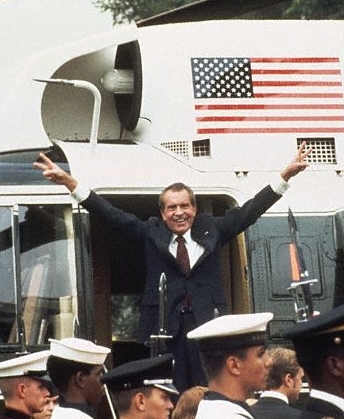
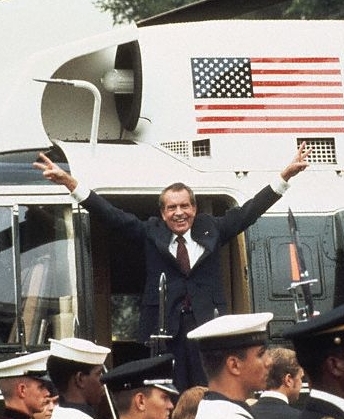
A certain American president leaves office

The heroic-journalist myth of Watergate is a telling example.

India’s leading English-language newspaper, the Hindu, invoked that myth the other day in a commentary that declared:

“More than 30 years ago, a certain American newspaper brought down a certain president by courageously exposing his wrongdoings entirely on the strength of information supplied by an anonymous source. It was not until some quarter of a century later that the real identity of Washington Post’s source for its expose of the Watergate scandal was revealed.”

Alright, let’s unbundle that myth-freighted paragraph:

  • Richard Nixon’s corrupt presidency was not brought down by the Washington Post, or by any other American newspaper — a topic I discuss in my media mythbusting book, Getting It Wrong.
  • Nixon’s fall in 1974 had nothing to do with “information supplied by an anonymous source” — a reference to the Post’s stealthy, high-level contact code-named “Deep Throat.” In 2005, a former senior FBI official named W. Mark Felt announced that he had been the Post’s Deep Throat.”

I note in Getting It Wrong that the heroic-journalist interpretation of Watergate — “the endlessly appealing notion that the dogged reporting of two young, hungry, and tireless Washington Post journalists, Bob Woodward and Carl Bernstein, brought down Nixon and his corrupt presidency” — has become the dominant narrative of the greatest scandal in American political history.

“But to explain Watergate through the lens of the heroic-journalist is,” I write, “to abridge and misunderstand the scandal and to indulge in a particularly beguiling media-driven myth.”

I point out that the heroic-journalist trope “minimizes the far more decisive forces that unraveled the scandal and forced Nixon from office.”

Those forces, I write, included “the collective if not always the coordinated forces of special prosecutors, federal judges, both houses of Congress, the Supreme Court, as well as the Justice Department and the FBI.”

But even then, Nixon likely would have served out his second term as president if not for the audiotape recordings he secretly made of most conversations in the Oval Office of the White House.

Only when compelled by the Supreme Court in July 1974 did Nixon surrender the recordings that captured him plotting to cover up his administration’s ties to the burglary at the headquarters of the Democratic National Committee in Washington.

I note that the heroic-journalist interpretation “has become the dominant popular narrative of the Watergate scandal for several reasons,” including:

Woodward and Bernstein’s book about their reporting of the unfolding Watergate scandal; the popular cinematic version of their book, All the President’s Men, and the years-long guessing game about the identity of “Deep Throat,” with whom Woodward (but never Bernstein) met periodically in 1972 and 1973, while investigating Watergate.

The role of “Deep Throat,” the reporters wrote in All the President’s Men, was to “confirm information that had been obtained elsewhere and to add some perspective.”

Those factors, I write, “combined to place Woodward and Bernstein at the center of Watergate in popular consciousness” while projecting and reinforcing the erroneous notion that the scandal’s outcome pivoted on disclosures reported by the news media.

WJC

Recent and related:

The ‘stories that brought down a president’: Sure, they did

In Debunking, Media myths, Washington Post, Watergate myth on September 26, 2011 at 3:31 am

The Guardian, one of London’s top newspapers, bought into Watergate’s dominant myth yesterday in a flattering article about Carl Bernstein, who teamed with Bob Woodward to report the scandal for the Washington Post.

Referring to the resignation of President Richard Nixon in 1974 at the height of Watergate, the Guardian asserted that Bernstein and Woodward produced “a string of stories that brought down a president.”

That claim may be the dominant narrative of Watergate. But it’s simplistic, a media-centric misreading of history.

As I discuss in my latest book, Getting It Wrong, the heroic-journalist interpretation of Watergate — the notion that Bernstein and Woodward’s dogged reporting forced Nixon from office in disgrace — “minimizes the far more decisive forces that unraveled the scandal and forced Nixon from office.”

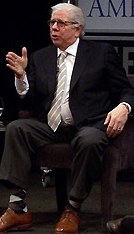
Bernstein: Didn't bring down Nixon

Those forces included special Watergate prosecutors, federal judges, bipartisan panels of both houses of Congress, the U.S. Supreme Court, as well as the Justice Department and the FBI.

To explain Watergate through the lens of the heroic-journalist interpretation, I write in Getting It Wrong, is to short-change and “misunderstand the scandal and to indulge in a particularly beguiling media-driven myth.”

The myth, though, is endlessly appealing – as the Guardian article suggested.

Interestingly, though, not even the Washington Post embraces the heroic-journalist trope.

For example, Michael Getler, then the newspaper’s ombudsman wrote in 2005:

“Ultimately, it was not The Post, but the FBI, a Congress acting in bipartisan fashion and the courts that brought down the Nixon administration. They saw Watergate and the attempt to cover it up as a vast abuse of power and attempted corruption of U.S. institutions.”

And Ben Bradlee, the Post’s executive editor during and after Watergate, said on the Meet the Press interview show in 1997:

[I]t must be remembered that Nixon got Nixon. The Post didn’t get Nixon.”

Even Woodward has dismissed the heroic-journalist interpretation, stating in an interview with American Journalism Review:

To say the press brought down Nixon, that’s horse shit.”

What brought down Nixon’s presidency was evidence of his guilty role in the crimes of Watergate — evidence captured on audiotapes that he secretly made of his conversations at the White House.

The decisive evidence — known as the “Smoking Gun” tape — revealed that Nixon at a meeting with his top aide, H.R. Haldemann, on June 23, 1972, sought to deflect or derail the FBI investigation into the Watergate burglary.

Bernstein and Woodward didn’t reveal the contents of that tape, which Watergate prosecutors had subpoenaed and which Nixon refused to surrender until ordered by the U.S. Supreme Court to comply.

Nor did Bernstein and Woodward reveal the existence of Nixon’s taping system, which proved so crucial to Watergate’s outcome.

In All the President’s Men, their book about their Watergate reporting, Bernstein and Woodward said they had received a tip about the taping system a few days before its existence was made public in July 1973.

But according to the book, Bradlee, the executive editor, suggested not expending much energy pursuing the tip. And they didn’t.

WJC

Recent and related:

Accepting the 2010 SPJ award for Research about Journalism

In Debunking, Media myths on September 25, 2011 at 7:22 am

I was in New Orleans last night to accept the Society of Professional Journalists’  Sigma Delta Chi award for Research about Journalism, for my media-mythbusting book, Getting It Wrong.

The occasion was a fine, smoothly run ceremony at a hotel near the city’s French Quarter.

Getting It Wrong, which was published last year by the University of California Press, addresses and debunks 10 prominent media-driven myths — those dubious tales about the news media that masquerade as factual.

Here’s a rundown about the respective myths dismantled in Getting It Wrong:

  1. Remington-Hearst: William Randolph Hearst’s famous vow “to furnish the war” with Spain is almost certainly apocryphal.
  2. War of Worlds: The notion that the War of Worlds radio dramatization in 1938 caused nationwide panic and mass hysteria is highly exaggerated.
  3. Murrow-McCarthy: Edward R. Murrow’s famous See It Now program in March 1954 did not end Senator Joseph McCarthy’s communists-in-government witch-hunt; Murrow in fact was very late to take on McCarthy.
  4. Bay of Pigs: The New York Times did not suppress its reporting in the run-up to the ill-fated Bay of Pigs invasion in April 1961.
  5. Cronkite-Johnson: The Walter Cronkite special report on Vietnam in February 1968 did not prompt an immediate reassessment or revision of U.S. war policy. Nor did it prompt President Lyndon Johnson to declare, “If I’ve lost Cronkite, I’ve lost Middle America.”
  6. Bra-burning: Humor columnist Art Buchwald helped spread the mistaken notion that feminist demonstrators dramatically burned their bras at a Miss America protest in September 1968.
  7. Watergate: The Washington Post’s intrepid reporters, Carl Bernstein and Bob Woodward, did not bring down Richard Nixon’s corrupt presidency. That they did is a trope that knows few bounds.
  8. Crack babies: The much-feared “bio-underclass” of children born to women who smoked crack cocaine during their pregnancies never materialized.
  9. Jessica Lynch: The Washington Post’s erroneous reporting about Jessica Lynch early in the Iraq War gave rise to several myths about her capture and rescue.
  10. Hurricane Katrina: News coverage of Katrina’s aftermath in New Orleans in early September 2005 was marred by wild exaggerations about extreme, Mad Max-like violence.

The “Research about Journalism” award recognizes “an investigative study about some aspect of journalism,” according to SPJ, and has to be “based on original research; either published or unpublished and … completed during the 2010 calendar year. … Judges will consider value to the profession, significance of the subject matter, thoroughness of the research, and soundness of the conclusion.”

WJC

Recent and related:

Where do they get this stuff?

In 1897, Debunking, Furnish the war, Media myths, Spanish-American War, Yellow Journalism on September 24, 2011 at 5:06 am

William Randolph Hearst almost surely never vowed to “furnish the war” with Spain, and his newspapers of the late 19th century were much more than rumor-mongering sheets.

Hearst: Never made the vow

None of this is particularly new, though.

The tale about “furnish the war” was debunked as a media myth years ago, for example.

And Hearst’s leading biographer, David Nasaw, noted in his authoritative 2000 work, The Chief, that “Hearst and his staff improved on their product” day by day in the late 1890s.

“Their headlines,” Nasaw wrote, “were more provocative than anyone else’s, their drawings more lifelike … the writing throughout the paper outstanding, if, at times, a bit long-winded. Equally important in attracting new readers, the paper’s layout was excellent, with text and drawing breaking through columns to create new full-page landscapes….”

So it’s a bit baffling just where the exaggerated and cartoonish characterizations about Hearst come from. When they are cited, they’re usually accompanied by little or no sourcing information — as was the case in a commentary posted yesterday at the Technorati news site.

The commentary asserted:

“Media magnate William Randolph Heart once quipped, ‘You furnish the pictures and I’ll furnish the war.’ As the father of yellow journalism, he was well known for providing his stories as a game of Telephone, repeating a rumor of a rumor of a rumor. It made him billions, and lowered the discourse of media to this day.”

I revisit the tale about “furnish the war” in my latest book, Getting It Wrong, noting that it was first recounted in a memoir published in 1901 by James Creelman, a portly, Canadian-born journalist prone to pomposity and exaggeration.

Creelman

Creelman, I write, “never explained how he learned about the anecdote” about Hearst’s purported vow to “furnish the war.” Creelman offered no citation for it in his memoir, On the Great Highway.

According to Creelman, Hearst’s vow was contained in an exchange of telegrams with the artist Frederic Remington, who went to Cuba in early 1897 to draw sketches for Hearst’s newspapers about the rebellion against Spanish colonial rule.

The Cuba rebellion gave rise 15 months later to the Spanish-American War.

At the time Remington was in Cuba, Creelman was in Madrid, which means he had no first-hand knowledge of the purported exchange of telegrams.

I point out in Getting It Wrong that the artifacts — the telegrams supposedly exchanged by Remington and Hearst — have never turned up and that Hearst denied ever having sent such a message.

What’s more, I write, the anecdote “lives on despite an irreconcilable internal inconsistency: It would have been absurd for Hearst to vow to ‘furnish the war’ because war — specifically, the Cuban rebellion against Spain’s colonial rule — was the very reason Hearst sent Remington to Cuba in the first place.”

Interestingly, Creelman recounted Hearst’s purported vow not as a rebuke but, I write, “as a compliment, to commend Hearst and the activist, anticipatory ‘yellow journalism’ that he had pioneered in New York City.”

The anecdote was, to Creelman, illustrative of the power and potential of what Hearst championed as the “journalism of action” — the journalism that gets things done.

It was journalism with a social conscience.

Hearst’s leading newspaper, the New York Journal, insisted in editorials that a newspaper’s duty should not be “confined to exhortation.” Rather, newspapers had an obligation to inject themselves into public life, to right the wrongs that government could not or would not address.

So Hearstian journalism of the late 19th century was scarcely a game of “telephone,” of rumor piled upon rumor.

Why is all this significant?

Because the anecdote about “furnish the war” is often presented as evidence that Hearst did foment the conflict with Spain over Cuba in 1898.

Which is nonsense.

The reasons why the United States went to war in 1898 are far more profound and complex than the supposed manipulative powers of Hearst and his newspapers.

WJC

More treat than trick: Recalling the ‘War of the Worlds’ radio ‘panic’

In Debunking, Media myths, Media myths and radio, War of the Worlds on September 23, 2011 at 4:12 am

The autumnal equinox inevitably signals an uptick in media references to the famous radio adaptation in 1938 of The War of the Worlds, the show that gave rise to Halloween’s greatest media myth.

The program’s accounts of invading Martians wielding deadly heat rays supposedly were so realistic and unnerving that they set off nationwide panic and mass hysteria.

That’s the media myth, anyway. Like many media myths, it’s a good yarn but thinly documented. There’s scant evidence that the radio show — the work of Orson Welles and his Mercury Theatre on the Air troupe — left millions of Americans panic-stricken that night.

It is a delicious tale, one inevitably recited this time of year — as suggested by a theatrical review posted yesterday at the Berkshire Eagle.

“It was trick and it was treat,” the newspaper said about Welles’ radio adaptation of the 1898 science fiction work, The War of the Worlds.

“On Oct. 30, 1938, millions of radio listeners were thrown into near hysteria when a radio broadcast by Mercury Theatre was interrupted by eyewitness, live-from-the-field reports of an alien invasion from Mars.

“By the time it was all over about an hour later, it became clear to everyone who had missed the advisory at the top of the show that this was make-believe; the clever invention of a brash, wildly creative 22-year-old force of artistic nature named Orson Welles who had taken H.G. Wells’ novel, ‘War of the Worlds,’ and, capitalizing on the power of the radio to catch our imagination in ways that only radio could, gave it chilling immediacy.”

Except that panic and “near hysteria” were not at all widespread. Fright that night certainly did not reach nationwide dimension, as I discuss in my latest book Getting It Wrong.

While some Americans may have been briefly disturbed or upset by Welles’ program, I write, “most listeners, overwhelmingly, were not: They recognized it for what it was — an imaginative and entertaining show on the night before Halloween.”

I also point out in Getting It Wrong that Hadley Cantril, a psychologist at Princeton University who promoted the notion that the radio show caused widespread panic, drew on surveys to estimate that at least 6 million people listened to the hour-long program, which aired live over the CBS radio network.

Of those listeners, Cantril estimated, 1.2 million were “frightened,” “disturbed,” or “excited” by what they heard.

But as I point out in Getting It Wrong, “Cantril left unclear the distinctions among ‘frightened,’ ‘disturbed,’ or ‘excited.’ Nor did Cantril not estimate how many listeners acted on their fears and excitement”  — a crucial element had there indeed been widespread panic that night.

Being “frightened,” “disturbed,” or “excited” is hardly akin to being panic-stricken. Or pitched into hysteria.

Cantril’s estimates, moreover, signal that an overwhelming majority of listeners recognized Welles’ program for what it was — imaginative radio entertainment.

It was for them more treat than trick.

Had the War of the Worlds show created nationwide panic and mass hysteria, the related turmoil surely would have resulted in deaths and serious injuries.

But newspaper reports in the program’s aftermath were notably silent on extensive casualties.

Not only that, but American newspapers quickly dropped the story from their pages after a day or two.

“Had there truly been mass panic and hysteria across the country that night, newspapers for days and even weeks afterward could have been expected to have published detailed reports about the dimensions and repercussions of such an extraordinary event,” I note in Getting It Wrong.

But newspapers gave little sustained attention to The War of the Worlds broadcast and the reactions it supposedly stirred.

WJC

Misreading the ‘Cronkite Moment’ — and media power

In Cronkite Moment, Debunking, Media myths on September 13, 2011 at 7:27 am

LBJ wasn't watching Cronkite

The mythical “Cronkite Moment” — that heady occasion in 1968 when an editorial comment by CBS News anchor Walter Cronkite purportedly altered the course of the war in Vietnam — lives on as an irresistible parable about the power of the news media.

The parable is timeless and often invoked — most recently in a commentary posted yesterday at the online sports site, Bleacher Report.

The commentary declared:

“The flashy columnist, opinionated radio host, or aggressive TV interviewer that pushes the needle and ultimately helps get those in charge to make a move for fear of public ridicule and backlash.

“A great example of this came in 1968 in the time of the Vietnam War when a story by broadcasting legend Walter Cronkite called the war unwinnable and un-American, then-president Lyndon B. Johnson was reported to have said ‘If I’ve lost Cronkite, I have lost middle America.’

“That is the kind of power that a strong media personality can have: the power to affect change.”

Except Cronkite didn’t cause such change.

As I discuss in my latest book, Getting It Wrong, Johnson wasn’t in front of a television when Cronkite’s special report aired on February 27, 1968. The president wasn’t lamenting the loss of Cronkite’s support, either.

Rather, Johnson was on the campus of the University of Texas at Austin, offering light-hearted banter at the 51st birthday party of Governor John Connally, a longtime political ally.

At about the time Cronkite was offering his downbeat assessment about the U.S. war effort, Johnson was quipping:

“Today you are 51, John. That is the magic number that every man of politics prays for — a simple majority.”

Not only was the president not watching, but Cronkite’s editorial comment wasn’t especially dramatic or incisive. His comment, offered at the close of his special report, was quite mild.

Most certainly Cronkite did not say the war was “unwinnable” or “un-American,” as the Bleacher Report commentary asserts. He said the U.S. military was “mired in stalemate” in Vietnam and that negotiations eventually might offer America a way out.

The “mired in stalemate” comment was hardly an original assessment.

Leading U.S. news outlets such as the New York Times had turned to “stalemate” for months before the Cronkite program.

For example, in a news analysis published July 4, 1967, the Times said of the war effort:

“Many officers believe that despite the commitment of 466,000 United States troops now in South Vietnam … the military situation there has developed into a virtual stalemate.”

In a report from Saigon that was published August 7, 1967, the Times noted:

“‘Stalemate’ is a fighting word in Washington. President Johnson rejects it as a description of the situation in Vietnam. But it is the word used by almost all Americans here, except the top officials, to characterize what is happening. They use the word for many reasons ….”

Far more assertive than the “mired in stalemate” assessment was a Wall Street Journal editorial, published four days before Cronkite’s special report aired.

The Journal said the U.S. war effort in Vietnam “may be doomed” and that “everyone had better be prepared for the bitter taste of defeat beyond America’s power to prevent.”

As I note in Getting It Wrong, the “Cronkite Moment,” when scrutinized, dissolves as illusory — a chimera, a media-driven myth.

“That it does is not so surprising,” I write. “Seldom, if ever, do the news media exert truly decisive influences in decisions to go to war or to seek negotiated peace. Such decisions typically are driven by forces and factors well beyond the news media’s ability to shape, alter, or significantly influence.

“So it was in Vietnam, where the war ground on for years after the ‘Cronkite moment.’”

WJC

Recent and related:

‘Kane’ at 70: ‘More relevant than ever’?

In Anniversaries, Cinematic treatments on September 10, 2011 at 9:53 am

In the year of its 70th anniversary, Orson Welles’ cinematic masterpiece Citizen Kane “is more relevant than ever,” says a polished, thoughtful essay posted yesterday at TechCentral, a South African site devoted to technology news and reviews.

Orson Welles in 'Kane'

In pressing the point about Kane’s relevance, the essay argues:

“Newspaper magnate Charles Foster Kane, sitting in his already-crumbling but unfinished Xanadu, is Colonel Gaddafi railing at the Libyan rebels from his exile or a doddering Rupert Murdoch stumbling over his words in front of the commission investigating the News of the World scandal.”

Those are telling observations, particularly the reference to the 80-year-old Murdoch and his excruciating, hapless performance before a Parliamentary commission hearing in July in London.

“Today,” the TechCentral essay adds, “you’ll see Citizen Kane’s influence in the strangest places,” including parodies in The Simpsons” television show.

As superb and influential as it was, Kane took liberties and in doing so helped popularize a powerful media-driven myth.

The movie was released in 1941 and was based loosely on the life and times of American media magnate William Randolph Hearst.

A rollicking scene early in Kane offers clear evidence that Hearst was the movie’s principal inspiration; the scene paraphrased Hearst’s purported vow, which he supposedly cabled to an artist in Cuba months before the Spanish-American War:

You furnish the pictures, and I’ll furnish the war.”

As I note in my latest book, Getting It Wrong, that scene in Kane “firmly and finally pressed Hearst’s purported vow to ‘furnish the war’ into the public’s consciousness.”

I also point out in Getting It Wrong that the anecdote about Hearst’s vow “is almost too good not to be true” and note that the “furnish the war” line “has made its way into countless textbooks of journalism.

“It [also] has figured in innumerable discussions about Hearst and about the news media and war. It has been repeated over the years by no small number of journalists, scholars, and critics of the news media such as Ben Bagdikian, Helen Thomas, Nicholas Lemann, and the late David Halberstam.”

Interestingly, “furnish the war” endures despite a near-total absence of supporting documentation. It lives on even though cable containing Hearst’s purported vow has never turned up.

It lives on even though Hearst denied ever sending such a message.

It lives on despite of what I call “an irreconcilable internal inconsistency”: It would have been absurd for Hearst to vow to “furnish the war” because war — specifically, the Cuban rebellion against Spanish rule — was the very reason Hearst sent the artist, Frederic Remington, to Cuba in the first place.

And Remington’s trip to Cuba came in January 1897 — more than 15 months before the start of the Spanish-American War.

Kane is no faithful portrait of Hearst.

As David Nasaw pointed out in The Chief, his admirably even-handed biographyof Hearst:

“Welles’ Kane is a cartoon-like caricature of a man who is hollowed out on the inside, forlorn, defeated, solitary because he cannot command the total obedience … of those around him. Hearst, to the contrary, never regarded himself as a failure, never recognized defeat, never stopped loving Marion [his mistress] or his wife.

“He did not, at the end of his life, run away from the world to entomb himself in a vast, gloomy, art-choked hermitage,” as portrayed in Citizen Kane.

WJC

Recent and related:

Recalling the 1960s ‘bra-burning days of women’s lib’

In Bra-burning, Debunking, Media myths on September 6, 2011 at 4:33 am

Ah, yes: “the 60s bra-burning days of women’s lib.”

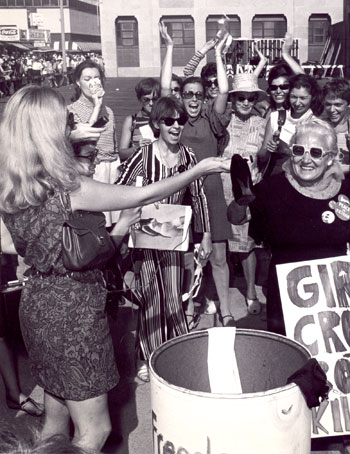
Those “bra-burning days” can be traced to the boardwalk at Atlantic City, NJ, 43 years ago, when about 100 women’s liberation demonstrators protested the Miss America pageant at the city’s Convention Center.

At the 'Freedom Trash Can,' 1968

A centerpiece of the protest was what the demonstrators called the “freedom trash can,” into which they consigned such “instruments of torture” as brassieres, girdles, high-heeled shoes, false eyelashes, copies of  Playboy and Cosmopolitan magazines.

The protesters have long insisted that, contrary to legend, bras and other items were not set afire that long ago September day.

The protest’s principal organizer, Robin Morgan, has asserted:

“There were no bras burned” at Atlantic City. “That’s a media myth.”

But in my latest book, Getting It Wrong, I offer evidence that bras were set afire, briefly, during the protest at Atlantic City. It was perhaps more akin to bra-smoldering.

The evidence is from separate witness accounts — one of them published in the local newspaper, the Press of Atlantic City, on September 8, 1968, the day after the protest.

That account appeared beneath the byline of a veteran reporter named John L. Boucher and carried the headline:

Bra burners blitz Boardwalk.”

The article’s key passage stated:

“As the bras, girdles, falsies, curlers, and copies of popular women’s magazines burned in the ‘Freedom Trash Can,’ the demonstration reached the pinnacle of ridicule when the participants paraded a small lamb wearing a gold banner worded ‘Miss America.’”

Boucher’s account, as I note in Getting It Wrong, “did not elaborate about the fire and the articles burning in the Freedom Trash Can, nor did it suggest the fire was all that important. Rather, the article conveyed a sense of astonishment that an event such as the women’s liberation protest could take place near the venue of the pageant.”

Boucher’s contemporaneous account was buttressed by the recollections of Jon Katz, a prolific writer who in 1968 was a young reporter for the Atlantic City Press.

He was on the boardwalk the day of the protest, gathering material for a sidebar article about reactions to the demonstration.

Katz’s article did not mention the burning bras. But in correspondence with me, Katz stated:

“I quite clearly remember the ‘Freedom Trash Can,’ and also remember some protestors putting their bras into it along with other articles of clothing, and some Pageant brochures, and setting the can on fire. I am quite certain of this.”

He added: “I recall and remember noting at the time that the fire was small, and quickly was extinguished, and didn’t pose a credible threat to the Boardwalk. I noted this as a reporter in case a fire did erupt ….”

Boucher’s long-overlooked article and Katz’s more recent recollections represent strong evidence that bras and other items were burned at the 1968 protest.

As I write in Getting It Wrong,  “This evidence cannot be taken lightly, dismissed or ignored.

“But it must be said as well,” I add, “that the witness accounts of Boucher and Katz lend no support to the far more vivid and popular imagery that many bras went up in flames in flamboyant protest that September day.”

Still, the notion that bra burnings were numerous during the late 1960s and 1970s became well-ingrained in American popular culture — as the recent reference in the Australian newspaper to “the 60s bra-burning days of women’s lib” suggests.

The phrase “bra-burning,” as I note in Getting It Wrong, became a sneering, off-hand way “of ridiculing feminists and mocking their sometimes-militant efforts to confront gender-based discrimination in the home and the work place.”

Bra-burning was hardly a common element of women’s liberation protests of the late 1960s and 1970s. Evidence is scant at best of feminist protesters during those years setting fire to bras and tossing the flaming undergarments into spectacular bonfires.

WJC

Recent and related:

No, really: Ray Nagin sought out for advice on hurricane prep

In Debunking, Hurricane Katrina, Media myths on August 28, 2011 at 2:37 am

What a joke.

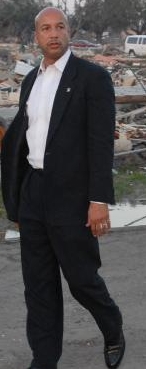
Nagin in New Orleans

As Hurricane Irene churned toward the East Coast of the United States, MSNBC brought on Ray Nagin, the former mayor of New Orleans, for insights about storm preparations.

In introducing Nagin, MSNBC anchor Martin Bashir declared:

“Former New Orleans Mayor Ray Nagin joins us to explain what leaders must do to avoid the mistakes that were made six years ago” when Hurricane Katrina battered the Gulf Coast.

Nagin, a preparedness authority?

Hardly.

Not only did Nagin fumble the local response to Hurricane Katrina (remember the yellow school buses, all neatly parked and submerged by flood waters?). He contributed significantly to the terribly misleading notion that in the storm’s aftermath, the city was swept by mayhem and lawlessness.

As I point out in my media mythbusting book, Getting It Wrong, Nagin offered up  what proved to be highly exaggerated estimates of Katrina-related deaths in New Orleans.

He said the toll could reach 10,000.

Deaths attributed to the hurricane in Louisiana were a little more than 1,000.

What’s more, I note in Getting It Wrong, “Nagin and the city’s police commissioner, Eddie Compass, were sources for some of the most shocking and exaggerated reports about the disaster.”

During an appearance on Oprah Winfrey’s television talk show on September 6, 2005, Nagin said “hundreds of armed gang members” were terrorizing storm evacuees inside the Louisiana Superdome.

Nagin said conditions at the Superdome had deteriorated to “an almost animalistic state” and evacuees “in that frickin’ Superdome for five days, watching dead bodies, watching hooligans killing people, raping people.”

Nagin was winging it on national television. And smearing his city in the process.

(It deserves noting that Nagin was criticized in a bipartisan Congressional report about the responses to Katrina. The report, issued in 2006 and titled A Failure of Initiative, pointed out that the mayor had “repeated unsubstantiated rumors before the national media, creating an exaggerated image of utter lawlessness.”)

As I note in Getting It Wrong, Nagin’s descriptions “were widely reported — and proved to be almost totally without foundation. In all, six people died in the Superdome during the Katrina aftermath. None of those deaths was related to violent crime.”

Interestingly, Compass was asked months afterward why he had depicted post-Katrina New Orleans as swept by mayhem and terror.

He offered this strange reply:

“I didn’t want people to think we were trying to cover anything up,” he said. “So I repeated things without being substantiated, and it caused a lot of problems.”

Compass was forced to resign within a few weeks of his appearance on Oprah. Nagin, though, was reelected in 2006 to a four-year term as mayor. He left office in 2010.

He’s out now with a self-published book, Katrina’s Secrets: Storms after the Storm (Volume I). In it, Nagin stokes the undocumented claims about violence inside the Superdome in the hurricane’s aftermath.

According to an essay written by Brendan McCarthy of the New Orleans Times-Picayune and posted at nola.com, Nagin claims in the book to have had “private conversations” with “several” women who said they were raped there.

McCarthy’s post quotes Nagin’s book as stating:

“The political and media spin later claimed that many of the rapes were basically the figment of our collective imagination. This ensured that anyone who was raped would not come forward to face unfair, invasive scrutiny while being forced to defend their credibility.”

McCarthy’s post also quotes Compass’ successor, Warren Riley, as having said in 2010:

“The stories that people had died in the Superdome, that people were being raped — there’s not one iota of evidence to show that anyone was killed or raped in the Dome.”

WJC

Recent and related:

Woodward, Bernstein toppled Nixon? Think again

In Media myths, Washington Post, Watergate myth on August 27, 2011 at 9:58 am

'Nixon got Nixon'

The passing of time is making the heroic-journalist narrative of Watergate even more heroic.

A commentary yesterday at Huffington Post suggests as much, in extolling — and overstating — the accomplishments of Bob Woodward and Carl Bernstein, the Washington Post reporters who covered the scandal.

The commentary, which considers the state of investigative reporting, says Woodward and Bernstein “plugged away for two years at the Watergate story through thick and thin and false leads. They were determined to nail then President Richard Nixon for authori[z]ing a break in at the Democratic Party HQ during his re-election campaign and then organi[z]ing a cover up. They did, with his resignation in August 1974.”

Woah. A lot of overstatement there.

First, there’s no evidence that Nixon authorized or even knew in advance about the burglary in June 1972 at the headquarters of the Democratic National Committee, the signal crime of Watergate.

Nixon, however, certainly did seek to block the FBI’s investigation of the breakin — and for that obstruction of justice, he was compelled to resign the presidency in disgrace.

But more important is that Woodward and Bernstein didn’t “nail” Nixon on Watergate. As I discuss in my latest book, Getting It Wrong, their investigative reporting for the Post certainly didn’t bring down Nixon’s corrupt presidency.

The heroic-journalist interpretation of Watergate, I write in Getting It Wrong, is to “misunderstand the scandal and to indulge in a particularly beguiling media-driven myth.

“The heroic-journalist interpretation,” I add, “minimizes the far more decisive forces that unraveled the scandal and forced Nixon from office.” Those forces included bipartisan panels of both houses of Congress, special federal Watergate prosecutors, federal judges, the Justice Department, the FBI, and the U.S. Supreme Court.

If inelegantly, even Woodward has concurred, declaring in an interview in 2004:

To say the press brought down Nixon, that’s horse shit.”

What toppled Nixon, what brought down his presidency, was clear evidence of his culpability in the crimes of Watergate — evidence captured on audiotapes that he secretly made of his conversations at the White House.

The decisive evidence — known as the “Smoking Gun” tape — revealed that Nixon at a meeting with his top aide, H.R. Haldemann, on June 23, 1972, sought to deflect or derail the FBI investigation into the Watergate burglary.

Woodward and Bernstein didn’t reveal the contents of that tape, which Watergate prosecutors had subpoenaed and which Nixon had refused to surrender until ordered to do so by the U.S. Supreme Court.

Nor did Woodward and Bernstein disclose the existence of Nixon’s secret taping system. That was revealed in July 1973, during hearings of the Senate Select Committee on Watergate.

In All the President’s Men, their book about their reporting, Woodward and Bernstein said they had received a tip about the taping system a few days before its existence was made public.

According to All the President’s Men, Ben Bradlee, then the Post‘s executive editor, suggested not expending much energy pursuing the tip. And they didn’t.

Interestingly, Bradlee also insisted the Post did not nail Nixon.

Speaking on a Meet the Press interview program at the 25th anniversary of the Watergate break-in, Bradlee declared:

[I]t must be remembered that Nixon got Nixon. The Post didn’t get Nixon.”

WJC

Recent and related: