W. Joseph Campbell

Posts Tagged ‘Getting It Wrong’

Recalling who gave us the ‘manufactured heroism’ of Jessica Lynch

In Debunking, Jessica Lynch, Media myths, Watergate myth on August 22, 2011 at 5:09 am

Lynch: No hero, she

I’ve noted how remarkable it is that the Washington Post so thoroughly eludes censure for placing the bogus hero-warrior tale about Jessica Lynch into the public domain during the first days of the Iraq War.

Confirmation of that observation came yesterday in an otherwise thoughtful essay in the New York Times about the deference Americans across the political spectrum tend to pay the military.

The essay described the Lynch case not as a stunning example of errant journalism but as “an instrument of propaganda.”

The essay, written by William Deresiewicz, asserts that in 2003, “we were treated to the manufactured heroism of Jessica D. Lynch, the young supply clerk who was rescued from an Iraqi hospital a few days after her capture by enemy forces (both events turning out to be far less cinematic than initially put out) and who finally felt compelled to speak out against her own use as an instrument of propaganda.”

Great line, “manufactured heroism.”

But who really was responsible for the “manufactured heroism”?

Deresiewicz avoids saying.

He fails to identify the Washington Post as solely responsible for placing the hero-warrior tale about Lynch into worldwide circulation.

He doesn’t say that the Post’s botched story about Lynch’s purported heroics was picked up by news organizations around the world, turning the 19-year-old Army private into the best-known American solider of the Iraq War.

WaPo's botched hero-warrior story

It was the Post, citing otherwise unnamed “U.S. officials,” that offered up the electrifying tale about how Lynch “fought fiercely and shot several enemy soldiers after Iraqi forces ambushed” her unit, the 507th Maintenance Company, in Nasiriyah on March 23, 2003.

It was the Post that reported Lynch “continued firing at the Iraqis even after she sustained multiple gunshot wounds and watched several other soldiers in her unit die around her” in the fighting.

None of it was true, however.

Lynch never fired a shot in Iraq. Her weapon jammed during the ambush. Her shattering injuries were suffered in the crash of a Humvee as it fled the attack.

It wasn’t long before the Post’s erroneous report about Lynch’s derring-do began to unravel.

But as I discuss in my latest book, Getting It Wrong, the newspaper in the years since has never fully explained how it got the Lynch story so badly wrong.

Nor has the Post ever identified the sources who led it so badly astray.

And why has the Post sidestepped blame for the botched Lynch narrative? Why isn’t the newspaper more routinely cited in essays, such as Deresiewicz’s, that invoke the Lynch case?

It’s principally because details of the Lynch case have been subordinated to a far more sinister narrative that says the Pentagon conjured the hero-warrior tale about the waif-like young woman in order to bolster popular support for the Iraq War.

It’s a perversely appealing narrative — and it’s quite false.

As Vernon Loeb, one of the Post reporters who shared a byline on the botched Lynch story in 2003, has said:

“Our sources for that story were not Pentagon sources.”

Loeb also said, in an interview that aired on NPR’s Fresh Air program in mid-December 2003:

“I just didn’t see the Pentagon trying to create a hero where there was none. I mean …they never showed any interest in doing that, to me.”

Loeb said the story was provided by “some really good intelligence sources” in Washington, D.C., adding:

“We wrote a story that turned out to be wrong because intelligence information we were given was wrong. That happens quite often.”

As I note in Getting It Wrong, Loeb on another occasion was quoted in the New York Times as saying:

“Far from promoting stories about Lynch, the military didn’t like the story.”

What’s more, the notion the Pentagon’s made up the story  — and somehow fed it to the Post — to bolster popular support for the war doesn’t make much sense. After all, the American public in overwhelming numbers supported the war in its early days and months.

But it’s clear that if not for the Post, the “manufactured” tale of Lynch’s heroism never would have circulated as it did.

Far from being an “instrument of propaganda,” the Lynch hero-warrior narrative is a case of bungled reporting that has never been adequately explained, let alone corrected.

WJC

Recent and related:

Misreporting Watergate

In Debunking, Media myths, Washington Post, Watergate myth on August 20, 2011 at 5:15 am

That new historical marker at the parking garage where Bob Woodward of the Washington Post occasionally met his stealthy “Deep Throat” source has stirred some cheery buzz among journalists — and some breathtaking exaggeration about the consequences of Woodward’ reporting on the Watergate scandal.

Credit: Odestreet.com

The marker titled “Watergate Investigation” went up late last week outside the garage in the Rosslyn section of Arlington, Virginia.

As I’ve noted at Media Myth Alert, the marker errs in stating that information Deep Throat” (who in 2005 was self-revealed to have been W. Mark Felt) provided Woodward “exposed the Nixon administration’s obstruction of the FBI’s Watergate investigation.”

For some news outlets commenting about the marker, it has been occasion to assert hyperbolic claims that the Post’s reporting on Watergate brought down Richard Nixon’s scandal-riddled presidency.

For example, the widely followed all-news radio station in Washington, WTOP,  said yesterday in its report about the marker:

“Mark ‘Deep Throat’ Felt, passed state secrets to Washington Post reporter Bob Woodward for a string of stories that would eventually take down a president — what would come to be known as the Watergate scandal.”

Quite simply not true.

Felt, formerly a top official at the FBI, offered Woodward mostly incremental details about Watergate as the scandal unfolded in 1972 and 1973. And as Woodward noted in the book, All the President’s Men, the role of “Deep Throat” was “only to confirm information that had been obtained elsewhere, and to add some perspective.”

It was hardly the stuff of “state secrets.”

More important, the reporting of Woodward and his Post colleague Carl Bernstein assuredly did not “take down” Nixon’s presidency.

Embracing that interpretation of Watergate, I write my media-mythbusting book, Getting It Wrong, “is to abridge and misunderstand the scandal and to indulge in a particularly beguiling media-driven myth.”

It’s an interpretation that not even officials at the Post have endorsed.

For example, Kathryn Graham, the newspaper’s publisher during and after Watergate, said in 1997, at a Newseum program marking the scandal’s 25th anniversary:

“Sometimes people accuse us of bringing down a president, which of course we didn’t do. The processes that caused [Nixon’s] resignation were constitutional.”

And Woodward, in earthier terms, has concurred, telling American Journalism Review in 2004:

To say that the press brought down Nixon, that’s horseshit.

The popular Washington entertainment blog, DCist, offered an even stranger interpretation of “Deep Throat” and his meetings with Woodward in the garage.

DCist, in a brief report about the marker, said yesterday the garage was where  “the informant, the FBI’s Mark ‘Deep Throat’ Felt, fessed up to what would eventually become the Watergate scandal that brought down President Richard Nixon.”

Huh? The “Deep Throat” source “fessed up to what would eventually become the Watergate scandal”?

“Fessed up”?

Such wording suggests that Felt/”Deep Throat” was a culprit or a suspect in the Watergate scandal.

Which he wasn’t.

Felt in fact wasn’t even around the FBI when the scandal reached its climax with Nixon’s resignation in August 1974.

He had been passed over for the FBI directorship and left the agency in 1973. Felt last conferred with Woodward at the Arlington garage in November that year.

But that’s not to say Felt was beyond reproach.

He really wasn’t such a hero.

In his senior position at the FBI, Felt had authorized illegal burglaries in the early 1970s as part of the agency’s investigations into leftists associated with the radical Weather Underground.

Felt was convicted in 1980 on felony charges related to those break-ins, but pardoned by President Ronald Reagan.

So if it not Felt’s tips to Woodward, what then brought down Nixon?

As I point out in Getting It Wrong, rolling up a scandal of Watergate’s complexity and dimension demanded “the collective if not always the coordinated forces of special prosecutors, federal judges, both houses of Congress, the Supreme Court, as well as the Justice Department and the FBI.

“Even then,” I write, “Nixon likely would have served out his term if not for the audiotape recordings he secretly made of most conversations in the Oval Office of the White House.”

Only when compelled by the Supreme Court did Nixon surrender the recordings that captured him plotting to cover up the break-in in June 1972, the signal crime of Watergate.

WJC

Recent and related:

‘Deep Throat’ garage marker errs about Watergate source disclosures

In Debunking, Media myths, Washington Post, Watergate myth on August 18, 2011 at 10:16 am

An historical marker went up the other day outside the parking garage in Arlington, Virginia, where Washington Post reporter Bob Woodward periodically met during the Watergate scandal with a stealthy, high-level source code-named “Deep Throat.”

It’s a handsome marker, artfully scalloped at the top.

Felt: Cagey source

But it errs in describing the information Woodward received from “Deep Throat,” who in 2005 revealed himself as W. Mark Felt, formerly the FBI’s second in command.

The marker, which is titled “Watergate Investigation,” says:

“Felt provided Woodward information that exposed the Nixon administration’s obstruction of the FBI’s Watergate investigation.”

Not so.

Such evidence would have been so damaging and explosive that it surely would have forced Nixon to resign the presidency well before he did, in August 1974.

Felt didn’t have that sort of information — or (less likely) didn’t share it with Woodward.

As described in Woodward’s book about Felt, The Secret Man, the FBI official provided or confirmed a good deal of piecemeal evidence about the scandal as it unfolded.

And he could be cagey and evasive in doing so.

Here, for example, is a passage from Secret Man, in which Woodward discussed efforts he and his Post colleague Carl Bernstein had made to identify Nixon’s chief of staff, H.R. Haldemann, as one of five people controlling a secret slush fund:

“I told Felt that we were going to publish a story next week saying that Haldemann was the fifth and final person to control the secret fund.

“‘You’ve got to do it on your own,’ Felt said.

“I said I expected him to warn me if we were wrong.

“Felt said he would.

“So he was essentially confirming Haldemann?

“‘I’m not,’ he said. ‘You’ve got to do it on your own.’

“It was a distinction that didn’t make sense to me. I was tired of this dancing around.

“‘You cannot use me as a source [on that story],’ Felt said. ‘I won’t be a source on a Haldemann story.””

And so it went.

(All the President’s Men, Woodward and Bernstein’s book about their Watergate reporting, says Woodward’s conversations with “Deep Throat” were intended “only to confirm information that had been gathered elsewhere and to add some perspective.”)

Woodward met Felt at the garage six times from October 1972 to November 1973, the marker notes. The last meeting at the garage was a few months after Felt had been passed over for the FBI directorship and retired.

Not until late summer 1974 — months after Felt left the FBI — did unequivocal evidence emerge about Nixon’s attempt to thwart the agency’s investigation into Watergate.

That came when Nixon complied with a unanimous Supreme Court ruling and surrendered audiotape recordings he had secretly made of conversations at the White House.

A recording of Nixon’s meeting with Haldemann on June 23, 1972, revealed that the president had sought to deflect or derail the FBI investigation into the burglary six days before at the headquarters of the Democratic National Committee at the Watergate complex in Washington.

The recording was called the “Smoking Gun” tape — and that tape, not information Felt gave Woodward, exposed Nixon’s guilt and forced his resignation.

The tape offered stunning and incontrovertible evidence that Nixon “had participated in an obstruction of justice almost from the outset” of the scandal, Stanley I. Kutler, the leading historian of the scandal, wrote in The Wars of Watergate.

As I note in my latest book, Getting It Wrong, had Nixon not recorded his conversations, he likely would have survived the Watergate scandal and served out his second term.

The marker outside the “Deep Throat” garage contains another, smaller error, too.

It says it was “erected in 2008 by Arlington County, Virginia.” But the online news site arlnow .com pointed out that the marker went up late last week — “after a three year delay.”

WJC

Recent and related:

That’s not what Zhou meant

In Debunking, Furnish the war, Media myths, Spanish-American War on August 17, 2011 at 7:52 am

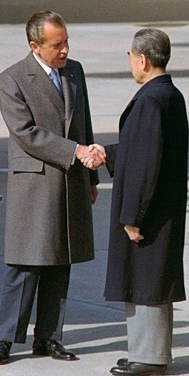
Nixon and Zhou, 1972

In 1972, Chinese premier Zhou Enlai told President Richard M. Nixon that it was “too early to say” what would be the implications of political upheaval in France.

It’s long been thought that Zhou was referring to the French Revolution that began in 1789 — that Zhou was taking a decidedly wise, sagacious, and patient view of history.

But in reality, according to a former U.S. diplomat who was present at the discussion in China, Zhou was referring to the more recent turmoil that had shaken France in 1968.

Still, the conventional interpretation — the Zhou was thinking in centuries, not in mere years — is so appealing that it lives on, as was suggested by a commentary posted yesterday by the English-language Moscow Times newspaper.

The commentary, which considered the significance of the attempted coup in the former Soviet Union in August 1991, began this way:

“Chinese leader Zhou Enlai may have been correct when he told U.S. President Richard Nixon in 1972 that it was too early to determine the impact of the French Revolution, but 20 years is usually enough to assess the importance of most historical events.”

The commentary may be quite correct about a 20-year interval being sufficient for assessing historical events.

But the characterization about Zhou’s comment is off-target, in light of recollections offered in June by Charles W.  (Chas) Freeman Jr., a retired diplomat who was interpreter for Nixon on his famous 1972 trip to China.

The Financial Times of London was first to report about the revised interpretation of Zhou’s comment. The newspaper quoted Freeman’s remarks at a panel discussion in Washington, D.C., that the Chinese leader was referring to the events of 1968.

Freeman, in a subsequent interview with me, described Zhou’s comment as “one of those convenient misunderstandings that never gets corrected,” noting that “it conveniently bolstered a stereotype … about Chinese statesmen as far-sighted individuals who think in longer terms than their Western counterparts.”

The misconstrued comment fit nicely with “what people wanted to hear and believe,” Freeman said, “so it took” hold.  And is not infrequently repeated.

Freeman said it was “absolutely clear” from the context of the discussion that Zhou’s “too early to say” remark was in reference to upheaval of 1968, not the years of turmoil that began in 1789.

Freeman described Zhou’s remark as “a classic of the genre of a constantly repeated misunderstanding that has taken on a life of its own.”

In that way, it’s akin to other deliciously irresistible quotations that are just too neat and too tidy to be true — a topic I discuss in my latest book, Getting It Wrong, which addresses and debunks 10 prominent media-driven myths.

One of the too-perfect-to-be-true quotations I discuss is the vow attributed to William Randolph Hearst, who purportedly pledged to “furnish the war” with Spain in the late 19th century.

The Hearstian vow suggests the depths to which journalists can stoop — to agitate for a war the country otherwise would not fight. That’s a reason for the tenacity of the purported Hearst quote. It reveals journalists at their most depraved.

But the purported vow, however well-known, is surely apocryphal.

Hearst denied having sent such a message, and the artifact — the telegram conveying the vow — has never turned up.

What’s more, pledging to “furnish the war” would have made no sense, given the context. Hearst’s telegram was supposedly sent to an artist, Frederic Remington, who was in Cuba to draw sketches of the rebellion against Spanish colonial rule.

It’s illogical that Hearst would have vowed to “furnish the war” when war — the Cuban rebellion — was the reason he sent Remington to the island in the first place.

WJC

Recent and related:

Fox News misremembers Watergate and ‘follow the money’

In Cinematic treatments, Debunking, Media myths, Washington Post, Watergate myth on August 16, 2011 at 9:20 am

I’ve referred to “follow the money” as Watergate’s best-known made-up line.

It also can be thought of as Watergate’s best-known misremembered line.

I say that because a Fox News commentary posted yesterday thoroughly misremembered the phrase as having been part of the “media circus” of Watergate in the months before the scandal reached its denouement with Richard Nixon’s resignation in August 1974.

The Fox commentary declared:

“America was transfixed for months by [Watergate-related] televised hearings presided over by the colorful Sen. Sam Ervin. … We learned about the mysterious insider, pornographically code-named ‘Deep Throat’ murmuring intriguing clues like ‘Follow the Money….’ It was a media circus.”

But as I’ve noted at Media Myth Alert, follow the money” was not part of the vernacular of Watergate. It was never offered as advice — murmured or otherwise — by the stealthy “Deep Throat” source, who met periodically with Bob Woodward of the Washington Post as the scandal unraveled.

(The identity of “Deep Throat” remained a secret for more than 30 years until W. Mark Felt, a former top FBI official, self-identified himself as having been Woodward’s secret source during Watergate.)

What’s more, “follow the money” appeared in no Watergate-related article or editorial in the Post until June 1981.

Nor is the line to be found in All the President’s Men, the book Woodward and his Post colleague, Carl Bernstein, wrote about their Watergate reporting.

The phrase exists only in the movies — in the cinematic version of All the President’s Men, which came out in April 1976.

Follow the money” was written into the screenplay of All the President’s Men and spoken by the actor Hal Holbrook, who turned in a memorable performance as “Deep Throat.”

Holbrook intoned “follow the money” with such steely assurance that it did indeed seemed to suggest a way — however simplistic — to unravel the scandal.

But even if “Deep Throat”/Felt had counseled Woodward to “follow the money,” the advice would have neither unraveled Watergate nor led the reporter to Nixon.

Nixon quit the presidency not because he misused campaign funds; he resigned in disgrace after it became clear he had sought to obstruct justice by covering up the signal crime of Watergate, the break-in at the headquarters of the Democratic National Committee in June 1972.

As I note in my latest book, Getting It Wrong, rolling up a scandal of the dimension and complexity of Watergate required “the collective if not always the coordinated forces of special prosecutors, federal judges, both houses of Congress, the Supreme Court, as well as the Justice Department and the FBI.

“Even then,” I write, “Nixon likely would have served out his term if not for the audiotape recordings he secretly made of most conversations in the Oval Office of the White House.

“Only when compelled by the Supreme Court did Nixon surrender those recordings, which captured him plotting the cover-up” — which cost him the presidency.

WJC

Recent and related:

Media myth infiltrates NYTimes ‘Learning Network’

In 1897, Debunking, Furnish the war, New York Times, Spanish-American War on August 13, 2011 at 12:06 am

The New York Times’ Learning  Network” blog declares says it provides “teaching and learning materials and ideas” based on the newspaper’s archival content.

Its entry yesterday was pegged to the 113th anniversary of the effective end of the Spanish-American War — and offered up a hoary media myth in discussing newspaper coverage of the conflict.

The Times item stated:

Support for the Spanish-American War was stirred by sensationalist accounts of Spanish wrongdoing in the newspapers of [William] Randolph Hearst and Joseph Pulitzer; according to legend, Hearst told an illustrator covering the war, ‘You furnish the pictures and I will furnish the war.'”

It’s highly debatable whether much support for the war was generated by the newspapers of Hearst and Pulitzer. There is considerable evidence to suggest that their newspapers had little if any agenda-setting effect on the administration of President William McKinley on the question of going to war with Spain over Cuba in 1898.

And it’s virtually certain that Hearst’s purported vow to “furnish the war” is apocryphal.

As I discuss in my latest book, Getting It Wrong, the anecdote about “furnish the war” is a hardy media myth that lives on despite concerted attempts to dismantle and debunk it.

The vow supposedly was contained in a telegram sent to the artist, Frederic Remington, who was in Cuba on assignment for Hearst’s New York Journal. Remington and the correspondent Richard Harding Davis were there to cover the rebellion against Spain’s harsh colonial rule — a rebellion that gave rise in 1898 to the Spanish-American War.

Remington and Davis reached Havana in early January 1897; Remington stayed just six days.

Before leaving for New York by passenger steamer, Remington supposedly cabled Hearst, stating:

“Everything is quiet. There will be no war. I wish to return.”

Hearst is said to have replied:

Please remain. You furnish the pictures, and I’ll furnish the war.”

But Remington didn’t remain in Cuba.

He promptly returned to New York, where his sketches received prominent display in Hearst’s Journal. They appeared beneath such flattering headlines as:

“Cuban War Sketches Gathered in the Field by Frederic Remington; The Gifted Artist, Visiting Cuba Especially for the Journal.”

That’s scarcely the kind of tribute Hearst would have given a wayward artist who ignored instructions to “remain” in Cuba.

I further note in Getting It Wrong that the myth about Hearst’s vow “lives on despite an irreconcilable internal inconsistency: It would have been absurd for Hearst to vow to ‘furnish the war’ because war — specifically, the Cuban rebellion against Spain’s colonial rule — was the very reason Hearst sent Remington to Cuba in the first place.”

Anyone reading U.S. newspapers in early 1897 “would have been well aware,” I point out, “that Cuba was a theater of a nasty war” of rebellion.

Not only that, but the artifacts — the telegrams reputedly exchanged by Remington and Hearst — have never surfaced. Spanish censors closely monitored incoming and outgoing telegraphic traffic in Havana and they surely would have intercepted and called attention to Hearst’s incendiary message, had it been sent.

For those and other reasons, the tale about the Remington-Hearst exchange is surely apocryphal — a myth too often presented as fact.

The “Learning Network” isn’t off the hook by couching its reference to the purported Remington-Hearst exchange as “legend.” If the blog had doubts about the veracity of Heart’s purported vow, then it ought not have mentioned it in the first place.

WJC

Recent and related:

Blogging about journalism history: Why, and why bother?

In Debunking, Media myths on August 10, 2011 at 6:44 am

Journalism historians who blog.

It seems a little oxymoronic.

After all, isn’t journalism history a little too fusty, a little too musty, and a little too obscure to be readily adapted to contemporary social media such as blogging?

One might reflexively think so.

But a panel of four journalism historians who blog will discuss why they do so at a panel in St. Louis this afternoon, during the annual conference of the Association for Education in Journalism and Mass Communication (AEJMC).

The panel, titled “We blog about journalism history: Why, and why bother,” will consider the value of injecting historical dimension into contemporary debates and critiques about the performance of  news media, both traditional and online.

I’ll moderate and participate on the panel, which will bring together Chris Daly of Boston University, Karen Russell of the University of Georgia, and James McPherson of Whitworth College.

I intend to point out how blogging about journalism history can offer relevant and valuable context to the blogosphere’s never-ending debates about media performance. Journalism historians can bring to those debates perspective and analysis that would otherwise be missing or overlooked.

I also expect to note there are personal reasons for blogging as well. By blogging, journalism historians can test emergent ideas and hypotheses. Blogging can reinforce (and direct attention to) previously published work — much as Media Myth Alert seeks to do in promoting my latest book, Getting It Wrong, which debunks 10 prominent media-driven myths.

Blogging is a way to call out media myths. After all, as historian Gerard DeGroot has pointed out, “The good historian is a mythbuster.”

Blogging also allows journalism historians to take the steps toward developing larger, more detailed works, a point suggested several years ago in an intriguing blog post by Timothy Burke about why historians blog.

Among other points, Burke said he writes online essays because “I want to find out how much of my scholarly work is usefully translatable into a wider public conversation.”

Blogging about journalism history can have pedagogical value and impact far beyond the blogger’s expectations and knowledge. As such, blog posts about topics in journalism history may greatly expand the reach and application of a scholar’s research.

So it promises to be lively, the AEJMC blogging panel, which convenes at 1:30 p.m. in the Landmark #1 meeting room of the Renaissance Grand and Suites Hotel in St. Louis.

Panel-goers are invited to live-Tweet the proceedings, and use the Twitter hashtags #AEJMCblogging and #AEJMC11.

WJC

Recent and related:

Following the money on 37th anniversary of Nixon’s fall

In Anniversaries, Cinematic treatments, Debunking, Media myths, Washington Post on August 9, 2011 at 12:55 am

Nixon resigns, 1974

It’s somehow fitting on this, the 37th anniversary of President Richard Nixon’s resignation, to direct attention to the myth and hyperbole that embrace the best-known line of the Watergate scandal, the line that supposedly helped bring him down.

That line, of course, is “follow the money,” which purportedly was crucial advice given the Washington Post by a super-secret, high-level source code-named “Deep Throat.”

Follow the money” was said to have been so telling and effective that it’s still cited as exemplary guidance applicable in journalism, politics, and finance.

Just yesterday, for example, Barry Nolan, a journalist and contributor to Boston Magazine’sBoston Daily” blog, invoked the famous phrase, writing:

“Any time you really want to know why a vote happened the way it did, the single best piece of advice ever given came from ‘Deep Throat,’ the shadowy tipster in the Watergate scandal. ‘Follow the money,’ he told the Washington Post reporters.”

It may seem like stellar advice, but it’s guidance that the “Deep Throat” source offered only in the movies.

As I’ve discussed at Media Myth Alert, “follow the money” is Watergate’s most famous made-up line.

The phrase was written into the screenplay of All the President’s Men, the 1976 cinematic version of the book by Bob Woodward and Carl Bernstein of the Washington Post.

“Follow the money” appears nowhere in Woodward and Bernstein’s book about their Watergate reporting — reporting that did not, as I discuss in my latest work, Getting It Wrong, take down Nixon’s corrupt presidency.

Nor did “follow the money” appear in any Watergate-related news article or editorial in the Post until June 1981, nearly seven years after Nixon’s resignation.

Nor did “Deep Throat” — who was self-identified in 2005 as W. Mark Felt, formerly the FBI’s second-ranking official — utter the line in his periodic meetings with Woodward. (And Felt/”Deep Throat” didn’t meet Bernstein until 2008.)

Follow the money” was memorably intoned not by Mark Felt but by Hal Holbrook, the actor who played “Deep Throat” in All the President’s Men.

As I’ve noted, Holbrook turned in a marvelous performance as a tormented, conflicted, and stealthy “Deep Throat.”

Holbrook delivered the “follow the money” line with such conviction and steely assurance, that it seemed for all the world to offer a way through the labyrinth of the Watergate scandal.

But even if Woodward had been counseled to “follow the money,” the advice certainly neither would have unraveled Watergate nor led him to Nixon.

Nixon resigned 37 years ago today not because he misused campaign funds but because he sought to obstruct justice by covering up the signal crime of Watergate, the break-in at the headquarters of the Democratic National Committee in June 1972.

The simplified follow-the-money  interpretation of Watergate effectively deflects attention from the decisive forces that ultimately forced Nixon from office.

As I note in Getting It Wrong, rolling up a scandal of Watergate’s intricacy and dimension required “the collective if not always the coordinated forces of special prosecutors, federal judges, both houses of Congress, the Supreme Court, as well as the Justice Department and the FBI.

“Even then,” I write, “Nixon likely would have served out his term if not for the audiotape recordings he secretly made of most conversations in the Oval Office of the White House.

“Only when compelled by the Supreme Court did Nixon surrender those recordings, which captured him plotting the cover-up” that cost him the presidency.

WJC

Recent and related:

India high court order invokes phony Watergate line

In Debunking, Furnish the war, Media myths, Washington Post, Watergate myth on August 2, 2011 at 9:48 am

Two Supreme Court judges in India last month turned to Watergate’s most famous made-up line in ordering an investigation into large sums of money believed stashed in banks abroad.

The judges in their order cited the made-up line as if it had been genuine advice from a high-level source to Bob Woodward of the Washington Post  during the newspaper’s investigation of the Watergate scandal.

The line is “follow the money” — and it had no role whatsoever in the Watergate scandal.

Follow the money” was never uttered by Woodward’s stealthy source, who was code-named “Deep Throat.”

The line appears nowhere in the All the President’s Men, the book Woodward and Carl Bernstein wrote about their Watergate reporting for the Post.

Nor did the passage appear in any Watergate-related news article or editorial in the Post before June 1981 — nearly seven years after the scandal reached its denouement with President Richard Nixon’s resignation.

Follow the money” was written into the screenplay of All the President’s Men, the 1976 movie based on Woodward and Bernstein’s book.

Many people and many news outlets over the years have cited “follow the money” as if it were real, as if it had been advice to Woodward that really worked.

Just last week, for example, a column in London’s high-brow Financial Times newspaper described “follow the money” as the “mantra” of Watergate. And a column posted at Huffington Post a couple of weeks ago also repeated “follow the money” as if it had been vital guidance to uncovering Watergate.

But finding its way into a high court order probably represents a first for “follow the money.”

As noted in a Bloomberg news service report yesterday, the two judges — B. Sudershan Reddy and S.S. Singh Nijjar — invoked “follow the money” at the outset of the order they released early last month.

Credulously, the judges wrote:

“‘Follow the money’ was the short and simple advice given by the secret informant, within the American Government, to Bob Woodward, the journalist from Washington Post, in aid of his investigations of the Watergate Hotel break in.”

So how is it that such errors are made? What explains the impressive reach and popularity of this appealing but contrived statement?

A partial explanation is that “follow the money” seems just too good, too delicious, not to be true. It’s in the class of William Randolph Hearst’s purported vow to “furnish the war” with Spain: It’s a quotation that really ought to true.

And as I point out in my media myth-busting book, Getting It Wrong:

“To thwart media myths, journalists can start by applying a measure of skepticism to pithy, telling quotes such as Hearst’s vow to ‘furnish the war.’ … Turns of phrase that sound too neat and tidy often are too perfect to be true.”

The popularity of “follow the money” goes beyond appealing pithiness and is rooted in the dramatic quality of All the President’s Men, the most-watched movie ever made about Watergate.

The “Deep Throat” character was played in All the President’s Men by the actor Hal Holbrook, who turned in a marvelous performance.

In a late-night scene in a darkened parking garage, the shadowy, raspy-voiced Holbrook told the Woodward character (played by Robert Redford):

“I have to do this my way. You tell me what you know, and I’ll confirm. I’ll keep you in the right direction, if I can, but that’s all.

“Just follow the money.”

Holbrook delivered the line with such quiet insistence that it truly seemed to offer a way through the labyrinth of the Watergate scandal. And the popularity of the movie carried “follow the money” into the vernacular.

But such guidance, had it really been offered to Woodward, would have taken the reporter only so far. Watergate, after all, was much broader than the improper use of campaign monies.

Nixon was toppled not by heroic journalists who followed a money trail, but by irrefutable evidence captured on audiotapes that he had ordered the cover up Watergate’s signal crime, the break-in at the headquarters of the Democratic National Committee in June 1972.

WJC

Recent and related:

A media myth eruption: WaPo, Watergate, and Nixon’s fall

In Debunking, Media myths, Washington Post, Watergate myth on July 30, 2011 at 4:55 am

Bimbo eruptions” was the memorably colorful term invoked during the 1992 presidential campaign by Betsey Wright, an aide to presidential candidate Bill Clinton, to describe the suspicions and potential allegations about Clinton’s womanizing.

Sure, he did

The past couple of days have brought an eruption of media myth — notably, the rich and appealing tale that Bob Woodward and Carl Bernstein’s reporting for the Washington Post brought down Richard Nixon’s corrupt presidency in the Watergate scandal.

Not even the Post buys into that simplistic and media-centric interpretation. As Michael Getler, the newspaper’s then-ombudsman correctly noted in 2005:

“Ultimately, it was not The Post, but the FBI, a Congress acting in bipartisan fashion and the courts that brought down the Nixon administration. They saw Watergate and the attempt to cover it up as a vast abuse of power and attempted corruption of U.S. institutions.”

(More coarsely, Woodward himself has declared: “To say the press brought down Nixon, that’s horseshit.”)

Even so, the media myth about Woodward, Bernstein, and the Post — the heroic-journalist myth, as I describe it in my latest book, Getting It Wrong — is so delicious and compelling that it lives on and on, as this recent eruption attests.

Figuring in the media myth eruption have been:

  • The Daily Beast, which rhetorically asked in a commentary yesterday about the phone-hacking scandal that has battered Rupert Murdoch’s media in Britain: “Did Woodward and Bernstein need [phone-hackers and private investigators] to bring down Richard Nixon?”
  • The Daily Mirror  tabloid in Britain declared in an article posted online today that “Watergate was exposed by Washington Post reporters Carl Bernstein and Bob Woodward.”
  • Charleston Gazette in West Virginia, which declared passage in an editorial about Murdoch’s troubles in Britain: “The Washington Post toppled President Richard Nixon in the Watergate scandal.”
  • The publisher of the North Platte Telegraph in Nebraska, who in a column the other day referred to the “early 1970s when the Post brought down the presidency of Richard Nixon using primarily an unnamed source.” That was a reference to Woodward’s stealthy, high-level source who was code-named “Deep Throat.”

The appearance of the heroic-journalist myth in such diverse outlets and contexts is testifies to how deeply embedded the tale has become in the popular consciousness.

And why is that?

The heroic-journalist myth, as I discuss in Getting It Wrong, is “ready short-hand for understanding Watergate and its denouement, a proxy for grasping the scandal’s essence while avoiding its forbidding complexity.”

Rather that attempting to keep straight the dimensions of a scandal that began to break nearly 40 years ago, it is fair easier to embrace the proxy version — the simplified narrative that Woodward and Bernstein took down Nixon, with help from the “Deep Throat” source.

The identity of “Deep Throat” remained a secret — and the subject of much speculation and many guessing games — until 2005 when W. Mark Felt and his family announced that Felt, a former FBI official, had been Woodward’s mysterious source.

The heroic-journalist myth lives on because it’s such a reassuring narrative for the news media — a tale that describes the news media at their supposed best, a time when their reporting made a powerful difference in national life.

As I note in Getting It Wrong, the notion that the Post and its reporters exposed the Watergate scandal “is deeply ingrained in American journalism as one of the field’s most important and self-reverential stories.”

It’s a comforting trope about a purported triumph for a profession that’s more accustomed to scorn and condemnation than applause and approbation.

But it’s no less a media myth.

WJC

Many thanks to Instapundit
Glenn Reynolds for linking to this post.

Recent and related: