W. Joseph Campbell

Posts Tagged ‘Getting It Wrong’

‘War Lovers’: A myth-indulging disappointment

In 1897, Furnish the war, Media myths, Spanish-American War, Yellow Journalism on May 2, 2010 at 3:37 pm

I had a chance today to thumb through The War Lovers, the widely reviewed new book by Evan Thomas about the run-up to Spanish-American War.

But I didn’t buy it. It’s a myth-indulging disappointment.
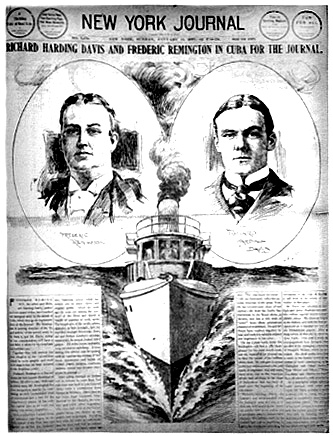
Remington in Cuba

In sections of the book about the yellow press period at the end of the 19th century, Thomas ignored–or was unaware of–recent scholarship that has cast serious doubt on anecdotes he included.

Notably, Thomas embraced the media-driven myth of William Randolph Hearst’s purported vow to “furnish the war” with Spain–a vow supposedly contained in a telegram to the artist Frederic Remington, on assignment in Cuba.

It is perhaps American journalism’s best-known tale. But as I wrote in my 2001 book, Yellow Journalism: Puncturing the Myths, Defining the Legacies, the anecdote almost certainly is apocryphal.

It lives on despite a nearly complete absence of supporting documentation. It lives on even though the telegram Hearst’s reputedly sent has never turned up. It lives on even though Hearst denied ever sending such a message.

And it lives on despite an obvious and irreconcilable internal inconsistency: It would have been absurd for Hearst to have vowed to “furnish the war” because war—specifically, the Cuban rebellion against Spain’s colonial rule—was the reason Hearst sent Remington to Cuba in the first place.

Remington was there in early 1897, at a time when anyone reading U.S. newspapers would have been quite aware that Cuba for two years had been a theater of a very nasty war. By 1897, Spain had sent nearly 200,000 soldiers to Cuba in a failed attempt to put down the rebellion, which in 1898 gave rise to the Spanish-American War.

Thomas–whose biography at Amazon.com says he “is one of the most respected historians and journalists writing today”–overlooked almost all of that.

He cited as his authority James Creelman, the pompous, hyperbolic reporter for Hearst’s New York Journal who recounted the anecdote, without documentation, in his 1901 memoir, On the Great Highway.

Creelman presented the “furnish the war” anecdote in an admiring way, saying it demonstrated how Hearst’s “yellow journalism” had an eye toward the future and was good at anticipating events. But over the years, the vow has taken on the more sinister overtones, of the sort that Thomas invoked in his book.

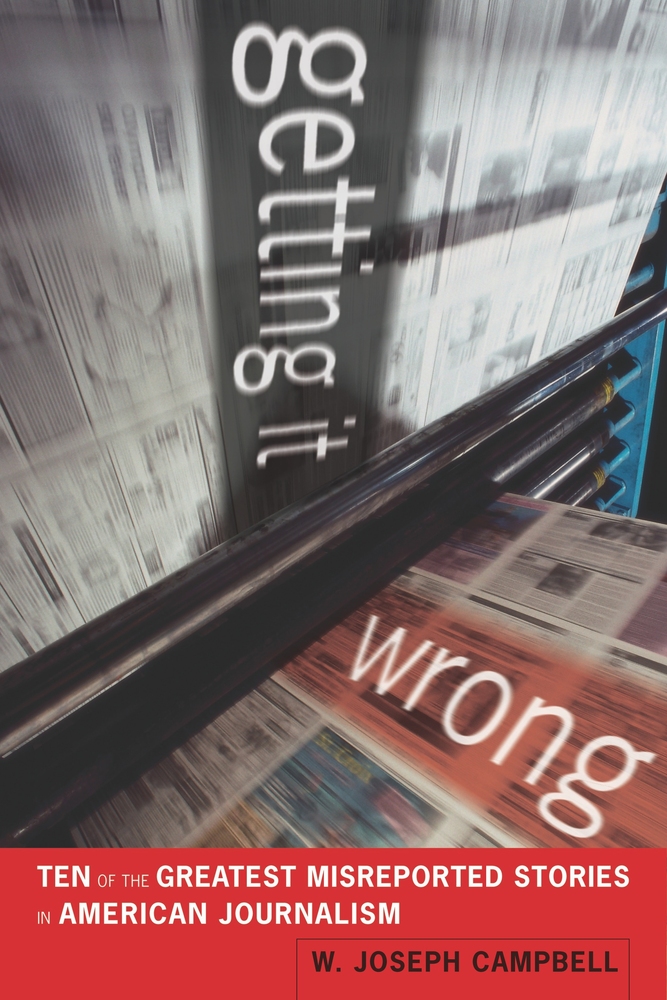
The anecdote’s evolution over the past 110 years is discussed in Chapter One of Getting It Wrong, my forthcoming book on media-driven myths.

Creelman, by the way, wasn’t with Remington in Cuba in early 1897. He wasn’t in New York with Hearst, either. Creelman was in Europe, as the Journal‘s special correspondent on the continent. So he would not have had first-hand knowledge about the “furnish the war” telegram, had Hearst sent it to Remington in Cuba.

Thomas indulged in another myth of yellow journalism, one that centers around what I call the greatest escape narrative in American media history.

In what also is known as the case of “jail-breaking journalism,” Hearst’s Journal organized the escape in 1897 of a 19-year-old Cuban political prisoner named Evangelina Cisneros.

By then, she had been held in a Havana jail, without trial, for 15 months on suspicion of conspiring to kill a senior Spanish military officer. Cisneros claimed the officer had made her the target of unwelcome sexual advances.

As I described in my 2006 book, a year-study titled The Year That Defined American Journalism: 1897 and the Clash of Paradigms,  Hearst sent a reporter named Karl Decker to Cuba, ostensibly as the Journal correspondent in Havana.

In reality, Decker was under orders to organize the rescue of Cisneros.

With the quiet help of U.S. diplomatic personnel in Cuba, and with the vital support of a clandestine smuggling network in Havana, Decker succeeded: He and two accomplices broke Cisneros out of jail in early October 1897. She was smuggled aboard a passenger steamer to New York City, where Hearst organized a delirious reception for her.

Thomas claimed that Decker, in articles the Journal published about jailbreak, “neglected to inform readers that he had bribed the guards, who arranged the theater of the escape as a way to save face.”
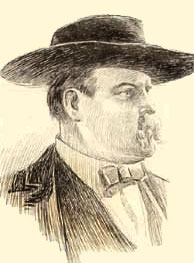
Decker

Such claims have circulated since 1897, mostly as a way to denigrate the Journal and its brazen accomplishment. Decker did say he tried, but failed, to bribe the jailer.

As is noted in The Year That Defined American Journalism, the evidentiary record to support the claim that bribes were paid is very, very thin.

“No one has identified to whom bribes were paid, how much, by what method, and how the purported payoffs secured the enduring silence of the authorities,” I wrote, adding:

“The allegations or suspicions of bribery rest more on assertion—and newspaper rivals’ contempt for the Journal—than on specific, persuasive documentation.”

It’s a good story, though. Like many media-driven myths, the Decker-bribery tale is delicious and enticing.

But it withers under scrutiny.
WJC

On columnists and burning bras

In Bra-burning, Debunking, Media myths on May 1, 2010 at 9:16 am

Two dozen men and women bared torsos and marched in Farmington, Maine, yesterday, prompting a snarky commentary in the Bangor Daily News about social protests–and bra-burning.

“In the 1960s and 1970s there was that whole Vietnam War issue and the sexual revolution to boot. There were lots of things to protest and stand for,” the commentary declared, adding:

“During that time I believe there were more than a few college-age women who burned their bras. Some believe young women tossed their bras into burning trash cans as a protest of the Vietnam War, but others stand firm that the first ‘bra burning’ incident actually occurred in 1968 at a demonstration against the Miss America contest.”

Like many discussions about bra-burning–a topic addressed in Getting It Wrong, my forthcoming book about media-driven myths–the commentary is more than a bit tangled and confused.

As I write in Getting It Wrong, the notion of bra-burning took hold in the days after the Miss America pageant at Atlantic City, N.J., on September 7, 1968.

“Early that afternoon,” I write, “about 100 women from New York City, New Jersey, Boston, Washington, D.C., and elsewhere arrived by bus at the Atlantic City boardwalk.

“They were, according to the New York Times, ‘mostly middle-aged careerists and housewives’ and they set up a picket line at Kennedy Plaza, across from the Convention Center. They were there, as one participant declared, ‘to protest the degrading image of women perpetuated by the Miss America pageant,’ which took place that night inside the Convention Center.”

A highlight of their protest came when the demonstrators tossed into a barrel what they called “instruments of torture,” including brassieres, girdles, high-heeled shoes, and magazines such as Playboy and Cosmopolitan. The protesters dubbed the barrel the Freedom Trash Can.

The protest organizers, who included the activist and former child actor Robin Morgan, have long insisted that bras and other contents of the Freedom Trash Can were not set afire during the protest.

But the notion that bra-burning was a dramatic element of the demonstration at Atlantic City was driven by syndicated columnists, including Harriett Van Horne.

Soon after the protest, Van Horne wrote that the protesters had been “scarred by consorting with the wrong men. Men who do not understand the way to a woman’s heart, i.e., to make her feel utterly feminine, desirable and almost too delicate for this hard world. … No wonder she goes to Atlantic City and burns her bra.”

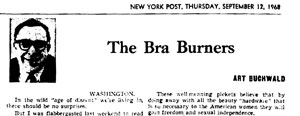
Van Horne was not at the protest, however. Nor was Art Buchwald, then American journalism’s preeminent humorist, who played on the bra-burning trope in a column published in the Washington Post and other newspapers.

With tongue in cheek, Buchwald wrote that he had been “flabbergasted to read that about 100 women had picketed the Miss America pageant in Atlantic City against ‘ludicrous beauty standards that had enslaved the American woman.’”

He added: “The final and most tragic part of the protest took place when several of the women publicly burned their brassieres.”

As I note in Getting It Wrong, Buchwald’s “characterization of the protest at Atlantic City introduced the notion of flamboyant bra-burning to a national audience, conjuring as it did a powerful mental image of angry women setting fire to bras and twirling them, defiantly, for all … to see.”

But as for the claim in the Bangor Daily News commentary that “more than a few college-age women … burned their bras” in the 1960s and 1970s, well, the supporting evidence just isn’t there.

WJC

Cronkite ‘dissed’ Johnson? Think again

In Cronkite Moment, Debunking, Media myths on April 30, 2010 at 3:40 pm

When the Daily Show’s Jon Stewart weighed on the Apple-Gizmodo dust-up over the lost prototype of a next generation iPhone, it was akin to Walter Cronkite’s taking to the air to criticize the U.S. war effort in Vietnam in 1968.

Or so says an item posted yesterday at the  tech-news blog DVICE.

Stewart the other night called out Apple over the police search at the home of the Gizmodo editor who had blogged about the iPhone prototype, which an Apple employee reportedly had lost at a bar.

In a segment about the Gizmodo controversy, Stewart in mock lament asked of Apple: “Are you becoming the Man?”

He also said in skewering Apple: “I mean, if you want to break down someone’s door, why don’t you start with AT&T, for god’s sake? They make your amazing phone unusable as a phone.”

In reaching–overreaching–for significance, DVICE said of Stewart’s segment:

“Is that a paradigm we feel shifting? It reminds us of when President Lyndon Johnson got dissed by Walter Cronkite in a scathing report on the futility of the Vietnam War, with Johnson saying, ‘If I’ve lost Cronkite, I’ve lost Middle America.'”

Interesting analogy.

Trouble is, there’s no documented evidence of Johnson ever having said anything of the sort.

The Cronkite-Johnson anecdote is one of 10 media-driven myths that I address, and debunk, in my forthcoming book, Getting It Wrong.

The anecdote–often called the “Cronkite moment“–centers around the special report on Vietnam that aired February 27, 1968, on CBS. At the end of the program, Cronkite declared the U.S. military effort in Vietnam was “mired in stalemate” and suggested a negotiated settlement would be the only way out.

Legend has it that Johnson watched the program at the White House and, upon hearing Cronkite’s editorial comment, snapped off the television and said to an aide or aides:

“If I’ve lost Cronkite, I’ve lost Middle America.”

Or words to that effect. Versions vary.

But as I note in Getting It Wrong, Johnson wasn’t in Washington when the Vietnam special was shown. He was in Austin, Texas, at the 51st birthday party of Governor John Connally–and did not see the Cronkite program.

As such, I write:

Johnson in Austin, February 27, 1968

“Johnson did not have—could not have had—the abrupt yet resigned reaction that so often has been attributed to him.”

Moreover, I add, “Johnson’s supposedly downbeat, self-pitying reaction to Cronkite’s on-air assessment clashes sharply with the president’s aggressive characterization about the war. Hours before the Cronkite program, Johnson delivered a little-recalled but rousing speech on Vietnam, a speech cast in Churchillian terms. It seems inconceivable that Johnson’s views would have pivoted so swiftly and dramatically, upon hearing the opinion of a television news anchor, even one as esteemed as Cronkite.”

I further write in Getting It Wrong that even if the president had “later heard—or heard about—Cronkite’s assessment, it was no epiphany for Johnson. Not long after the program, Johnson gave a rousing, lectern-pounding speech in which he urged a ‘total national effort’ to win the war in Vietnam.”

So Johnson “got dissed” by Cronkite? One might say that, but Johnson didn’t care. Or even know about it. Not immediately.

And more important, Cronkite’s comments made no significant difference to Johnson and his Vietnam policy.

WJC

Advance pub for ‘Getting It Wrong’

In 1897, Cronkite Moment, Debunking, Media myths, War of the Worlds, Washington Post on April 28, 2010 at 3:47 pm

The online site of the School of Communication here at American University posts today a Q-and-A with me about Getting It Wrong, my forthcoming book that debunks 10 prominent media-driven myths.

Topics addressed include the Remington-Hearst/furnish the war anecdote; the War of the Worlds/mass hysteria myth, and the “Cronkite moment“/”I’ve lost Middle America” meme.

And while the topic is not considered in Getting It Wrong, I also mention the “pharm parties” myth, in which young people are said to take pills of any kind from their parents’ medicine cabinets. They supposedly show up at a party and dump the purloined pills into a large, common bowl. Then they are purported to take turns scooping out and swallowing handfuls of the medications, not knowing what they’re taking, in the supposed pursuit of a drug-induced high.

Jack Shafer, media critic for slate.com, has done fine work in knocking down the “pharm party” meme.

Here are excerpts from the Q-and-A:

Q: “Myth busting” can upset people who have accepted, or even benefited from, the myth. Have you gotten any negative feedback?

A:  Not really. Not so far. I do know that some people wonder “who cares?” about some of the myths debunked in Getting It Wrong. The Hearst—”furnish the war” myth, after all, is more than 100 years old. But I emphasize in the book that media-driven myths are neither innocuous nor trivial. They can, and do, promote stereotypes. They can deflect attention or blame away from the makers of flawed policies. They can, and often do, offer an exaggerated sense of the power and influence of the news media. Plus, debunking myths is a pursuit that’s aligned with a fundamental objective of mainstream American journalism—that of getting it right.

Q: What’s next?

A: I’d like to think there’s a sequel to Getting It Wrong. The universe of media-driven myths isn’t confined to 10, after all. There are more to confront. Also, in fall 2010, I’ll be teaching a “wild card” course in the University’s General Education program titled “Media Myth and Power.” The course will consider several of the myths debunked in Getting It Wrong.

A tip of the chapeau to Michael Wargo of the School of Communication for putting together the Q-and-A, which follows the writeup about the book that appeared April 11 in the “Outlook” section of the Washington Post.

WJC

Remembering ‘journalism hero’ Murrow, 45 years on

In Anniversaries, Debunking, Media myths, Murrow-McCarthy myth on April 27, 2010 at 9:46 am

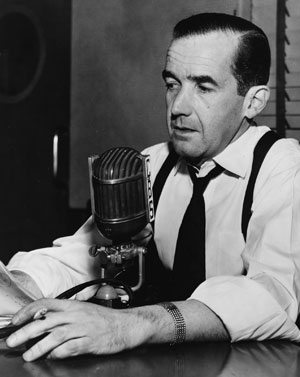
The Poughkeepsie Journal notes the 45th anniversary today of the  death of legendary broadcast journalist Edward R. Murrow.

Murrow died April 27, 1965, at his farm near Pawling, N.Y., about 20 miles from Poughkeepsie. Murrow, a chainsmoker, fell victim to lung cancer. He had just turned 57.

Chainsmoking Ed Murrow

Inevitably, the Poughkeepsie Journal tribute–which carried the headline, “Journalism hero Edward R. Murrow lives on”–recalled Murrow’s famous See It Now documentary program in March 1954. That was when he took on the red-baiting Republican senator from Wisconsin, Joseph R. McCarthy.

The newspaper’s article said Murrow’s program on McCarthy “is credited for exposing the senator’s tactics by using clips of his own words, and helped lead to the senator’s downfall.”

The program’s mythical dimensions are addressed in my forthcoming book, Getting It Wrong, in which I note:

See It Now that night was powerful television. More accurately, it was a hearty serving of advocacy journalism. … Murrow and his See It Now team assembled a series of film clips that was decidedly unflattering to McCarthy.”

I also write:

“McCarthy’s oddball appearance and mannerisms—his hulking, menacing presence, his nutty laugh, his five o’clock shadow, his careless grooming that allowed strands of thinning, greasy hair to creep down his forehead—were among the most revealing and most unforgettable moments of the program.”

But did the show expose McCarthy’s tactics?

Not at all.

McCarthy had burst upon the national scene four years earlier, claiming in a series of speeches that scores of communists, communist sympathizers, or persons of risk were embedded in the U.S. State Department.

His charges were almost immediately challenged by Drew Pearson, a nationally syndicated muckraking columnist based in Washington, D.C.

“The Senator from Wisconsin has been a healthy watchdog of some government activities, but the alleged communists which he claims are sheltered in the State Department just aren’t,” Pearson wrote in February 1950, more than four years before Murrow’s program on McCarthy.

So did the See It Now show “helped lead to the senator’s downfall,” as the Poughkeepsie Journal claims?

Not so much.

By the time Murrow took to the air to confront McCarthy, the senator’s favorability ratings had already hit the skids.

As I write in Getting It Wrong, “it wasn’t as if Americans in early 1954 were hoping for someone to step up and expose McCarthy, or waiting for a white knight like Murrow to tell them about the toxic threat the senator posed.”

Thanks to Pearson, and other journalists, they knew.

WJC

Another movie list, another myth invoked

In Cinematic treatments, Debunking, Media myths, Washington Post, Watergate myth on April 26, 2010 at 11:52 am

The cinema can be a powerful propellant of media-driven myths.

As I note in my forthcoming book, Getting It Wrong, cinematic treatments can and do “influence how historical events are collectively remembered and can harden media-driven myths against debunking.”

I invoke as an example the Watergate scandal, which culminated in 1974 with the resignation of President Richard Nixon. It is often said that the Watergate reporting of Washington Post reporters Bob Woodward and Carl Bernstein “brought down” Nixon’s corrupt presidency.

Woodward and Bernstein’s best-selling book about their Watergate reporting, All the President’s Men, was turned into a highly successful motion picture by the same title.

And as I write in Getting It Wrong, the cinematic version of All the President’s Men, which cast Robert Redford and Dustin Hoffman in the roles of Woodward and Bernstein, “helped ensure that the journalists and their newspaper would be regarded as central to cracking the Watergate scandal.”

Testimony to that observation was offered yesterday in an item at the Huffington Post blog referring to All the President’s Men as “one of the top films about the presidency.”

The item said the film “documents how the power of the press and the determination of two young journalists brought down this occupant [Nixon], who only two years prior had won re-election by the widest margin in history.”

As I’ve noted several times at MediaMythAlert, the notion that Woodward, Bernstein, and the Washington Postbrought down” Nixon is a media-driven myth, a trope that knows few bounds.

It is, I write in Getting It Wrong, a misleading interpretation that “minimizes the far more decisive forces that unraveled the scandal and forced Nixon from office.”

The “heroic-journalist myth of Watergate” took hold for a number of reasons, among them the sheer complexity of the scandal. Not only was Nixon turned from office but  19 men associated with his presidency or his 1972 reelection campaign went to jail.

The “heoric-journalist” memo has become, I write, “a proxy for grasping the scandal’s essence while avoiding its forbidding complexity.”

The cinematic version of All the President’s Men accomplished that, too, by offering what I call “an unmistakable assertion of the power and centrality of the press in Nixon’s fall.”

The contribution of other agencies and entities in unraveling Watergate and prosecuting Nixon’s men is downplayed or ignored.

The Huffington Post item that invoked the heroic-journalist myth discussed 11 films that examine the American presidency, including two fine motion pictures, Primary Colors and the Manchurian Candidate.

Also on the movie list was Dick, an improbable spoof about Watergate and the Nixon White House that depicts Woodward and Bernstein as antagonistic incompetents who bungle their way to a Pulitzer Prize.

WJC

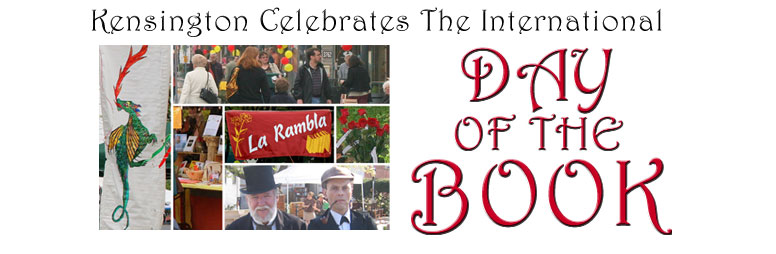
‘Getting It Wrong’ at Kensington’s ‘Day of the Book’

In 1897, Debunking, Media myths, Year studies on April 25, 2010 at 8:19 am

I participated today in the “Day of the Book” festival in the antique row section of  Kensington, MD.

The event represented first book-event exposure for Getting It Wrong, my forthcoming book that addresses, and debunks, 10 prominent media-driven myths.

Getting It Wrong will be published this summer by University of California Press. Chapter One may be read here.

Also on display at the “Day of the Book” was my year study, The Year That Defined American Journalism: 1897 and the Clash of Paradigms, which was published in 2006. The book tells the story of a decisive year in American journalism.

Book signing in Kensington (AMR photo)

Principal organizer of the “Day of the Book” was Kensington Row Bookshop and at least 80 authors and poets had registered for the event.

The threat of rain kept some of them away. But nasty weather was a no-show and a fine time was had.

I enjoyed meeting several other local authors, including Bernadette LeDoux-Brodsky,  a Parisienne who used to teach French at Georgetown University; Bob Gregg, a retired dean and professor at American University, and Ben Farmer, a young author who graduated a few years ago from Kenyon College.

Bernadette said the ambiance in Kensington evoked for her the cafe scene of streets in Paris–sans les apéritifs, of course. She sold copies of her Ici et Ailleurs: Parisienne dans le Maryland. Bob sold several of his novels, among them The Scarecrow in the Vineyard. And the gregarious Ben Farmer seemed to make a lot of friends as well several sales of his new novel, Evangeline.

For me, the event was mostly a chance to gauge interest in Getting It Wrong. And more men than women stopped by to chat about the book and/or take a flyer.

There also was some mild interest in The Year That Defined American Journalism (see book-signing photo, above).

The dog in the picture? That’s Lil, our bichon frise. She was at the book fair, too, and proved to be quite the magnet.

WJC

Halberstam the ‘unimpeachable’? Try myth-promoter

In Bay of Pigs, Cronkite Moment, Debunking, Furnish the war, Media myths, New York Times, Spanish-American War on April 24, 2010 at 9:02 am

A book review in the New York Times the other day referred to David Halberstam, the legendary author and journalist, as an “unimpeachable” source.

Halberstam, who died in an automobile accident three years ago, certainly built an outsize reputation. But unimpeachable?

I’d say no way.

Halberstam, in his hefty and still-popular 1979 study of the news media, The Powers That Be, encouraged the rise of two prominent media-driven myths and endorsed a third.

As I note in Getting It Wrong, my forthcoming book about media-driven myths, Halberstam’s Powers That Be was an important source, perhaps the original source, for the so-called “Cronkite Moment” of February 27, 1968.

That was when CBS anchorman Walter Cronkite asserted in a special report that the U.S. war effort in Vietnam was “mired in stalemate.”

In Halberstam’s telling, Cronkite’s report represented “the first time in American history a war had been declared over by an anchorman.”

Halberstam wrote that President Lyndon Johnson was in Washington and watched the Cronkite special that night. Upon hearing Cronkite’s dire assessment about Vietnam, the president said that if he had lost Cronkite, he had lost Mr. Average Citizen.

Interestingly, Halberstam did not place Johnson’s purported lament inside quotation marks. He paraphrased the remarks and said Johnson had directed  them to presidential press secretary George Christian.

But as I write in Getting It Wrong, Johnson was not in Washington that night. He did not see the Cronkite program when it aired. Thus, he could not have had the abrupt, dramatic, yet resigned reaction that Halberstam, and others, have attributed to him.

Johnson that night was in Austin, Texas, at the 51st birthday party of a political ally, Governor John Connally.

About the time Johnson supposedly made the comment about losing Cronkite, he was offering light-hearted banter about Connally’s age, saying:

“That is the magic number that every man of politics prays for—a simple majority. Throughout the years we have worked long and hard—and I might say late—trying to maintain it, too.”

The “Cronkite Moment,” I write in Getting It Wrong, “is a media-driven myth. It did not have the effects that Halberstam and many others have attributed to it.”

Halberstam’s Powers That Be also offered a graphic, if exaggerated, account that President John Kennedy supposedly called James Reston of the New York Times in April 1961 and urged him not to publish a report about the pending Bay of Pigs invasion.

Kennedy “argued strongly and passionately,” Halberstam wrote, that the Times by reporting the story would damage his policy. Halberstam also wrote that in his call to Reston, Kennedy said the Times risked having blood on its hands were the article published and the invasion failed.

Such a conversation never happened, according to Reston and others quoted in Harrison Salisbury’s insider’s account of the Times, Without Fear or Favor.

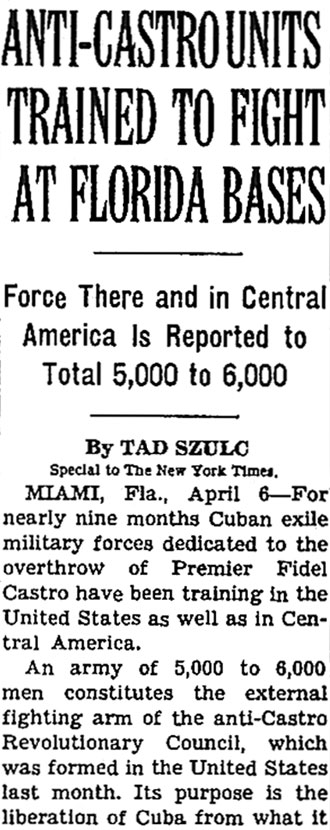
Indeed, there is no evidence that Kennedy called anyone at the Times in advance of the report–which was written by Tad Szulc and published April 7, 1961, on the Times front page (see right).

As I note in Getting It Wrong:

“The Kennedy Library in Boston says that the White House telephone logs reveal no calls were placed to Reston” or other Times executives on April 6, 1961, the day the story was prepared for publication.

“Moreover,” I note, “Kennedy had almost no chance to speak with those executives during the interval from when Szulc’s story arrived at the Times building in midtown Manhattan and when it was set in type. … During that time, Kennedy was otherwise preoccupied. He spent the last half of the afternoon of April 6, 1961, playing host to Harold Macmillan, the British prime minister, on a lengthy cruise down the Potomac River to Mount Vernon.”

In addition, Halberstam’s Powers That Be invoked one of the most enduring media myths–the anecdote about William Randolph Hearst’s purported vow to “furnish the war” with Spain at the end of the 19th century.

That anecdote is revisited, and dismantled, in the first chapter of Getting It Wrong.

The Powers That Be was a popular success, reaching the second spot on the New York Times best-selling list in May 1979. But the book wasn’t without persuasive critics.

Among them was David Culbert, an historian at Louisiana State University who years ago raised questions about the “Cronkite Moment,” noting that Johnson was in Texas when the program aired.

In a devastating review published in the American Historical Review, Culbert called The Powers That Be overlong and declared:

“The absence of a developed thesis, lack of proper documentation, and numerous errors of fact for events before the 1960s suggest that historians will have to use this book with caution. There is much here that might be true and, if true, valuable, but there is also no certainty that sloppy research does not undermine the very parts that seem most interesting.”

WJC

Read Chapter One: ‘Furnish the war’

In Debunking, Furnish the war, Media myths, Spanish-American War on April 23, 2010 at 10:07 am

The opening chapter of Getting It Wrong, my forthcoming work debunking 10 prominent media-driven myths, is available at the Web site for the book sponsored by the publisher, University of California Press.

Chapter One is titled “‘I’ll furnish the war'” and examines one of the hardiest myths in American journalism–William Randolph Hearst’s purported vow to “furnish the war” with Spain, at the end of the 19th century.

As I write in Chapter One:

“Like many media-driven myths, it is succinct, savory, and easily remembered. It is almost too good not to be true. Not surprisingly, Hearst’s vow to ‘furnish the war’ has made its way into countless textbooks of journalism. It has figured in innumerable discussions about Hearst and about the news media and war. It has been repeated over the years by no small number of journalists, scholars, and critics of the news media such as Ben Bagdikian, Helen Thomas, Nicholas Lemann, and the late David Halberstam.”

I further write:

“Interestingly, the anecdote lives on despite a nearly complete absence of supporting documentation. … It lives on even though Hearst denied ever sending such a message.”

The sole original source for the now-famous anecdote was a slim memoir, On the Great Highway, written by James Creelman and published in 1901.

I note in Getting It Wrong that Creelman’s taste for hyperbole represents one of many solid reasons for doubting “that Hearst ever vowed ‘to furnish the war.’ Creelman’s record of exaggeration offers compelling reason to challenge the anecdote’s authenticity.”

I refer to the anecdote “Creelman’s singular contribution to American journalism” and note how it “feeds popular mistrust of the news media and promotes the improbable notion the media are powerful and dangerous forces, so powerful they can even bring on a war.”

Getting It Wrong will be out this summer. It is set in a Sabon typeface, which is quite handsome.

WJC

‘Revealing the scandal of Watergate’

In Debunking, Media myths, Washington Post, Watergate myth on April 22, 2010 at 3:58 pm

I blogged the other day about the polyglot nature of enduring media-driven myths, notably the heroic-journalist myth of Watergate, which holds that two Washington Post reporters exposed the Watergate scandal and brought down the corrupt presidency of Richard Nixon.

“It’s a sure sign of tenacity and hardiness when media-driven myths cross linguistic barriers to become embedded in other languages,” I wrote.

Confirmation of that observation is offered today in a post at the French-language Swiss online site, Les Quotidiennes, which declared:

“In the ’70s, Carl Bernstein and Bob Woodward, two journalists for the Washington Post, inspired entire generations by revealing the Watergate scandal which led to the resignation of President Nixon.”

Bernstein and Woodward’s Watergate reporting won the Public Service Pulitzer Prize for the Post in 1973. They did fine work.

But it can’t really be said that they “revealed” or disclosed the Watergate scandal. Credit for that accomplishment goes largely to federal investigative agencies, bipartisan congressional panels, federal prosecutors and judges, and the U.S. Supreme Court.

Edward Jay Epstein persuasively argued this point in his  fine essay in 1976 about Watergate and the news media. He wrote that “the FBI, the federal prosecutors, the [federal] grand jury, and the Congressional committees … unearthed and developed all the actual evidence and disclosures of Watergate.”

Epstein noted that Bernstein and Woodward, in All the President’s Men, their book about their Watergate reporting, “systematically ignored or minimized” the work of those agencies and institutions.

“Instead,” Epstein wrote, “they simply focus[ed] on those parts of the prosecutors’ case, the grand-jury investigation, and the FBI reports that were leaked to them.”

I address the heroic-journalist myth of Watergate in my forthcoming book, Getting It Wrong, noting that it is “the most familiar storyline of Watergate: ready short-hand for understanding Watergate and its denouement, a proxy for grasping the scandal’s essence while avoiding its forbidding complexity.

“How the Post and its reporters uncovered Watergate is deeply ingrained in American journalism as one of the field’s most important and self-reverential stories.”

I add:

“But to explain Watergate through the lens of the heroic-journalist is to abridge and misunderstand the scandal and to indulge in a particularly beguiling media-driven myth. The heroic-journalist interpretation minimizes the far more decisive forces that unraveled the scandal and forced Nixon from office,” such as the subpoena-wielding federal authorities.

I further note in Getting It Wrong that the media scholar Jay Rosen has referred to the heroic-journalist construct as “the redemptive tale believers learn to tell about the press and what it can do for the American people. It is a story of national salvation: truth their only weapons, journalists save the day.”

It’s an endlessly appealing meme: easy to grasp, and not difficult to translate.

WJC

Jay Rosen, a media scholar, has called the heroic-journalist construct “the redemptive tale believers learn to tell about the press and what it can do for the American people. It is a story of national salvation: truth their only weapons, journalists save the day.”[i]


[i] Jay Rosen, “Deep Throat, J-School and Newsroom Religion,” PressThink Web log (5 June 2005), posted at: http://journalism.nyu.edu/pubzone/weblogs/pressthink/2005/06/05/wtrg_js.html. Rosen also wrote: “When the press took over the legend of Watergate, the main characters were no longer the bad guys like Richard Nixon [and his corrupt aides] John Mitchell, Bob Haldeman, John Erlichman, or Chuck Colson, all of whom broke the law and abused state power. The narrative got turned around. Watergate became a story about heroism at the Washington Post. The protagonists were Woodward and Bernstein ….”