The newspaper that brought us the bogus story about the battlefield heroics of Jessica Lynch during the Iraq War has goofed again in recounting details about the case.
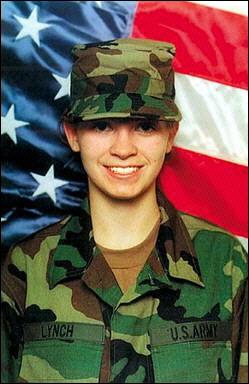
Lynch: Never fired a shot
The Washington Post — which erroneously claimed in early April 2003 that Lynch had fought fiercely despite being shot and stabbed in the ambush of her unit — mistakenly described in a blog post yesterday the circumstances of Lynch’s subsequent rescue from captivity.
Lynch was a supply clerk in the 507th Maintenance Company, which was attacked in Nasiriyah on March 23, 2003. Lynch, who never fired a shot in the ambush, was severely injured in the crash of a Humvee as she and four colleagues tried to escape. She was neither shot nor stabbed.
Two days later, the Post published its bogus, front-page report about Lynch’s purported derring-do on the battlefield, a story that cited otherwise anonymous “U.S. officials” and appeared beneath the headline:
Yesterday, the Post’s “Checkpoint” Web log erred in asserting that Lynch was one of several U.S. soldiers “held in captivity for 22 days before being rescued by Marines.” Lynch was not among those prisoners and her rescuers were special operations forces.
The “Checkpoint” post focused on about a talk given at a conference in San Antonio by Shoshana Johnson, who was shot in the ankles in the Nasiriyah ambush and also taken prisoner. Her rescue from captivity came more than a week after the operation that freed Lynch.
Conflating the cases of Lynch and Johnson obviously is not an error as significant as the Post’s report of April 3, 2003, which said Lynch “continued firing at the Iraqis even after she sustained multiple gunshot wounds and watched several other soldiers in her unit die around her in fighting” at Nasiriyah.
Still, the erroneous “Checkpoint” report is sloppy, and signals continued inattention to detail about the Lynch case.
One might think, given the embarrassment of the botched “fighting to the death” story, that Post reporters would be especially mindful about the details of the Lynch case.
And yet, the “Checkpoint” writeup wasn’t the first time in recent years that the newspaper has erred in referring to Lynch.
The Post invoked the Lynch case in 2010, in a movie review that disingenuously blamed the Pentagon for the bogus tale about Lynch’s heroics. Nearly seven weeks later, the newspaper published a belated and awkwardly worded correction about the review’s erroneous passage.
It is worth noting that the Post has never fully accounted for its botched hero-warrior story in 2003. It has never disclosed the identities of the anonymous sources who provided the salient details for a story so electrifying that was picked up by news organizations around the world.
The Post’s unwillingness to identify its sources contributed to the tenacity of a toxic narrative that the Pentagon concocted the story and somehow fed it to the Post in a crude attempt to boost U.S. public support for the war.
As I discuss in my media-mythbusting book, Getting It Wrong, Vernon Loeb, who shared a byline on the Post’s hero-warrior story about Lynch, has said unequivocally that the anonymous sources were not Pentagon officials.
The Los Angeles Times, for example, declared that the Post’s Watergate reporting “ultimately brought down a president.”
The online version of the New York Times obituary said Bradlee, who was 93, had “presided over The Washington Post’s Watergate reporting that led to the fall of President Richard M. Nixon.”
The Guardian newspaper in London asserted that Bradlee “oversaw the reporting that brought down a president.”
Britain’s Economist magazine said the Post under Bradlee “toppled President Richard Nixon.”
And so it went.
But as I pointed out in discussing those erroneous characterizations, Bradlee, himself, had rejected the notion that the Post’sWatergate reporting brought down Nixon’s corrupt presidency. He said in 1997 that “it must be remembered that Nixon got Nixon. The Post didn’t get Nixon.” (Bradlee was referring to the White House tapes which Nixon secretly made and which revealed the president’s guilty role in covering up the crimes of Watergate, forcing him to quit in August 1974.)
His comment “that Nixon got Nixon” was in keeping with the tendency of senior figures at the Post to reject the simplistic notion that the newspaper’s reporting — especially that of Bob Woodward and Carl Bernstein — uncovered the crimes that led to Nixon’s downfall.
Indeed, it is revealing to consider what critical disclosures the Post missed in its Watergate reporting.
It failed to disclose the White House cover up of the Watergate crimes.
It likewise failed to reveal the existence of the White House tapes, which clearly revealed Nixon’s active role in seeking to block the FBI’s investigation of the seminal crime of Watergate — the break-in at the headquarters of the Democratic National Committee.
Moreover, the story that Woodward and Bernsteinstill say they are most proud of was in error on crucial details.
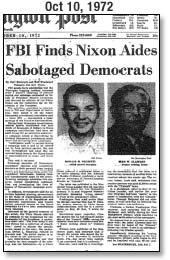
That story was published October 10, 1972, beneath the headline, “FBI Finds Nixon Aides Sabotaged Democrats.” It claimed — wrongly — that the FBI had determined some 50 political saboteurs had traveled the country, disrupting Democratic candidates who were seeking to run against Nixon. Internal FBI memoranda dismissed key elements of the Post’s story as conjecture or “absolutely false.”
As I noted in my media-mythbusting book Getting It Wrong, the contributions of Woodward and Bernstein to Watergate’s outcome at best “were modest, and certainly not decisive.”
Far more important in bringing about Nixon’s resignation were the collective efforts of special prosecutors, federal judges, both houses of Congress, the Supreme Court, as well as the Justice Department and the FBI.
The Post report cited otherwise unidentified “U.S. officials” and said that Lynch, a 19-year-old Army private, had fought fiercely in the ambush of the 507th Maintenance Company in Nasiriyah in southern Iraq on March 23, 2003.
Lynch in fact had not fired a shot. Nor was she shot and stabbed, as the Post had reported. She suffered severe injuries in the crash of a Humvee as it fled the attack. She was taken prisoner and hospitalized by the Iraqis but rescued by U.S. special forces on April 1, 2003.
Vernon Loeb, one of the Post reporters who wrote the hero-warrior story about Lynch — which was wrong in its most crucial details — made clear that the Pentagon had not been the newspaper’s source.
As I noted in Getting It Wrong, Loeb went on NPR’s Fresh Air program in December 2003 and flatly declared:
“Our sources for that story were not Pentagon sources.”
Loeb, who then covered the Pentagon for the Post and who now is managing editor at the Houston Chronicle, also told NPR that he “could never get anybody from the Pentagon to talk about” the Lynch case.
He also said: “I just didn’t see the Pentagon trying to create a hero where there was none.”
But none of that vital context was mentioned by Maddow in her commentary on June 3.
“If the heroics that the Pentagon made up about her didn’t really happen, and they didn’t, maybe the U.S. special forces who rescued her, maybe they shouldn’t have bothered,” Maddow said about Lynch. (Maddow’s commentary came amid the controversy stirred by the release of Bowe Bergdahl, an Army sergeant who apparently had walked away from his post in Afghanistan and was held captive by the Taliban for five years. The administration of President Barack Obama released five senior Taliban figures to gain Bergdahl’s freedom.)
When Maddow was called out for her erroneous claim about the Pentagon, she dodged a correction by cherry-picking — by referring to an obscure report in the Military Times on April 3, 2003, in which a U.S. military spokesman, Frank Thorp, was quoted as saying that Lynch “waged quite a battle prior to her capture.
“We do have very strong indications that Jessica Lynch was not captured very easily,” Thorp was quoted as saying.
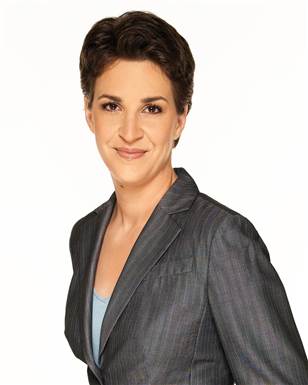
Maddow (NBC News)
Crowed Maddow: “That information straight from a military public affairs official was not true. It was made up. But it landed in press reports anyway.”
What Maddow neglected to mention was that Thorp was recapping for the Military Times what the Washington Post had already placed in the public domain.
Thorp, then a Navy captain, was assigned to U.S. Central Command headquarters in Doha, Qatar. He was following, not fabricating: He was, unwisely, restating elements of the Post’s sensational story about Lynch’s purported heroics, which Loeb and co-author Susan Schmidt had prepared in Washington.
I noted in discussing Maddow’s cherry-picking that it is impossible to address the hero-warrior tale about Lynch without considering the Post’s central role in publicizing the bogus narrative, which was picked up by news organizations around the world.
But Maddow ignored the agenda-setting character of the Post’s reporting about Lynch: It didn’t fit her narrative.
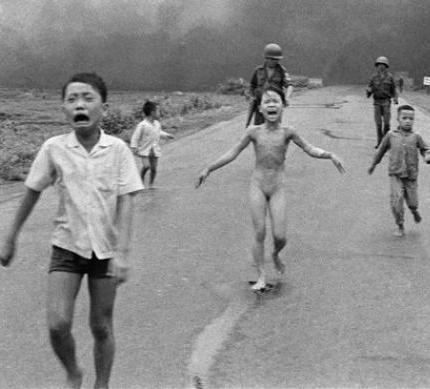
The photograph showed Vietnamese children terror-stricken by a misdirected napalm attack on their village by the South Vietnamese Air Force. At the center of image was a 9-year-old girl named Kim Phuc, shown screaming and naked as she fled.
The photograph, taken by Nick Ut of the Associated Press and formally titled “The Terror of War,” won a Pulitzer Prize in 1973.
In the years since, it also has become an artifact of exaggeration, as is evident in a tendency to ascribe powerful effects to the photograph, effects that it never had.
‘Napalm girl,’ 1972 (Nick Ut/AP)
In May, for example, the Guardian newspaper in London exaggerated the effects of the “napalm girl” image, asserting in an exhibit review that it had “galvani[z]ed” American “public opinion and expedited the end of the Vietnam war.”
In fact, “napalm girl” did neither.
U.S. public opinion had turned against the war in Vietnam well before June 1972. For example, nearly 60 percent of respondents to a Gallup poll conducted early in 1971 had said that the United States had made a mistake by sending troops to fight in Vietnam. (Gallup periodically has asked the question since 1965, when just 24 percent of respondents said it was a mistake to have sent troops to Vietnam. By August 1968, a majority of respondents said it had been a mistake.)
So Ut’s photo hardly can be said to have galvanized opinion against the war: Nor can it be said that the photo “expedited” the war’s end.
By June 1972, the war was essentially over for American forces in Vietnam. President Richard Nixon had announced in November 1971 that U.S. ground operations had ended in South Vietnam and by June 1972, nearly all U.S. combat units had been removed from the country.
No single photograph turned public opinion against the war in Vietnam; no single image “expedited” its end. The war’s confusing aims and uncertain policy objectives, its duration, and its toll in dead and wounded all were far more decisive to its outcome.
Had that been the case, had Nixon run for president saying he had “secret plan,” the country’s leading newspapers surely would have called attention to such a claim.
But they didn’t, as a search of a full-text database of leading U.S. newspapers makes clear. (The newspapers included the New York Times, Washington Post, Los Angeles Times, Baltimore Sun, Wall Street Journal, and Chicago Tribune.) Searching for “Nixon” and “secret plan” returned no articles from January 1967 to January 1969 that quoted Nixon as touting or promising or describing a “secret plan” for Vietnam.
Still, the old chestnut still circulates, usually invoked as supposed evidence of Nixon’s guile, shiftiness, and venality.
Secret plan? Who me?
In September, for example, a columnist for the Washington Examiner summoned the myth in seeking historical context to discuss President Barack Obama’s air war against Islamic militants in Iraq and Syria.
“Obama wasn’t the first president to promise peace and deliver war,” the columnist, Timothy P. Carney, wrote. “Woodrow Wilson ran for reelection on keeping America out of the Great War. Nixon promised a secret plan to exit Vietnam quickly.”
As I noted at the time, “Missing from Carney’s discussion were details about when Nixon made such a promise, and what the ‘secret plan’ entailed. Those elements are missing because Nixon never promised a ‘secret plan’ on Vietnam.”
The derivation of the hoary myth can be traced to the presidential primary election campaign of 1968 and a speech in New Hampshire. There, in early March 1968, Nixon pledged that “new leadership” in Washington — a Nixon administration, in other words — would “end the war” in Vietnam.
In reporting on the speech, the wire service United Press International said Nixon “did not spell out how” he would “end the war.” Nixon may have been vague in those remarks about Vietnam. But he made no claim about a “secret plan.”
And he was asked about having a secret plan, according to an article published March 28, 1968, in the Los Angeles Times. Nixon replied that he had “no gimmicks or secret plans” for Vietnam.
He also said then: “If I had any way to end the war, I would pass it on to President [Lyndon] Johnson.” Nixon’s comments were made just a few days before Johnson announced he would not seek reelection.
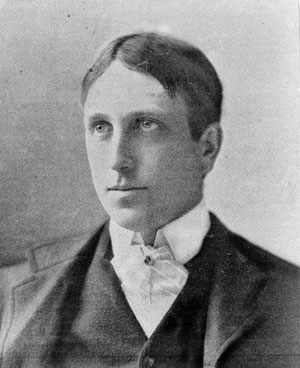
The claim is absurd, embraced by few if any serious historians of the era — and by no recent biographer of Hearst.
Nonetheless, the myth was offered up as fact in a commentary in Politico Magazine in June.
The commentary pointedly criticized the scholar Robert Kagan for having “sounded his favorite, and the neocons’, favorite theme” in a 2006 book, Dangerous Nation.
“He depicted America as uniquely virtuous, pursuing idealistic aims, while presenting all other great powers as fighting for venal and self-interested motives. So assiduous was Kagan in his fanciful interpretation of American actions,” the Politico commentary said, “that even the Spanish-American War, seen by most historians as the product of William Randolph Hearst’s yellow press and the U.S. desire to expand its influence on behalf of economic imperialism, becomes something else entirely — a bright and shining crusade for freedom….”
But in characterizing the war as “the product” of Hearst’s yellow press, Politico erred.
As I wrote in my 2001 book, Yellow Journalism: Puncturing the Myths, Defining the Legacies, the newspapers of Hearst and his rival, Joseph Pulitzer, “did not force — it could not have forced— the United States into hostilities with Spain over Cuba in 1898. The conflict was, rather, the result of a convergence of forces far beyond the control or direct influence of even the most aggressive of the yellow newspapers, William Randolph Hearst’s New York Journal.”
Claims that the yellow press brought on the war, I noted, “are exceedingly media-centric, often rest on the selective use of evidence, and tend to ignore more relevant and immediate factors that give rise to armed conflict.”
In 1898, those factors centered around a diplomatic impasse between the United States and Spain over Spanish rule of Cuba, which since early 1895 had been the scene of an islandwide rebellion.
In a failed attempt to put down the uprising, Spanish authorities sent as many as 200,000 troops to the island and imposed a policy called “reconcentration,” which forcibly removed thousands of Cubans — mostly old men, women, and children — into garrison towns where they could neither support nor offer supplies to the Cuban rebels.
Spain’s “reconcentration” policy gave rise to malnutrition and disease: Unknown tens of thousands of Cuban non-combatants died from illness and starvation.
The humanitarian nightmare in Cuba “inevitably stirred outrage and condemnation in the United States,” I wrote in Yellow Journalism. The desperate conditions were in 1897 and early 1898 a frequent topic of reporting in the American press, including but by no means limited to the newspapers of Hearst and Pulitzer.
The yellow press reported on — but certainly did not create — the terrible effects of Spain’s “reconcentration” policy.
In the end, the humanitarian crisis on Cuba, and Spain’s inability to resolve the crisis, weighed decisively in the U.S. decision to go to war in 1898. It was not the content of the yellow press — and not “economic imperialism,” as Politico put it — that pushed America into conflict with Spain.
One-hundred years ago, a reporter for the old New York Sun caught up with Virginia O’Hanlon who, as an 8-year-old in 1897, had written the letter to the newspaper that inspired American journalism’s most memorable editorial, a paen to childhood and the Christmas spirit titled “Is There A Santa Claus?”
The editorial’s most famous lines sought to reassure young Virginia, saying:
“Yes, Virginia, there is a Santa Claus. He exists as certainly as love and generosity and devotion exist, and you know that they abound and give to your life its highest beauty and joy. Alas! how dreary would be the world if there were no Santa Claus! It would be as dreary as if there were no Virginias.”
Virginia and daughter (From New York Sun, December 25, 1914)
Seventeen years later, on Christmas Eve 1914, Virginia O’Hanlon spoke about the editorial and recalled it fondly.
“I think that I have never been so happy in my life as when the Sun told me that there was a Santa Claus and that he would live forever,” she told the newspaper’s reporter. “I was eight years old then, just at the age when doubts creep in and when most children get their first touch of cynicism.”
She also recalled having told her father in 1897: “‘I am going to write to the Sun and ask it to tell me the truth, the honest to goodness truth, about Santa Claus. If the Sun says there isn’t any I’ll believe it; if it tells me Santa Claus is real I’ll make those girls at school sorry they ever teased me” by telling her Santa did not exist.
The interview was conducted at the home of Virginia’s parents at 121 West 95th Street in New York City, a few doors from where she had written to the Sun in 1897, saying: “Some of my little friends say there is no Santa Claus. Papa says, ‘If you see it in The Sun, it’s so.’ Please tell me the truth, is there a Santa Claus?”
At the time of the interview, Virginia was a married woman, 25-years-old. She was wed at her parents’ home in June 1913 to a jeweler named Edwin Malcolm Douglas. They were the parents of Laura Virginia Douglas, who on Christmas Eve was 9-months-old.
The marriage to Douglas was not to last; he eventually left her. And the Sun’s writeup of the interview 100 years ago hinted at strains in the union.
Virginia’s husband was absent that Christmas Eve. His business, the Sun said “takes him away from New York frequently and keeps him away from the city for long periods and the [Douglas] home in Orange, N.J., would be too lonesome for the wife and child.” So Virginia and the baby decamped to her parents’ place.
Douglas “will be home to-night or early in the morning” Christmas Day, Virginia told the Sun’s reporter, “and we will have a lovely Christmas.”
She spoke at some length during the interview about the Sun’s editorial, which was written by Francis P. Church and published September 21, 1897. The newspaper’s reply surprised and elated her, and her parents, Virginia said.
“It used to make me as proud as a peacock,” she said, “to go along in the street in the neighborhood and hear somebody say, ‘Oh, look. There’s Virginia O’Hanlon. Did you see that editorial the New York Sun had about her?’ And father and mother were even prouder than I, I think. They still show the editorial to callers and just talk people’s arms off about it.”
The day the editorial appeared, her father, Dr. Philip F. O’Hanlon, “hustled out and came back loaded down with [copies of the newspaper] until he looked like a pack mule,” Virginia said. “He scattered them all over town, I think, he was so proud.”
The editorial “was a wonderful thing in my life,” she said “and I mean it to be a wonderful thing in my baby’s. As soon as she masters her ABC’s it will be the first thing she will read. I’ll help her over the big words and hard spots, but I want her to get the beautiful spirit of it as quickly as she can.”
The writeup of the interview, published in the Sun on Christmas Day 1914, noted that the newspaper had “never quite lost sight of Virginia. … [I]t is impossible to forget the sort of little girl who wrote so sincerely and trustfully as Virginia did. The Sun knew when she left school, knew when she was married, knew when Laura Virginia opened her blue eyes, and remembered yesterday that Laura Virginia was on the eve of her first Christmas.”
In what likely was an unprecedented public gathering, programs yesterday at the Newseum in Washington, D.C., brought together several descendants of Virginia O’Hanlon, who as an 8-year-old in 1897 wrote a letter to the old New York Sun that inspired American journalism’s best-known and most-reprinted editorial.
The remarkable reunion included Virginia’s only grandson, two granddaughters, two great-grandsons, and a great-great granddaughter, who is 8-years-old. Her name is Mehren O’Hanlon Blair, and she recited Virginia’s letter at the central, holiday-themed event of what the Newseum called “Yes, Virginia, Family Day.”
Mehren was followed by one of the great-grandsons, Nick Hromalik, who read the famous editorial, which appeared in the Sun as a reply to Virginia’s letter that implored: “Please tell me the truth; is there a Santa Claus?”
Both the letter and editorial were published on September 21, 1897, beneath the headline, “Is There A Santa Claus?” The editorial’s most familiar and most-quoted passage is: “Yes, Virginia, there is a Santa Claus.”
At a panel program that preceded the readings, Hromalik and Jim Temple, who is Virginia’s grandson, spoke about the editorial’s significance and described how it has left lasting impressions on their families. (I moderated the panel discussion; in the audience were two of Temple’s sisters — granddaughters of Virginia O’Hanlon — as well as another great-grandson.)
Temple recalled how Virginia gladly accepted invitations to speak about the editorial, and would take no money to do so. He said he has followed that practice, as have other descendants of Virginia, who died in upstate New York in 1971 at 81-years-old.
Temple also said he remembered his grandmother was a gifted and imaginative storyteller. She also was an accomplished woman, earning advanced degrees and working more than 40 years as a teacher or principal in the New York school system. Virginia also was essentially a single mother; her husband left her when her only child — Temple’s mother — was just an infant.
Virginia’s letter to the Sun and the newspaper’s reply — written by Francis P. Church, who died in 1906 — have exerted an appeal across generations that is as astounding as it is undying. In my book about 1897, The Year That Defined American Journalism, I characterized the editorial as “a lyrical and timeless tribute to childhood and the Christmas spirit.”
It is, moreover, a cheering and reaffirming commentary, one without villains or sinister elements. The editorial also is a searching intellectual discussion that nonetheless is largely understandable to 8-year-olds, as Temple pointed out. (It also has been a way for generations of parents to address skepticism of their children about Santa Claus: They can point to the editorial and its timeless answer to an inevitable question – and not really have to fib about Santa’s existence.)
Temple politely took issue with television depictions of the story of Virginia’s letter to the Sun. He said the representations were not entirely accurate.
He may have been too polite.
Nick Hromalik, left, and Jim Temple (Photo credit: Bruce Guthrie )
The most recent such depiction, an animated TV program released in 2009 and shown on CBS during every holiday season since then, succeeds in distorting all major elements of the back story of the editorial. Notably, Virginia is depicted as a waddling, round-headed girl obsessed about the existence of Santa Claus. It portrays Church as scowling, loud, and unrelievedly disagreeable.
Neither portrayal, as I have pointed out, is very convincing. Neither is very accurate.
The following is an expansion of remarks I offered yesterday, at a memorial service in Delaware, Ohio, for Verne E. Edwards, my undergraduate journalism professor and mentor who died this month at 90-years-old. I dedicated my media mythbusting book, Getting It Wrong, to Edwards, who for 33 years taught journalism at Ohio Wesleyan University.
Verne Edwards, mid-1970s
How was it that Verne Edwards commanded such respect, such reverence, across generations of students?
He was a professor known for rigorous expectations — and sometimes-stern appraisals. I remember writing a headline for the student newspaper, the Transcript, that referred to Mount Union College (now University of Mount Union) as “Mount Vernon.”
In his weekly markup of the Transcript, Verne circled the errant headline in red pencil and identified it as the worst he had ever seen.
Verne was exacting, and could be quirky; he sometimes addressed his classes in a sidelong manner, not making much eye contact. But he was tough, and honest, and fair. And his students tended to feel terrible when they believed they had let him down. As in mistaking Mount Union for Mount Vernon.
The question of Verne Edwards’ appeal across generations has personal dimension and relevance: I have taught at American University for 17 years and know few faculty who command the kind of respect, indeed the reverence, that Verne so clearly won from generations of students. I have puzzled about the qualities and attributes that gained for Verne Edwards such esteem.
It is a puzzle; I call it the Verne Edwards Mystique, and I cannot claim to have fathomed all its sources.
The Verne Edwards Mystique surely sprang, in measure, from the authority borne of high standards and relevant experience. Verne was a print journalist. At one time or another, he wrote editorials or edited copy at such newspapers such as the Detroit Free Press, the Milwaukee Journal, and the Toledo Blade. He wrote the textbook, too — Journalism in a Free Society, which he required in his classes for years.
It was little exaggeration that Ohio Wesleyan’s journalism program was known, to some of us, as “Vernalism.”
The Verne Edwards Mystique was rooted, too, in a deep and abiding interest in students, and a dedication to staying in touch. Verne would keep up on the accomplishments of his former students, and would welcome them back to campus.
Year after year, for many years, Verne prepared an annual alumni newsletter that he filled with details and updates about his students from across the generations. His newsletter was a highlight of the end-of-year holidays. And it created bonds among his former students, even for those who had never met one another.
What may best explain the Verne Edwards Mystique, though, is modesty, a decided modesty.
Verne was no self-promoter. He could have been, surely, given the awards and the recognition he received during his career. But his ego was kept under wraps and under control; his was a modesty that’s rather rare in the academy.
Students sensed that, too. Verne, they knew, was the real deal. And he didn’t flaunt it.
The death of Ben Bradlee, the celebrated former executive editor of the Washington Post, touched off a wave of tributes that erroneously cited the newspaper’s central role in the Watergate scandal, which culminated 40 years ago with the resignation of President Richard Nixon.
Bradlee, himself, had rejected the simplistic and mythical notion that the Post’sWatergate reporting brought down Nixon’s corrupt presidency, saying in 1997 that “it must be remembered that Nixon got Nixon. The Post didn’t get Nixon.” He was referring to the White House tapes which Nixon secretly made and which revealed the president’s guilty role in covering up the crimes of Watergate, forcing him to quit in August 1974.
But as news spread yesterday that Bradlee had died at age 93, adulatory tributes poured in, many of them blithely invoking the media myth of Watergate.
USA Today, for example, said Bradlee “led” the Post’s “Watergate coverage that brought down the Nixon administration.”
The Los Angeles Timesdeclared that the Post’s Watergate reporting “ultimately brought down a president.”
The online version of the New York Times obituary about Bradlee stated that he “presided over The Washington Post’s Watergate reporting that led to the fall of President Richard M. Nixon.” (The print edition of the Times is less sweeping if not more accurate, saying Bradlee “presided over The Washington Post’s exposure of the Watergate scandal that led to the fall of President Richard M. Nixon.”)
The Guardian newspaper in London asserted that Bradlee “oversaw the reporting that brought down a president.”
Similarly, the German news service Deutsche Wellesaid “Bradlee oversaw the journalistic investigation that brought down US president Richard Nixon.” (The new service also claimed the Post’s reporting “led to the impeachment and resignation of Nixon”: Not only was the Post’s reporting a marginal factor in Nixon’s resignation, which he submitted before he could be impeached.)
And so it went.
Even the Post, which over the years had largely refrained from embracing the Watergate myth, went all in, saying on its front page today that Watergate was “a political scandal touched off by the Post’s reporting.”
The scandal, in fact, was touched off by a burglary in June 1972 at Democratic National Committee headquarters, and investigative authorities quickly tied the crime to Nixon’s reelection committee and to White House operatives. Watergate hardly was “touched off by the Post’s reporting”; nor did the Post contribute significantly to the scandal’s unraveling.
Indeed, as I pointed out in my 2010 media-mythbusting book, Getting It Wrong, the Post’s reporting failed to disclose the White House cover up of the Watergate crimes. It also failed to reveal the existence of Nixon’s White House tapes, which were crucial to the scandal’s outcome.
Their existence was disclosed in July 1973, during hearings of the Senate Select Committee on Watergate.
In their book All the President’s Men, the Post’s lead Watergate reporters, Bob Woodward and Carl Bernstein, said they received a tip about the secret White House taping system a few days before its existence was made public.
But according to the book, Bradlee suggested they not expend much energy pursuing the tip. They didn’t, and thus missed reporting a decisive breakthrough in Watergate.
The Post went hagiographic in its editorial page tribute to Bradlee, describing him as “the architect and builder of the modern Washington Post. His conviction that even the most powerful should be held to a standard of truth-telling inspired journalists well beyond The Post. His exuberance at work and in life served as a model well beyond journalism.”
The editorial continued, saying, “There was nothing like working for him …. His newsroom crackled with the energy of a modern startup. A certain ‘creative tension’ was the reality, a competition among reporters and editors to win his approval. Mr. Bradlee loved the chase and the thrill of discovery.”
And so on.
Surely it is not churlish to point out that the editorial failed to mention Bradlee’s greatest failure as editor — the fraud of “Jimmy’s World,” a fabricated story about an 8-year-old heroin addict that the Post published in 1980. The article was so compelling that it won the Pulitzer Prize in 1981.
But soon after the award was announced, it was revealed that Janet Cooke, the author of “Jimmy’s World,” had falsified key elements of the biography submitted to the Pulitzer board, claiming among other credentials a degree from Vassar and a command of six languages.
The exposure of those lies forced the Post editors to confront Cooke about “Jimmy’s World,” and she soon confessed to having made it all up.
The extensive back story to “Jimmy’s World” was reported by William Green, then the Post’s ombudsman, in 1981; his writeup is available here and, 33 years on, it still makes absorbing reading.
Conservative commentators sometimes invoke the narrative in bashing the news media as agenda-driven and untrustworthy. Left-wing outlets are known to embrace the meme as an ostensible example of crusading journalism that made a difference.
Both impulses were in evidence this week.
Rush Limbaugh, the conservative talk radio host, referred to Woodward and Bernstein during his show yesterday, saying they exemplified a tendency in American journalism to lust after career-shattering exposés.
“If you take somebody out,” Limbaugh said, according to a transcript of his program, “if you expose a fraud or a cheat — or if you just take out somebody that you don’t like who has a lot of power — if you as a journalist are instrumental in doing that, then you are considered worthy of advancement in that industry, and it’s best exemplified by Watergate. Woodward and Bernstein and getting Nixon, forcing Nixon to resign.”
Earlier in the week and across the spectrum, the New York Times profiled the Post’snew publisher, Frederick J. Ryan Jr., and took the occasion to recall one his predecessors, Katharine Graham. She was, the Timesarticle noted, the publisher during the Watergate period who “famously stood up to the White House and helped bring down a president.”
Left unsaid by the talk show host and by the Times was just how the work of Woodward, Bernstein, and Graham led to Nixon’s ouster in the Watergate scandal, which broke in June 1972 with a burglary at the headquarters of the Democratic National Committee.
Truth is, their work didn’t lead to Nixon’s resignation in August 1974. Or much contribute to his fall.
As Ben Bradlee, the Post’s Watergate-era executive editor, once put it in referring to the secret White House tapes that demonstrated the president’s culpability in attempting to cover up the burglary:
“[I]t must be remembered that Nixon got Nixon. The Post didn’t get Nixon.”
Or as Katharine Graham herself said at the 25th anniversary of the Watergate breakin:
“Sometimes people accuse us of bringing down a president, which of course we didn’t do. The processes that caused [Nixon’s] resignation were constitutional.”
Graham was quite right: Unraveling a scandal of the density and complexity of Watergate required, as I wrote in media mythbusting book, Getting It Wrong, subpoena power and “the collective if not always the coordinated forces of special prosecutors, federal judges, both houses of Congress, the Supreme Court, as well as the Justice Department and the FBI.”
And even then, despite the forces arrayed against him, Nixon probably would have survived Watergate and served out his term as president if not for the White House tapes — the disclosure of which was made not by Woodward and Bernstein but by Alexander Butterfield, a former Nixon aide, during questioning before a Senate select committee investigating the scandal.
The heroic-journalist trope is a simplified version of the scandal that cuts through complexities and intricacies to make Watergate accessible. It offers a narrative that’s appealing, memorable, and easy to grasp.
In reaching for historical context to assess President Barack Obama’s war against Islamic militants in Iraq and Syria, a columnist for the Washington Examiner summoned a hoary media myth — that of Richard Nixon’s putative “secret plan” to end the war in Vietnam.
“Obama wasn’t the first president to promise peace and deliver war,” Timothy P. Carney wrote in his column posted today. “Woodrow Wilson ran for reelection on keeping America out of the Great War. Nixon promised a secret plan to exit Vietnam quickly.”
Missing from Carney’s discussion were details about when Nixon made such a promise, and what the “secret plan” entailed.
Those elements are missing because Nixon never promised a “secret plan” on Vietnam.
Even so, the chestnut still circulates as purported evidence of Nixon’s guile, shiftiness, and venality. It dates to the presidential primary election campaign of 1968 and a speech in New Hampshire. There, in early March 1968, Nixon vowed that “new leadership” in Washington — a Nixon administration, in other words — would “end the war” in Vietnam.
In reporting on the speech, the wire service United Press International pointed out that Nixon “did not spell out how” he would “end the war.” The UPI dispatch also noted that “Nixon’s promise evoked Dwight D. Eisenhower’s pledge in 1952, when Nixon was his running mate, to end the war in Korea.”
Nixon may have been vague in those remarks about Vietnam but he made no claim to possess a “secret plan” to end the war. Nor did he campaign for the presidency saying he had one.
That he did not is clear in a search of a full-text database of leading U.S. newspapers in 1968 — among them the New York Times, Washington Post, Los Angeles Times, Baltimore Sun, Wall Street Journal, and Chicago Tribune. The search terms “Nixon” and “secret plan” returned no articles from January 1967 to January 1969 that Nixon quoted as touting or promising a “secret plan” for Vietnam. (The search period embraced Nixon’s campaign and its immediate aftermath.)
Surely, had Nixon run for president saying he had “secret plan,” the country’s leading newspapers in 1968 would have noted it.
Nixon was asked about having a secret plan, according to an article published March 28, 1968, in the Los Angeles Times. He replied that he had “no gimmicks or secret plans” for Vietnam.
What ‘secret plan’?
He also said on that occasion:
“If I had any way to end the war, I would pass it on to President [Lyndon] Johnson.” (Nixon’s remarks were made just a few days before Johnson announced he would not seek reelection.)
Nixon may or may not have had a “secret plan” in mind in 1968. But if so, he did not discuss it openly. And he certainly did not make it a campaign promise.
Like many other media myths, the “secret plan” anecdote is a dubious bit of popular history that can be too delicious to resist. It is, as William Safire, a former Nixon speechwriter and New York Times columnist, once wrote, a “non-quotation [that] never seems to go away.”
News that Jeff Bezos is ousting the publisher of the Washington Post about a year after he purchased the newspaper prompted recollections of the Post’s better days — recollections both exaggerated and erroneous.
Marginal on Watergate
The recollections centered around the newspaper’s reporting of the Watergate scandal, which culminated 40 years ago last month in the resignation of President Richard M. Nixon.
It was the Post’s onetime archrival, the New York Times, that indulged today in the most excessive overstatement.
In its initial online report about the departure of Katharine Weymouth as publisher, the Times stated that “she was the last major link to the Graham family, which had become a Washington institution and had presided over The Post’s most glorious era — the decades surrounding the Watergate scandal, in which it was instrumental in forcing the resignation of President Richard M. Nixon.”
While Weymouth’s departure, effective October 1, is intriguing — it means that Bezos, the multibillionaire founder and CEO of Amazon.com, is imposing his will on what has become in recent years a thin and faded newspaper — Media Myth Alert is most interested in the mischaracterization of the Post’s role in Watergate.
The newspaper assuredly was not, as the Times claimed, “instrumental in forcing the resignation of President Richard M. Nixon.”
The Post’sinvestigative reporting on Watergate linked Nixon’s reelection committee to the seminal crime of Watergate, the foiled burglary in June 1972 at the headquarters of the Democratic National Committee. The Post also implicated the likes of John Mitchell, the former attorney general who was Nixon’s campaign manager, in the scandal.
Such reports helped the Post win a Pulitzer Prize in 1973. But they were hardly enough to threaten Nixon’s presidency.
Indeed, as I discussed in my media-mythbusting book, Getting It Wrong, the Post’s contributions in reporting on the unfolding scandal in 1972-73 were “modest, and certainly not decisive.”
Unseating Nixon, I further noted in Getting It Wrong, “required the collective if not always the coordinated forces of special prosecutors, federal judges, both houses of Congress, the Supreme Court, as well as the Justice Department and the FBI.”
And even then, Nixon likely would have survived the scandal were it not for the audiotapes he surreptitiously made of many conversations in the Oval Office. Only when compelled by the U.S. Supreme Court did Nixon surrender the tapes that clearly depicted him as taking an active role in plotting the coverup of the Watergate breakin.
Interestingly, it was not reporters for the Post but investigators for a select committee of the U.S. Senate who learned of and forced the disclosure about the existence of the tapes. It was, in other words, a pivotal Watergate story that the Post missed.
The Post lagged on other decisive Watergate stories, notably the existence of the White House coverup of the breakin.
And the story that Bob Woodward and Carl Bernstein, the Post’s lead Watergate reporters, still say they are most proud of was in error on crucial details.
Washington Post, October 10, 1972
That story was published October 10, 1972, beneath the headline, “FBI Finds Nixon Aides Sabotaged Democrats.” It claimed — erroneously — that the FBI had determined some 50 political saboteurs had traveled the country, disrupting Democratic candidates mounting challenges to Nixon. Internal FBI memoranda disputed key elements of the Post’s story as conjecture or “absolutely false.”
So “modest at best” aptly characterizes the Post’s contributions in unraveling Watergate.
The departure of Weymouth, and her replacement by Frederick J. Ryan Jr., once an official in the administration of President Ronald Reagan, was accompanied by another interesting sidebar: That of Bezos’ refusal to discuss the move with a reporter for the Post.
“Bezos kept up a dubious practice of refusing comment to the journalists he pays when it was announced … that he had replaced the Post’s publisher, Katharine Weymouth, with former Politico executive and Reagan administration official Fred Ryan. … Anybody expecting openness and transparency from Bezos, however, would be disappointed, as the Post’s own story made clear.”
The Post’s article said the statement by Bezos announcing the change in publishers “‘did not give reasons for the change or its timing. Bezos declined to comment through a spokesman.”
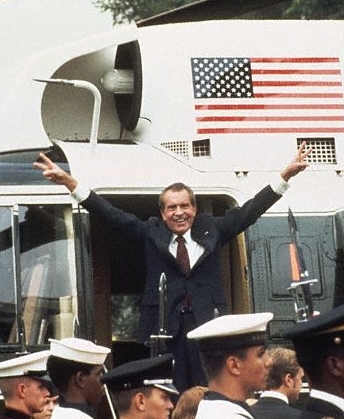
I plan to call attention to prominent media myths of Watergate during a panel discussion in Montreal this afternoon, three days shy of the 40th anniversary of President Richard Nixon’s resignation in America’s gravest political scandal.
The venue is the annual conference of AEJMC, the Association for Education in Journalism and Mass Communication, and other panelists include Max Holland, author of the well-received Watergate book, Leak: Why Mark Felt Became Deep Throat, and my colleague at American University, John C. Watson, author of Journalism Ethics by Court Decree.
I intend to discuss the dominant narrative of Watergate — the mythical notion that the dogged reporting by Bob Woodward and Carl Bernstein of the Washington Post exposed the Watergate crimes of Nixon and forced his resignation.
The trope is endlessly appealing to journalists and has become the most familiar storyline of Watergate. It is, after all, a handy proxy for grasping the essence of Watergate — Nixon resigned because of criminal misconduct — while avoiding the scandal’s mind-numbing complexity.
The many layers of Watergate — the webs of lies, the deceit, and the criminality that characterized the Nixon White House; the multiple lines of investigation that slowly unwound the scandal, and the drama of a constitutional crisis — are not easily understood or readily recalled these days. The scandal that unfolded from 1972 to 1974 has become so distant that few Americans can accurately describe what took place.
As I plan to point out today, the disclosures by Woodward and Bernstein about the unfolding Watergate scandal in 1972 weren’t nearly enough to force the president’s resignation. And the decisive revelations of Watergate — among them the existence of Nixon’s White House taping system — weren’t the work of the Washington Post.
Indeed, as I pointed out in my 2010 media-mythbusting book, Getting It Wrong: To roll up a scandal of the dimensions of Watergate “required the collective if not always the coordinated forces of special prosecutors, federal judges, both houses of Congress, the Supreme Court, as well as the Justice Department and the FBI.”
Even then, Nixon likely would have served out his term in office if not for the Watergate tapes, which clearly showed him approving a cover-up of the seminal crime of Watergate — the break-in of Democratic National Committee headquarters in June 1972.
The heroic-journalist myth — and the celebrity cult of Watergate — were solidified by the film adaptation of All the President‘s Men, Woodward and Bernstein’s book about their Watergate reporting. I note in Getting It Wrong that the cinematic version of All the President’s Men “allows no other interpretation: It was the work Woodward and Bernstein that set in motion far-reaching effects that brought about the first-ever resignation of a U.S. president.”
The movie in fact ignores and even denigrates the work of other agencies and actors in the many-tenacled investigations of Watergate.
But why, some observers might ask, do Watergate, and Woodward and Bernstein, still matter after 40 years? Why does anyone much care?
They care because Woodward and Bernstein are living reminders of the unmasking of America’s greatest political scandal — one that sent to jail nearly 20 men associated with Nixon’s presidency or his 1972 reelection campaign.
Woodward and Bernstein are septuagenarians but they speak eagerly about their salad days, especially on occasions presented by the anniversaries of Watergate. The Post brought them together last week for what turned out to be a surprisingly boring look back at Watergate. That tedious program notwithstanding, their saga remains an appealing parable — that dogged and imaginative reporting can make a difference, can bring about dramatic change.








 Media Myth Alert