W. Joseph Campbell

Posts Tagged ‘Journalism’

Oprah as ‘this generation’s Walter Cronkite’?

In Cronkite Moment, Debunking, Error, Media myths, Television on January 13, 2013 at 3:26 pm

Here’s a good one: Oprah Winfrey is a latter-day Walter Cronkite, a television personality “capable of massively shifting public sentiment.”

LBJ in Austin

Lyndon Johnson in Austin, February 27, 1968

So writes a sports columnist for the Detroit Free Press.

It’s a ridiculous claim, but not for reasons that may immediately come to mind.

Walter Cronkite was the avuncular anchorman on the CBS Evening News from 1962-81. Oprah Winfrey is an iconic talk-show host, whose appeal may or may not be ebbing.

Her clout is formidable. Cronkite’s was overstated.

But to return to the columnist’s claim:

Drew Sharp, writing in the Free Press about Oprah’s upcoming interview with disgraced international cycling star Lance Armstrong, notes that it’ll be an occasion for “staged news.”

Armstrong, he observes, “made the smart move, agreeing to a 90-minute taped interview with Oprah, which will air on her OWN cable network Thursday. It no doubt will be well watched.”

Sharp also declares, in a passage of particular interest to Media Myth Alert, that Oprah “has become this generation’s Walter Cronkite, capable of massively shifting public sentiment.

“It was,” Sharp adds, “the late CBS anchorman’s pointed commentary 45 years [ago,] following the North Vietnamese’s Tet Offensive in which he argued in a rare editorial that the U.S. couldn’t win the Vietnam War. President Lyndon B. Johnson famously said afterward that if he lost Cronkite, he lost Middle America.

“Not long afterward, LBJ opted not to run for reelection in the 1968 presidential campaign.”

In his claims about the effects of Cronkite’s report about Vietnam, the columnist indulges in one of American journalism’s most prominent and tenacious media myths.

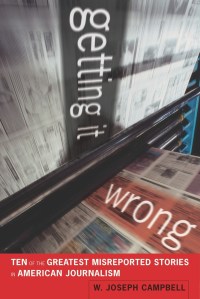
As I discuss in my mythbusting book, Getting It Wrong, there is no evidence that Johnson saw the Cronkite program when it aired on the night of February 27, 1968, or that he viewed it afterward on videotape.

So it’s hard to argue that Johnson could have been much moved by a television report he didn’t see.

The president wasn’t in front of a television set that night. He was in Austin, Texas, at a black-tie party (see photo, above) to mark the 51st birthday of Governor John Connally, a longtime political ally.

About the time Cronkite was offering his pessimistic, on-air assessment about the war in Vietnam — that the U.S. military was “mired in stalemate” — Johnson wasn’t bemoaning a loss of Cronkite’s support; he was saying:

“Today you are 51, John. That is the magic number that every man of politics prays for — a simple majority.”

Johnson did announce, a month later, that he was not running for reelection to the presidency. But his reasons had little, if anything, to do with Cronkite and the anchorman’s comments about Vietnam.

More significant to Johnson’s decision was his eroding political strength. By late March 1968, he was facing insurgent challenges within his own party from senators Eugene McCarthy and Robert F. Kennedy.

Not only that, but Johnson may have decided long before March 1968 not to seek reelection.

“Long before I settled on the proper forum to make my announcement,” Johnson wrote in his memoir, The Vantage Point, “I had told a number of people of my intention not to run again.”

The memoir, by the way, has nothing to say about the Cronkite program of February 1968.

What’s more, there’s no evidence that Cronkite’s “mired in stalemate” comment influenced public opinion “massively” or otherwise.

Indeed, as I point out in Getting It Wrong, polls signaled shifts in public opinion against Vietnam months before Cronkite’s program. The anchorman followed rather than led deepening popular doubts about the wisdom of the war.

And until late in his life, Cronkite pooh-poohed the notion that his assessment of the war had much effect, saying it was akin to “another straw on the back of a crippled camel.”

To liken Oprah to Cronkite is, of course, more than a little incongruous. But it has been done before.

In a commentary published at Huffington Post in 2007 and titled “Oprah is to Iraq what Cronkite was to Vietnam,” Marty Kaplan asserted that “Oprah may actually be the twenty-first century’s de facto national anchor.”

A more frequent if similarly imprecise comparison is to identify Jon Stewart as a latter-day Cronkite.

But both comparisons are strained and feeble: They seek to reapportion to contemporary contexts influence the legendary Cronkite never really possessed. As such, they succeed only in promoting a media-driven myth.

WJC

More from Media Myth Alert:

Media myth distorts Chicago Tribune timeline of newspaper history

In Debunking, Error, Media myths, Newspapers, Washington Post, Watergate myth on November 20, 2012 at 9:24 am

The Chicago Tribune the other day published a timeline of American newspaper history over the past 50 years — a chronology tainted by the inclusion of a prominent media myth.

The Tribune declared “the daily paper remains vital to an informed citizenry” in presenting the timeline, which it said demonstrated “how newspapers expose — and occasionally commit — wrongdoing.”

The myth appears in the timeline entry for 1974, which says: “A corrupt U.S. president, Richard Nixon, is brought down by a newspaper, The Washington Post.”

Brought down by a newspaper.

Now, that may be the popular dominant narrative of the Watergate scandal — that the dogged reporting of Washington Post reporters Bob Woodward and Carl Bernstein exposed the corruption that forced Nixon’s resignation.

But it’s a mythical, media-centric interpretation, a trope that not even the Post embraces.

In fact, Woodward once dismissed such characterizations as “horseshit.” And for good reason.

As I discuss in a chapter in my 2010 book, Getting It Wrong, unraveling a scandal of the dimension and complexity of Watergate demanded the collective if not always coordinated efforts of special prosecutors, federal judges, both houses of Congress, the Supreme Court, as well as the Justice Department and the FBI.

Even then, as I note in Getting It Wrong, Nixon likely would have survived the scandal and served out his term had it not been for the audiotape recordings he secretly made of conversations in the Oval Office of the White House.

Only when compelled by the Supreme Court did Nixon surrender the telltale recordings, which captured him approving a plan to divert the FBI’s investigation into Watergate’s seminal crime, the break-in June 17, 1972, at the headquarters of the Democratic National Committee.

It is interesting to note that the Post in its Watergate reporting did not disclose the existence of the Watergate tapes, nor did the newspaper identify or unravel the coverup of Watergate-related crimes.

To assert that the Post brought down Nixon is, as I write in Getting It Wrong, “to abridge and misunderstand the scandal and to indulge in a particularly beguiling media-driven myth.”

What, then, accounts for the tenacity of this hoary media myth? Why does it persist, despite the evidence that can be arrayed against it?

A number of reasons offer themselves.

The Watergate myth, after all, offers a simplistic, easy-to-grasp interpretation of a scandal that was intimidating in its complexity: The web of misconduct that took down Nixon also landed nearly 20 of his top aides, associates, and cabinet officers in jail.

Media myths often spring from simplicity, from the desire for tidy and uncomplicated versions of history. Not only that, but the notion that the Post brought down Nixon fits neatly into a timeline.

A feel-good component buoys the Watergate myth, too: The myth affirms the notion that newspapers, beleaguered though they are, really can make a difference in American politics and in American democracy.

Which, itself, is something of a media myth.

WJC

Recent or related:

Debates are over, media myth lives on

In Debunking, Media myths on October 28, 2012 at 12:05 pm

The runup to the three presidential debates this month inevitably was accompanied by references to the 1960 encounter between John F. Kennedy and Richard M. Nixon — and to references to the media myth distorts understanding of the historic confrontation 52 years ago.

Debates are over, myth lives on

Even days after the final debate between President Barack Obama and Republican challenger Mitt Romney, the 1960 debate myth still swirls.

The myth has it that television viewers thought Kennedy won the first debate of that campaign while radio listeners believed Nixon prevailed.

It’s a dubious bit of political lore that long ago became a defining feature of that debate. And it lives on as a reminder about how appearances supposedly trump substance in American presidential politics.

The notion of viewer-listener disagreement in the first Kennedy-Nixon debate is implausible for several reasons, including the absence of representative polling data that confirmed such a disparity.

What likely was more decisive than appearance in that debate was Nixon’s willingness to be conciliatory, to concur with Kennedy. In his opening statement, Nixon seemed to second the points raised by Kennedy, who had spoken first.

Nixon said:

“The things that Senator Kennedy has said many of us can agree with. … There is no question but that this nation cannot stand still; because we are in a deadly competition, a competition not only with the men in the Kremlin, but the men in Peking. We’re ahead in this competition, as Senator Kennedy, I think, has implied. But when you’re in a race, the only way to stay ahead is to move ahead. And I subscribe completely to the spirit that Senator Kennedy has expressed tonight, the spirit that the United States should move ahead.”

But in discussing the debate more than 50 years later, it’s far easier to reach for the myth of viewer-listener disagreement than it is to recall Nixon’s ill-advised tactics.

This was suggested in a lengthy commentary about the Obama-Romney debates, posted the other day at the online site of the liberal American Prospect political magazine.

The commentary invoked the first Kennedy-Nixon debate in stating:

“As for wishing these suckers were serious policy discussions, I can’t think of a single presidential debate that’s ever been decided on those grounds. Even in 1960, when the jousting between Kennedy and Nixon was relatively substantive, JFK triumphed purely on image, one proof being that people who only heard their confrontations on radio famously thought Nixon had cleaned his clock.”

The commentary offered no evidence to support the claim of clock-cleaning-on-the-radio.

That’s because there is no persuasive, contemporaneous evidence to that effect.

The notion of viewer-listener disagreement was demolished in a journal article published 25 years ago by scholars David L. Vancil and Sue D. Pendell.

Their article, published in Central States Speech Journal, noted that accounts of viewer-listener disagreement about the Kennedy-Nixon debate invariably were anecdotal and impressionistic — and hardly representative of the American electorate in 1960.

The polling organization Sindlinger & Co. did report that its survey respondents who listened to the debate on radio thought Nixon won, by a 2-to-1 margin.

But as  Vancil and Pendell pointed out, Sindlinger’s sample of radio listeners included just 282 respondents — of whom 178 offered an opinion about the debate winner. The numbers were far too few to permit meaningful generalizations or conclusions.

Like many media myths, the notion of listener-viewer disagreement is so delicious that it must have been true.

The New Republic hinted at such sentiment on Monday, the day of the final Obama-Romney debate, in an essay that stated: “[P]erhaps it’s safe to say that 1960 was the year we learned that looks and demeanor, as seen on TV, were just as important as speech when it came to winning over voters.”

In making the claim, the New Republic essay cited an intriguing experiment, reported in 2003, in which 171 summer students at the University of Minnesota either viewed a video of the first Kennedy-Nixon debate or listened to an audio recording of the encounter.

None of the participants had prior knowledge about the Kennedy-Nixon debate, according to the researcher, James Druckman.

He reported finding that television viewers in his experiment “were significantly more likely to believe Kennedy won the debate than audio listeners.”

This, he declared, represented “the first clear empirical evidence consistent with the widespread assertion of viewer-listener disagreement in the first Kennedy-Nixon debate.”

But in a footnote, Druckman reported that 81 percent of the viewers in his experiment thought Kennedy won; so did 60 percent of listeners.

That finding is inconsistent with the central element of alleged viewer-listener disagreement — that Kennedy won among television viewers while Nixon won among radio listeners.

What’s more, participants in Druckman’s experiment skewed Democratic: The “sample did underrepresent Republicans,” he wrote in another footnote. As such, participants may have been more readily sympathetic to Kennedy, the Democratic candidate, than to Nixon, the Republican.

Druckman also acknowledged that “younger people”  in the early 21st century may have processed “televised information differently” from viewers in 1960. To be sure, applying the experiment’s results to viewers and listeners of the presidential debate in 1960 is impossible.

WJC

Recent and related:

1960 myth ricochets around the media in advance of Obama-Romney debate

In Debunking, Error, Media myths, Media myths and radio, Television on October 3, 2012 at 1:58 pm

Kennedy, Nixon at their mythical debate

In the hours before tonight’s encounter between President Barack Obama and Republican challenger Mitt Romney, the beguiling myth of the first-ever presidential debate — the notion that image trumped spoken word — has ricocheted across the U.S. news media.

News organizations of all types have been invoking the myth, which has it that television viewers overwhelmingly felt John F. Kennedy won the first televised debate in 1960 while radio listeners thought Richard M. Nixon had the best of it.

Here are a few examples of media indulgence in that fable:

  • The Boston Globe:  “According to those listening on the radio, Nixon won the debate or it was a draw. But most Americans watched it on TV, and they overwhelmingly were impressed by the … collected performance” of Kennedy.
  • The Hartford (Connecticut) Courant:  “Famously, those who listened to the radio thought that Nixon had defeated Kennedy in their famous first debate in 1960. By contrast, those watching on television thought that the dapper and cool Kennedy had won.”
  • Entertainment Weekly: “Radio audiences thought Nixon won the debate, but those who watched on television were convinced that Kennedy dominated.”
  • Huffington Post: “Richard Nixon’s haggard appearance vs. John F. Kennedy’s vigor is widely cited as contributing to a Kennedy victory in the first 1960 debate. But polls showed that was true mostly for those who watched it on TV, while those listening to the radio generally picked Nixon as victor.”
  • NBC Channel 5 in Chicago: “Pollsters found that people who listened to this debate on the radio thought that Nixon, the vice president, beat Kennedy. But those who followed on television … sided with Kennedy, who won the election.”
  • A blog of the Voice of America, the U.S. government’s voice abroad: ” Nixon’s refusal to wear makeup did not hurt him with those listening on the radio. They gave him the edge.  But Kennedy had the advantage with TV viewers and the rest, as they say, is history.”

Make that bad history.

There is quite simply no persuasive evidence to support the notion that television viewers and radio listeners decisively disagreed about the outcome of the first Kennedy-Nixon debate, which took place in Chicago on September 26, 1960.

That such an effect did occur — or must have occurred — is attractive for a number of reasons: It acknowledges the presumptive power of the televised image. It renders uncomplicated the intricacies of an important political moment of long ago. And it offers an enduring though misguided lesson that content matters less than appearance.

Significantly, the broad media embrace of the debate myth ignores the powerful dismantling published 25 years ago by scholars David L. Vancil and Sue D. Pendell.

In their article in Central States Speech Journal, Vancil and Pendell noted that one “of the most perplexing legacies of the first Kennedy-Nixon debate is the claim that radio listeners and television viewers came to opposite conclusions about the debate winners.”

They proceeded to explode that notion, pointing out that accounts of viewer-listener disagreement about the debate typically were anecdotal and impressionistic — hardly representative of the American electorate in 1960.

They also called attention to “a false impression” that “major polling organizations, such as Gallup, concentrated part of their attention on the reactions of radio listeners.” That hardly was the case.

The one polling organization that did identify radio listeners in a post-debate survey was Sindlinger & Co.

Sindlinger reported that poll respondents who listened to the debate on radio thought Nixon won, by a 2-to-1 margin.

But the Sindlinger sub-sample of radio listeners included 282 respondents — of whom only 178 offered an opinion about the debate winner, far too few to permit meaningful generalizations or conclusions.

Not only was the sub-sample unrepresentative, it did not identify from where the sub-sample of radio listeners was drawn. “A location bias in the radio sample,” Vancil and Pendell pointed out, “could have caused dramatic effects on the selection of a debate winner. A rural bias, quite possible because of the relatively limited access of rural areas to television in 1960, would have favored Nixon.”

Those and several other defects render the Sindlinger result meaningless.

It should be noted that the run-up to tonight’s debate has brought some faint recognition about the mythical character of viewer-listener disagreement in the 1960 debate.

For example, the latest Washington Examiner column of political commentator Michael Barone reads as if he had consulted recent posts at Media Myth Alert.

Barone wrote:

“It is generally held that television viewers felt Kennedy won the first debate, while those listening on radio, unaware of Nixon’s improvised makeup, felt Nixon won. That’s probably overstated. Contemporary [news] accounts suggest most viewers felt both candidates did well, while the single poll of radio listeners had a small sample possibly tilted toward pro-Nixon rural areas lacking TV reception.”

Such observations, however well-reasoned, likely are to be of scant effect in countering the present contagion of the 1960 debate myth.

Like many media-driven myths, it is after all almost too delicious not to be true.

WJC

Recent or related:

In run-up to Obama-Romney encounter, myth of first presidential debate circulates anew

In Anniversaries, Debunking, Error, Media myths, Television on September 30, 2012 at 5:20 am

The runup to this week’s televised debate between President Barack Obama and Republican challenger Mitt Romney has, inevitably, spurred the renewed circulation of a hoary media myth centered around the first such presidential debate, in September 1960.

That encounter, between John F. Kennedy and Vice President Richard M. Nixon, gave rise to the media myth of viewer-listener disagreement: Those who watched the debate on television supposedly thought Kennedy got the best of it; those who listened on radio thought Nixon was the winner.

The myth of viewer-listener disagreement was demolished long ago, in a journal article by scholars David L. Vancil and Sue D. Pendell.

But demolition hasn’t killed the myth.

Indeed, the notion that viewers and listeners came away with markedly different impressions of the debate’s outcome is just too delicious, and too appealing, for journalists to sidestep. After all, viewer-listener disagreement suggests the primacy of television and the triumph of image over substance.

And that’s just what the Chicago Tribune suggests, in an article today recalling the first Kennedy-Nixon debate, which took place September 26, 1960.

The Tribune account says Kennedy won an “unexpected and devastating victory” in that encounter — the first of four debates during that campaign.

“Yet,” the Tribune declares, “not everyone thought Kennedy had won the debate. Pollsters found that those who heard the radio broadcast thought Nixon won. The very first televised debate wasted no time in demonstrating that the ‘medium is the message,’ a maxim coined by communications guru Marshall McLuhan a few years later and leveraged by campaign managers ever since. Television viewers experienced a different debate from radio listeners.”

Who the “pollsters” were, the Tribune doesn’t say.

Only one polling organization, Sindlinger & Company, conducted a survey of any size that included a sub-sample of radio listeners.

The Sindlinger survey, taken the day after the Kennedy-Nixon debate, indicated that radio listeners thought Nixon had prevailed, by a margin of 2-to-1.

But in their article published in Central States Speech Journal in 1987, Vancil and Pendell pointed out that the Sindlinger survey included more than 2,100 respondents — of whom only 282 had listened to the debate on radio.

They noted that “a subordinate group of 282 interviews is below the threshold normally required for a national sample.” Not only that, but just 178 of the 282 respondents “expressed an opinion on the debate winner,” Vancil and Pendell wrote.

Moreover, they said, the Sindlinger sample did not specify where the radio listeners lived, adding:

“A location bias in the radio sample … could have [had] dramatic effects on the selection of a debate winner.  A rural bias, quite possible because of the relatively limited access of rural areas to television in 1960, would have favored Nixon.”

Given the defects of the unrepresentative Sindlinger sample, Nixon’s reported 2-to-1 margin over Kennedy among radio listeners dissolves as meaningless.

And was the first debate really such a “devastating victory” for Kennedy?

You wouldn’t know it from reading the Tribune’s day-after coverage.

“It was a battle, not of minds, but of personalities,” the newspaper reported in its main story about the Kennedy-Nixon encounter. The candidates, the newspaper said, “were almost subdued in demeanor.”

The Tribune further noted that the debate produced “no flashes of wit, no memorable phrases, no give-and-take with a personal flavor.”

It was, the Tribune, said, “a political television show familiar to many viewers ….”

WJC

Recent or related:

‘Cronkite Moment’ morphing ‘into a general civic belief’? Why should it?

In Cronkite Moment, Debunking, Media myths, Reviews, Television on September 9, 2012 at 4:06 pm

Robert MacNeil writes in today’s Washington Post that the presumptive power and influence of  Walter Cronkite, the former CBS News anchorman, “has morphed into a general civic belief.”

Let’s hope not.

Let’s hope the opposite effect is becoming more pronounced — that Cronkite’s presumed influence is slowly being recognized for the myth that it is.

MacNeil, the former co-anchor of the PBS News Hour program, takes up the notion of Cronkite’s power to move national events in a review of the Cronkite biography that came out at the end of May.

The biography, written by Douglas Brinkley and titled Cronkite, appeared for a short time on the New York Times list of non-fiction best-sellers.  I found the book hagiographic, especially its treatment of the so-called “Cronkite Moment” of late February 1968.

That was when Cronkite declared on the air that the U.S. military was “mired in stalemate” in Vietnam and suggested that negotiations might lead to a way out.

But as I pointed out in my 2010 book, Getting It Wrong, Cronkite’s “stalemate” characterization was hardly novel and exerted little demonstrable effect on the policy or decisions of the administration of President Lyndon B. Johnson. The myth also has it that Cronkite’s “mired in stalemate” commentary prompted Johnson not to seek reelection in 1968.

MacNeil in his review notes the doubts about whether Cronkite’s assessment exerted much influence on Johnson but asserts nonetheless the “idea [that it did] has morphed into a general civic belief.”

It’s regrettable that MacNeil didn’t pause to consider the implications of the morphing, or reflect on why the myth of the “Cronkite Moment” is so appealing and so eagerly retold, despite the considerable evidence that can be arrayed in debunking it.

Cronkite himself (until late in his life) rejected the notion that his “mired in stalemate” assessment was all that influential, likening the effect to that merely of a “straw on the back of a crippled camel.”

Indeed, other news organizations in February 1968 were offering assessments far more pointed that Cronkite’s. For example, the Wall Street Journal said a few days before Cronkite’s “mired in stalemate” commentary that the U.S. war effort in Vietnam “may be doomed.”

National political figures likewise were expressing downbeat opinions about the war that month. George Romney, then a long-shot Republican candidate for president, declared in mid-February 1968:

“We haven’t been told the truth about Vietnam. They’re winning; we’re not winning: we’re losing, thus far.”

Such observations obviously were more emphatic than Cronkite’s tentative “mired in stalemate” assessment.

And yet, MacNeil in his review favorably notes a passage from Cronkite, that “America asked for truth about Vietnam, and Cronkite dutifully delivered.”

Americans in February 1968 had many sources other than Cronkite for analysis about Vietnam — analysis that was far sharper and far less equivocal.

WJC

Recent or related:

Pardon the scoffing: NYT corrections desk is ‘a powerful engine of accountability’?

In Error, New York Times, Photographs on August 26, 2012 at 11:49 am

The swan song column of Arthur Brisbane, the New York Times public editor, salutes the newspaper’s corrections desk as “a powerful engine of accountability” unmatched by similar operations elsewhere.

Brisbane salutes ‘powerful engine of accountability’ (NYTimes photo)

Pardon my scoffing: A “powerful engine of accountability”?

The Times has been often and rightly lampooned for obsessing over trivial lapses while ignoring far more consequential missteps — as suggested by its ignoring repeated recent requests to correct its unambiguous error about the context of the famous “napalm girl” photograph taken in Vietnam in June 1972.

The image, taken by Associated Press photographer Nick Ut, shows a naked child, screaming in pain as she fled an aerial napalm attack near a village in South Vietnam. The photograph won a Pulitzer Prize and remains one of the most memorable images of the Vietnam War.

In an obituary published in May, the Times referred to the image as showing “the aftermath of one of the thousands of bombings in the countryside by American planes: a group of terror-stricken children fleeing the scene, a girl in the middle of the group screaming and naked, her clothes incinerated by burning napalm.”

But as has been repeatedly pointed out to the Times, the plane that dropped the napalm wasn’t American; it was South Vietnamese.

Among those who’ve called attention to the Times’ error are two senior former Associated Press journalists, Richard Pyle, the news agency’s Saigon bureau chief from 1970-73, and Hal Buell, a retired AP vice president.

Both men have petitioned the Times for a correction, stating in a joint letter sent last month by email:

“Our larger concern, beyond amending the immediate record, is that if left standing, this error will be repeated in future by the Times and any publications that might rely on it as a source, in effect causing a significant piece of misinformation to be cast in journalistic stone.”

Pyle and Buell also pointed to the Times’ inclination to police its minor errors, writing:

“Given the Times’ demonstrated commitment to correcting middle initials, transposed letters and other Lilliputian errata, it shouldn’t be asking too much for it to repair a factual error of greater magnitude.”

But the “powerful engine of accountability” hasn’t deigned to address the error, which insinuates that the U.S. military was responsible for the attack that preceded Ut’s “napalm girl” photograph.

By June 1972, however, most U.S. combat units had been removed from South Vietnam. For the American military, the war then was winding down.

Pyle and Buell, jointly and individually, have sought a correction, addressing email to Brisbane’s desk and elsewhere at the Times. I, too, have pointed out the Times’ lapse and in May received this frankly illogical reply from the newspaper’s assistant obituary editor, Peter Keepnews:

“You are correct that the bombing in question was conducted by the South Vietnamese Air Force. However, the obituary referred only to ‘American planes,’ and there does not seem to be any doubt that this plane was American –- a Douglas A-1 Skyraider, to be precise.”

As if the aircraft’s manufacturer were vital to the napalm strike by the South Vietnamese.

The Times’ failure to address the error hints at limited viewpoint diversity in the newsroom, a topic that Brisbane points to in his swan song.

He writes:

“Across the paper’s many departments … so many share a kind of political and cultural progressivism — for lack of a better term — that this worldview virtually bleeds through the fabric of The Times.

“As a result,” Brisbane states, “developments like the Occupy movement and gay marriage seem almost to erupt in The Times, overloved and undermanaged, more like causes than news subjects.”

That description prompted a rebuke from the Times’ executive editor, Jill Abramson. But it’s a telling and doubtless accurate observation that Brisbane ought to have made more often during his two-year tenure as “public editor,” or internal critic.

Brisbane’s comment about “political and cultural progressivism” evokes an observation by the Times’ first ombudsman, Daniel Okrent. In a column in 2004, Okrent addressed what he called “the flammable stuff that ignites the [political] right. These are the social issues: gay rights, gun control, abortion and environmental regulation, among others.

“And if you think The Times plays it down the middle on any of them, you’ve been reading the paper with your eyes closed.”

Brisbane’s comment also is evocative of one of the final columns that Deborah Howell wrote as ombudsman at the Washington Post.

She acknowledged in mid-November 2008 that “some of the conservatives’ complaints about a liberal tilt [in mainstream journalism] are valid. Journalism naturally draws liberals; we like to change the world. I’ll bet that most Post journalists voted for Obama. I did.”

She also wrote:

“There are centrists at The Post as well. But the conservatives I know here feel so outnumbered that they don’t even want to be quoted by name in a memo.”

Howell’s column quoted the director of the Project for Excellence in Journalism, Tom Rosenstiel, as saying:

“The perception of liberal bias is a problem by itself for the news media. It’s not okay to dismiss it. Conservatives who think the press is deliberately trying to help Democrats are wrong. But conservatives are right that journalism has too many liberals and not enough conservatives. It’s inconceivable that that is irrelevant.”

I argue in my latest book, Getting It Wrong, that viewpoint diversity and contrarian thinking should be vigorously promoted in American newsrooms.

But the ideological imbalance of mainstream American journalism never receives much more than passing attention in mainstream American journalism.

It’s little wonder, then, that the believability quotient of leading U.S. news media continues to ebb: There’s a keen sense that they’re not dealing it straight.

According to a recent survey by the Pew Research Center, 14 percent of respondents said they said believed “all or most” of what the Times has to say.

WJC

Recent or related:

NYTimes ignores senior former AP journalists seeking correction on ‘napalm girl’ context

In Debunking, New York Times, Photographs on August 17, 2012 at 10:35 am

‘Napalm girl,’ 1972 (Nick Ut/AP)

The New York Times has ignored written requests by two senior former Associated Press journalists seeking the correction of an unambiguous error published in a Times obituary three months ago.

The journalists are Richard Pyle, a Vietnam War correspondent for nearly five years and the news agency’s Saigon bureau chief from 1970-73, and Hal Buell, a retired AP vice president who for years directed the agency’s photo service.

At issue is the Times’  mischaracterization of the attack that gave rise to one of the Vietnam War’s most memorable photographs — the “napalm girl” image of June 1972.

Update: The Times publishes a sort-of correction.

The centerpiece of the photograph, taken by AP photographer Nick Ut, shows a naked child, screaming in pain as she fled an aerial napalm attack near a village in South Vietnam.

In an obituary published in May about Horst Faas — an award-winning AP photographer and editor who helped make sure Ut’s photograph moved across the agency’s wires — the Times described the image as “the aftermath of one of the thousands of bombings in the countryside by American planes: a group of terror-stricken children fleeing the scene, a girl in the middle of the group screaming and naked, her clothes incinerated by burning napalm.”

But as I pointed out in an email sent to the Times soon after the obituary was published, the aircraft that dropped the napalm wasn’t American; it was South Vietnamese.

The newspaper’s assistant obituary editor, Peter Keepnews, replied to me on May 22, stating in an email:

“You are correct that the bombing in question was conducted by the South Vietnamese Air Force. However, the obituary referred only to ‘American planes,’ and there does not seem to be any doubt that this plane was American –- a Douglas A-1 Skyraider, to be precise.”

As if the aircraft’s manufacturer were a crucial element in the napalm strike by the South Vietnamese.

I wrote about the Times’ error — and Keepnews’ illogical response — in a post in early June at Media Myth Alert.

Quite independently of my efforts, Pyle and Buell also called the Times’ attention to the error about the napalm attack.

Their requests for a correction have been ignored, Pyle said.

Pyle shared the contents of a letter he sent by email to the Times in mid-June, in which he noted that the Faas obituary “included a serious error, asserting … that the napalm bombs were dropped by U.S. aircraft.  In fact the planes were A-1 Skyraiders of the South Vietnamese Air Force (VNAF), supporting a ground operation by South Vietnamese troops, in which there was no U.S. involvement.”

Pyle, a correspondent for AP from 1960 until retiring in 2009, also wrote that he was “dismayed to see the inclusion of an error that had first cropped up in a report about Nick Ut’s photo more than a decade ago, and which has required correction on several occasions since.

“It’s a classic example of how an error in print can be ‘killed’ repeatedly but never die.”

In a joint letter sent by email to the Times on July 22 and subsequently shared with me, Pyle and Buell reiterated that the error, if left uncorrected, may harden into wide acceptance.

They wrote:

“Our larger concern, beyond amending the immediate record, is that if left standing, this error will be repeated in future by the Times and any publications that might rely on it as a source, in effect causing a significant piece of misinformation to be cast in journalistic stone.”

They pointed out that they had separately sent letters by email to the Times but those letters “were simply ignored.” (The Times has not replied to an email I sent Wednesday, seeking comment about this matter.)

In their letter, Pyle and Buell also noted the Times’ earnest efforts to correct even minor errors and trivial lapses that creep into its columns, stating:

“Given the Times’ demonstrated commitment to correcting middle initials, transposed letters and other Lilliputian errata, it shouldn’t be asking too much for it to repair a factual error of greater magnitude.

“By clarifying this for the current record, you can also assure that it won’t be mindlessly recycled in future references to one of the Vietnam’s war’s most oft-published photo images.”

“Napalm girl” won the Pulitzer Prize in 1973 for spot news photography.

(Full disclosure: I reported from Europe and West Africa for the Associated Press in the early 1980s but have never met Pyle or Buell.)

The Times’reluctance to address and correct this error evokes a couple of telling observations offered by media critic Jack Shafer, in a column for Slate in 2004.

Shafer wrote: “The rotten truth is that media organizations are better at correcting trivial errors of fact — proper spellings of last names, for example — than they are at fixing a botched story.”

He further stated:

“Individual journalists are a lot like doctors, lawyers, and pilots in that they hate to admit they were wrong no matter what the facts are.”

The Times’ unwillingness to acknowledge and correct its error about the context of the “napalm girl” image also brings to mind a sanctimonious pledge last year by the newspaper’s then-executive editor, Bill Keller.

He declared in a column in March 2011 that at the Times, “[w]e put a higher premium on accuracy than on speed or sensation. When we report information, we look hard to see if it stands up to scrutiny.”

Keller further declared that “when we get it wrong, we correct ourselves as quickly and forthrightly as possible.”

That sure sounds good. Admirable, even.

But in fulfilling those high-sounding virtues, the Times fails utterly, at least in this case. And it is arrogant and dismissive in its failure.

WJC

Many thanks to Instapundit
Glenn Reynolds for linking to this post

Recent or related:

ABC needs to explain how, why Brian Ross so badly erred

In Debunking, Media myths, Television on July 24, 2012 at 11:59 am

Brian Ross’ stunning error last week linking the suspected Batman-movie shooter to the conservative Tea Party movement has been roundly and appropriately condemned — from Mother Jones to Rush Limbaugh, from the comedian Jon Stewart to the NewsBusters blog.

What’s missing, though, is a thorough, candid, and transparent accounting of what led Ross to proclaim on air that someone sharing the suspected shooter’s name, James Holmes, belonged to the Colorado Tea Party.

Ross, the chief investigative correspondent for ABC News, declared in a brief segment Friday morning, hours after the movie theater shootings in Aurora, Colorado:

“There is a Jim Holmes of Aurora, Colorado, page on the Tea Party site as well, talking about him joining the Tea Party last year.

“Now, we don’t know if this is the same Jim Holmes,” Ross said, “but it is a Jim Holmes of Aurora, Colorado.”

Ross and the network apologized later Friday morning for the error. In a statement posted online, ABC said:

“An earlier ABC News broadcast report suggested that a Jim Holmes of a Colorado Tea Party organization might be the suspect, but that report was incorrect. ABC News and Brian Ross apologize for the mistake, and for disseminating that information before it was properly vetted.”

It was a vague and empty apology that said nothing specifically to the misidentified Jim Holmes — and offered little insight into circumstances that gave rise to a towering error.

Still unexplained is what prompted Ross — whose online biography says he’s one of America’s “most honored and respected journalists” — to disseminate “information before it was properly vetted.”

So there ought to be a very public explanation for breaching such a fundamental protocol of professional journalism. Ross, and ABC News, ought to clarify, in detail, the circumstances that produced such a staggering lapse.

In a telephone conversation with me this morning, a spokesman for ABC News, Jeffrey W. Schneider, resisted engaging in a detailed discussion about Ross’ error.

“It was a mistake,” Schneider said. “We made it plainly clear it was a mistake. I think there’s been all kinds of speculation about how and why. It was simply an error. We made a human error.”

But why is such a broad acknowledgement of error not enough?

A number of reasons offer themselves.

By not explaining the back story to the error, Ross and ABC News have left themselves open to suspicions that political bias immediately and instinctively drove them to suspect a Tea Party connection to the shootings that left 12 people dead.

Rightly or wrongly, that conclusion has been reached often in the days since the shooting.

For example, John Kass of the Chicago Tribune  wrote in a column Sunday: “How long does it take for a major American television news network to politicize mass murder and blame conservatives for the blood of innocents?

“Not long.”

What’s more, by not specifying the circumstances that led to the stunning lapse, Ross and ABC News have effectively deprived serious-minded journalists and media audiences of an opportunity to understand the derivation of error and misjudgment of the kind that can blight the coverage of major breaking stories.

There is more than thumbsucking interest in understanding, at a granular level, why and how the news media get it so badly wrong.

Error-plagued coverage happens often enough: Consider, as another recent example, the wrongheaded early reports by CNN and FoxNews about the Supreme Court’s frankly baffling ruling on the constitutionality of ObamaCare.

As I point out in my latest book, Getting It Wrong, news reporting in the first hours of a dramatic event often is in error, owing in part to the swirl of rumor and confusion that typically accompanies a major breaking story.

And as Kass wrote, “when you add political bias to the rush of breaking news, as seems to have happened here, things get stinky.”

And worse.

WJC

Many thanks to Instapundit
Glenn Reynolds for linking to this post

Recent or related:

Slow to learn: Lesson for journos in Brian Ross’ egregious error on ABC

In Debunking, Media myths, Television on July 20, 2012 at 5:17 pm

Brian Ross’ appalling error linking the Tea Party movement to the suspected Batman-movie shooter in Colorado demonstrates anew how slow journalists can be in grasping an elementary lesson of disaster coverage: Resist temptation to report more than you can immediately verify.

In the hours just after a disaster, journalists tend to be especially prone to error and imprecision, as Ross, the chief investigative correspondent for ABC News, amply demonstrated in declaring today on Good Morning America:

“There is a Jim Holmes of Aurora, Colorado, page on the Tea Party site as well, talking about him joining the Tea Party last year.

“Now, we don’t know if this is the same Jim Holmes,” Ross added, “but it is a Jim Holmes of Aurora, Colo.”

The suspect arrested in the shootings early today at a movie theater in Aurora, Colorado, is named James Holmes. But he is not the “Jim Holmes” to whom Ross referred, and the suspected killer has no known connections to the grassroots Tea Party movement, which advocates restraints in government spending.

It soon was clear that Ross’ speculative remarks associating the killer with the Tea Party were in error. ABC News offered an apology — an apology that raised important unanswered questions:

“An earlier ABC News broadcast report suggested that a Jim Holmes of a Colorado Tea Party organization might be the suspect, but that report was incorrect. ABC News and Brian Ross apologize for the mistake, and for disseminating that information before it was properly vetted.”

But how did that happen? How did Ross — a veteran television reporter whose ABC biography unabashedly declares him “one of the most honored and respected journalists in the country” — come to disseminate “information before it was properly vetted”?

ABC’s apology didn’t say.

It may have been that Ross was excessively eager to be first in reporting a linkage to a conservative political movement. He may have been unable to restrain his ideological inclinations. He may have been misled by a producer.

Whatever the reason, his error on a television program that attracts 4.5 million viewers was inexcusable — and eminently preventable.

In the swirling uncertainty that invariably marks the hours after a disaster, journalists are well-served to show deliberation and restraint, to be mindful that error and distortion often blight the first reports of dramatic events.

I discuss this phenomenon in my latest book, Getting It Wrong, noting that “it is a near-certainty that erroneous reports will circulate in a disaster’s immediate aftermath.”

I also point out in Getting It Wrong:

“By recognizing that implausible rumors and exaggerated casualty tolls almost always are among the first effects of major disasters, journalists may spare themselves considerable embarrassment and their audiences great confusion.”

Getting It Wrong revisits the badly flawed news reporting of Hurricane Katrina’s assault on New Orleans in 2005 — which offers enduring if unlearned lessons for journalists about the near-certainty of error in disaster coverage.

The reporting about Katrina’s destructive assault, I write, “was in important respects flawed and exaggerated. On crucial details, journalists erred badly, and got it wrong.”

I note:

“They reported snipers firing at medical personnel. They reported that shots were fired at helicopters, halting evacuations from the Convention Center [in New Orleans].

“They told of bodies being stacked there like cordwood. They reported roving gangs were preying on tourists and terrorizing the occupants of the Superdome, raping and killing. They said children were victims of sexual assault, that one seven-year-old was raped and her throat was slit. They reported that sharks were plying the flooded streets of New Orleans.”

In the end, none of those reports was verified or substantiated.

Other examples of erroneous news reports about unfolding disasters are not difficult to find.

As I point out in Getting It Wrong, “initial and worst-case estimates of disaster casualties almost always are exaggerated. This happened in the aftermath of the September 11 terrorist attacks on New York City, offering a ready point of reference for reporters covering Katrina’s aftermath. The initial estimates of 10,000 deaths in New York were considerably overstated.”

Early reports about the attacks of September 11, 2001, also were distorted by error — by accounts, for example, of a car bombing at State Department, of military aircraft downing a hijacked plane near Camp David.

All too often, the news media are disinclined to revisit their disaster-coverage lapses and account for the errors. Such was the case in Katrina’s aftermath, when news organizations offered at best feeble and one-off explanations for their flawed and exaggerated reporting.

Ross and ABC News owe their viewers nothing less than a thorough and candid accounting for their error today.

WJC

Many thanks to Instapundit
Glenn Reynolds for linking to this post

Recent or related: