W. Joseph Campbell

Posts Tagged ‘Media-driven myths’

‘Getting It Wrong’ goes on ‘PJM Political’

In Cronkite Moment, Debunking, Furnish the war, Hurricane Katrina, Media myths on October 10, 2010 at 10:24 am

I had a fine interview recently with Silicon Valley blogger Ed Driscoll for the Pajamas Media radio show, PJM Political.

The interview aired yesterday on Sirus-XM radio’s POTUS channel.

Topic: My new book, Getting It Wrong, which debunks 10 prominent media-driven myths, those dubious and improbable tales about the news media that masquerade as factual.

Driscoll, who conducts a thoughtful and well-prepared interview, led me through a discussion of several myths addressed in Getting It Wrong, including the Cronkite Moment” of 1968.

That was when, supposedly, the on-air analysis of CBS anchorman Walter Cronkite prompted President Lyndon Johnson to change his thinking about the Vietnam War and led him to decide against seeking reelection.

“That’s simply not true,” I pointed out. “Lyndon Johnson didn’t even see the [Cronkite] program when it aired in February 1968. And his decision not to seek reelection was driven by other forces and factors. Cronkite really was irrelevant to that equation, to that decision.

“But yet it lives on, as an example of media power, the media telling truth to power. And it’s a misleading interpretation, it’s a misreading of history.”

Driscoll said that the chapters of Getting It Wrong “have a sort of curious” set of bookends, in that they begin with a discussion of William Randolph Hearst’s famous vow to “furnish the war” with Spain and end with a look at the exaggerated, over-the-top coverage of Hurricane Katrina’s aftermath.

“Was this sort of book-ending intentional?” Driscoll asked.

It was an insightful question–and the first time an interviewer had asked about the book’s conceptual component.

I noted that the “original framework of the book had it organized more thematically, by ‘media and war’ and ‘media and government,'” and so on.

That framework was discarded, I said, “for a more chronological approach. So the bookends were driven more by chronology than anything else.”

We discussed how Orson Welles‘ cinematic masterpiece, Citizen Kane, helped cement the “furnish the war” myth in the public’s consciousness. Kane includes a scene that paraphrases Hearst’s purported vow.

The “furnish-the-war” anecdote about Hearst is dubious in many respects, I said, adding:

“Yet it lives on as an example of Hearst as the war-monger, as an example of the media–at its most malignant, in an extreme–can bring about a war that the country otherwise wouldn’t have fought.”

I mentioned how media-driven myths can be thought of as the “junk food of journalism,” which prompted Driscoll to ask:

What’s wrong with the American people being fed a little junk food? What’s wrong with being fed a few media myths?

There are several reasons, I replied.

Notably, “these myths tend to misrepresent the role of the news media in American society. They tend to grant the news media far more power and far more influence than they really do exert in American life.”

I added:

“Most people believe the media are powerful agents and powerful entities and often refer to some of the myths that I address, and debunk, in Getting It Wrong. They refer to them in support of this mistaken notion.”

In wrapping up the interview, Driscoll referred to Media Myth Alert as “a nifty blog.”

It was a generous plug that was much appreciated.

WJC

Recent and related:

Doing more than casting ‘doubt’ on Hearst’s famous vow

In 1897, Cinematic treatments, Debunking, Furnish the war, Media myths, Newspapers, Spanish-American War, Yellow Journalism on October 9, 2010 at 7:15 am

In a thoughtful essay posted the other day about “Hollywood and the Power of Myth,” the director of new media at the Wharton School invoked my research into William Randolph Hearst’s purported vow to “furnish the war” with Spain, saying that I’ve cast “doubt” on the often-repeated anecdote.

I like to think that I’ve pretty much demolished that tale.

The Wharton new media director is Kendall Whitehouse, who referred in his essay to my 2000 article in Journalism and Mass Communication Quarterly that challenges the Hearstian vow as improbable. In that article, I wrote that the anecdote deserved “relegation to the closet of historical imprecision.”

I revisited the tale in my latest book, Getting It Wrong, which debunks 10 prominent media-driven myths–dubious and improbable stories about the news media that masquerade as factual.

Chapter One in Getting It Wrong is devoted to the Hearstian tale, which I flatly describe as a media-driven myth, calling it “perhaps the hardiest myth in American journalism.”

I note:

“Hearst’s famous vow to ‘furnish the war’ has achieved unique status as an adaptable, hardy, all-purpose anecdote, useful in illustrating any number of media sins and shortcomings. It has been invoked to illustrate the media’s willingness to compromise impartiality, promote political agendas, and indulge in sensationalism. It has been used, more broadly, to suggest the media’s capacity to inject malign influence into international affairs.”

Its versatility and its pithiness are two of the reasons the Hearstian myth has lived on.

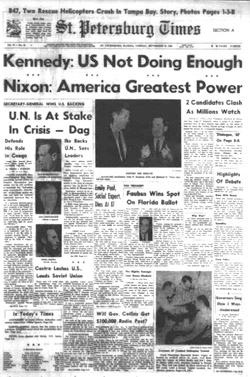
The anecdote stems from Hearst’s assigning Frederic Remington, the famous artist of the American West, to Cuba, to draw illustrations for the New York Journal of the island-wide rebellion against Spanish colonial rule. Remington and the writer Richard Harding Davis, who also was on Hearst’s payroll, reached Cuba in January 1897. (Both are shown in the front-page image above.)

Remington was in Cuba six days before returning to New York. He suffered in the tropical heat and didn’t along with the self-important Davis, who called the rotund Remington “a large, blundering bear.”

Before returning, the media myth has it, Remington sent Hearst a telegram stating:

“Everything is quiet. There is no trouble here. There will be no war. I wish to return.”

Hearst supposedly cabled the artist reply: “Please remain. You furnish the pictures, and I’ll furnish the war.”

In most tellings of the anecdote, Hearst supposedly made good on his promise and brought on the war with Spain, which was declared 15 months later.

The Remington-Hearst anecdote is riven with flaw and incongruity. For starters, Hearst at least twice denied ever having sent such a message. And Remington apparently never discussed the anecdote.

Moreover, as I write in Getting It Wrong, “the anecdote lives on despite a nearly complete absence of supporting documentation. It lives on even though telegrams supposedly exchanged by Remington and Hearst have never turned up.”

And it lives on despite what I call “an irreconcilable internal inconsistency.” That is, it would have been absurd for Hearst to have vowed to “furnish the war” because war—specifically, the Cuban rebellion against Spain’s colonial rule—was the very reason Hearst sent Remington and Davis to Cuba in the first place.

“Anyone reading U.S. newspapers in early 1897 would have been well aware that Cuba was a theater of a nasty war,” I write in Getting It Wrong. “By then, the Cuban rebellion had reached islandwide proportions and not a single province had been pacified by Spain’s armed forces.”

Despite those and other flaws, the tale lives on as too good to check out, too good not to be true.

And as I note in Getting It Wrong:

“What firmly and finally pressed Hearst’s purported vow to ‘furnish the war’ into the public’s consciousness was Citizen Kane, the 1941 motion picture that was based loosely on Hearst’s life and times.”

In a scene early in the film, Orson Welles in the role of Charles Foster Kane, a newspaper tycoon who readily invites comparisons to Hearst, paraphrases the purported Remington-Hearst exchange.

Whitehouse noted in his essay: “Rightly or wrongly, Orson Welles’s … Citizen Kane has largely shaped our popular perception of William Randolph Hearst.” True enough.

Kane certainly helped solidify a robust media-driven myth.

WJC

Recent and related:

Mythical ‘War of the Worlds’ radio show adapted to stage

In Debunking, Media myths, Media myths and radio, War of the Worlds on October 8, 2010 at 9:15 am

Orson Welles’ famous radio dramatization in 1938 of the War of the Worlds was an adaptation of the 1898 novel of the same title by H.G. Wells.

And Welles’ radio show–the source for what has become a delicious and tenacious media-driven myth, one debunked in my new book, Getting It Wrong–has been adapted to the stage. A run of the World of Wars, based on Welles’  radio adaptation, opened last night at a theater in Tampa. (The Tampa production, to be clear, is not the first stage adaptation of Welles’ version of War of the Worlds. There have been others.)

In publicizing the stage production, Tampa’s alternative newspaper, Creative Loafing, offered up the myth that Welles’ program in 1938 created mass panic and nationwide hysteria.

The Creative Loafing write-up said:

“Welles presented the first two-thirds of 1938 radio broadcast as a series of fake news bulletins, which listeners believed and in turn incited mass hysteria.

“People really thought that an alien invasion by Martians was really in progress.”

Both paragraphs are in error.

The War of the Worlds show, which aired on CBS radio on October 30, 1938, made clever and effective use of simulated news bulletins about an invasion of Earth by Martians wielding deadly heat rays. But “fake news bulletins” comprised nothing close to two-thirds of Welles’ hour-long program.

The program’s use of simulated bulletins was intermittent, and largely confined to the opening 20 minutes, by which time it sounded as if the Earth were under alien attack.

But as I write in Getting It Wrong, “Listeners who followed closely would have easily recognized that events moved far too quickly to be plausible.” It took the invaders less than a half an hour to blast off from Mars, crash-land on Earth, and launch their deadly onslaught.

Most listeners–in overwhelming numbers–recognized the show for what it was: Great entertainment on the eve of Halloween. Surveys taken in the days following the show found that a fraction of the radio audience was “frightened,” “disturbed,” or “excited” by what they heard.

The terms were those of Hadley Cantril, a Princeton University psychologist who investigated the aftermath of the War of the Worlds program. In his 1940 book, The Invasion From Mars, Cantril estimated the program attracted no fewer than 6 million listeners, of whom at least 1.2 million were “frightened,” “disturbed,” or “excited.”

Cantril did not explain what the terms meant; nor did he offer estimates about how many people acted on their fears.

In any case, being “frightened,” “disturbed,” or “excited” was far from being convulsed in panic or driven to hysteria.

Cantril’s estimates signal that most listeners were neither panic-stricken nor fear-struck. Even though his data indicate that comparatively few listeners were upset by the show, Cantril offered the inconsistent view that “[l]ong before the broadcast had ended people all over the United States were praying, crying, fleeing frantically to escape death from Martians.”

The Invasion From Mars became the cornerstone study of audience reaction to the War of the Worlds program. It has been recognized as something of an early landmark in mass communication research.

But over the past 20 years or so, Cantril’s findings about the War of the Worlds “have been challenged by sociologists and others who point out that mass hysteria and panic are rare and, given their transient nature, difficult to study,” as I note in Getting It Wrong. “Cantril, they say, failed to demonstrate that panicked reactions and flight were widespread among listeners to the show.”

I point out that Robert E. Bartholomew, “an authority on mass hysteria and social delusions, has said that ‘a growing consensus among sociologists that the extent of the panic, as described by Cantril, was greatly exaggerated.'”

Bartholomew also wrote that only “scant anecdotal evidence” exists “to suggest that many listeners actually took some action—such as packing belongings, grabbing guns, or fleeing in cars after hearing the broadcast.”

I also write in Getting It Wrong:

“Had mass panic and hysteria indeed swept the country that night, the trauma and turmoil surely would have resulted in many deaths and injuries. But the newspaper reports were notably silent on casualties.” Those reports, I write, “contained few references to injury or adverse health effects linked to the program.”

WJC

Recent and related:

Myth appeal runs deep abroad; Watergate a case in point

In 1897, Debunking, Furnish the war, Media myths, Spanish-American War, Washington Post, Watergate myth, Yellow Journalism on October 7, 2010 at 10:20 am

I  spoke about my new book, Getting It Wrong, at a superbly organized American University alumni event last night, at a venue commanding spectacular views of Seattle, Puget Sound, and the Olympic Mountains.

Following my talk, which focused on three of the 10 media-driven myths debunked in Getting It Wrong, I was asked by one of the people in attendance whether myths have similarly emerged about the media in other countries.

A very good question, I replied: I really don’t think so.

Maybe in Britain, I suggested, given the robust media scene there. But I couldn’t say for sure.

While I had to hedge a bit on the question, there’s no doubt that myth appeal runs deep from the United States to other countries. That is, news organizations outside the United States not infrequently repeat what are American media myths.

Media-driven myths, I have noted, can and do travel far, and well.  Take, for example, the heroic-journalist myth of Watergate.

The notion is often embraced in news media in the United States and overseas that the investigative reporting of Bob Woodward and Carl Bernstein, then-young reporters for the Washington Post, took down Richard Nixon and his corrupt presidency.

A measure of the myth’s international appeal can found in a report that aired today on Australia’s ABC radio network, which described Woodward as “one of the Washington Post journalists who brought down a U.S. President.”

Not even Woodward embraces that claim. He said in an interview in 2005:

“To say the press brought down Nixon, that’s horseshit.”

And he’s right. Earthy, perhaps, but right.

I discuss the heroic-journalist myth in Getting It Wrong, noting that it’s a simplistic and misleading interpretation of what was a sprawling and complex scandal. Watergate’s web of misconduct forced Nixon from office and landed nearly 20 of his top aides, associates, and cabinet officers in jail.

To roll up a scandal of such dimension, I write,  required the collective, if not always the coordinated, efforts of special prosecutors, bipartisan congressional panels, federal judges, the FBI, and, ultimately, the U.S. Supreme Court, which ordered Nixon to surrender audiotapes that proved his complicity in the Watergate cover-up.

Against that tableau, journalism’s contributions to unraveling Watergate were modest—certainly not decisive.

But because the heroic-journalist interpretation is such an unambiguous assertion of the media’s presumed power, it tends to travel well.

The same holds for the purported vow of William Randolph Hearst to “furnish the war” with Spain.

Hearst supposedly made the pledge in a cable to the artist Frederic Remington, who was in Cuba in early 1897, on assignment for Hearst’s New York Journal to draw illustrations of the rebellion against Spanish colonial rule.

The anecdote lives on as one of the most famous and delicious in American journalism—even though it is buttressed by no supporting documentation. And Hearst denied ever having made such statement.

It is, however, a tale almost too good to be disbelieved, given that it so effectively represents Hearst as warmonger. The tale’s sheer deliciousness is another reason why the anecdote turns up more than infrequently in news outlets abroad, especially in Spanish-language media.

The media myths associated with Watergate, the so-called “Cronkite Moment” of 1968, and the War of the Worlds radio dramatization of 1938 were the principal elements of my talk last night.

Those myths live on, I said, in part because “they are appealing reductive, in that they minimize the complexity of historical events and offer simplistic and misleading interpretations instead. The Washington Post no more brought down Nixon that Walter Cronkite swayed [Lyndon] Johnson’s views about Vietnam.

“Yet those and other media myths endure because they present unambiguous, easy-to-remember explanations for complex historic events.”

WJC

Recent and related:

Pentagon ‘caught creating false narrative’ about Lynch? How so?

In Debunking, Jessica Lynch, Media myths, Washington Post on October 6, 2010 at 10:51 am

The Los Angeles Times indulged the other day in the tenacious media myth about the Pentagon’s concocting the hero-warrior tale about Jessica Lynch early in the Iraq War.

It was in fact the Washington Post that thrust the erroneous account about Lynch’s supposed battlefield heroics into the public domain, in a sensational front-page report published April 3, 2003. The article appeared beneath the headline: “‘She was fighting to the death.'”

The hero-warrior tale offered by the Post–which said Lynch had fought fiercely in an ambush in southern Iraq before being shot, stabbed, and taken prisoner–was picked up by news organizations around the world and turned Lynch into the best-known Army private of the war.

But the story wasn’t true.

Lynch never fired a shot in the ambush in Nasiriyah on March 23, 2003. Her gun jammed, she later said. She was neither shot nor stabbed; she suffered shattering injuries in the crash of a Humvee as it tried to flee the attack.

A U.S. special forces team rescued Lynch from a hospital in Iraq two days before the Post‘s erroneous hero-warrior tale was published.

In invoking the Lynch case, in an article examining why few Medals of Honor have been awarded in the Iraq and Afghan wars, the Los Angeles Times said:

“The medals process was tarnished when the Pentagon was caught creating false narratives to justify medals awarded in the high-profile cases of Army Ranger Pat Tillman and Army Pfc. Jessica Lynch.”

The matter of “false narratives” in the Tillman case is murky. The unrelated Lynch case is more clear-cut.

As I discuss in Getting It Wrong, my new book debunking 10 prominent media-driven myths, the Pentagon was not the source for the Post‘s botched hero-warrior report. Vernon Loeb, one of the authors of the “fighting to the death” story, was quite explicit on that point.

Loeb, who then was the Washington-based defense correspondent for the Post, said in an interview on NPR’s Fresh Air program in December 2003:

“I could never get anybody from the Pentagon to talk about those reports at all.”

He added that “the Pentagon was completely unwilling to comment on those reports at all. They wouldn’t say anything about Jessica Lynch.”

Loeb also said that the Post had been “told by some really good intelligence sources here in Washington that, you know, there were indications that she had, you know, fired back and resisted her capture and actually been shot and possibly stabbed doing so.”

Those sources have never been identified. But Loeb, who now is a senior editor for the Philadelphia Inquirer, scoffed at the interviewer’s suggestion that the Post‘s erroneous “fighting to the death” report was the result of clever manipulation by the Pentagon.

“I just didn’t see the Pentagon trying to create a hero where there was none,” Loeb said. “I mean …they never showed any interest in doing that, to me.”

On another occasion, Loeb was quoted in a commentary in the New York Times as saying:

“Far from promoting stories about Lynch, the military didn’t like the story.”

Lynch, who still struggles with the effects of injuries suffered in the Humvee crash, never claimed to have fought heroically in Iraq. She has suggested, though,  that “it would have been easy for me” to have adopted the hero’s mantle and embraced the  accounts about her supposed derring-do.

She was honorably discharged from the military in 2003–and was awarded the bronze star (see photo) for meritorious combat service, a decision that prompted low-level controversy.

The Lynch case–and the Post‘s hero-warrior tale–gave rise to another dispute about medals for valor.

According to Michael DeLong, a Marine lieutenant general who was deputy commander of U.S. Central Command in 2003, “politicians from her home state, West Virginia,” pressed the military “to award her the Medal of Honor.”

The requests were based on the Post‘s hero-warrior tale and “rose up the ladder until finally it reached me,” DeLong recalled in 2007 in a commentary in the New York Times, adding:

“In the case of Private Lynch, additional time was needed, since she was suffering from combat shock and loss of memory; facts, therefore, had to be gathered from other sources. The military simply didn’t know at that point whether her actions merited a medal.

“This is why, when the request landed on my desk, I told the politicians that we’d need to wait. I made it clear that no one would be awarded anything until all of the evidence was reviewed.

“The politicians did not like this,” DeLong added. “They called repeatedly, through their Congressional liaison, and pressured us to recommend her for the medal, even before all the evidence had been analyzed. I would not relent and we had many heated discussions.”

DeLong did not identify the politicians who lobbied for Lynch to be awarded the Medal of Honor but he wrote that they “repeatedly said that a medal would be good for women in the military; I responded that the paramount issue was finding out what had really happened.”

WJC

Recent and related:

‘War of the Worlds’ radio panic was overstated

In Anniversaries, Debunking, Media myths, Media myths and radio, War of the Worlds on October 3, 2010 at 8:02 am

Welles in bronze

October always brings frequent reminders about radio’s most memorable and myth-beclouded program–Orson Welles’ superb dramatization of the War of the Worlds that aired on Halloween eve 1938.

So realistic was Welles’ show, so alarming were its simulated news reports of invading Martians, that listeners by the tens of thousands—or more—were convulsed in panic and hysteria.

Fright beyond measure gripped the country that night; it was the night that panicked America.

Or so the media myth has it.

The delicious, ever-appealing tale of mass hysteria sown by the War of the Worlds program is one of the 10 prominent media-driven myths that I address and debunk in my new book, Getting It Wrong.

I note that some Americans were frightened by the program. But most listeners, in overwhelming numbers, were not. They recognized it for what it was—an imaginative and entertaining radio show that aired in its usual Sunday evening time slot.

Still, this media myth is just too well-known, too entrenched in the American consciousness, ever to fall into disuse.

That’s why October brings numerous references to the War of the Worlds show and the panic it supposedly caused. Indeed, just the other day, an item posted at examiner.com said the program fooled “over a million people into thinking the world was actually under attack by Martians.”

But there’s simply no data to support such claims.

Hadley Cantril, a psychologist at Princeton University who helped promote the notion that the Welles’ program caused widespread panic, drew on surveys to estimate that at least 6 million people listened to the hour-long program, which aired live over the CBS radio network.

Of those listeners, Cantril estimated, 1.2 million were “frightened,” “disturbed,” or “excited” by what they heard.

But as I note in Getting It Wrong, “Cantril left unclear the distinctions among ‘frightened,’ ‘disturbed,’ or ‘excited.’ Nor did Cantril not estimate how many listeners acted on their fears and excitement,” a critical element had there indeed been widespread panic that night.

I further note that “one can watch a horror movie and feel ‘frightened,’ ‘disturbed,’ or ‘excited,’ but such responses are hardly synonymous with panic or hysteria.” Far from it.

The notion that mass panic had accompanied the airing the War of the Worlds program spread quickly, mostly by U.S. newspapers which reported the day after the show that hysteria had swept the country.

Their reports, however, “were almost entirely anecdotal,” I note, “and largely based on sketchy wire service roundups that emphasized breadth over in-depth detail.”

Newspapers simply had no reliable way of testing or ascertaining the validity of the sweeping claims they made about the War of the Worlds program.

Here’s why.

The War of the Worlds dramatization aired from 8-9 on Sunday night in the East, a time when most newspaper newsrooms were thinly staffed.

Reporting on the reactions to The War of The Worlds broadcast represented no small challenge, especially for morning newspapers having late-night deadlines.

“Given the constraints of time and staffing,” I write in Getting It Wrong, “relying on wire services such as the Associated Press became essential. This dependency, in turn, had the effect of promoting and deepening the notion that panic was widespread that night: On a late-breaking story of uncertain dimension and severity, many newspapers took their lead from wire service dispatches.

“They had little choice.”

The AP’s reports about the program essentially were roundups of reactions culled from the agency’s bureaus across the country, I write. Typically, AP roundups emphasized sweep—pithy anecdotal reports from many places—over depth and detail.

The anecdotes about people frightened by the show tended to be sketchy, shallow, and small-bore. But their scope contributed to and confirmed the sense that widespread panic was afoot that night.

The reliance on wire service roundups helps explain the consensus among U.S. newspapers that the broadcast had created mass panic.

Interestingly, newspaper content also helps to undercut the notion that panic and hysteria  swept the country that night.  Had that happened, the resulting trauma and turmoil surely would have led to many deaths and serious injuries.

But newspaper reports were notably silent on extensive casualties.

No deaths were attributed to the War of the Worlds broadcast. And as Michael J. Socolow wrote in his fine essay about the program, no suicides could “be traced to the broadcast,” either.

WJC

Recent and related:

Pew: Woodward, Bernstein ‘unraveled Watergate cover-up’

In Debunking, Media myths, Washington Post, Watergate myth on October 1, 2010 at 8:27 am

Bob  Woodward’s new book, Obama’s Wars, was the single most-discussed topic in news links posted at Web logs Monday through Friday last week,  the Pew Research Center’s Project for Excellence in Journalism said yesterday.

Woodward (Library of Congress)

Pew said that 35 percent of news links at blogs during the period September 20-24 were about the book, which has received mostly so-so reviews. (For example, the Wall Street Journal said in its critique yesterday, “To read ‘Obama’s Wars’ is to feel trapped in a daylong meeting in an airless room. That’s because much of the book consists of a near-verbatim account of meetings—specifically the National Security Council meetings last fall where the administration hashed out its Afghanistan policy.”)

The book and blog posts about it are of mild interest to Media Myth Alert.

What caught this blog’s attention was assertion in Pew’s news release–duplicated in a separate release by the Project for Excellence in Journalism–that referred to Woodward as “a Washington Post associate editor and half of the famous reporting duo that unraveled the Watergate cover-up.”

That last bit, about having “unraveled the Watergate cover-up,” is in error.

As I discuss in Getting It Wrong, my new book that debunks 10 prominent media-driven myths, Woodward and his Post colleague Carl Bernstein, “did not uncover defining and decisive elements” of Watergate—including the cover-up of the break-in at offices of the Democratic National Committee, the scandal’s signal crime.

The Watergate cover-up was exposed incrementally in 1973 and 1974 by the combined forces of such subpoena-wielding entities as federal prosecutors, federal grand juries, and U.S. Senate investigators. Ultimately the U.S. Supreme Court ordered President Richard Nixon to hand over audiotapes of secretly recorded conversations at the White House that unequivocally demonstrated Nixon’s guilty role in the cover-up.

The Supreme Court decision was handed down in July 1974. Nixon resigned soon after.

Woodward and Bernstein’s award-winning reporting on Watergate was published in summer and fall 1972, as the scandal slowly unfolded during the weeks and months following the break-in at Democratic headquarters.

By late October 1972, I note in Getting It Wrong, “the Post’s investigation into Watergate ‘ran out of gas,’ as Barry Sussman, then the newspaper’s city editor, acknowledged.”

Edward Jay Epstein pointed out in his classic essay about the press and Watergate that “it was not because of the reporting of Woodward and Bernstein, but because of the pressures put on the conspirators by Judge John Sirica, the grand jury, and Congressional committees that the cover-up was unraveled.”

Sirica, a federal judge, presided at the trial of the Watergate burglars that ended in guilty pleas in January 1973. Afterward, the judge “made it abundantly clear,” Epstein wrote, that the convicted burglars “could expect long prison sentences unless they cooperated with the investigation” of the Senate select committee on Watergate.

One of the burglars, James McCord, soon wrote to Sirica, saying that “perjury had been committed at the trial and the defendants had been induced by ‘higher-ups’ to remain silent,” Epstein pointed out.

McCord’s letter thus began the unraveling of the Watergate cover-up.

I discuss in Getting It Wrong factors that help account for the tenacity of the “heroic-journalist” interpretation of Watergate–the erroneous notion that the reporting of Woodward and Bernstein brought down Nixon’s corrupt presidency.

“Media myths,” I write, “often emerge from an eagerness to find influence and lasting significance in what journalists do and tend to extend credit where credit is not entirely due.

“The heroic-journalist myth of Watergate is a telling example. The myth holds that the reporting of Bob Woodward and Carl Bernstein in the Washington Post brought down Richard Nixon. In reality, the Post and other news organizations were marginal factors in unraveling the Watergate scandal.”

Media myths thus can be self-flattering; they offer heroes like Woodward and Bernstein to a profession that is more used to criticism than applause.

Besides, claiming that Woodward and Bernstein brought down Nixon, or that they “unraveled the Watergate cover-up,” long ago became a ready if misleading way for journalists to distill what was a sprawling scandal.

WJC

Recent and related:

Obama, journalism history, and ‘folks like Hearst’

In 1897, Debunking, Media myths, Yellow Journalism on September 29, 2010 at 9:45 am

President Obama stirred a fair amount of comment and criticism by declaring in a recent interview with Rolling Stone magazine that Fox News pursues a point of view that’s “ultimately destructive” to the country’s “long-term growth.”

As if Fox News, or any news organization, had such power.

And Obama offered another comment that signaled a less-than-profound grasp of American journalism history.

Media baron W.R. Hearst

That came when he invoked William Randolph Hearst, the much-misunderstood practitioner of activist yellow journalism who came to prominence in the 1890s. Obama said:

“We’ve got a tradition in this country of a press that oftentimes is opinionated. The golden age of an objective press was a pretty narrow span of time in our history. Before that, you had folks like Hearst who used their newspapers very intentionally to promote their viewpoints.”

Hearst, though, was something of an exception among newspaper publishers; there haven’t been many “folks like Hearst” in American journalism. Certainly not in the late 19th and early 20th centuries, the most innovative period of Hearst’s years as a press baron.

Hearst arrived in New York City from San Francisco in 1895 and promptly shook a media landscape dominated by the likes of James Gordon Bennett Jr., the often-absent owner of the New York Herald; Joseph Pulitzer, the ailing and churlish proprietor of the New York World, and Charles A. Dana, the prickly force behind the New York Sun.

They all were past their prime, and their newspapers were in decline.

As I discussed in my 2006 book, The Year That Defined American Journalism: 1897 and the Clash of Paradigms, Hearst’s entry into New York City journalism was something of “a seismic event.”

By late 1897, he had developed and began pursuing a robust and fairly progressive view of journalism, maintaining that newspapers had a duty and obligation to inject themselves conspicuously into public life, to fill the void left by government inaction and incompetence.

Hearst called this the “journalism of action” or the “journalism that acts.” It was journalism with a social conscience.

His New York Journal insisted in editorials that a newspaper’s duty should not be “confined to exhortation.”

Instead, the Journal declared, when “things are going wrong” the newspaper should step in and “set them right, if possible.”

Hearst’s “journalism of action” embraced an element of what we would recognize as consumer protection. In the aftermath of a snowstorm that swept New York late in January 1897, the Journal set up a relief effort, saying, “The time has come to help the poor who starve, who freeze. Charity’s hand is almost empty.”

There was no more stunning manifestation of Hearst’s activist vision of journalism than the jailbreak his Journal pulled off in Havana in October 1897, freeing a 19-year-old political prisoner named Evangelina Cisneros.

She had been jailed without trial for more than a year in a prison for women. Spanish authorities who then ruled Cuba spurned Hearst’s editorial campaign for Cisneros’ release.

In late August 1897 he sent Karl Decker, a reporter in the Journal‘s Washington bureau, to Havana, with instructions to win Cisneros’ freedom. And with the quiet help of U.S. diplomats in Cuba, and the vital assistance of a clandestine smuggling network in Havana, Decker broke Cisneros from prison.

Cisneros

She soon was smuggled out of Cuba and welcomed to New York City in a delirious reception organized by Hearst and the Journal.

It was American journalism’s greatest escape narrative. And it demonstrated the breathtaking scope and potential of the “journalism of action.”

Freeing Cisneros, the Journal declared, was “epochal” and a “supreme achievement of the journalism of action.” (Illicit “jail-breaking journalism” was more like it, scoffed the Chicago Times-Herald.)

Eventually, though, Hearst’s interest in developing the “journalism of action” was supplanted by his soaring, and mostly unfulfilled, political ambitions.

In 1902, Hearst was elected to the first of two terms in Congress.

He sought, but lost, the Democratic nomination for president in 1904. He lost the New York gubernatorial race in 1906. And he twice ran unsuccessfully for New York City mayor.

What’s more, I write in The Year That Defined American Journalism, “Hearst never completely shook the reputation of a spoiled little rich kid, and the ‘journalism of action’ surely suffered because of his personality.”

In his comment about “folks like Hearst,” Obama also seemed to embrace a version of the “golden age” fallacy, that there was a time in American journalism when newspapers were paragons of objectivity.

That’s a myth, really.

“Objectivity”–or what Richard Taflinger of Washington State University has succinctly termed “the detached and unprejudiced gathering and dissemination of news”–is a normative value or ambition in American journalism.

But it has never been practiced on anything approaching a sustained basis.

WJC

Recent and related:

My many thanks to fivefeetoffury and to Jim Romenesko for linking to this post.

Indulging in myth on debate’s 50th anniversary

In Anniversaries, Debunking, Media myths, Washington Post, Watergate myth on September 27, 2010 at 7:12 am

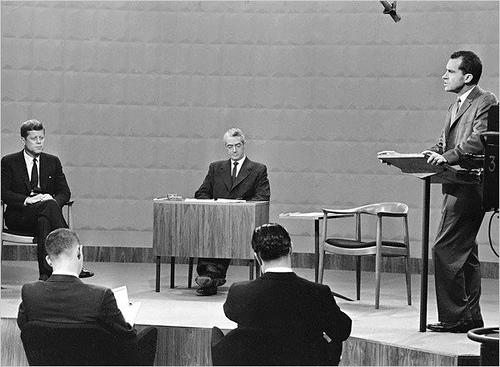
News outlets indulged in the myth of viewer-listener disagreement right through the 50th anniversary yesterday of the first Kennedy-Nixon debate.

The myth holds that people who watched the debate on television thought that Senator John F. Kennedy won; those who listened on radio thought Vice President Richard Nixon had the best of it.

The myth was long ago debunked by scholars David L. Vancil and Sue D. Pendell, in an article in Central States Speech Journal. They noted that reports of viewer-listener disagreement typically were anecdotal, and the few surveys that hinted at a viewer-listener disconnect were too small and unrepresentative by which to make confident judgments.

While it has been thoroughly dismantled, the myth lives on as irresistible testimony about the power of television and the importance of image in presidential politics.

An item posted yesterday at Andrew Breitbart’s Big Journalism online site said as much, declaring:

“The face of TV and politics changed forever on this date in history. …

“Those who watched the broadcast of the first ever televised presidential debate declared Kennedy the winner, those who listened on the radio gave the nod to Nixon. Thus, the political world changed forever.”

WLS-TV in Chicago, the city where the debate took place on September 26, 1960, said at its online site yesterday: “Most of the 70 million people who watched the event on television were convinced Kennedy won, and they voted for him in the presidential election of 1960.

“Surveys showed, though, that most of the people who listened on the radio thought Nixon won. It was the first time a nominee’s appearance may have affected voters.”

In addition, CBS Channel 2 in Chicago declared at its online site:

“Some listening on radio said it seemed like Nixon won. But as many as 74 million Americans were watching on television, and the medium became an overnight unexpected game-changer in our political system.”

As I’ve noted, specific evidence almost never is cited to support such claims about the debate. It’s as if the notion of viewer-listener disagreement is just too good, too delicious to check out–a factor that often characterizes the telling of media-driven myths. It’s a point I make in Getting it Wrong, my new book that debunks 10 prominent media myths. (While certainly prominent, the 1960 debate myth is not included in Getting It Wrong.)

There is evidence that a plurality of registered voters thought Kennedy fared better than Nixon in the debate 50 years ago.

But such impressions did not alter the campaign’s dynamic: The race remained a toss-up to Election Day.

Here’s what the evidence shows: A Gallup poll released in October 1960 reported that 43 percent of voters thought Kennedy “did the better job” in the first debate (of four debates during the campaign). Twenty-three percent thought Nixon was better; 29 percent said both candidates were about the same. Five percent offered no opinion.

The same survey reported Kennedy was narrowly ahead in the race, by 49 percent to 46 percent, with 5 percent undecided.

That result represented a slight change from Gallup’s survey taken just before the debate, which reported Nixon leading narrowly, by 47 percent to 46 percent.

Gallup called the post-debate shift too slight to be meaningful.

“The prudent reader can see,” George Gallup, head of the polling organization, wrote in reporting the results, “that polling accuracy has not reached the degree of accuracy required to say with certainty which candidate is ahead in a close race such as the present one.”

So, no: The debate 50 years ago didn’t change the “political world … forever.” Television wasn’t an “overnight … game-changer” in presidential campaigns. Nothing of the sort.

Media-driven myths are known to give rise to spin-off or subsidiary myths, a phenomenon I discuss in Getting It Wrong.

An example is the heroic-journalist myth of Watergate, which holds that the investigative reporting of Washington Post reporters Bob Woodward and Carl Bernstein brought down Nixon’s presidency in the 1970s. The spin-off or subsidiary myth is that Woodward and Bernstein’s work was so widely appealing that it prompted a surge in college students majoring in journalism.

But that wasn’t so: The surge in enrollments in journalism programs predated the Watergate scandal and was due in measure to young women entering the field.

A spin-off of the Kennedy-Nixon debate myth is that the widely watched televised encounter helped Kennedy become better known among Americans. Before then, the argument goes, Kennedy lacked much national recognition. Nixon, on the other hand, was well-known, having been vice president for almost eight years.

But in fact Kennedy had become nationally prominent long before the first debate.

So well-known that he ran well ahead of Nixon in many of the presidential trial heats that Gallup conducted nationally in late 1958 and 1959.

These matchups, while volatile, were seen by Gallup as early tests of a prospective candidate’s political strength.

The Gallup trial heat in December 1958 had Kennedy leading Nixon by 59 percent to 41 percent.

Kennedy was favored over Nixon by a larger margin, 61 percent to 39 percent, in the trial heat reported in July 1959.

To have polled as well as he did so long before the 1960 campaign, Kennedy simply could not have been an unknown in national politics.

WJC

Recent and related:

My many thanks to fivefeetoffury and Ed Driscoll for linking to this post.

Who won ’60 debate? Can’t say: Didn’t see it on TV

In Anniversaries, Debunking, Media myths on September 26, 2010 at 8:33 am

Sander Vanocur has been much in demand in the run-up to today’s 50th anniversary of the first Kennedy-Nixon televised presidential debate.

The 82-year-old Vanocur is sharp, witty, and droll–and the sole surviving member of the media panel that questioned the candidates during the debate on September 26, 1960.

Vanocur

Vanocur, a retired NBC newsman, has appeared on a number of panels in Washington that have examined the implications and legacies of the encounter between Senator John F. Kennedy and Vice President Richard Nixon. He’s also to participate on a panel today in Chicago, where the Kennedy-Nixon debate took place.

Among the comments that Vanocur has offered at these look-back events is:

“I don’t know who won the debate: I didn’t see it on television.”

He made such a remark yesterday, during a panel discussion at the Newseum, the $450 million museum of news in downtown Washington. (It’s where my new myth-busting book, Getting It Wrong, was launched in June.)

The comment “I didn’t see it on television” suggests the tube was decisive that night 50 years ago–and even was decisive to the outcome of the 1960 election.

Debate coverage, 1960

Which it wasn’t.

Nixon supposedly lost the debate among television viewers because he looked so poorly, what with sweaty brow, wan complexion, and ill-chosen gray suit. But among radio listeners, he is said to have bested Kennedy.

That, anyway, is the widely told media myth that has come to define the first presidential debate.

It is also an explanation for Vanocur’s comment: You had to see the debate on television to appreciate fully the importance that image made that night.

Time magazine was among the news organizations to have repeated the debate myth in the run-up to the 50th anniversary, stating:

“As the story goes, those who listened to the debate on the radio thought Nixon had won. .. Those that watched the debate on TV thought Kennedy was the clear winner. Many say Kennedy won the election that night.”

But television images were decisive neither in the debate (the first of four during the fall campaign), nor in the 1960 election.

David L. Vancil and Sue D. Pendell, in an article in the Central States Speech Journal in 1987, thoroughly dismantled the notion that disagreement among TV viewers and radio listeners characterized the debate 50 years ago.

They identified serious flaws in the anecdotal reports and the limited post-debate surveys that suggested there had been such a divergence of opinion in assessing the Kennedy- Nixon encounter.

Vancil and Pendell also challenged the notion that Nixon’s beleaguered appearance much contributed to views about the debate.

“Appearance problems, such as Nixon’s perspiring brow, could have had a negative impact on viewer perceptions,” Vancil and Pendell wrote, “but it is also possible for viewers to be sympathetic to such problems, or to interpret them as evidence of attractive or desirable qualities.”

They added: “Even if viewers disliked Nixon’s physical appearance, the relative importance of this factor is a matter of conjecture.”

Indeed. The Washington Post declared in its post-debate editorial:

“Of the two performances Mr. Nixon’s probably was the smoother.”

Vancil and Pendell also pointed out that “the inference that appearance problems caused Nixon’s loss is classic post hoc fallacy.”

Nixon’s supporters may have been dismayed by his appearance that night; but that factor was scarcely enough to prompt them to alter their opinions about the vice president’s candidacy and opt for Kennedy.

The debate 50 years ago only slightly nudged public opinion–and any effect it had on voters dissipated by election day in November.

On the eve of that debate, the U.S. electorate was split. According to the Gallup poll before the encounter in Chicago, 47 percent of registered voters favored Nixon, 46 percent favored Kennedy, and 7 percent were undecided.

The Gallup poll immediately after the first debate put Kennedy ahead by three percentage points, 49-46, among registered voters. (Gallup noted in reporting the post-debate results: “polling accuracy has not reached the degree of accuracy required to say with certainty which candidate is ahead in a close race such as the present one.”)

The popular vote for president was quite close: Kennedy won by about 113,000 votes–a margin of just 0.1 percent.

The first debate had at best a modest effect in shifting public opinion–and was a wash in the overall sweep of the 1960 presidential campaign.

WJC

Recent and related: