W. Joseph Campbell

Posts Tagged ‘Media-driven myths’

Advance pub for ‘Getting It Wrong’

In 1897, Cronkite Moment, Debunking, Media myths, War of the Worlds, Washington Post on April 28, 2010 at 3:47 pm

The online site of the School of Communication here at American University posts today a Q-and-A with me about Getting It Wrong, my forthcoming book that debunks 10 prominent media-driven myths.

Topics addressed include the Remington-Hearst/furnish the war anecdote; the War of the Worlds/mass hysteria myth, and the “Cronkite moment“/”I’ve lost Middle America” meme.

And while the topic is not considered in Getting It Wrong, I also mention the “pharm parties” myth, in which young people are said to take pills of any kind from their parents’ medicine cabinets. They supposedly show up at a party and dump the purloined pills into a large, common bowl. Then they are purported to take turns scooping out and swallowing handfuls of the medications, not knowing what they’re taking, in the supposed pursuit of a drug-induced high.

Jack Shafer, media critic for slate.com, has done fine work in knocking down the “pharm party” meme.

Here are excerpts from the Q-and-A:

Q: “Myth busting” can upset people who have accepted, or even benefited from, the myth. Have you gotten any negative feedback?

A:  Not really. Not so far. I do know that some people wonder “who cares?” about some of the myths debunked in Getting It Wrong. The Hearst—”furnish the war” myth, after all, is more than 100 years old. But I emphasize in the book that media-driven myths are neither innocuous nor trivial. They can, and do, promote stereotypes. They can deflect attention or blame away from the makers of flawed policies. They can, and often do, offer an exaggerated sense of the power and influence of the news media. Plus, debunking myths is a pursuit that’s aligned with a fundamental objective of mainstream American journalism—that of getting it right.

Q: What’s next?

A: I’d like to think there’s a sequel to Getting It Wrong. The universe of media-driven myths isn’t confined to 10, after all. There are more to confront. Also, in fall 2010, I’ll be teaching a “wild card” course in the University’s General Education program titled “Media Myth and Power.” The course will consider several of the myths debunked in Getting It Wrong.

A tip of the chapeau to Michael Wargo of the School of Communication for putting together the Q-and-A, which follows the writeup about the book that appeared April 11 in the “Outlook” section of the Washington Post.

WJC

Remembering ‘journalism hero’ Murrow, 45 years on

In Anniversaries, Debunking, Media myths, Murrow-McCarthy myth on April 27, 2010 at 9:46 am

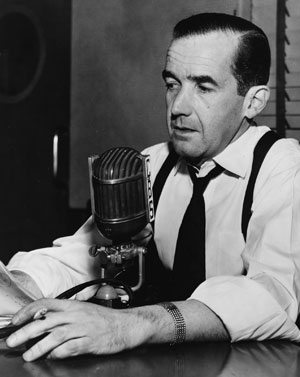
The Poughkeepsie Journal notes the 45th anniversary today of the  death of legendary broadcast journalist Edward R. Murrow.

Murrow died April 27, 1965, at his farm near Pawling, N.Y., about 20 miles from Poughkeepsie. Murrow, a chainsmoker, fell victim to lung cancer. He had just turned 57.

Chainsmoking Ed Murrow

Inevitably, the Poughkeepsie Journal tribute–which carried the headline, “Journalism hero Edward R. Murrow lives on”–recalled Murrow’s famous See It Now documentary program in March 1954. That was when he took on the red-baiting Republican senator from Wisconsin, Joseph R. McCarthy.

The newspaper’s article said Murrow’s program on McCarthy “is credited for exposing the senator’s tactics by using clips of his own words, and helped lead to the senator’s downfall.”

The program’s mythical dimensions are addressed in my forthcoming book, Getting It Wrong, in which I note:

See It Now that night was powerful television. More accurately, it was a hearty serving of advocacy journalism. … Murrow and his See It Now team assembled a series of film clips that was decidedly unflattering to McCarthy.”

I also write:

“McCarthy’s oddball appearance and mannerisms—his hulking, menacing presence, his nutty laugh, his five o’clock shadow, his careless grooming that allowed strands of thinning, greasy hair to creep down his forehead—were among the most revealing and most unforgettable moments of the program.”

But did the show expose McCarthy’s tactics?

Not at all.

McCarthy had burst upon the national scene four years earlier, claiming in a series of speeches that scores of communists, communist sympathizers, or persons of risk were embedded in the U.S. State Department.

His charges were almost immediately challenged by Drew Pearson, a nationally syndicated muckraking columnist based in Washington, D.C.

“The Senator from Wisconsin has been a healthy watchdog of some government activities, but the alleged communists which he claims are sheltered in the State Department just aren’t,” Pearson wrote in February 1950, more than four years before Murrow’s program on McCarthy.

So did the See It Now show “helped lead to the senator’s downfall,” as the Poughkeepsie Journal claims?

Not so much.

By the time Murrow took to the air to confront McCarthy, the senator’s favorability ratings had already hit the skids.

As I write in Getting It Wrong, “it wasn’t as if Americans in early 1954 were hoping for someone to step up and expose McCarthy, or waiting for a white knight like Murrow to tell them about the toxic threat the senator posed.”

Thanks to Pearson, and other journalists, they knew.

WJC

Another movie list, another myth invoked

In Cinematic treatments, Debunking, Media myths, Washington Post, Watergate myth on April 26, 2010 at 11:52 am

The cinema can be a powerful propellant of media-driven myths.

As I note in my forthcoming book, Getting It Wrong, cinematic treatments can and do “influence how historical events are collectively remembered and can harden media-driven myths against debunking.”

I invoke as an example the Watergate scandal, which culminated in 1974 with the resignation of President Richard Nixon. It is often said that the Watergate reporting of Washington Post reporters Bob Woodward and Carl Bernstein “brought down” Nixon’s corrupt presidency.

Woodward and Bernstein’s best-selling book about their Watergate reporting, All the President’s Men, was turned into a highly successful motion picture by the same title.

And as I write in Getting It Wrong, the cinematic version of All the President’s Men, which cast Robert Redford and Dustin Hoffman in the roles of Woodward and Bernstein, “helped ensure that the journalists and their newspaper would be regarded as central to cracking the Watergate scandal.”

Testimony to that observation was offered yesterday in an item at the Huffington Post blog referring to All the President’s Men as “one of the top films about the presidency.”

The item said the film “documents how the power of the press and the determination of two young journalists brought down this occupant [Nixon], who only two years prior had won re-election by the widest margin in history.”

As I’ve noted several times at MediaMythAlert, the notion that Woodward, Bernstein, and the Washington Postbrought down” Nixon is a media-driven myth, a trope that knows few bounds.

It is, I write in Getting It Wrong, a misleading interpretation that “minimizes the far more decisive forces that unraveled the scandal and forced Nixon from office.”

The “heroic-journalist myth of Watergate” took hold for a number of reasons, among them the sheer complexity of the scandal. Not only was Nixon turned from office but  19 men associated with his presidency or his 1972 reelection campaign went to jail.

The “heoric-journalist” memo has become, I write, “a proxy for grasping the scandal’s essence while avoiding its forbidding complexity.”

The cinematic version of All the President’s Men accomplished that, too, by offering what I call “an unmistakable assertion of the power and centrality of the press in Nixon’s fall.”

The contribution of other agencies and entities in unraveling Watergate and prosecuting Nixon’s men is downplayed or ignored.

The Huffington Post item that invoked the heroic-journalist myth discussed 11 films that examine the American presidency, including two fine motion pictures, Primary Colors and the Manchurian Candidate.

Also on the movie list was Dick, an improbable spoof about Watergate and the Nixon White House that depicts Woodward and Bernstein as antagonistic incompetents who bungle their way to a Pulitzer Prize.

WJC

‘Getting It Wrong’ at Kensington’s ‘Day of the Book’

In 1897, Debunking, Media myths, Year studies on April 25, 2010 at 8:19 am

I participated today in the “Day of the Book” festival in the antique row section of  Kensington, MD.

The event represented first book-event exposure for Getting It Wrong, my forthcoming book that addresses, and debunks, 10 prominent media-driven myths.

Getting It Wrong will be published this summer by University of California Press. Chapter One may be read here.

Also on display at the “Day of the Book” was my year study, The Year That Defined American Journalism: 1897 and the Clash of Paradigms, which was published in 2006. The book tells the story of a decisive year in American journalism.

Book signing in Kensington (AMR photo)

Principal organizer of the “Day of the Book” was Kensington Row Bookshop and at least 80 authors and poets had registered for the event.

The threat of rain kept some of them away. But nasty weather was a no-show and a fine time was had.

I enjoyed meeting several other local authors, including Bernadette LeDoux-Brodsky,  a Parisienne who used to teach French at Georgetown University; Bob Gregg, a retired dean and professor at American University, and Ben Farmer, a young author who graduated a few years ago from Kenyon College.

Bernadette said the ambiance in Kensington evoked for her the cafe scene of streets in Paris–sans les apéritifs, of course. She sold copies of her Ici et Ailleurs: Parisienne dans le Maryland. Bob sold several of his novels, among them The Scarecrow in the Vineyard. And the gregarious Ben Farmer seemed to make a lot of friends as well several sales of his new novel, Evangeline.

For me, the event was mostly a chance to gauge interest in Getting It Wrong. And more men than women stopped by to chat about the book and/or take a flyer.

There also was some mild interest in The Year That Defined American Journalism (see book-signing photo, above).

The dog in the picture? That’s Lil, our bichon frise. She was at the book fair, too, and proved to be quite the magnet.

WJC

Halberstam the ‘unimpeachable’? Try myth-promoter

In Bay of Pigs, Cronkite Moment, Debunking, Furnish the war, Media myths, New York Times, Spanish-American War on April 24, 2010 at 9:02 am

A book review in the New York Times the other day referred to David Halberstam, the legendary author and journalist, as an “unimpeachable” source.

Halberstam, who died in an automobile accident three years ago, certainly built an outsize reputation. But unimpeachable?

I’d say no way.

Halberstam, in his hefty and still-popular 1979 study of the news media, The Powers That Be, encouraged the rise of two prominent media-driven myths and endorsed a third.

As I note in Getting It Wrong, my forthcoming book about media-driven myths, Halberstam’s Powers That Be was an important source, perhaps the original source, for the so-called “Cronkite Moment” of February 27, 1968.

That was when CBS anchorman Walter Cronkite asserted in a special report that the U.S. war effort in Vietnam was “mired in stalemate.”

In Halberstam’s telling, Cronkite’s report represented “the first time in American history a war had been declared over by an anchorman.”

Halberstam wrote that President Lyndon Johnson was in Washington and watched the Cronkite special that night. Upon hearing Cronkite’s dire assessment about Vietnam, the president said that if he had lost Cronkite, he had lost Mr. Average Citizen.

Interestingly, Halberstam did not place Johnson’s purported lament inside quotation marks. He paraphrased the remarks and said Johnson had directed  them to presidential press secretary George Christian.

But as I write in Getting It Wrong, Johnson was not in Washington that night. He did not see the Cronkite program when it aired. Thus, he could not have had the abrupt, dramatic, yet resigned reaction that Halberstam, and others, have attributed to him.

Johnson that night was in Austin, Texas, at the 51st birthday party of a political ally, Governor John Connally.

About the time Johnson supposedly made the comment about losing Cronkite, he was offering light-hearted banter about Connally’s age, saying:

“That is the magic number that every man of politics prays for—a simple majority. Throughout the years we have worked long and hard—and I might say late—trying to maintain it, too.”

The “Cronkite Moment,” I write in Getting It Wrong, “is a media-driven myth. It did not have the effects that Halberstam and many others have attributed to it.”

Halberstam’s Powers That Be also offered a graphic, if exaggerated, account that President John Kennedy supposedly called James Reston of the New York Times in April 1961 and urged him not to publish a report about the pending Bay of Pigs invasion.

Kennedy “argued strongly and passionately,” Halberstam wrote, that the Times by reporting the story would damage his policy. Halberstam also wrote that in his call to Reston, Kennedy said the Times risked having blood on its hands were the article published and the invasion failed.

Such a conversation never happened, according to Reston and others quoted in Harrison Salisbury’s insider’s account of the Times, Without Fear or Favor.

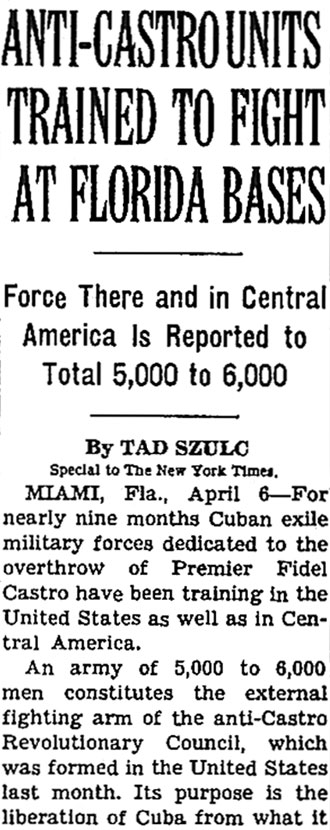
Indeed, there is no evidence that Kennedy called anyone at the Times in advance of the report–which was written by Tad Szulc and published April 7, 1961, on the Times front page (see right).

As I note in Getting It Wrong:

“The Kennedy Library in Boston says that the White House telephone logs reveal no calls were placed to Reston” or other Times executives on April 6, 1961, the day the story was prepared for publication.

“Moreover,” I note, “Kennedy had almost no chance to speak with those executives during the interval from when Szulc’s story arrived at the Times building in midtown Manhattan and when it was set in type. … During that time, Kennedy was otherwise preoccupied. He spent the last half of the afternoon of April 6, 1961, playing host to Harold Macmillan, the British prime minister, on a lengthy cruise down the Potomac River to Mount Vernon.”

In addition, Halberstam’s Powers That Be invoked one of the most enduring media myths–the anecdote about William Randolph Hearst’s purported vow to “furnish the war” with Spain at the end of the 19th century.

That anecdote is revisited, and dismantled, in the first chapter of Getting It Wrong.

The Powers That Be was a popular success, reaching the second spot on the New York Times best-selling list in May 1979. But the book wasn’t without persuasive critics.

Among them was David Culbert, an historian at Louisiana State University who years ago raised questions about the “Cronkite Moment,” noting that Johnson was in Texas when the program aired.

In a devastating review published in the American Historical Review, Culbert called The Powers That Be overlong and declared:

“The absence of a developed thesis, lack of proper documentation, and numerous errors of fact for events before the 1960s suggest that historians will have to use this book with caution. There is much here that might be true and, if true, valuable, but there is also no certainty that sloppy research does not undermine the very parts that seem most interesting.”

WJC

One paragraph, three myths

In Cronkite Moment, Debunking, Media myths, Murrow-McCarthy myth, New York Times, Washington Post, Watergate myth on April 21, 2010 at 11:45 am

A column posted today at a Canadian online news site achieved the feat of working three media-driven myths into a single paragraph.

Here’s what the columnist wrote, in a paean to the power and influence that traditional news media once wielded, supposedly:

“A Walter Cronkite could, however belatedly, expose the pointlessness of Vietnam. Famously, Edward R. Murrow deflated McCarthy. A pair of scruffy reporters could bring down a Nixon.”

Three sentences, three myths–a trifecta that is very rare.

All three media-driven myths are addressed, and debunked, in my book, Getting It Wrong, to be published in summer by the University of California Press.

The reference to Cronkite is to the CBS anchorman’s report of February 27, 1968, in which he said the U.S. military was “mired in stalemate” in Vietnam. As I write in Getting It Wrong, such a characterization was scarcely original or exceptional at the time. It was no exposé.

Indeed, nearly seven months before Cronkite’s pronouncement, the New York Times had suggested in a front-page report that the war was stalemated.

Victory in Vietnam, the Times report said, “is not close at hand. It may be beyond reach.”

That Murrow “deflated” Senator Joseph R. McCarthy is another media myth, stemming from Murrow’s See It Now television program of March 9, 1954.

Murrow in fact was quite belated in confronting McCarthy and the senator’s communists-in-government witch hunt.

The half-hour See It Now program on McCarthy came many months–even years–after other journalists had pointedly challenged the senator and his bullying tactics. Eric Sevareid, a friend and CBS colleague of Murrow, pointedly noted that Murrow’s program “came very late in the day.”

In an interview in 1978, Sevareid said: “The youngsters read back and they think only one person in broadcasting and the press stood up to McCarthy and this has made a lot of people feel very upset, including me, because that program came awfully late.”

And by the time Murrow’s report aired, McCarthy’s favorable ratings had been in decline for three months, as also I note in Getting It Wrong.

The Canadian columnist’s reference to “a pair of scruffy reporters” who supposedly brought down Richard Nixon is, of course, to Carl Bernstein and Bob Woodward, who covered the Watergate scandal for the Washington Post.

As I’ve noted in previous posts at MediaMythAlert, the notion that the reporters brought down Nixon and his corrupt presidency is a myth that even the Post has tried to dismiss.

Howard Kurtz, the newspaper’s media reporter, wrote in 2005, for example:

“Despite the mythology, The Post didn’t force Richard Nixon from office—there were also two special prosecutors, a determined judge, bipartisan House and Senate committees, the belated honesty of [former White House lawyer] John Dean and those infamous White House tapes.”

Kurtz’s observations parallel those of Stanley I. Kutler, a leading historian of the  Watergate scandal, who has written:

“The fact is, an incredible array of powerful actors all converged on Nixon at once—the FBI, prosecutors, congressional investigators, the judicial system.”

The three myths are stories well-known and even cherished in American journalism. They almost always are cited as examples of media power and influence, of journalists at their courageous best.

But as I write in Getting It Wrong:

“To identify these tales as media myths is to confront the reality that the news media are not the powerful agents they, and many others, assume them to be.”

WJC

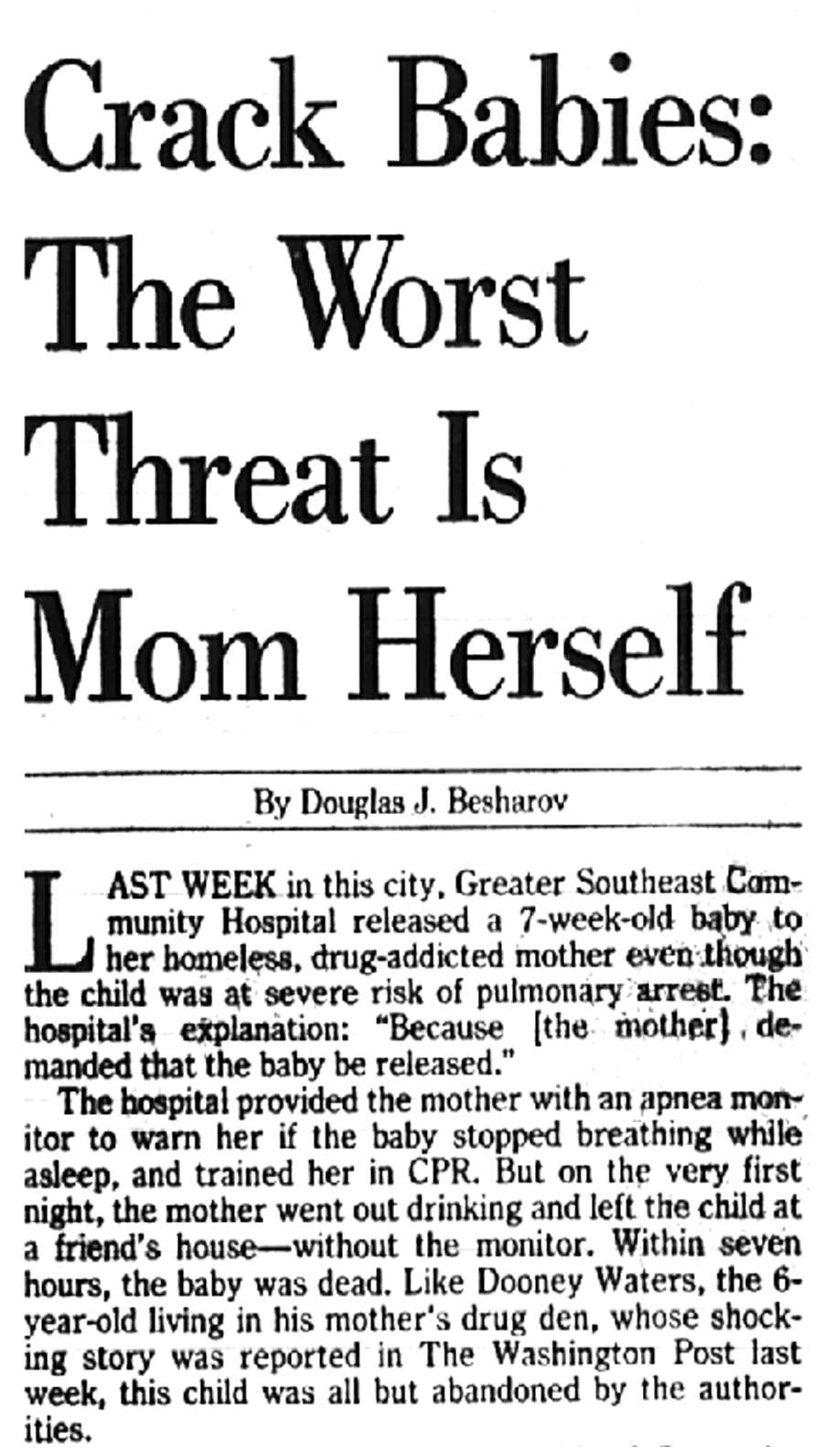
Skirting the media’s role in the ‘crack baby’ scare

In Debunking, Media myths, Newspapers, Washington Post on April 18, 2010 at 3:40 pm

The Washington Post today revisits the “crack baby” scare of the late 1980s and 1990s and reports that “in the two decades that have passed since … these babies have grown into young adults who can tell their stories–and for the most part, they are tales of success.”

The Post notes that “a lot of misinformation surfaced” about the “crack baby” phenomenon, and cites an often-quoted column by Charles Krauthammer who in 1989 wrote:

Washington Post, August 1989

“Theirs will be a life of certain suffering, of probable deviance, of permanent inferiority.”

(Although the Post article doesn’t mention it, Krauthammer also wrote in that column: “The inner-city crack epidemic is now giving birth to the newest horror: a bio-underclass, a generation of physically damaged cocaine babies whose biological inferiority is stamped at birth.”)

Otherwise, the Post‘s report steered well clear of considering the news media’s central role in spreading “misinformation” about “crack babies,” a topic is explored in Getting It Wrong, my forthcoming book about media-driven myths.

The scare, I write, “was a media-driven myth based more on anecdote than solid, sustained research, a myth that had the effect of stigmatizing underprivileged children presumed to have been born damaged and despised as ‘crack babies.’”

I further note:

“To be sure, smoking crack during pregnancy is hardly risk-free, and certainly neither prudent nor sensible.”

However, I add, “the effects of prenatal cocaine exposure have proved more subtle than sweeping: Newborns exposed to crack during pregnancy tend to be smaller in birth weight, in length, and in head circumference. Some research suggested that mild cognitive deficiencies, such as difficulties in concentrating on tasks at hand, might be attributable to prenatal cocaine exposure, especially as cognitive demands on children intensify as they grow older.

“But biomedical research has found nothing akin to a ‘bio-underclass,’” that Krauthammer and others warned about some 20 years ago.

Revisiting the media-driven myth of the crack baby is important, I write in Getting It Wrong, because doing so “allows insights into a tendency among journalists to neglect or disregard the tentativeness that characterizes serious scientific and biomedical research, and to reach for certainty and definitiveness that are not often found in preliminary findings.

“The tendency of journalists to push hard on tentative data has been apparent in coverage of more recent drug scares, notably that of methamphetamine in 2004 and 2005.”

The Post‘s report today was the latest in what, in effect, has been an intermittent series in leading newspapers to revisit the “crack baby” scare and find it to have been exaggerated.

In a lengthy article published 15 months ago, the New York Times called the scare “the epidemic that wasn’t.” A columnist for the New York Daily News acknowledged in 2004 that “we probably overreacted with forecasts of harm to so-called ‘crack babies.’”

And more than 12 years ago, the Post carried a story similar to today’s. That article appeared on page Z10, beneath the headline: “‘Crack Baby’ Fears May Have Been Overstated.”

As I note in Getting It Wrong, “The news media’s retreat or rollback on crack babies was neither as extensive nor as prominent as the dramatic and ominous reports about the scourge in the late 1980s and early 1990s.”

I quote the alternative magazine, Mother Jones, which pointed out in 1995:

“The publicity blitz that spread the crack-baby myth has not been matched by an attempt to unmake the myth—and many, many people still believe in it.”

The term “crack babies” remains firmly in circulation; it is invoked casually and idiomatically, as something of a cliché.

WJC

Movies about journalists: Another list, another myth

In Cinematic treatments, Debunking, Furnish the war, Media myths, Newspapers, Washington Post, Watergate myth on April 17, 2010 at 6:31 pm

The blog True/Slant includes a ranking today of the 10 best-ever movies about journalism, and the Bogart film, Deadline U.S.A., tops the list.

This 10-best lineup was inspired by the series of newspapering movies running at Film Forum in Manhattan.

Absence of Malice (which I thought was dreadfully stereotypical), ranked second on the True/Slant list; The Paper was third, and All the President’s Men, the best-known movie about the Watergate scandal, was fourth.

Almost predictably, the description about All the President’s Men said:  “Robert Redford and Dustin Hoffman play Washington Post reporters Carl Bernstein and Bob Woodward, who reported the Watergate scandal and brought down a President. One of the few movies that makes journalism look like something worth doing.”

So there we are again–the hoary claim resurfaces that Nixon was “brought down” by the reporting of the intrepid Post reporters.

It’s what I call the heroic-journalist myth, and it’s addressed, and debunked, in Getting It Wrong, my forthcoming book about media-driven myths.

I note in the book, which is due out this summer, that heroic-journalist myth of Watergate is one of the most appealing and self-reverential stories in American media history.

It is striking indeed how routinely and even off-handedly Bernstein and Woodward are credited with the accomplishment, especially when the record of Watergate shows that the Post’s reporting had at best a marginal effect on forcing Nixon’s resignation in 1974.

Other forces and factors were far more decisive to the denouement of Watergate. As Howard Kurtz, the Post’s media reporter, has written:

“Despite the mythology, The Post didn’t force Richard Nixon from office—there were also two special prosecutors, a determined judge, bipartisan House and Senate committees, the belated honesty of [former White House lawyer] John Dean and those infamous White House tapes.”

Nixon’s White House tapes were crucial to the outcome. He resigned the presidency shortly after the Supreme Court ordered him to turn over the tapes subpoenaed by the Watergate special prosecutor.

One of the tapes undeniably showed Nixon participating in the coverup of the burglary at Democratic national headquarters, the signal crime of the Watergate scandal.

I also note in Getting It Wrong that motion pictures have a way of solidifying media-driven myths in the public’s consciousness.

“High-quality cinematic treatments,” I write, “are powerful agents of media myth-making, and can enhance a myth’s durability.”

And so what’s my top movie about newspapering? The 1941 Orson Welles masterpiece, Citizen Kane.

And that’s probably because I get such a laugh every time I watch the scene that paraphrases William Randolph Hearst‘s purported vow “to furnish the war” with Spain.

That may be the hardiest media myth of all.

A sleeper in my lineup of best movies about journalism is John Ford’s 1962 Western, The Man Who Shot Liberty Valence.

Why Liberty Valence?

Solely because of the movie’s greatest line, which is so applicable to media myth-making:

“This is the West, sir. When the legend becomes fact, print the legend.”

WJC

On bringing down Nixon

In Cinematic treatments, Debunking, Media myths, Newspapers, Washington Post, Watergate myth on April 12, 2010 at 4:07 pm

My guestpost the other day at the “Political Bookworm” blog–in which I reviewed three media-driven myths explored in my forthcoming book, Getting It Wrong–has attracted more than a few comments, including this particularly blinkered rhetorical question:

“Do you really know anyone who believes the Washington Post brought Nixon down?”

For starters, check Investor’s Business Daily.

On the day the guestpost and the blinkered comment appeared, Investor’s Business Daily said the New York Times, in its coverage of sexual abuses by Roman Catholic priests, was “seeking the biggest prey since Woodward and Bernstein brought down Richard Nixon.”

There you go: Brought down Nixon.

Gerald Ford became president on Nixon's resignation

The Investor’s Business Daily reference, of course, was to Bob Woodward and Carl Bernstein of the Washington Post whose investigative reporting in the Watergate scandal is often and inaccurately said to have toppled Richard Nixon’s corrupt presidency.

As I note in Getting It Wrong, the heroic-journalist meme of Watergate is one of the most hardy, persistent, and delicious myths in American media history.

Interestingly, it lives on despite periodic efforts by principals at the Washington Post to dismiss it. (“Political Bookworm” is a Washington Post blog, it should be noted.)

The newspaper’s media reporter, Howard Kurtz, wrote in 2005, for example:

“Despite the mythology, The Post didn’t force Richard Nixon from office—there were also two special prosecutors, a determined judge, bipartisan House and Senate committees, the belated honesty of [former White House lawyer] John Dean and those infamous White House tapes.”

Kurtz’s observations parallel those of Stanley I. Kutler, a leading historian of Watergate, who has written:

“The fact is, an incredible array of powerful actors all converged on Nixon at once—the FBI, prosecutors, congressional investigators, the judicial system.”

Amid this array of subpoena-wielding authorities investigating Watergate, the contributions of Woodward and Bernstein were modest–and certainly not decisive to the scandal’s outcome.

Still, the heroic-journalist myth is alive, well–and often invoked.

In large measure, that’s because the 1976 motion picture All the President’s Men–the leading movie about Watergate–depicted Woodward and Bernstein as essential to unraveling the scandal.

Indeed, this myth is a trope that knows few bounds.

WJC

In today’s ‘Outlook’ section

In Cronkite Moment, Debunking, Furnish the war, Media myths, Murrow-McCarthy myth, Newspapers, Washington Post, Watergate myth on April 11, 2010 at 12:13 pm

An abbreviated version of my recent guestpost at the “Political Bookworm” blog appeared today in the “Outlook” section of the Washington Post.

Here’s the text of the “Outlook” piece, with links that I’ve added:

W. Joseph Campbell, a professor of communication at American University, busts some media myths in his book, “Getting It Wrong: Ten of the Greatest Misreported Stories in American Journalism,” coming in July from the University of California Press. Here are three of Campbell’s biggies:

1. William Randolph Hearst’s purported vow, telegraphed to the artist Frederic Remington in Cuba, to “furnish the war” with Spain. Hearst denied making such a statement. The telegram containing his purported pledge has never turned up. The “furnish the war” anecdote can be traced to 1901 and a memoir by another journalist, James Creelman, who did not say when or how he learned the story about Hearst’s vow.

2. Edward R. Murrow brought an end to Sen. Joseph R. McCarthy’s communists-in-government witch hunt. This myth stems from Murrow’s CBS program “See It Now” on March 9, 1954, when the newsman dissected McCarthy’s crude investigative techniques and taste for the half-truth — none of which was unknown to American audiences at the time. The myth took hold even though years before the program aired, several prominent journalists — including Washington-based syndicated columnist Drew Pearson — had become searching critics of McCarthy and his tactics.

Nixon resigns, 1974

3. The Washington Post’s investigative reporting brought down Richard Nixon’s corrupt presidency. Katharine Graham, The Post’s publisher during the Watergate period, said in 1997: “Sometimes people accuse us of bringing down a president, which of course we didn’t do. The processes that caused [Nixon’s] resignation were constitutional.” She was right, but the complexities of Watergate are not readily recalled these days. What does stand out is a media-centric interpretation that the dogged reporting of Post journalists Bob Woodward and Carl Bernstein brought Nixon down.

WJC