W. Joseph Campbell

Posts Tagged ‘Media’

Four weeks on: No answer from WaPo about empty links to Jessica Lynch stories

In Debunking, Jessica Lynch, Media myths, Newspapers, Washington Post on May 25, 2012 at 6:55 am

Lynch photo at WaPo’s Iraq archive

Want to read the Washington Post article of April 10, 2003, about the fall of Baghdad to U.S. forces? The article’s online link is here.

How about the Post’s report about the Iraqi lawyer who helped lead U.S. rescuers to Jessica Lynch, the Army private taken prisoner and hospitalized following a deadly ambush in the war’s early days? Here’s the link to that story,  which the Post published on its front page April 4, 2003.

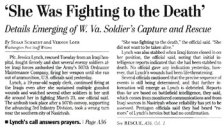
How about the Post’s front-page article of the day before, which told of Lynch’s supposed heroism in the ambush, how she had fought fiercely and “continued firing at the Iraqis even after she sustained multiple gunshot wounds and watched several other soldiers in her unit die around her”?

It was an electrifying report, one picked up by news organizations around the world.

But it turned out that the Post’s hero-warrior tale about Lynch was embarrassingly wrong in all important details. Lynch never fired a shot in Iraq; she was neither shot nor stabbed, as the Post had reported, but badly injured in the crash of a Humvee as it fled the ambush.

Try finding the botched hero-warrior story at the Post’s online site. All that turns up is a headline, byline, and date of publication. Otherwise, it’s an empty link. No content, in other words.

That’s also true for a column published April 20, 2003, by Michael Getler, the newspaper’s then-ombudsman, who criticized the hero-warrior story: Another empty, no-content link.

Same for the Post’s partial rollback of the hero-warrior story, published in mid-June 2003: Also an empty link.

So what gives? Why is some of the Post’s content about the Iraq War — and Jessica Lynch — freely available online while the more embarrassing material shows up as empty links?

Is this a matter of digital scrubbing, akin to Vogue magazine’s excising of a flattering profile of the wife of the Syrian dictator, Bashar al-Asad? The Post last month described the Vogue matter as “an almost-unheard-of step for a mainstream media organization.”

Periodically over the past four weeks, I’ve asked the Post’s ombudsman, Patrick Pexton, about the digitally unavailable versions of the newspaper’s reports about Lynch.

Pexton has  promised to look into my questions.

But four weeks on, he has yet to offer a substantive reply.

I have asked him: “Does the embarrassment quotient explain this apparent inconsistency?” That is, is the Post too embarrassed by its botched reporting about Lynch to make the links freely available online?

I suspect it is.

In his most recent email to me, on May 16, Pexton said he receives “200 to 300 e-mails per day and we’re always behind. We are working on trying to get you some answers on this.”

I replied the following day, thanking him for the update and saying I hoped to hear from him soon.

I also wrote:

“I believe my request can be distilled thusly:

“Why is some Lynch-related content from 2003 freely available online (see here), while content more embarrassing to the Post (see empty links here, here, and here) not available? Shouldn’t those empty links be restored, and added to the Post’s link-rich Iraq War archive, where Lynch’s name and image already appear?”

That email produced no response from Pexton, however.

The Post‘s digital archive of the Iraq War offers a functioning link to the article about the Iraqi lawyer who helped guide rescuers to Lynch.

In fact, the only U.S. soldier identified by name and image at the archive is Jessica Lynch.

I discuss the Post’s reporting of the Lynch case in a chapter in my latest book, Getting It Wrong.

WJC

Many thanks for Instapundit
Glenn Reynolds for linking to this post

Recent and related:

On bra-burning, Erica Jong is wrong

In Bra-burning, Debunking, Media myths, Photographs on March 28, 2012 at 4:25 pm

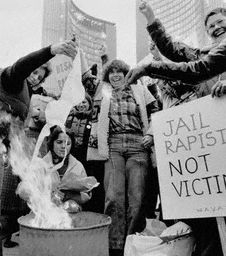
Bra-burning in Toronto, 1979 (Bettmann/Corbis)

The writer Erica Jong asserts in a rambling commentary posted yesterday at the Daily Beast that bra-burning “never actually occurred.”

The mischaracterization of bra-burning was an element of Jong’s defense of feminism and the sexual revolution of the 1960s and 1970s.

Jong wrote in the commentary:

“The fact that the so-called mainstream press reduced our valid struggles to sex, drugs, rock and roll, and bra burning (which, btw, never actually occurred) was their attempt to further disempower us. And they surely prevailed.”

It’s not an infrequent claim, that feminist bra-burning was a media trope, a media myth. That it “never actually occurred.”

But there were at least a couple of documented occasions when feminist protesters set fire to bras.

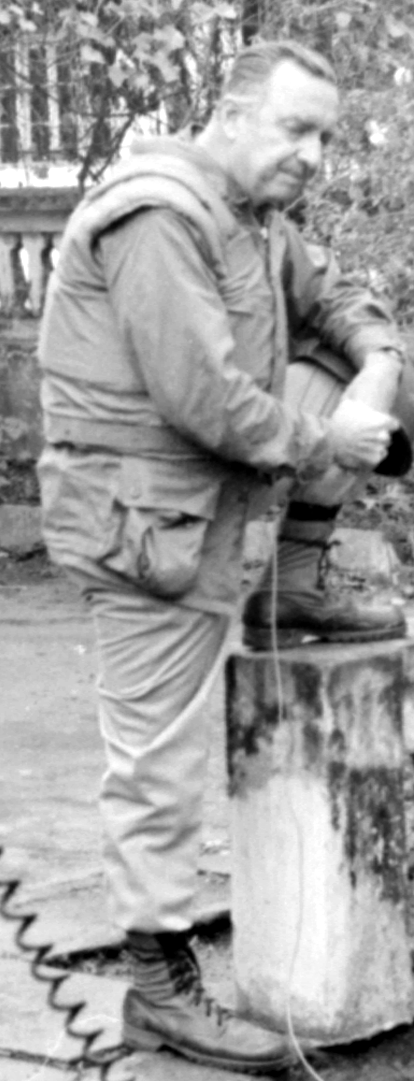
One occasion came 33 years ago this month, when members of Women Against Violence Against Women demonstrated outside Toronto City Hall. As the demonstration neared its end, a protester named Pat Murphy dropped a white bra into the hungry flames of a burn barrel (see photo, above).

The demonstration in Toronto on March 8, 1979, coincided with International Women’s Day and was aimed at denouncing a report on rape prepared by the Ontario Provincial Police.

The police report said “promiscuity” was a factor in many rapes.

The Women Against Violence Against Women group assailed the report as outrageous and “dazzling in its illogic.” Protesters carried signs saying: “Take a Rapist to Lunch — Charcoal Broiled” and “Hookers Who Wink Go to the Clink! Men Who Rape Escape.”

The Globe and Mail newspaper reported that the protesters lighted “a fire in a garbage can, to the obvious annoyance of about a dozen watchful constables, [and] shouted: ‘Burn the rapists, burn the city, burn the OPP,’” acronym for Ontario Provincial Police.

The newspaper’s account did not specifically mention bra-burning which, one participant has told me, “wasn’t a focal point” of the protest.

But bra-burning did happen there.

Another participant has recalled that “weighing in on the stereotype of ‘feminist bra-burners’ was actually an effective way [for protesters] to say: Women will control our own bodies, thank you!

“The bra burning,” she said, “was a way to entice the media as well as [offer] a critique of the police report.”

A little more than 10 years before the demonstration in Toronto, some 100 women gathered on the boardwalk at Atlantic City, New Jersey, to protest the 1968 Miss America pageant. The demonstration was organized by a small group called New York Radical Women and was an early manifestation of the women’s liberation movement.

In Getting It Wrong, my mythbusting book that came out in 2010, I offer evidence that bras were set afire, briefly, during the demonstration at Atlantic City.

The evidence is from two witness accounts, one of which was published in the local newspaper, the Press of Atlantic City, on September 8, 1968, the day after the protest.

Boucher (1949 photo)

That account appeared beneath the byline of a veteran reporter named John L. Boucher and carried the headline:

“Bra-burners blitz boardwalk.”

Boucher’s article referred to the burn barrel that demonstrators dubbed the “Freedom Trash Can” and stated:

“As the bras, girdles, falsies, curlers, and copies of popular women’s magazines burned in the ‘Freedom Trash Can,’ the demonstration reached the pinnacle of ridicule when the participants paraded a small lamb wearing a gold banner worded ‘Miss America.’”

That published account was buttressed by recollections of the writer Jon Katz, who in 1968 was a young reporter for the Atlantic City newspaper. Katz was on the Atlantic City boardwalk the day of the protest, gathering material for a sidebar article about reactions to the demonstration.

Katz’s sidebar didn’t mention the fire in the “Freedom Trash Can.”

But in correspondence with me, Katz stated:

“I quite clearly remember the ‘Freedom Trash Can,’ and also remember some protestors putting their bras into it along with other articles of clothing, and some Pageant brochures, and setting the can on fire.

“I am quite certain of this.”

WJC

Many thanks to Instapundit
Glenn Reynolds for linking to this post.

Recent and related:

Just what we need: Barbra Streisand, media critic

In Cronkite Moment, Debunking, Media myths, Murrow-McCarthy myth on February 5, 2012 at 9:25 am

Celebrities and movie stars rarely make thoughtful, searching media critics, as Barbra Streisand demonstrated in a tedious and predictable essay the other day at Huffington Post.

The actress indulged a bit in the golden age fallacy, recalling broadcast journalists Edward R. Murrow and Walter Cronkite as exemplary newsmen whose talents these days are sorely missed.

“Americans,” Streisand wrote, “are busy, working hard to support and provide for their families. They don’t have time to parcel out fact from fiction. They depend on the Fourth Estate to guide them and to hold individuals running for office, especially the highest office in our country, accountable.”

The claim that Americans “depend on the Fourth Estate to guide them” is surely overstated, given evidence that many Americans go newsless and ignore media content altogether.

Streisand went on, extolling media icons of the past:

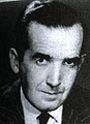
Murrow

“Journalists like Walter Cronkite and Edward R. Murrow knew it was their duty to know the facts and disseminate them to the public. That responsibility in today’s media world seems to be diminishing.”

Murrow, who came to fame on CBS radio in the 1940s and on CBS television in 1950s, was no white knight, though. He hardly was above the political fray.

As I note in my media mythbusting book, Getting It Wrong, Murrow privately donated time and expertise in acquainting Adlai Stevenson, the 1956 Democratic presidential candidate, with television.

I cite A.M. Sperber, one of Murrow’s leading biographers, who wrote that Murrow agreed “to help the Democrats” in offering Stevenson tips on “the finer points of speaking to the camera.”

Sperber, who characterized Murrow’s move “a radical departure from his usual practice,” said Stevenson “barely endured” the tutoring.

What’s more, Murrow is the subject of one of American journalism’s more savory and tenacious myths — that he stood up to the red-baiting senator, Joseph R. McCarthy, when no other journalist would, or dared.

Which is nonsense.

As I discuss in Getting It Wrong, Murrow was quite late in confronting McCarthy, doing so long after a number of journalists – including the muckraking columnist Drew Pearson– had become persistent and searching critics of the senator, his record, and his tactics.

Cronkite, the famous CBS News anchorman from 1963 to 1981, likewise is the subject of a durable media-driven myth — that his editorializing about the war in Vietnam in February 1968 forced President Lyndon B. Johnson to realize the folly of his policy.

Legend has it that Johnson was watching at the White House when Cronkite pronounced the U.S. military “mired in stalemate” in Vietnam. Cronkite also suggested the negotiations might offer a way out of the morass.

Upon hearing Cronkite’s downbeat assessment, Johnson supposedly leaned over and snapped off the television set, telling an aide or aides, “If I’ve lost Cronkite, I’ve lost Middle America.”

Or something to that effect. Versions vary, markedly.

But as I discuss in Getting It Wrong, Johnson did not see the program in which Cronkite made his editorial comment.

Johnson in Austin: Didn't see Cronkite show

Johnson at the time was in Austin, Texas, attending the 51st birthday party of Governor John Connally, a longtime political ally. About the time Cronkite was intoning “mired in stalemate,” Johnson was joking about Connally’s age, saying:

“Today you are 51, John. That is the magic number that every man of politics prays for—a simple majority.”

It’s illogical to argue that Johnson could have been much moved by a television report he hadn’t seen.

Granted, Cronkite’s editorial comment about Vietnam — tepid though it was — represented something of a departure for the avuncular anchorman. He usually tried to play it straight, because he had to.

As media critic Jack Shafer pointed out shortly after Cronkite’s death in 2009, the anchorman’s impartiality was partly a function of the federal “Fairness Doctrine,” which sought to encourage balanced reporting on the air.

Shafer wrote that “between 1949 and 1987 — which come pretty close to bookending Cronkite’s TV career — news broadcasters were governed by the federal ‘Fairness Doctrine.’ The doctrine required broadcast station licensees to address controversial issues of public importance but also to allow contrasting points of view to be included in the discussion.

“One way around the Fairness Doctrine was to tamp down controversy,” which he notes, the three U.S. television networks of the time “often did.”

So, no: Murrow and Cronkite weren’t exactly paragons of play-it-straight journalism. Pining for them while deploring today’s freewheeling media landscape is neither very sophisticated nor very useful.

Nor even fair to the historical record.

WJC

Recent and related:

‘Yellow journalism’: The back story to a sneer, 115 years on

In 1897, Anniversaries, Spanish-American War, Yellow Journalism on January 31, 2012 at 6:35 am

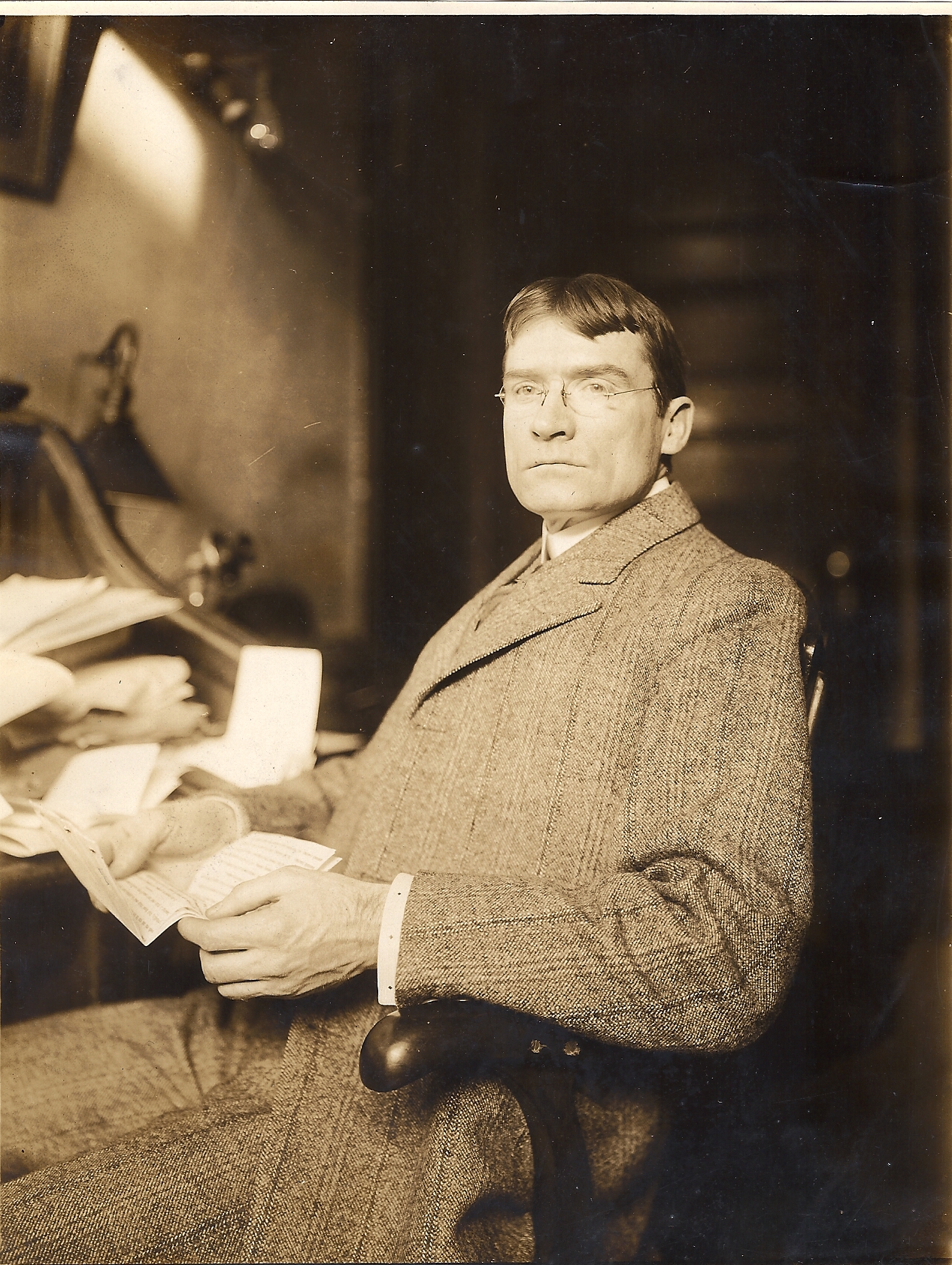
Wardman: Gave us 'yellow journalism'

Yellow journalism” is a disparaging epithet often invoked in journalism, even though its derivation is little known.

This is the back story to a sneer that trips easily off the tongue with scorn and condescension.

The first verified use of the term was 115 years ago today, when “yellow journalism” appeared in the old New York Press.

The phrase “the Yellow Journalism” appeared in a small headline on the Press’ editorial page on January 31, 1897. The phrase also appeared that day in the newspaper;s editorial page gossip column, “On the Tip of the Tongue.”

Yellow journalism” was quickly embraced in American newspapering, as a way to disparage and denigrate the freewheeling practices of William Randolph Hearst and his New York Journal as well as Joseph Pulitzer and the New York World.

Within weeks of the first use of the term, references to “yellow journalism” had appeared in newspapers in Providence, Richmond, and San Francisco.

In the 115 years since then, “yellow journalism” has turned into a derisive if vague shorthand for denouncing sensationalism and journalistic misconduct of all kinds.

“It is,” I wrote in my 2001 book, Yellow Journalism: Puncturing the Myths, Defining the Legacies, “an evocative term that has been diffused internationally, in contexts as diverse as Greece and Nigeria, as Israel and India.”

I also noted that yellow journalism emerged in “a lusty, fiercely competitive, and intolerant time, when newspapers routinely traded brickbats and insults” and even threats.

Just how Wardman and the Press came up with “yellow journalism” is not clear.

The newspaper’s own, brief discussion of the term’s derivation was decidedly unrevealing. “We called them Yellow because they are Yellow,” the Press said in 1898 in a comment about the Journal and the World.

In the 1890s, the color yellow sometimes was associated with depraved literature, which may have been an inspiration to Wardman, an austere figure largely lost to New York newspaper history. (The New York Times said in 1923 in its obituary of Wardman: “Like many another anonymous worker in journalism, his name was not often conspicuously before the public, and he was content to sink his personality in that of the papers which he served.”)

Wardman, who earned a bachelor’s degree in three years at Harvard University, once was described as showing “Calvinistic ancestry in every line of his face.” He did little to conceal his contempt for Hearst and Hearst’s flamboyant style of journalism.

Disdain routinely spilled into the columns of the Press, of which Wardman became editor in chief in 1896 at the age of 31. (The Press ceased publication in 1916.)

The Press took to taunting Hearst, Hearst’s mother, and Hearst’s support for Democratic candidate William Jennings Bryan in the 1896 presidential election. Hearst’s Journal was virtually alone among New York newspapers in supporting Bryan’s “free silver” candidacy.

The Press taunted Hearst, then 34, as a mama’s boy and “little Willie.” It referred to the Journal as “our silverite, or silver-wrong, contemporary.”

The Press also experimented with pithy if stilted turns of phrase to denounce “new journalism,” Hearst’s preferred term to characterize his style of newspapering.

“The ‘new journalism,’” the Press said in early January 1897 “continues to think up a varied assortment of new lies.”

Later in the month, the Press asked in a single-line editorial comment:

“Why not call it nude journalism?”

It clearly was a play on “new journalism” and was meant to suggest the absence of “even the veneer of decency.”

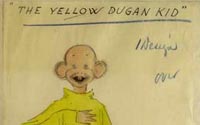
It wasn’t long before Wardman and the Press seized upon the phrase “yellow-kid journalism,” which evoked the Hearst-Pulitzer rivalry over a popular cartoon character known as the “Yellow Kid.” Both the Journal and the World at the time were publishing versions of the kid.

The Yellow Kid (Library of Congress)

At the end of January 1897, the phrase “yellow-kid journalism” was modified  to “the Yellow Journalism,” and the sneer was born.

Wardman turned often to this delicious pejorative, invoking it in a number of brief editorial comments such as:

“The Yellow Journalism is now so overripe that the little insects which light upon it quickly turn yellow, too.”

The diffusion of “yellow journalism” was confirmed when Hearst’s Journal embraced the term in mid-May 1898, during the Spanish-American War. With typical immodesty, it declared:

“… the sun in heaven is yellow—the sun which is to this earth what the Journal is to American journalism.”

WJC

Adapted from an essay posted in 2010 at Media Myth Alert.

Recent and related:

WaPo still dodging responsibility in Jessica Lynch case

In Debunking, Jessica Lynch, Washington Post on December 14, 2011 at 2:01 pm

Lynch in 2003

The Washington Post — the newspaper that brought the world the bogus hero-warrior tale about Jessica Lynch early in the Iraq War — placed at its Web site today a wire service report about Lynch’s completing an education degree at the University of West Virginia at Parkersburg.

The 900-word report made no mention about the Post’s singular role in pressing the hero-warrior tale into the public domain but instead invoked the false narrative that the U.S. military made up the account about Lynch’s battlefield heroics to bolster support at home for the war.

“To make her seem more heroic and rally public support for the war,” said the report by the Associated Press, which the Post placed online, “the military claimed she’d gone down firing — when, in fact, her rifle had jammed.”

How arrogant: It was the Post that reported Lynch had “gone down firing,” that she had fought ferociously in the ambush of her unit, the 507th Maintenance Company, at Nasariyah in March 2003.

It was the Post — citing otherwise unnamed “U.S. officials” — that presented the electrifying tale that Lynch had “shot several enemy soldiers” in the ambush.

It was the Post that reported Lynch “continued firing at the Iraqis even after she sustained multiple gunshot wounds and watched several other soldiers in her unit die around her” in the fighting.

It was the Post that said Lynch also suffered stab wounds in the ambush.

But none of it was true.

Lynch never fired a shot in Iraq. Her weapon jammed during the ambush.

She suffered shattering injuries not in battling Iraqi soldiers but in the crash of a Humvee as it fled the ambush.

As I discuss in a chapter in my latest book, Getting It Wrong, the Post has never fully explained how it got the Lynch story so badly wrong.

It has never disclosed the anonymous sources it cited in presenting the bogus hero-warrior tale.

Indeed, the Post has largely sidestepped accountability for the bogus hero-warrior narrative, which has allowed the false narrative about the military’s concocting the Lynch story to take hold and proliferate.

We know it’s a false narrative from one of the Post reporters whose byline appeared on the botched Lynch story, which was published April 3, 2003, beneath the headline:

“‘She was fighting to the death.'”

Vernon Loeb, a veteran journalist whose byline appeared on that report, said in an interview on NPR’s Fresh Air program in December 2003:

“Our sources for that story were not Pentagon sources.”

He also said in the interview:

“They wouldn’t say anything about Jessica Lynch.”

Loeb added: “I just didn’t see the Pentagon trying to create a hero where there was none. I mean …they never showed any interest in doing that, to me.”

Loeb said the Post based its story on the accounts of “some really good intelligence sources” in Washington, D.C., adding:

“We wrote a story that turned out to be wrong because intelligence information we were given was wrong. That happens quite often.”

As I note in Getting It Wrong, Loeb on another occasion was quoted in a commentary in the New York Times as saying:

“Far from promoting stories about Lynch, the military didn’t like the story.”

Loeb also was quoted in the commentary as saying that “the sources for this information [about Lynch’s derring-do] were apparently Iraqis, both Iraqi informants and intercepts.”

Loeb’s disclaimers notwithstanding, the notion that the Pentagon’s made up the story to bolster domestic U.S. support for the war makes little sense. The American public, after all, supported the Iraq War in overwhelming numbers in its early days and weeks, as I point out in Getting It Wrong.

But it’s clear that if not for the Post’s erroneous reporting, the bogus tale of Lynch’s battlefield heroism never would have circulated as widely and as profoundly as it did.

WJC

Recent and related:

The ‘War of the Worlds’ radio show produced a ‘Paul Revere effect’

In Anniversaries, Debunking, Media myths, Media myths and radio on October 31, 2011 at 5:15 pm

I call it the “Paul Revere” effect, and it helps explain the many reports of fright associated with the radio dramatization 73 years ago of The War of the Worlds, a clever program that told of a lethal Martian invasion of Earth.

The radio show aired October 30, 1938, and supposedly stirred panic and hysteria across the United States — a delicious narrative that I debunk in my latest book, Getting It Wrong, as a media-driven myth.

I also discuss in Getting It Wrong the seldom-examined “Paul Revere effect” associated with The War of the Worlds program, which was the work of Orson Welles and his “Mercury Theatre on the Air” troupe.

This effect occurred when well-intentioned people who had little more than an incomplete understanding of The War of the Worlds broadcast decided individually and on their own to warn others about what they thought was a sudden and terrible threat.

These self-motivated Paul Reveres, I write in Getting It Wrong, “burst into churches, theaters, taverns, and other public places, shouting that the country was being invaded or bombed, or that the end of the world was near.”

I note that it must “have been a cruel and unnerving way of receiving word of a supposedly calamitous event — to be abruptly disturbed in familiar settings by a vague reports offered by people who themselves clearly were terror-stricken.”

The unsuspecting recipients of these invariably garbled, second- and third-hand accounts of calamity had no immediate way of verifying the wrenching news they had heard. Unlike the audiences of Welles’ dramatization, they could not spin the radio dial to find out whether other networks were reporting an invasion from Mars.

Scrutiny of contemporaneous newspaper accounts reveals numerous cases of this false-alarm contagion. This meant that people who had not heard not a word of The War of the Worlds show were themselves fearstricken, if only briefly.

In New York, for example, some apartment houses “were hurriedly emptied by frantic listeners to the program and by those who heard second- and third-hand accounts multiplying the supposed peril,” the Newark Star-Eagle reported.

“Many of the panic-stricken did not hear the original broadcast but got their misinformation from others,” the newspaper said.

A Methodist church service in Indianapolis was disrupted that night “when an hysterical woman member of the congregation entered shortly after worship had begun,” the Indianapolis Star reported.

The woman rushed to the pulpit, telling the pastor, “Something so terrible has happened that I must interfere.”

She told worshippers that “New York has been destroyed” and added: “I believe the end of the world has come. I heard it over the radio.”

The pastor offered a short prayer and excused anyone who wanted to return home. Several members of the choir “doffed robes and went from the church, followed by a portion of the congregation,” the Star reported. But the service continued.

Soon, several members of the congregation returned, explaining sheepishly that the alarm had been caused by nothing more than a misunderstood radio show.

As I note in Getting It Wrong, it is impossible to estimate the cumulative effect of the false-alarm contagion that night. But the second- and third-hand accounts, spread Paul Revere-like, stirred some measure of evanescent apprehension among untold thousands of people who had not listened to the program.

It is tempting to suggest, I write, “that what radio-induced fear there was that night was mostly spread by credulous people who heard muddled and fragmentary accounts about the program and set about to alert others,” on their own.

WJC

Recent and related:

Historian dismisses as ‘self-promotion’ the heroic-journalist interpretation of Watergate

In Debunking, Media myths, Washington Post, Watergate myth on October 25, 2011 at 5:44 am

Kutler

Stanley I. Kutler, the preeminent historian of the Watergate scandal, was on campus yesterday to speak to a government class, and he told me after his talk that the heroic-journalist interpretation of Watergate is grounded in reportorial “self-promotion.”

The heroic-journalist narrative has it that Richard Nixon’s corrupt presidency was brought down through the reporting of Bob Woodward and Carl Bernstein for the Washington Post.

It’s a myth, as I discuss in my latest book, Getting It Wrong. But it long ago became the dominant narrative of how Watergate was rolled up — a simplistic narrative that Kutler effectively dismantled during his appearance at American University.

In response to a question I posed afterward, Kutler said “self-promotion” by Woodward and Bernstein — notably their book about their Watergate reporting — explains the tenacity of what I call the heroic-journalist narrative.

Kutler, an emeritus professor at the University of Wisconsin, is the author, among other works, of The Wars of Watergate, a thorough and definitive treatment of the scandal that unfolded from 1972-74.

His talk at American was organized around the question, “Who really unraveled Watergate?”

In the final analysis, Kutler said, Nixon “was primarily responsible” for bringing down Nixon.

If not for the evidence of Nixon’s complicity — captured on audiotapes that he secretly recorded of conversations at the Oval Office of the White House — Nixon would have survived the scandal, Kutler said.

“Absent the tapes, Nixon walks,” he said. “You had to have that kind of corroborative evidence to nail the president of the United States.”

The tapes, which Nixon surrendered when compelled by the U.S. Supreme Court, captured the president participating in June 1972 in a clumsy attempt to cover up the signal crime of Watergate, the break-in a few days before at the headquarters of the Democratic National Committee.

Kutler devoted little time in his talk to the contributions of Woodward and Bernstein, whose book about their reporting, All the President’s Men, was an immediate best-seller when it came out in June 1974, less than two months before Nixon resigned.

Kutler said the book “is a potboiler in many, many ways” and offered “a layman’s brief for understanding Watergate.”

The book, he added, is “important in that way.”

Kutler praised the work of Earl Silbert, the U.S. attorney in Washington whose office investigated the unfolding scandal in 1972-73, until a special Watergate prosecutor was named. The criminal cases against Nixon’s closest aides were “made by these guys,” Kutler said of Silbert and his investigators.

The Senate select committee on Watergate, he added, “did incredible work” in investigating the scandal — notably in extracting testimony that revealed Nixon’s secret tape-recordings. “The whole story changes,” Kutler said, with the disclosure in July 1973 of the tapes’ existence.

Kutler also lauded the contributions of federal Judge John J. Sirica, of the Watergate special prosecutors, and of the House Judiciary Committee, which approved four articles of impeachment against Nixon before his resignation in August 1974.

“Everybody has a role to play” in unraveling Watergate, Kutler said. “But let’s face it: Richard Nixon was primarily responsible” for bringing down Nixon. “The tapes damn him.”

Kutler has been at the forefront of efforts to win release of transcripts of grand jury testimony that Nixon gave in June 1975.

He won a judge’s order to unseal the testimony, which is to be made available November 10 at the online site of the Nixon Presidential Library and Museum.

“We just don’t know what’s in there,” Kutler said of the grand jury testimony, adding, however, that he expects it to contain “no spectacular fireworks.”

Kutler said that Nixon in going before the grand jury was “not going to lie. … He knew how to give non-answers.”

WJC

Recent and related:

Expansive claims for a mythical ‘moment’

In Cronkite Moment, Debunking on October 24, 2011 at 1:05 am

Cronkite in Vietnam, 1968

The claims about the presumed power of the “Cronkite Moment” of 1968 — when CBS News anchorman Walter Cronkite declared on-air that the U.S. military was “mired in stalemate” in Vietnam — are expansive and ever-expanding.

What supposedly made the “Cronkite Moment” so powerful and memorable was its effect of President Lyndon Johnson who, upon hearing the anchorman’s assessment, purportedly exclaimed:

“If I’ve lost Cronkite, I’ve lost Middle America.”

Or something to that effect.

Versions vary, markedly.

But as I discuss in my latest book, Getting It Wrong, Johnson did not see the Cronkite show when it aired on February 27, 1968. The president at the time was offering light-hearted remarks at the 51st birthday party of John Connally, then the governor of Texas.

So it’s hard to fathom how Johnson could have been much moved by a program he did not see.

Another expansive claim for the presumptive “Cronkite Moment” was that the “mired in stalemate” assessment turned American public opinion against the war.

Forbes magazine offered up that claim in a recent commentary, which declared:

“After viewing the carnage of a real war on televised nightly news for a few years, Middle America eventually agreed with CBS anchor Walter Cronkite, the ‘most trusted man in America,’ when he declared in 1968 that the war would end in stalemate.”

Agreed with Cronkite? In fact, Cronkite was following rather than leading American public opinion on the war.

As I discuss in Getting It Wrong, support for the war had begun ebbing months before the Cronkite program.

A Gallup poll in October 1967 found for the first time that a plurality of Americans — 47 percent — felt sending troops to fight in Vietnam had been a mistake.

A little more than two years earlier, only 24 percent of respondents said they thought sending American forces to Vietnam had been a mistake.

Not only that, but Cronkite’s “mired in stalemate” was hardly a remarkable or original assessment.

U.S. news media had used “stalemate” to describe the war months before Cronkite used the word in his on-air editorial comment.

For example, syndicated columnist James J. Kilpatrick wrote in August 1967:

“So long as the present ground rules obtain in Vietnam, this war will drag along its indecisive way. … [T]he condition is stalemate.”

And a few weeks before Cronkite’s on-air commentary, the NewYork Times declared in an editorial:

“Politically as well as militarily, stalemate increasingly appears as the unavoidable outcome of the Vietnam struggle.”

The Times’ observation, published February 8, 1968, anticipated Cronkite’s quite similar assessment of February 27, 1968:

“To say we are mired in stalemate seems the only realistic, yet unsatisfactory, conclusion.”

WJC

Recent and related:

Ignore new Jefferson-paternity study, see accuracy suffer

In Debunking, Media myths on October 20, 2011 at 9:53 am

The mainstream news media have largely shunned a significant new book that disputes the notion Thomas Jefferson had a long, loving relationship with a slave, Sally Hemings.

The drawbacks of ignoring the book, The Jefferson-Hemings Controversy: A Report of the Scholars Commission, are suggested by a Politico item posted yesterday.

Politico asserted:

“Most historians have concluded that, as a widower, Jefferson may have had as many as six children with Hemings, maintaining a 38-year relationship with her until his death in 1826.”

“Most historians”?

That’s a stretch, as The Jefferson-Hemings Controversy suggests.

It’s a collaborative work of 13 scholars, 12 of whom are either historians of Jefferson and his times or experts on politics and government. The outlier, as it were, is a biochemist, an expert on DNA testing.

The members of the scholars commission — empaneled by the Thomas Jefferson Heritage Society, which seeks to protect the reputation of the third president — describe in the book their collective credentials, writing:

“Most of us have studied Thomas Jefferson and his era for at least two decades, and we have held teaching or research appointments at Harvard, Yale, Stanford, Brown, Virginia, North Carolina, Kentucky, Indiana, Bowdoin, and many other respected institutions of higher learning.”

They also state that “after a careful review of all of the evidence, the commission agrees unanimously that the allegation [against Jefferson] is by no means proven. … With the exception of one member … our individual conclusions range from serious skepticism about the charge to a conviction that it is almost certainly false.”

But it’s “by no means proven.”

And yet media reports, such as that in Politico, typically treat the purported Jefferson-Hemings relationship as if it were settled history.

An important reason for the misinterpretation stems from DNA test results reported in 1998. The tests were widely misreported as identifying Jefferson as the father of Hemings’ youngest son, Eston.

The results were published in the journal Nature, which placed this erroneous headline above the article:

“Jefferson fathered slave’s last child.”

The Nature headline and its misreported findings had significant agenda-setting power.

The scholars commission, which was chaired by Robert Turner of the University of Virginia, note in the book that “much of the public has been misled about the significance of the DNA tests … reported in the journal Nature in November 1998.

“While the tests were professionally done by distinguished experts, they were never designed to prove, and in fact could not have proven, that Thomas Jefferson was the father of any of Sally Hemings’ children.”

The Jefferson-Hemings Controversy addresses the DNA evidence in some detail, noting that the tests “did no more than establish that Eston Hemings’ father was almost certainly a Jefferson.”

A Jefferson.

More than two dozen Jefferson men, including Thomas, could have been the father.

By then, though, Thomas Jefferson was 64-years-old — scarcely a leading paternity candidate.

The Jefferson-Hemings Controversy offers an intriguing hypothesis about why the DNA tests of 1998 were so widely misunderstood.

“Most Americans,” the book points out, “learned about DNA testing during the period leading up to and during the 1995 murder trial of O.J. Simpson, and they read in USA Today and other major papers than DNA ‘genetic fingerprints’ are ‘99.9 accurate’ or even ‘99.99 percent accurate.’

“When the Jefferson-Hemings story broke [nearly] four years later, it was not surprising that many people assumed scientists had matched Thomas Jefferson’s DNA with that of Sally Hemings’ children, and conclusively established Jefferson’s paternity by this remarkable new technology.

“But that is clearly not the case.”

WJC

Recent and related:

Finally: Some attention for book disputing Jefferson-slave mistress liaison

In Debunking, Media myths on October 16, 2011 at 11:22 am

C-Span 3 aired today the news conference launch of a thoroughly researched but largely ignored book disputing the narrative that Thomas Jefferson had children by a slave-mistress.

The C-Span program represented a rare occasion in which prominent U.S. news media have given attention to the book, The Jefferson-Hemings Controversy: Report of the Scholars Commission, which was released September 1 at the National Press Club in Washington.

The C-Span program showed the 90-minute news conference in full, and featured the editor of the volume, Robert Turner, a history professor at the University of Virginia.

Turner headed a commission of Jefferson scholars, which was organized in 2000 by the Thomas Jefferson Heritage Society to explore claims about Jefferson and his slave, Sally Hemings.

Turner at the news conference reviewed a welter of evidence, circumstantial and otherwise, that points away from Jefferson’s paternity.

“You look at all the pieces,” Turner said, “and they don’t point to a romantic or a sexual relationship” between Jefferson and Hemings.

The book points out that little is known about Hemings and that she “appears to have been a very minor figure in Thomas Jefferson’s life.” The third U.S. president referred to her in just four of the tens of thousands of letters he wrote.

Mainstream U.S. news media have assiduously ignored the book and its exculpatory detail about Jefferson.

When of late they have mentioned the matter, they’ve essentially bowed to the orthodoxy that Jefferson and Hemings were sexual partners.

The Washington Post, for example, referred in an article late last week to “the discovery of descendants of Thomas Jefferson and his slave Sally Hemings” — without saying just who those descendants were, or how “the discovery” was made.

As The Jefferson-Hemings Controversy points out, the evidence is neither conclusive nor compelling that Jefferson fathered any of Hemings’ children.

The book notes that DNA testing conducted in 1998 was widely misreported as identifying Jefferson as having fathered children by Hemings. The DNA test results were reported in Nature in November 1998 beneath the erroneous headline, “Jefferson fathered slave’s last child.”

Nature’s error, Turner said, “caused a lot of confusion among the American people, very sadly.”

As the book points out, the DNA tests “were never designed to prove, and in fact could not have proven, that Thomas Jefferson was the father of any of Sally Hemings’ children.

“The tests merely establish a strong probability that Sally Hemings’ youngest son, Eston, was fathered by one of the more than two dozen Jefferson men in Virginia at the time, seven of whom there is documentary evidence to believe may well have been at Monticello when Eston was conceived.”

One of more than two dozen Jefferson men.

Thomas Jefferson at the time was 64 and ailing, hardly making him a leading paternity candidate. (Turner observed at the news conference that “most men in that era didn’t see 40.”)

A more likely candidate, Turner said, is Jefferson’s younger brother, Randolph, who was known to have socialized with the slaves at Thomas Jefferson’s home, Monticello.

So — will the Post correct or clarify its unsubstantiated and probably erroneous reference to “descendants” of Jefferson and Hemings?

That it will is probably as likely as the Post’s deciding to review The Jefferson-Hemings Controversy.

WJC

Recent and related: