W. Joseph Campbell

Posts Tagged ‘Media’

Accepting the 2010 SPJ award for Research about Journalism

In Debunking, Media myths on September 25, 2011 at 7:22 am

I was in New Orleans last night to accept the Society of Professional Journalists’  Sigma Delta Chi award for Research about Journalism, for my media-mythbusting book, Getting It Wrong.

The occasion was a fine, smoothly run ceremony at a hotel near the city’s French Quarter.

Getting It Wrong, which was published last year by the University of California Press, addresses and debunks 10 prominent media-driven myths — those dubious tales about the news media that masquerade as factual.

Here’s a rundown about the respective myths dismantled in Getting It Wrong:

  1. Remington-Hearst: William Randolph Hearst’s famous vow “to furnish the war” with Spain is almost certainly apocryphal.
  2. War of Worlds: The notion that the War of Worlds radio dramatization in 1938 caused nationwide panic and mass hysteria is highly exaggerated.
  3. Murrow-McCarthy: Edward R. Murrow’s famous See It Now program in March 1954 did not end Senator Joseph McCarthy’s communists-in-government witch-hunt; Murrow in fact was very late to take on McCarthy.
  4. Bay of Pigs: The New York Times did not suppress its reporting in the run-up to the ill-fated Bay of Pigs invasion in April 1961.
  5. Cronkite-Johnson: The Walter Cronkite special report on Vietnam in February 1968 did not prompt an immediate reassessment or revision of U.S. war policy. Nor did it prompt President Lyndon Johnson to declare, “If I’ve lost Cronkite, I’ve lost Middle America.”
  6. Bra-burning: Humor columnist Art Buchwald helped spread the mistaken notion that feminist demonstrators dramatically burned their bras at a Miss America protest in September 1968.
  7. Watergate: The Washington Post’s intrepid reporters, Carl Bernstein and Bob Woodward, did not bring down Richard Nixon’s corrupt presidency. That they did is a trope that knows few bounds.
  8. Crack babies: The much-feared “bio-underclass” of children born to women who smoked crack cocaine during their pregnancies never materialized.
  9. Jessica Lynch: The Washington Post’s erroneous reporting about Jessica Lynch early in the Iraq War gave rise to several myths about her capture and rescue.
  10. Hurricane Katrina: News coverage of Katrina’s aftermath in New Orleans in early September 2005 was marred by wild exaggerations about extreme, Mad Max-like violence.

The “Research about Journalism” award recognizes “an investigative study about some aspect of journalism,” according to SPJ, and has to be “based on original research; either published or unpublished and … completed during the 2010 calendar year. … Judges will consider value to the profession, significance of the subject matter, thoroughness of the research, and soundness of the conclusion.”

WJC

Recent and related:

As if it were toxic: Media ignore exculpatory Jefferson-paternity study

In Debunking, Media myths on September 17, 2011 at 5:49 am

More than two weeks have passed since publication of a hefty scholarly study disputing that Thomas Jefferson sired children by one of his slaves, and America’s mainstream news media have shunned the work as if it were toxic.

The work, after all, does pose an acute threat to the dominant narrative that Jefferson had an intimate relationship with slave Sally Hemings.

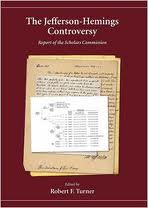
But rather than engage and scrutinize the study — the collective work of a dozen Jefferson scholars that’s titled The Jefferson-Hemings Controversy: Report of the Scholars Commission and was released September 1 — the mainstream media have resolutely ignored it.

When they have had opportunities recently to address the Jefferson-Hemings tale, news outlets have turned blithely to what amounts to defamation of the third president.

The day before the scholars commission study was released, for example, the Atlanta Journal-Constitution observed:

“The descendants of slavery-era unions were often consigned to a shadowy middle-ground, as the black descendants of Thomas Jefferson and Sally Hemings will attest.”

The Washington Post flatly asserted recently that Jefferson “fathered children with his slave Sally Hemings.”

And the Huffington Post the other day published a commentary that declared:

“It wasn’t until the late ’90s when new biographies of the founding fathers — like American Sphinx by Joseph Ellis, which revealed that Thomas Jefferson had a sexual relationship with his slave Sally Hemings that bore him six children — suddenly brought them to life in full color, foibles and all.”

There is, quite simply, no persuasive or compelling evidence — from Ellis or anyone else — that Jefferson fathered any of Hemings’ children, let alone six.

Indeed, the weight of available evidence favors the exculpatory interpretation offered by the new book, which states:

“Trying to prove a negative is usually difficult. But we have found most of the arguments used to point suspicion toward Thomas Jefferson to be unpersuasive and often factually erroneous. Not a single member of our group, after an investigation lasting roughly one year, finds the case against Thomas Jefferson to be highly compelling, and the overwhelming majority of us believe that it is very unlikely that he fathered any children by Sally Hemings.”

The scholars reported that had Jefferson carried on such a sexual relationship, it is “very difficult to believe that he would have selected as his companion the teenaged maid to his young daughters. … We … think it highly unlikely that Thomas Jefferson would have placed at risk the love and respect of his young children in this manner.”

The scholars’ work also notes that the DNA testing conducted in 1998 was widely misinterpreted as identifying Jefferson the father of Hemings’ children. (Ellis in American Sphinx incorrectly wrote that the testing “demonstrated a match between Jefferson” and the youngest son of Hemings.)

The DNA tests, the study points out, “were never designed to prove, and in fact could not have proven, that Thomas Jefferson was the father of any of Sally Hemings’ children.

“The tests merely establish a strong probability that Sally Hemings’ youngest son, Eston, was fathered by one of the more than two dozen Jefferson men in Virginia at the time, seven of whom there is documentary evidence to believe may well have been at Monticello when Eston was conceived.”

What’s more, the book says there’s no “clear evidence that Sally Hemings or any of her children ever alleged that Thomas Jefferson was her lover or their father, save for the statement attributed to an aging and clearly bitter Madison Hemings [another son] nearly five decades after Thomas Jefferson’s death.

“Surely, if they believed the famous President to be their father, they would have found it to their benefit to make this fact known to others before 1873.”

The Jefferson-Hemings Controversy is rich material and certainly worthy of thorough and frank consideration by the news media.

Instead they demur, fearful perhaps of what scrutiny of the evidence will reveal.

WJC

Recent and related:

Misreading the ‘Cronkite Moment’ — and media power

In Cronkite Moment, Debunking, Media myths on September 13, 2011 at 7:27 am

LBJ wasn't watching Cronkite

The mythical “Cronkite Moment” — that heady occasion in 1968 when an editorial comment by CBS News anchor Walter Cronkite purportedly altered the course of the war in Vietnam — lives on as an irresistible parable about the power of the news media.

The parable is timeless and often invoked — most recently in a commentary posted yesterday at the online sports site, Bleacher Report.

The commentary declared:

“The flashy columnist, opinionated radio host, or aggressive TV interviewer that pushes the needle and ultimately helps get those in charge to make a move for fear of public ridicule and backlash.

“A great example of this came in 1968 in the time of the Vietnam War when a story by broadcasting legend Walter Cronkite called the war unwinnable and un-American, then-president Lyndon B. Johnson was reported to have said ‘If I’ve lost Cronkite, I have lost middle America.’

“That is the kind of power that a strong media personality can have: the power to affect change.”

Except Cronkite didn’t cause such change.

As I discuss in my latest book, Getting It Wrong, Johnson wasn’t in front of a television when Cronkite’s special report aired on February 27, 1968. The president wasn’t lamenting the loss of Cronkite’s support, either.

Rather, Johnson was on the campus of the University of Texas at Austin, offering light-hearted banter at the 51st birthday party of Governor John Connally, a longtime political ally.

At about the time Cronkite was offering his downbeat assessment about the U.S. war effort, Johnson was quipping:

“Today you are 51, John. That is the magic number that every man of politics prays for — a simple majority.”

Not only was the president not watching, but Cronkite’s editorial comment wasn’t especially dramatic or incisive. His comment, offered at the close of his special report, was quite mild.

Most certainly Cronkite did not say the war was “unwinnable” or “un-American,” as the Bleacher Report commentary asserts. He said the U.S. military was “mired in stalemate” in Vietnam and that negotiations eventually might offer America a way out.

The “mired in stalemate” comment was hardly an original assessment.

Leading U.S. news outlets such as the New York Times had turned to “stalemate” for months before the Cronkite program.

For example, in a news analysis published July 4, 1967, the Times said of the war effort:

“Many officers believe that despite the commitment of 466,000 United States troops now in South Vietnam … the military situation there has developed into a virtual stalemate.”

In a report from Saigon that was published August 7, 1967, the Times noted:

“‘Stalemate’ is a fighting word in Washington. President Johnson rejects it as a description of the situation in Vietnam. But it is the word used by almost all Americans here, except the top officials, to characterize what is happening. They use the word for many reasons ….”

Far more assertive than the “mired in stalemate” assessment was a Wall Street Journal editorial, published four days before Cronkite’s special report aired.

The Journal said the U.S. war effort in Vietnam “may be doomed” and that “everyone had better be prepared for the bitter taste of defeat beyond America’s power to prevent.”

As I note in Getting It Wrong, the “Cronkite Moment,” when scrutinized, dissolves as illusory — a chimera, a media-driven myth.

“That it does is not so surprising,” I write. “Seldom, if ever, do the news media exert truly decisive influences in decisions to go to war or to seek negotiated peace. Such decisions typically are driven by forces and factors well beyond the news media’s ability to shape, alter, or significantly influence.

“So it was in Vietnam, where the war ground on for years after the ‘Cronkite moment.’”

WJC

Recent and related:

Challenge the dominant narrative? Who, us?

In Debunking, Media myths on September 4, 2011 at 9:01 am

No surprise here.

The mainstream news media, as expected, have ignored the publication of an impressively researched and authoritative book challenging the narrative that Thomas Jefferson had children by one of his slaves, Sally Hemings.

The 400-page work, The Jefferson-Hemings Controversy: Report of the Scholars Commission, was released September 1 at a news conference at the National Press Club in Washington.

A search of the LexisNexis database reveals no major U.S. news organization has since reported on the book’s appearance or, more important, on its content.

That Jefferson sired children with Hemings has long been accepted and reported as fact by mainstream news media, even though DNA testing often cited to support the claim was misreported when released in Nature magazine in 1998.

News reports then often characterized the DNA tests as having verified Jefferson’s parentage of at least one of Hemings’ children.

The Philadelphia Inquirer, for example, declared:

“DNA evidence has confirmed that Thomas Jefferson, the revered third president of the United States, fathered at least one child by his slave-mistress, Sally Hemings.”

And the New York Times asserted:

“DNA tests on the descendants of Thomas Jefferson’s family and of Jefferson’s young slave, Sally Hemings, offer compelling evidence that the nation’s third President fathered at least one of her children, according to an article in the scientific journal Nature.”

That evidence, the Times declared, “is likely to send historians scurrying to re-evaluate Jefferson, particularly his role in the anti-slavery movement.”

But in fact the DNA tests identified Jefferson as one of about two dozen Jefferson males who could have fathered Hemings’ last child, Eston.

The new book  — which places between hard covers the report and essays issued 10 years ago by a commission of scholars that investigated the Jefferson-Hemings matter — declares that “much of the public has been misled about the significance of the DNA tests … first reported in the journal Nature in November 1998.

“While the tests were professionally done by distinguished experts, they were never designed to prove, and in fact could not have proven, that Thomas Jefferson was the father of any of Sally Hemings’ children.

“The tests merely establish a strong probability that Sally Hemings’ youngest son, Eston, was fathered by one of the more than two dozen Jefferson men in Virginia at the time ….”

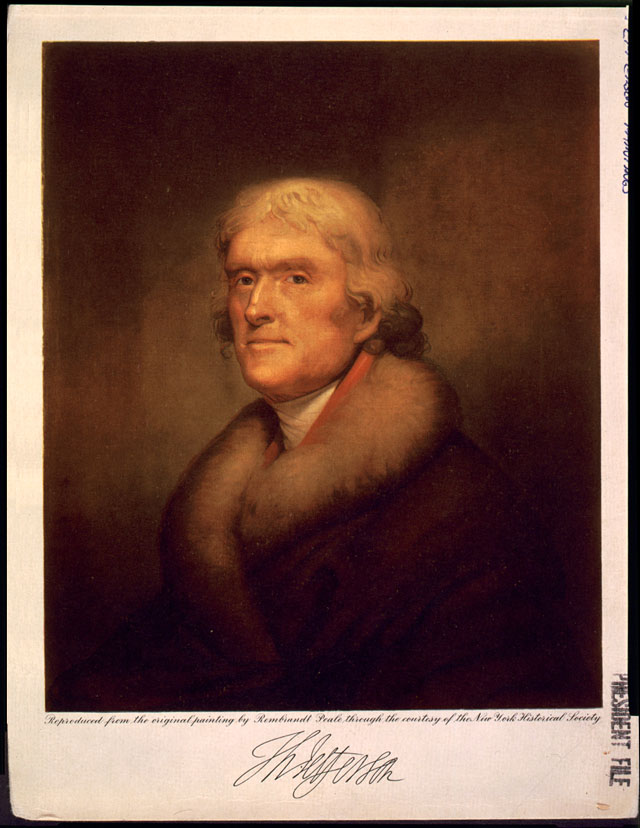
Thomas Jefferson: Library of Congress

The new book says circumstantial evidence points more powerfully to Jefferson’s younger brother, Randolph (or his sons), in the question of Eston Hemings’ paternity.

Randolph Jefferson, the book says, was known to have socialized with the slaves at Monticello, Thomas Jefferson’s home near Charlottesville, VA.

Randolph Jefferson was a dozen years younger than the president, and the available record offers no evidence that Thomas Jefferson “enjoyed socializing at night with Monticello slaves,” the book says.

Eston Hemings’ was conceived around August 1807, when Thomas Jefferson was 64 and in declining health — factors that further diminish the likelihood of his paternity.

Jefferson’s age and ailments always have represented crucial exculpatory evidence, in my view. That and the fact that Hemings had no children after Jefferson retired to Monticello from public life.

What’s more, the book says “Sally Hemings appears to have been a very minor figure in Thomas Jefferson’s life,” noting that Jefferson referred to her “in but four of his tens of thousands of letters.”

Of particular interest to Media Myth Alert is why the mainstream news media would ignore compelling evidence that exonerates Jefferson, or at least seriously complicates the paternity case against him.

Why wouldn’t the news media find appealing an opportunity to challenge the dominant narrative about Jefferson and his purported slave-mistress?

A number of reasons offer themselves.

One is that the new book essentially is a compilation of reports released in April 2001. In the new book’s acknowledgements, editor Robert F. Turner apologizes to members of the scholars commission “for the long delay in finally getting this volume in print.”

But the volume’s delayed publication doesn’t make the case against Jefferson’s paternity any less powerful or less compelling.

It is a complex case, and complexity seldom appeals to the news media. Simplistic tales are far more engaging, alluring, and easy to report.

As I point out in my latest book, Getting It Wrong (which does not discuss the Jefferson-Hemings controversy), media-driven myths “tend to minimize or negate complexity in historical events and offer simplistic and misleading interpretations instead.”

As does the dominant narrative of the Jefferson-Hemings matter.

That Thomas Jefferson sired offspring by a slave-mistress is an intriguing and perversely delicious story. But it is hardly settled history. It’s more likely a misreading of history — a misreading that the well-written and thoroughly researched new book, to its credit, seeks to correct.

WJC

Recent and related:

Blogging about journalism history: Why, and why bother?

In Debunking, Media myths on August 10, 2011 at 6:44 am

Journalism historians who blog.

It seems a little oxymoronic.

After all, isn’t journalism history a little too fusty, a little too musty, and a little too obscure to be readily adapted to contemporary social media such as blogging?

One might reflexively think so.

But a panel of four journalism historians who blog will discuss why they do so at a panel in St. Louis this afternoon, during the annual conference of the Association for Education in Journalism and Mass Communication (AEJMC).

The panel, titled “We blog about journalism history: Why, and why bother,” will consider the value of injecting historical dimension into contemporary debates and critiques about the performance of  news media, both traditional and online.

I’ll moderate and participate on the panel, which will bring together Chris Daly of Boston University, Karen Russell of the University of Georgia, and James McPherson of Whitworth College.

I intend to point out how blogging about journalism history can offer relevant and valuable context to the blogosphere’s never-ending debates about media performance. Journalism historians can bring to those debates perspective and analysis that would otherwise be missing or overlooked.

I also expect to note there are personal reasons for blogging as well. By blogging, journalism historians can test emergent ideas and hypotheses. Blogging can reinforce (and direct attention to) previously published work — much as Media Myth Alert seeks to do in promoting my latest book, Getting It Wrong, which debunks 10 prominent media-driven myths.

Blogging is a way to call out media myths. After all, as historian Gerard DeGroot has pointed out, “The good historian is a mythbuster.”

Blogging also allows journalism historians to take the steps toward developing larger, more detailed works, a point suggested several years ago in an intriguing blog post by Timothy Burke about why historians blog.

Among other points, Burke said he writes online essays because “I want to find out how much of my scholarly work is usefully translatable into a wider public conversation.”

Blogging about journalism history can have pedagogical value and impact far beyond the blogger’s expectations and knowledge. As such, blog posts about topics in journalism history may greatly expand the reach and application of a scholar’s research.

So it promises to be lively, the AEJMC blogging panel, which convenes at 1:30 p.m. in the Landmark #1 meeting room of the Renaissance Grand and Suites Hotel in St. Louis.

Panel-goers are invited to live-Tweet the proceedings, and use the Twitter hashtags #AEJMCblogging and #AEJMC11.

WJC

Recent and related:

Following the money on 37th anniversary of Nixon’s fall

In Anniversaries, Cinematic treatments, Debunking, Media myths, Washington Post on August 9, 2011 at 12:55 am

Nixon resigns, 1974

It’s somehow fitting on this, the 37th anniversary of President Richard Nixon’s resignation, to direct attention to the myth and hyperbole that embrace the best-known line of the Watergate scandal, the line that supposedly helped bring him down.

That line, of course, is “follow the money,” which purportedly was crucial advice given the Washington Post by a super-secret, high-level source code-named “Deep Throat.”

Follow the money” was said to have been so telling and effective that it’s still cited as exemplary guidance applicable in journalism, politics, and finance.

Just yesterday, for example, Barry Nolan, a journalist and contributor to Boston Magazine’sBoston Daily” blog, invoked the famous phrase, writing:

“Any time you really want to know why a vote happened the way it did, the single best piece of advice ever given came from ‘Deep Throat,’ the shadowy tipster in the Watergate scandal. ‘Follow the money,’ he told the Washington Post reporters.”

It may seem like stellar advice, but it’s guidance that the “Deep Throat” source offered only in the movies.

As I’ve discussed at Media Myth Alert, “follow the money” is Watergate’s most famous made-up line.

The phrase was written into the screenplay of All the President’s Men, the 1976 cinematic version of the book by Bob Woodward and Carl Bernstein of the Washington Post.

“Follow the money” appears nowhere in Woodward and Bernstein’s book about their Watergate reporting — reporting that did not, as I discuss in my latest work, Getting It Wrong, take down Nixon’s corrupt presidency.

Nor did “follow the money” appear in any Watergate-related news article or editorial in the Post until June 1981, nearly seven years after Nixon’s resignation.

Nor did “Deep Throat” — who was self-identified in 2005 as W. Mark Felt, formerly the FBI’s second-ranking official — utter the line in his periodic meetings with Woodward. (And Felt/”Deep Throat” didn’t meet Bernstein until 2008.)

Follow the money” was memorably intoned not by Mark Felt but by Hal Holbrook, the actor who played “Deep Throat” in All the President’s Men.

As I’ve noted, Holbrook turned in a marvelous performance as a tormented, conflicted, and stealthy “Deep Throat.”

Holbrook delivered the “follow the money” line with such conviction and steely assurance, that it seemed for all the world to offer a way through the labyrinth of the Watergate scandal.

But even if Woodward had been counseled to “follow the money,” the advice certainly neither would have unraveled Watergate nor led him to Nixon.

Nixon resigned 37 years ago today not because he misused campaign funds but because he sought to obstruct justice by covering up the signal crime of Watergate, the break-in at the headquarters of the Democratic National Committee in June 1972.

The simplified follow-the-money  interpretation of Watergate effectively deflects attention from the decisive forces that ultimately forced Nixon from office.

As I note in Getting It Wrong, rolling up a scandal of Watergate’s intricacy and dimension required “the collective if not always the coordinated forces of special prosecutors, federal judges, both houses of Congress, the Supreme Court, as well as the Justice Department and the FBI.

“Even then,” I write, “Nixon likely would have served out his term if not for the audiotape recordings he secretly made of most conversations in the Oval Office of the White House.

“Only when compelled by the Supreme Court did Nixon surrender those recordings, which captured him plotting the cover-up” that cost him the presidency.

WJC

Recent and related:

No ‘rock-em,’ no ‘sock-em’: What ails WaPo

In Debunking, Jessica Lynch, Media myths, Newspapers, Washington Post, Watergate myth on August 7, 2011 at 1:59 am

The ombudsman of the Washington Post, Patrick Pexton, weighs in today with platitudes and hang-wringing about the newspaper. He mostly misses the mark.

Pexton writes in his column that the Post’s “future lies not with the rich; it lies with the citizenry.

“This newspaper must be the one source of high-quality, probing Washington news that readers in this region and across the country can look to for holding their government accountable. This publication must be for all Americans.”

Oh, brother.

But wait: Here’s more vague abstraction:

“The Post,” Pexton writes, “can’t be a liberal publication or a conservative one. It must be hard-hitting, scrappy and questioning — skeptical of all political figures and parties and beholden to no one. It has to be the rock-’em-sock-’em organization that is passionate about the news. It needs to be less bloodless and take more risks when chasing the story and the truth.”

A “rock-’em-sock-’em organization,” eh? Well, that’s useful guidance.

In his five or so months as ombudsman, Pexton hasn’t dared touch the electrified third rail about the Post, which one of his predecessors, Deborah Howell, gamely if belatedly addressed.

That’s a decided lack of intellectual diversity in the Post’s newsroom. In mid-November 2008, shortly after Barack Obama was elected president, Howell wrote in her ombudsman column:

“I’ll bet that most Post journalists voted for Obama. I did. There are centrists at The Post as well. But the conservatives I know here feel so outnumbered that they don’t even want to be quoted by name in a memo.”

Howell’s column quoted Tom Rosenstiel of the Project for Excellence in Journalism as saying that “conservatives are right that journalism has too many liberals and not enough conservatives. It’s inconceivable that that is irrelevant.”

In Obama's thrall

The lack of intellectual diversity often shows in the Post’s report. Even casual reading signals that the newspaper remains in the thrall of Obama, despite his clearly failing presidency.

Obama scarcely gets “rock-’em-sock-’em” treatment from the Post.

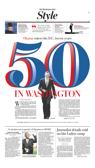
Last Wednesday, for example, the Post’s once-edgy “Style” section devoted most of its front page to a cheery feature about the meaning of Obama’s turning 50-years-old.

“On Thursday,” the article gushed, “President Obama — one of American history’s most precocious achievers — joins the ranks of Washington 50-somethings ….”

But what ails the Post goes well beyond its routinely tender treatment of Obama.

The Post’s local report is superficial, a diet of eye-rolling, feel-good features. The newspaper carries little staff-produced national coverage. Its international report is undistinguished, especially compared to that of the New York Times.

Moreover, the Post offers few notable cases of investigative journalism any more.

It has won two Pulitzer Prizes for investigative reporting in 25 years, which has to be considered meager for a newspaper that reputedly brought down Richard Nixon’s corrupt presidency with its relentless digging into the Watergate scandal.

But as I discuss in my latest book, Getting It Wrong, the Post-Watergate trope, of course, is a powerful media-driven myth.

I’d be remiss were I to fail to note that the Post never has come clean about how it erred so utterly in offering the world the bogus hero-warrior tale about Jessica Lynch in the early days of the Iraq War.

Lynch, the Post reported on its front page on April 3, 2003, “fought fiercely and shot several enemy soldiers after Iraqi forces ambushed the Army’s 507th Ordnance Maintenance Company, firing her weapon until she ran out of ammunition, U.S. officials said yesterday.”

But none of the derring-do attributed to Lynch was true, and the Post has never explained who led it so badly astray.

Moreover, the staff cuts and buyouts of recent years left few notable characters on the newspaper’s staff.

Gone are such colorful figures as the erudite and pugnacious Henry Allen, a Pulitzer winner who left the Post after throwing punches at a staff writer who called him a c—sucker.

Now there was “rock-’em-sock-’em,” old school variety.

WJC

Many thanks to Instapundit
Glenn Reynolds for linking to this post.

Recent and related:

India high court order invokes phony Watergate line

In Debunking, Furnish the war, Media myths, Washington Post, Watergate myth on August 2, 2011 at 9:48 am

Two Supreme Court judges in India last month turned to Watergate’s most famous made-up line in ordering an investigation into large sums of money believed stashed in banks abroad.

The judges in their order cited the made-up line as if it had been genuine advice from a high-level source to Bob Woodward of the Washington Post  during the newspaper’s investigation of the Watergate scandal.

The line is “follow the money” — and it had no role whatsoever in the Watergate scandal.

Follow the money” was never uttered by Woodward’s stealthy source, who was code-named “Deep Throat.”

The line appears nowhere in the All the President’s Men, the book Woodward and Carl Bernstein wrote about their Watergate reporting for the Post.

Nor did the passage appear in any Watergate-related news article or editorial in the Post before June 1981 — nearly seven years after the scandal reached its denouement with President Richard Nixon’s resignation.

Follow the money” was written into the screenplay of All the President’s Men, the 1976 movie based on Woodward and Bernstein’s book.

Many people and many news outlets over the years have cited “follow the money” as if it were real, as if it had been advice to Woodward that really worked.

Just last week, for example, a column in London’s high-brow Financial Times newspaper described “follow the money” as the “mantra” of Watergate. And a column posted at Huffington Post a couple of weeks ago also repeated “follow the money” as if it had been vital guidance to uncovering Watergate.

But finding its way into a high court order probably represents a first for “follow the money.”

As noted in a Bloomberg news service report yesterday, the two judges — B. Sudershan Reddy and S.S. Singh Nijjar — invoked “follow the money” at the outset of the order they released early last month.

Credulously, the judges wrote:

“‘Follow the money’ was the short and simple advice given by the secret informant, within the American Government, to Bob Woodward, the journalist from Washington Post, in aid of his investigations of the Watergate Hotel break in.”

So how is it that such errors are made? What explains the impressive reach and popularity of this appealing but contrived statement?

A partial explanation is that “follow the money” seems just too good, too delicious, not to be true. It’s in the class of William Randolph Hearst’s purported vow to “furnish the war” with Spain: It’s a quotation that really ought to true.

And as I point out in my media myth-busting book, Getting It Wrong:

“To thwart media myths, journalists can start by applying a measure of skepticism to pithy, telling quotes such as Hearst’s vow to ‘furnish the war.’ … Turns of phrase that sound too neat and tidy often are too perfect to be true.”

The popularity of “follow the money” goes beyond appealing pithiness and is rooted in the dramatic quality of All the President’s Men, the most-watched movie ever made about Watergate.

The “Deep Throat” character was played in All the President’s Men by the actor Hal Holbrook, who turned in a marvelous performance.

In a late-night scene in a darkened parking garage, the shadowy, raspy-voiced Holbrook told the Woodward character (played by Robert Redford):

“I have to do this my way. You tell me what you know, and I’ll confirm. I’ll keep you in the right direction, if I can, but that’s all.

“Just follow the money.”

Holbrook delivered the line with such quiet insistence that it truly seemed to offer a way through the labyrinth of the Watergate scandal. And the popularity of the movie carried “follow the money” into the vernacular.

But such guidance, had it really been offered to Woodward, would have taken the reporter only so far. Watergate, after all, was much broader than the improper use of campaign monies.

Nixon was toppled not by heroic journalists who followed a money trail, but by irrefutable evidence captured on audiotapes that he had ordered the cover up Watergate’s signal crime, the break-in at the headquarters of the Democratic National Committee in June 1972.

WJC

Recent and related:

Some dubious history from Frank Rich

In Media myths, Spanish-American War, Yellow Journalism on August 1, 2011 at 9:50 am

Frank Rich, in a lengthy New York magazine screed about Rupert Murdoch, invokes the hoary media myth that William Randolph Hearst’s “papers famously fomented the Spanish-American War and perfected the modern gossip machine.”

I won’t quarrel much with Rich’s claim about “the modern gossip machine.” But the bit about the Spanish-American War represents a serious misreading of history.

In addressing such a dubious assertion as Hearst’s yellow press “fomented the Spanish-American War,” it’s useful to ask: How’d they do it? How was newspaper content translated into war policy?

Rich doesn’t say. He doesn’t pause to consider how it was that content of Hearst’s newspapers set an agenda for war that the administration of President William McKinley pursued.

The yellow press in fact had no such agenda-setting influence. It was a negligible factor.

As I wrote in my 2001 book, Yellow Journalism: Puncturing the Myths, Defining the Legacies, McKinley administration officials took no leads from Hearst’s newspapers.

They derided the yellow press, when they thought of it at all, and regarded it as a complicating factor in efforts to resolve a diplomatic impasse over Spain’s harsh rule of Cuba — an impasse that gave rise in April 1898 to the Spanish-American War.

The impasse arose from Spain’s brutal but ineffective attempts to put down a rebellion on Cuba that began in 1895 and reached islandwide proportion by 1898.

To tamp down the rebellion, Spain imposed a policy it called “reconcentration,” in which tens of thousands of Cuban men, women, and children were herded into garrisons towns and fortified areas, from where they could provide no aid or support to Cuban insurgents in the countryside.

Reconcentration” brought on widespread starvation, malnutrition, and disease. Tens of thousands of Cuban non-combatants died as a result of the Spanish policy which, as historian Ivan Musicant has written, “did more to bring on the Spanish-American War than anything else the Spanish could have done.”

The misguided policy, Musicant also noted, “turned public opinion enormously in the United States.”

Ultimately, then, as I wrote in Yellow Journalism, the Spanish-American War was “the result of a convergence of forces far beyond the control or direct influence of even the most aggressive of the yellow newspapers, William Randolph Hearst’s New York Journal.”

I also noted:

“While the yellow press may have reported extensively on the consequences of Spain’s failures and missteps, it did not create them.”

So what? one might ask.

After all, Rich’s reference to Hearst and the Spanish-American War represented a small portion of a lengthy article about Murdoch. So why make a fuss about it?

Several reasons offer themselves.

For starters, the Hearst-Murdoch comparison, as I’ve pointed out previously at Media Myth Alert, is facile and inexact. The similarities between the two media tycoons are largely superficial.

Notably, Hearst had nothing akin to the global reach of Murdoch’s multimedia empire. And Hearst, unlike Murdoch, vigorously pursued political ambitions: Hearst ran repeatedly and mostly unsuccessfully for high political office during his late 30s and 40s, before giving up.

But a more important reason for directing attention to this dubious bit of media history is that Rich arguably should have known better: Few serious historians buy into the claim about Hearst and his newspapers fomenting the war with Spain.

And thinking it through, it doesn’t seem very logical: Could newspaper content be so powerful and decisive that it could push a country into war it otherwise wouldn’t have fought?

Does it really work that way?

Assuredly not.

WJC

Recent and related:

A media myth eruption: WaPo, Watergate, and Nixon’s fall

In Debunking, Media myths, Washington Post, Watergate myth on July 30, 2011 at 4:55 am

Bimbo eruptions” was the memorably colorful term invoked during the 1992 presidential campaign by Betsey Wright, an aide to presidential candidate Bill Clinton, to describe the suspicions and potential allegations about Clinton’s womanizing.

Sure, he did

The past couple of days have brought an eruption of media myth — notably, the rich and appealing tale that Bob Woodward and Carl Bernstein’s reporting for the Washington Post brought down Richard Nixon’s corrupt presidency in the Watergate scandal.

Not even the Post buys into that simplistic and media-centric interpretation. As Michael Getler, the newspaper’s then-ombudsman correctly noted in 2005:

“Ultimately, it was not The Post, but the FBI, a Congress acting in bipartisan fashion and the courts that brought down the Nixon administration. They saw Watergate and the attempt to cover it up as a vast abuse of power and attempted corruption of U.S. institutions.”

(More coarsely, Woodward himself has declared: “To say the press brought down Nixon, that’s horseshit.”)

Even so, the media myth about Woodward, Bernstein, and the Post — the heroic-journalist myth, as I describe it in my latest book, Getting It Wrong — is so delicious and compelling that it lives on and on, as this recent eruption attests.

Figuring in the media myth eruption have been:

  • The Daily Beast, which rhetorically asked in a commentary yesterday about the phone-hacking scandal that has battered Rupert Murdoch’s media in Britain: “Did Woodward and Bernstein need [phone-hackers and private investigators] to bring down Richard Nixon?”
  • The Daily Mirror  tabloid in Britain declared in an article posted online today that “Watergate was exposed by Washington Post reporters Carl Bernstein and Bob Woodward.”
  • Charleston Gazette in West Virginia, which declared passage in an editorial about Murdoch’s troubles in Britain: “The Washington Post toppled President Richard Nixon in the Watergate scandal.”
  • The publisher of the North Platte Telegraph in Nebraska, who in a column the other day referred to the “early 1970s when the Post brought down the presidency of Richard Nixon using primarily an unnamed source.” That was a reference to Woodward’s stealthy, high-level source who was code-named “Deep Throat.”

The appearance of the heroic-journalist myth in such diverse outlets and contexts is testifies to how deeply embedded the tale has become in the popular consciousness.

And why is that?

The heroic-journalist myth, as I discuss in Getting It Wrong, is “ready short-hand for understanding Watergate and its denouement, a proxy for grasping the scandal’s essence while avoiding its forbidding complexity.”

Rather that attempting to keep straight the dimensions of a scandal that began to break nearly 40 years ago, it is fair easier to embrace the proxy version — the simplified narrative that Woodward and Bernstein took down Nixon, with help from the “Deep Throat” source.

The identity of “Deep Throat” remained a secret — and the subject of much speculation and many guessing games — until 2005 when W. Mark Felt and his family announced that Felt, a former FBI official, had been Woodward’s mysterious source.

The heroic-journalist myth lives on because it’s such a reassuring narrative for the news media — a tale that describes the news media at their supposed best, a time when their reporting made a powerful difference in national life.

As I note in Getting It Wrong, the notion that the Post and its reporters exposed the Watergate scandal “is deeply ingrained in American journalism as one of the field’s most important and self-reverential stories.”

It’s a comforting trope about a purported triumph for a profession that’s more accustomed to scorn and condemnation than applause and approbation.

But it’s no less a media myth.

WJC

Many thanks to Instapundit
Glenn Reynolds for linking to this post.

Recent and related: