W. Joseph Campbell

Posts Tagged ‘Media’

Commodity markets and Watergate’s most famous made-up line

In Cinematic treatments, Debunking, Media myths, Washington Post, Watergate myth on June 15, 2011 at 7:56 am

Follow the money,” that famous and dramatic line about the Watergate scandal, was made up for the cinema.

Not in this book

But because it’s so pithy and compelling, the passage is routinely treated as if it had been advice vital to unseating President Richard Nixon and unraveling the greatest scandal in American politics.

The Reuters wire service yesterday offered “follow the money” as if it were genuine, stating in a dispatch posted at the Commodities Now online site:

“‘Follow the money,’ FBI Deputy Director Mark Felt (‘Deep Throat’) told Washington Post reporters Bob Woodward and Carl Bernstein during their investigation into the Watergate break ins. It remains good advice for participants in commodity markets.”

Follow the money” may well be sound guidance for commodities brokers. But in the Watergate scandal, the line had relevance and as dramatic effect only in the movies.

Felt — whose family disclosed in 2005 that he had been the fabled “Deep Throat” source of the Washington Postdidn’t offer such guidance to Woodward during their periodic meetings in 1972 and 1973 as the scandal unfolded. Felt, moreover, never spoke with Bernstein during Watergate.

Nor does the advice to “follow the money” appear in All the President’s Men, Woodward and Bernstein’s book about their Watergate reporting. And the line can’t be found in any Watergate-related article or editorial in the Washington Post before 1981.

The derivation of the line lies in the screenplay of All the President’s Men, the cinematic version of Woodward and Bernstein’s book. The movie came out 35 years ago and has been seen by millions of people, easily qualifying it as the most-viewed film about Watergate.

All the President’s Men included a boffo performance by Hal Holbrook who played the stealthy, conflicted “Deep Throat” character.

Holbrook advised the Woodward character, played by Robert Redford, to “follow the money” — and did so with such quiet assurance and insistence that it sure seemed as if the guidance were vital to rolling up Watergate.

But had the advice indeed been given to Woodward, “follow the money” would’ve have taken the reporter only so far. Watergate, after all, was a scandal far more complex than the misuse of campaign monies.

As I write in Getting It Wrong, my media-mythbusting book that came out last year, some 20 men associated with Richard Nixon’s presidency or his 1972 reelection campaign went to jail for crimes linked to Watergate.

To unravel a scandal of such dimension, I write in Getting It Wrong, “required the collective if not always the coordinated forces of special prosecutors, federal judges, both houses of Congress, the Supreme Court, as well as the Justice Department and the FBI.

“Even then,” I add, “Nixon likely would have served out his [second] term if not for the audiotape recordings he secretly made of most conversations in the Oval Office of the White House. Only when compelled by the Supreme Court did Nixon surrender those recordings, which captured him plotting the cover-up and authorizing payments of thousands of dollars in hush money.”

As I’ve noted previously at Media Myth Alert, what cost Nixon the presidency wasn’t of the improper use of campaign funds but his obstruction of justice in attempting to thwart the FBI’s investigation of the scandal.

The misunderstanding about “follow the money” is an element in the broader mythology of Watergate, which centers around the historically inaccurate notion that Woodward and Bernstein, through their dogged investigative reporting, brought down Nixon’s presidency.

To embrace that interpretation of Watergate is, I write in Getting It Wrong, “to abridge and misunderstand the scandal and to indulge in a particularly beguiling media-driven myth.”

WJC

Recent and related:

‘Too early to say’: Zhou was speaking about 1968, not 1789

In Debunking, Media myths on June 14, 2011 at 8:50 am

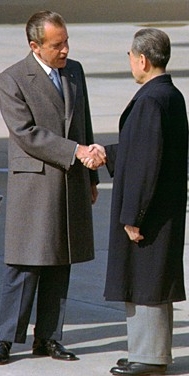
Nixon and Zhou, 1972

When Chinese premier Zhou Enlai famously said it was “too early” to assess the implications of the French revolution, he was referring to turmoil in France in 1968 and not — as is commonly thought — to the more distant political upheaval of 1789.

So says a retired American diplomat, Charles W.  (Chas) Freeman Jr., who was present when Zhou made the comment during President Richard Nixon’s visit to China in February 1972.

Freeman, who was Nixon’s interpreter during the historic, weeklong trip, made the disclosure last week during a panel discussion in Washington about On China, the latest book by former Secretary of State Henry Kissinger.

The discussion was moderated by Richard McGregor, a journalist and China expert who wrote about Freeman’s comments for the Financial Times of London.

In an interview yesterday, Freeman elaborated on his recollection about Zhou’s comment, the conventional interpretation of which is frequently offered as evidence of China’s sage, patient, and far-sighted ways. Foreign Policy magazine, for example, referred last month to that interpretation, saying the comment was “a cautionary warning of the perils of judgments made in real time.”

The Washington Post’s recent review of Kissinger’s book likewise referred to the conventional understanding of Zhou’s remark.

Freeman described Zhou’s misconstrued comment as “one of those convenient misunderstandings that never gets corrected.”

He said Zhou’s remark probably was made over lunch or dinner, during a discussion about revolutions that had succeeded and failed. They included, Freeman said, the Prague Spring of 1968 and the Hungarian uprising of 1956, both of which the Soviet Union crushed.

He said it was clear from the context and content of Zhou’s comment that in saying it was “too early to say” the Chinese leader was speaking about the events in France in May 1968, not the years of upheaval that began in 1789.

Freeman acknowledged that the conventional interpretation makes for a better story but added that it was “absolutely clear” from the context of the discussion that Zhou was speaking about 1968.

Just how Zhou’s remark came to be misinterpreted, Freeman was unable to say.

“I cannot explain the confusion about Zhou’s comment except in terms of the extent to which it conveniently bolstered a stereotype (as usual with all stereotypes, partly perceptive) about Chinese statesmen as far-sighted individuals who think in longer terms than their Western counterparts,” Freeman said in a follow-up email. “It was what people wanted to hear and believe, so it took” hold.

He described Zhou’s misinterpreted remark as “a classic of the genre of a constantly repeated misunderstanding that has taken on a life of its own.”

The Zhou comment also represents a reminder about the often-irresistible quality of pithy and apparently telling quotations — a topic discussed in my latest book, Getting It Wrong, which addresses and debunks 10 prominent media-driven myths. (An expanded second edition of Getting It Wrong came out in late 2016.)

“Turns of phrase that sound too neat and tidy often are too perfect to be true,” I write in discussing such media myths as William Randolph Hearst’s reputed vow — supposedly made in an exchange of telegrams with the artist Frederic Remington — to “furnish the war” with Spain in the 1890s.

“Like many media-driven myths,” I write, the purported Hearstian vow “is succinct, savory, and easily remembered. It is almost too good not to be true.” As is the conventional interpretation of Zhou’s “too early to say” remark.

I note in Getting It Wrong that among the many reasons for doubting the anecdote is that it “would have been absurd for Hearst to vow to ‘furnish the war’ because war — specifically, the Cuban rebellion against Spain’s colonial rule — was the very reason Hearst sent Remington to Cuba in the first place.”

Anyone reading U.S. newspapers in January 1897, when Remington was in Cuba on assignment for Hearst’s New York Journal, “would have been well aware,” I write, “that Cuba was a theater of a nasty war.”

What I call version variability — the imprecision that alters or distorts an anecdote in its retelling — has afflicted Zhou’s “too early to say” comment. Some accounts, for example, have attributed the remark to Chinese dictator Mao Zedong.

Another account has it that Zhou, who died in 1976, made the comment in Geneva in 1953, in response to a French journalist’s question.

Freeman said he doubted that version was accurate.

Zhou, he said, “was a man with a graceful wit but not given to facetious remarks.”

WJC

Recent and related:

On Gingrich, JFK, and the appearance factor in presidential debates

In Debunking, Media myths on June 13, 2011 at 11:19 am

First presidential debate, 1960

The first televised presidential debate set a standard for American politics.

A myth-encrusted standard.

John F. Kennedy supposedly won that debate in September 1960 because he looked so much more rested and telegenic than his rival, Richard M. Nixon. There is, however, scant evidence to support that notion, which was revived yesterday in a commentary at the Daily Caller blog.

The commentary suggested that Newt Gingrich’s beleaguered presidential campaign might find a spark during tonight’s debate in New Hampshire among seven Republicans seeking the presidency.

In 1960, the Daily Caller commentary stated, “then-Sen. John F. Kennedy reportedly spent the day of his big debate against Vice President Richard Nixon getting a sun tan and resting. Nixon, on the other hand, spent the day rigorously campaigning (he also didn’t wear makeup). It worked for Kennedy who, thanks to the advent of TV, ‘won’ the debate. A rested Gingrich might likewise perform well in Monday’s debate in New Hampshire.”

Gingrich’s hopes to win the presidency probably were destroyed with last week’s mass departure of top campaign staffers and advisers. But his long-shot candidacy is of scant interest to Media Myth Alert. Far more compelling is the Daily Caller’s claim about the presidential debate in September 1960.

It’s important to note that most commentary in the debate’s immediate aftermath called the Kennedy-Nixon encounter a draw.

For example, James Reston, then the Washington bureau chief for the New York Times, wrote in a post-debate column: “Who took the first round is a matter of individual opinion. My own view is that Kennedy gained more than Nixon, but it was a fielder’s choice, settling nothing.”

The Washington Post, on the other hand, said in a post-debate editorial:

“Of the two performances, Mr. Nixon’s was probably the smoother. He is an accomplished debater with a professional polish, and he managed to convey a slightly patronizing air of a master instructing a pupil.”

The St. Louis Post-Dispatch hedged in its assessment, declaring: “We should not say that anybody won. … They both looked pretty young to us.”

Immediately after the Kennedy-Nixon encounter, the Associated Press conducted an unscientific survey in 10 major U.S. cities and reported that most respondents said they hadn’t been influenced by the exchanges. “Only a few persons,” according to AP, “said they had actually switched from one candidate to the other because of the debate.”

In the months afterward, Nixon’s sweaty brow and haggard appearance during the debate emerged as factors supposedly decisive to the outcome of the encounter — and to the 1960 election. Such claims, however, rest on more on conjecture than compelling evidence.

David L. Vancil and Sue D. Pendell wrote in a revealing journal article published in 1987 that “the inference that appearance problems caused Nixon’s loss, or Kennedy’s victory [in the debate], is classic post hoc fallacy.

“Appearance problems, such as Nixon’s perspiring brow, could have had a negative impact on viewer perceptions, but it is also possible for viewers to be sympathetic to such problems, or to interpret them as evidence of attractive or desirable qualities.”

That is, Nixon’s sweating under hot television lights could have stirred viewers empathy, making them feel more kindly toward the Republican candidate. It’s a plausible supposition.

Vancil and Pendell also wrote:

“Even if viewers disliked Nixon’s physical appearance, the relative importance of this factor in viewers’ selection of a debate winner is a matter of conjecture.”

A Gallup poll conducted during the week following the debate and released October 11, 1960, reported that 43 percent of voters thought Kennedy “did the better job” in the debate, which was the first of four during the 1960 fall campaign. Twenty-three percent thought Nixon was better; 29 percent said both candidates were about the same. Five percent offered no opinion.

But the poll did not specifically address the appearance of either candidate; nor did the poll detect a sharp swing of support to Kennedy. The survey reported Kennedy to be narrowly ahead, by 49 percent to 46 percent, with 5 percent undecided.

That result represented a slight change from a Gallup survey taken just before the debate, which reported Nixon leading by 47 percent to 46 percent.

But Gallup termed the post-debate shift too slight to be meaningful.

“The prudent reader can see,” George Gallup, head of the polling organization, stated in reporting the results, “that polling accuracy has not reached the degree of accuracy required to say with certainty which candidate is ahead in a close race such as the present one.”

By the way, Kennedy didn’t take off the day of the debate to rest and work on his tan, as the Daily Caller commentary said. The Chicago Tribune reported that Kennedy received “a boisterous welcome” in an appearance that afternoon at a carpenters union convention in Chicago, the debate’s host city.

WJC

Recent and related:

Invoking Murrow-McCarthy myth to assert the worthiness of TV

In Debunking, Media myths, Murrow-McCarthy myth on June 11, 2011 at 6:58 am

Murrow

Media-driven myths have a variety of perverse applications — including value in scoring points in arguments.

Today’s Sydney Morning Herald does just that in turning to a particularly hardy media myth — that of Edward R. Murrow’s supposedly decisive televised report in 1954 about Senator Joseph R. McCarthy.

In a commentary titled “In defense of the idiot box,” the Morning Herald argues for the worthiness of television, asserting that the medium “has the power to shock, appeal, nauseate and, if everything comes together, inspire.”

The commentary further states:

“TV has made a difference before. In the early days, Edward R. Murrow took on Joe McCarthy, starting a tradition of fearless TV journalism exposing the corruption of government, the horrors of war and the dark side of society. The medium may have numbed the odd brain but it’s also done a lot of good ….”

Mind-numbing television generally is.

More doubtful is the commentary’s extravagant claim about the fearlessness of Murrow. His report about McCarthy, which aired on the See It Now show of March 9, 1954, scarcely can be termed “fearless” and shouldn’t be seen as inaugurating any sort of “tradition” of searching, intrepid broadcast journalism.

That’s because Murrow was very late in taking on McCarthy and the senator’s heavy-handed campaign against communists in government.

Pearson, muckraking columnist

As I discuss in Getting It Wrong, my media mythbusting book that came out last year, the evidence “is overwhelming that Murrow’s famous program on McCarthy had no … decisive effect, that Murrow in fact was very late in confronting McCarthy, that he did so only after other journalists had challenged the senator and his tactics for months, even years.”

Notable among those journalists was Drew Pearson, who wrote the syndicated and widely read muckraking column, “Washington Merry-Go-Round.” Pearson was quick to call attention to the recklessness of McCarthy’s claims.

He took on McCarthy in February 1950, soon after the senator first raised his claims about communists in high places in the U.S. government.

Pearson wrote that month that “the alleged communists which [McCarthy] claims are sheltered in the State Department just aren’t.”

Far from being fearless, Murrow, it can be argued, waited till the risks had subsided before taking on McCarthy. By March 1954, McCarthy’s capacity to stir dread was in decided retreat.

I note in Getting It Wrong that Eric Sevareid, Murrow’s friend and colleague at CBS News, was among those who chafed at the interpretation of fearlessness attached to the Murrow program which, he noted, “came very late in the day.”

Sevareid said in the 1970s:

“The youngsters read back and they think only one person in broadcasting and the press stood up to McCarthy and this has made a lot of people feel very upset, including me, because that program came awfully late.”

I further note in Getting It Wrong how the media myth about Murrow took hold despite the protestations of its central figures.

“In the days and weeks after the See It Now program,” I write, “Murrow said he recognized his accomplishments were modest, that at best he had reinforced what others had long said about McCarthy.

“Jay Nelson Tuck, the television critic for the New York Post, wrote that Murrow felt ‘almost a little shame faced at being saluted for his courage in the McCarthy matter. He said he had said nothing that … anyone might not have said without a raised eyebrow only a few years ago.'”

Murrow, moreover, told Newsweek magazine: “It’s a sad state of affairs when people think I was courageous” in confronting McCarthy.

Fred W. Friendly, Murrow’s collaborator and co-producer, likewise rejected claims that the See It Now program on McCarthy was pivotal or decisive. As Friendly wrote in his memoir:

“To say that the Murrow broadcast of March 9, 1954, was the decisive blow against Senator McCarthy’s power is as inaccurate as it is to say that Joseph R. McCarthy … single-handedly gave birth to McCarthyism.”

WJC

Recent and related:

No bra-burning at Atlantic City?

In Bra-burning, Debunking, Media myths on June 10, 2011 at 8:19 am

Bra-burning” was a late 20th century phenomenon that’s given rise to considerable and enduring misunderstanding.

Atlantic City, 1968

The notion that feminists in the late 1960s and 1970s frequently and demonstratively set fire to bras is erroneous — as is the view that bra-burning never happened, that it was all a nasty media myth.

In a brief item posted online today, the Irish Independent veers toward the latter interpretation. It cites the women’s liberation protest in September 1968 at Atlantic City, a demonstration against the Miss America Pageant that gave dimension to the epithet “bra-burning.”

The Independent says that “hundreds of women protested the Miss America Pageant by tossing tweezers, high heels and bras — symbols of objectification — into a bin.” It adds, parenthetically:

“Bra burning at this event, however, is a myth.”

Not exactly.

In Getting It Wrong, my media mythbusting book that came out last year, I offer evidence that bras were set afire, if briefly, during the demonstration at the Atlantic City — where about 100 women (certainly not “hundreds of women”) protested the pageant as a demeaning spectacle.

The evidence is in separate witness accounts by journalists, including an article report published in the Press of Atlantic City on September 8, 1968, the day after the protest.

The article appeared on page 4 of the Press, beneath the byline of John L. Boucher, a gruff, locally prominent journalist known to take pains not to embroider or exaggerate his reporting.

Boucher’s article carried the headline:

“Bra-burners blitz boardwalk.”

The article mentioned a burn barrel that demonstrators had dubbed the “Freedom Trash Can,” stating:

“As the bras, girdles, falsies, curlers, and copies of popular women’s magazines burned in the ‘Freedom Trash Can,’ the demonstration reached the pinnacle of ridicule when the participants paraded a small lamb wearing a gold banner worded ‘Miss America.’”

Boucher’s report was buttressed by the separate recollections of Jon Katz, a writer who in 1968 was a young reporter for the Atlantic City Press. Katz was assigned to women’s liberation protest to gather material for a sidebar article about the reactions of passersby.

In correspondence with me as I researched Getting It Wrong, Katz wrote:

“I quite clearly remember the ‘Freedom Trash Can,’ and also remember some protestors putting their bras into it along with other articles of clothing, and some Pageant brochures, and setting the can on fire.

“I am quite certain of this.”

As I point out in Getting It Wrong, these accounts at very least “offer fresh dimension to the bra-burning legend.

“They represent two witness accounts that bras and other items were burned, or at least smoldered, in the Freedom Trash Can.”

This evidence, I write, cannot be taken lightly, dismissed or ignored.

At the same time, I add, the accounts of Boucher and Katz “lend no support to the far more vivid and popular imagery that many bras went up in flames in flamboyant protest that September day.”

Even so, I note that “bra-burning” is an epithet not at all misapplied to the protest at Atlantic City. The evidence is that bras and other items were set afire, briefly, at that long ago demonstration.

WJC

Recent and related:

Bra-burning, a media myth ‘that will never die’?

In Bra-burning, Debunking, Media myths, Washington Post on June 8, 2011 at 1:23 pm

Bra-burning a myth? (Corbis)

A commentary in the Washington Post the other day referred to the famous protest at Atlantic City in 1968 at which women’s liberation demonstrators “tossed their bras and high heels into a trash can … kicking off the bra-burning myth that will never die.”

Well, it was more nuanced than that. Bra-burning, at least in a modest, smoldering kind of way, wasn’t such a myth at all.

I offer evidence in my latest book, Getting It Wrong, which debunks 10 prominent media-driven myths, that bras were  set afire, briefly, during the protest on the Atlantic City boardwalk on September 7, 1968. The 100 or so demonstrators there that day were protesting the Miss America pageant as a sexist and degrading spectacle.

I also note in Getting It Wrong that “the notion of flamboyant bra-burnings is fanciful and highly exaggerated.” The demonstrators at Atlantic City, I write, did not set fire to bras and twirl them above their heads in a way that coincides with the far more vivid and popular imagery of bra-burning.

But evidence that bra-burning — or bra-smoldering — did take place at Atlantic City comes from separate witness accounts, including a report published in the Press of Atlantic City on September 8, 1968.

That account appeared beneath the byline of a veteran reporter, John L. Boucher, and carried the headline:

“Bra-burners blitz boardwalk.”

The article referred to a burn barrel that the demonstrators dubbed the “Freedom Trash Can” and stated:

“As the bras, girdles, falsies, curlers, and copies of popular women’s magazines burned in the ‘Freedom Trash Can,’ the demonstration reached the pinnacle of ridicule when the participants paraded a small lamb wearing a gold banner worded ‘Miss America.’”

Boucher’s account was buttressed by recollections of the writer Jon Katz, who in 1968 was a young reporter for the Atlantic City Press. Katz was at protest that September day, gathering material for a sidebar article about reactions to the demonstration.

Katz’s sidebar focused on the befuddled reactions of passersby who saw the women’s liberation protest but did not mention fire in the “Freedom Trash Can.”

However, in correspondence with me, Katz stated:

“I quite clearly remember the ‘Freedom Trash Can,’ and also remember some protestors putting their bras into it along with other articles of clothing, and some Pageant brochures, and setting the can on fire.

“I am quite certain of this.”

Katz added:

“I recall and remember noting at the time that the fire was small, and quickly was extinguished, and didn’t pose a credible threat to the Boardwalk. I noted this as a reporter in case a fire did erupt …. It is my recollection that this burning was planned, and that a number of demonstrators brought bras and other articles of clothing to burn, including, I believe some underwear.”

Nearly 11 years after the protest at Atlantic City, a feminist group in Canada called Women Against Violence Against Women burned a bra during a protest near Toronto’s City Hall.

One of the demonstrators in Toronto recalled that the group was media-savvy and “knew that if they burned a bra, someone would take their picture.” (See photo, above.)

So bra-burning is no myth. It’s the mischaracterization that feminists never burned bras that more likely “will never die.”

WJC

Many thanks to Little Miss Attila for linking to this post.

Recent and related:

Noting the anniversary of Twain’s ‘report of my death’ comment

In 1897, Anniversaries, Debunking, Media myths, Newspapers, Yellow Journalism on June 1, 2011 at 7:02 am

Tomorrow marks the 114th anniversary of Mark Twain‘s well-known, much-quoted, often-distorted observation: “The report of my death was an exaggeration.”

As is discussed in my 2006 book, The Year That Defined American Journalism, Twain’s remark was prompted by an article published June 1, 1897, in the New York Herald.

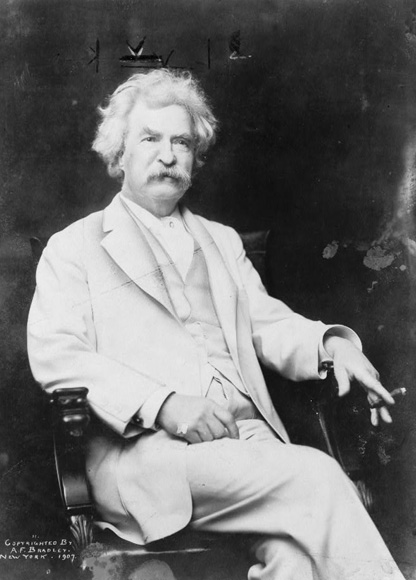
Mark Twain, 1907

The Herald, which then was regarded as one of the top daily newspapers in America, reported Twain, then 61, to be “grievously ill and possibly dying. Worse still, we are told that his brilliant intellect is shattered and that he is sorely in need of money.”

Twain was in London then, preparing to cover Queen Victoria’s Diamond Jubilee for William Randolph Hearst’s flamboyant New York Journal. That association allowed the Journal to puncture the Herald’s account as false.

In an article published June 2, 1897, beneath the headline, “Mark Twain Amused,” the Journal skewered the Herald’s story and offered Twain’s timeless denial: “The report of my death was an exaggeration.”

Twain’s line is often quoted as “the news of my death has been greatly exaggerated” and, sometimes, the Journal is said to have been the source for the erroneous report rather than the agent of its swift debunking.

According to the Journal, Twain said the likely source of the Herald’s error was the serious illness of his cousin, J.R. Clemens, who had been in London a few weeks before.

Ever eager to indulge in self-promotion, Hearst’s Journal enthusiastically embraced its brief association with Twain. Even so, it couldn’t have been much pleased with what the humorist filed about Victoria’s Jubilee.

As I wrote in The Year That Defined American Journalism, “Twain’s reporting about Victoria’s jubilee seemed half-hearted and hardly inspired. The spectacle was easily the most regal international story of 1897, and came at a time when the British empire was at or near its height. But Twain found the celebration overwhelming,” calling it “a spectacle for the kodak [camera], not the pen.”

Twain’s dispatch to the Journal also included this strange observation:

“I was not dreaming of so stunning a show. All the nations seemed to be filing by. They all seemed to be represented. It was a sort of allegorical suggestion of the Last Day, and some who live to see that day will probably recall this one if they are not too much disturbed in the mind at the time.”

Lining up Twain to cover the Jubilee was emblematic of Hearst’s inclination to spend lavishly to recruit big-name talent, if only for spot assignments.

Hearst was the leading practitioner of yellow journalism, or what he called the “journalism of action,” which embraced an activist vision for American newspapering.

His Journal argued that “a newspaper may fitly render any public service within its power. Acting on this principle, it has fed the hungry, brought criminals to justice and enforced by legal methods the responsibility of public officials.”

Not everyone was comfortable with or admired such an activist vision, especially as it came with such heavy and frequent doses of acute self-promotion.

Twain didn’t much like it, either. In his autobiography, he likened Hearstian yellow journalism to “that calamity of calamities.”

WJC

Related:

<!–[if !mso]> –> Twain’s reporting about Victoria’s jubilee seemed half-hearted and hardly inspired. The spectacle was easily the most regal international story of 1897, and came at a time when the British empire at or near its height. But Twain found the celebration overwhelming—“a spectacle for the kodak [camera], not the pen.”[i] His dispatch included this strange observation: “I was not dreaming of so stunning a show. All the nations seemed to be filing by. They all seemed to be represented. It was a sort of allegorical suggestion of the Last Day, and some who live to see that day will probably recall this one if they are not too much disturbed in mind at the time.”


[i]. Mark Twain, “The Great Jubilee As Described by the Journal’s Special Writers: Mark Twain’s Pen Picture of the Great Pageant in Honor of Victoria’s Sixtieth Anniversary,” New York Journal (23 June 1897): 1.

Six years on: Identity of Watergate’s ‘Deep Throat’ revealed

In Anniversaries, Cinematic treatments, Debunking, Media myths, Washington Post, Watergate myth on May 29, 2011 at 6:22 am

It’s been six years since W. Mark Felt,  once a senior FBI official, was revealed to have been “Deep Throat” of the Watergate era, the most famous source in modern American journalism.

Alias 'Deep Throat'

Felt’s “Deep Throat” identity had remained a secret — and was a topic of often-intense speculation — for more than 30 years.

On May 31, 2005, Vanity Fair disclosed that Felt had been the Washington Post’s elusive and enigmatic source as the Watergate scandal unfolded in 1972-73.

The disclosure was made with the consent of Felt — who then was 91 and in declining physical and mental health — and his daughter, Joan.

The Vanity Fair report meant that the Post effectively had been scooped on its own story.

“The identity of Deep Throat is modern journalism’s greatest unsolved mystery,” Vanity Fair crowed in its article lifting Felt’s secret. “It has been said that he may be the most famous anonymous person in U.S. history.”

As I note in Getting It Wrong, my media-mythbusting book that came out last year, the prolonged guessing game about the identity of “Deep Throat” help solidify the notion that the Post and its lead Watergate reporters, Bob Woodward and Carl Bernstein, were central to uncovering the scandal and forcing President Richard Nixon’s resignation.

I point out that speculation “about the identity of the ‘Deep Throat’ source provided periodic and powerful reminders about the Post and its Watergate coverage, serving to keep Woodward and Bernstein in the public eye far longer than they otherwise would have been.”

I further note:

“They and the mysterious ‘Deep Throat’ source became central figures” in what the Philadelphia Inquirer once called “the parlor game that would not die. … With each passing year, as ‘Deep Throat’s’ cloak of anonymity remained securely in place, his perceived role in Watergate gained gravitas.”

“And so,” I write, “… did the roles of Woodward and Bernstein.”

Although Alexander Haig, John Dean, and Henry Kissinger were among the suspects mentioned in the “Deep Throat” guessing game, Felt’s name always placed high on the roster of likely candidates.

As I discuss in Getting It Wrong, speculation about the identity of “Deep Throat” began in earnest in June 1974, with a front-page article in the Wall Street Journal, and continued periodically over the next 31 years.

The Journal article appeared soon after publication of All the President’s Men, Woodward and Bernstein’s best-selling book about Watergate in which they introduced the furtive source they called “Deep Throat.”

The Journal article described Felt as the top suspect.

Felt, though, repeatedly and adamantly denied having been “Deep Throat.” He was quoted as saying in the Journal article in 1974:

“I’m just not that kind of person.”

He told the Hartford Courant newspaper in 1999 that he “would have been more effective” had he indeed been Woodward’s secretive source, adding:

“Deep Throat didn’t exactly bring the White House crashing down, did he?”

That’s a revealing point that goes to the heart of what I call the heroic-journalist myth of Watergate: Disclosures by “Deep Throat” didn’t bring down Nixon’s corrupt presidency; nor did the reporting of Woodward and Bernstein.

(Bernstein, by the way, never spoke with Felt during the Watergate scandal; Felt was Woodward’s exclusive source. Bernstein finally met Felt in November 2008, shortly before the former G-man’s death.)

On the day six years ago when Felt was confirmed to have been “Deep Throat,” his family issued a statement calling him “a great American hero who went well above and beyond the call of duty at much risk to himself to save his country from a horrible injustice. We all sincerely hope the country will see him this way as well.”

Felt, though, hardly was such a noble character.

In his senior position at the FBI, he had authorized illegal burglaries as part of FBI investigations into leftists associated with the radical Weather Underground in the early 1970s.

Felt was convicted in 1980 on felony charges related to the break-ins, but pardoned by President Ronald Reagan.

Interestingly, his “Deep Throat” alter ego may best be known for a line Felt never spoke: “Follow the money.”

As I’ve discussed at Media Myth Alert, Felt never offered such guidance to Woodward. He never advised the reporter to “follow the money.”

The line doesn’t appear in the book All the President’s Men. But it was written into the script of the cinematic adaptation of Woodward and Bernstein’s book.

Follow the money” was spoken by Hal Holbrook, who delivered a bravado performance as “Deep Throat” in the movie.

Holbrook delivered his “follow the money” lines with such quiet insistence and knowing authority that it sounded for all the world as if it really had been guidance crucial to rolling up Watergate.

WJC

Recent and related:

Media myths, the ‘comfort food’ of journalism

In Debunking, Hurricane Katrina, Media myths on May 25, 2011 at 4:48 am

One of my favored characterizations of media-driven myths, those dubious tales about media power that masquerade as factual, is that they’re the “junk food of journalism.”

Not comforting at all

By that I mean they’re tasty and alluring, but not very nutritious, not very healthy.

The “junk food of journalism” is a turn of phrase suggested by an American University graduate student a few years ago. And, crediting him, I included that description in my media-mythbusting book, Getting It Wrong, which came out almost a year ago.

At a recent Roads Scholar (formerly ElderHostel) program at which I spoke about media myths, a participant offered a variation on “junk food of journalism.”

Media myths, she suggested, also are akin to “comfort food of journalism.”

The comfort food of journalism.

I liked the phrase. Liked it immediately.

Media myths, after all, do tend to offer comfort to journalists, the practitioners of a profession that’s largely unloved.

Tales such as those about the mythical “Cronkite Moment” or the heroic journalists who exposed Watergate make newsgathering seem vital, central, and essential. Those and other tales speak to the potential of journalism to do good, to make a difference.

The tales are indeed much like comfort food.

Seeking reassurance about the relevance of journalism helps explain the myth of superlative reporting that marred the coverage of the immediate aftermath of Hurricane Katrina’s landfall in late summer 2005.

The hurricane brought vast flooding to New Orleans, where levees failed.

“In the face of the deepening disaster, federal, state, and city emergency relief efforts proved sluggish, erratic, and stymied, especially in New Orleans,” I write in Getting It Wrong, adding:

“Evidence of government incompetence at all levels was abundant, and became a powerful story. People were suffering in New Orleans, and journalists went after the story vigorously, posing lacerating questions of federal, state, and city authorities: Where was the aid? Why had it not arrived? What was to be done to help the evacuees?”

In the turmoil, traditional news media seemed vital and authoritative. They were “essential again,” as American Journalism Review declared in a cover story both flattering and comforting.

“Those first days were a time for intrepid TV cameramen to take us into the stench and the sweat, the anger and the not knowing, the fear of those who seemed abandoned by their own country,” American Journalism Review asserted. “Those first days were a time for newspapers to put aside jitters about their declining importance and worries about layoffs and cutbacks. The old papers instead reasserted the comfort and utility of news you could hold in your hand.”

It added:

“In this era of blogs, pundits and shouted arguments, the coming of Katrina reunited the people and the reporters. In a time of travail, parts of the media landscape that had seemed faded, yea, even discarded, now felt true.”

Woah: “reunited the people and the reporters”? Talk about comfort food for the press.

As I write in Getting It Wrong, such self-reverential praise was “more than a little misleading.” The post-Katrina comfort-food story was largely wrong.

The reporting about Katrina’s aftermath was “no high, heroic moment in American journalism,” I note, adding:

“The coverage was in important respects flawed and exaggerated. On crucial details, journalists erred badly, and got it wrong.”

In the days immediately after Katrina’s landfall, news reports described apocalyptic horror supposedly unleashed by the hurricane. Journalists reported snipers firing at medical personnel. They reported shots were fired at helicopters, halting evacuations from the Convention Center. They told of bodies being stacked there like cordwood.

News reports spoke of roving gangs that preyed on tourists and terrorized the occupants of the Superdome. They said children were victims of sexual assault, that one seven-year-old was raped and her throat was slit. They reported that sharks were plying the flooded streets of New Orleans.

None of those reports, as it turned out, was verified or substantiated.

The exaggerated coverage not only delayed the arrival of aid to New Orleans; it impugned a battered city and defamed its residents, depicting them, inaccurately, as having shed all restraint in the face of a disaster.

WJC

Recent and related:

WaPo commentary off target on ‘sexual misbehavior of prominent men’

In Debunking, Media myths, Washington Post, Watergate myth on May 23, 2011 at 7:20 am

Packwood: Scuzzy guy

“Until recently,” declared a commentary in yesterday’s Washington Post, “we didn’t have to worry so much about how to talk about the sexual misbehavior of prominent men.”

The Post commentary asserted that “until recently, we didn’t talk much about it at all. But that certainly changed in the late 1990s, when Kenneth Starr broke the sexual sound barrier” with his allegations of sexual indiscretions by President Bill Clinton.

That’s nonsense, a misreading of recent history.

By the time Starr, a special federal prosecutor investigating Clinton’s suspected misdeeds, presented his case against the then-president, the “sexual sound barrier” had long been broken.

If anything, the sexual harassment scandal that ended the political career of Republican Senator Bob Packwood in 1995 was more likely a moment when “sexual misbehavior of prominent men” became a topic of considerable discussion.

Packwood was a scuzzy guy who resigned his Senate seat in 1995 in the face of probable expulsion, following release of the Senate Ethics Committee’s 10,000 page document that described a long history of his sexual misconduct.

The allegations against Packwood, a 26-year member of the Senate,  included no fewer than 18 “unwanted and unwelcome sexual advances,” many of which he described in his electronic diary.

One of Packwood’s victims was 17-years-old when, she said, the senator kissed her against her will.

The bipartisan ethics committee accused Packwood of having “engaged in a pattern of abuse of his position of power and authority as a United States Senator by repeatedly committing sexual misconduct, making at least 18 separate unwanted and unwelcome sexual advances between 1969 and 1990.”

He entered the Senate in 1969.

Most of Packwood’s victims were members of his staff, “or individuals whose livelihoods were dependent upon or connected to the power and authority” wielded by the senator, the ethics committee report said.

The ethics committee, moreover, charged Packwood with having “endeavored to obstruct and impede” the ethics committee investigation by “withholding, altering and destroying relevant evidence, including his diary transcripts and audio taped diary material.”

Packwood’s misconduct, the ethics committee said, brought “discredit and dishonor” upon the Senate.

About two months after Packwood resigned his Senate seat, Clinton began his furtive liaison with Monica Lewinsky, who was 27 years his junior.

In a way, Packwood’s execrable conduct probably helped Clinton sidestep political disaster in the Lewinsky affair.

The Lewinsky affair, while unseemly, was neither abusive nor unbidden, as were many of Packwood’s sordid overtures. Simply put, Clinton’s liaison with Lewinsky, and the lies he told about the affair, did not reach the seedy precedent that Packwood had set.

Lewinsky was a White House intern in late 1995 who, Starr later reported, seemed eager to initiate the liaison.

She performed oral sex with Clinton on November 15, 1995, while he spoke by telephone with a congressman. Clinton and Lewinsky had a second similar encounter two days later, and another on New Year’s Eve 1995.

Their liaison continued periodically until 1997.

When asked during a deposition about his sexual relations with Lewinsky, Clinton lied. The deposition was taken in January 1998, as part of Paula Corbin Jones’ civil lawsuit against the president.

Clinton’s lies under oath led to his impeachment in late 1998 by the House of Representatives and his trial and acquittal in 1999 by the Senate .

Clinton, though, was found in contempt of court by federal judge Susan Webber Wright for  “false, misleading and evasive answers” during the deposition in the Jones suit, answers the judge said “were designed to obstruct the judicial process.”

Clinton was ordered to pay nearly $90,000 to Jones’ lawyers and later agreed to a five-year suspension of his license to practice law.

While undeniably egregious, Clinton’s misconduct did not rise to the level of Packwood’s serial misconduct and repeated sexual harassment. Clinton’s misconduct also fell short of Richard Nixon’s criminality in the Watergate scandal — felonious wrongdoing that set a standard for turning a sitting president from office.

WJC

Recent and related: