W. Joseph Campbell

Posts Tagged ‘News’

Oprah as ‘this generation’s Walter Cronkite’?

In Cronkite Moment, Debunking, Error, Media myths, Television on January 13, 2013 at 3:26 pm

Here’s a good one: Oprah Winfrey is a latter-day Walter Cronkite, a television personality “capable of massively shifting public sentiment.”

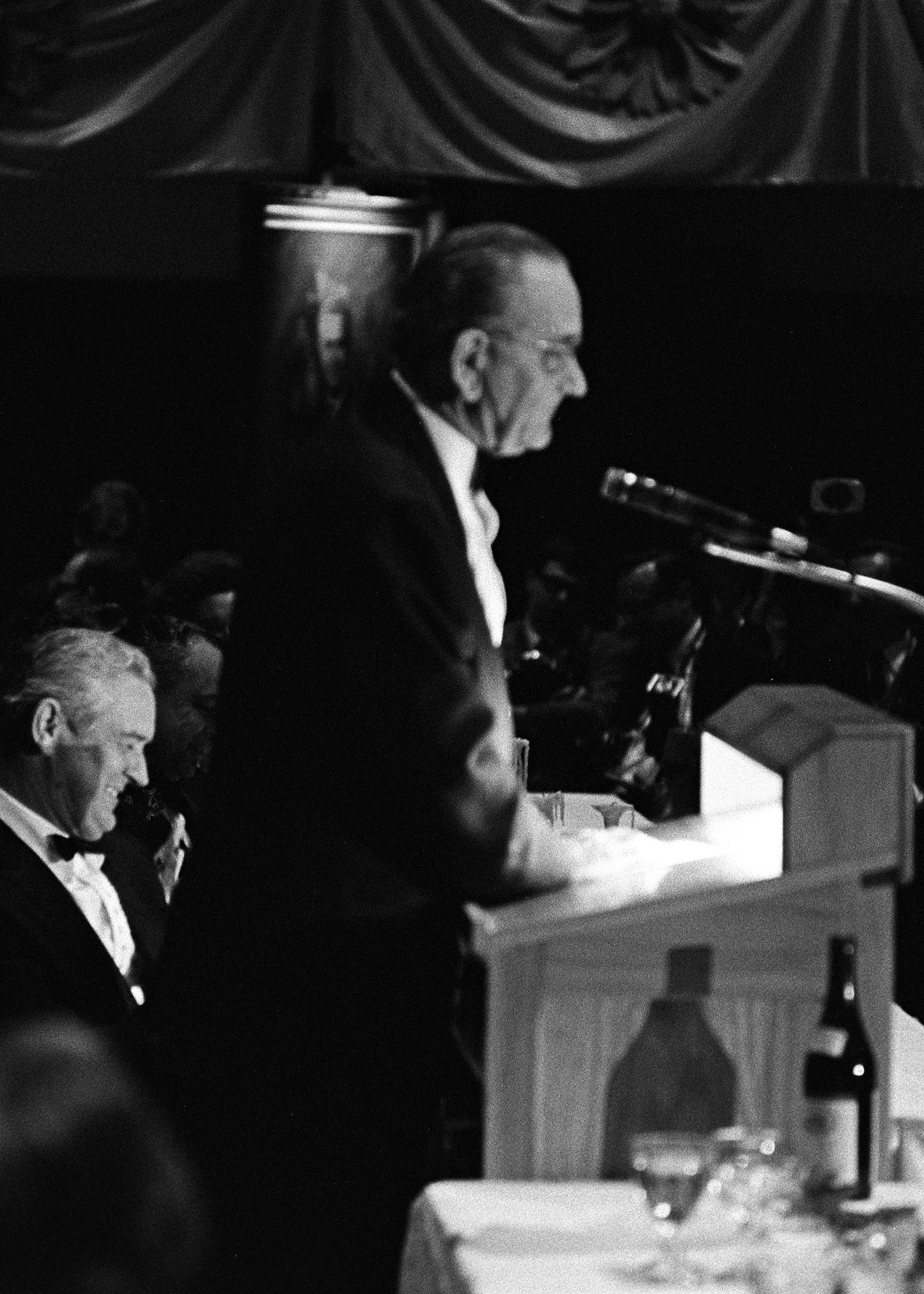
LBJ in Austin

Lyndon Johnson in Austin, February 27, 1968

So writes a sports columnist for the Detroit Free Press.

It’s a ridiculous claim, but not for reasons that may immediately come to mind.

Walter Cronkite was the avuncular anchorman on the CBS Evening News from 1962-81. Oprah Winfrey is an iconic talk-show host, whose appeal may or may not be ebbing.

Her clout is formidable. Cronkite’s was overstated.

But to return to the columnist’s claim:

Drew Sharp, writing in the Free Press about Oprah’s upcoming interview with disgraced international cycling star Lance Armstrong, notes that it’ll be an occasion for “staged news.”

Armstrong, he observes, “made the smart move, agreeing to a 90-minute taped interview with Oprah, which will air on her OWN cable network Thursday. It no doubt will be well watched.”

Sharp also declares, in a passage of particular interest to Media Myth Alert, that Oprah “has become this generation’s Walter Cronkite, capable of massively shifting public sentiment.

“It was,” Sharp adds, “the late CBS anchorman’s pointed commentary 45 years [ago,] following the North Vietnamese’s Tet Offensive in which he argued in a rare editorial that the U.S. couldn’t win the Vietnam War. President Lyndon B. Johnson famously said afterward that if he lost Cronkite, he lost Middle America.

“Not long afterward, LBJ opted not to run for reelection in the 1968 presidential campaign.”

In his claims about the effects of Cronkite’s report about Vietnam, the columnist indulges in one of American journalism’s most prominent and tenacious media myths.

As I discuss in my mythbusting book, Getting It Wrong, there is no evidence that Johnson saw the Cronkite program when it aired on the night of February 27, 1968, or that he viewed it afterward on videotape.

So it’s hard to argue that Johnson could have been much moved by a television report he didn’t see.

The president wasn’t in front of a television set that night. He was in Austin, Texas, at a black-tie party (see photo, above) to mark the 51st birthday of Governor John Connally, a longtime political ally.

About the time Cronkite was offering his pessimistic, on-air assessment about the war in Vietnam — that the U.S. military was “mired in stalemate” — Johnson wasn’t bemoaning a loss of Cronkite’s support; he was saying:

“Today you are 51, John. That is the magic number that every man of politics prays for — a simple majority.”

Johnson did announce, a month later, that he was not running for reelection to the presidency. But his reasons had little, if anything, to do with Cronkite and the anchorman’s comments about Vietnam.

More significant to Johnson’s decision was his eroding political strength. By late March 1968, he was facing insurgent challenges within his own party from senators Eugene McCarthy and Robert F. Kennedy.

Not only that, but Johnson may have decided long before March 1968 not to seek reelection.

“Long before I settled on the proper forum to make my announcement,” Johnson wrote in his memoir, The Vantage Point, “I had told a number of people of my intention not to run again.”

The memoir, by the way, has nothing to say about the Cronkite program of February 1968.

What’s more, there’s no evidence that Cronkite’s “mired in stalemate” comment influenced public opinion “massively” or otherwise.

Indeed, as I point out in Getting It Wrong, polls signaled shifts in public opinion against Vietnam months before Cronkite’s program. The anchorman followed rather than led deepening popular doubts about the wisdom of the war.

And until late in his life, Cronkite pooh-poohed the notion that his assessment of the war had much effect, saying it was akin to “another straw on the back of a crippled camel.”

To liken Oprah to Cronkite is, of course, more than a little incongruous. But it has been done before.

In a commentary published at Huffington Post in 2007 and titled “Oprah is to Iraq what Cronkite was to Vietnam,” Marty Kaplan asserted that “Oprah may actually be the twenty-first century’s de facto national anchor.”

A more frequent if similarly imprecise comparison is to identify Jon Stewart as a latter-day Cronkite.

But both comparisons are strained and feeble: They seek to reapportion to contemporary contexts influence the legendary Cronkite never really possessed. As such, they succeed only in promoting a media-driven myth.

WJC

More from Media Myth Alert:

Little sustained media reflection two weeks after botched massacre coverage

In Error, New York Times on December 28, 2012 at 11:29 am

The news media are notorious for seldom looking back in any sustained way to understand and explain their missteps when coverage of a prominent story has been botched.

This tendency was quite apparent in the aftermath of the exaggerated reporting of the mayhem Hurricane Katrina supposedly unleashed in New Orleans in 2005.

No media_cropped

Newtown, Connecticut

It also has been apparent in the two weeks since the schoolhouse massacre in Newtown, Connecticut.

There can be little dispute that the news media stumbled badly in reporting Adam Lanza’s lethal attack at Sandy Hook Elementary School in Newtown, an assault in which 26 people were killed, including 20 first-grade pupils.

As Andrew Beaujon of Poynter Online noted in an impressively succinct summary of the news media’s most glaring reporting errors:

“Adam Lanza was not buzzed in to Sandy Hook Elementary School …. His mother, Nancy, did not work at the school. He didn’t have an altercation with school officials the day before. He used a Bushmaster rifle, not the Glock and SIG Sauer pistols he was carrying, to carry out his massacre. The children he killed were first-graders, not mostly kindergarteners.

“Adam Lanza’s name was not Ryan.”

Ryan Lanza is the shooter’s brother.

Mistaking the assailant’s name may well endure as the single most memorable of the media’s errors in reporting the Newtown shootings. Just as Brian Ross’ egregious lapse last summer in tying the Colorado-movie theater shooter to the Tea Party movement stands as the most-remembered error in the coverage of that massacre.

Two weeks after the shootings in Connecticut, just how and why the news media failed so often has not been adequately dissected or explained. Not in any sustained or granular way.

When journalists and media critics have paused to consider the flawed reporting, they’ve tended to cite competitive pressures or have shifted blame to anonymous sources, especially those vaguely identified as “law enforcement” officials who provided bum information.

Blaming sources isn’t exculpatory, however. It doesn’t let journalists off the hook, despite an inclination to do so.

In a blog post the day after the shootings, Erik Wemple of the Washington Post wrote:

“The media can do many things; one thing they cannot do is on-the-spot fact-checking of the cops.”

But of course they can. Reporters have an obligation to press the cops for details about how they developed the information they’re passing along.

Journalists aren’t stenographers for the authorities;  they need not be timid or credulous.

Reporters covering unfolding disasters would be well-served to remember Eddie Compass, formerly the police commissioner in New Orleans, who offered graphic accounts of lawlessness in his city following Katrina’s landfall.

Little of Compass’ extravagance proved true.

As I note in my media-mythbusting book, Getting It Wrong, “Compass was asked months afterward why he had depicted New Orleans as swept by mayhem in Katrina’s aftermath. He offered a baffling reply. ‘I didn’t want people to think we were trying to cover anything up,’ he said. ‘So I repeated things without being substantiated, and it caused a lot of problems.'”

It sure did.

In the misreporting at Newtown, it’s not entirely clear that cops were the sources for the media’s most stunning error.

In the hours after the shootings on December 14, CNN correspondent Susan Candiotti went on the air and to say the shooter’s name was “Ryan” Lanza.

According to a transcript of CNN’s coverage available at the LexisNexis database, Candiotti said:

“The shooter has been identified to me by a source as Ryan Lanza, Ryan Lanza, in his 20s, apparently, we are told from the source, from this area.”

The identification, she said, was “by a source,” a most lazy and opaque sort of attribution. A “source” could be almost anyone, and not necessarily a “law enforcement” official.

In any case, the error about the shooter’s name soon was compounded.

The misidentification was reported by other news organizations in a revealing example of what Av Westin, formerly of ABC News, has called the “out there” syndrome. That is, if other news organizations are “out there” reporting what seems to be an important element of a disaster-related story, pressures mount on rival news outlets to match that information.

The New York Times repeated the misidentification in a report posted online — a report that said:

“Various news outlets identified the shooter as Ryan Lanza.”

The Times’ public editor (or in-house critic), Margaret Sullivan, noted that error in a blog post three days after the shootings.

But Sullivan did not consider the implications of the Times’ having joined in the “out there” syndrome. She offered neither criticism nor rebuke.

She wrote that “some mistakes may be inevitable on a major, fast-moving story, working against brutally demanding deadlines. That’s not an excuse, just a reality.”

Sullivan in a subsequent column seemed to modify that interpretation, writing that the Times “has to stand apart from those news sources that are getting information out in a fast, piecemeal and frequently inaccurate way.”

Fair enough.

Given that early disaster coverage does tend to be accompanied by missteps and error, journalists are well-advised to proceed cautiously. The challenges of filing on “brutally demanding deadlines” should give reporters, and their editors, pause: It should leave them more wary about what they are told and more cautious about what they report.

Greater restraint at such times — coupled with a broader inclination to study and learn from the missteps of disaster coverage — would leave journalists less likely to traffic in claims that prove exaggerated or unfounded.

WJC

Recent or related:

ABC needs to explain how, why Brian Ross so badly erred

In Debunking, Media myths, Television on July 24, 2012 at 11:59 am

Brian Ross’ stunning error last week linking the suspected Batman-movie shooter to the conservative Tea Party movement has been roundly and appropriately condemned — from Mother Jones to Rush Limbaugh, from the comedian Jon Stewart to the NewsBusters blog.

What’s missing, though, is a thorough, candid, and transparent accounting of what led Ross to proclaim on air that someone sharing the suspected shooter’s name, James Holmes, belonged to the Colorado Tea Party.

Ross, the chief investigative correspondent for ABC News, declared in a brief segment Friday morning, hours after the movie theater shootings in Aurora, Colorado:

“There is a Jim Holmes of Aurora, Colorado, page on the Tea Party site as well, talking about him joining the Tea Party last year.

“Now, we don’t know if this is the same Jim Holmes,” Ross said, “but it is a Jim Holmes of Aurora, Colorado.”

Ross and the network apologized later Friday morning for the error. In a statement posted online, ABC said:

“An earlier ABC News broadcast report suggested that a Jim Holmes of a Colorado Tea Party organization might be the suspect, but that report was incorrect. ABC News and Brian Ross apologize for the mistake, and for disseminating that information before it was properly vetted.”

It was a vague and empty apology that said nothing specifically to the misidentified Jim Holmes — and offered little insight into circumstances that gave rise to a towering error.

Still unexplained is what prompted Ross — whose online biography says he’s one of America’s “most honored and respected journalists” — to disseminate “information before it was properly vetted.”

So there ought to be a very public explanation for breaching such a fundamental protocol of professional journalism. Ross, and ABC News, ought to clarify, in detail, the circumstances that produced such a staggering lapse.

In a telephone conversation with me this morning, a spokesman for ABC News, Jeffrey W. Schneider, resisted engaging in a detailed discussion about Ross’ error.

“It was a mistake,” Schneider said. “We made it plainly clear it was a mistake. I think there’s been all kinds of speculation about how and why. It was simply an error. We made a human error.”

But why is such a broad acknowledgement of error not enough?

A number of reasons offer themselves.

By not explaining the back story to the error, Ross and ABC News have left themselves open to suspicions that political bias immediately and instinctively drove them to suspect a Tea Party connection to the shootings that left 12 people dead.

Rightly or wrongly, that conclusion has been reached often in the days since the shooting.

For example, John Kass of the Chicago Tribune  wrote in a column Sunday: “How long does it take for a major American television news network to politicize mass murder and blame conservatives for the blood of innocents?

“Not long.”

What’s more, by not specifying the circumstances that led to the stunning lapse, Ross and ABC News have effectively deprived serious-minded journalists and media audiences of an opportunity to understand the derivation of error and misjudgment of the kind that can blight the coverage of major breaking stories.

There is more than thumbsucking interest in understanding, at a granular level, why and how the news media get it so badly wrong.

Error-plagued coverage happens often enough: Consider, as another recent example, the wrongheaded early reports by CNN and FoxNews about the Supreme Court’s frankly baffling ruling on the constitutionality of ObamaCare.

As I point out in my latest book, Getting It Wrong, news reporting in the first hours of a dramatic event often is in error, owing in part to the swirl of rumor and confusion that typically accompanies a major breaking story.

And as Kass wrote, “when you add political bias to the rush of breaking news, as seems to have happened here, things get stinky.”

And worse.

WJC

Many thanks to Instapundit
Glenn Reynolds for linking to this post

Recent or related:

CBS marks a Cronkite anniversary, invokes a tenacious media myth

In Anniversaries, Cronkite Moment, Debunking, Media myths on April 17, 2012 at 3:23 pm

CBS News yesterday marked what has to be among the more obscure anniversaries in broadcast journalism — the 50th anniversary of the debut of Walter Cronkite’s old evening news show.

Cronkite in Vietnam, 1968

And in a flattering writeup recalling the occasion, CBS invoked a prominent media-driven myth — the notion that Cronkite’s on-air assessment in 1968 about the war in Vietnam exerted enormous influence. Until late in his life, not even Cronkite believed that was the case.

Even so, the CBS article declared:

“Cronkite’s intense focus on objectivity gave his rare dose of opinion — especially his 1968 assessment of the war in Vietnam — an enormous weight.”

The writeup quoted an executive producer, Susan Zirinsky, as saying:

“Lyndon Johnson remarked, because he looked at that broadcast, and he said, ‘If I’ve lost Walter Cronkite, I’ve lost the country.'”

President Lyndon Johnson’s purported comment lies at the heart of this tenacious media myth — one of the 10 I address and debunk in my latest book, Getting It Wrong.

Interestingly, the comment so often attributed to Johnson has been described in so many ways. That is, there is no single version of what the president supposedly said in reacting to Cronkite’s assessment that the war was stalemated.

There’s the version Zirinsky invoked: “‘If I’ve lost Walter Cronkite, I’ve lost the country.”

More common is: “If I’ve lost Walter Cronkite, I’ve lost Middle America.”

Another variant has the president saying: “If I’ve lost Cronkite, I’ve lost the war.”

And so on.

As I point out in Getting It Wrong, “Version variability of that magnitude signals of implausibility. It is a marker of a media-driven myth.”

And it’s highly likely that Johnson said nothing of the sort.

He did not, after all, not see Cronkite’s report about Vietnam when it aired on CBS on February 27, 1968. The president that night was not in front of a television set when, near the close of the program, Cronkite declared that the U.S. military was “mired in stalemate” in Vietnam.

Johnson: Not in front of a TV

Johnson at that moment was at a black-tie birthday party for Texas Governor John Connally. The president poked fun at Connally, who was marking his 51st birthday.

“Today you are 51, John,” the president said. “That is the magic number that every man of politics prays for — a simple majority.”

It is difficult to fathom how Johnson could have been much moved by a program he did not see. And the power of what often is called the “Cronkite Moment” stems from the supposedly immediate and visceral effect the anchorman’s assessment had on the president.

But what Cronkite had to say on air that night was hardly earth-shaking, hardly stunning or novel.

If anything, Cronkite’s observation about “stalemate” was a rehash of what other news organizations, such as the New York Times, had been saying for months.

For example in August 1967, the Times inserted “stalemate” into the headline over a front-page news analysis about the war. The Times headline read:

Vietnam: The Signs of Stalemate.”

The newspaper’s analysis was filed from the South Vietnamese capital, Saigon, and noted:

“‘Stalemate’ is a fighting word in Washington. President Johnson rejects it as a description of the situation in Vietnam. But it is the word used by almost all Americans here, except the top officials, to characterize what is happening” in the war.

Before that, on July 4, 1967, the Times published a news analysis that said of the war effort:

“Many officers believe that despite the commitment of 466,000 United States troops now in South Vietnam … the military situation there has developed into a virtual stalemate.”

So in the context of the war in Vietnam, “stalemate” was hardly new by the time Cronkite turned to the word.

WJC

Recent and related:

On bra-burning, Erica Jong is wrong

In Bra-burning, Debunking, Media myths, Photographs on March 28, 2012 at 4:25 pm

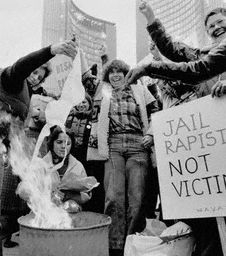
Bra-burning in Toronto, 1979 (Bettmann/Corbis)

The writer Erica Jong asserts in a rambling commentary posted yesterday at the Daily Beast that bra-burning “never actually occurred.”

The mischaracterization of bra-burning was an element of Jong’s defense of feminism and the sexual revolution of the 1960s and 1970s.

Jong wrote in the commentary:

“The fact that the so-called mainstream press reduced our valid struggles to sex, drugs, rock and roll, and bra burning (which, btw, never actually occurred) was their attempt to further disempower us. And they surely prevailed.”

It’s not an infrequent claim, that feminist bra-burning was a media trope, a media myth. That it “never actually occurred.”

But there were at least a couple of documented occasions when feminist protesters set fire to bras.

One occasion came 33 years ago this month, when members of Women Against Violence Against Women demonstrated outside Toronto City Hall. As the demonstration neared its end, a protester named Pat Murphy dropped a white bra into the hungry flames of a burn barrel (see photo, above).

The demonstration in Toronto on March 8, 1979, coincided with International Women’s Day and was aimed at denouncing a report on rape prepared by the Ontario Provincial Police.

The police report said “promiscuity” was a factor in many rapes.

The Women Against Violence Against Women group assailed the report as outrageous and “dazzling in its illogic.” Protesters carried signs saying: “Take a Rapist to Lunch — Charcoal Broiled” and “Hookers Who Wink Go to the Clink! Men Who Rape Escape.”

The Globe and Mail newspaper reported that the protesters lighted “a fire in a garbage can, to the obvious annoyance of about a dozen watchful constables, [and] shouted: ‘Burn the rapists, burn the city, burn the OPP,’” acronym for Ontario Provincial Police.

The newspaper’s account did not specifically mention bra-burning which, one participant has told me, “wasn’t a focal point” of the protest.

But bra-burning did happen there.

Another participant has recalled that “weighing in on the stereotype of ‘feminist bra-burners’ was actually an effective way [for protesters] to say: Women will control our own bodies, thank you!

“The bra burning,” she said, “was a way to entice the media as well as [offer] a critique of the police report.”

A little more than 10 years before the demonstration in Toronto, some 100 women gathered on the boardwalk at Atlantic City, New Jersey, to protest the 1968 Miss America pageant. The demonstration was organized by a small group called New York Radical Women and was an early manifestation of the women’s liberation movement.

In Getting It Wrong, my mythbusting book that came out in 2010, I offer evidence that bras were set afire, briefly, during the demonstration at Atlantic City.

The evidence is from two witness accounts, one of which was published in the local newspaper, the Press of Atlantic City, on September 8, 1968, the day after the protest.

Boucher (1949 photo)

That account appeared beneath the byline of a veteran reporter named John L. Boucher and carried the headline:

“Bra-burners blitz boardwalk.”

Boucher’s article referred to the burn barrel that demonstrators dubbed the “Freedom Trash Can” and stated:

“As the bras, girdles, falsies, curlers, and copies of popular women’s magazines burned in the ‘Freedom Trash Can,’ the demonstration reached the pinnacle of ridicule when the participants paraded a small lamb wearing a gold banner worded ‘Miss America.’”

That published account was buttressed by recollections of the writer Jon Katz, who in 1968 was a young reporter for the Atlantic City newspaper. Katz was on the Atlantic City boardwalk the day of the protest, gathering material for a sidebar article about reactions to the demonstration.

Katz’s sidebar didn’t mention the fire in the “Freedom Trash Can.”

But in correspondence with me, Katz stated:

“I quite clearly remember the ‘Freedom Trash Can,’ and also remember some protestors putting their bras into it along with other articles of clothing, and some Pageant brochures, and setting the can on fire.

“I am quite certain of this.”

WJC

Many thanks to Instapundit
Glenn Reynolds for linking to this post.

Recent and related:

ABC unaccountably excludes Bill Clinton from lineup of pols who led ‘double lives’

In Debunking, Media myths, Scandal on January 21, 2012 at 10:39 am

ABC News offered yesterday a risible lineup of two-timing politicians that omitted Bill Clinton, the philandering 42nd president, but included Thomas Jefferson, about whom the evidence of sexual dalliance is thin at best.

ABC’s roster of “the top eight politicians who led double lives” was posted online and promised “a look at some … tawdry affairs and public scandals” — and how the politicians implicated “weathered the storm.”

In addition to Jefferson, ABC included Grover Cleveland, the U.S. president in the 1880s and 1890s who fathered a child out of wedlock, and Eliot Spitzer, who as governor of New York consorted with a high-priced call girl.

The ABC roster also included an obscure and mostly forgotten former politician, Vito Fossella, a five-term New York congressman who in 2008 acknowledged fathering a child in an extramarital affair.

Given that the likes of Fossella made the list, it’s inexplicable that Clinton was omitted.

Clinton’s tawdry sexual affair with Monica Lewinsky, a White House intern, began in mid-November 1995 and continued intermittently until March 1997.

Disclosures of the Clinton-Lewinsky dalliance, and falsehoods he told under oath about the affair, nearly destroyed Clinton’s presidency.

He was impeached in December 1998 on two counts — lying under oath and obstructing justice to cover up the affair — but acquitted by the U.S. Senate in February 1999 and served out the 23 months remaining in his term.

Separately, a federal judge found Clinton in contempt of court for having lied under oath about the Lewinsky affair. Clinton was barred from practicing law for five years and ordered to pay nearly $90,000 to the lawyers of Paula Jones, who had accused him of sexual harassment while he was governor of Arkansas.

Clinton was the second U.S. president impeached in office. The other was Andrew Johnson, in 1868.

ABC’s including Jefferson in its “double lives” roster was little short of baffling: Indeed, its writeup about Jefferson’s purported sexual liaison with a slave-mistress named Sally Hemings offered no small amount of exculpatory evidence.

In fact, the writeup referred to “the myth of Jefferson’s double life” and noted:

“To this day, Jefferson’s paternity of any of her children has not been established with any absolute certainty.”

ABC also pointed out that a recent and detailed study about the purported Jefferson-Hemings affair which “did not show much support for the accusations” of a sexual liaison.

That study, a 400-page work titled The Jefferson-Hemings Controversy: Report of the Scholars Commission, was compiled by a commission of Jefferson scholars charged with puncturing the myriad misunderstandings about the third president and a slave whom he rarely mentioned in his letters.

Among the misunderstandings was the DNA testing released in 1998 — about the time Clinton was facing impeachment charges — confirmed that Jefferson fathered children by Hemings.

“While the tests were professionally done by distinguished experts,” the scholars commission pointed out, “they were never designed to prove, and in fact could not have proven, that Thomas Jefferson was the father of any of Sally Hemings’ children.

“The tests merely establish a strong probability that Sally Hemings’ youngest son, Eston, was fathered by one of the more than two dozen Jefferson men in Virginia at the time ….”

One of the more than two dozen Jefferson men.

Yet, news media reports at the time characterized the DNA tests as offering “compelling evidence” of a sexual relationship between Jefferson and Hemings.

The scholars commission — a panel of 13 experts organized by the Thomas Jefferson Heritage Society — said that circumstantial evidence points more powerfully to Jefferson’s younger brother, Randolph (or his sons), in the paternity question.

Randolph Jefferson, the book says, was known to have socialized with the slaves at Monticello, Thomas Jefferson’s home near Charlottesville, VA.

Randolph Jefferson was a dozen years younger than the president, and the available record offers no evidence that Thomas Jefferson “enjoyed socializing at night with Monticello slaves,” the book points out.

Eston Hemings’ was conceived around August 1807, when Thomas Jefferson was 64 and in declining health — factors that further diminish the likelihood of his paternity.

Also making ABC’s roster of politicians who led “double lives” were Mark Sanford, a former governor of South Carolina; John Edwards, a former U.S. senator from North Carolina; Arnold Schwarzenegger, a former governor of California, and Anthony Wiener, a former congressman from New York City.

WJC

Many thanks to Instapundit
Glenn Reynolds for linking to this post.

Recent and related:

Abrupt WaPo rollback stirs fresh questions about anonymous source use

In Debunking, Jessica Lynch, Washington Post on January 11, 2012 at 12:14 pm

The Washington Post offered online readers a dramatic example of “whiplash journalism” yesterday, reporting that the goal of U.S. sanctions against Iran was to topple the regime in Tehran then rolling back that stunning report.

Left thoroughly unclear was how the Post got the story so utterly wrong in the first place.

The original report, though based on the paraphrased remarks of a single anonymous source, seemed to signal a U.S. policy departure that would “reverberate around the world,” as Blake Hounsell, managing editor of Foreign Policy, promptly pointed out at the journal’s “Passport” blog.

Hounsell called it “a bombshell revelation” — if true.

The original report certainly seemed of bombshell quality; its opening paragraph declared:

“The goal of U.S. and other sanctions against Iran is regime collapse, a senior U.S. intelligence official said, offering the clearest indication yet that the Obama administration is at least as intent on unseating Iran’s government as it is on engaging with it.”

(The report was touted at the Post’s CheckpointWash” Twitter feed, which stated: “Goal of US sanctions on Iran is regime collapse, senior US intel official says.”)

But later in the day, the Post amended — and considerably softened — its report to say:

“The Obama administration sees economic sanctions against Iran as building public discontent that will help compel the government to abandon an alleged nuclear weapons program, according to a senior U.S. intelligence official.”

Discontent in Iran is quite pronounced already, so the Post’s revised version added little that’s new.

But quite puzzling is that the newspaper’s reporting could reach such dramatically differing interpretations on a leading foreign policy issue. The two-sentence correction appended to the revised version served only to deepen confusion.

The correction read:

“An earlier version of this article incorrectly reported that a U.S. intelligence official had described regime collapse as a goal of U.S. and other sanctions against Iran. An updated version clarifies the official’s remarks.”

Huh?

Did the Post reporters on the story not understand what their source — the “senior U.S. intelligence official” — was telling them? Did the source exaggerate under the cover of anonymity? Did the blanket of anonymity grant him license to speculate incautiously, or to go beyond his brief?

By email today, I asked Patrick Pexton, the Post’s ombudsman or reader’s representative, if he knew how or why the two versions of the same story differed so sharply.

Pexton has not replied to my inquiry. replied, saying he would look into the matter.

I also asked Pexton whether the Post’s rollback represented another example of playing fast and loose with the newspaper’s policy on anonymous sources. I believe it may.

Pexton’s predecessor as ombudsman, Andrew Alexander, noted in a column in 2010 that “too often it seems The Post grants anonymity at the drop of a hat.”

That may have been the case on the Iran-sanctions reporting: A too-quick grant of anonymity.

Alexander further wrote in the column:

“The Post’s internal policies set a high threshold for granting anonymity. It ‘should not be done casually or automatically.’ … If sources refuse to go on the record, ‘the reporter should consider seeking the information elsewhere.'”

That guidance seems not to have been followed in the Iran-sanctions report, which, in the confusion caused by relying on an anonymous source, is reminiscent of the enduring messiness created by another sensational Post story — its botched report in 2003 about Jessica Lynch’s purported battlefield heroics.

The Lynch story — a Post exclusive that was picked up by news organizations around the world — was based on anonymous sources whom the newspaper identified merely as “U.S. officials.”

The Post indirectly quoted one of the anonymous sources as saying Lynch, then a 19-year-old Army supply clerk, “continued firing” at her attackers “even after she sustained multiple gunshot wounds and watched several other soldiers in her unit die around her in fighting” in southern Iraq on March 23, 2003.

That source was quoted directly as saying:

“She was fighting to the death. She did not want to be taken alive.”

The comment inspired the memorable headline that accompanied the hero-warrior story:

“‘She was fighting to the death.'”

But the Post’s report about Lynch’s derring-do proved utterly wrong.

Lynch had not fired a shot in the attack; she cowered in the back of a fleeing Humvee which was struck by a rocket-propelled grenade and crashed, killing four of her Army comrades and leaving her unconscious and badly injured.

Lynch was taken to an Iraqi hospital, from where she was rescued nine days later, in a raid mounted by U.S. special forces.

The Post’s erroneous story about Lynch was has had enduring consequences.

The newspaper’s unwillingness to explain just how it got the hero-warrior story so utterly wrong, as well as its unwillingness to identify the sources who led it astray, have given rise to the tenacious false narrative that the military ginned up the story to bolster support for the war.

We know that it’s a false narrative from one of the reporters on the Lynch story, Vernon Loeb, who said in an interview with NPR in December 2003:

“Our sources for that story were not Pentagon sources.”

He also said in the interview that military officials “wouldn’t say anything about Jessica Lynch. I’ve never believed that, at least as far as the story we wrote goes, that it was a Pentagon attempt to create a hero there. … I just didn’t see the Pentagon trying to create a hero where there was none.”

Even so, the false narrative took hold and lives on, an ugly media-driven myth.

WJC

Many thanks to Instapundit
Glenn Reynolds for linking to this post.

Recent and related:

Misreading the ‘Cronkite Moment’ — and media power

In Cronkite Moment, Debunking, Media myths on September 13, 2011 at 7:27 am

LBJ wasn't watching Cronkite

The mythical “Cronkite Moment” — that heady occasion in 1968 when an editorial comment by CBS News anchor Walter Cronkite purportedly altered the course of the war in Vietnam — lives on as an irresistible parable about the power of the news media.

The parable is timeless and often invoked — most recently in a commentary posted yesterday at the online sports site, Bleacher Report.

The commentary declared:

“The flashy columnist, opinionated radio host, or aggressive TV interviewer that pushes the needle and ultimately helps get those in charge to make a move for fear of public ridicule and backlash.

“A great example of this came in 1968 in the time of the Vietnam War when a story by broadcasting legend Walter Cronkite called the war unwinnable and un-American, then-president Lyndon B. Johnson was reported to have said ‘If I’ve lost Cronkite, I have lost middle America.’

“That is the kind of power that a strong media personality can have: the power to affect change.”

Except Cronkite didn’t cause such change.

As I discuss in my latest book, Getting It Wrong, Johnson wasn’t in front of a television when Cronkite’s special report aired on February 27, 1968. The president wasn’t lamenting the loss of Cronkite’s support, either.

Rather, Johnson was on the campus of the University of Texas at Austin, offering light-hearted banter at the 51st birthday party of Governor John Connally, a longtime political ally.

At about the time Cronkite was offering his downbeat assessment about the U.S. war effort, Johnson was quipping:

“Today you are 51, John. That is the magic number that every man of politics prays for — a simple majority.”

Not only was the president not watching, but Cronkite’s editorial comment wasn’t especially dramatic or incisive. His comment, offered at the close of his special report, was quite mild.

Most certainly Cronkite did not say the war was “unwinnable” or “un-American,” as the Bleacher Report commentary asserts. He said the U.S. military was “mired in stalemate” in Vietnam and that negotiations eventually might offer America a way out.

The “mired in stalemate” comment was hardly an original assessment.

Leading U.S. news outlets such as the New York Times had turned to “stalemate” for months before the Cronkite program.

For example, in a news analysis published July 4, 1967, the Times said of the war effort:

“Many officers believe that despite the commitment of 466,000 United States troops now in South Vietnam … the military situation there has developed into a virtual stalemate.”

In a report from Saigon that was published August 7, 1967, the Times noted:

“‘Stalemate’ is a fighting word in Washington. President Johnson rejects it as a description of the situation in Vietnam. But it is the word used by almost all Americans here, except the top officials, to characterize what is happening. They use the word for many reasons ….”

Far more assertive than the “mired in stalemate” assessment was a Wall Street Journal editorial, published four days before Cronkite’s special report aired.

The Journal said the U.S. war effort in Vietnam “may be doomed” and that “everyone had better be prepared for the bitter taste of defeat beyond America’s power to prevent.”

As I note in Getting It Wrong, the “Cronkite Moment,” when scrutinized, dissolves as illusory — a chimera, a media-driven myth.

“That it does is not so surprising,” I write. “Seldom, if ever, do the news media exert truly decisive influences in decisions to go to war or to seek negotiated peace. Such decisions typically are driven by forces and factors well beyond the news media’s ability to shape, alter, or significantly influence.

“So it was in Vietnam, where the war ground on for years after the ‘Cronkite moment.’”

WJC

Recent and related:

Blogging about journalism history: Why, and why bother?

In Debunking, Media myths on August 10, 2011 at 6:44 am

Journalism historians who blog.

It seems a little oxymoronic.

After all, isn’t journalism history a little too fusty, a little too musty, and a little too obscure to be readily adapted to contemporary social media such as blogging?

One might reflexively think so.

But a panel of four journalism historians who blog will discuss why they do so at a panel in St. Louis this afternoon, during the annual conference of the Association for Education in Journalism and Mass Communication (AEJMC).

The panel, titled “We blog about journalism history: Why, and why bother,” will consider the value of injecting historical dimension into contemporary debates and critiques about the performance of  news media, both traditional and online.

I’ll moderate and participate on the panel, which will bring together Chris Daly of Boston University, Karen Russell of the University of Georgia, and James McPherson of Whitworth College.

I intend to point out how blogging about journalism history can offer relevant and valuable context to the blogosphere’s never-ending debates about media performance. Journalism historians can bring to those debates perspective and analysis that would otherwise be missing or overlooked.

I also expect to note there are personal reasons for blogging as well. By blogging, journalism historians can test emergent ideas and hypotheses. Blogging can reinforce (and direct attention to) previously published work — much as Media Myth Alert seeks to do in promoting my latest book, Getting It Wrong, which debunks 10 prominent media-driven myths.

Blogging is a way to call out media myths. After all, as historian Gerard DeGroot has pointed out, “The good historian is a mythbuster.”

Blogging also allows journalism historians to take the steps toward developing larger, more detailed works, a point suggested several years ago in an intriguing blog post by Timothy Burke about why historians blog.

Among other points, Burke said he writes online essays because “I want to find out how much of my scholarly work is usefully translatable into a wider public conversation.”

Blogging about journalism history can have pedagogical value and impact far beyond the blogger’s expectations and knowledge. As such, blog posts about topics in journalism history may greatly expand the reach and application of a scholar’s research.

So it promises to be lively, the AEJMC blogging panel, which convenes at 1:30 p.m. in the Landmark #1 meeting room of the Renaissance Grand and Suites Hotel in St. Louis.

Panel-goers are invited to live-Tweet the proceedings, and use the Twitter hashtags #AEJMCblogging and #AEJMC11.

WJC

Recent and related:

Following the money on 37th anniversary of Nixon’s fall

In Anniversaries, Cinematic treatments, Debunking, Media myths, Washington Post on August 9, 2011 at 12:55 am

Nixon resigns, 1974

It’s somehow fitting on this, the 37th anniversary of President Richard Nixon’s resignation, to direct attention to the myth and hyperbole that embrace the best-known line of the Watergate scandal, the line that supposedly helped bring him down.

That line, of course, is “follow the money,” which purportedly was crucial advice given the Washington Post by a super-secret, high-level source code-named “Deep Throat.”

Follow the money” was said to have been so telling and effective that it’s still cited as exemplary guidance applicable in journalism, politics, and finance.

Just yesterday, for example, Barry Nolan, a journalist and contributor to Boston Magazine’sBoston Daily” blog, invoked the famous phrase, writing:

“Any time you really want to know why a vote happened the way it did, the single best piece of advice ever given came from ‘Deep Throat,’ the shadowy tipster in the Watergate scandal. ‘Follow the money,’ he told the Washington Post reporters.”

It may seem like stellar advice, but it’s guidance that the “Deep Throat” source offered only in the movies.

As I’ve discussed at Media Myth Alert, “follow the money” is Watergate’s most famous made-up line.

The phrase was written into the screenplay of All the President’s Men, the 1976 cinematic version of the book by Bob Woodward and Carl Bernstein of the Washington Post.

“Follow the money” appears nowhere in Woodward and Bernstein’s book about their Watergate reporting — reporting that did not, as I discuss in my latest work, Getting It Wrong, take down Nixon’s corrupt presidency.

Nor did “follow the money” appear in any Watergate-related news article or editorial in the Post until June 1981, nearly seven years after Nixon’s resignation.

Nor did “Deep Throat” — who was self-identified in 2005 as W. Mark Felt, formerly the FBI’s second-ranking official — utter the line in his periodic meetings with Woodward. (And Felt/”Deep Throat” didn’t meet Bernstein until 2008.)

Follow the money” was memorably intoned not by Mark Felt but by Hal Holbrook, the actor who played “Deep Throat” in All the President’s Men.

As I’ve noted, Holbrook turned in a marvelous performance as a tormented, conflicted, and stealthy “Deep Throat.”

Holbrook delivered the “follow the money” line with such conviction and steely assurance, that it seemed for all the world to offer a way through the labyrinth of the Watergate scandal.

But even if Woodward had been counseled to “follow the money,” the advice certainly neither would have unraveled Watergate nor led him to Nixon.

Nixon resigned 37 years ago today not because he misused campaign funds but because he sought to obstruct justice by covering up the signal crime of Watergate, the break-in at the headquarters of the Democratic National Committee in June 1972.

The simplified follow-the-money  interpretation of Watergate effectively deflects attention from the decisive forces that ultimately forced Nixon from office.

As I note in Getting It Wrong, rolling up a scandal of Watergate’s intricacy and dimension required “the collective if not always the coordinated forces of special prosecutors, federal judges, both houses of Congress, the Supreme Court, as well as the Justice Department and the FBI.

“Even then,” I write, “Nixon likely would have served out his term if not for the audiotape recordings he secretly made of most conversations in the Oval Office of the White House.

“Only when compelled by the Supreme Court did Nixon surrender those recordings, which captured him plotting the cover-up” that cost him the presidency.

WJC

Recent and related: