W. Joseph Campbell

Posts Tagged ‘Orson Welles’

Inaugurating the Parker-Qualls lecture

In Debunking, Media myths, Spanish-American War, War of the Worlds, Washington Post, Watergate myth, Yellow Journalism on November 11, 2010 at 10:55 pm

I inaugurated last night the Parker-Qualls lecture in communications at the University of North Alabama with an audience of some 300 students, faculty, staff, administrators, and townspeople in attendance.
My talk centered on three of the 10 prominent media-driven myths debunked in  my latest book, Getting It Wrong.

I discussed the heroic-journalist myth that has become the dominant narrative of the Watergate scandal, which ended Richard Nixon’s presidency in 1974; the mythical  “Cronkite Moment” of 1968 that supposedly forced President Lyndon Johnson to realize the futility of the war effort in Vietnam, and The War of the Worlds radio dramatization that reputedly pitched Americans into panic and mass hysteria in 1938.

During the Q-and-A that followed my presentation, I was asked how media audiences can better identify potential media-driven myths, those dubious stories about or by the news media that masquerade as factual. It’s a fine question, with no easy answer.

I advised being wary about media-related stories that just sound too neat and too tidy. The famous vow attributed to William Randolph Hearst–“you furnish the pictures, and I’ll furnish the war”–is a telling example, I said. The quote just seems too good, too perfect to be true.  It deftly captures Hearst as war-monger, but it’s supported by almost no evidence. It’s almost certainly apocryphal.

Media audiences also should apply logic and healthy skepticism to stories about or by the news media and their power, I said, citing The War of the Worlds dramatization as an example. It it really plausible that a radio show–even one as  clever and imaginative as that–really could send tens of thousands, or hundreds of thousands of Americans into the streets in sheer panic and hysteria? It doesn’t seem logical to me.

I also recommended consulting online sources: Some, like Media Myth Alert, are devoted to mythbusting. Even a simple Google search will readily turn skeptical accounts of popular, mediacentric stories.

I also was asked whether there were candidate-media myths that proved to true. Another good question and I couldn’t recall any immediately.

Then I remembered having had suspicions about Joe Namath’s guarantee that the New York Jets would defeat the heavily favored Baltimore Colts in the 1969 Super Bowl. That Namath guaranteed victory sounded to me almost too neat and tidy to be true.  (I privately congratulated myself on remembering being suspicious of that quote,  as it enabled me to mention a football legend who starred at the University of Alabama, a team much followed in Northern Alabama.)

Anyway, it turned out that Namath had indeed made such a guarantee–which I quickly determined in a check of a database of historical newspapers. So that was a candidate myth that proved to be true.

I also was asked what prompted me to write Getting It Wrong. In some ways, I replied, the book built upon previous research. I mentioned my 2001 book, Yellow Journalism: Puncturing the Myths, Defining the Legacies, in which I addressed the myth of Hearst’s famous vow.

I noted that I returned to that topic in the first chapter of Getting It Wrong, offering additional detail about how the often-retold tale about Hearst’s vow took hold and was diffused.

Another inspiration for the book stemmed from my classes at American University. I’ve often included in my courses references to the “Cronkite Moment,” I noted for example, adding that the more I read about and thought about such anecdotes, the more dubious they seemed to be.

And under scrutiny–in researching them–they dissolved as apocryphal or wildly exaggerated.

My hosts at the University of North Alabama have been Greg Pitts, chair of the department of communications, and Jim R. Martin, a journalism historian and editor of the scholarly journal American Journalism.

WJC

Recent and related:

SRO for ‘Getting It Wrong’ talk at UMd

In Anniversaries, Cronkite Moment, Debunking, Furnish the war, Jessica Lynch, Media myths, Media myths and radio, War of the Worlds, Washington Post, Watergate myth on November 5, 2010 at 11:50 am

A terrific audience of journalism students and faculty turned out last night for my talk at the University of Maryland’s Merrill College of Journalism.

It was standing-room-only at the Knight Hall conference room, where I discussed several chapters in my latest book, Getting It Wrong, which debunks 10 prominent media-driven myths.

I walked through the heroic-journalist myth of the Watergate scandal that toppled Richard Nixon’s presidency; the mythical  “Cronkite Moment” of 1968 that reputedly shifted U.S. public opinion about the war in Vietnam, and The War of the Worlds radio dramatization of 1938 that supposedly panicked listeners across the United States.

During the Q-and-A period that followed, I touched on the famous vow to “furnish the war” attributed to William Randolph Hearst and on the erroneously reported battlefield heroics of Private Jessica Lynch early in the Iraq War.

An intriguing question from the audience was what message should students take away from a book that identifies as media-driven myths some of the best-known stories in American journalism. The implication was that mythbusting may undercut the regard would-be journalists have for the profession.

I replied by saying that I  don’t consider Getting It Wrong a media-bashing book: Such books are many on the market as it is.

Rather, I said, the mythbusting in Getting It Wrong is aligned with the fundamental objective of American journalism. And that is to get it right, to offer an account that is as accurate as possible.

And it does journalism little good to indulge in tales such as the heroic-journalist myth of Watergate or the mythical “Cronkite Moment” that offer misleading interpretations about the news media and their power.

Debunking media myths, as I write in Getting It Wrong, “can help to place media influence in more coherent context.”

Nor should we worry about students being disappointed that well-known and even cherished stories about American journalism have been exposed as mythical. It shouldn’t be disheartening to learn the news media aren’t necessarily the powerful forces they are often believed to be.

Students can handle it.

Not only that, but mythbusting can offer them useful lessons in the importance of applying skepticism and a critical eye to dominant narratives and received wisdom of American journalism.

Indeed, Professor John Kirch, host and organizer of my talk at Maryland, does just that in presenting these and other tales in his journalism classes. Doing so can become a revealing exercise in critical thinking.

I also was asked about candidate-myths for a prospective sequel to Getting It Wrong.

A strong candidate for such a book, I said, is the myth of viewer-listener disagreement in the first Kennedy-Nixon debate in 1960.

The myth has it that people who watched the debate on television thought that Senator John F. Kennedy won; those who listened on radio thought Vice President Richard Nixon had the better of the exchanges.

The notion of listener-viewer-disagreement was long ago debunked by David L. Vancil and Sue D. Pendell, in an article in Central States Speech Journal. They noted that reports of viewer-listener disagreement typically were anecdotal and the few surveys that hinted at a viewer-listener disconnect were too small and unrepresentative from which to make confident judgments.

But the myth is a hardy one, I noted, and it resurfaced in late September, at the 50th anniversary of the Kennedy-Nixon encounter.

Among the 80 or so people in attendance last night was Jamie McIntyre, former Pentagon correspondent for CNN. Afterward, we compared notes about the misreported Lynch case, which the Washington Post propelled into the public domain with a botched, front-page story in early April 2003.

Recent and related:

Why ‘War of the Worlds’ show didn’t panic America

In Anniversaries, Debunking, Media myths, Media myths and radio, Newspapers, War of the Worlds on October 30, 2010 at 12:54 am

Today’s the 72nd anniversary of the famous War of the Worlds radio dramatization, a show that was so realistic and made such effective use of simulated news reports that it pitched America into panic and mass hysteria.

That The War of the Worlds program created fear beyond measure on that long ago October night is a delicious tale, one inevitably recalled and retold with gusto as Halloween approaches.

The radio dramatization–the work of 23-year-old Orson Welles–was aired over the CBS radio network on Sunday evening, October 30, 1938.

As I write in my latest book, Getting It Wrong: “So alarming was the show, so realistic were its accounts of invading Martians wielding deadly heat rays, that listeners by the tens of thousands—or maybe the hundreds of thousands—were convulsed in panic.

“They fled their homes, jammed highways, overwhelmed telephone circuits, flocked to houses of worship, set about preparing defenses, and even contemplated suicide in the belief that the end of the world was at hand.

“Fright beyond measure seized America that night more than seventy years ago. … Or so the media myth has it.”

Getting It Wrong presents a compelling case that the panic and hysteria so commonly associated with The War of The Worlds program did not occur on anything approaching nationwide dimension. That it did can be called Halloween’s greatest media myth.

Some Americans may have been frightened by what they heard on Welles’ show, but most listeners, in overwhelming numbers, were not.

“They recognized it for what it was—an imaginative and entertaining show on the night before Halloween,” I write, citing data from surveys taken shortly after the program.

But newspaper reports appearing the day after the program advanced the thesis of mass panic had indeed swept the country. From coast to coast, front-page newspaper headlines  told of the fright, terror, and panic that the program supposedly caused.

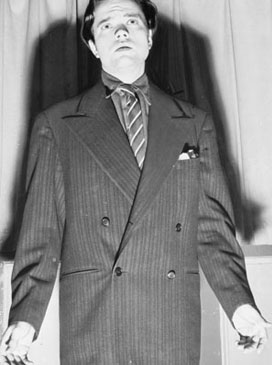
Welles, the day after

“U.S. Terrorized By Radio’s ‘Men From Mars,’” said the San Francisco Chronicle.

“Radio Listeners in Panic, Taking War Drama as Fact,” declared the New York Times.

“Attack From Mars In Radio Play Puts Thousands in Fear,” said the New York Herald Tribune.

“Radio Fake Scares Nation,” cried the Chicago Herald and Examiner.

These reports, however, were highly anecdotal and the reactions they reported simply did not rise to the level of nationwide panic and mass hysteria.

Newspapers, I point out, “had no reliable way of ascertaining the validity of the sweeping claims they offered in their columns the day after the program.”

Here’s why.

The broadcast aired late on Sunday evening in the Eastern time zone, a time when newsrooms of most daily newspapers were thinly staffed.

As such, collecting the reactions to The War of The Worlds broadcast represented no small challenge, especially for morning newspapers having late-night deadlines, I note in Getting It Wrong, adding:

“Given the constraints of time and staffing, relying on wire services such as the Associated Press became essential.

“This dependency, in turn, had the effect of promoting and deepening the notion that panic was widespread that night: On a late-breaking story of uncertain dimension and severity, many newspapers took their lead from wire service dispatches. They had little choice.”

The wire service reports were roundups that emphasized breadth rather than depth. Reliance on the roundups helps explain the consensus among U.S. newspapers that The War of the Worlds program had caused mass panic.

It also helps explains the striking similarity that characterized newspaper coverage of the broadcast. Many anecdotes transmitted by the wire services found their way into  newspapers across the country.

One widely recounted anecdote told of a woman in Pittsburgh whose husband prevented her from poisoning herself. “I’d rather die like this,” she exclaimed, than fall victim to a Martian heat ray.

Also widely reported was the story of a woman who told the Boston Globe she could “see the fire” caused by the alien attack and that she and her neighbors were preparing to flee.

Newspapers in their coverage also tended to place considerable importance on the unusually large volume of calls placed that October night to their switchboards and to those of police and fire departments and local radio stations.

“The surge in call volume was routinely but mistakenly characterized by newspapers as evidence of widespread fright and hysteria,” I write, noting that call volume was a misleading marker of fear and alarm.

The increased call volume is in fact best understood as signaling an altogether rational response by people who neither panicked nor became hysterical. Instead, they sought confirmation or clarification from external sources–newspapers, ironically, as well as police and fire departments–known to be usually reliable.

“Moreover, the call volume surely included people who telephoned friends and relatives to talk about the unusual and clever program they had just heard,” I point out in Getting It Wrong.

WJC

Recent and related:

Halloween’s greatest media myth

In Anniversaries, Debunking, Media myths, Media myths and radio, War of the Worlds on October 26, 2010 at 4:03 pm

My Q-and-A with Big Think blog was posted today. In it I discuss Halloween’s greatest media myth–Orson Welles’ famous War of the Worlds dramatization, which aired on CBS radio 72 years ago this week.

The War of the Worlds program was so clever, and made such effective use of simulated news bulletins reporting a Martian invasion of Earth, that tens of thousands–or even hundreds of thousands–of Americans were pitched into mass panic and hysteria.

Or so the media myth has it.

As I discuss in my new mythbusting book Getting It Wrong, “the panic and mass hysteria so readily associated with The War of The Worlds program did not occur on anything approaching nationwide dimension” on that long ago night in 1938.

While some Americans may have been briefly frightened or upset by Welles’ program, “most listeners, overwhelmingly, were not: They recognized it for what it was—an imaginative and entertaining show on the night before Halloween,” I point out in Getting It Wrong.

I discuss in the Q-and-A with Big Think just how improbable and unlikely it was that tens of thousands of people were panic-stricken by the radio show.

Think about it, I say: “Tens of thousands? Even hundreds of thousands? That sounded to me quite unlikely and highly improbable. Especially given that mass panic is such a rare phenomenon.”

I added that anecdotal news reports about reactions to the broadcast “simply did not rise to the level of nationwide panic and mass hysteria.”

I also pointed out that had there indeed been widespread panic and hysteria that night, “newspapers for days and even weeks afterward would have been expected to have published details about the upheaval and its repercussions. But as it was, newspapers dropped the story after only a day or two.”

No deaths, serious injuries, or even suicides were associated with the program. “Had there been widespread panic and hysteria,” I noted, “surely many people would have been badly injured and even killed in the resulting tumult.”

I discussed in some detail at Big Think what I call “the would-be Paul Revere effect,” which emerged as the The War of the Worlds show unfolded.

This effect occurred when well-intentioned people who had an incomplete understanding of The War of the Worlds broadcast set out to warn others of the sudden and terrible threat.

“These would-be Paul Reveres,” I noted, “burst into churches, theaters, taverns, and other public places, shouting that the country was being invaded or bombed, or that the end of the world was near. …

“The unsuspecting recipients of what were typically jumbled, second- and third-hand accounts had no immediate way of verifying the troubling news they had just received so unexpectedly. Unlike listeners of the radio show, they could not spin a dial to find out whether other networks were reporting an invasion. This second- and third-hand fright didn’t last long. It was evanescent.

“But it is interesting that the show caused some level of apprehension among many people who had not heard one word of the program.”

The “would-be Paul Revere effect” is a little-recognized subsidiary phenomenon of The War of the Worlds broadcast, a show that always is remembered at Halloween time.

WJC

Recent and related:

Check out new ‘War of Worlds’ mythbusting trailer

In Anniversaries, Media myths, Media myths and radio, War of the Worlds on October 21, 2010 at 9:17 am

No single program in American broadcasting has inspired more fear, controversy, and endless fascination than the radio dramatization of the War of The Worlds that aired on Halloween eve in 1938.

The program, which told of invading Martians wielding deadly heat rays, was the work of Orson Welles, a 23-year-old prodigy who directed and starred in the show.

As I write in my new mythbusting book, Getting It Wrong, Welles’ show supposedly was so alarming and made such effective use of simulated news bulletins that listeners by the tens of thousands—or even the hundreds of thousands—were convulsed in fear, panic, and mass hysteria, believing the Earth was under alien attack.

Fright beyond measure seized America that night more than 70 years ago.

Or so the media-driven myth has it.

Getting It Wrong offers compelling evidence that the fear, panic, and mass hysteria so readily associated with the War of The Worlds radio dramatization did not occur that night on anything approaching nationwide dimension.

I write that while some Americans may have been frightened by the program, the overwhelming number of listeners were not: They recognized it for what it was—an imaginative and entertaining radio show.

However, newspapers the day after Welles’ show suggested that mass panic had indeed swept the country.

Their reports were almost entirely anecdotal and based mostly on sketchy wire service roundups that emphasized breadth over depth. Newspapers, I write, “simply had no reliable way of ascertaining the validity of the sweeping claims” they made about the radio program.

“Inaccurate reporting,” I write, “gave rise to a misleading historical narrative and produced a savory and resilient media-driven myth.”

I further note in Getting It Wrong that the War of the Worlds show also offered American newspapers an “irresistible opportunity to rebuke radio—which in 1938 was an increasingly important rival source for news and advertising.”

Newspapers took delight in assailing radio as an unreliable, untrustworthy source of information. And this overwhelmingly negative commentary, I write, helped solidify the notion that the radio broadcast had sown mass panic and hysteria among Americans.

In short, the idea that the War of the Worlds program sent untold thousands of people into the streets in fear and panic, is a media-driven myth—one that offers a deceptive message about the influence of radio and about the media’s potential to cause panic and alarm.

I also note in Getting It Wrong that there can be “no disputing that the War of the Worlds dramatization was great entertainment”–worthy of distinction as perhaps the most famous radio show ever.

WJC

Recent and related:

Many thanks to Kathy Shaidle of fivefeetoffury for linking to this post.

‘Getting It Wrong’ goes on ‘PJM Political’

In Cronkite Moment, Debunking, Furnish the war, Hurricane Katrina, Media myths on October 10, 2010 at 10:24 am

I had a fine interview recently with Silicon Valley blogger Ed Driscoll for the Pajamas Media radio show, PJM Political.

The interview aired yesterday on Sirus-XM radio’s POTUS channel.

Topic: My new book, Getting It Wrong, which debunks 10 prominent media-driven myths, those dubious and improbable tales about the news media that masquerade as factual.

Driscoll, who conducts a thoughtful and well-prepared interview, led me through a discussion of several myths addressed in Getting It Wrong, including the Cronkite Moment” of 1968.

That was when, supposedly, the on-air analysis of CBS anchorman Walter Cronkite prompted President Lyndon Johnson to change his thinking about the Vietnam War and led him to decide against seeking reelection.

“That’s simply not true,” I pointed out. “Lyndon Johnson didn’t even see the [Cronkite] program when it aired in February 1968. And his decision not to seek reelection was driven by other forces and factors. Cronkite really was irrelevant to that equation, to that decision.

“But yet it lives on, as an example of media power, the media telling truth to power. And it’s a misleading interpretation, it’s a misreading of history.”

Driscoll said that the chapters of Getting It Wrong “have a sort of curious” set of bookends, in that they begin with a discussion of William Randolph Hearst’s famous vow to “furnish the war” with Spain and end with a look at the exaggerated, over-the-top coverage of Hurricane Katrina’s aftermath.

“Was this sort of book-ending intentional?” Driscoll asked.

It was an insightful question–and the first time an interviewer had asked about the book’s conceptual component.

I noted that the “original framework of the book had it organized more thematically, by ‘media and war’ and ‘media and government,'” and so on.

That framework was discarded, I said, “for a more chronological approach. So the bookends were driven more by chronology than anything else.”

We discussed how Orson Welles‘ cinematic masterpiece, Citizen Kane, helped cement the “furnish the war” myth in the public’s consciousness. Kane includes a scene that paraphrases Hearst’s purported vow.

The “furnish-the-war” anecdote about Hearst is dubious in many respects, I said, adding:

“Yet it lives on as an example of Hearst as the war-monger, as an example of the media–at its most malignant, in an extreme–can bring about a war that the country otherwise wouldn’t have fought.”

I mentioned how media-driven myths can be thought of as the “junk food of journalism,” which prompted Driscoll to ask:

What’s wrong with the American people being fed a little junk food? What’s wrong with being fed a few media myths?

There are several reasons, I replied.

Notably, “these myths tend to misrepresent the role of the news media in American society. They tend to grant the news media far more power and far more influence than they really do exert in American life.”

I added:

“Most people believe the media are powerful agents and powerful entities and often refer to some of the myths that I address, and debunk, in Getting It Wrong. They refer to them in support of this mistaken notion.”

In wrapping up the interview, Driscoll referred to Media Myth Alert as “a nifty blog.”

It was a generous plug that was much appreciated.

WJC

Recent and related:

Mythical ‘War of the Worlds’ radio show adapted to stage

In Debunking, Media myths, Media myths and radio, War of the Worlds on October 8, 2010 at 9:15 am

Orson Welles’ famous radio dramatization in 1938 of the War of the Worlds was an adaptation of the 1898 novel of the same title by H.G. Wells.

And Welles’ radio show–the source for what has become a delicious and tenacious media-driven myth, one debunked in my new book, Getting It Wrong–has been adapted to the stage. A run of the World of Wars, based on Welles’  radio adaptation, opened last night at a theater in Tampa. (The Tampa production, to be clear, is not the first stage adaptation of Welles’ version of War of the Worlds. There have been others.)

In publicizing the stage production, Tampa’s alternative newspaper, Creative Loafing, offered up the myth that Welles’ program in 1938 created mass panic and nationwide hysteria.

The Creative Loafing write-up said:

“Welles presented the first two-thirds of 1938 radio broadcast as a series of fake news bulletins, which listeners believed and in turn incited mass hysteria.

“People really thought that an alien invasion by Martians was really in progress.”

Both paragraphs are in error.

The War of the Worlds show, which aired on CBS radio on October 30, 1938, made clever and effective use of simulated news bulletins about an invasion of Earth by Martians wielding deadly heat rays. But “fake news bulletins” comprised nothing close to two-thirds of Welles’ hour-long program.

The program’s use of simulated bulletins was intermittent, and largely confined to the opening 20 minutes, by which time it sounded as if the Earth were under alien attack.

But as I write in Getting It Wrong, “Listeners who followed closely would have easily recognized that events moved far too quickly to be plausible.” It took the invaders less than a half an hour to blast off from Mars, crash-land on Earth, and launch their deadly onslaught.

Most listeners–in overwhelming numbers–recognized the show for what it was: Great entertainment on the eve of Halloween. Surveys taken in the days following the show found that a fraction of the radio audience was “frightened,” “disturbed,” or “excited” by what they heard.

The terms were those of Hadley Cantril, a Princeton University psychologist who investigated the aftermath of the War of the Worlds program. In his 1940 book, The Invasion From Mars, Cantril estimated the program attracted no fewer than 6 million listeners, of whom at least 1.2 million were “frightened,” “disturbed,” or “excited.”

Cantril did not explain what the terms meant; nor did he offer estimates about how many people acted on their fears.

In any case, being “frightened,” “disturbed,” or “excited” was far from being convulsed in panic or driven to hysteria.

Cantril’s estimates signal that most listeners were neither panic-stricken nor fear-struck. Even though his data indicate that comparatively few listeners were upset by the show, Cantril offered the inconsistent view that “[l]ong before the broadcast had ended people all over the United States were praying, crying, fleeing frantically to escape death from Martians.”

The Invasion From Mars became the cornerstone study of audience reaction to the War of the Worlds program. It has been recognized as something of an early landmark in mass communication research.

But over the past 20 years or so, Cantril’s findings about the War of the Worlds “have been challenged by sociologists and others who point out that mass hysteria and panic are rare and, given their transient nature, difficult to study,” as I note in Getting It Wrong. “Cantril, they say, failed to demonstrate that panicked reactions and flight were widespread among listeners to the show.”

I point out that Robert E. Bartholomew, “an authority on mass hysteria and social delusions, has said that ‘a growing consensus among sociologists that the extent of the panic, as described by Cantril, was greatly exaggerated.'”

Bartholomew also wrote that only “scant anecdotal evidence” exists “to suggest that many listeners actually took some action—such as packing belongings, grabbing guns, or fleeing in cars after hearing the broadcast.”

I also write in Getting It Wrong:

“Had mass panic and hysteria indeed swept the country that night, the trauma and turmoil surely would have resulted in many deaths and injuries. But the newspaper reports were notably silent on casualties.” Those reports, I write, “contained few references to injury or adverse health effects linked to the program.”

WJC

Recent and related:

‘War of the Worlds’ radio panic was overstated

In Anniversaries, Debunking, Media myths, Media myths and radio, War of the Worlds on October 3, 2010 at 8:02 am

Welles in bronze

October always brings frequent reminders about radio’s most memorable and myth-beclouded program–Orson Welles’ superb dramatization of the War of the Worlds that aired on Halloween eve 1938.

So realistic was Welles’ show, so alarming were its simulated news reports of invading Martians, that listeners by the tens of thousands—or more—were convulsed in panic and hysteria.

Fright beyond measure gripped the country that night; it was the night that panicked America.

Or so the media myth has it.

The delicious, ever-appealing tale of mass hysteria sown by the War of the Worlds program is one of the 10 prominent media-driven myths that I address and debunk in my new book, Getting It Wrong.

I note that some Americans were frightened by the program. But most listeners, in overwhelming numbers, were not. They recognized it for what it was—an imaginative and entertaining radio show that aired in its usual Sunday evening time slot.

Still, this media myth is just too well-known, too entrenched in the American consciousness, ever to fall into disuse.

That’s why October brings numerous references to the War of the Worlds show and the panic it supposedly caused. Indeed, just the other day, an item posted at examiner.com said the program fooled “over a million people into thinking the world was actually under attack by Martians.”

But there’s simply no data to support such claims.

Hadley Cantril, a psychologist at Princeton University who helped promote the notion that the Welles’ program caused widespread panic, drew on surveys to estimate that at least 6 million people listened to the hour-long program, which aired live over the CBS radio network.

Of those listeners, Cantril estimated, 1.2 million were “frightened,” “disturbed,” or “excited” by what they heard.

But as I note in Getting It Wrong, “Cantril left unclear the distinctions among ‘frightened,’ ‘disturbed,’ or ‘excited.’ Nor did Cantril not estimate how many listeners acted on their fears and excitement,” a critical element had there indeed been widespread panic that night.

I further note that “one can watch a horror movie and feel ‘frightened,’ ‘disturbed,’ or ‘excited,’ but such responses are hardly synonymous with panic or hysteria.” Far from it.

The notion that mass panic had accompanied the airing the War of the Worlds program spread quickly, mostly by U.S. newspapers which reported the day after the show that hysteria had swept the country.

Their reports, however, “were almost entirely anecdotal,” I note, “and largely based on sketchy wire service roundups that emphasized breadth over in-depth detail.”

Newspapers simply had no reliable way of testing or ascertaining the validity of the sweeping claims they made about the War of the Worlds program.

Here’s why.

The War of the Worlds dramatization aired from 8-9 on Sunday night in the East, a time when most newspaper newsrooms were thinly staffed.

Reporting on the reactions to The War of The Worlds broadcast represented no small challenge, especially for morning newspapers having late-night deadlines.

“Given the constraints of time and staffing,” I write in Getting It Wrong, “relying on wire services such as the Associated Press became essential. This dependency, in turn, had the effect of promoting and deepening the notion that panic was widespread that night: On a late-breaking story of uncertain dimension and severity, many newspapers took their lead from wire service dispatches.

“They had little choice.”

The AP’s reports about the program essentially were roundups of reactions culled from the agency’s bureaus across the country, I write. Typically, AP roundups emphasized sweep—pithy anecdotal reports from many places—over depth and detail.

The anecdotes about people frightened by the show tended to be sketchy, shallow, and small-bore. But their scope contributed to and confirmed the sense that widespread panic was afoot that night.

The reliance on wire service roundups helps explain the consensus among U.S. newspapers that the broadcast had created mass panic.

Interestingly, newspaper content also helps to undercut the notion that panic and hysteria  swept the country that night.  Had that happened, the resulting trauma and turmoil surely would have led to many deaths and serious injuries.

But newspaper reports were notably silent on extensive casualties.

No deaths were attributed to the War of the Worlds broadcast. And as Michael J. Socolow wrote in his fine essay about the program, no suicides could “be traced to the broadcast,” either.

WJC

Recent and related:

‘Persuasive and entertaining’: WSJ reviews ‘Getting It Wrong’

In Cronkite Moment, Debunking, Furnish the war, Jessica Lynch, Media myths, Murrow-McCarthy myth, New York Times, Reviews, Spanish-American War, War of the Worlds, Washington Post, Watergate myth on July 12, 2010 at 6:05 am

Today’s Wall Street Journal reviews Getting It Wrong, characterizing as “persuasive and entertaining” my new book debunking 10 prominent media-driven myths.

The review–which appears beneath the headline “Too good to check”–is clever and engaging, and opens this way:

“Hello, city desk, get me rewrite. Here’s the lead: Many of the landmark moments in American journalism are carefully nurtured myths—or, worse, outright fabrications.

“William Randolph Hearst never said, ‘You furnish the pictures, and I’ll furnish the war.’ Orson Welles’s ‘War of the Worlds’ radio broadcast didn’t panic America. Ed Murrow’s ‘See It Now’ TV show didn’t destroy Sen. Joseph McCarthy. JFK didn’t talk the New York Times into spiking its scoop on the Bay of Pigs invasion. Far from being the first hero of the Iraq War, captured Army Pvt. Jessica Lynch was caught sobbing ‘Oh, God help us’ and never fired a shot.

“These fables and more are lovingly undressed in W. Joseph Campbell’s persuasive and entertaining ‘Getting It Wrong.’ With old-school academic detachment, Mr. Campbell, a communications professor at American University, shows how the fog of war, the warp of ideology and muffled skepticism can transmute base journalism into golden legend.”

The reviewer, Edward Kosner, author of the memoir It’s News to Me, also discusses the myth of the “Cronkite Moment,” writing, “Television icons are central to two of Mr. Campbell’s dubious cases: Murrow and his successor as the patron saint of TV news, Walter Cronkite.”

Kosner notes–as I do in Getting It Wrong–that at least some of the myths confronted in the book will likely survive their debunking.

“For all Mr. Campbell’s earnest scholarship,” Kosner writes, “these media myths are certain to survive his efforts to slay them. Journalism can’t help itself—it loves and perpetuates its sacred legends of evil power-mongers, courageous underdogs, dread plagues and human folly.”

Well said.

And, alas, he may be right. Some of the myths almost certainly will live on. As I write in the introduction to Getting It Wrong, they “may prove resistant to debunking. They may still be widely believed despite the contrary evidence marshaled against them.

“The most resilient myths,” I further write, “may be those that can be distilled to a catchy, pithy phrase like: ‘If I’ve lost Cronkite, I’ve lost Middle America.’ Such quotations are neat, tidy, and easily remembered. Cinematic treatments influence how historical events are collectively remembered and can harden media-driven myths against debunking. The motion picture All the President’s Men, which cast Robert Redford and Dustin Hoffman in the lead roles of Washington Post reporters [B0b] Woodward and [Carl] Bernstein, has helped ensure that the journalists and their newspaper would be regarded as central to cracking the Watergate scandal.”

Kosner closes the review with a humorous observation, writing:

“At the end of the book, Mr. Campbell offers some remedies for media mythologizing, urging journalists, among other things, ‘to deepen their appreciation of complexity and ambiguity.’ Good luck with that, professor.'”

Heh, heh. Nice touch.

WJC

Related:

‘Getting It Wrong’ goes Majic

In Bay of Pigs, Bra-burning, Debunking, Furnish the war, Jessica Lynch, Media myths, Media myths and radio, New York Times, War of the Worlds, Washington Post, Watergate myth on July 1, 2010 at 11:34 am

I did an engaging and entertaining in-studio interview yesterday on the Lanigan & Malone show, one of the most popular radio programs in Cleveland, the gritty city where I cut my teeth, journalistically, years ago.

On the air with Lanigan (center) and Malone

The show airs on WMJI, Majic 105.7 FM, and I spoke with hosts John Lanigan and Jimmy Malone about several media-driven myths addressed and debunked in my new book, Getting It Wrong.

They included the case of Jessica Lynch, the waiflike Army private whom the Washington Post elevated to hero status in a sensational but utterly erroneous report early in the Iraq War in 2003.

The Post depicted Lynch as having “fought fiercely” in the Iraqi ambush at Nasiriyah of the Army’s 507th Maintenance Company. The newspaper said Lynch had “shot several enemy soldiers” and kept “firing her weapon until she ran out of ammunition.”

Walters

The Lynch case, I said during the Lanigan & Malone interview, appears to have centered around a case of mistaken identity. It wasn’t Lynch who had fought heroically at Nasiriyah. It was most likely Donald Walters, a cook-sergeant in Lynch’s unit who, after running out of ammunition, was captured by Iraqi irregulars and executed.

I pointed out during the interview how war and conflict can readily give rise to myth and misunderstanding. Indeed, half the chapters in Getting It Wrong are related to warfare, including the book’s first chapter, the myth of William Randolph Hearst’s infamous vow to “furnish the war” with Spain.

We moved on to discuss the myth that widespread panic and mass hysteria characterized the reactions to the 1938 radio dramatization of The War of the Worlds, then jumped to a discussion of the myth of superlative reporting of Hurricane Katrina’s aftermath in September 2005, and considered at some length about what I call the “nuanced myth” of bra-burning.

“Bra-smoldering,” I said, would be a more accurate characterization of what happened during the women’s liberation protest at Atlantic City in September 1968. My research shows that bras and other items were set afire, if briefly, during the demonstration against that year’s Miss America pageant.

“All these are ruined,” Lanigan said at one point about the myths debunked in Getting It Wrong.

We also discussed the Bay of Pigs-New York Times suppression myth. That myth centers around a telephone call President John F. Kennedy supposedly placed to the Times publisher or top editors in April 1961, asking that the newspaper hold off on reporting about the pending CIA-supported invasion of Cuba.

There is no evidence, I said, that Kennedy ever placed such a call. (Or even had time to place such a call.)

What appears to have happened is that the Bay of Pigs-suppression myth has become confounded with the 1962 Cuban missile crisis, during which Kennedy did call the Times to request a delay on a report about nuclear-tipped missiles the Soviets had deployed on the island.

As the interview wrapped up, Lanigan said he’s “sure there will be another” volume, a sequel, to Getting It Wrong.

“It’s a good book,” he said afterward. “I’m glad he did it.”

WJC

Related: