W. Joseph Campbell

Posts Tagged ‘Vietnam War’

Welcome perspective on the ‘Cronkite moment’

In Cronkite Moment, Debunking, Media myths on June 26, 2010 at 7:37 am

A blog post yesterday at the Atlantic Free Press offered some unusual–and refreshing–perspective about the so-called “Cronkite Moment” of 1968, when CBS anchorman Walter Cronkite declared the U.S. military was “mired in stalemate” in Vietnam.
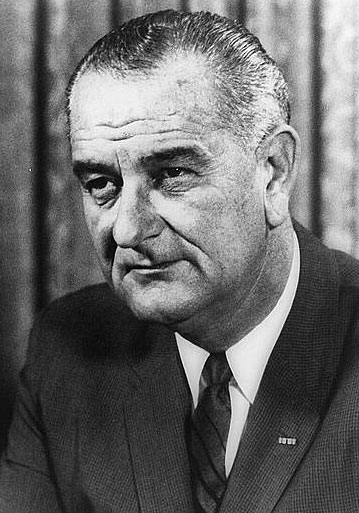
Johnson

The tenacious media-driven myth surrounding the “Cronkite Moment” has it that the anchorman’s insight was so powerful and so incisive that public opinion promptly swung against the war and President Lyndon Johnson immediately realized his war policy was doomed.

As has been discussed often at Media Myth Alert, neither of those characterizations is accurate. Months before Cronkite’s pronouncement, U.S. public opinion began to turn against the war. And Johnson did not watch Cronkite’s program when it aired on February 27, 1968. At that time, the president was in Austin, Texas,  at the 51st birthday party of Governor John Connally.

As I write in Getting It Wrong, my new book about media-driven myths, the power of the so-called “Cronkite moment”  lies “in the sudden, unexpected, and decisive effect it supposedly had on the president. Such an effect would have been absent, or greatly diminished, had Johnson had seen the program on videotape at some later date.”

Indeed, the power of the anecdote would have been diluted severely.

As I say, the Atlantic Free Press post offered perspective about the “Cronkite Moment” that is seldom encountered in the news media, traditional or online.

The post said that “words like ‘stymied’ and ‘stalemate’ are often applied to the Afghanistan war. But that hardly means the U.S. military is anywhere near withdrawal.

“Walter Cronkite used the word ‘stalemate’ in his famous February 1968 declaration to CBS viewers that the Vietnam War couldn’t be won. ‘We have been too often disappointed by the optimism of the American leaders both in Vietnam and Washington to have faith any longer in the silver linings they find in the darkest clouds,’ he said. And: ‘It seems now more certain than ever that the bloody experience of Vietnam is to end in a stalemate.’

“Yet the U.S. war on Vietnam continued for another five years, inflicting more unspeakable horrors on a vast scale.”
It is rarely noted in discussions of the “Cronkite Moment” that U.S. combat troops were not completely withdrawn from Vietnam until 1973–despite the claim by David Halbertstam in The Powers That Be that Cronkite’s program represented “the first time in American history a war had been declared over by an anchorman.”
That’s just not so. Not at all.

WJC

Related:

‘Getting It Wrong’ launched at Newseum

In Cronkite Moment, Debunking, Furnish the war, Media myths, Murrow-McCarthy myth, Spanish-American War, Washington Post, Watergate myth on June 20, 2010 at 2:09 pm

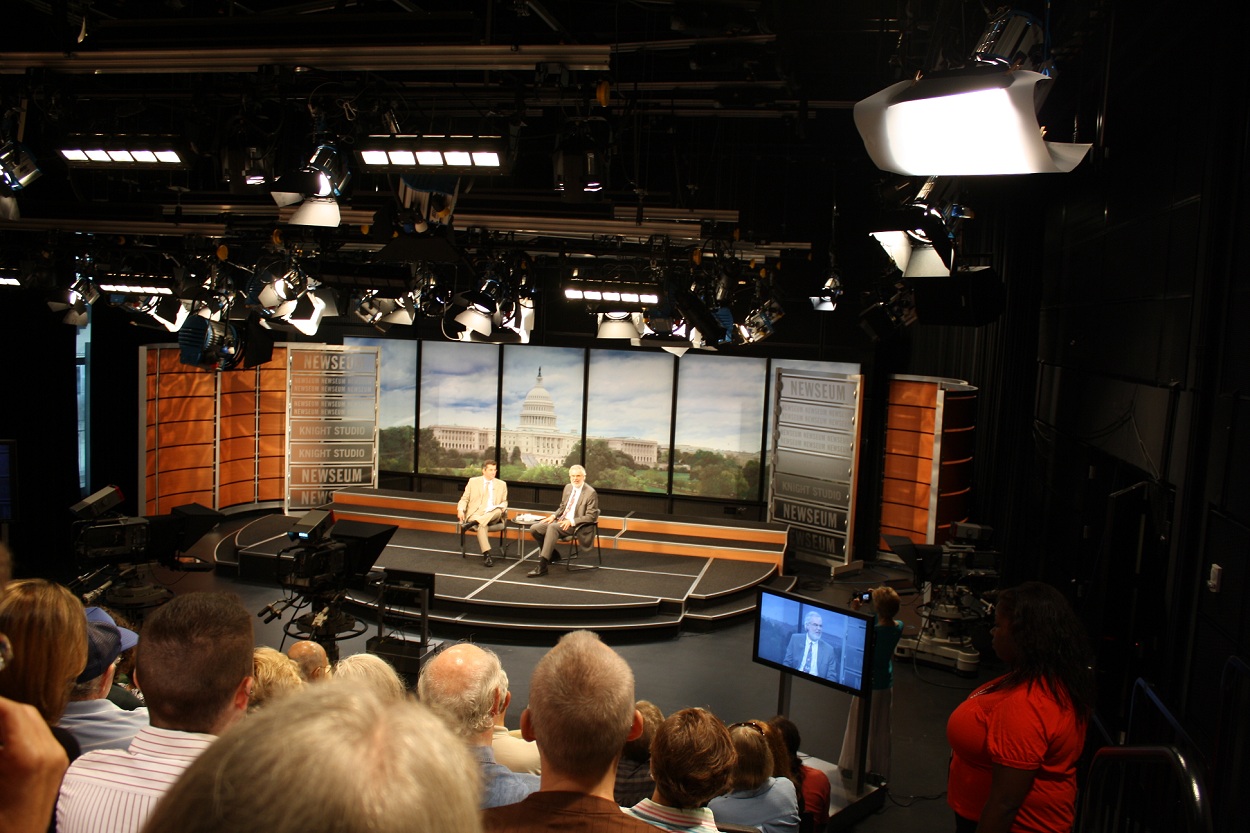
Newseum program, audience view

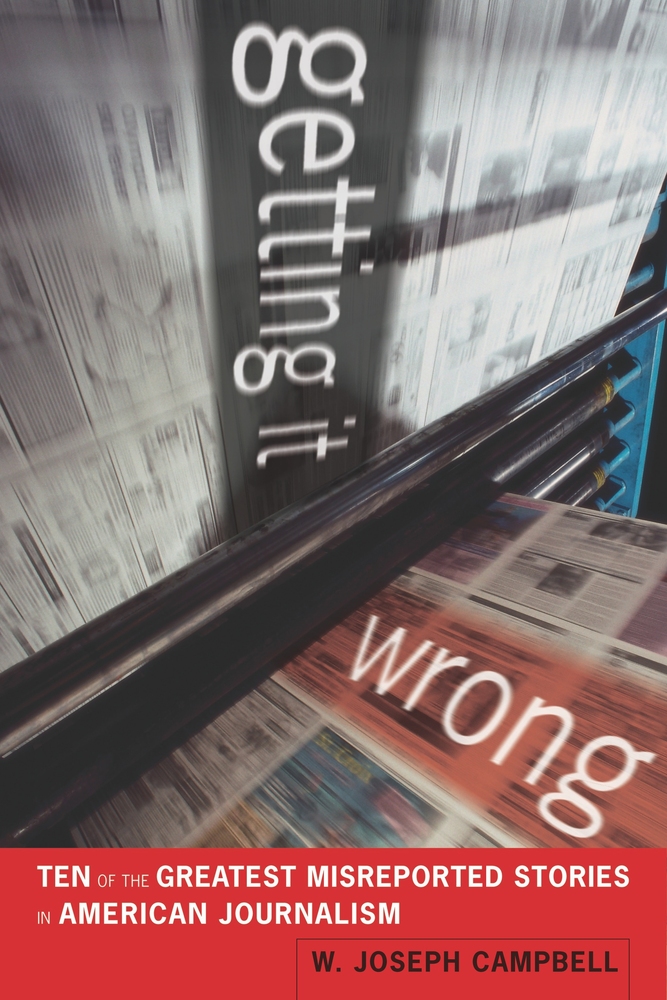
Getting It Wrong, my new book about media-driven myths, was launched at a terrific program yesterday at the Newseum, the $450 million museum of news in downtown Washington, D.C.

The Newseum’s John Maynard moderated a brisk “Inside Media” talk, during which I reviewed the myths of:

  • William Randolph Hearst’s purported vow to “furnish the war” with Spain,
  • Edward R. Murrow‘s  1954 See It Now television program that supposedly ended Senator Joseph R. McCarthy’s communists-in-government witch-hunt,
  • the so-called “Cronkite moment” of 1968,
  • the heroic-journalist of Watergate, and
  • the supposedly superlative reporting in the immediate aftermath of Hurricane Katrina‘s landfall in 2005.

The audience (see photo, above) posed several intriguing questions about the book. Among them was whether I thought the media myths confronted in Getting It Wrong would now be forever buried.

It’s probably too soon to say, given the book’s recent publication. But I mentioned in my reply that I’ve been struck by how dearly some myths are held.

The myth of the “Cronkite moment” is an example, I said: It seems quite difficult for some people to believe that Walter Cronkite’s program on Vietnam in February 1968 was not of decisive effect.

The “Cronkite moment” may live on, and continue to be embraced, despite the weight of the evidence that Cronkite’s television report about Vietnam was of scant importance in revising policy or in shaping the president’s thinking about reelection.

At the book launch

A question was posed about how media myths emerge, and I noted that they arise from several sources, including an urge to identify examples of media power. Another factor is  what I call “complexity-avoidance”–the appeal of simplified explanations for complex historical events.

It is, after all, far easier to believe that Hearst and his “yellow press” brought on the Spanish-American War in 1898, I said, than it is to grasp the complexities of the failed diplomacy among Spain, Cuba, and the United States that gave rise to that conflict. It is far easier to believe that the Washington Post brought down Richard Nixon’s corrupt presidency, I said, than it is to sort through tangled lines of investigation of the Watergate scandal that ultimately forced Nixon from office.

Even then, I said, Nixon may have served out his term if not for the tape-recordings he made of his private Oval Office conversations. Those tapes, which the U.S. Supreme Court forced Nixon to produce in 1974, revealed his guilty role in the Watergate coverup.

I also was asked whether there are other media myths to bust.

Indeed there are, I said.

Getting It Wrong may deserve a sequel and suggested as candidates for a follow-on book the dubious phenomenon of “Pharm Parties” and the question of whether Cronkite really was “the most trusted man in America.”

Book signing at Newseum

I signed copies of Getting It Wrong following the “Inside Media” program, and then toasted the book’s publication at a reception sponsored by the Newseum and American University’s School of Communication.

The School’s dean, Larry Kirkman, offered generous remarks in his toast at the reception, which was attended by AU colleagues, former students, past research assistants, and friends and family.

WJC

Related:

Photo credits:

  • Ruxandra Giura (audience view)
  • Bruce Guthrie

Launching ‘Getting It Wrong’ at Newseum

In Bay of Pigs, Bra-burning, Cronkite Moment, Debunking, Furnish the war, Jessica Lynch, Media myths, Murrow-McCarthy myth, War of the Worlds, Washington Post, Watergate myth on June 14, 2010 at 6:28 am

My new book, Getting It Wrong, will be launched Saturday, June 19, at an “Inside Media” program at the Newseum, the $450 million museum of news in downtown Washington, D.C.

The program will begin at 2:30 p.m. in the Knight TV Studio on the third level and will feature a discussion with the Newseum’s John Maynard, followed by audience Q-and-A.

I’ll be signing copies of Getting It Wrong afterward.

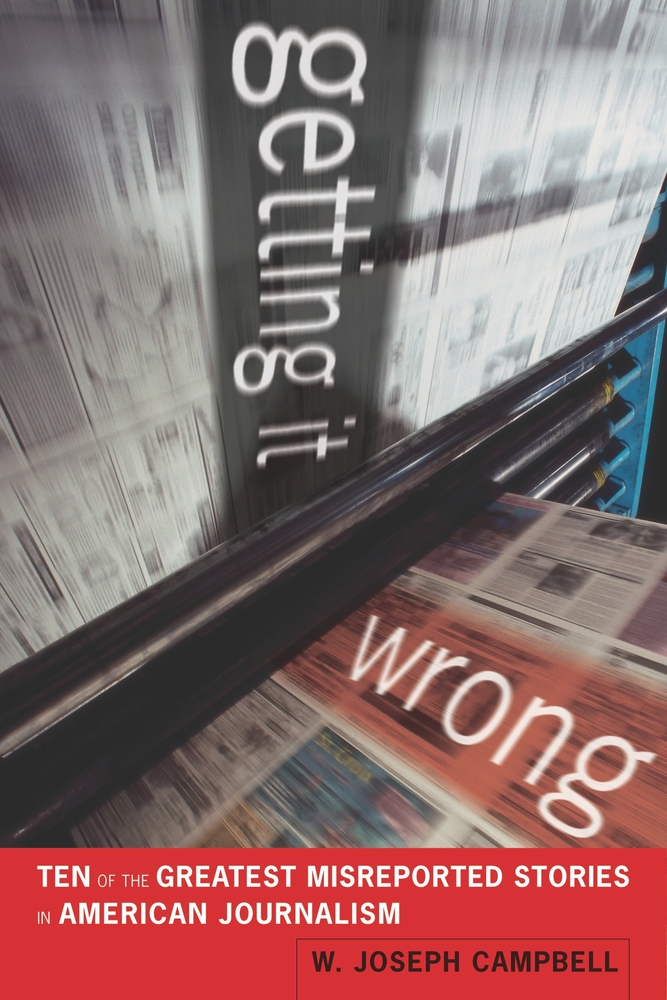
The book addresses, and debunks, 10 prominent media-driven myths–stories about and/or by the news media that are widely believed and often retold but which, on close inspection, proved to be apocryphal or wildly exaggerated.

Here is a brief description about each of the 10 myths:

  1. Remington-Hearst: William Randolph Hearst’s famous vow, “you furnish the pictures, I’ll furnish the war,” is almost certainly apocryphal.
  2. War of Worlds: The notion that the War of Worlds radio dramatization in 1938 caused nationwide panic and mass hysteria is exaggerated.
  3. Murrow-McCarthy: Edward R. Murrow’s famous See It Now program in March 1954 did not end Senator Joseph McCarthy’s communists-in-government witch-hunt; Murrow in fact was very late to take on McCarthy.

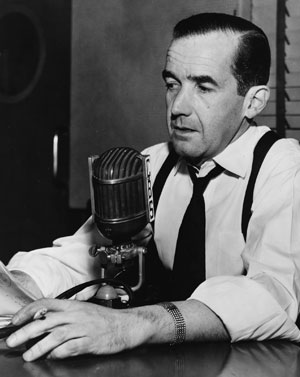
    Murrow in 1954

  4. Bay of Pigs: The New York Times did not suppress its reporting in the run-up to the ill-fated Bay of Pigs invasion in April 1961.
  5. Cronkite-Johnson: Walter Cronkite’s special report on Vietnam in February 1968 did not prompt an immediate reassessment of U.S. war policy.
  6. Bra-burning: Humor columnist Art Buchwald helped spread the notion that feminist demonstrators dramatically burned their bras at a Miss America protest in September 1968.
  7. Watergate: The Washington Post’s intrepid reporters, Carl Bernstein and Bob Woodward, did not bring down Richard Nixon’s corrupt presidency. That they did is a trope that knows few bounds.
  8. Crack babies: The much-feared “bio-underclass” of children born to women who smoked crack cocaine during their pregnancies never materialized.
  9. Jessica Lynch: The Washington Post’s erroneous reporting about Jessica Lynch early in the Iraq War gave rise to several myths about her capture and rescue.
  10. Hurricane Katrina: News coverage of Katrina’s aftermath in New Orleans in early September 2005 was marred by wild exaggerations of extreme, Mad Max-like violence.

As I write in Getting It Wrong, the myths debunked “are among American journalism’s best-known stories. Most of them are savory tales. And at least some of them seem almost too good to be false.”

I further write that because it “takes on some of the most treasured stories in American journalism,” Getting It Wrong is “a work with a provocative edge. It could not be otherwise.”

WJC

Related:

The wobbly components of the ‘Cronkite moment’

In Cronkite Moment, Debunking, Media myths on June 7, 2010 at 5:23 am

It’s often claimed that Walter Cronkite’s analysis in February 1968 that the U.S. military effort in Vietnam was “mired in stalemate” helped swing public opinion against the war.

Not to mention that Cronkite’s penetrating assessment brought President Lyndon Johnson face-to-face with the realization his war policy was a shambles.

And so incisive was Cronkite’s assessment that it supposedly was a factor in Johnson’s decision, announced a month later, not to seek reelection to the presidency.

Those are three components of an especially tenacious and popular media-driven myth, all of which I address in a chapter in my new book, Getting It Wrong.

The wide circulation of what I call the mythical “Cronkite moment” was evident in a commentary aired the other day on Vermont Public Radio, which asserted:

“In 1968, when CBS anchorman Walter Cronkite delivered a downbeat report on American progress in Vietnam, public opinion rapidly soured on the war. President Lyndon Johnson lamented, ‘If I’ve lost Cronkite, I’ve lost the country.’  Several weeks later, Johnson decided not to run for re-election.”

In fact, as I discuss in Getting It Wrong, public opinion had begun shifting against the war weeks and months before Cronkite’s special report about Vietnam, which aired February 27, 1968.

By October 1967, 47 percent of Americans, a plurality, maintained that U.S. military presence in Vietnam was a mistake, according to Gallup surveys.

Moreover, Cronkite’s “mired in stalemate” assessment was, I write in Getting It Wrong, “neither notable nor extraordinary,” pointing out that Mark Kurlansky in his study of the year 1968 stated that Cronkite’s view was “hardly a radical position” for the time.

Indeed, nearly seven months before the “Cronkite moment,” the New York Times published on its front page as analysis that said victory in Vietnam “is not close at hand. It may be beyond reach.” The analysis was published in August 1967 beneath the headline:

“Vietnam: The Signs of Stalemate.”

As has been noted many times at MediaMythAlert, Johnson did not see the Cronkite program when it aired. The president at the time was in Austin, Texas, at the 51st birthday party of Governor John Connally.

So he could not have had “the abrupt yet resigned reaction that so often has been attributed to him,” I write in the book.

There is, moreover, no evidence that Johnson ever watched the Cronkite program on videotape.

And as I note in Getting It Wrong:

“The power of the ‘Cronkite moment’ resides in the sudden, unexpected, and decisive effect it supposedly had on the president. Such an effect would have been absent, or greatly diminished, had Johnson had seen the program on videotape at some later date.”

As for Johnson’s decision not to seek reelection, which he announced at the end of March 1968: The “Cronkite moment” certainly was a non-factor.

There’s evidence that Johnson never intended to seek reelection, that he had privately decided in 1967 against another campaign.

Also important in Johnson’s decision was Senator Eugene McCarthy’s surprisingly potent bid for the Democratic nomination for president in early 1968.

Under scrutiny, then, the components of the “Cronkite moment” prove to be wobbly: They don’t hold up to inspection. And that’s “not so surprising,” I write in Getting It Wrong, adding:

“Seldom, if ever, do the news media exert truly decisive influences in decisions to go to war or to seek negotiated peace. Such decisions typically are driven by forces and factors well beyond the news media’s ability to shape, alter, or significantly influence.”

So it was with the often-misinterpreted “Cronkite moment” of 1968.

WJC

Related:

‘Commentary’ reviews ‘Getting It Wrong’

In Cronkite Moment, Debunking, Murrow-McCarthy myth, Reviews, Washington Post, Watergate myth on June 4, 2010 at 11:27 am

The June 2010 number of Commentary magazine includes a fine, favorable, and thoughtful review of Getting It Wrong, my new book about media-driven myths.

The reviewer, Andrew Ferguson, who writes the “Press Man” column for Commentary, says of Getting It Wrong:

“It may be the best book about journalism in recent memory; it is certainly the most subversive.”

A wonderful, telling line, that.

He also writes:

“Campbell does what journalists, and most journalism professors, seldom think to do when they exchange the oft-repeated tales: he checks them out. And through a pitiless accretion of detail, he dissolves them one by one.

“As he reveals, Edward R. Murrow did not ‘bring down Joe McCarthy’ with his famous 1954 episode of See It Now; Campbell looked up the poll numbers and found that McCarthy’s favorability ratings were in free fall well before Murrow took to the air.

“No, Cronkite did not turn the public against the Vietnam War with an on-air editorial in February 1968: five months earlier, Gallup had registered that a plurality of Americans, 47 percent, agreed that the war was a mistake.

“And no, Woodward and Bernstein were not responsible for uncovering the entirety of the Watergate scandal; as reporters, they had pretty much run out of scoops by October 1972, when congressional investigators, criminal prosecutors, and other newspapers took over the story and drove it till President Nixon’s resignation in August 1974.

“And no, the bestselling author David Halberstam, who promoted each of these stories with unfailing pomposity, was not a reliable chronicler of even the most recent past.”

Ferguson wraps up his review by writing:

“Journalism’s myths about journalism, you’ll notice, are self-aggrandizing. They cast the journalist as hero. No wonder they’re so popular… among journalists. We warm ourselves by such tales, draw compensation and comfort from them, which is why they’re taught in our trade schools as elements of basic training.”

WJC

Related:

‘Getting It Wrong’ goes ‘On Point’

In Cinematic treatments, Cronkite Moment, Debunking, Furnish the war, Media myths, Media myths and radio, Spanish-American War, Washington Post, Watergate myth on June 3, 2010 at 8:52 pm

I was interviewed today by Tom Ashbrook, the engaging host of NPR’s On Point program, which is produced by WBUR in Boston.

We discussed Getting It Wrong, my new book about media-driven myths, and it was a fine show. (Audio is available here.)

As Ashbrook promised in his introduction, the conversation ranged over a variety of topics–or what he called “iconic media tales from the Spanish-American War to Hurricane Katrina.”

We were joined by Jack Beatty, the program’s news analyst, and discussed at some length the myth of the so-called “Cronkite Moment” of 1968, in which CBS News anchorman Walter Cronkite characterized the war in Vietnam as a stalemate, supposedly prompting President Lyndon Johnson to alter his policy on the conflict.

We also took up myth surrounding the famous anecdote about William Randolph Hearst’s purported vow to “furnish the war” with Spain at the end of the 19th century, the dubious notion that Orson Welles’ 1938 radio dramatization of the War of the Worlds set off nationwide panic and mass hysteria, and what I call the heroic-journalist myth of Watergate, in which Bob Woodward and Carl Bernstein of the Washington Post supposedly brought down Richard Nixon’s corrupt presidency.

On the latter topic, I mentioned how the cinematic version of All the President’s Men, Woodward and Bernstein’s book about their Watergate reporting, has become the vehicle by which people learn about and remember the scandal.

Watergate was, I noted, “so complex that people these days, many years removed from it, find it hard to keep it all straight. … The high-quality, cinematic treatment of the Watergate scandal, featuring Woodward and Bernstein and the Washington Post in All the President’s Men, does happen to be the way that many people remember the Watergate scandal. …

“The movie’s a great movie,” I added. “But it helped to solidify the notion that the Post, the Washington Post, and Woodward and Bernstein were at the center, were at the heart, of uncovering the scandal.”

On Point featured questions and comments from a few callers–including a guy named Phil in Bowling Green, Kentucky, who said about me:

“I think the professor has got too much time on his hands. ” I chuckled.

He added: “I lived through most of that–the Watergate and Vietnam War.  I think he’s underestimating the persuasive attitude that Walter Cronkite had on this country. … Everybody’s opinion turned on what Walter Cronkite thought.”

But another caller, Gary from Nashville, Tennessee, weighed in, saying he disagreed with Phil from Bowling Green, offered the thought that public opinion about Vietnam turned not on the views of one journalist but on “the unrelenting reporting on the war by the media.”

It was a lively, substantive program that has generated a few dozen or so comments at the On Point online site.

The discussion made me recognize anew how deeply embedded and tenaciously held some media-driven myths really are, and how an hour-long program is hardly enough to encourage people even to think about giving them up. As Jack Shafer noted in his review of Getting It Wrong, “a debunker’s work is never done.”

But perhaps the show’s content will entice some listeners to buy and read the book. Even then, though, I suspect some media myths will prove resistant to thorough debunking.

WJC

Related:

On version variability and the ‘Cronkite moment’

In Cronkite Moment, Debunking, Media myths on May 25, 2010 at 10:34 am

As I note in my soon-to-be-published book, Getting It Wrong, version variability–the imprecision that alters or distorts an anecdote in its retelling–can be a marker of media-driven myths.

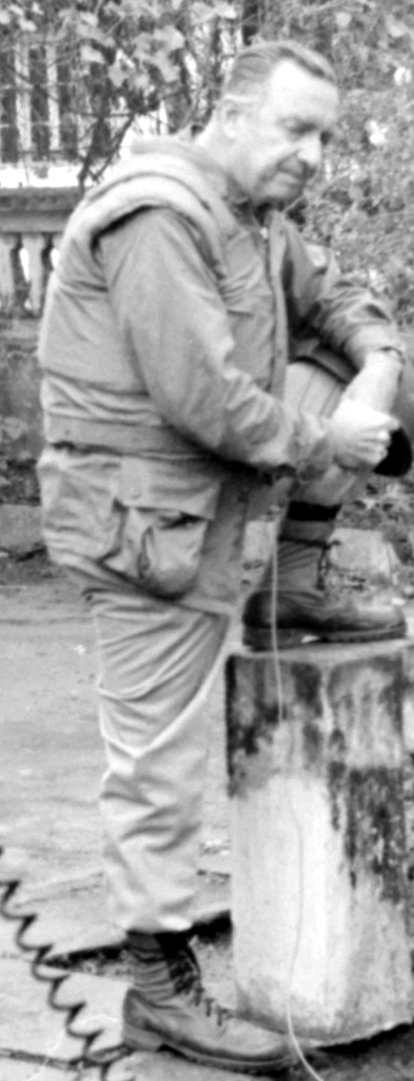
Cronkite in Vietnam, 1968

So it is with the purported “Cronkite moment” of 1968, when CBS anchorman Walter Cronkite asserted in a special televised report that the U.S. military was “mired in stalemate” in Vietnam. President Lyndon Johnson supposedly saw the Cronkite program and promptly realized the war effort was doomed.

“If I’ve lost Cronkite,” the president is reputed to have said in reaction to Cronkite’s pronouncement, “I’ve lost Middle America.”

Or, as a columnist for Townhall.com wrote yesterday, Johnson “said to an aide, ‘If we’ve lost Walter, then we’ve lost the war.'”

Those are just two of many variations of Johnson’s supposed response to Cronkite’s downbeat assessment.

Other versions include:

“I’ve lost Cronkite, I’ve lost the country.”

“If I’ve lost Cronkite, I’ve lost the American people.”

“If I’ve lost Cronkite, I’ve lost the war.”

“If we lose Cronkite, we lose America.”

As I write in Getting It Wrong, “Version variability of that magnitude signals implausibility.”

I also note that version variability “suggests more than sloppiness in journalistic research or a reluctance to take time to trace the derivation of the popular anecdote. The varying accounts of Johnson’s purported reactions represent another, compelling reason for regarding the ‘Cronkite moment’ with doubt and skepticism.”

Moreover, as I write in Getting It Wrong, Johnson did not see the Cronkite program when it aired February 27, 1968. At the time, Johnson was in Austin, Texas, at the 51st birthday party of his longtime political ally, Governor John Connally.

Johnson teased Connally about his age, saying: “Today you are 51, John. That is the magic number that every man of politics prays for—a simple majority. Throughout the years we have worked long and hard—and I might say late—trying to maintain it, too.”

And even if Johnson later heard—or heard about—Cronkite’s assessment, it represented no epiphany for the president, no burst of clarity about a policy gone sour.

A few weeks after the Cronkite program, Johnson gave a rousing, lectern-thumping speech in Minneapolis, in which he urged a “total national effort” to win the war in Vietnam.

The speech was delivered March 18, 1968, and in it, the president declared:

“We love nothing more than peace, but we hate nothing worse than surrender and cowardice.”

So in the weeks immediately following the purported “Cronkite moment,” Johnson maintained an aggressive public stance on the war. He clearly wasn’t swayed by Cronkite’s “mired in stalemate” analysis.

WJC

Related:

‘A debunker’s work is never done’

In Bay of Pigs, Bra-burning, Cronkite Moment, Debunking, Furnish the war, Media myths, Murrow-McCarthy myth, New York Times, Reviews, War of the Worlds, Washington Post, Watergate myth, Yellow Journalism on May 21, 2010 at 6:14 pm

So notes the inestimable media critic Jack Shafer in his review of my forthcoming book, Getting It Wrong, posted today at slate.com.

And what a generous, engaging, and insightful review it is.

Under the headline “The Master of Debunk,” Shafer notes that “the only way to debunk an enshrined falsehood is with maximum reportorial firepower.

“Toting big guns and an itchy trigger-finger is American University professor W. Joseph Campbell, whose new book Getting It Wrong: Ten of the Greatest Misreported Stories in American Journalism flattens established myths that you were brought up to believe were true.”

Shafer’s review specifically discusses a variety of media-driven myths, including William Randolph Hearst’s purported vow to “furnish the war” with Spain; the so-called “Cronkite moment” that supposedly altered President Lyndon Johnson’s Vietnam policy; the Bay of Pigs suppression myth that erroneously says President John F. Kennedy persuaded the New York Times to spike a story about the pending U.S.-backed invasion of Cuba, and the heroic-journalist myth of Watergate.

Shafer rightly points out that “a debunker’s work is never done” and to that end notes my recent post at Media Myth Alert about Evan Thomas’ new book, The War Lovers. The book embraces myths of the yellow press period in American journalism, including the Hearst vow.

Shafer thoughtfully considers the tenacity of media-driven myths, writing:

“Some myths endure because the stories are so compelling, like the Hearst tale and the alleged mayhem caused by Orson Welles’ [War of the Worlds] broadcast. Others survive because our prejudices nourish them (“crack babies,” bra burners) or because pure repetition has drummed them into our heads, smothering the truth in the process.

“The best tonic for the brain fever caused by media myths is an open mind and a free inquiry,” he writes.

Shafer wraps up the review by invoking this observation, by Jonathan Rauch:

“It is the error we punish, not the errant.”

Shafers adds:

“Of course when you do such a good job punishing the error, as Campbell does, you don’t need to bother with the errant.”

WJC

Related:

Just go, Rambo

In Debunking, New York Times on May 21, 2010 at 6:56 am

At least one Connecticut newspaper is having some fun with the dissembling of U.S. Senate candidate Richard Blumenthal about what he did during the Vietnam War.

The Republican American of Waterbury has taken to calling the brittle, strikingly thin Blumenthal “Rambo,” after the beefy fictional hero of cinematic treatments of the war.

And the newspaper has, with tongue undeniably in cheek, has taken to calling Rambogate” the furor that has erupted over Blumenthal’s periodic false claims to have served in Vietnam.

Blumenthal, the state’s attorney general, received at least five deferments that kept him out of the war before landing a coveted place in the Marine Reserve, which was not deployed to Vietnam.

As the New York Times first reported this week, Blumenthal from time to time  has dissembled about his wartime service. The Stamford Advocate in Connecticut added to the controversy yesterday, recalling that Blumenthal in 2008 falsely and publicly claimed:

“I wore the uniform in Vietnam and many came back to all kinds of disrespect. Whatever we think of war, we owe the men and women of the armed forces our unconditional support.”

The occasion was a Veterans Day parade in November 2008, the newspaper said.

It’s hard to envision how Blumenthal’s candidacy and credibility can survive the damage accompanying such disclosures. The attorney general has acknowledged that he inadvertently “misspoke” on a few occasions about his wartime service.

But these false claims clearly are more serious than an occasional slip of the tongue.

Although he probably won’t, it’s time for Blumenthal to pack it in.

Just go, Rambo.

I remain surprised that more attention hasn’t been devoted to Blumenthal’s  subsidiary fictional claims of having faced abuse and indignities upon his fictional “return” from Vietnam.

As I’ve noted, the news reports quoting Blumenthal as having said veterans were spat upon as they came back from Vietnam should prompt further questions about the senate candidate’s truthfulness.

Serious doubts have been raised over the years about such accounts. And yet, Blumenthal has invoked such claims more than a couple of times.

Perhaps the most thoughtful commentary about the Blumenthal mess appeared in yesterday’s Washington Post. It was written by veteran journalist Henry Allen, himself a former Marine.

Allen wrote:

“Blumenthal didn’t get in trouble for confessing he had ducked Vietnam but for lying that he hadn’t, for saying that he’d served there.

“What demon haunts him and others like him? What inconsolable regret provoked these desperate lies?

“He didn’t have to claim he’d been in Vietnam. He already had the résumé to be a shoo-in candidate. Rich kid, Harvard (editor of the Crimson), reporter at The Washington Post, Yale Law School (editor of the law journal), almost two decades as attorney general, the perfect knowledge-class candidate of the kind favored by modern Democrats. (In looks, however, he does bear an unsettling resemblance to disgraced former New York governor Eliot Spitzer.)”

Yes, more Spitzer than Rambo.

But Rambo ought to go.

WJC

Republican American

Blumenthal and his spat-upon claim: More myth?

In Debunking, Media myths, New York Times on May 19, 2010 at 4:43 pm

The New York Times articles this week about the Richard Blumenthal, the Connecticut attorney general who falsely stated he served in Vietnam, mentioned but didn’t explore Blumenthal’s reference to having been spat upon by antiwar protestors.

The Times report Tuesday quoted Jean Risley, chairwoman of the Connecticut Vietnam Veterans Memorial Inc., as saying Blumenthal, a Democrat running for the U.S. Senate, once described indignities he and other veterans faced upon returning from Vietnam.

“It was a sad moment,” the Times quoted Risley as saying. “He said, ‘When we came back, we were spat on; we couldn’t wear our uniforms.’ It looked like he was sad to me when he said it.”

In a follow-up report today, the Times indirectly quoted former Congressman Christopher H. Shays as saying that at a recent event in Bridgeport, Connecticut, Blumenthal “brought up the subject of his military service and lamented that when ‘we returned from Vietnam’ Americans had spit on soldiers.”

The separate reports of Blumenthal’s recollections about veterans having been spat upon should prompt additional questions about the Senate candidate’s truthfulness–questions that go beyond his false claim of having served in Vietnam during the war. (Blumenthal, the Times has reported, secured “at least five military deferments from 1965 to 1970 and took repeated steps that enabled him to avoid going to war, according to records” the newspaper reviewed.)

Doubts have been raised over the years about accounts of soldiers being spat upon as they returned from Vietnam. Jerry Lembcke notably challenged such claims in his 1998 study, The Spitting Image: Myth, Memory, and the Legacy of Vietnam.

Lembcke noted “that stories of veterans being abused by anti-war activists only surfaced years after the abuses were alleged to have happened.”

He also wrote that his “search through news stories and polls … revealed no basis for the widespread belief that the alleged spitting incidents actually occurred.”

Lembcke, a Vietnam veteran who became an opponent of the war, returned to the topic in 2005, writing in a commentary in the Boston Globe:

“Stories about spat-upon Vietnam veterans are like mercury: Smash one and six more appear. It’s hard to say where they come from. For a book I wrote in 1998 I looked back to the time when the spit was supposedly flying, the late 1960s and early 1970s. I found nothing. No news reports or even claims that someone was being spat on.”

He also noted:

“GIs [returning from Vietnam] landed at military airbases, not civilian airports, and protesters could not have gotten onto the bases and anywhere near deplaning troops. There may have been exceptions, of course, but in those cases how would protesters have known in advance that a plane was being diverted to a civilian site?”

Now, I haven’t studied the spat-upon claims to be in a position to embrace Lembcke’s findings, independently. It is a touchy and disputed topic. But I am impressed with the earnest quality of Lembcke’s research.

Moreover, I incorporate in Getting It Wrong, my forthcoming book about media-driven myths, a telling observation in Lembcke’s book about the tenacity of myths.

It appears as a chapter-opening quotation in the discussion in Getting It Wrong about the heroic-journalist myth of Watergate:

“Unlike a society with a strong oral tradition, American today remembers its history through visual imagery.”

True enough: The cinema can be a powerful force in pressing media-driven myths into the collective memory.

I also was impressed with Lembcke’s point that myths “help people come to terms with difficult periods of their past. They provide explanations for why things happened. Often, the explanations offered by myths help reconcile disparities between a group’s self-image and the historical record of a group’s behavior.”

Or, as might be paraphrased in the matter of Blumenthal’s dissembling, myths can help reconcile disparities between an individual’s self-image and the record of his behavior.

WJC