W. Joseph Campbell

Posts Tagged ‘Washington Post’

One paragraph, three myths

In Cronkite Moment, Debunking, Media myths, Murrow-McCarthy myth, New York Times, Washington Post, Watergate myth on April 21, 2010 at 11:45 am

A column posted today at a Canadian online news site achieved the feat of working three media-driven myths into a single paragraph.

Here’s what the columnist wrote, in a paean to the power and influence that traditional news media once wielded, supposedly:

“A Walter Cronkite could, however belatedly, expose the pointlessness of Vietnam. Famously, Edward R. Murrow deflated McCarthy. A pair of scruffy reporters could bring down a Nixon.”

Three sentences, three myths–a trifecta that is very rare.

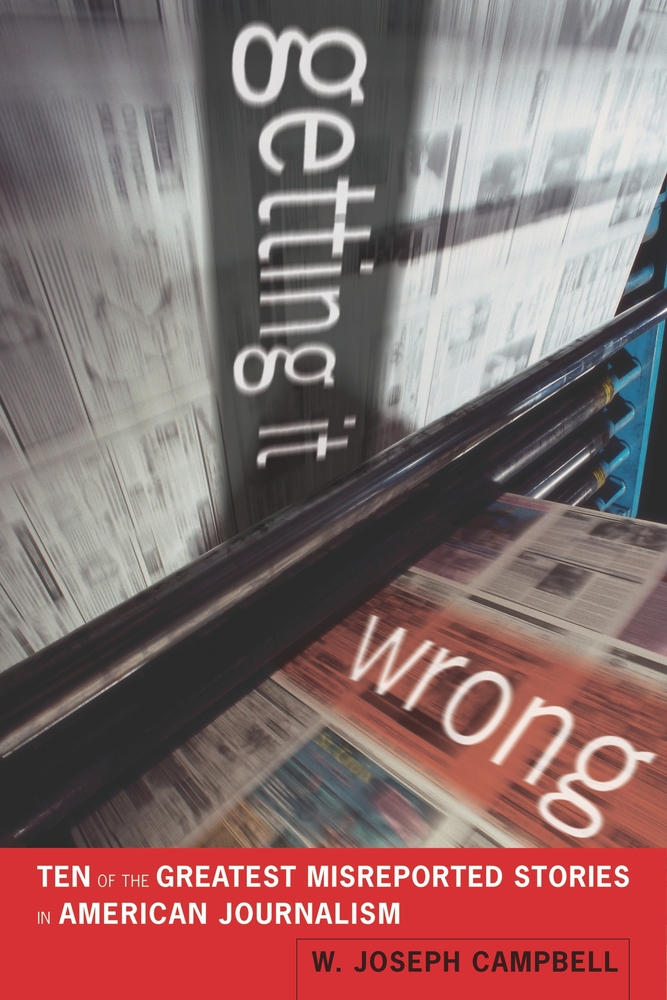
All three media-driven myths are addressed, and debunked, in my book, Getting It Wrong, to be published in summer by the University of California Press.

The reference to Cronkite is to the CBS anchorman’s report of February 27, 1968, in which he said the U.S. military was “mired in stalemate” in Vietnam. As I write in Getting It Wrong, such a characterization was scarcely original or exceptional at the time. It was no exposé.
Indeed, nearly seven months before Cronkite’s pronouncement, the New York Times had suggested in a front-page report that the war was stalemated.

Victory in Vietnam, the Times report said, “is not close at hand. It may be beyond reach.”

That Murrow “deflated” Senator Joseph R. McCarthy is another media myth, stemming from Murrow’s See It Now television program of March 9, 1954.

Murrow in fact was quite belated in confronting McCarthy and the senator’s communists-in-government witch hunt.

The half-hour See It Now program on McCarthy came many months–even years–after other journalists had pointedly challenged the senator and his bullying tactics. Eric Sevareid, a friend and CBS colleague of Murrow, pointedly noted that Murrow’s program “came very late in the day.”

In an interview in 1978, Sevareid said: “The youngsters read back and they think only one person in broadcasting and the press stood up to McCarthy and this has made a lot of people feel very upset, including me, because that program came awfully late.”

And by the time Murrow’s report aired, McCarthy’s favorable ratings had been in decline for three months, as also I note in Getting It Wrong.

The Canadian columnist’s reference to “a pair of scruffy reporters” who supposedly brought down Richard Nixon is, of course, to Carl Bernstein and Bob Woodward, who covered the Watergate scandal for the Washington Post.

As I’ve noted in previous posts at MediaMythAlert, the notion that the reporters brought down Nixon and his corrupt presidency is a myth that even the Post has tried to dismiss.

Howard Kurtz, the newspaper’s media reporter, wrote in 2005, for example:

“Despite the mythology, The Post didn’t force Richard Nixon from office—there were also two special prosecutors, a determined judge, bipartisan House and Senate committees, the belated honesty of [former White House lawyer] John Dean and those infamous White House tapes.”

Kurtz’s observations parallel those of Stanley I. Kutler, a leading historian of the  Watergate scandal, who has written:

“The fact is, an incredible array of powerful actors all converged on Nixon at once—the FBI, prosecutors, congressional investigators, the judicial system.”

The three myths are stories well-known and even cherished in American journalism. They almost always are cited as examples of media power and influence, of journalists at their courageous best.

But as I write in Getting It Wrong:

“To identify these tales as media myths is to confront the reality that the news media are not the powerful agents they, and many others, assume them to be.”
WJC

Skirting the media’s role in the ‘crack baby’ scare

In Debunking, Media myths, Newspapers, Washington Post on April 18, 2010 at 3:40 pm

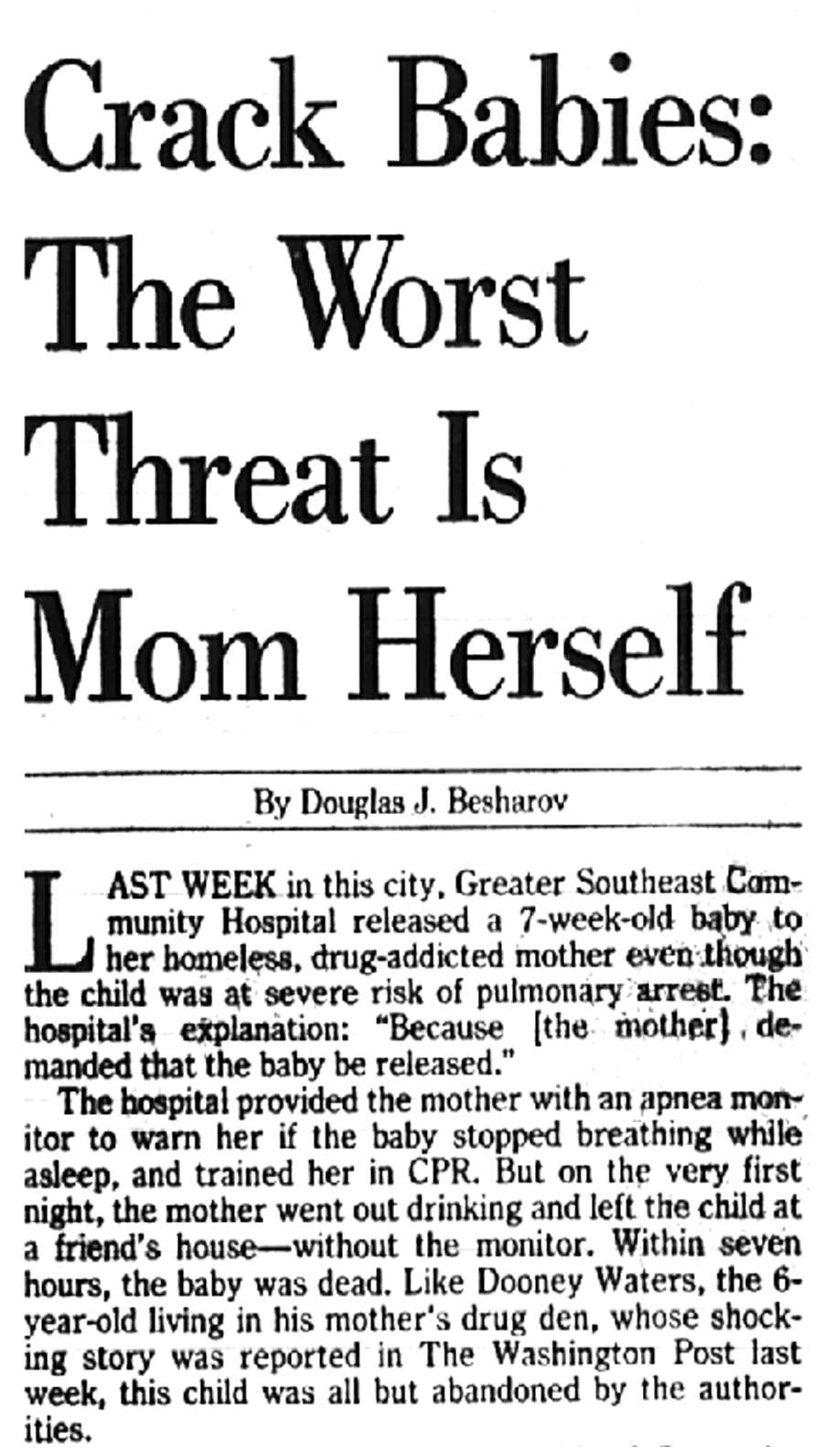
The Washington Post today revisits the “crack baby” scare of the late 1980s and 1990s and reports that “in the two decades that have passed since … these babies have grown into young adults who can tell their stories–and for the most part, they are tales of success.”

The Post notes that “a lot of misinformation surfaced” about the “crack baby” phenomenon, and cites an often-quoted column by Charles Krauthammer who in 1989 wrote:

Washington Post, August 1989

“Theirs will be a life of certain suffering, of probable deviance, of permanent inferiority.”

(Although the Post article doesn’t mention it, Krauthammer also wrote in that column: “The inner-city crack epidemic is now giving birth to the newest horror: a bio-underclass, a generation of physically damaged cocaine babies whose biological inferiority is stamped at birth.”)

Otherwise, the Post‘s report steered well clear of considering the news media’s central role in spreading “misinformation” about “crack babies,” a topic is explored in Getting It Wrong, my forthcoming book about media-driven myths.

The scare, I write, “was a media-driven myth based more on anecdote than solid, sustained research, a myth that had the effect of stigmatizing underprivileged children presumed to have been born damaged and despised as ‘crack babies.’”

I further note:

“To be sure, smoking crack during pregnancy is hardly risk-free, and certainly neither prudent nor sensible.”

However, I add, “the effects of prenatal cocaine exposure have proved more subtle than sweeping: Newborns exposed to crack during pregnancy tend to be smaller in birth weight, in length, and in head circumference. Some research suggested that mild cognitive deficiencies, such as difficulties in concentrating on tasks at hand, might be attributable to prenatal cocaine exposure, especially as cognitive demands on children intensify as they grow older.

“But biomedical research has found nothing akin to a ‘bio-underclass,’” that Krauthammer and others warned about some 20 years ago.

Revisiting the media-driven myth of the crack baby is important, I write in Getting It Wrong, because doing so “allows insights into a tendency among journalists to neglect or disregard the tentativeness that characterizes serious scientific and biomedical research, and to reach for certainty and definitiveness that are not often found in preliminary findings.

“The tendency of journalists to push hard on tentative data has been apparent in coverage of more recent drug scares, notably that of methamphetamine in 2004 and 2005.”

The Post‘s report today was the latest in what, in effect, has been an intermittent series in leading newspapers to revisit the “crack baby” scare and find it to have been exaggerated.

In a lengthy article published 15 months ago, the New York Times called the scare “the epidemic that wasn’t.” A columnist for the New York Daily News acknowledged in 2004 that “we probably overreacted with forecasts of harm to so-called ‘crack babies.’”

And more than 12 years ago, the Post carried a story similar to today’s. That article appeared on page Z10, beneath the headline: “‘Crack Baby’ Fears May Have Been Overstated.”

As I note in Getting It Wrong, “The news media’s retreat or rollback on crack babies was neither as extensive nor as prominent as the dramatic and ominous reports about the scourge in the late 1980s and early 1990s.”

I quote the alternative magazine, Mother Jones, which pointed out in 1995:

“The publicity blitz that spread the crack-baby myth has not been matched by an attempt to unmake the myth—and many, many people still believe in it.”

The term “crack babies” remains firmly in circulation; it is invoked casually and idiomatically, as something of a cliché.

WJC

Movies about journalists: Another list, another myth

In Cinematic treatments, Debunking, Furnish the war, Media myths, Newspapers, Washington Post, Watergate myth on April 17, 2010 at 6:31 pm

The blog True/Slant includes a ranking today of the 10 best-ever movies about journalism, and the Bogart film, Deadline U.S.A., tops the list.

This 10-best lineup was inspired by the series of newspapering movies running at Film Forum in Manhattan.

Absence of Malice (which I thought was dreadfully stereotypical), ranked second on the True/Slant list; The Paper was third, and All the President’s Men, the best-known movie about the Watergate scandal, was fourth.

Almost predictably, the description about All the President’s Men said:  “Robert Redford and Dustin Hoffman play Washington Post reporters Carl Bernstein and Bob Woodward, who reported the Watergate scandal and brought down a President. One of the few movies that makes journalism look like something worth doing.”

So there we are again–the hoary claim resurfaces that Nixon was “brought down” by the reporting of the intrepid Post reporters.

It’s what I call the heroic-journalist myth, and it’s addressed, and debunked, in Getting It Wrong, my forthcoming book about media-driven myths.

I note in the book, which is due out this summer, that heroic-journalist myth of Watergate is one of the most appealing and self-reverential stories in American media history.

It is striking indeed how routinely and even off-handedly Bernstein and Woodward are credited with the accomplishment, especially when the record of Watergate shows that the Post’s reporting had at best a marginal effect on forcing Nixon’s resignation in 1974.

Other forces and factors were far more decisive to the denouement of Watergate. As Howard Kurtz, the Post’s media reporter, has written:

“Despite the mythology, The Post didn’t force Richard Nixon from office—there were also two special prosecutors, a determined judge, bipartisan House and Senate committees, the belated honesty of [former White House lawyer] John Dean and those infamous White House tapes.”

Nixon’s White House tapes were crucial to the outcome. He resigned the presidency shortly after the Supreme Court ordered him to turn over the tapes subpoenaed by the Watergate special prosecutor.

One of the tapes undeniably showed Nixon participating in the coverup of the burglary at Democratic national headquarters, the signal crime of the Watergate scandal.

I also note in Getting It Wrong that motion pictures have a way of solidifying media-driven myths in the public’s consciousness.

“High-quality cinematic treatments,” I write, “are powerful agents of media myth-making, and can enhance a myth’s durability.”

And so what’s my top movie about newspapering? The 1941 Orson Welles masterpiece, Citizen Kane.

And that’s probably because I get such a laugh every time I watch the scene that paraphrases William Randolph Hearst‘s purported vow “to furnish the war” with Spain.

That may be the hardiest media myth of all.

A sleeper in my lineup of best movies about journalism is John Ford’s 1962 Western, The Man Who Shot Liberty Valence.

Why Liberty Valence?

Solely because of the movie’s greatest line, which is so applicable to media myth-making:

“This is the West, sir. When the legend becomes fact, print the legend.”

WJC

Myths going polyglot: An emblem of hardiness

In Debunking, Media myths, Washington Post, Watergate myth on April 16, 2010 at 9:29 am

It’s a sure sign of tenacity and hardiness when media-driven myths cross linguistic barriers to become embedded in other languages.

The heroic-journalist myth of Watergate–which I explore in Getting It Wrong, my forthcoming book about media-driven-myths–represents that phenomenon quite well.

In the past few days, references to the myth–which maintains that the work of two young, intrepid reporters for the Washington Post brought down Richard Nixon’s corrupt presidency–have appeared online in French and Italian.

The French version was posted at the Web site of the weekly lifestyle magazine, Paris Match.  The item was about Sheri Fink, who this week became a winner of a Pulitzer Prize in investigative reporting.

Paris Match said of Fink: “She enters the pantheon of the press that includes famous predecessors such as Bob Woodward of the Washington Post who disclosed the Watergate scandal leading to the impeachment of President Nixon.”

For starters, Nixon was never impeached; he resigned the presidency in 1974, to head off certain impeachment and conviction.

Moreover, Woodward and his reporting partner, Carl Bernstein, did not uncover or disclose the Watergate scandal.

As Edward Jay Epstein wrote years ago in a marvelous essay about the news media and Watergate, “the FBI, the federal prosecutors, the [federal] grand jury, and the Congressional committees … unearthed and developed all the actual evidence and disclosures of Watergate.”

Epstein noted that Woodward and Bernstein, in All the President’s Men, their book about their Watergate reporting, “systematically ignored or minimized” the work of those agencies and institutions.

“Instead,” Epstein wrote, “they simply focus on those parts of the prosecutors’ case, the grand-jury investigation, and the FBI reports that were leaked to them.”

The heroic-journalist meme also popped up in an item posted the other day at VignaClaraBlog, an online local news site in Rome. That item told of an upcoming interview with Bernstein, whom it credited with breaking the Watergate scandal, leading to Nixon’s resignation.

The objective here is not to score points at the expense of foreign-language sites invoking the heroic-journalist myth. Rather, it is to underscore how persistent and insidious media-driven myths can be.

Crossing linguistic barriers not only is an emblem of their appeal: It suggests that myths such as that of the heroic-journalist of Watergate are now thoroughly immune to conclusive uprooting.

WJC

On bringing down Nixon

In Cinematic treatments, Debunking, Media myths, Newspapers, Washington Post, Watergate myth on April 12, 2010 at 4:07 pm

My guestpost the other day at the “Political Bookworm” blog–in which I reviewed three media-driven myths explored in my forthcoming book, Getting It Wrong–has attracted more than a few comments, including this particularly blinkered rhetorical question:

“Do you really know anyone who believes the Washington Post brought Nixon down?”

For starters, check Investor’s Business Daily.

On the day the guestpost and the blinkered comment appeared, Investor’s Business Daily said the New York Times, in its coverage of sexual abuses by Roman Catholic priests, was “seeking the biggest prey since Woodward and Bernstein brought down Richard Nixon.”

There you go: Brought down Nixon.

Gerald Ford became president on Nixon's resignation

The Investor’s Business Daily reference, of course, was to Bob Woodward and Carl Bernstein of the Washington Post whose investigative reporting in the Watergate scandal is often and inaccurately said to have toppled Richard Nixon’s corrupt presidency.

As I note in Getting It Wrong, the heroic-journalist meme of Watergate is one of the most hardy, persistent, and delicious myths in American media history.

Interestingly, it lives on despite periodic efforts by principals at the Washington Post to dismiss it. (“Political Bookworm” is a Washington Post blog, it should be noted.)

The newspaper’s media reporter, Howard Kurtz, wrote in 2005, for example:

“Despite the mythology, The Post didn’t force Richard Nixon from office—there were also two special prosecutors, a determined judge, bipartisan House and Senate committees, the belated honesty of [former White House lawyer] John Dean and those infamous White House tapes.”

Kurtz’s observations parallel those of Stanley I. Kutler, a leading historian of Watergate, who has written:

“The fact is, an incredible array of powerful actors all converged on Nixon at once—the FBI, prosecutors, congressional investigators, the judicial system.”

Amid this array of subpoena-wielding authorities investigating Watergate, the contributions of Woodward and Bernstein were modest–and certainly not decisive to the scandal’s outcome.

Still, the heroic-journalist myth is alive, well–and often invoked.

In large measure, that’s because the 1976 motion picture All the President’s Men–the leading movie about Watergate–depicted Woodward and Bernstein as essential to unraveling the scandal.

Indeed, this myth is a trope that knows few bounds.

WJC

In today’s ‘Outlook’ section

In Cronkite Moment, Debunking, Furnish the war, Media myths, Murrow-McCarthy myth, Newspapers, Washington Post, Watergate myth on April 11, 2010 at 12:13 pm

An abbreviated version of my recent guestpost at the “Political Bookworm” blog appeared today in the “Outlook” section of the Washington Post.

Here’s the text of the “Outlook” piece, with links that I’ve added:

W. Joseph Campbell, a professor of communication at American University, busts some media myths in his book, “Getting It Wrong: Ten of the Greatest Misreported Stories in American Journalism,” coming in July from the University of California Press. Here are three of Campbell’s biggies:

1. William Randolph Hearst’s purported vow, telegraphed to the artist Frederic Remington in Cuba, to “furnish the war” with Spain. Hearst denied making such a statement. The telegram containing his purported pledge has never turned up. The “furnish the war” anecdote can be traced to 1901 and a memoir by another journalist, James Creelman, who did not say when or how he learned the story about Hearst’s vow.

2. Edward R. Murrow brought an end to Sen. Joseph R. McCarthy’s communists-in-government witch hunt. This myth stems from Murrow’s CBS program “See It Now” on March 9, 1954, when the newsman dissected McCarthy’s crude investigative techniques and taste for the half-truth — none of which was unknown to American audiences at the time. The myth took hold even though years before the program aired, several prominent journalists — including Washington-based syndicated columnist Drew Pearson — had become searching critics of McCarthy and his tactics.

Nixon resigns, 1974

3. The Washington Post’s investigative reporting brought down Richard Nixon’s corrupt presidency. Katharine Graham, The Post’s publisher during the Watergate period, said in 1997: “Sometimes people accuse us of bringing down a president, which of course we didn’t do. The processes that caused [Nixon’s] resignation were constitutional.” She was right, but the complexities of Watergate are not readily recalled these days. What does stand out is a media-centric interpretation that the dogged reporting of Post journalists Bob Woodward and Carl Bernstein brought Nixon down.

WJC

Now at Political Bookworm, where ‘must-read books are discovered’

In Cronkite Moment, Debunking, Furnish the war, Media myths, Washington Post, Watergate myth on April 9, 2010 at 7:35 am

I guestpost today at the Political Bookworm, a Washington Post-sponsored site that describes itself as a blog where “tomorrow’s must-read political books are discovered today.”

In my post, I discuss three of the media-driven myths examined in my forthcoming book, Getting It Wrong, which the University of California Press will publish in the summer.

Political Bookworm is edited by Steven Levingston, the Post‘s nonfiction editor. The blog notes that it “discusses new books long before they hit the shelves.”

And here’s the text of my guest post:

The most famous anecdote in American journalism may be William Randolph Hearst’s purported vow, telegraphed to the artist Frederic Remington in Cuba, to “furnish the war” with Spain at the end of the 19th century.

Or it may be Edward R. Murrow’s television program on CBS in 1954, which supposedly brought an end to Sen. Joseph R. McCarthy’s communists-in-government witch-hunt.

Or it may be the interpretation of Watergate that says The Washington Post’s investigative reporting brought down Richard Nixon’s corrupt presidency.

All three are well-known stories about the exercise of media power, for good or bad. All three anecdotes are often retold.

All three are media-driven myths.

Media myths often confer on the news media far more power and influence than they merit or possess. Media myths also tend to minimize the complexity of historical events in favor of simplistic and misleading interpretations.

That’s an important reason why Hearst’s vow has lived on for more than 100 years: It is succinct, savory, and easily remembered. It conforms to the popular image of Hearst as war-monger.

Hearst, though, denied making such a statement. The telegram containing his purported pledge has never turned up. And it would have been absurd for Hearst to vow to “furnish the war” because war — Cuba’s rebellion against Spain’s colonial rule — was the reason he sent Remington to Cuba. (The Cuban rebellion gave rise in 1898 to the Spanish-American War.)

The “furnish the war” anecdote can be traced to 1901 and a memoir by another journalist, James Creelman, who did not say when or how he learned story about Hearst’s vow.

The Murrow-McCarthy myth stems from Murrow’s See It Now program on March 9, 1954. See It Now that night dissected McCarthy’s crude investigative techniques and taste for the half-truth — none of which was unknown to American audiences at the time

Years before the program aired, several prominent journalists — including the Washington-based syndicated columnist Drew Pearson — had become searching critics of McCarthy and his tactics.

Interestingly, the myth took hold despite Murrow’s protests. In the weeks following the See It Now program, Murrow said he recognized that at best he had reinforced what others had long said about the red-baiting senator.

Similarly, principals at The Washington Post over the years have disputed the notion their newspaper toppled Nixon, who resigned in 1974. Among them was Katharine Graham, the Post’s publisher during the Watergate period. “Sometimes people accuse us of bringing down a president, which of course we didn’t do,” she said in 1997. “The processes that caused [Nixon’s] resignation were constitutional.”

She was right, but the complexities of Watergate — the deceit and criminality that characterized the Nixon White House and the multiple lines of investigation that slowly unwound the scandal — are not readily recalled these days.

What does stand out is a media-centric interpretation, that the dogged reporting of Washington Post journalists Bob Woodward and Carl Bernstein brought Nixon down. It’s a familiar storyline, a proxy for grasping Watergate’s essence while sidestepping its complexities.

That storyline was solidified by the 1976 motion picture, “All the President’s Men,” the screen adaptation of Bernstein and Woodward’s book of the same title. The film casts the reporters as central to unraveling the scandal.

Debunking these and other media myths matters for a variety of reasons. Media myths can and do feed stereotypes. They distort our understanding of the news media and of history. And there is inherent value in setting the record straight.

In that sense, myth-busting is aligned with a central objective of newsgathering — that of getting it right.

WJC

15 movies about journalists: At least 3 boosted myths

In Cinematic treatments, Debunking, Media myths, Murrow-McCarthy myth, Washington Post, Watergate myth on April 8, 2010 at 7:47 pm

It was the day of the journalist (“Dia do Jornalista”) in Brazil yesterday and to help mark the occasion, the RevistaMonet blog posted a lineup, with brief descriptions, of 15 movies about the work of journalists.

They included classics such as The Front Page and His Girl Friday, as well as surprises such as How to Lose a Guy in 10 Days and Superman Returns.

All 15 were English-language films. At least three of them have contributed to, or helped solidify, media-driven myths.

The three myth-builders: All the President’s Men; Good Night, and Good Luck, and my favorite, Citizen Kane.

Cinema’s role in solidifying media-driven myths is discussed in Getting It Wrong, my next book, which will be out in the summer.

“Cinematic treatments,” I write, “influence how historical events are collectively remembered and can harden media-driven myths against debunking.”

That certainly was so with All the President’s Men, the 1976 screen adaptation of Carl Bernstein and Bob Woodward’s book by the same title.

The film characterized Bernstein and Woodward, both of the Washington Post, as central and essential to unraveling the Watergate scandal that toppled President Richard Nixon.

The upshot, I write in  Getting It Wrong, has been “to solidify and elevate the heroic-journalist myth” of Watergate and sustain it in the collective memory.

Indeed, it’s hard to think of Watergate without thinking of All the President’s Men.

Similarly, the 2005 motion picture Good Night, and Good Luck served to popularize and extend the media myth that broadcasting legend Edward R. Murrow exposed and abruptly ended the communists-in-government witch-hunt of Senator Joseph R. McCarthy.

Good Night, and Good Luck was a dramatic retelling of Murrow’s See It Now program on McCarthy, which aired on CBS on March 9, 1954, and often is credited with exposing McCarthy’s crude investigative tactics and bullying ways.

McCarthy in 1954

But as I point out in Getting It Wrong, Murrow’s program on McCarthy came very late–years after other journalists had confronted and challenged the red-baiting senator. By 1954, it wasn’t as if American audiences were waiting for a white knight like Murrow to tell them of the toxic threat McCarthy posed.

They already knew. And in the months immediately before Murrow’s program, the senator’s favorability ratings had begun to fall.

While it never explicitly said as much, Good Night, and Good Luck left the inescapable but erroneous impression that Murrow had courageously and single-handedly challenged and stopped McCarthy.

Citizen Kane, which was released in 1941, arguably is the finest motion picture ever made about journalism: It may have been the best movie, ever.

It certainly was Orson Welles’ towering and most memorable cinematic achievement. Kane was vaguely based on the life and times of media mogul William Randolph Hearst.

Kane‘s contribution to media mythmaking came in a scene that paraphrased Hearst’s purported vow to “furnish the war” with Spain at the end of the 19th century.

As I note in Getting It Wrong,  the Hearstian vow lives on despite a nearly complete absence of supporting documentation. It lives on even though the telegram that supposedly contained Hearst’s message has never turned up. It lives on even though Hearst denied ever making such a statement.

Like many media-driven myths, the story of Hearst’s purported vow is almost too good not to be true.

And given cinematic treatment, it may be impossible ever to inter.

WJC

Remembering big: Another April anniversary

In Anniversaries, Debunking, Jessica Lynch, Media myths, Washington Post, Watergate myth on April 4, 2010 at 5:56 pm

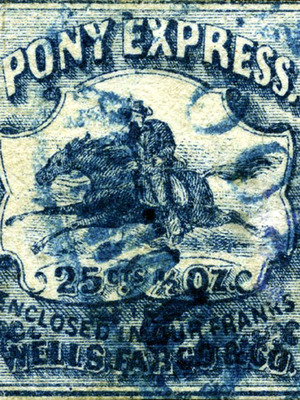
April 3 not only was the seventh anniversary of the Washington Post‘s botched report about the mythical battlefield heroics of Jessica Lynch. The date also marked the 150th anniversary of the first run of the legendary Pony Express–a short-lived institution that is impressively steeped in myth.

As Christopher Corbett wrote in an engaging commentary published Friday in the Wall Street Journal:

“We remember the Pony Express as one of the most enduring and endearing of American stories, a tale of the frontier, a story of bold entrepreneurs, daring young horsemen, true riders of the purple sage and all that.

“In truth, the venture hemorrhaged money from day one, was doomed by technology (another particularly American story), lasted a mere 78 weeks, ruined its backers and then disappeared into what historian Bernard DeVoto called ‘the border land of fable.'”

Corbett noted: “It was all over in 18 months. The service was shut down in the flash of a telegrapher’s key when the transcontinental telegraph was completed in October 1861.”

But for years afterward, “the West was aswarm with old men who claimed to be ‘the last of the Pony Express riders,'” Corbett wrote.

The tall tales and exaggerations that grew up around the Pony Express were in large part promoted by the cinema and the entertainment industry–factors akin to those that contribute to the rise and tenacity of media-driven myths, which are stories about and/or by the news media that are widely believed and often retold but which, on close inspection, prove to be apocryphal or wildly exaggerated.

The filmmaker John Ford incorporated the Pony Express into the 1948 Western, Fort Apache, where, Corbett noted, “the brave rider thunders into the fort to bring news of Custer’s Last Stand, which, alas, took place some 15 years after the Pony stopped running.”

It’s faintly reminiscent of the classic cinematic treatment of the Watergate scandal: Easily the best-known Watergate movie is All the President’s Men, a screen adaptation of the best-selling book by the same title.

The cinematic version of All the President‘s characterized the book’s authors, Carl Bernstein and Bob Woodward of the Washington Post, as central and essential to the scandal’s unraveling.

The upshot of that misrepresentation, I write in  Getting It Wrong, my forthcoming book about media-driven myths, has been “to solidify and elevate the heroic-journalist myth” of Watergate, to give it dramatic power, and sustain it in the collective memory.

I further note in Getting It Wrong that the film offers an unmistakable and unambiguous statement about “the power and centrality of the press in Nixon’s fall. All the President’s Men allows no other interpretation: It was the work Woodward and Bernstein that set in motion far-reaching effects that brought about the first-ever resignation of a U.S. president,” Richard Nixon.

What’s more, the heroic-journalist interpretation of Watergate minimizes or ignores the more decisive contributions in Nixon’s fall by agencies and organizations besides the Washington Post.

In his fine commentary, Corbett noted “the person who immortalized the Pony was William Frederick Cody, or Buffalo Bill. (He also claimed he had been a rider. Not true.)

“The [Pony Express] fast-mail service may have lasted only a year and a half, but it thrived for four decades in Cody’s Wild West show, seen by millions in the U.S. and Europe. To add drama to his re-enactment, Buffalo Bill might throw in a war party of savage Indians chasing a heroic rider who always managed to escape.

“It would become one of the most enduring images of the Pony Express, but it was not true; the actual riders rarely tangled with Indians,” Corbett wrote, adding:

“Why would a Paiute want a two-week-old copy of Horace Greeley’s New York Tribune?”

Corbett noted in closing:

“If the Pony Express continues to thrill and baffle us, consider the words of an old horseman in western Nebraska who advised me when I expressed some concerns about the pedigree of this yarn. ‘We don’t lie out here,’ he explained kindly. ‘We just remember big.'”

“Remember big.” A great line. And it’s certainly applicable in understanding why media-driven myths can be so tenacious and enduring.

WJC

Seven years after ‘fighting to the death’: Who was the Post’s source?

In Anniversaries, Debunking, Jessica Lynch, Media myths, Washington Post on April 2, 2010 at 10:49 am

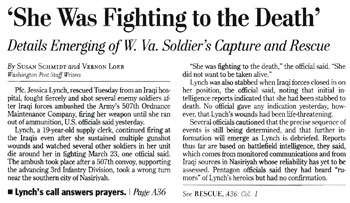
It will be seven years tomorrow since the Washington Post published its erroneous front-page report about Jessica Lynch, the Army private whom the newspaper had said “fought fiercely” in an early engagement of the Iraq War.

“‘She Was Fighting to the Death,'” the Post‘s headline said of Lynch, then a 19-year-0ld supply clerk in the Army’s 507th Maintenance Company.

The Post cited “U.S. officials” who otherwise were unidentified as saying Lynch had “continued firing at the Iraqis even after she sustained multiple gunshot wounds and watched several other soldiers in her unit die around her in fighting” at Nasiriyah on March 23, 2003.

The Post further cited the unnamed sources in reporting that Lynch had “shot several enemy soldiers after Iraqi forces ambushed” the 507th and kept “firing her weapon until she ran out of ammunition.”

None of it was true, however.

Lynch never fired a shot at Nasiriyah; her rifle jammed during the attack. She suffered shattering injuries when a rocket-propelled grenade struck her Humvee, causing the vehicle to crash. But she wasn’t shot.

Lynch was taken prisoner and treated at an Iraqi hospital, from where she was rescued April 1, 2003, by a U.S. special operations team.

As I write in Getting It Wrong, my forthcoming book about media-driven myths, “The Post’s erroneous hero-warrior tale thrust Lynch into an international spotlight that has never fully receded.”

The Post, though, has never disclosed identity of the source or sources for its bogus “fighting to the death” report, which was published April, 3, 2003.

Over the years, speculation has been that the U.S. military leaked the hero-warrior tale about Lynch. But one of the reporters on the story, Vernon Loeb, has said the Pentagon wasn’t the source.

“I could never get anybody from the Pentagon to talk about those reports at all,” Loeb said on an NPR program in late 2003. “I got indications that they had, in fact, received those intelligence reports, but the Pentagon was completely unwilling to comment on those reports at all. They wouldn’t say anything about Jessica Lynch.”

He added that “we wrote a story that turned out to be wrong because intelligence information we were given was wrong.”

So who were the Post‘s sources? Who supplied the erroneous details about Lynch?

When I reached him by phone in 2008 to talk about the Lynch case, Loeb hung up on me.

The author Jon Krakauer claimed in a book published last year that a former White House operative named Jim Wilkinson “arranged to give the Washington Post exclusive access to classified intelligence that was the basis for the now-discredited ‘She Was Fighting to the Death’ story that ran on the front page of that newspaper.”

Krakauer, writing in Where Men Win Glory: The Odyssey of Pat Tillman, called Wilkinson a “master propagandist” and said he “deserves top billing for creating the myth of Jessica Lynch.”

Krakauer’s book identified no specific sources for its claims about Wilkinson, who at the time of Lynch’s capture and rescue was director of strategic communications for General Tommy Franks, then the commander of U.S. forces in Iraq.

I recently spoke by phone with Wilkinson, now a managing partner for the Brunswick Group in San Francisco. He vigorously disputed Krakauer’s account as “factually incorrect” and insisted that “not one shred of evidence” links him to leaking the erroneous report to the Post.

Wilkinson also said:

“Tommy Franks would have killed me” had he been the Post’s source for the erroneous report about Lynch.

Wilkinson’s denial has the ring of authenticity, especially so his point about Tommy Franks. The tenor of Franks’ memoir, American Soldier, makes it clear that Wilkinson’s subordinate and advisory role would have ended abruptly had he crossed the general.

So seven years on, the Post‘s bogus report about Jessica Lynch reverberates still.

WJC