W. Joseph Campbell

Archive for the ‘Cinematic treatments’ Category

Washington Post ignores its singular role in Lynch hero-warrior story

In Cinematic treatments, Debunking, Jessica Lynch, Media myths, Washington Post on September 3, 2010 at 9:47 am

In its review today of the new movie about Pat Tillman, the Army Ranger killed by friendly fire in Afghanistan, the Washington Post invokes the Jessica Lynch case–but disingenuously shifts blame to the Pentagon for thrusting the former Army private into unsought and undeserved fame early in the Iraq War.

In fact it was the Post that gave the world the erroneous story about Lynch and her supposed battlefield heroics in 2003. The hero-warrior tale about Lynch was an embarrassment that the Post still seems eager to sidestep.
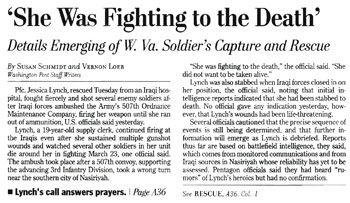
The Post's report on Lynch, April 3, 2003

Not surprisingly, today’s review fails to mention the Post and its electrifying, but inaccurate, front-page report of April 3, 2003. The Post said Lynch had been shot and stabbed but yet “was fighting to the death” when captured by Iraqis.

Lynch then was a 19-year-old Army private, a supply clerk with the 507th Maintenance Company. Elements of her unit were ambushed in Nasiriyah, in southern Iraq, on March 23, 2003, a few days after the war began.

Lynch never fired a shot during the attack; her gun had jammed, she later said. She was neither shot nor stabbed; she suffered shattering injuries in the crash of a Humvee as it tried to flee the ambush.

Lynch was taken prisoner and hospitalized. She was rescued by a U.S. special forces team on April 1, 2003.

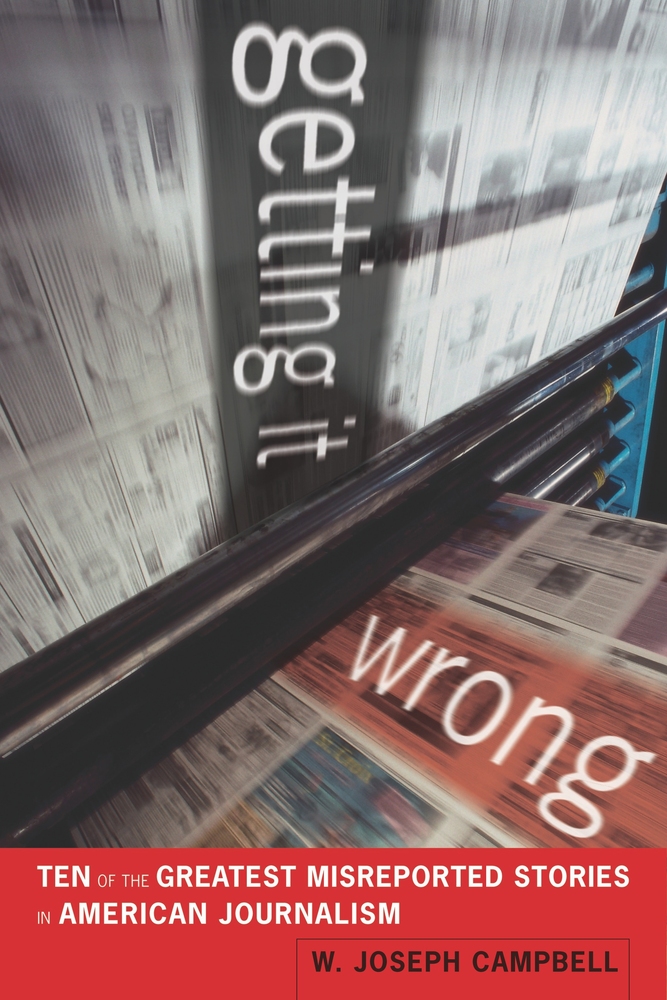
Two days later, the Post published its sensational account of Lynch’s supposed heroism, an account “unlike any to emerge from the war,” I write in Getting It Wrong, my new book debunking 10 prominent media-driven myths.

I note that the Post’s story about Lynch “quickly became a classic illustration of intermedia agenda-setting: News organizations around the world followed the Post’s lead by prominently reporting the supposed heroics of young Jessica Lynch and contemplating their significance.”

It was “all quite remarkable, fascinating, and irresistible,” I write in Getting It Wrong. “The petite, shy clerk who, in the Post’s telling, had fought her attackers with Rambo-like ferocity. But little of it proved true.”

Private Lynch

There’s no hint of any of that in the Post‘s review of the Tillman movie. Instead, the review serves up the dubious interpretation that the Pentagon concocted the hero-warrior story about Lynch.

“In a surreal coincidence,” the review says, “Tillman’s first Army tour was in Iraq, where he helped provide perimeter support for the stage-managed rescue of Pfc. Jessica Lynch. Lynch later debunked the Pentagon’s account of her own actions before being captured by Iraqi forces, accusing the military of using her in their propaganda efforts.” (Emphasis added.)

The Pentagon treated the hero-warrior story as if it were radioactive. And Vernon Loeb, who shared a byline on the Post‘s report about Lynch, later said the military was not the source.

I point out in Getting It Wrong that in “a little-noted interview on National Public Radio’s Fresh Air interview program in late 2003, Loeb made it clear the Post’s sources were not Pentagon officials.”

Loeb, then the Post‘s defense correspondent, said on the radio program:

“Our sources for that story were not Pentagon sources.

“And, in fact, I could never get anybody from the Pentagon to talk about those reports [about Lynch’s battlefield heroics] at all. I got indications that they had, in fact, received those intelligence reports, but the Pentagon was completely unwilling to comment on those reports at all. They wouldn’t say anything about Jessica Lynch.”

Loeb said in the interview that the Post had been “told by some really good intelligence sources here in Washington that, you know, there were indications that she had, you know, fired back and resisted her capture and actually been shot and possibly stabbed doing so.”

He added that the Post on April 3, 2003, “basically told our readers that day what the U.S. intelligence community was telling senior members of the U.S. government.”

Loeb dismissed at the interviewer’s suggestion that the Post‘s “fighting to the death” report was the upshot of clever manipulation by the Pentagon.

“I just didn’t see the Pentagon trying to create a hero where there was none,” Loeb said. “I mean …they never showed any interest in doing that, to me.”

The Post‘s movie review today refers to Lynch’s rescue as having been “stage-managed.”

That notion, I write in Getting It Wrong, represents a spinoff, or subsidiary, myth of the Lynch case.

The BBC was among the first to claim the rescue was a put-up job, calling it one  of the most stunning pieces of news management ever conceived.”

The Pentagon dismissed the BBC’s claims as “void of all facts and absolutely ridiculous.”

Later, at the request of three Democratic members of Congress, the Defense Department’s inspector general investigated the BBC’s allegations and found them baseless.

In testimony to Congress in April 2007, Thomas F. Gimble, then the acting inspector general, said no evidence had been uncovered to support claims that Lynch’s rescue “was a staged media event.”

Instead, Gimble said, the rescue operation was found to have been “a valid mission” to recover a prisoner of war “under combat conditions.”

More than 30 witnesses were interviewed in the inspector general’s inquiry, including members of the special operations team that had rescued Lynch, Gimble stated in written testimony.

Few if any of those witnesses, he noted, had been interviewed by news organizations.

WJC

Related:

Nixon quits–36 years on

In Anniversaries, Cinematic treatments, Media myths, Washington Post, Watergate myth on August 9, 2010 at 8:40 am

Richard Nixon resigned the presidency 36 years ago today–the only American president to have done so.

Nixon leaves, August 9, 1974

He left the White House on August 9, 1974, to avoid certain impeachment and conviction. By then it had become clear that Nixon had ordered senior aides to cover up the Watergate scandal’s signal crime, the burglary in June 1972 at Democratic national headquarters.

As I write in Getting It Wrong, my new book about media-driven myths, forcing Nixon’s resignation “required the collective if not always the coordinated forces of special prosecutors, federal judges, both houses of Congress, the Supreme Court, as well as the Justice Department and the FBI.”

But in the years since 1974, the dominant popular narrative of the Watergate scandal has become the heroic-journalist meme, the widely held notion that the investigative reporting of two young, tireless reporters for the Washington Post led the way in bringing down Nixon’s corrupt presidency.

Such claims appear often in the news media, both in the United States and abroad.

As I note in Getting It Wrong, “The heroic-journalist has become the most familiar storyline of Watergate: ready short-hand for understanding Watergate and its denouement, a proxy for grasping the scandal’s essence while avoiding its forbidding complexity.”

Indeed, 19 men associated with Nixon’s administration or his reelection campaign in 1972 went to jail for crimes in the Watergate scandal–a revealing marker of the scandal’s reach and complexity.

I write in Getting It Wrong that how “the Post and its reporters uncovered Watergate is deeply ingrained in American journalism as one of the field’s most important and self-reverential stories.”

So why has the heroic-journalist interpretation of Watergate become the dominant popular narrative?

Three related reasons offer themselves, I write in Getting It Wrong.

They are:

  • the well-timed release in June 1974 of All the President’s Men, the best-selling book by Washington Post reporters Bob Woodward and Carl Bernstein about their Watergate reporting
  • the cinematic version of the book, which was released in 1976 to very favorable reviews, and
  • the decades-long guessing game about the identity of the helpful and anonymous high-level source, code-named “Deep Throat,” with whom Woodward surreptitiously met while investigating Watergate. The secret source was introduced in All the President’s Men and immediately prompted considerable speculation as to who he was.

“These factors,” I write in Getting It Wrong, “combined to place Woodward and Bernstein at the center of Watergate in popular consciousness, and project the notion that the scandal’s outcome pivoted on disclosures reported by the news media.”

This is especially so in the movie All the President’s Men, which, I write, “offers an unmistakable assertion of the power and centrality of the press in Nixon’s fall.”

The movie also suggested their reporting was more hazardous than it was, that by digging into Watergate, Woodward and Bernstein exposed themselves to not insignificant risk and peril.

However, to explain Watergate through the lens of the heroic-journalist is, I note, “to abridge and misunderstand the scandal and to indulge in a particularly beguiling media-driven myth.

“The heroic-journalist interpretation minimizes the far more decisive forces that unraveled the scandal and forced Nixon from office”–the special Watergate prosecutors, the federal judges, bipartisan congressional panels, the Justice Department, the FBI, and the Supreme Court.

Even then, I argue, Nixon probably would have survived in office and served out his term–albeit as a wounded and weakened chief executive–had it not been for the existence of the audiotapes he made of many of his conversations in the Oval Office.

Only when ordered by the Supreme Court in late July 1974 did Nixon surrender those recordings, which captured him plotting the cover-up and authorizing payments of thousands of dollars in hush money.

Interestingly, Woodward and Bernstein did not uncover the defining and decisive element of the Watergate scandal—the existence of the audiotaping system that Nixon had installed in the Oval Office.

And the tapes were decisive in ultimately forcing his resignation.

WJC

Related:

Going international: Media myths travel far, well

In Cinematic treatments, Debunking, Furnish the war, Media myths, Newspapers, Spanish-American War, Washington Post, Watergate myth on July 15, 2010 at 6:05 am

Prominent media-driven myths—the subject of my new book, Getting It Wrong—not only can be tenacious; some of them travel quite well, crossing linguistic and cultural borders with surprising ease.

Indeed, it’s a sign of hardy appeal when media-driven myths turn up in international contexts more often than just occasionally.

The heroic-journalist myth of Watergate–one of the 10 media myths I explore in Getting It Wrong—represents this phenomenon quite well. The heroic-journalist meme has it that the fearless investigative reporting by Bob Woodward and Carl Bernstein, then-young journalists for the Washington Post, brought down Richard Nixon’s corrupt presidency in the Watergate scandal.

Woodward

It’s a compelling tale that long ago became the scandal’s dominant popular narrative.

It’s also a simplistic interpretation of what was a complex and intricate web of misconduct that took down Nixon and landed nearly 20 of his top aides, associates, and cabinet officers in jail.

I note in Getting It Wrong that to roll up a scandal of such dimension required the collective, if not always the coordinated, efforts of special prosecutors, bipartisan congressional panels, federal judges, the FBI, and, ultimately, the U.S. Supreme Court, which ordered Nixon to surrender audiotapes that proved his complicity in the Watergate cover-up.

Against such a tableau, journalism’s contributions to unraveling Watergate were modest—certainly not decisive.

But because the heroic-journalist interpretation is so straightforward and unambiguous, it’s not surprising that it finds appeal across cultures and turns up fairly often in media reports outside the United States.

Simplicity propels the Watergate myth, enabling it to travel far and well.

Just the other day, for example, a commentary at Mediapart, a French online investigative reporting site, recalled Woodward and Bernstein as “the two journalists for the Washington Post who, thanks to their investigation, set in motion the resignation of President Richard Nixon, during Watergate.”

Another media myth that travels widely and well is that of William Randolph Hearst’s purported vow to “furnish the war” with Spain at the end of the 19th century. Hearst’s pledge supposedly was contained in a cable to the artist Frederic Remington, whom Hearst sent to draw illustrations of the Cuban rebellion, which preceded the Spanish-American War.

The anecdote lives on as one of the most famous and delicious in American journalism—even though it is buttressed by no supporting documentation and is improbable on its face.

It is, however, a tale almost too good to be disbelieved, given that it so effectively captures Hearst as warmonger . The anecdote turns up more than occasionally abroad, especially in Spanish-language media.

I note in Getting It Wrong that “Hearst’s famous vow to ‘furnish the war’ has achieved unique status as an adaptable, hardy, all-purpose anecdote, useful in illustrating any number of media sins and shortcomings. It has been invoked to illustrate the media’s willingness to compromise impartiality, promote political agendas, and indulge in sensationalism. It has been used, more broadly, to suggest the media’s capacity to inject malign influence into international affairs.”

With all that going for it, the step to adoption in international contexts is fairly small.

Beyond simplicity and deliciousness, the international appeal of prominent media myths also may be attributed to a keen and enduring curiosity abroad in American journalism. For all its faults and uncertainties, American journalism is a sprawling, robust, and intriguing profession. Such dynamism exerts appeal and interest beyond the United States.

American cinema is perhaps an even more powerful force: Hollywood treatments have helped solidify media myths. And Hollywood productions often travel well abroad.

The 1976 film All the President’s Men certainly helped propel the heroic-journalist myth of Watergate, for example. As I write in Getting It Wrong: “More than thirty-five years later, what remains most vivid, memorable, and accessible about Watergate is the cinematic version of All the President’s Men.”

The movie, I note, “helped ensure the [heroic-journalist] myth would live on by offering a neat, tidy, and vastly simplified account the Watergate scandal, one that allowed viewers to sidestep the scandal’s complexity while engaging in an entertaining storyline.”

Hollywood also was crucial to cementing Hearst’s purported vow into the popular consciousness. That vehicle was Citizen Kane, the 1941 motion picture based loosely on Hearst’s life and times.

Hearst’s purported vow is paraphrased in a scene early in Kane, which some critics regard as the best-ever American motion picture.

The Hearstian vow also is quoted in the 1997 James Bond movie, Tomorrow Never Dies. Or, as it was known in francophone countries, Demain ne meurt jamais.

WJC

A version of this post first appeared at the University of California Press blog.

Movies, and a myth, for the Fourth

In Anniversaries, Cinematic treatments, Media myths, Washington Post, Watergate myth on July 4, 2010 at 12:28 pm

The online site movieviral.com today offers a top 10 listing of what it terms the “best movies that involve July 4th, politics, and other historic events in US history.”

The list–yes, another list of favorite movies–merits attention here principally because of the inclusion of All the President’s Men. The movie–as I discuss in Getting It Wrong, my new book debunking prominent media-driven myths–helped solidify the notion that two young and intrepid reporters for the Washington Post brought down Richard Nixon’s corrupt presidency in the Watergate scandal.

The movieviral.com post says that All the President’s Men “follows Washington Post reporters Bob Woodward (Robert Redford) and Carl Bernstein (Dustin Hoffman) as they uncover what would become known as Watergate, thus ending the political career of President Nixon.”

Woodward and Bernstein did not “uncover” the Watergate scandal, although the notion they did, I write in Getting It Wrong, “is deeply ingrained in American journalism as one of the field’s most important and self-reverential stories.”

And as Edward Jay Epstein wrote years ago in a superb essay about the news media and Watergate, “the FBI, the federal prosecutors, the [federal] grand jury, and the Congressional committees … unearthed and developed all the actual evidence and disclosures of Watergate.”

Indeed, Woodward and Bernstein did not uncover the defining and decisive elements of the Watergate scandal—the cover-up and the payment of hush money to the burglars who were arrested at Democratic national headquarters in June 1972. Nor did Woodward and Bernstein uncover the existence of the audiotaping system that Nixon had installed in the Oval Office, which proved so critical in forcing the president’s resignation.

The Senate Select Committee on Watergate–not Woodward and Bernstein–disclosed the existence of the White House tapes that captured Nixon’s complicity in the coverup. Special federal prosecutors on Watergate pressed for their release. And the U.S. Supreme Court in 1974  unanimously ordered Nixon to turn over key tapes that had been subpoenaed by the special prosecutor.

Those were pivotal events that led to Nixon’s resignation in August 1974.

As I write in Getting It Wrong, against the tableau of prosecutors, courts, federal investigators, and bipartisan congressional panels, “the contributions of Woodward and Bernstein were modest, and certainly not decisive.

“Principals at the Post have acknowledged as much. Katharine Graham, the newspaper’s doughty publisher, often insisted the Post did not topple Nixon.”

Indeed, as Graham said at a program in 1997 marking the scandal’s 25th anniversary, “The processes that caused [Nixon’s] resignation were constitutional.”

Woodward has concurred, albeit in earthier terms.  “To say that the press brought down Nixon, that’s horseshit,” he said in 2004 in an interview with American Journalism Review.

The movieviral.com roster includes a particularly fine selection in the musical comedy 1776, which, as the site says, “follows the Second Continental Congress for the three months in the hot 1776 summer [when] it deliberated and eventually signed the Declaration of Independence.”

1776 is engaging and entertaining, and I always try to find time to watch at least a portion of the movie on the Fourth. I’ll do so today.

WJC

Related:

Discussing ‘Getting It Wrong’ with AU alums

In Cinematic treatments, Cronkite Moment, Debunking, Media myths, Media myths and radio, War of the Worlds, Washington Post, Watergate myth on June 30, 2010 at 10:35 pm

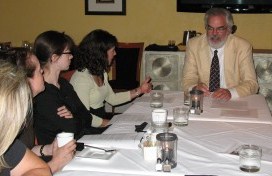
I met in Cleveland’s Little Italy neighborhood last night with a terrific group of American University alumni, at a program that featured a discussion of Getting It Wrong, my new book about media-driven myths.

With AU alums in Cleveland

The gathering was the second of the Cleveland area alumni chapter, which is ably led by Neil T. Young, Anthony Vacanti, and Antoinette Bacon. I was privileged to talk with the group about the book, which addresses and debunks 10 prominent media myths–those false, dubious, improbable stories about the news media that masquerade as factual.

We met at Michaelangelo’s, a fine Italian restaurant where the service is superb. Our discussion about Getting It Wrong was conducted seminar style and featured my fairly lengthy review of the heroic-journalist myth of Watergate–the notion that the intrepid investigative reporting by the Washington Post brought down Richard Nixon’s corrupt presidency.

I described how the book All the President’s Men and the cinematic version by the same title helped solidify the notion that the Post and its reporters Bob Woodward and Carl Bernstein were central to unraveling the Watergate scandal.

The book and the movie have had the effect of focusing on the Post reporters while ignoring or overlooking the far more significant contributions of federal prosecutors, federal judges, bipartisan congressional panels, and ultimately the U.S. Supreme Court in identifying Nixon’s efforts to obstruct justice in the scandal.

“Against that backdrop,” I said, “the news media were decidedly modest factors” in Watergate’s outcome.

Orson Welles

We also discussed the War of the Worlds myth–that Orson Welles’ 1938 radio dramatization of an invasion from Mars was so realistic that tens of thousands of Americans were convulsed in panic and fled their homes in hysteria. The program was imaginative entertainment–and was recognized as such by listeners in overwhelming numbers, I pointed out.

In addition, we talked about the so-called “Cronkite Moment” of February 1968, when CBS anchorman Walter Cronkite offered a downbeat analysis of the U.S. war effort in Vietnam, saying the military was “mired in stalemate.”

Supposedly, Cronkite’s assessment came as an epiphany to President Lyndon Johnson who, it is said, snapped off the television set upon hearing the anchorman’s “mired in stalemate” characterization and said, “If I’ve lost Cronkite, I’ve lost Middle America.”

Or words to that effect.

In reality, I pointed out, the president wasn’t in front of a television set that night.

He was in Austin, Texas, at the 51st birthday party of Governor John Connally. And even if Johnson had seen the Cronkite report on videotape, the anchorman’s assessment really was no epiphany, because the president in the days and weeks immediately afterward hewed to a hawkish line on Vietnam.

Questions from the alums were quite thoughtful. Among them was a query about the common threads may be found in the myths debunked in Getting It Wrong.

A thoughtful and perceptive question, that.

And indeed there are some shared characteristics of media myths.

Many myths are reductive, in that they offer simplistic explanations for complex historical events. That factor certainly helps explains the tenacity of the heroic-journalist myth of Watergate and the “Cronkite Moment.” It is far easier to characterize the news media as prime movers in the outcomes of Watergate and Vietnam than it is to grapple with the complexities and nuances of those landmark events, I said.

Additionally, media myths tend to be delicious stories–stories almost too good to be disbelieved. And that certainly holds for Watergate, the “Cronkite Moment,” and the War of the Worlds dramatization.

And media myths tend to be ways to assert the notion that the news media are powerful and influential forces in American society.

But as I write in Getting It Wrong, media power “tends to be modest, nuanced, diffused, and situational” and altogether “too often the ubiquitous presence of the news media is mistaken for power and influence.”

Moreover, I write, “The American media these days are far too splintered and diverse—print, broadcast, cable, satellite, online—to exert much in the way of collective and sustained influence on policymakers or media audiences.”

WJC

Related:

‘Getting It Wrong’ goes ‘On Point’

In Cinematic treatments, Cronkite Moment, Debunking, Furnish the war, Media myths, Media myths and radio, Spanish-American War, Washington Post, Watergate myth on June 3, 2010 at 8:52 pm

I was interviewed today by Tom Ashbrook, the engaging host of NPR’s On Point program, which is produced by WBUR in Boston.

We discussed Getting It Wrong, my new book about media-driven myths, and it was a fine show. (Audio is available here.)

As Ashbrook promised in his introduction, the conversation ranged over a variety of topics–or what he called “iconic media tales from the Spanish-American War to Hurricane Katrina.”

We were joined by Jack Beatty, the program’s news analyst, and discussed at some length the myth of the so-called “Cronkite Moment” of 1968, in which CBS News anchorman Walter Cronkite characterized the war in Vietnam as a stalemate, supposedly prompting President Lyndon Johnson to alter his policy on the conflict.

We also took up myth surrounding the famous anecdote about William Randolph Hearst’s purported vow to “furnish the war” with Spain at the end of the 19th century, the dubious notion that Orson Welles’ 1938 radio dramatization of the War of the Worlds set off nationwide panic and mass hysteria, and what I call the heroic-journalist myth of Watergate, in which Bob Woodward and Carl Bernstein of the Washington Post supposedly brought down Richard Nixon’s corrupt presidency.

On the latter topic, I mentioned how the cinematic version of All the President’s Men, Woodward and Bernstein’s book about their Watergate reporting, has become the vehicle by which people learn about and remember the scandal.

Watergate was, I noted, “so complex that people these days, many years removed from it, find it hard to keep it all straight. … The high-quality, cinematic treatment of the Watergate scandal, featuring Woodward and Bernstein and the Washington Post in All the President’s Men, does happen to be the way that many people remember the Watergate scandal. …

“The movie’s a great movie,” I added. “But it helped to solidify the notion that the Post, the Washington Post, and Woodward and Bernstein were at the center, were at the heart, of uncovering the scandal.”

On Point featured questions and comments from a few callers–including a guy named Phil in Bowling Green, Kentucky, who said about me:

“I think the professor has got too much time on his hands. ” I chuckled.

He added: “I lived through most of that–the Watergate and Vietnam War.  I think he’s underestimating the persuasive attitude that Walter Cronkite had on this country. … Everybody’s opinion turned on what Walter Cronkite thought.”

But another caller, Gary from Nashville, Tennessee, weighed in, saying he disagreed with Phil from Bowling Green, offered the thought that public opinion about Vietnam turned not on the views of one journalist but on “the unrelenting reporting on the war by the media.”

It was a lively, substantive program that has generated a few dozen or so comments at the On Point online site.

The discussion made me recognize anew how deeply embedded and tenaciously held some media-driven myths really are, and how an hour-long program is hardly enough to encourage people even to think about giving them up. As Jack Shafer noted in his review of Getting It Wrong, “a debunker’s work is never done.”

But perhaps the show’s content will entice some listeners to buy and read the book. Even then, though, I suspect some media myths will prove resistant to thorough debunking.

WJC

Related:

‘Good narrative trumps good history’
In 1897, Cinematic treatments, Furnish the war, Media myths, Reviews, Yellow Journalism on May 28, 2010 at 1:53 pm

The Shotgun Blog today quotes an excerpt from my recent review of Evan Thomas’ disappointing new book, The War Lovers, and offers this telling observation:

“A good narrative trumps good history about nine times out of ten.”

The Shotgun Blog excerpt carries the headline, “You Furnish the Myth, We’ll Furnish the History,” and includes this passage from my review of War Lovers:

“Thomas embraced the media-driven myth of William Randolph Hearst’s purported vow to furnish the war with Spain–a vow supposedly contained in a telegram to the artist Frederic Remington, on assignment in Cuba” in 1897.

The Remingt0n-Hearst anecdote almost certainly is apocryphal, as I discuss in my 2001 book, Yellow Journalism: Puncturing the Myths, Defining the Legacies.

I revisit the anecdote in the first chapter of my soon-to-be-published book, Getting It Wrong, which debunks 10 prominent media-driven myths—false, dubious, or improbable stories about the news media that masquerade as factual.

The Shotgun Blog’s observation about good narrative routinely trumping good history is worthy of rumination, as it does often seem to be the case. It is a topic that I address in Getting It Wrong.

A reason narratives like the Remington-Hearst anecdote triumph is that they are succinct, savory, and easily remembered–as are many media-driven myths.

The Remington-Hearst anecdote is almost too good to be false, a narrative so delicious that it deserves to be true.

The anecdote lives on “despite a nearly complete absence of supporting documentation,” I note in Getting It Wrong, adding:

“It lives on even though telegrams supposedly exchanged by Remington and Hearst have never turned up. It lives on even though Hearst denied ever sending such a message.

“It lives on despite an irreconcilable internal inconsistency: It would have been absurd for Hearst to vow to ‘furnish the war’ because war—specifically, the Cuban rebellion against Spain’s colonial rule—was the very reason Hearst sent Remington to Cuba in the first place.

“Anyone reading U.S. newspapers in early 1897 would have been well aware that Cuba was a theater of a nasty war. By then, the Cuban rebellion had reached island-wide proportion and not a single province had been pacified by Spain’s armed forces.”

What pressed the “furnish the war” anecdote unequivocally into the public consciousness–what sealed the narrative’s triumph over history, if you will–was Citizen Kane, the 1941 motion picture based loosely on Hearst’s life and times.

Kane was not a commercial success, in part because of Hearst’s attempts to block its release, but the film is consistently ranked by critics among the finest ever made, as I note in Getting It Wrong.

A scene early in the film shows Charles Foster Kane, the newspaper tycoon who invites comparisons to Hearst, at his desk, tie untied, quarreling with his former guardian. They are interrupted by Kane’s business manager, “Mr. Bernstein,” who reports that a cable a just arrived from a correspondent in Cuba.

Bernstein reads the contents and Kane, who is played superbly by Orson Welles, dictates a reply that paraphrases Hearst’s purported vow.

Orson Welles

“You provide the prose poems,” Kane says, “and I’ll provide the war.”

Bernstein congratulates Kane on a splendid and witty reply.

Saying he rather likes it himself, Kane instructs Bernstein to send it at once.

WJC

Related:

Another movie list, another myth invoked

In Cinematic treatments, Debunking, Media myths, Washington Post, Watergate myth on April 26, 2010 at 11:52 am

The cinema can be a powerful propellant of media-driven myths.

As I note in my forthcoming book, Getting It Wrong, cinematic treatments can and do “influence how historical events are collectively remembered and can harden media-driven myths against debunking.”

I invoke as an example the Watergate scandal, which culminated in 1974 with the resignation of President Richard Nixon. It is often said that the Watergate reporting of Washington Post reporters Bob Woodward and Carl Bernstein “brought down” Nixon’s corrupt presidency.

Woodward and Bernstein’s best-selling book about their Watergate reporting, All the President’s Men, was turned into a highly successful motion picture by the same title.

And as I write in Getting It Wrong, the cinematic version of All the President’s Men, which cast Robert Redford and Dustin Hoffman in the roles of Woodward and Bernstein, “helped ensure that the journalists and their newspaper would be regarded as central to cracking the Watergate scandal.”

Testimony to that observation was offered yesterday in an item at the Huffington Post blog referring to All the President’s Men as “one of the top films about the presidency.”

The item said the film “documents how the power of the press and the determination of two young journalists brought down this occupant [Nixon], who only two years prior had won re-election by the widest margin in history.”

As I’ve noted several times at MediaMythAlert, the notion that Woodward, Bernstein, and the Washington Postbrought down” Nixon is a media-driven myth, a trope that knows few bounds.

It is, I write in Getting It Wrong, a misleading interpretation that “minimizes the far more decisive forces that unraveled the scandal and forced Nixon from office.”

The “heroic-journalist myth of Watergate” took hold for a number of reasons, among them the sheer complexity of the scandal. Not only was Nixon turned from office but  19 men associated with his presidency or his 1972 reelection campaign went to jail.

The “heoric-journalist” memo has become, I write, “a proxy for grasping the scandal’s essence while avoiding its forbidding complexity.”

The cinematic version of All the President’s Men accomplished that, too, by offering what I call “an unmistakable assertion of the power and centrality of the press in Nixon’s fall.”

The contribution of other agencies and entities in unraveling Watergate and prosecuting Nixon’s men is downplayed or ignored.

The Huffington Post item that invoked the heroic-journalist myth discussed 11 films that examine the American presidency, including two fine motion pictures, Primary Colors and the Manchurian Candidate.

Also on the movie list was Dick, an improbable spoof about Watergate and the Nixon White House that depicts Woodward and Bernstein as antagonistic incompetents who bungle their way to a Pulitzer Prize.

WJC

Movies about journalists: Another list, another myth

In Cinematic treatments, Debunking, Furnish the war, Media myths, Newspapers, Washington Post, Watergate myth on April 17, 2010 at 6:31 pm

The blog True/Slant includes a ranking today of the 10 best-ever movies about journalism, and the Bogart film, Deadline U.S.A., tops the list.

This 10-best lineup was inspired by the series of newspapering movies running at Film Forum in Manhattan.

Absence of Malice (which I thought was dreadfully stereotypical), ranked second on the True/Slant list; The Paper was third, and All the President’s Men, the best-known movie about the Watergate scandal, was fourth.

Almost predictably, the description about All the President’s Men said:  “Robert Redford and Dustin Hoffman play Washington Post reporters Carl Bernstein and Bob Woodward, who reported the Watergate scandal and brought down a President. One of the few movies that makes journalism look like something worth doing.”

So there we are again–the hoary claim resurfaces that Nixon was “brought down” by the reporting of the intrepid Post reporters.

It’s what I call the heroic-journalist myth, and it’s addressed, and debunked, in Getting It Wrong, my forthcoming book about media-driven myths.

I note in the book, which is due out this summer, that heroic-journalist myth of Watergate is one of the most appealing and self-reverential stories in American media history.

It is striking indeed how routinely and even off-handedly Bernstein and Woodward are credited with the accomplishment, especially when the record of Watergate shows that the Post’s reporting had at best a marginal effect on forcing Nixon’s resignation in 1974.

Other forces and factors were far more decisive to the denouement of Watergate. As Howard Kurtz, the Post’s media reporter, has written:

“Despite the mythology, The Post didn’t force Richard Nixon from office—there were also two special prosecutors, a determined judge, bipartisan House and Senate committees, the belated honesty of [former White House lawyer] John Dean and those infamous White House tapes.”

Nixon’s White House tapes were crucial to the outcome. He resigned the presidency shortly after the Supreme Court ordered him to turn over the tapes subpoenaed by the Watergate special prosecutor.

One of the tapes undeniably showed Nixon participating in the coverup of the burglary at Democratic national headquarters, the signal crime of the Watergate scandal.

I also note in Getting It Wrong that motion pictures have a way of solidifying media-driven myths in the public’s consciousness.

“High-quality cinematic treatments,” I write, “are powerful agents of media myth-making, and can enhance a myth’s durability.”

And so what’s my top movie about newspapering? The 1941 Orson Welles masterpiece, Citizen Kane.

And that’s probably because I get such a laugh every time I watch the scene that paraphrases William Randolph Hearst‘s purported vow “to furnish the war” with Spain.

That may be the hardiest media myth of all.

A sleeper in my lineup of best movies about journalism is John Ford’s 1962 Western, The Man Who Shot Liberty Valence.

Why Liberty Valence?

Solely because of the movie’s greatest line, which is so applicable to media myth-making:

“This is the West, sir. When the legend becomes fact, print the legend.”

WJC

On bringing down Nixon

In Cinematic treatments, Debunking, Media myths, Newspapers, Washington Post, Watergate myth on April 12, 2010 at 4:07 pm

My guestpost the other day at the “Political Bookworm” blog–in which I reviewed three media-driven myths explored in my forthcoming book, Getting It Wrong–has attracted more than a few comments, including this particularly blinkered rhetorical question:

“Do you really know anyone who believes the Washington Post brought Nixon down?”

For starters, check Investor’s Business Daily.

On the day the guestpost and the blinkered comment appeared, Investor’s Business Daily said the New York Times, in its coverage of sexual abuses by Roman Catholic priests, was “seeking the biggest prey since Woodward and Bernstein brought down Richard Nixon.”

There you go: Brought down Nixon.

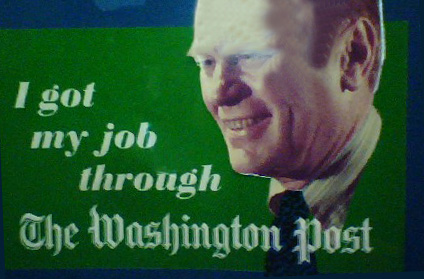
Gerald Ford became president on Nixon's resignation

The Investor’s Business Daily reference, of course, was to Bob Woodward and Carl Bernstein of the Washington Post whose investigative reporting in the Watergate scandal is often and inaccurately said to have toppled Richard Nixon’s corrupt presidency.

As I note in Getting It Wrong, the heroic-journalist meme of Watergate is one of the most hardy, persistent, and delicious myths in American media history.

Interestingly, it lives on despite periodic efforts by principals at the Washington Post to dismiss it. (“Political Bookworm” is a Washington Post blog, it should be noted.)

The newspaper’s media reporter, Howard Kurtz, wrote in 2005, for example:

“Despite the mythology, The Post didn’t force Richard Nixon from office—there were also two special prosecutors, a determined judge, bipartisan House and Senate committees, the belated honesty of [former White House lawyer] John Dean and those infamous White House tapes.”

Kurtz’s observations parallel those of Stanley I. Kutler, a leading historian of Watergate, who has written:

“The fact is, an incredible array of powerful actors all converged on Nixon at once—the FBI, prosecutors, congressional investigators, the judicial system.”

Amid this array of subpoena-wielding authorities investigating Watergate, the contributions of Woodward and Bernstein were modest–and certainly not decisive to the scandal’s outcome.

Still, the heroic-journalist myth is alive, well–and often invoked.

In large measure, that’s because the 1976 motion picture All the President’s Men–the leading movie about Watergate–depicted Woodward and Bernstein as essential to unraveling the scandal.

Indeed, this myth is a trope that knows few bounds.

WJC