W. Joseph Campbell

Archive for the ‘Debunking’ Category

Bra-burning in Toronto: Confirmed

In Bay of Pigs, Bra-burning, Debunking, Media myths, Photographs on February 19, 2011 at 12:12 am

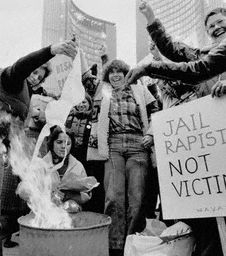
It happened, and the photo’s no hoax.

The bra-burning episode pictured at left took place near Toronto city hall on March 8, 1979.

One of the participants, speaking by phone from Vancouver, confirmed the incident, saying, “The photo is authentic. Absolutely. It happened.”

The participant was Vicki Trerise, who is shown at the far right in the photograph, a larger version of which is accessible here.

I had not seen the photograph until February 6; it was posted that day with an article at the London Guardian online site.

I had had doubts about its authenticity.

Given periodic claims that no bras ever were burned at a feminist protest, the image, I suspected, may have been unethically altered.

Not only that, but the photograph seemed almost too good to be true, what with the white bra dangling above lapping flames of the burn barrel.

Trerise, though, assured me the photograph was legitimate. And her confirmation effectively represents a challenge to claims that feminist bra-burning is a media myth.

It happened in Toronto. The photograph shows a moment of demonstrative bra-burning, even though it “wasn’t a focal point” of the protest, Trerise said.

The bra-burning took place near the end of the demonstration, during which the group Women Against Violence Against Women protested what it termed was an illogical report prepared by the Ontario Provincial Police about rape.

Trerise said the demonstrators were media-savvy and “knew that if they burned a bra, someone would take their picture.”

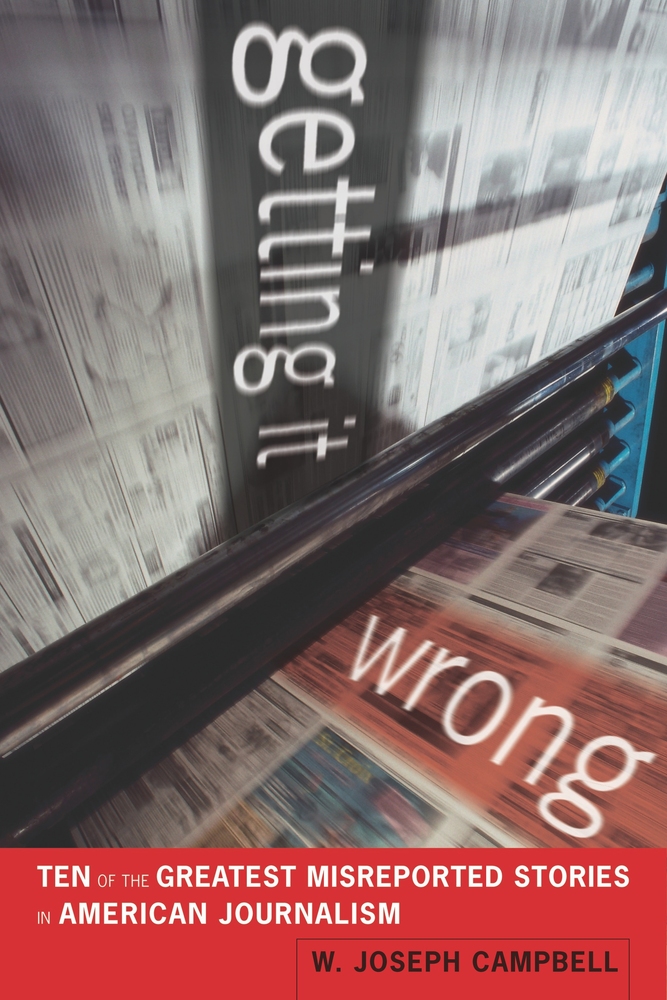
By 1979, “bra-burning” had become part of the vernacular in North America, a dismissive term often invoked “to denigrate women’s liberation and feminist advocacy as trivial and even a bit primitive,” as I note in my latest book, Getting It Wrong.

“Invoking ‘bra-burning,'” I write, “was a convenient means of brushing aside the issues and challenges raised by women’s liberation and discrediting the fledgling movement as shallow and without serious grievance.”

The term emerged in the aftermath of a women’s liberation demonstration outside the Miss America pageant in September 1968 at Atlantic City, New Jersey.

Protest leaders have long insisted that nothing was burned at Atlantic City. However, I present evidence in Getting It Wrong that bras were set afire, briefly, during the demonstration on that long ago September day.

But I acknowledge that the evidence of bra-burning at Atlantic City doesn’t correspond to the “widely held image of angry feminists demonstratively setting fire to their bras and tossing the flaming undergarments into a spectacular bonfire.”

The demonstrators in Toronto in 1979 hardly looked angry; but they were flamboyant.

Trerise said the bra-burning that day “was a bit of a reverse spoof,” a parody of media claims that burning bras was commonplace at feminist protests in the late 1960s and 1970s. “It was like a joke,” she said, and “it wasn’t planned.”

She also said the demonstrators “all had been involved in street activism for many years.”

Dangling the bra above the burn barrel was Pat Murphy, who died in 2003. In the center of the photograph with her right arm upraised was Adrienne Potts.

Murphy and Potts were two members of the so-called “Brunswick Four” — lesbians arrested in 1974, following an episode at a tavern in Toronto where they sang a parody of “I Enjoy Being a Girl.” For “girl,” they had substituted “dyke.”

WJC

Many thanks to FiveFeetofFury for linking to this post

Recent and related:

A history lesson not to miss? No, but it is entertaining

In Anniversaries, Cinematic treatments, Debunking, Media myths, Reviews, Washington Post, Watergate myth on February 18, 2011 at 9:14 am

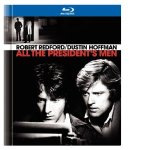
The Blu-ray edition of the most-watched movie about Watergate, All the President’s Men, is out, and its release has been received with favorable-to-glowing reviews.

One writeup, posted the other day at HamptonRoads.com went so far as to declare: “This history lesson shouldn’t be missed — especially if you’re an aspiring journalist.”

Well, that’s disputable.

All the President’s Men is entertaining and has help up impressively well in the 35 years since its release. The movie purports to recount tell the ingenuity and persistence of Washington Post reporters Bob Woodward and Carl Bernstein in investigating the scandal that ultimately brought down Richard Nixon’s corrupt presidency.

Trouble is, All the President’s Men — which is based on Woodward and Bernstein’s 1974 book of the same title — offers up an entirely misleading view of history.

It unabashedly advances what I call “the heroic-journalist interpretation of Watergate” — the endlessly appealing notion that it Woodward and Bernstein’s dogged work that exposed the crimes of Watergate and forced Nixon to resign.

And that’s a trope that knows few bounds.

The heroic-journalist interpretation of Watergate, as I write in my latest book, Getting It Wrong, serves “to abridge and misunderstand the scandal and to indulge in a particularly beguiling media-driven myth. The heroic-journalist interpretation minimizes the far more decisive forces that unraveled the scandal” and brought about  Nixon’s resignation in August 1974.

Watergate also led to the conviction and imprisonment of nearly 20 men associated with his presidency or his 1972 reelection campaign.

To roll up a scandal of such dimension, I write in Getting It Wrong, “required the collective if not always the coordinated forces of special prosecutors, federal judges, both houses of Congress, the Supreme Court, as well as the Justice Department and the FBI.

“Even then,” I add, “Nixon likely would have served out his term if not for the audiotape recordings he secretly made of most conversations in the Oval Office of the White House.”

Only when ordered by an 8-0 decision of the U.S. Supreme Court did Nixon surrender the audiotape recordings, which revealed his efforts to obstruct justice in the early days of the federal investigation into Watergate.

The cinematic version of All the President’s Men glosses over, ignores, or even denigrates the contributions of federal investigative agencies. It makes little or no mention of special Watergate prosecutors or of the bipartisan Senate select committee on Watergate or of the pivotal Supreme Court decision.

Not only that, but as I write in Getting It Wrong, All the President’s Men the movie suggests that the reporting of Woodward and Bernstein “was more hazardous than it was, that by digging into Watergate, Woodward and Bernstein exposed themselves to not insignificant risk and peril.”

As Woodward said in 1997, in an online chat at washingtonpost.com, “there is no evidence that anyone involved in the Nixon operation was going to threaten us.”

Because the cinematic version of All the President’s Men inaccurately places Woodward and Bernstein at the center of Watergate’s unraveling, because it minimizes the far more decisive efforts of subpoena-wielding investigative agencies, the movie really can’t be called a “history lesson” not to be missed.

It elevates and solidifies the heroic-journalist myth of Watergate. That makes for good entertainment — and for very deceptive history.

WJC

Recent and related:

Suspect Murrow quote pulled at Murrow school

In Debunking, Furnish the war, Media myths, Murrow-McCarthy myth on February 17, 2011 at 7:37 am

Did he say it?

I’ve written occasionally at Media Myth Alert about a suspect quotation attributed to broadcasting legend Edward R. Murrow.

Here’s the quotation:

“We must not confuse dissent with disloyalty. When the loyal opposition dies, I think the soul of America dies with it.”

The quotation is half true. That is, the first part was indeed spoken by Murrow; the other part is just too good to be true.

I happened to find the full quotation posted at the welcome page of the dean of the Edward R. Murrow College of Communication at Washington State University.

By email, I asked the dean, Lawrence Pintak, what he could tell me about the quote’s provenance.

I noted in my email that the first portion  of the passage – “We must not confuse dissent with disloyalty” – was spoken by Murrow near the end of his 1954 See It Now program about the witch-hunting ways of Senator Joseph R. McCarthy.

“But the rest of quotation – ‘When the loyal opposition dies, I think the soul of America dies with it’ – was not spoken during that program,” I noted in my email. I added that “I’ve not been able to determine where and when it was spoken or written.”

I further noted that I had consulted a database of historical newspapers — a full-text repository that includes the New York Times, Washington Post, Chicago Tribune, and Los Angeles Times — but no articles quoting the “loyal opposition” passage were returned.

I also mentioned in my email that a search of the LexisNexis database “produced a few returns, but none dated before 2001.” None of them state where and when Murrow made the purported comment.

Pintak, who became the first dean of the Murrow College in 2009, stated in reply that the online site had been constructed before his arrival at Washington State. He added:

“My suspicion is that the site was built by the university marketing comm. people and they may well have just pulled it from the web, rather than original source. If it’s not correct, we certainly need to get it pulled.”

He referred my inquiry to an instructor on his faculty, Paul Mark Wadleigh, whom he asked to investigate.

A few hours later, Wadleigh sent an email to the dean and me, stating:

“While it seems to reflect the Murrow spirit, the lack of evidence that he phrased it that way is indeed suspicious.”

Wadleigh also wrote that the transcript of Murrow’s closing comments in the 1954 show about McCarthy “reveals a different language and tone than the ‘loyal opposition’ quote.”

Good point.

His bottom line?

“I feel the evidence says no, Murrow did not say this,” Wadleigh wrote.

By the end of the day, the suspect quote had been pulled from the dean’s welcome page. Just the authentic portion — “We must not confuse dissent with disloyalty” — remains posted there.

The College’s move to pull the quote not only was commendable; it stands as further evidence that the “loyal opposition” line attributed to Murrow is dubious. It may have been made up well after Murrow’s death in 1965, perhaps to score points politically.

I’ve noted that if it were genuine, if Murrow had uttered the line, then its derivation shouldn’t be too difficult to determine.

Moreover, the quotation seems too neat and tidy to be authentic — which can be a marker of a media-driven myth.

As I write in my mythbusting book, Getting It Wrong:

“To thwart media myths, journalists can start by applying a measure of skepticism to pithy, telling quotes such as [William Randolph] Hearst’s vow to ‘furnish the war‘ and even to euphonic phrases such as ‘bra burning.’

“Turns of phrase that sound too neat and tidy,” I write, “often are too perfect to be true.”

WJC

Recent and related:

Remembering the ‘Maine,’ Hearst, and Remington

In 1897, Anniversaries, Debunking, Furnish the war, Media myths, Spanish-American War on February 16, 2011 at 7:01 am

Wreckage of the 'Maine'

The battleship Maine blew up in Havana harbor 113 years ago yesterday, a development that rocked Americans and helped trigger the brief but decisive Spanish-American War.

The Brooklyn Daily Eagle recalled the battleship’s destruction in a post yesterday that invoked one of American journalism’s most tenacious myths — the purported vow of William Randolph Hearst to “furnish the war” with Spain.

The item in the Eagle — a latter-day version of the storied Brooklyn Daily Eagle that was published from 1841 until 1955 — said in its post that after the Maine blew up, Hearst “sent artist Frederic Remington to cover the war story in Cuba.

“When Remington found little happening there, he asked about coming home. Hearst wired back: ‘Please remain. You furnish the pictures and I’ll furnish the war.'”

As I discuss in the first chapter of my latest book, Getting It Wrong, the Hearstian vow, while well-known and often retold, is almost surely apocryphal.

I note in Getting It Wrong that that the vow “has achieved unique status” in American journalism “as an adaptable, hardy, all-purpose anecdote, useful in illustrating any number of media sins and shortcomings.

“It has been invoked to illustrate the media’s willingness to compromise impartiality, promote political agendas, and indulge in sensationalism. It has been used, more broadly, to suggest the media’s capacity to inject malign influence into international affairs.”

Reasons for doubting that Hearst ever sent such a message are many, and include the fact that the artifacts — the purported telegrams exchanged between Remington and Hearst — have never turned up.

Hearst

Hearst, moreover, denied ever having sent such a message, and there’s no known record of Remington ever having discussed the purported exchange.

I note in Getting It Wrong that the Remington-Hearst anecdote “lives on despite an irreconcilable internal inconsistency: It would have been absurd for Hearst to vow to ‘furnish the war’ because war — specifically, the Cuban rebellion against Spain’s colonial rule — was the very reason Hearst sent Remington to Cuba in the first place.”

Had the Remingt0n-Hearst exchange taken place, it would have been in mid-January 1897, at the end of Remington’s lone visit to Cuba in the months before the loss of the Maine.

We know that because the sole original source of the anecdote, a self-centered journalist named James Creelman, claimed in a book of reminiscences that exchange took place “some time before the destruction of the battleship Maine in the harbor of Havana” on February 15, 1898.

Creelman, who titled his book On the Great Highway, did not say how he learned about the purported exchange. In early 1897, Creelman was not in New York with Hearst, nor in Cuba with Remington. Creelman was in Spain, on assignment for Hearst’s New York Journal, the leading exemplar of what was called “yellow journalism.”

It is exceedingly unlikely that the telegrams would have flowed freely between Hearst and Remington as Creelman suggested. Spanish authorities in Havana, after all, had imposed strict censorship of international cable traffic. As I note in Getting It Wrong:

“Spanish control of the cable traffic in Havana was too vigilant and severe to have allowed such an exchange to have gone unnoticed and unremarked upon. A vow such as Hearst’s to ‘furnish the war’ surely would have been intercepted and publicized by Spanish authorities as a clear-cut example of Yankee meddling in Cuba.”

I also note in Getting It Wrong that the purported Hearstian vow is a telling example of a quote that’s so neat and tidy that it should immediately trigger suspicions.

“Like many media-driven myths,” I write, “it is succinct, savory, and easily remembered.

“It is almost too good not to be true.”

WJC

Recent and related:

‘Follow the money’ and the ‘new blue bloods’ in Parliament

In Cinematic treatments, Debunking, Media myths, Washington Post, Watergate myth on February 12, 2011 at 10:17 am

Spear’s is a glossy magazine published quarterly in London for the super rich. At its online site, Spear’s describes itself as “the essential resource for high net worths.”

In one of its recent articles, “The New Blue Bloods,” Spear’s discussed the number of entrepreneurs who sit in the British Parliament. The article opened by invoking the famous made-up line of Watergate:

“Deep Throat’s parking-lot exhortation to Bob Woodward to ‘follow the money’ has long established itself as shorthand for the pursuit of corruption in politics, but in the modern Parliament of the United Kingdom it has come to mean something altogether different.

“The otherwise-indecisive election of May 2010 saw one trend emerge strongly: a surprising number of those new members now sitting on the Government benches are successful entrepreneurs, and it is following the money they have made that has brought them into politics.”

I thought the 2010 election was decisive, that it turned out a Labor government and brought to power a Tory-led coalition.

Anyway. What most interests Media Myth Alert is Spear’s using that famous made-up line, “follow the money.”

The article, however inelegantly written, demonstrates anew the striking versatility of that contrived phrase as well as its impressive international resonance and its too-good-not-to-be-true quality.

“Follow the money” was never spoken by the Watergate source “Deep Throat” in his periodic meetings — sometimes in a parking garage in suburban Virginia — with Bob Woodward of the Washington Post.

The screenwriter William Goldman has taken credit for writing the line into the script of All the President’s Men, the cinematic version of Woodward and Carl Bernstein’s book about their Watergate reporting.

The movie came out in April 1976, less than two years after the Watergate scandal reached a climax with the resignation of President Richard Nixon.

The actor Hal Holbrook gave a stellar performance in All the President’s Men as the shadowy, conflicted, chain-smoking “Deep Throat” source.

“Follow the money” was uttered in a memorable scene of a late-night meeting in the parking garage, in which Holbrook tells the Woodward character, played by Robert Redford:

“I have to do this my way. You tell me what you know, and I’ll confirm. I’ll keep you in the right direction, if I can, but that’s all.

“Just follow the money.”

Holbrook’s lines were delivered with such authority that it’s not difficult to understand how “follow the money” has crossed from the screen to the vernacular, how the phrase has been embraced not only as plausible but as guidance that was genuine and essential.

But as I’ve noted, Watergate was more than a matter of pursuing and understanding a money trail. Rolling up a scandal of Watergate’s dimensions required more than simply following the money.

In the end, it was Nixon’s efforts to obstruct justice by covering up the break-in at headquarters Democratic national committee headquarters in 1972 that brought down his presidency.

As I note in my latest book, Getting It Wrong, the cinema can be a powerful agent in propelling and solidifying media-driven myths. Indeed, All the President’s Men, in its mediacentric focus on the supposed exploits of Woodward and Bernstein, helped inculcate the notion that the reporters’ investigative work was decisive in bringing down Nixon.

I point out in Getting It Wrong that “the cinematic treatment of All the President’s Men placed Woodward and Bernstein at the center of Watergate’s unraveling while denigrating the efforts of investigative agencies such as the FBI.

“The effect was to solidify and elevate the heroic-journalist myth, giving it dramatic power, and sustaining it in the collective memory.”

I further write that the movie “offers an unmistakable assertion of the power and centrality of the press in Nixon’s fall. All the President’s Men allows no other interpretation: It was the work Woodward and Bernstein that set in motion far-reaching effects that brought about the first-ever resignation of a U.S. president.

“And it is a message that has endured. More than thirty-five years later, what remains most vivid, memorable, and accessible about Watergate is the cinematic version of All the President’s Men.”

And a related and intriguing effect has been the tenacity of “follow the money” and the unwitting inclination to treat that pithy, well-delivered line as if it had been advice of decisive importance.

WJC

Recent and related:

Keller no keeper of the flame on famous NYT motto

In 1897, Anniversaries, Debunking, New York Times, Newspapers, Year studies, Yellow Journalism on February 11, 2011 at 8:56 am

Keller

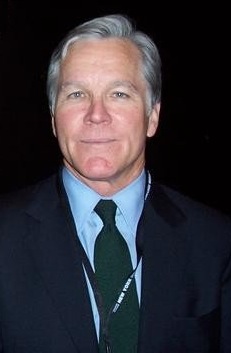
Bill Keller, executive editor of the New York Times, made clear the other day he doesn’t fully understand the derivation and significance of his newspaper’s famous, 114-year-old motto, “All the News That’s Fit to Print.”

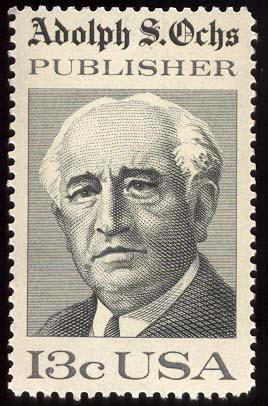
And he didn’t seem particularly comfortable with the slogan coined (most likely) by Adolph Ochs, who in 1896 acquired the then-beleaguered Times and eventually led the newspaper to preeminence in American journalism.

Ochs, commemorated

Sure, the motto’s smug and overweening, elliptical and easily parodied. But it is the most recognizable motto in American journalism, and it evokes a time now passed when slogans helped define and distinguish U.S. newspapers.

In an appearance not long ago at the National Press Club in Washington, Keller was asked about “All the News That’s Fit to Print,” which took a permanent place of prominence on the newspaper’s front page on February 10, 1897.

Keller rather sniffed at it, saying the motto “harkens back to a day when the aim of the newspaper was to be comprehensive.”

According to a transcript of his remarks, Keller said that nowadays the Times is “going to tell you maybe only a little bit, but a little bit about everything.

“And I think that slogan describes an aspiration, or a mindset. Now we tend to be more selective, and try to give you more depth, to tell you the stories that are not obvious.”

Actually, “All the News That’s Fit to Print” was framed a riposte to activist-oritented yellow journalism that flared in New York City in the closing years of the 19th century.

Ochs clearly meant the slogan to be a rebuke to the flamboyant ways of the  New York Journal of William Randolph Hearst and the New York World of Joseph Pulitzer. Their newspapers were the leading exemplars of the yellow press in fin-de-siècle urban America.

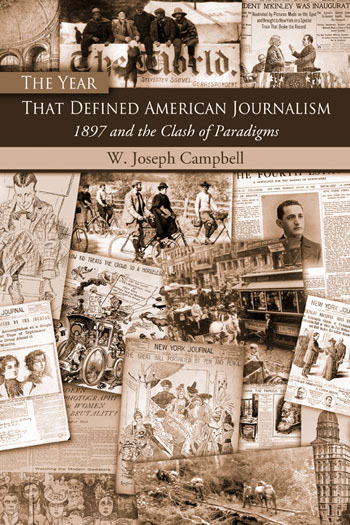
As I wrote in my 2006 book, a year study titled The Year That Defined American Journalism: 1897 and the Clash of Paradigms, the motto was, and remains, a daily rejection of flamboyant, self-promoting journalism.

And as the Times pointed out in 1935 in its obituary about Ochs, the motto “has been much criticized, but the criticisms deal usually with the phraseology rather than with its practical interpretation, and the phraseology was simply an emphatic announcement that The Times was not and would not be what the nineties called a yellow newspaper.”

I further noted in The Year That Defined American Journalism that the Times, at its 50th anniversary in 1901, “referred to ‘All the News That’s Fit to Print’ as its ‘covenant.’ One-hundred years later, a columnist for the Wall Street Journal aptly identified the motto as the ‘leitmotif not merely for the Times, but also, by a process of osmosis and emulation, for most other general-interest papers in the country, as well as for much of the broadcast media.'”

So, no, the motto wasn’t an assertion of intent to be comprehensive — although the Times surely carried a lot of news in the late 1890s. Thirty or more articles, many of them a paragraph or two in length, usually found places on its front page back then.

Ochs’ slogan was more than a daily slap at yellow journalism.

It also represents “a daily and lasting reminder of the Times’ triumph in a momentous … clash of paradigms that took shape in 1897—a clash that helped define the modern contours of American journalism,” as I noted in The Year That Defined American Journalism.

That clash pitted three rival, incompatible models for the future of American journalism.

“As suggested by its slogan,” I wrote, “the Times offered a detached, impartial, fact-based model that embraced the innovative technologies emergent in the late nineteenth century but eschewed extravagance, prurience, and flamboyance in presenting the news.

“Extravagance, prurience, and flamboyance were features typically associated with yellow journalism, a robust genre which, despite its controversial and self-indulgent ways, seemed to be irresistibly popular in 1897. The leading exemplar of yellow journalism was … Hearst’s New York Journal, which in 1897 claimed to have developed a new kind of journalism, a paradigm infused by a self-activating ethos that sidestepped the inertia of government to ‘get things done.’

“The Journal called its model the ‘journalism of action’ or the ‘journalism that acts,’ and declared it represented ‘the final state in the evolution of the modern newspaper.’

“The third rival paradigm,” I wrote, “was more modest and idiosyncratic than those of the Times and Journal. If improbable, it was nonetheless an imaginative response to the trends of commercialization in journalism. The paradigm was an anti-journalistic literary model devised and promoted by J. Lincoln Steffens, who in late 1897 became city editor of the New York Commercial Advertiser, then New York’s oldest newspaper.”

That model, Steffens said, was predicated on the notion “that anything that interested any of us would interest our readers and, therefore, would be news if reported interestingly.”

The Times ultimately prevailed in the three-sided rivalry that emerged in 1897, and “All the News That’s Fit to Print” lives on as a reminder of the outcome of that momentous clash of paradigms.

WJC

Recent and related:

‘Follow the money’: Why the made-up Watergate line endures

In Cinematic treatments, Debunking, Furnish the war, Media myths, Washington Post, Watergate myth on February 8, 2011 at 10:32 am

Watergate’s most famous made-up line — “follow the money” — is impressively versatile and doggedly persistent, some 35 years after it was written into a screenplay.

Mark Felt, 'Deep Throat' source

It’s a phrase that has resonance internationally. It’s made its way onto the sports pages and into publications on topics as diverse as secondary education and systems analysis.

And yesterday, the CBS business news site BNET invoked the passage in a post discussing a recent report of the Financial Crisis Inquiry Commission.

The reference to “follow the money” appeared at the end of BNET, as if it were an attempt at a witty ending:

“As Deep Throat said about the Watergate investigation, ‘follow the money.'”

But “follow the money” is really more clichéd than witty.

More important, it was a line not spoken by the stealthy “Deep Throat” source (see photo, above) of the Washington Post during its investigation of the Watergate scandal. The passage never appeared in the newspaper’s Watergate-related coverage.

No, it wasn’t the “Deep Throat” newspaper source who uttered “follow the money.” It was the actor Hal Holbrook, who played “Deep Throat” in the motion picture, All the President’s Men. The movie was based on Bob Woodward and Carl Bernstein’s book about their Watergate reporting for the Post.

Screenwriter William Goldman has taken credit for writing “follow the  money” into the script of All the President’s Men, which came out in 1976, less than two years after Watergate reached a climax with the resignation of President Richard Nixon.

Since 1976, millions of people have repeated the line, oblivious to its derivation and unaware of its falsity.

So why does this made-up line persist? Why is “follow the money” so appealing and versatile?

Like many media myths, “follow the money” is pithy, accessible, and easy-to-remember.

As I write in my latest book, Getting It Wrong, “Turns of phrase that sound too neat and tidy often are too perfect to be true.” William Randolph Hearst’s pithy vow to “furnish the war” with Spain is a particularly telling example.

There are, of course, other explanations for the persistent popularity of “follow the money.” It is, after all, a supposedly famous piece of advice — advice presumably crucial in unraveling Watergate.

The line suggests that rolling up the scandal was accomplished by identifying, pursuing, and reporting on an illicit money trail. Its purported centrality to understanding the Watergate scandal is an important reason why “follow the money” crossed smoothly from the silver screen to the vernacular and lives on.

But the Watergate scandal was more than a matter of a money trail. In the end, Nixon’s attempts to obstruct justice by covering up the break-in at headquarters Democratic national committee headquarters in 1972 brought down his presidency.

Moreover, “follow the money” is adaptable advice. It can be applied in many contexts. As Frances Miller wrote last year in the American Journal of Law and Medicine:

“Follow the money is a versatile phrase; the term can be used as an exhortation, designate a pathway, or denote a lifestyle choice. When it comes to health care, following the money is at least part of the sine qua non for anyone seeking to understand how this complex sector of the U.S. economy has arrived at its present sorry state.”

Similarly, “follow the money” has offered pertinent lessons in systems thinking, a broad-based approach to organizational assessment.

The journal Quality Progress invoked “Deep Throat” and “follow the money” in observing in 2004:

“What Deep Throat did, in effect, was lead Woodward, his colleague Carl Bernstein and the rest of us Watergate observers through an experiential workshop in systems thinking. The general instruction he gave the reporters to unravel the plot was, ‘Follow the money.’

“He assured them the money would connect the dots for them and eventually reveal the conspiracy’s entire ‘circulatory’ system. Identifying resources is one way to sketch in the outlines of some systems.”

That assessment was offered in the year before W. Mark Felt, formerly the second-ranking official at the FBI, identified himself as having been the “Deep Throat” of the Washington Post.

WJC

Recent and related:

JHistory: ‘Getting It Wrong’ deserves to be ‘required reading’

In Bay of Pigs, Bra-burning, Cronkite Moment, Debunking, Hurricane Katrina, Media myths, New York Times, Newspapers, Reviews, War of the Worlds, Washington Post, Watergate myth on February 7, 2011 at 9:51 am

JHistory, the listserv devoted to issues in journalism history, posted yesterday a very insightful and favorable review of my latest book, Getting It Wrong, saying it “should be required reading for journalism students as well as journalists and editors.”

Getting It Wrong “reinforces the necessity of healthy skepticism; a commitment to fully understanding the implications of one’s research; and the importance of cultivating diverse, credible sources and viewpoints for probing, quality journalism,” the review says.

Getting It Wrong, which was published in summer 2010 by University of California Press, addresses and debunks 10 prominent media-driven myths — those dubious tales about and/or by the news media that masquerade as factual.

The reviewer for JHistory, Jeanette McVicker of SUNY-Fredonia, says Getting It Wrong is a “compelling book” that “generated a minor sensation in journalism circles all summer, with good reason.”

McVicker, whom I do not know, notes:

“In each chapter, Campbell delivers pithy, well-researched correctives for each sensational claim.

“No,” she writes, “Orson Welles’s ‘War of the Worlds‘ radio broadcast did not induce a national panic in October 1938. Yes, there was symbolic bra burning in the Freedom Trash Can at the 1968 protest of the Miss America pageant in Atlantic City, but no mass stripping of undergarments by wild women’s liberationists. No, the Kennedy administration did not request the New York Times to spike or delay a report on the imminent Bay of Pigs invasion: ‘utter fancy,’ Campbell writes.”

McVicker adds:

“The deconstruction of these cherished media myths by Campbell’s archival, source-driven research is praiseworthy, and makes for fascinating reading.”

She further notes:

“In most of these examples, the devastating legacy of the mythmaking media machine continues far beyond attempts to backpedal and correct the erroneous reporting: sensational stories tend to remain in public consciousness for years and sometimes decades.”

Indeed.

Getting It Wrong, McVicker adds, “demonstrates with tremendous force how discrete instances of media reporting and mythmaking have built up a golden age fallacy of journalism’s self-importance, and his work goes a long way toward deflating such heroic myths and consensus-narratives at the heart of modern journalism history.”

Her principal challenge to Getting It Wrong lies in my view that stripping away and debunking prominent media myths “enhances a case for limited news media influence. Media power tends to be modest, nuanced, diffused, and situational.”

Too often, I write, “the ubiquitous presence of the news media is mistaken for power and influence. … The influence of the news media is typically trumped by other forces.”

It’s an accurate assessment, especially given that media myths — such as the notion that investigative reporting by the Washington Post brought down Richard Nixon’s corrupt presidency in the Watergate scandal — often seek to “ascribe power, significance, and sometimes great courage to the news media and their practitioners.”

Puncturing media myths thus serves to deflate the notion of sweeping media power.

McVicker tends to disagree, writing that “it is surely not the case that the combined effects of such narratives are ‘modest, nuanced, diffused, and situational.'”

She notes as an example “the ongoing legacy of mainstream media’s failure to hold members of the Bush administration accountable during the buildup to the invasion of Iraq, a devastating correlate to Campbell’s spot-on analysis of the distorted, erroneous reporting of what was happening in the streets of New Orleans following Hurricane Katrina.”

There is, though, a fair amount of evidence that the news media were neither gullible nor comatose in the run-up to the war in Iraq, that tough questions were raised of the Bush administration’s pre-war plans.

While the notion of a docile news media has hardened into conventional wisdom about the pre-war coverage, that view has been challenged, notably by David Gregory of NBC News, who has asserted:

“I think the questions were asked [in the run-up to the war].  I think we pushed. I think we prodded. I think we challenged the president. I think not only those of us the White House press corps did that, but others in the rest of the landscape of the media did that.

“If there wasn’t a debate in this country” about going to war in Iraq, Gregory has said, “then maybe the American people should think about, why not?  Where was Congress? Where was the House? Where was the Senate? Where was public opinion about the war?”

I find quite telling this observation, offered in 2007 by Reason magazine:

“The ‘we should have done more to head off this war’ arguments assumes too much, exaggerates the media’s power to influence, removes the onus from politicians and infantilizes news consumers. … many in the media did ask tough questions of the administration, but the public wasn’t paying much attention.”

That the news media were comatose in the run-up to the Iraq War may be yet another media-driven myth.

WJC

Recent and related:


Campbell’s

book should be required reading for journalism students as well as

journalists and editors, for it reinforces the necessity of healthy

skepticism; a commitment to fully understanding the implications of one’s

research; and the importance of cultivating diverse, credible sources and

viewpoints for probing, quality journalism. There is an even greater lesson

here, however, pertinent for all readers: consistent with the rise of

“modern” journalism from the late 1800s to the present, the institution of

journalism has bolstered itself with narratives celebrating its own

strategic importance to society, even when the narratives turn out to be

fictions.

America ‘was saved by Murrow’? No way

In Debunking, Media myths, Murrow-McCarthy myth on February 5, 2011 at 10:14 am

He 'saved' America?

Edward R. Murrow’s legendary television report in 1954 about Senator Joseph R. McCarthy has stirred no small praise over the years.

The accolades for Murrow’s unflattering portrait of the senator and his communists-in-goverment witch-hunt have been many and often excessive.

Murrow’s show often is praised for putting an end to McCarthy’s blustering and erratic campaign that he had begun in 1950. But few bows to Murrow have been as deep as this characterization, which appeared yesterday in the Jerusalem Post:

“America under Joseph McCarthy’s influence was in danger of losing its right of dissent until it was saved by courageous men like Edward R. Murrow and Joseph Welch with his famous accusation, ‘Have you no shame?'” (Welch was a lawyer who famously confronted McCarthy at Senate hearing in June 1954.)

But what a minute: America “was in danger of losing its right of dissent” in 1954? How so?

And America was “saved by courageous men” like Murrow and Welch? “Saved“? Again, how so?

The article doesn’t say. So let’s examine, and debunk, both over-the-top assertions.

Simply put, America was in no danger in 1954 “of losing its right of dissent.” Notably, Americans had registered opposition to McCarthy and his hardball tactics well before Murrow’s program, which aired March 9, 1954.

McCarthy: Americans disapproved

A Gallup Poll published in mid-January 1954 reported that 47 percent of Americans disapproved of the methods McCarthy used in pressing his anti-communist campaign. Thirty-eight percent said they approved of the senator’s methods, and 15 percent said they had no opinion.

Disapproval rates were highest among what Gallup called the “professional and business” and “white-collar” occupations. A small plurality of “manual workers,” Gallup said, approved of McCarthy’s methods.

So Americans in early 1954 were well aware of McCarthy’s aggressive, often-bullying ways, and largely found them disagreeable. They didn’t need Murrow or Welch to demonstrate McCarthy’s offensiveness.

They knew.

Gallup also reported that objections to McCarthy’s tactics were many. Most frequently mentioned by Americans, Gallup said, was that “the senator is overly harsh in his methods, that ‘he goes too far,’ that ‘he is too rough,’ and ‘uses methods like the Gestapo.'”

Additionally, Gallup said, many Americans complained that “McCarthy ‘never has proof of what he claims’ in his investigations. ‘He should find out if they are Communists before exposing them to the public’ was the type of sentiment offered by many persons.”

So in their reactions to McCarthy, Americans were hardly cowed, hardly inclined to silence about the senator and his witch-hunting ways.

And as for the claim America was “saved” by the courage of Murrow and Welch?

As I write in my mythbusting book, Getting It Wrong, which came out last summer, “the evidence is overwhelming that Murrow’s famous program on McCarthy had no such decisive effect, that Murrow in fact was very late in confronting McCarthy, that he did so only after other journalists had challenged the senator and his tactics for months, even years.”

Among those journalists was the Washington-based syndicated columnist Drew Pearson, who took to challenging — and even ridiculing — McCarthy soon after the senator launched his communists-in-government witch-hunt in 1950, years before the Murrow program.

Indeed, I write, “McCarthy had no more relentless, implacable, or scathing foe in the news media than Drew Pearson, the lead writer of the syndicated muckraking column, ‘Washington Merry-Go-Round.'”

I also write in Getting It Wrong that Murrow was loath to claim much significance for his televised report about McCarthy, saying he “recognized his accomplishments were modest, that at best he had reinforced what others had long said about McCarthy.”

I note, for example, that Jay Nelson Tuck, then the television critic for the New York Post, wrote that Murrow felt “almost a little shame faced at being saluted for his courage in the McCarthy matter. He said he had said nothing that … anyone might not have said without a raised eyebrow only a few years ago.”

Indeed.

Murrow’s collaborator and co-producer, Fred W. Friendly, also rejected claims the 1954 program on McCarthy was pivotal or decisive. Friendly wrote in his memoir:

“To say that the Murrow broadcast of March 9, 1954, was the decisive blow against Senator McCarthy’s power is as inaccurate as it is to say that Joseph R. McCarthy … single-handedly gave birth to McCarthyism.”

Welch: 'No decency?'

As for Joseph Welch: He memorably upbraided McCarthy during a televised Senate hearing June  9, 1954, declaring:

“Have you no sense of decency, sir? At long last, have you left no sense of decency?”

Welch was counsel for the U.S. Army in the Senate’s Army-McCarthy hearings, which considered allegations that McCarthy and his top aide, Roy Cohn, sought favored treatment for a staff member who had been drafted into military service.

The New York Times reported that Welch’s rebuke of McCarthy was greeted by a burst of applause in the Senate gallery and that Welch the next day had reported having received 1,400 telegrams, most of them supportive.

However, a database review of coverage by the Times and four other leading U.S. newspapers indicates that the Welch-McCarthy encounter was, at the time, essentially a one-day story, to which lasting importance only later became attached.

WJC

Recent and related:

‘Follow the money’: As if it were genuine

In Cinematic treatments, Debunking, Media myths, Washington Post, Watergate myth on February 4, 2011 at 8:00 am

I followed a hyperlink the other day to the Winter 2010 number of Rethinking Schools magazine to find that Watergate’s most famous made-up line prominently presented as if it were advice vital to unraveling the scandal.

Nixon resigns, 1974

The opening paragraphs of an article in Rethinking Schools, titled “The Ultimate $uperpower,” read this way:

“In 1972, two young Washington Post reporters were investigating a low-level burglary at the Watergate Hotel and stumbled upon a host of unexplained coincidences and connections that reached to the White House.

“One of the reporters, Bob Woodward, went to a high-level government source and complained: ‘The story is dry. All we’ve got are pieces. We can’t seem to figure out what the puzzle is supposed to look like.’

“To which the infamous Deep Throat replied: ‘Follow the money. Always follow the money.’

“For nearly 40 years, ‘follow the money’ has been an axiom in both journalism and politics—although, as Shakespeare might complain, one ‘more honour’d in the breach than the observance.'”

It may be an axiomatic line — it’s certainly invoked frequently enough — but it wasn’t used in the Washington Post investigation of the Watergate scandal.

Nor, it should be noted, did the Post bring down Richard Nixon’s corrupt presidency.

As I note in my latest book, Getting It Wrong, the contributions of Woodward and Bernstein’s investigative reporting, I write, “were modest, and certainly not decisive” to the outcome of Watergate.

The line “follow the money” was created, for dramatic effect, for the movie version of Woodward and Bernstein’s book about their Watergate reporting, All the President’s Men.

It wasn’t the “Deep Throat” source who uttered the line. It was his cinematic character, played in All the President’s Men by the actor Hal Holbrook.

In a scene showing a late-night meeting in a parking garage, Holbrook tells the Woodward character, played by Robert Redford:

“I have to do this my way. You tell me what you know, and I’ll confirm. I’ll keep you in the right direction, if I can, but that’s all. Just follow the money.”

As an article in the Post last summer pointed out that “the film’s most iconic piece of dialogue — ‘Follow the money’ — was never spoken in real life.”

Indeed, as I’ve noted previously at Media Myth Alert, no Post article or editorial related to Watergate used “follow the money” until June 1981 – nearly seven years after Richard Nixon resigned the presidency and well after the successor who pardoned him, Gerald Ford, had lost reelection. (The article in June 1981 merely noted that the line was used in a fifth grade play.)

“Follow the money” was the creation of screenwriter William Goldman. He has taken credit for working it into the script of All the President’s Men, which came out in 1976.

Since then, millions of people — among them, the author of the Rethinking Schools article — have unwittingly repeated the line, oblivious to its falsity, believing it had been guidance vital in rolling up Watergate.

But what harm is there in that? It’s just a movie, after all. A movie made a long time ago.

The phony but often-quoted line is suggestive of the exaggerations that infuse the cinematic version of All the President’s Men — a version that offers up “a neat, tidy, and vastly simplified account” of the scandal, as I write in Getting It Wrong.

The simplified version of Watergate enables viewers “to sidestep the scandal’s complexity while engaging in an entertaining storyline,” I further note.

Follow the money” also lends the inaccurate suggestion that unraveling Watergate was a matter of identifying, pursuing, and reporting about an illicit money trail. It was more than that.

What ultimately brought down Nixon was indisputable evidence of his order to cover up the signal crime of Watergate, the 1972 break-in at the headquarters of the Democratic National Committee. Nixon’s guilty role in the coverup was captured by audiotape recordings he secretly made of his conversation in the Oval Office of the White House.

Moreover, the movie version of All the President’s Men celebrated and helped firm up what I call the heroic-journalist myth of Watergate. The film’s inescapable but erroneous conclusion is that Woodward and Bernstein were central to unraveling the scandal and to forcing the resignation of a dishonest president.

WJC

Recent and related: