W. Joseph Campbell

Archive for the ‘Debunking’ Category

Puncturing media myths: A case for modest media influence

In Cronkite Moment, Debunking, Jessica Lynch, Media myths, Murrow-McCarthy myth, Washington Post, Watergate myth on July 7, 2010 at 2:02 pm

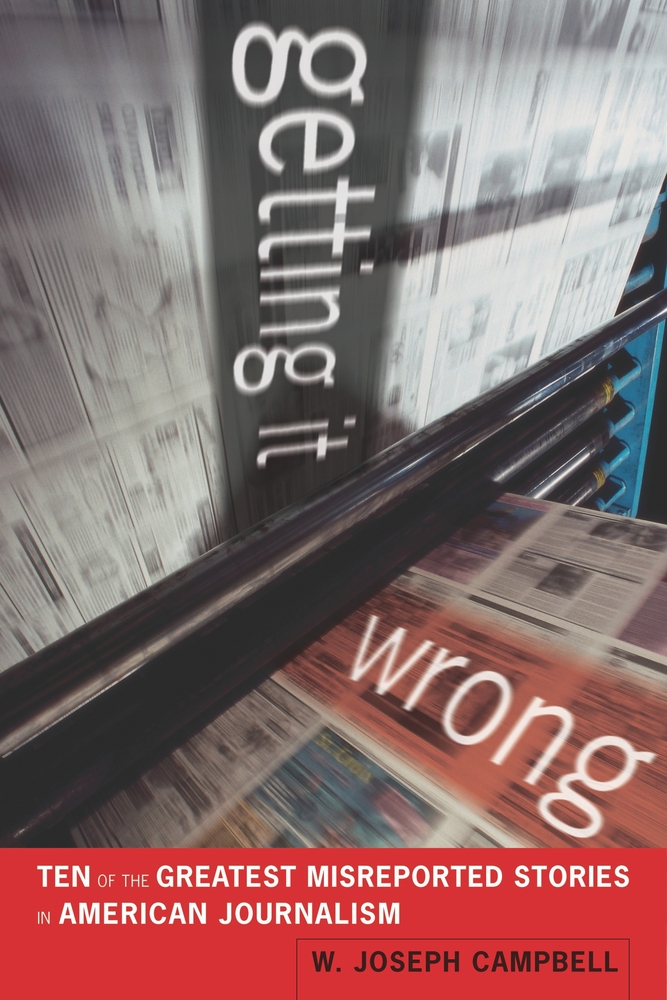
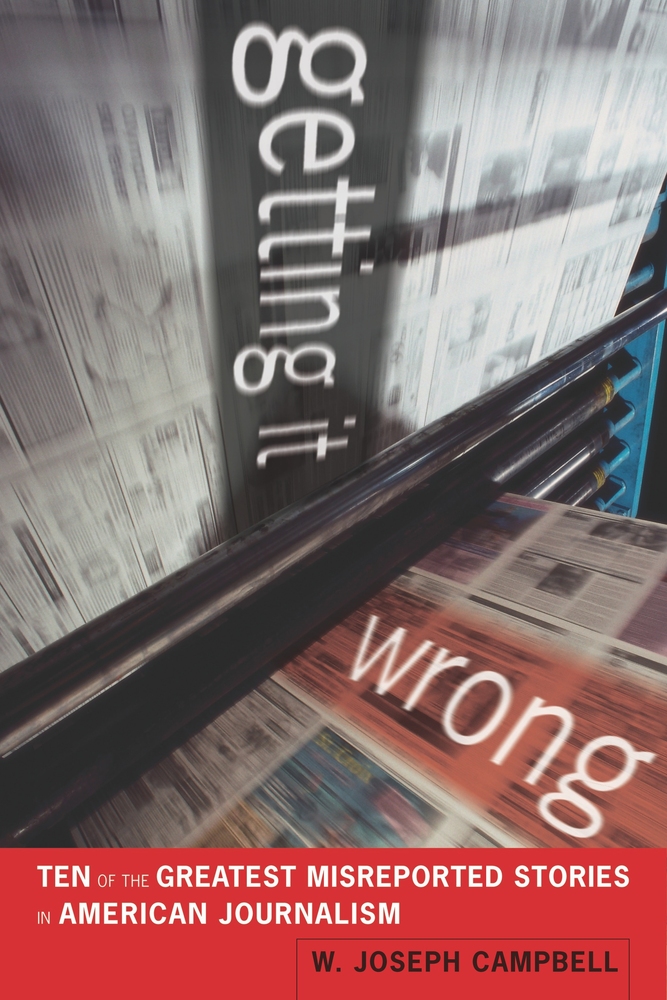
Getting It Wrong: Ten of the Greatest Misreported Stories in American Journalism punctures prominent media-driven myths—false, dubious, and improbable stories about the news media that masquerade as factual.

The 10 tales debunked in Getting It Wrong often ascribe power, significance, and sometimes great courage to the news media and their practitioners. The book dismantles the legend of Edward R. Murrow’s crushing the menace of McCarthyism, of Walter Cronkite’s effectively ending a faraway and unpopular war, and of Bob Woodward and Carl Bernstein’s toppling Richard Nixon’s corrupt presidency.

Those stories, I write, “are compelling and exert an enduring allure; to expose them as exaggerated or untrue is to take aim at the self-importance of American journalism.”

I further write:

“To identify these tales as media myths is to confront the reality that the news media are not the powerful agents they, and many others, assume them to be.”

Indeed, it is quite rare for any news report to trigger a powerful, immediate, and decisive reaction akin to President Lyndon Johnson’s purported woe-is-me response to Cronkite’s televised assessment about Vietnam in 1968: “If I’ve lost Cronkite, I’ve lost Middle America.” (Or words to that effect.)

Researchers long ago dismissed the notion that the news media can create profound and immediate effects, as if absorbing media messages were akin to receiving potent drugs via a hypodermic needle.

Debunking media-driven myths thus enhances the case for modest or limited media effects. Getting It Wrong points out that “too often the ubiquitous presence of the news media is mistaken for power and influence.” Robert J. Samuelson, a columnist who writes on economics issues for Newsweek and the Washington Post, has described this fallacy notably well.

“Because the media are everywhere—and inspire much resentment—their influence is routinely exaggerated,” Samuelson wrote in Newsweek in 2003. “The mistake is in confusing visibility with power, and the media are often complicit in the confusion. We [in the news media] embrace the mythology, because it flatters our self-importance.”

What’s more, the news media nowadays are too diverse and too splintered—into print, broadcast, cable, satellite, and online options—to exert much collective or sustained influence on policymakers and broader audiences.

And as Herbert Gans, a sociologist who has written widely about the news media, once noted:

“If news audiences had to respond to all the news to which they are exposed, they would not have time to live their own lives. In fact, people screen out many things, including news, that could interfere with their own lives.”

That’s for sure. Large numbers of Americans ignore the news altogether: They are beyond media influence in any case. Nearly 20 percent of American adults go newsless on a typical day, according to a study conducted in 2008 by the Pew Research Center for the People & the Press.

The newsless option is particularly striking among young adults, 18-to-24-years-old. Thirty-four percent of that cohort goes newsless, according to Pew Research. (That proportion represents a substantial increase from 1998 when 25 percent of the 18-to-24-year-old cohort shunned the news.)

Media power tends to be modest, nuanced, diffused, and situational. And overstated.

Debunking media-driven myths helps place media influence in a more coherent, more rational context.

WJC

A version of this post first appeared at the University of California Press blog.
Murrow, McCarthy and ‘the guts to say enough is enough’

In Debunking, Media myths, Murrow-McCarthy myth on July 5, 2010 at 3:42 pm

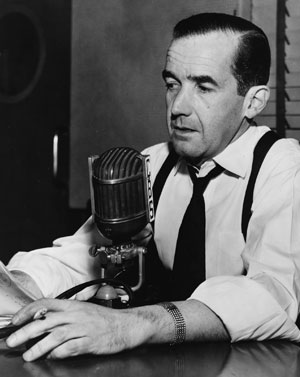
The heroic tale of Edward R. Murrow’s taking on, and supposedly ending, Senator Joseph McCarthy’s communists-in-government witch-hunt is the stuff of legend.

Murrow in 1954

It’s no surprise that the story–so rich and delicious in its assertion of media power–would resurface on the Fourth of July. A guest column yesterday in the Los Angeles Daily News, a regional newspaper in southern California, invoked the tale, stating:

“The 1950s were disgraced by Joseph McCarthy. The senator from Wisconsin bullied hundreds of witnesses with reckless charges of communism until CBS newsman Edward R. Murrow and a patrician lawyer from Boston, Joseph Welch, had the guts to say enough is enough.”

Welch was lead counsel for the Army during the Army-McCarthy hearings in Congress in 1954. In what perhaps was the most dramatic and memorable moment of the hearings, Welch confronted the red-baiting senator, telling him:

“You’ve done enough. Have you no sense of decency, sir? At long last, have you left no sense of decency?”

The hearings were a disaster for the senator, who was censured by the Senate late in 1954 and fell into political eclipse.

There is little doubt, though, that Murrow’s contributions to McCarthy’s decline and fall have been dramatically overstated.

The claim that Murrow and his See It Now program on the senator in March 1954 “ended Joe McCarthy’s reign of terror is,”  I write in my new book, Getting It Wrong, “a compelling story, one of the best-known in American journalism.

“It also is a media-driven myth.”

Interestingly, the media myth took hold despite Murrow’s protestations.

“In the days and weeks after the See It Now program,” I note in Getting It Wrong, “Murrow said he recognized his accomplishments were modest, that at best he had reinforced what others had long said about McCarthy.”

I also write that “the evidence is overwhelming that … Murrow in fact was very late in confronting McCarthy, that he did so only after other journalists had challenged the senator and his tactics for months, even years.”

Notably, the muckraking journalist Drew Pearson had written critically of McCarthy and his reckless charges about communists in government years before Murrow took to the air with his show about McCarthy.

And in September 1951, the New York Post published a bare-knuckled, 17-part series about McCarthy and his ways. The installments of the Post‘s series appeared with the logo “Smear Inc.”

The first article in the series–which is little-remembered in the historiography of the media and McCarthy–said in part:

“McCarthy has raced to the fore with breakneck speed. In the course of his careening, reckless, headlong drive down the road to political power and personal fame, he has smashed the reputations of countless men, destroyed Senate careers, splattered mud on the pages of 20 years of national history, confused and distracted the public mind, bulldozed press and radio.”

That characterization was to echo 2½ years later, on Murrow’s See It Now program about McCarthy.

So, no, it’s not accurate to say Murrow had “the guts to say enough is enough” about McCarthy.

By March 1954, taking on McCarthy hardly was a gutsy thing to do.

WJC

Related:

Seeking antidotes to journalism’s ‘junk food’

In Bra-burning, Debunking, Furnish the war, Jessica Lynch, Media myths, Murrow-McCarthy myth on July 2, 2010 at 12:31 am

Media-driven myths—those false, dubious yet prominent stories about the news media that masquerade as factual—can be thought of as the junk food of journalism. They’re alluring and delicious, but neither especially wholesome nor healthy.

As I note in Getting It Wrong, media-driven myths can spring from many sources. War is an especially fertile breeding ground for media myths, partly because the shock of combat is alien and unfamiliar to most people. Given their limited first-hand experience with war, media audiences generally are in no position to challenge reports from the battlefield.

“The confusion and intensity inherent in warfare can lead journalists to place fragmented information that emerges from conflict into recognizable if sometimes misleading frames,” I write.

An example of that came early in the Iraq War in 2003, with the Washington Post’s erroneous report about the battlefield heroics of Jessica Lynch, a topic discussed in Getting It Wrong. The Post’s characterization of Lynch as a female Rambo, pouring lead into attacking Iraqis, did not seem entirely implausible. It was, after all, a story picked up by news organizations around the world.

Hurried and sloppy reporting, which certainly figured in the sensational report about Lynch, also contributes to the rise to media myths. The myth of “crack babies” of the late 1980s and 1990s was certainly propelled by hurried reporting, by over-eager journalism and by premature medical findings.

Reporters and columnists pushed too eagerly on preliminary and inconclusive research about children born to women who took crack cocaine during pregnancy. The horrors that many journalists predicted—that “crack babies” would grow up to be a vast, permanently dependent class, a so-called “bio-underclass” of staggering dimension—proved quite wrong.

So are there antidotes to media-driven myths?

I argue in Getting It Wrong that while “they spring from multiple sources, it is not as if media-driven myths are beyond being tamed.”

To slow or thwart the spread of media myths, journalists might start by applying a measure of skepticism to pithy, telling quotes such as William Randolph Hearst’s vow to “furnish the war” with Spain at the end of the 19th century.

Turns of phrase that sound too neat and too tidy often are too good to be true.

Journalists also would do well to cultivate greater recognition of their fallibility. Too often they seem faintly concerned with correcting the record they tarnish. They tend not to like revisiting major flaws and errors. As Jack Shafer, media critic for the online magazine Slate, has written:

“The rotten truth is that media organizations are better at correcting trivial errors of fact—proper spellings of last names, for example—than they are at fixing a botched story.”

Not surprisingly, there was no sustained effort by the news media to set straight the record about the chimerical scourge of “crack babies.” Not surprisingly, there was little sustained effort to explore and explain the distorted and badly flawed reporting from New Orleans in 2005, in the aftermath of Hurricane Katrina’s landfall.

Encouraging a culture of skepticism and tolerance for viewpoint diversity in American newsrooms also would help curb the rise and dissemination of media-driven myths. Newsrooms can seem like bastions of group-think. Michael Kelly, the former editor of National Journal and the Atlantic once observed:

“Reporters like to picture themselves as independent thinkers. In truth, with the exception of 13-year-old girls, there is no social subspecies more slavish to fashion, more terrified of originality and more devoted to group-think.”

Group-think and viewpoint diversity are not topics often discussed in American newsrooms. But they’re hardly irrelevant. It is not inconceivable that a robust newsroom culture that embraces encourages skepticism, invites challenges to dominant narratives, and rewards contrarian thinking would have helped thwart publication of embarrassingly mistaken tales such as the Post’s account about Jessica Lynch.

Another antidote to media-driven myths is offered by the digitization of newspapers and other media content.

Digitization has made it easier than ever to consult and scrutinize source material from the past. Never has journalism’s record been more readily accessible, through such databases as ProQuest and LexisNexis.

Reading what was written makes it clear that radio dramatization of the War of the Worlds in 1938 created nothing approaching nationwide panic and hysteria. Reading what was written makes clear that Edward R. Murrow’s televised critique of Senator Joseph McCarthy in 1954 was belated and quite unremarkable.

Reading what was written can be a straightforward and effective antidote to media-driven myths.

WJC

A version of this post first appeared at the University of California Press blog.
‘Getting It Wrong’ goes Majic

In Bay of Pigs, Bra-burning, Debunking, Furnish the war, Jessica Lynch, Media myths, Media myths and radio, New York Times, War of the Worlds, Washington Post, Watergate myth on July 1, 2010 at 11:34 am

I did an engaging and entertaining in-studio interview yesterday on the Lanigan & Malone show, one of the most popular radio programs in Cleveland, the gritty city where I cut my teeth, journalistically, years ago.

On the air with Lanigan (center) and Malone

The show airs on WMJI, Majic 105.7 FM, and I spoke with hosts John Lanigan and Jimmy Malone about several media-driven myths addressed and debunked in my new book, Getting It Wrong.

They included the case of Jessica Lynch, the waiflike Army private whom the Washington Post elevated to hero status in a sensational but utterly erroneous report early in the Iraq War in 2003.

The Post depicted Lynch as having “fought fiercely” in the Iraqi ambush at Nasiriyah of the Army’s 507th Maintenance Company. The newspaper said Lynch had “shot several enemy soldiers” and kept “firing her weapon until she ran out of ammunition.”

Walters

The Lynch case, I said during the Lanigan & Malone interview, appears to have centered around a case of mistaken identity. It wasn’t Lynch who had fought heroically at Nasiriyah. It was most likely Donald Walters, a cook-sergeant in Lynch’s unit who, after running out of ammunition, was captured by Iraqi irregulars and executed.

I pointed out during the interview how war and conflict can readily give rise to myth and misunderstanding. Indeed, half the chapters in Getting It Wrong are related to warfare, including the book’s first chapter, the myth of William Randolph Hearst’s infamous vow to “furnish the war” with Spain.

We moved on to discuss the myth that widespread panic and mass hysteria characterized the reactions to the 1938 radio dramatization of The War of the Worlds, then jumped to a discussion of the myth of superlative reporting of Hurricane Katrina’s aftermath in September 2005, and considered at some length about what I call the “nuanced myth” of bra-burning.

“Bra-smoldering,” I said, would be a more accurate characterization of what happened during the women’s liberation protest at Atlantic City in September 1968. My research shows that bras and other items were set afire, if briefly, during the demonstration against that year’s Miss America pageant.

“All these are ruined,” Lanigan said at one point about the myths debunked in Getting It Wrong.

We also discussed the Bay of Pigs-New York Times suppression myth. That myth centers around a telephone call President John F. Kennedy supposedly placed to the Times publisher or top editors in April 1961, asking that the newspaper hold off on reporting about the pending CIA-supported invasion of Cuba.

There is no evidence, I said, that Kennedy ever placed such a call. (Or even had time to place such a call.)

What appears to have happened is that the Bay of Pigs-suppression myth has become confounded with the 1962 Cuban missile crisis, during which Kennedy did call the Times to request a delay on a report about nuclear-tipped missiles the Soviets had deployed on the island.

As the interview wrapped up, Lanigan said he’s “sure there will be another” volume, a sequel, to Getting It Wrong.

“It’s a good book,” he said afterward. “I’m glad he did it.”

WJC

Related:

Discussing ‘Getting It Wrong’ with AU alums

In Cinematic treatments, Cronkite Moment, Debunking, Media myths, Media myths and radio, War of the Worlds, Washington Post, Watergate myth on June 30, 2010 at 10:35 pm

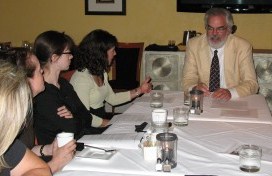
I met in Cleveland’s Little Italy neighborhood last night with a terrific group of American University alumni, at a program that featured a discussion of Getting It Wrong, my new book about media-driven myths.

With AU alums in Cleveland

The gathering was the second of the Cleveland area alumni chapter, which is ably led by Neil T. Young, Anthony Vacanti, and Antoinette Bacon. I was privileged to talk with the group about the book, which addresses and debunks 10 prominent media myths–those false, dubious, improbable stories about the news media that masquerade as factual.

We met at Michaelangelo’s, a fine Italian restaurant where the service is superb. Our discussion about Getting It Wrong was conducted seminar style and featured my fairly lengthy review of the heroic-journalist myth of Watergate–the notion that the intrepid investigative reporting by the Washington Post brought down Richard Nixon’s corrupt presidency.

I described how the book All the President’s Men and the cinematic version by the same title helped solidify the notion that the Post and its reporters Bob Woodward and Carl Bernstein were central to unraveling the Watergate scandal.

The book and the movie have had the effect of focusing on the Post reporters while ignoring or overlooking the far more significant contributions of federal prosecutors, federal judges, bipartisan congressional panels, and ultimately the U.S. Supreme Court in identifying Nixon’s efforts to obstruct justice in the scandal.

“Against that backdrop,” I said, “the news media were decidedly modest factors” in Watergate’s outcome.

Orson Welles

We also discussed the War of the Worlds myth–that Orson Welles’ 1938 radio dramatization of an invasion from Mars was so realistic that tens of thousands of Americans were convulsed in panic and fled their homes in hysteria. The program was imaginative entertainment–and was recognized as such by listeners in overwhelming numbers, I pointed out.

In addition, we talked about the so-called “Cronkite Moment” of February 1968, when CBS anchorman Walter Cronkite offered a downbeat analysis of the U.S. war effort in Vietnam, saying the military was “mired in stalemate.”

Supposedly, Cronkite’s assessment came as an epiphany to President Lyndon Johnson who, it is said, snapped off the television set upon hearing the anchorman’s “mired in stalemate” characterization and said, “If I’ve lost Cronkite, I’ve lost Middle America.”

Or words to that effect.

In reality, I pointed out, the president wasn’t in front of a television set that night.

He was in Austin, Texas, at the 51st birthday party of Governor John Connally. And even if Johnson had seen the Cronkite report on videotape, the anchorman’s assessment really was no epiphany, because the president in the days and weeks immediately afterward hewed to a hawkish line on Vietnam.

Questions from the alums were quite thoughtful. Among them was a query about the common threads may be found in the myths debunked in Getting It Wrong.

A thoughtful and perceptive question, that.

And indeed there are some shared characteristics of media myths.

Many myths are reductive, in that they offer simplistic explanations for complex historical events. That factor certainly helps explains the tenacity of the heroic-journalist myth of Watergate and the “Cronkite Moment.” It is far easier to characterize the news media as prime movers in the outcomes of Watergate and Vietnam than it is to grapple with the complexities and nuances of those landmark events, I said.

Additionally, media myths tend to be delicious stories–stories almost too good to be disbelieved. And that certainly holds for Watergate, the “Cronkite Moment,” and the War of the Worlds dramatization.

And media myths tend to be ways to assert the notion that the news media are powerful and influential forces in American society.

But as I write in Getting It Wrong, media power “tends to be modest, nuanced, diffused, and situational” and altogether “too often the ubiquitous presence of the news media is mistaken for power and influence.”

Moreover, I write, “The American media these days are far too splintered and diverse—print, broadcast, cable, satellite, online—to exert much in the way of collective and sustained influence on policymakers or media audiences.”

WJC

Related:

‘Junk food of jornalismo’: Diário writes up ‘Getting It Wrong’

In Bay of Pigs, Cronkite Moment, Debunking, Furnish the war, Media myths, Media myths and radio, Murrow-McCarthy myth, Reviews, Watergate myth on June 28, 2010 at 2:49 pm

Today’s edition of the venerable  Portuguese newspaper Diário de Notícias includes a write up about Getting It Wrong, my new book about prominent media-driven myths–those false, dubious, improbable stories about the news media that masquerade as factual.

With the help of the online translation site Babelfish, I was able to make out a good deal of the Diário review, which says in part:

“W. Joseph Campbell in Getting it Wrong: Ten of the Greatest Misreported Stories in American Journalism, published the University of California Press, [says] these ‘myths can be thought as junk food of jornalismo.'”

The Diário article mentions several media myths addressed and debunked in Getting It Wrong, including those of William Randolph Hearst’s purported vow to “furnish the war” with Spain; the 1938 radio dramatization of the War of the Worlds which supposedly sowed panic across the United States; the notion that Edward R. Murrow’s 1954 See It Now television program abruptly halted Senator Joseph McCarthy’s communists-in-government witch-hunt, and the myth that the New York Times suppressed its coverage of the run-up to the Bay of Pigs invasion in 1961.

Diário characterizes as one of the book’s “more concrete” examples “the Watergate case,” in which reporters for the Washington Post are credited with having toppled the corrupt presidency of Richard Nixon.

Media myths, the articles notes, are not innocuous; ” they can distort the perception of the power and function of jornalismo” because “they tend to give the media” more power and influence than they rightly deserve. It also says that myths can “minimize the complexity of the historical events for simplistic interpretations.” Both of those are important points raised in Getting It Wrong.

The review closes by taking up the suggestion I offer in the conclusion of Getting It Wrong, namely that there are more media myths to debunk.

“By no means do the media myths examined on these pages represent a closed universe,” I write in the book’s closing passage. “Others surely will assert themselves. They may tell of great deeds by journalists, or of their woeful failings. They may well hold appeal across the political spectrum, offering something for almost everyone. They may be about war, or politics, or biomedical research.

“Predictably, they will be delicious tales, easy to remember, and perhaps immodest and self-congratulatory. They probably will offer vastly simplified accounts of history, and may be propelled by cinematic treatment.  They will be media-driven myths, all rich candidates for debunking.”

WJC

Related:

‘Getting It Wrong’ on the road in Oberlin, OH

In Cronkite Moment, Debunking, Furnish the war, Media myths, Murrow-McCarthy myth, Spanish-American War, War of the Worlds, Watergate myth, Yellow Journalism on June 27, 2010 at 8:40 am

I gave a talk yesterday about Getting It Wrong to an engaging audience at the college bookstore in Oberlin, Ohio.

The talk was facilitated quite well by Kira McGirr, the bookstore’s tradebook manager, and covered such topics as William Randolph Hearst’s purported vow to “furnish the war” with Spain at the end of the 19th century, the myth of the “Cronkite Moment” of February 1968, and the heroic-journalist myth of Watergate.

We also discussed the media-driven myth of “crack babies” and the famous 1938 radio dramatization of The War of the Worlds, which supposedly was so dramatic that tens of thousands of Americans were seized by panic and mass hysteria.

One of Kira’s questions was how long it may take before the myths discussed and debunked in Getting It Wrong to be excised from history books. It’s a very good question, and difficult to say for sure.

I responded by saying some of the myths–such as those of Watergate and the War of the Worldsare so appealing, delicious, and ingrained that they may never be totally uprooted.

The same probably goes for Hearst’s purported vow: That anecdote has been around since 1901 and likely is too appealing ever to be utterly debunked. What’s more, the “furnish the war” tale is a neat, tidy, reductive way of explaining the causes of the Spanish-American War:  Hearst, the war-mongering publisher, is to blame.

It’s far easier to blame Hearst than it is to grapple with the complexities of the diplomatic demarche in 1897-98 that failed to resolve differences among Spain, Cuba, and the United States: Failed diplomacy, not the contents of Hearst’s yellow press, led to the Spanish-American War.

We also discussed how high-quality cinematic treatments can press media myths into the public consciousness.

That certainly was the case with All the President’s Men, the most-viewed movie about Watergate, in which Robert Redford and Dustin Hoffman played the starring roles of Washington Post reporters Bob Woodward and Carl Bernstein.

The film depicted the reporters as central, indeed crucial, to cracking the Watergate scandal, I noted. For many Americans,  All the President’s Men is an important way of learning about Watergate. As I write in Getting It Wrong: “More than thirty-five years later, what remains most vivid, memorable, and accessible about Watergate is the cinematic version of All the President’s Men.”

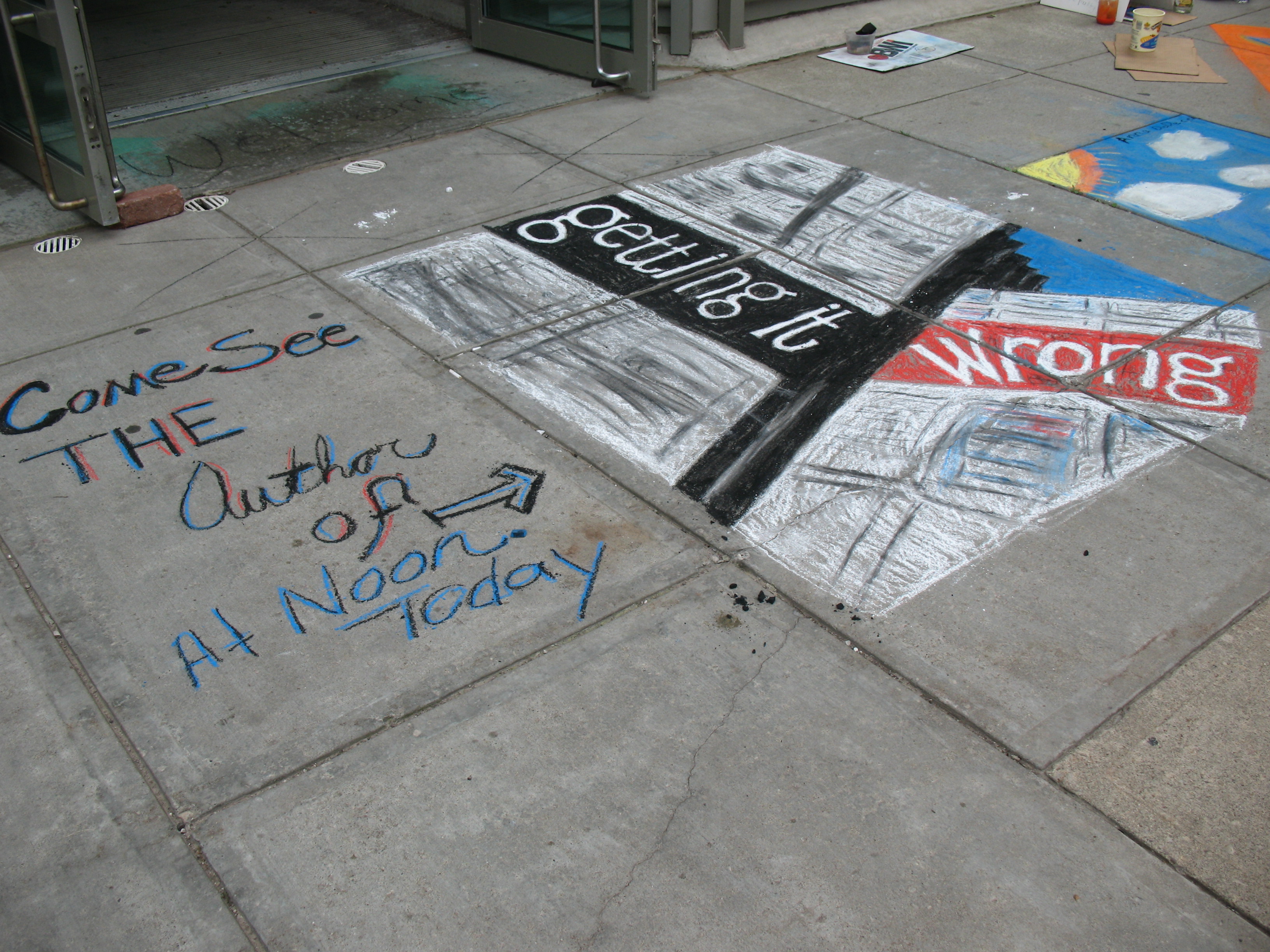
The book talk coincided with Oberlin’s fifth annual Chalk Walk event, at which artists and aspiring artists draw often-elaborate pastel images on the sidewalks in the heart of town.

One of Kira’s colleagues, Amanda Turner, drew a fine rendering of the cover of Getting It Wrong at the entrance to the bookstore (see photo).

Amanda, Kira, and I posed for the photo below.
Several former classmates of mine at Oberlin Firelands High School (class of 1970) also attended the book talk.

WJC

Related:

Photo credit: Ann-Marie C. Regan (Chalk Walk images)

Welcome perspective on the ‘Cronkite moment’

In Cronkite Moment, Debunking, Media myths on June 26, 2010 at 7:37 am

A blog post yesterday at the Atlantic Free Press offered some unusual–and refreshing–perspective about the so-called “Cronkite Moment” of 1968, when CBS anchorman Walter Cronkite declared the U.S. military was “mired in stalemate” in Vietnam.

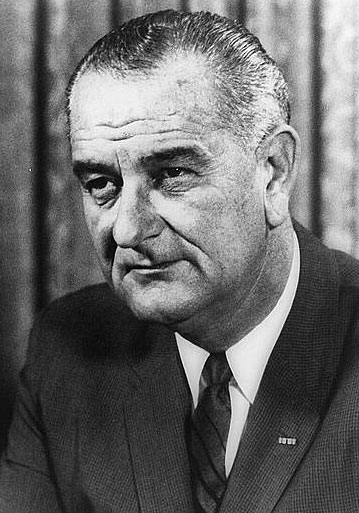
Johnson

The tenacious media-driven myth surrounding the “Cronkite Moment” has it that the anchorman’s insight was so powerful and so incisive that public opinion promptly swung against the war and President Lyndon Johnson immediately realized his war policy was doomed.

As has been discussed often at Media Myth Alert, neither of those characterizations is accurate. Months before Cronkite’s pronouncement, U.S. public opinion began to turn against the war. And Johnson did not watch Cronkite’s program when it aired on February 27, 1968. At that time, the president was in Austin, Texas,  at the 51st birthday party of Governor John Connally.

As I write in Getting It Wrong, my new book about media-driven myths, the power of the so-called “Cronkite moment”  lies “in the sudden, unexpected, and decisive effect it supposedly had on the president. Such an effect would have been absent, or greatly diminished, had Johnson had seen the program on videotape at some later date.”

Indeed, the power of the anecdote would have been diluted severely.

As I say, the Atlantic Free Press post offered perspective about the “Cronkite Moment” that is seldom encountered in the news media, traditional or online.

The post said that “words like ‘stymied’ and ‘stalemate’ are often applied to the Afghanistan war. But that hardly means the U.S. military is anywhere near withdrawal.

“Walter Cronkite used the word ‘stalemate’ in his famous February 1968 declaration to CBS viewers that the Vietnam War couldn’t be won. ‘We have been too often disappointed by the optimism of the American leaders both in Vietnam and Washington to have faith any longer in the silver linings they find in the darkest clouds,’ he said. And: ‘It seems now more certain than ever that the bloody experience of Vietnam is to end in a stalemate.’

“Yet the U.S. war on Vietnam continued for another five years, inflicting more unspeakable horrors on a vast scale.”
It is rarely noted in discussions of the “Cronkite Moment” that U.S. combat troops were not completely withdrawn from Vietnam until 1973–despite the claim by David Halbertstam in The Powers That Be that Cronkite’s program represented “the first time in American history a war had been declared over by an anchorman.”
That’s just not so. Not at all.

WJC

Related:

Media myths and their spinoffs: The case of Watergate

In Debunking, Media myths, Washington Post, Watergate myth on June 23, 2010 at 3:53 pm

Prominent media-driven myths, the subject of my new book, Getting It Wrong, can be self-sustaining: That is, they can and do give rise to subsidiary media myths.

The heroic-journalist myth of Watergate is a notable example of this tendency. It has given rise to particularly tenacious, though appealing, subsidiary myth.

The  heroic-journalist myth has it that the intrepid investigative reporting of Bob Woodward and Carl Bernstein of the Washington Post brought down Richard Nixon’s corrupt presidency in the Watergate scandal.

Nixon resigns, 1974

As I write in Getting It Wrong:

“The heroic-journalist has become the most familiar storyline of Watergate—ready short-hand for understanding Watergate and its denouement, a proxy for grasping the scandal’s essence while avoiding its forbidding complexity. How the Post and its reporters uncovered Watergate is deeply ingrained in American journalism as one of the field’s most important and self-reverential stories.”

Except that it’s exaggerated.

“The heroic-journalist interpretation” of Watergate, I write in Getting It Wrong, “minimizes the far more decisive forces that unraveled the scandal and forced Nixon from office.” Those forces were typically subpoena-wielding and including federal prosecutors, the FBI, bipartisan Congressional committees, and ultimately the U.S. Supreme Court.

In the end, the contributions of the Washington Post to the scandal’s outcome were modest, and certainly not decisive. Over the years, principals at the Post have emphasized as much. For example, Katharine Graham, the newspaper’s doughty publisher, insisted the Post did not topple Nixon.

“Sometimes people accuse us of bringing down a president, which of course we didn’t do,” Graham said in 1997, at a program in Washington marking the scandal’s twenty-fifth anniversary. “The processes that caused [Nixon’s] resignation were constitutional,” she said.

In earthier terms, Woodward has concurred, telling American Journalism Review in 2004:

“To say that the press brought down Nixon, that’s horseshit.”

Nonetheless, the heroic-journalist myth lives on. It’s a robust myth, little-restrained in its reach and infiltration, and highly resistant to debunking. It is retold in textbooks, in classrooms, in newsrooms.

And it has spun off a durable subsidiary myth, one that revolves around the hoopla associated with Woodward and Bernstein: Their book about their reporting, All the President’s Men, was a best-seller. Its cinematic version was a box office success and, quite likely, is the most-viewed film ever about Watergate.

The book and the movie made journalism seem sexy, and caused enrollments at college and university journalism programs to soar.

Supposedly.

As I write in Getting It Wrong, “there is no evidence to support the notion that enrollments in journalism programs surged because of Woodward, Bernstein … and All the President’s Men. The subsidiary myth lives on despite its thorough repudiation in scholarly research.”

A study financed by the Freedom Forum media foundation and released in 1995 reported that “growth in journalism education result[ed] not from specific events as Watergate … but rather to a larger extent from the appeal of the field to women, who ha[d] been attending universities in record numbers. The growth also in part reflect[ed] the applied nature of the field and its link to specific job skills.”

Seven years earlier, Maxwell E. McCombs reported in the Gannett Center Journal that “the boom in journalism education was underway at least five years before” the Watergate scandal broke in 1972.

McCombs, a veteran mass communication scholar, further wrote:

“It is frequently, and wrongly, asserted that the investigative reporting of Woodward and Bernstein provided popular role models for students, and led to a boom in journalism school enrollments. The data … reveal, however, that enrollments already had doubled between 1967 and 1972….”

Despite such solid scholarly research, the subsidiary myth lives on.

It’s a neat and tidy tale, the notion that the exploits of Woodward and Bernstein were a profound stimulus to enrollments in collegiate journalism programs. Like many other media myths, it’s a tale almost too good not to be true.

WJC

A version of this post first appeared at the University of California Press blog.

LBJ’s ‘Vietnam epiphany’ wasn’t Cronkite’s show

In Cronkite Moment, Debunking, Media myths on June 22, 2010 at 12:28 pm

The irresistible “Cronkite Moment” emerged again the other day, this time in a column in a Michigan newspaper claiming that “President Lyndon Baines Johnson had his Vietnam epiphany when he lost Walter Cronkite.”

The “Cronkite Moment” was a broadcast in February 1968 that supposedly was so potent  that it had the effect of prompting Johnson to realize the hopelessness of his war policy in Vietnam.

The story goes that Johnson at the White House watched Cronkite’s special report on Vietnam and, after hearing the anchorman say the U.S. military was “mired in stalemate” and might consider a negotiated settlement, snapped off the television set and exclaimed:

“If I’ve lost Cronkite, I’ve lost Middle America.”

Or words to that effect.

As is described in Getting It Wrong, my new book about media-driven myths, versions vary as to what the president supposedly said.

Getting It Wrong also points out that Johnson did not see the Cronkite program when it aired. The president at the time was in Austin, Texas, making light-hearted comments at the 51st birthday party of Governor John Connally.

As I write in Getting It Wrong, “Even if he later heard—or heard about— Cronkite’s assessment, it was no epiphany for Johnson. Not long after the program, Johnson gave a rousing, lectern-pounding speech in which he urged a ‘total national effort’ to win the war in Vietnam.”

Thus in the days and weeks immediately after the Cronkite program, Johnson remained hawkish on the war.

Johnson’s “epiphany,” as it were, came not in front of a television set in late February 1968 but in discussions a month later with informal advisers at the White House.

As I write in Getting It Wrong, “Johnson’s change of heart on Vietnam came about through a complex process in which Cronkite’s views counted for little. Among the forces and factors that influenced Johnson’s thinking … was the counsel of an influential and informal coterie of outside advisers known as the ‘Wise Men.’

“They included such foreign policy notables as Dean Acheson, a former secretary of state; McGeorge Bundy, a former National security adviser to Kennedy and Johnson; George Ball, a former under-secretary of state; Douglas Dillon, a former treasury secretary; General Omar Bradley, a former chairman of the joint chiefs of staff, and Abe Fortas, a U.S. Supreme Court justice and friend of Johnson.

“The ‘Wise Men’ had met in November 1967, and expressed their near-unanimous support for Johnson’s Vietnam policy. They met again, at the request of the White House, in late March 1968.”

Largely, though not unanimously, the “Wise Men,” expressed opposition to escalating the war in Vietnam.

“The theme that ran around the table was, ‘You’ve got to lower your sights,’” George Ball later recalled.

Johnson, he said, “was shaken by this kind of advice from people in whose judgment he necessarily had some confidence, because they’d had a lot of experience.”

The counsel of the Wise Men represented a tipping point in Johnson’s deciding to seek “peace through negotiations.” In a speech March 31, 1968, the president announced a limited halt to U.S. aerial bombing of North Vietnam as an inducement to the communist government in Hanoi to enter peace talks.

Johnson closed his speech with the stunning announcement that he would not seek reelection to the presidency.

WJC

Related:

<!–[if !mso]> .[i] In a nationally televised speech on March 31, Johnson announced that he had decided to seek “peace through negotiations.” He ordered a limited halt to U.S. aerial bombing of North Vietnam as an inducement to the Hanoi government to enter peace talks. Johnson closed the speech with the stunning announcement that he would not seek reelection to the presidency


[i] George C. Herring, LBJ and Vietnam: A Different Kind of War (Austin: University of Texas Press, 1994), 163.