W. Joseph Campbell

Archive for the ‘Jessica Lynch’ Category

Jessica Lynch returns to spotlight in unedifying Bio interview

In Debunking, Jessica Lynch, Media myths, Washington Post on August 24, 2010 at 12:41 am

Jessica Lynch returned to the national spotlight last night in a tedious and unedifying television interview that not once mentioned the Washington Post and its erroneous report that thrust her into unsought and largely undeserved fame early in the Iraq War.

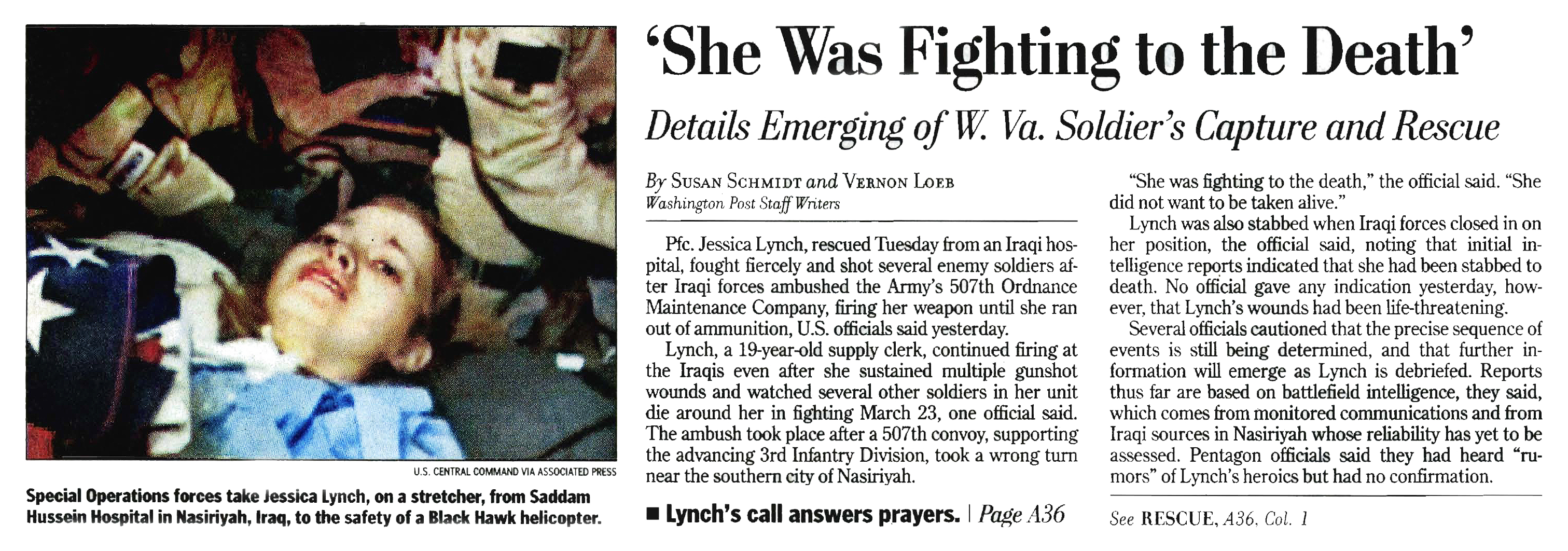
Lynch, an Army supply clerk taken prisoner after her unit was ambushed at Nasiriyah in March 2003, was said by the Post in a sensational front-page account that to have fiercely battled her Iraqi attackers.

That Post‘s report–published April 3, 2003, beneath the headline “‘She Was Fighting to the Death'”–made her the single best-known Army private of the war.

Lynch, then 19, was rescued by U.S. special forces after nine days in captivity at an Iraqi hospital.

She was interviewed by William Shatner, the actor of Star Trek fame, on the Bio channel’s Aftermath show, which  seeks to catch up on people who once had been famous, or notorious.

Probing, Shatner proved not to be.

He was sappy, patronizing, and wholly uninterested in the derivation of the erroneous but electrifying story of Lynch’s battlefield heroics.

Shatner referred vaguely to the “machinery of publicity” and the “stage-managed media frenzy,” clearly suggesting–but not explicitly stating–that the Pentagon had concocted the hero-warrior story.

Astonishingly, neither Shatner nor Lynch spoke specifically about the Washington Post report that was solely responsible for placing her name and supposed heroics into the public domain.

The Post said in its hero-warrior story that Lynch had been shot and stabbed by attacking Iraqis, but had kept “firing her weapon until she ran out of ammunition.”

It was stunning detail, but none of it was true.

Lynch never fired a shot at Nasiriyah. She suffered severe injuries not from gunfire, but from the crash of the Humvee in which she tried to flee the ambush.

The Aftermath interview made no mention of the account offered by Vernon Loeb, a reporter who shared a byline on the hero-warrior story about Lynch. Loeb, in an interview with NPR’s Fresh Air program late in late 2003, made clear the Pentagon was not the source for the erroneous story about Lynch.

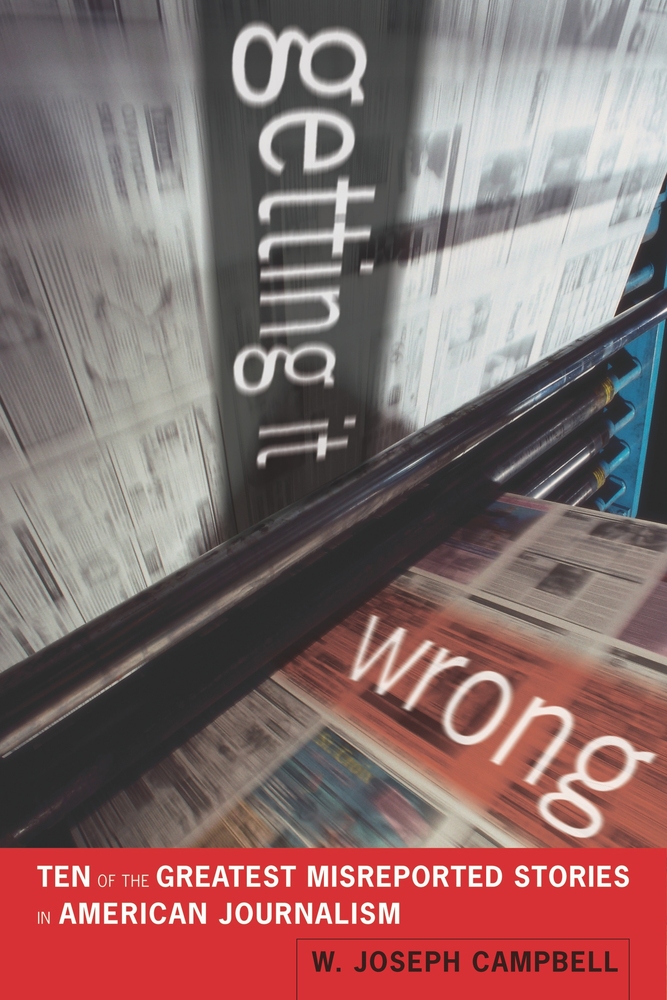
In the Fresh Air interview–which I cite in Getting It Wrong, my new book debunking prominent media-driven myths–Loeb said of U.S. military officials:

“They wouldn’t say anything about Jessica Lynch.”

He added:

“I just didn’t see the Pentagon trying to create a hero where there was none. I mean …they never showed any interest in doing that, to me.”

On another occasion, Loeb was quoted in the New York Times as saying:

“Far from promoting stories about Lynch, the military didn’t like the story.”

While he did not identify the Post’s sources for the hero-warrior story about Lynch, Loeb characterized them as “U.S. officials” who were “really good intelligence sources” in Washington, where he was based.

But more than seven years later, the identity of the Post‘s sources on the hero-warrior story remain unclear.

Lynch, who remained fairly poised throughout the hour-long Aftermath interview, said at one point “it would have been easy for me” to have adopted the hero’s mantle and embraced the Post‘s report about her supposed derring-do.

But in reality, doing so would have been untenable.

As I note in Getting It Wrong, the colonel commanding the Army hospital at Landstuhl, Germany, where Lynch was treated after her rescue, told journalists the day after the Post published its hero-warrior story that Lynch had been neither shot nor stabbed.

He thus undercut a crucial element of the hero-warrior narrative.

And as I write in Getting It Wrong:

“If the military was complicit in fabricating the Lynch saga, it defies logic to believe that it would permit one of its own, an Army colonel, to impugn that narrative just as it had begun circulating around the world.”

WJC

Related:

Lynch heroics ‘ginned up by Bush-era Pentagon’?

In Debunking, Jessica Lynch, Media myths, Washington Post on August 17, 2010 at 4:44 pm

Private Lynch

The Huffington Post today reviews the new movie about Pat Tillman, the pro football player turned Army Ranger who was killed in Afghanistan in 2004. The review also takes a swipe at the Pentagon for supposedly concocting a hero-warrior story around 19-year-old Army private Jessica Lynch in the early days of the Iraq War.

The review says that Lynch’s “combat actions, as ginned up by the Bush-era Pentagon, did not square with reality.”

Well, frankly, that observation doesn’t quite “square with reality.”

I discuss the myths that have been spun off from the Lynch case in my new book Getting It Wrong, noting that the Pentagon wasn’t the source for the erroneous account of Lynch’s battlefield heroics.

The Washington Post thrust that account into the public domain in a sensational, front-page report on April 3, 2003.

The Post‘s story described how Lynch, despite being shot and stabbed, fiercely fought Iraqi attackers in an ambush at Nasiriyah. The electrifying report appeared beneath the headline:

“‘She was fighting to the death.’”

And the story was picked up around the world. But it was wrong, badly wrong.

Lynch never fired a shot in the fighting at Nasiriyah. She suffered neither gunshot nor stab wounds; her injuries were severe, and came in the crash of a Humvee fleeing the ambush.

The Post‘s article was based on sources identified only as “U.S. officials.” The article said that “Pentagon officials … had heard ‘rumors’ of Lynch’s heroics but had no confirmation” to offer.

As I note in Getting It Wrong, one of the Post reporters on the story said on at least two occasions that the Pentagon was not the source for the Lynch story.

The reporter, Vernon Loeb, who has since moved on to the Philadelphia Inquirer, told the NPR Fresh Air program in December 2003 that he “could never get anybody from the Pentagon to talk about those reports [of Lynch’s supposed heroics] at all.”

He added that the Pentagon “was completely unwilling to comment on those reports at all.

“They wouldn’t say anything about Jessica Lynch.”

As denials and knock-downs go, that one is pretty solid. And unequivocal.

A few months earlier, Loeb was quoted in an op-ed article in the New York Times as saying: “Far from promoting stories about Lynch, the military didn’t like the story.”

As I also note in Getting It Wrong, the Pentagon’s then-spokeswoman, Victoria Clarke, told the Associated Press in June 2003: “We were downplaying [the Lynch story]. We weren’t hyping it.”

Even in the face of such denials, the notion the Pentagon concocted a phony hero-warrior story about Lynch has become the dominant narrative–one repeated blithely and often.

Interestingly, those pushing the Pentagon-made-it-up meme never seem to explain just how the veteran Post reporters on the Lynch story were so easily and thoroughly duped.

Loeb shared the byline on the story with Susan Schmidt, who later won a Pulitzer Prize for investigative reporting. Among those contributing to the story was Dana Priest, who also has won a Pulitzer.

And if the Pentagon had “ginned up” the hero-warrior story about Lynch, “it failed miserably in keeping the ruse from unraveling, ” I write in Getting It Wrong.

The day after the Post‘s “‘fighting to the death'” article appeared, the head of the Army hospital at Landstuhl, Germany, told reporters that Lynch had been neither shot nor stabbed–undercutting crucial elements of the hero-warrior tale.

WJC

Related:

<!–[if !mso]> the article that their information about Lynch and her heroics was from “U.S. officials” with access to what the reporters called “battlefield intelligence” compiled from “monitored communications and from Iraqi sources in Nasiriyah whose reliability has yet to be assessed.” The article said that “Pentagon officials … had heard ‘rumors’ of Lynch’s heroics but had no confirmation” to offer.[i]


[i] Schmidt and Loeb, “‘She Was Fighting to the Death,’” Washington Post.

Ignoring the astonishing reporting lapses in Lynch case

In Debunking, Jessica Lynch, Media myths on August 15, 2010 at 9:09 am

It’s astonishing, and a bit dismaying, how readily the Jessica Lynch case is cited as an example as a hoax perpetuated by the Pentagon. And how readily the Washington Post‘s central role in promoting the case is overlooked and ignored.

Lynch was the waiflike, 19-year-old Army private whom the Washington Post, in its erroneous reporting, catapulted into sudden and undeserved international fame in April 2003, during the first days of the Gulf War.

As I discuss in Getting It Wrong, my new book debunking prominent media-driven myths, the Post published a sensational, front-page report on April 3, 2003, that  said Lynch had fought with Rambo-like ferocity in an ambush at Nasiriyah in southern Iraq.

Washington Post, April 3, 2003

The Post said Lynch had “shot several enemy soldiers,” had herself been shot and stabbed, but had kept “firing her weapon until she ran out of ammunition.”

The article quoted a U.S. official as saying, anonymously:

“‘She was fighting to the death. She did not want to be taken alive.’”

“It was an electrifying account,” I write, one picked up by news outlets across the United States and around the world.

Only it wasn’t true.

Lynch didn’t fire a shot in the ambush.

She was badly injured not from gunshots and stabbings but from the crash of the Humvee fleeing the attack.

In the years since, the narrative of the Lynch case has shifted. The Post‘s role in injecting the story into the public domain has been largely forgotten–even though the newspaper “never fully acknowledged or explained its extraordinary error about Jessica Lynch,” as I write in Getting It Wrong.

Instead, the dominant narrative now blames the Pentagon for supposedly concocting a story about a heroic female soldier.

There’s scant evidence to support such claims, which reemerged the other day at the Huffington Post, in an interview with author Laura Browder.

The interview was to promote Browder’s book, When Janey Comes Marching Home. And in the interview, Browder declares:

“The Army’s first story about Lynch was that she tried to fight off her captors, then was taken prison[er] and needed to be rescued. Their version of events was pure fiction. And it embodied this stereotype of women in the military: the damsel in distress.”

Let’s see: The “pure fiction” part was that Lynch “tried to fight off her captors,” and that came from the Post, which cited as sources unidentified “U.S. officials.”

The Pentagon was not the source for the Post‘s erroneous account, one of the Post reporters on the story has said.

That reporter, Vernon Loeb, told the Fresh Air radio program in December 2003:

“I could never get anybody from the Pentagon to talk about those reports at all. I got indications that they had, in fact, received those intelligence reports [about Lynch], but the Pentagon was completely unwilling to comment on those reports at all.

“They wouldn’t say anything about Jessica Lynch.”

Loeb added:

“I just didn’t see the Pentagon trying to create a hero where there was none. I mean …they never showed any interest in doing that, to me.”

As I note in Getting It Wrong, Loeb on another occasion was quoted by the New York Times as saying:

“Far from promoting stories about Lynch, the military didn’t like the story.”

While he did not identify the Post’s sources for its “fighting to the death” article about Lynch, Loeb characterized them as “U.S. officials” who were “really good intelligence sources” in Washington, where he was based at the time.

It is little-remembered these days, but the Post‘s stunning story about Lynch’s heroics began unraveling within hours after publication.

I note in Getting It Wrong that Lynch’s father told reporters on the day the Post‘s account appeared that doctors at the U.S. military hospital in Landstuhl, Germany, said Jessica Lynch had suffered neither gunshot nor knife wounds.

If the military were complicit in fabricating the Lynch hero-warrior saga, it defies logic to believe that it would permit its doctors at Landstuhl to impugn that narrative just as it had begun circulating around the world.

WJC

Related:

‘Getting It Wrong’ plays the Tattered Cover

In Debunking, Furnish the war, Jessica Lynch, Media myths, Washington Post, Watergate myth on August 7, 2010 at 7:28 pm

Denver’s well-known Tattered Cover bookstore was the venue last night for a fine discussion about Getting It Wrong, my new book that addresses and debunks 10 prominent, media-driven myths.

At the Tattered Cover

About 60 people attended the book event, at least a few of whom had learned about it in listening to my in-studio interview Friday morning with David Sirota on KKZN, AM 760, Denver’s progressive talk radio station.

At the Tattered Cover, one of the country’s top independent bookstores, I discussed the myths of Watergate, of the “Cronkite Moment,” of William Randolph Hearst’s purported vow to “furnish the war” with Spain, and of the famous War of Worlds radio dramatization of  1938.

Those stories, I noted, are “all well-known—they are often taught in schools, colleges, and universities. They’re all delicious tales about the power of the news media to bring about change, for good or ill.”

And I proceeded to explain why all of them are media-driven myths–dubious and improbable tales about the news media that masquerade as factual. “They can be thought of as the junk food of journalism,” I noted. “Tasty and alluring, perhaps, but in the end, not terribly healthy or nutritious.”

The surprise of the evening came in discussing the mythical “Cronkite Moment,” in which President Lyndon Johnson supposedly realized U.S. policy in Vietnam was doomed, given the on-air assessment by CBS anchorman Walter Cronkite that the war was “mired in stalemate.”

Among the reasons the “Cronkite Moment” is a media myth, I said, is that Johnson did not see the Cronkite program on Vietnam when it aired on February 27,  1968.

Johnson was not in Washington; he was not in front of a television set. He was in Austin, Texas, making light-hearted comments at a black-tie birthday party for Governor John Connally, who that day turned 51.

“At about the time Cronkite was intoning his ‘mired in stalemate’ commentary,” I said at the Tattered Cover, “Johnson was at the podium at Connally’s birthday party, saying: ‘Today you are 51, John. That is the magic number that every man of politics prays for—a simple majority.'”

And with that, the audience burst into laughter.

Never before had the line prompted so many laughs. For some reason last night, it did.

The audience was attentive and inquisitive. Questions were raised about the media myth associated with coverage of the Jessica Lynch case and of the aftermath of Hurricane Katrina, which battered the Gulf Coast five years ago this month.

Another question was about the cinema’s capacity to promote and propel media myths. It was a good observation, one that I wished I had emphasized earlier in my talk.

A telling example of the how cinematic can solidify media myths is to be found in the 1976 film All the President’s Men, an adaptation of the book by the same name by Carl Bernstein and Bob Woodward about their Watergate reporting.

As I write in Getting It Wrong the cinematic version of All the President’s Men “helped ensure the [heroic-journalist] myth would live on by offering a neat, tidy, and vastly simplified account the Watergate scandal, one that allowed viewers to sidestep the scandal’s complexity while engaging in an entertaining storyline.”

I noted in my talk that Bernstein and Woodward did not uncover the defining and decisive elements of the Watergate scandal—the cover-up and the payment of hush money to the burglars arrested at Democratic national headquarters in June 1972, the signal crime of Watergate. Nor did Woodward and Bernstein uncover the existence of the audiotaping system that Nixon had installed in the Oval Office, which proved decisive in forcing the president’s resignation.

The Tattered Cover was a wonderful venue–comfortable, inviting. Its staff is exceptionally courteous and professional, and the hour-and-a-half went by extremely quickly.

WJC

Related:

Photo credit: Ann-Marie C. Regan

A subsidiary myth: Lynch rescue ‘was played acted’

In Jessica Lynch, Media myths, Washington Post on July 29, 2010 at 12:11 pm

Seven years on, suspicions endure about the rescue of Jessica Lynch, the 19-year-old Army private whom the Washington Post catapulted into unsought, and undeserved, fame and celebrity early in the Iraq War.

Lynch was severely injured an ambush in Nasiriyah on March 23, 2003, and taken prisoner. Nine days later, a U.S. Special Operations team rescued Lynch  from a hospital that also had been a command post for Iraqi irregulars.

Rescuing Jessica Lynch

The Post reported soon after the rescue that Lynch had “fought fiercely” when her unit, the Army’s 507th Maintenance Company, was ambushed, and that she had “shot several enemy soldiers” and kept “firing her weapon until she ran out of ammunition.”

But as I write in Getting It Wrong, my new book about media-driven myths,  it turned out that Lynch was no hero; she never fired a shot at Nasiriyah. Her injuries were suffered not from gunfire but in the crash of a Humvee as she and others sought to flee.

The account of her battlefield derring-do probably was a case of mistaken identity or misattribution.  It wasn’t Lynch who had fought heroically at Nasiriyah, it most likely was Donald Walters, a cook-sergeant in Lynch’s unit who, after running out of ammunition, was captured by Iraqi irregulars, and executed.

I further note in Getting It Wrong that the Post’s sensational but erroneous account about Lynch’s heroics was picked up by news organizations around the world. The tale became what I call “a foundation myth” that enabled and encouraged “the emergence of subsidiary media myths, including the notion that Lynch’s dramatic rescue … a stunt manipulated by the U.S. military to boost morale at home.”

That subsidiary or spinoff myth reemerged yesterday in a commentary in Boston Globe, which declared:

“In April 2003, the American media latched onto the story of Jessica Lynch, a 19 year-old soldier, who, it was said, had been captured and mistreated by Iraqi soldiers. Her ‘rescue’ was play acted.”

Meaning what, “play acted”? That the rescue of Lynch wasn’t authentic? That it was staged? Bogus?

Presumably so. The writer doesn’t elaborate.

The BBC was among the first to claim the rescue was a put-up job. The BBC report’s, “War Spin,” called it “one of the most stunning pieces of news management ever conceived.”

The Pentagon dismissed the BBC’s claims as “void of all facts and absolutely ridiculous.”

Later, at the request of three Democratic members of Congress, the Defense Department’s inspector general investigated the BBC’s allegations and found them baseless.

In testimony to Congress in April 2007, Thomas F. Gimble, then the acting inspector general, reported that no evidence had been uncovered to support the claim that Lynch’s rescue “was a staged media event.”

Instead, Gimble said, the rescue operation was found to have been “a valid mission” to recover a prisoner of war “under combat conditions.”

More than thirty witnesses were interviewed in the inspector general’s inquiry, including members of the Special Operations team that rescued Lynch, Gimble said in his written testimony.

Few if any of those witnesses had been interviewed by news organizations, he noted.

In undertaking the Lynch rescue, Gimble said, the extrication team “fully expected to meet stiff resistance” and had come under enemy fire from the hospital building and areas nearby.

As I note in Getting It Wrong, Gimble’s report came four years after the BBC’s account. By then, the view that the rescue was a stunt had become solidified, a widely accepted element of the Lynch saga.

Gimble’s report in 2007 did not fit what had become the dominant narrative about the rescue.

It made little news.

That’s not so surprising.  After all, the notion of a counterfeit rescue operation fit well with the curdled popular view about the war in Iraq, I note in Getting It Wrong.

WJC

Related:

‘Persuasive and entertaining’: WSJ reviews ‘Getting It Wrong’

In Cronkite Moment, Debunking, Furnish the war, Jessica Lynch, Media myths, Murrow-McCarthy myth, New York Times, Reviews, Spanish-American War, War of the Worlds, Washington Post, Watergate myth on July 12, 2010 at 6:05 am

Today’s Wall Street Journal reviews Getting It Wrong, characterizing as “persuasive and entertaining” my new book debunking 10 prominent media-driven myths.

The review–which appears beneath the headline “Too good to check”–is clever and engaging, and opens this way:

“Hello, city desk, get me rewrite. Here’s the lead: Many of the landmark moments in American journalism are carefully nurtured myths—or, worse, outright fabrications.

“William Randolph Hearst never said, ‘You furnish the pictures, and I’ll furnish the war.’ Orson Welles’s ‘War of the Worlds’ radio broadcast didn’t panic America. Ed Murrow’s ‘See It Now’ TV show didn’t destroy Sen. Joseph McCarthy. JFK didn’t talk the New York Times into spiking its scoop on the Bay of Pigs invasion. Far from being the first hero of the Iraq War, captured Army Pvt. Jessica Lynch was caught sobbing ‘Oh, God help us’ and never fired a shot.

“These fables and more are lovingly undressed in W. Joseph Campbell’s persuasive and entertaining ‘Getting It Wrong.’ With old-school academic detachment, Mr. Campbell, a communications professor at American University, shows how the fog of war, the warp of ideology and muffled skepticism can transmute base journalism into golden legend.”

The reviewer, Edward Kosner, author of the memoir It’s News to Me, also discusses the myth of the “Cronkite Moment,” writing, “Television icons are central to two of Mr. Campbell’s dubious cases: Murrow and his successor as the patron saint of TV news, Walter Cronkite.”

Kosner notes–as I do in Getting It Wrong–that at least some of the myths confronted in the book will likely survive their debunking.

“For all Mr. Campbell’s earnest scholarship,” Kosner writes, “these media myths are certain to survive his efforts to slay them. Journalism can’t help itself—it loves and perpetuates its sacred legends of evil power-mongers, courageous underdogs, dread plagues and human folly.”

Well said.

And, alas, he may be right. Some of the myths almost certainly will live on. As I write in the introduction to Getting It Wrong, they “may prove resistant to debunking. They may still be widely believed despite the contrary evidence marshaled against them.

“The most resilient myths,” I further write, “may be those that can be distilled to a catchy, pithy phrase like: ‘If I’ve lost Cronkite, I’ve lost Middle America.’ Such quotations are neat, tidy, and easily remembered. Cinematic treatments influence how historical events are collectively remembered and can harden media-driven myths against debunking. The motion picture All the President’s Men, which cast Robert Redford and Dustin Hoffman in the lead roles of Washington Post reporters [B0b] Woodward and [Carl] Bernstein, has helped ensure that the journalists and their newspaper would be regarded as central to cracking the Watergate scandal.”

Kosner closes the review with a humorous observation, writing:

“At the end of the book, Mr. Campbell offers some remedies for media mythologizing, urging journalists, among other things, ‘to deepen their appreciation of complexity and ambiguity.’ Good luck with that, professor.'”

Heh, heh. Nice touch.

WJC

Related:

Puncturing media myths: A case for modest media influence

In Cronkite Moment, Debunking, Jessica Lynch, Media myths, Murrow-McCarthy myth, Washington Post, Watergate myth on July 7, 2010 at 2:02 pm

Getting It Wrong: Ten of the Greatest Misreported Stories in American Journalism punctures prominent media-driven myths—false, dubious, and improbable stories about the news media that masquerade as factual.

The 10 tales debunked in Getting It Wrong often ascribe power, significance, and sometimes great courage to the news media and their practitioners. The book dismantles the legend of Edward R. Murrow’s crushing the menace of McCarthyism, of Walter Cronkite’s effectively ending a faraway and unpopular war, and of Bob Woodward and Carl Bernstein’s toppling Richard Nixon’s corrupt presidency.

Those stories, I write, “are compelling and exert an enduring allure; to expose them as exaggerated or untrue is to take aim at the self-importance of American journalism.”

I further write:

“To identify these tales as media myths is to confront the reality that the news media are not the powerful agents they, and many others, assume them to be.”

Indeed, it is quite rare for any news report to trigger a powerful, immediate, and decisive reaction akin to President Lyndon Johnson’s purported woe-is-me response to Cronkite’s televised assessment about Vietnam in 1968: “If I’ve lost Cronkite, I’ve lost Middle America.” (Or words to that effect.)

Researchers long ago dismissed the notion that the news media can create profound and immediate effects, as if absorbing media messages were akin to receiving potent drugs via a hypodermic needle.

Debunking media-driven myths thus enhances the case for modest or limited media effects. Getting It Wrong points out that “too often the ubiquitous presence of the news media is mistaken for power and influence.” Robert J. Samuelson, a columnist who writes on economics issues for Newsweek and the Washington Post, has described this fallacy notably well.

“Because the media are everywhere—and inspire much resentment—their influence is routinely exaggerated,” Samuelson wrote in Newsweek in 2003. “The mistake is in confusing visibility with power, and the media are often complicit in the confusion. We [in the news media] embrace the mythology, because it flatters our self-importance.”

What’s more, the news media nowadays are too diverse and too splintered—into print, broadcast, cable, satellite, and online options—to exert much collective or sustained influence on policymakers and broader audiences.

And as Herbert Gans, a sociologist who has written widely about the news media, once noted:

“If news audiences had to respond to all the news to which they are exposed, they would not have time to live their own lives. In fact, people screen out many things, including news, that could interfere with their own lives.”

That’s for sure. Large numbers of Americans ignore the news altogether: They are beyond media influence in any case. Nearly 20 percent of American adults go newsless on a typical day, according to a study conducted in 2008 by the Pew Research Center for the People & the Press.

The newsless option is particularly striking among young adults, 18-to-24-years-old. Thirty-four percent of that cohort goes newsless, according to Pew Research. (That proportion represents a substantial increase from 1998 when 25 percent of the 18-to-24-year-old cohort shunned the news.)

Media power tends to be modest, nuanced, diffused, and situational. And overstated.

Debunking media-driven myths helps place media influence in a more coherent, more rational context.

WJC

A version of this post first appeared at the University of California Press blog.

Seeking antidotes to journalism’s ‘junk food’

In Bra-burning, Debunking, Furnish the war, Jessica Lynch, Media myths, Murrow-McCarthy myth on July 2, 2010 at 12:31 am

Media-driven myths—those false, dubious yet prominent stories about the news media that masquerade as factual—can be thought of as the junk food of journalism. They’re alluring and delicious, but neither especially wholesome nor healthy.

As I note in Getting It Wrong, media-driven myths can spring from many sources. War is an especially fertile breeding ground for media myths, partly because the shock of combat is alien and unfamiliar to most people. Given their limited first-hand experience with war, media audiences generally are in no position to challenge reports from the battlefield.

“The confusion and intensity inherent in warfare can lead journalists to place fragmented information that emerges from conflict into recognizable if sometimes misleading frames,” I write.

An example of that came early in the Iraq War in 2003, with the Washington Post’s erroneous report about the battlefield heroics of Jessica Lynch, a topic discussed in Getting It Wrong. The Post’s characterization of Lynch as a female Rambo, pouring lead into attacking Iraqis, did not seem entirely implausible. It was, after all, a story picked up by news organizations around the world.

Hurried and sloppy reporting, which certainly figured in the sensational report about Lynch, also contributes to the rise to media myths. The myth of “crack babies” of the late 1980s and 1990s was certainly propelled by hurried reporting, by over-eager journalism and by premature medical findings.

Reporters and columnists pushed too eagerly on preliminary and inconclusive research about children born to women who took crack cocaine during pregnancy. The horrors that many journalists predicted—that “crack babies” would grow up to be a vast, permanently dependent class, a so-called “bio-underclass” of staggering dimension—proved quite wrong.

So are there antidotes to media-driven myths?

I argue in Getting It Wrong that while “they spring from multiple sources, it is not as if media-driven myths are beyond being tamed.”

To slow or thwart the spread of media myths, journalists might start by applying a measure of skepticism to pithy, telling quotes such as William Randolph Hearst’s vow to “furnish the war” with Spain at the end of the 19th century.

Turns of phrase that sound too neat and too tidy often are too good to be true.

Journalists also would do well to cultivate greater recognition of their fallibility. Too often they seem faintly concerned with correcting the record they tarnish. They tend not to like revisiting major flaws and errors. As Jack Shafer, media critic for the online magazine Slate, has written:

“The rotten truth is that media organizations are better at correcting trivial errors of fact—proper spellings of last names, for example—than they are at fixing a botched story.”

Not surprisingly, there was no sustained effort by the news media to set straight the record about the chimerical scourge of “crack babies.” Not surprisingly, there was little sustained effort to explore and explain the distorted and badly flawed reporting from New Orleans in 2005, in the aftermath of Hurricane Katrina’s landfall.

Encouraging a culture of skepticism and tolerance for viewpoint diversity in American newsrooms also would help curb the rise and dissemination of media-driven myths. Newsrooms can seem like bastions of group-think. Michael Kelly, the former editor of National Journal and the Atlantic once observed:

“Reporters like to picture themselves as independent thinkers. In truth, with the exception of 13-year-old girls, there is no social subspecies more slavish to fashion, more terrified of originality and more devoted to group-think.”

Group-think and viewpoint diversity are not topics often discussed in American newsrooms. But they’re hardly irrelevant. It is not inconceivable that a robust newsroom culture that embraces encourages skepticism, invites challenges to dominant narratives, and rewards contrarian thinking would have helped thwart publication of embarrassingly mistaken tales such as the Post’s account about Jessica Lynch.

Another antidote to media-driven myths is offered by the digitization of newspapers and other media content.

Digitization has made it easier than ever to consult and scrutinize source material from the past. Never has journalism’s record been more readily accessible, through such databases as ProQuest and LexisNexis.

Reading what was written makes it clear that radio dramatization of the War of the Worlds in 1938 created nothing approaching nationwide panic and hysteria. Reading what was written makes clear that Edward R. Murrow’s televised critique of Senator Joseph McCarthy in 1954 was belated and quite unremarkable.

Reading what was written can be a straightforward and effective antidote to media-driven myths.

WJC

A version of this post first appeared at the University of California Press blog.

‘Getting It Wrong’ goes Majic

In Bay of Pigs, Bra-burning, Debunking, Furnish the war, Jessica Lynch, Media myths, Media myths and radio, New York Times, War of the Worlds, Washington Post, Watergate myth on July 1, 2010 at 11:34 am

I did an engaging and entertaining in-studio interview yesterday on the Lanigan & Malone show, one of the most popular radio programs in Cleveland, the gritty city where I cut my teeth, journalistically, years ago.

On the air with Lanigan (center) and Malone

The show airs on WMJI, Majic 105.7 FM, and I spoke with hosts John Lanigan and Jimmy Malone about several media-driven myths addressed and debunked in my new book, Getting It Wrong.

They included the case of Jessica Lynch, the waiflike Army private whom the Washington Post elevated to hero status in a sensational but utterly erroneous report early in the Iraq War in 2003.

The Post depicted Lynch as having “fought fiercely” in the Iraqi ambush at Nasiriyah of the Army’s 507th Maintenance Company. The newspaper said Lynch had “shot several enemy soldiers” and kept “firing her weapon until she ran out of ammunition.”

Walters

The Lynch case, I said during the Lanigan & Malone interview, appears to have centered around a case of mistaken identity. It wasn’t Lynch who had fought heroically at Nasiriyah. It was most likely Donald Walters, a cook-sergeant in Lynch’s unit who, after running out of ammunition, was captured by Iraqi irregulars and executed.

I pointed out during the interview how war and conflict can readily give rise to myth and misunderstanding. Indeed, half the chapters in Getting It Wrong are related to warfare, including the book’s first chapter, the myth of William Randolph Hearst’s infamous vow to “furnish the war” with Spain.

We moved on to discuss the myth that widespread panic and mass hysteria characterized the reactions to the 1938 radio dramatization of The War of the Worlds, then jumped to a discussion of the myth of superlative reporting of Hurricane Katrina’s aftermath in September 2005, and considered at some length about what I call the “nuanced myth” of bra-burning.

“Bra-smoldering,” I said, would be a more accurate characterization of what happened during the women’s liberation protest at Atlantic City in September 1968. My research shows that bras and other items were set afire, if briefly, during the demonstration against that year’s Miss America pageant.

“All these are ruined,” Lanigan said at one point about the myths debunked in Getting It Wrong.

We also discussed the Bay of Pigs-New York Times suppression myth. That myth centers around a telephone call President John F. Kennedy supposedly placed to the Times publisher or top editors in April 1961, asking that the newspaper hold off on reporting about the pending CIA-supported invasion of Cuba.

There is no evidence, I said, that Kennedy ever placed such a call. (Or even had time to place such a call.)

What appears to have happened is that the Bay of Pigs-suppression myth has become confounded with the 1962 Cuban missile crisis, during which Kennedy did call the Times to request a delay on a report about nuclear-tipped missiles the Soviets had deployed on the island.

As the interview wrapped up, Lanigan said he’s “sure there will be another” volume, a sequel, to Getting It Wrong.

“It’s a good book,” he said afterward. “I’m glad he did it.”

WJC

Related:

‘Regret the Error’ considers ‘Getting It Wrong’

In Cronkite Moment, Debunking, Jessica Lynch, Media myths, Reviews, Watergate myth on June 18, 2010 at 6:41 pm

Craig Silverman’s latest “Regret the Error” column, posted today at the Columbia Journalism Review online site, offers a searching discussion of my new book, Getting It Wrong, and notes, insightfully:

“Every society needs heroes and villains, and stories that help forge identity and community. That’s why myths exist in the first place. But the press has the ability and means to shape and disseminate the tales of champions and villains, to create and propagate stories that reinforce role and identity. Media-driven myths are particularly powerful, which in turn makes them even harder to debunk.”

Silverman is the author of the well-received 2007 book, Regret the Error: How Media Mistakes Pollute the Press and Imperil Free Speech. His column discussing Getting It Wrong begins this way:

“Journalism is a profession built on storytelling, so it’s no surprise that its history is filled with some remarkable tales. Think Woodward and Bernstein bringing down a president. Or Walter Cronkite’s 1968 CBS News special about Vietnam that caused President Lyndon Johnson to exclaim, ‘If I’ve lost Cronkite, I’ve lost Middle America.’ Think of Edward R. Murrow demolishing Senator [Joe] McCarthy’s communist witch hunt on television, or William Randolph Hearst telling his correspondent in Cuba, ‘You furnish the pictures, I’ll furnish the war.’

McCarthy

“Great stories, all of them. If only they were built on facts—the other thing our profession is supposed to revere. W. Joseph Campbell, a professor at American University and respected journalism scholar, smashes the above media-driven myths, along with a few more, in his new book, Getting It Wrong: Ten of the Greatest Misreported Stories in American Journalism.”

About the emergence of media-driven myths, Silverman quotes me as saying:

“The notion of media power both for good, as in the Watergate example, or for bad, as in the William Randolph Hearst example, is one of the driving forces behind media myths.”

Indeed. Media myths, I write in Getting It Wrong, often stem from “an eagerness to find influence and lasting significance in what journalists do and tend to extend credit where credit is not entirely due.”

I further note in the book that media myths can “be self-flattering, offering heroes … to a profession more accustomed to criticism than applause.”

Silverman’s column wraps up by considering how to combat media-driven myths, quoting me as underscoring the importance of viewpoint diversity in American media newsrooms.

“There is room for a newsroom culture that embraces diverse viewpoints, and I think that will help encourage skepticism … and negate the groupthink that tends to take hold in newsroom culture,” he quotes me as saying.

“Challenging the dominant narrative and encouraging contrarian thinking is a good thing.”

On that point, I write in Getting It Wrong:

“It is certainly not inconceivable that a robust newsroom culture that embraces viewpoint diversity, encourages skepticism, invites challenges to dominant narratives, and rewards contrarian thinking would have helped thwart publication of embarrassing tales such as the Washington Post’s ‘fighting to the death‘ story about Jessica Lynch.”

WJC

Related: