W. Joseph Campbell

Archive for the ‘Newspapers’ Category

A fiasco for the press, too: Error, hype marked Bay of Pigs reporting

In Anniversaries, Bay of Pigs, Debunking, New York Times, Newspapers, Washington Post on April 15, 2011 at 3:17 am

The Wall Street Journal told of at least three landings in “a land, air and sea struggle” to topple Fidel Castro’s regime in Cuba.
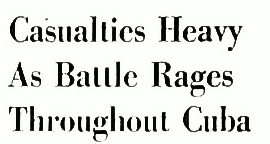
Miami Herald headline

The Miami Herald spoke of battles raging “throughout” the island.

The United Press International wire service said invading “revolutionaries … appeared to have knocked back Fidel Castro’s forces in the initial assault.”

Thus, a sampling of some of the erroneous first U.S. news reports about the ill-fated invasion of Cuba, launched 50 years ago this weekend at the Bay of Pigs.

Castro’s military overwhelmed the assault in less than three days; the CIA-trained invasion force of some 1,400 Cuban exiles never gained much more than a bitterly contested beachhead.

The thwarted invasion entrenched Castro’s dictatorship and represented a major foreign policy setback for the United States and the three-month-old administration of President John F. Kennedy.

It was something of a fiasco for the U.S. news media as well.
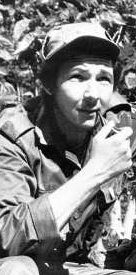
Raul Castro: Not captured

No correspondents were with the invading forces and Castro’s regime imposed a blackout on U.S. correspondents assigned to Cuba. The first news accounts of the invasion of April 17, 1961, as a result were wildly inaccurate and, in some cases, highly colorful and imaginative.

Those initial reports, while still interesting on their face, offer timeless testimony to the extraordinary difficulties of covering conflict from afar.

They also offer a lesson the U.S. news media seem intent on never remembering: First reports from the battlefield, or from the scene of a disaster, almost reliably will be in error. Cautious reporting and scrutiny of sources are thus always advisable amid uncertain and shifting conditions.

Such lessons tend to remain unlearned, however — as was apparent in the highly exaggerated news reports about violence and mayhem that supposedly swept New Orleans in the immediate aftermath of Hurricane Katrina’s landfall in 2005.

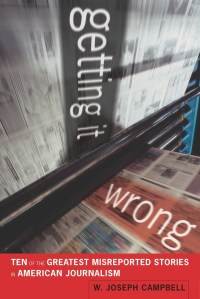
As I note in my media-mythbusting book, Getting It Wrong, “the erroneous and exaggerated reporting [about post-Katrina New Orleans] had the cumulative the effect of painting for America and the rest of the world a scene of surreal violence and terror, something straight out of Mad Max or Lord of the Flies.”

I further note that “initial and worst-case estimates of disaster casualties almost always are exaggerated. … Recognition of this tendency may well have helped to temper or curb the exaggerated reports of lawlessness and violence” in Katrina’s wake.

Revisiting the Bay of Pigs coverage also demonstrates how wished-for outcomes can color and distort news coverage.

The Miami Herald, which clearly wanted Castro gone, was eager to report imagined gains by the undermanned exile force, while offering no sources at all in its breathless accounts.

Beneath a banner headline that read, “Invaders Slug Into Interior,” the Herald reported on April 18, 1961, that the anti-Castro rebels “were pushing into the interior of Cuba” after launching assaults “at several key points” on the island.

“It was brother against brother,” the Herald said of the fighting, adding, “A virtual blackout was stretched across Cuba since the first shot of the civil war was fired.”

The newspaper further reported — while citing no sources — that it had “learned that the rebel troops are paying heavily for every mile gained.”

The Herald also attempted to divine the invaders’ strategy, asserting: “Rebels pouring in from Las Villas in the soft underbelly of Cuba were headed towards Central Highway in an apparent attempt to control the strategic road and cut the island in two.”

While somewhat more cautious than the colorful account in the Miami Herald, the Wall Street Journal of April 18, 1961, reported that at “least three widely scattered landings” had “brought an immediate state of emergency and brisk fighting inside Cuba and rapid repercussions around the globe.”

The Journal noted that the “cutoff of telephone and cable communications by the Castro government and conflicting battle reports made the tide of fighting difficult to assess,” but added:

“The invaders seem bent on cutting Cuba in half, then wheeling westward to Havana, about 100 miles from their original beachhead.”

The Journal didn’t hold back from publishing what it acknowledged were unverified reports that anti-Castro forces had captured the Isle of Pines and freed 10,000 political prisoners; had taken Santiago de Cuba, the country’s second-largest city, and had seized Raul Castro, Fidel’s brother.

“None of these reports were confirmed, however,” the Journal added — as if such a disclaimer were of much value after having offered up what proved to be wild and fanciful rumors.

The Washington Post of April 18, 1961, turned to wire service dispatches in compiling its first account of the invasion. It led with a United Press International report that breathlessly declared:

“Invading Cuban revolutionary troops, landed from the sea and dropped from planes, fought a bloody battle yesterday in the swamps 90 miles southeast of Havana and appeared to have knocked back Fidel Castro’s forces in the initial assault.

“There were reports that segments of the Cuban Navy had revolted.

“The revolutionary front directed by former Castro Premier Jose Miro Cardona in a secret United States headquarters was estimated to have thrown 5,000 anti-Castro Cubans into action in 48 hours on the east and south coasts.”

The Post’s report incorporated an Associated Press dispatch that said “the invaders hit the beaches in four of Cuba’s six provinces.”

Within weeks of the failed invasion, one of the leading journalists in America, James (“Scotty”) Reston of the New York Times, charged in a column that U.S. government officials and the CIA had fed reporters erroneous information about the assault on Cuba.

“When the landings started,” Reston wrote, “American reporters in Miami were told that this was an ‘invasion’ of around 5,000 men — this for the purpose of creating the impression among the Cuban people that they should rise up to support a sizable invasion force.

“When the landing … began to get in trouble, however,” Reston added, “officials here in Washington put out the story — this time to minimize the defeat in the minds of the American people — that there was no ‘invasion’ at all, but merely a landing of some 200-400 men to deliver supplies to anti-Castro guerrillas already in Cuba.

“Both times the press was debased for the Government’s purpose.”

Could be, but journalists amply demonstrated in their reporting that they were inclined to be gullible accomplices — eager at least to embrace wishful scenarios about the invasion. Official disinformation only partly explains the media credulity in reporting the Bay of Pigs.

News outlets bear a far heavier burden for botching the coverage.

WJC

Recent and related:

No one-off story: Reporting the run-up to Bay of Pigs

In Anniversaries, Bay of Pigs, Debunking, Media myths, New York Times, Newspapers on April 7, 2011 at 7:46 am

The tenacious New York Times-Bay of Pigs suppression myth centers around a single story that the Times supposedly bungled or censored in its issue 50 years ago today.

But reporting about the pending assault on Fidel Castro’s Cuba went beyond a single story. The Times and other U.S. news outlets reported frequently —  if not always accurately — about the run-up to the Bay of Pigs invasion, which was launched April 17, 1961, and was rolled up within three days.

The suppression myth has it that at President John F. Kennedy’s behest, the Times spiked or emasculated a story telling of preparations by U.S.-trained Cuban exiles to attack Cuba.

The suppression tale is untrue, however. The Times of April 7, 1961, was no artifact of censorship: It reported what it knew about the unfolding invasion preparations.

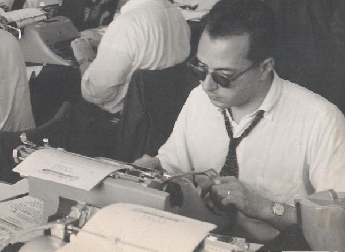
Szulc, undated photo (Courtesy Anthony Szulc)

Best testimony to that comes from reading what was published: Doing so reveals that the news report at heart of the myth appeared beneath the byline of a veteran correspondent named Tad Szulc; the article was displayed above the newspaper’s front-page fold.

The Times, didn’t thereafter drop the invasion-preparations story, either. Szulc’s report of 50 years ago was no one-off effort.

As I point out in Getting It Wrong, my media-mythbusting book that came out last year:

“The suppression myth fails to recognize or acknowledge that the Times coverage was not confined to Szulc’s article ten days before the invasion. It ignores that several follow-up stories and commentaries appeared in the Times during the run-up to the invasion.”

Reporting by Szulc and others for the Times after April 7, 1961, “kept expanding the realm of what was publicly known about a coming assault against Castro,” I write.

For example, on April 8, 1961, the Times published a front-page article about the Cuban exiles and their eagerness to toppled Castro.

That report, which appeared beneath the headline, “Castro Foe Says Uprising Is Near,” quoted the president of the U.S.-based umbrella group of exiles, the Cuban Revolutionary Council, as saying that a revolt against the Castro regime was “imminent.”

The following day, the Times published two articles about Cuba on its front page. One of them was the lead story, which appeared beneath the headline, “Castro Foes Call Cubans To Arms; Predict Uprising,” and discussed the vow of the exiled Cuban Revolutionary Council to topple Castro.

“Duty calls us to the war against the executioners of our Cuban brethren,” the Revolutionary Council declared. “Cubans! To victory! For democracy! For the Constitution! For social justice! For liberty!”

The Times front page of April 9, 1961, also carried a report by Szulc, who described how the exile leaders were attempting to cover over rivalries and divisions in advance of what Szulc termed the coming “thrust against Premier Fidel Castro.”

The “first assumption” of the leaders’ plans, Szulc wrote, “is that an invasion by a ‘liberation army,’ now in the final stages of training in Central America and Louisiana, will succeed with the aid of internal uprising in Cuba. It is also assumed that a provisional ‘government in arms’ will be established promptly on the island.”

With those sentences, Szulc effectively summarized the strategic objectives of what became the Bay of Pigs invasion.

As I point out in Getting It Wrong, none of the Times’ pre-invasion reports included a prospective date for the invasion. But they unmistakably signaled that something was afoot, that an attempt to oust Castro by arms was forthcoming.

Moreover, on April 11, 1961, James Reston, the Washington bureau chief, reported on the Times’ front page that Kennedy administration officials were divided “about how far to go in helping the Cuban refugees to overthrow the Castro Government.”

Reston described in detail how the president had been receiving conflicting counsel from advisers at the White House, the Central Intelligence Agency, and the State and Defense departments. Reston also identified the time pressures confronting the president, writing:

“It is feared that unless something is done fairly soon nothing short of direct military intervention by United States forces will be enough to shake the Castro Government’s hold over the Cuban people.”

Reston, I note in Getting It Wrong, “followed that report the next day with a commentary that addressed the moral dimensions of an armed attempt to topple Castro. His column noted that ‘while the papers have been full of reports of U.S. aid to overthrow Castro, the moral and legal aspects of the question have scarcely been mentioned.'”

Nor was the Times alone in reporting about invasion preparations. Its competition on the pre-invasion story included the Miami Herald, the New York Herald Tribune, and Time magazine.

According to a critique published in May 1961 in The Reporter, a journalists’ trade publication, the pre-invasion story “was covered heavily if not always well.” The Reporter added:

“Remarkably detailed reports were published and broadcast describing the stepped-up preparations” for the assault on Cuba.

Indeed, reporting and commentary about invasion plans reached such  intensity that according to Kennedy’s press secretary, Pierre Salinger, the president complained a week before the invasion, saying:

“I can’t believe what I’m reading! Castro doesn’t need agents over here. All he has to do is read our papers. It’s all laid out for him.”

The CIA’s planning for the Bay of Pigs invasion was cloaked in secrecy of the skimpiest kind. In the days and weeks before the assault, the Cuban exile community in Miami teemed with talk about an invasion.

“It was,” Szulc recalled about two months later, in testimony before a closed session of a Senate Foreign Relation subcommittee,  “the most open operation which you can imagine.”

WJC

Recent and related:

What a Rash remark: ‘If I’ve lost Cronkite, I’ve….’

In Cronkite Moment, Debunking, Media myths, New York Times, Newspapers on April 2, 2011 at 7:17 am

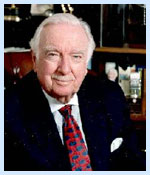
The mythical “Cronkite Moment” can be an irresistible point of reference in broadcast journalism, especially in assessing the shortcomings and inadequacies of contemporary network news anchors.

A commentary posted yesterday at the online site of the Minneapolis Star Tribune offered such a comparison, unfavorably comparing CBS News anchor Katie Couric to the venerable Walter Cronkite.

Couric is believed on her way out as CBS anchor and the commentary’s author, John Rash, noted that Cronkite said he regretted leaving the anchor’s chair in 1981.

In what could pass for a eulogy, Rash also wrote:

“The avuncular Cronkite, once considered the most trusted man in America, was also one of the most influential. His … clear-eyed assessment of Vietnam as a ‘stalemate’ led [John] Kennedy’s successor, President Lyndon B. Johnson, to say, ‘If I’ve lost Cronkite, I’ve lost America.'”

There’s no small amount of myth to unpack in that paragraph.

Most trusted?

For starters, the claim that Cronkite was the “most trusted man in America” rests on a flimsy foundation. The characterization stems from an unrepresentative survey conducted in 18 states in 1972, and from subsequent newspaper advertisements in which CBS touted Cronkite as most trusted.

As for Cronkite’s assertion that the U.S. military was “mired in stalemate” in Vietnam — well, there’s no evidence that Johnson reacted by saying, “If I’ve lost Cronkite, I’ve lost America.”

Or by saying anything akin to such a comment.

The Cronkite-Johnson anecdote, though, is one of the best known in American journalism. It’s often called as the “Cronkite Moment” — and it’s also a media-driven myth, one of 10 I address and debunk in my latest book, Getting It Wrong.

Cronkite certainly made the “mired in stalemate” assessment, at the close of a special report that CBS aired on February 27, 1968.

At the White House, the story goes, Johnson watched the Cronkite program and upon hearing the anchorman’s “mired in stalemate” critique, reached over, snapped off the television and said to an aide or aides:

“If I’ve lost Cronkite, I’ve lost Middle America.”

But as I point out in Getting It Wrong, Johnson wasn’t at the White House that night. He wasn’t in front of a television set.

He didn’t see the program.

Johnson was in Austin, Texas, at the 51st birthday party of Governor John Connally, a longtime political ally.

And about the time Cronkite intoned his “mired in stalemate” assessment, Johnson wasn’t wringing his hands about his war policy. He was cracking a light-hearted joke about Connally’s age.

“Today, you are 51, John,” the president said. “That is the magic number that every man of politics prays for—a simple majority.”

As I’ve noted at Media Myth Alert, it is difficult to fathom how Johnson could have been much moved by a television program he didn’t see.

Besides, Cronkite was scarcely the first to invoke “stalemate” in describing Vietnam.

The New York Times turned to that term periodically in the months before the presumptive “Cronkite Moment.”

In a front-page analysis published August 7, 1967, the Times declared that “the war is not going well. Victory is not close at hand.”

The Times report was published on its front page beneath the headline:

Vietnam: The Signs of Stalemate.

A month before, on July 4, 1967, the Times had said of the war effort:

“Many officers believe that despite the commitment of 466,000 United States troops now in South Vietnam … the military situation there has developed into a virtual stalemate.”

And the Times said in an editorial published October 29, 1967:

“Instead of denying a stalemate in Vietnam, Washington should be boasting that it has imposed a stalemate, for that is the prerequisite–on both sides–to a negotiated settlement. That settlement, if it is to be achieved, will have to be pursued with the same ingenuity and determination that have been applied to fighting the war.”

So Cronkite in his report about Vietnam on February 27, 1968, essentially reiterated an assessment that the Times had offered on a number of occasions  in the months before.

“Stalemate” may have been a “clear-eyed” assessment. But by the time Cronkite invoked the term, “stalemate” in Vietnam was neither novel nor stunning.

WJC

Recent and related:

Myth and error: Recalling the rescue of Private Lynch

In Anniversaries, Debunking, Jessica Lynch, Media myths, Newspapers, Washington Post on April 1, 2011 at 12:49 pm

Today marks the eighth anniversary of the swiftly executed rescue of Private Jessica Lynch from a hospital in Iraq, an event long since steeped in myth and distortion. The prevailing dominant narrative has it that the rescue was contrived — much like the rationale for the war in Iraq.

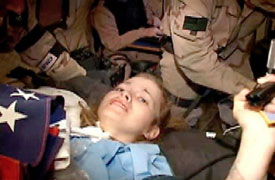
Lynch rescued

But the dominant narrative is in error.

Lynch’s rescue, the first of a U.S. soldier held captive behind enemy lines since World War II, was the highly effective work of a team of Army Rangers and Navy Seals which extricated Lynch within minutes, and without injury.

But less than two days later, the Lynch case became swept up in myth and error that persist eight years on.

On April 3, 2003, the Washington Post published its famously botched story about Lynch, saying the young woman had fought fiercely against Iraqis attackers before being wounded, overwhelmed, and taken prisoner in an ambush at Nasiriyah on March 23, 2003.

The Post report, which appeared beneath the headline, “‘She Was Fighting to the Death’,” was an instant sensation, picked up by news organizations around the world. The Times of London, for example, said that Lynch’s battlefield derring-do surely had won her “a place in history as a gritty, all-American hero…”

Sgt. Walters

The tale of Lynch’s heroics turned out to be utterly false, a case of apparent mistaken identity. Although the Post never adequately addressed how it got the story so thoroughly wrong, the battlefield heroics it attributed to Lynch most likely were the deeds of a cook-sergeant in Lynch’s unit, Donald Walters.

As I write in Getting It Wrong, my media-mythbusting book that came out last year,  Walters during the ambush at Nasiriyah “either stayed behind, or was left behind, to lay down covering fire as his fellow soldiers tried to make their escape. Walters fought his attackers in a fashion that the Post attributed to Lynch.”

Richard S. Lowry, in a fine account of the battle at Nasiriyah, wrote of Walters:

“He probably ‘fought to his last bullet.’ He was captured alive and taken to an Iraqi stronghold and later murdered.”

Walters, the father of three children, was executed by Iraqi irregulars.

Lynch, as it turned out, had never fired a shot in the attack. She was badly injured in the crash of a Humvee in trying to escape the Iraqi ambush.

As the Post’s erroneous report about Lynch’s purported heroics unraveled in the spring of 2003, suspicions arose that her rescue had been drama contrived.

“Such suspicions,” I write in Getting It Wrong, “reached full expression in May 2003, in a documentary broadcast on the British Broadcasting Corporation …. Relying almost entirely on the accounts of Iraqi medical personnel at the hospital, the BBC concluded that the rescue of Lynch was ‘one of the most stunning pieces of news management ever conceived,’ a shameless bit of stagecraft done for propaganda purposes.”

The BBC version of the rescue, though vigorously disputed by the Pentagon, soon congealed into the dominant popular narrative about the Lynch case. “After all,” I note in Getting It Wrong, “the notion of a theatrical but counterfeit rescue operation fit well with the curdled popular view about the war in Iraq.”

But an investigation by the Defense Department’s inspector general — an inquiry requested by three Democratic members of Congress, including Rahm Emanuel — reported in 2007 that the BBC’s allegations had not been substantiated, that no evidence had been uncovered to support the notion the rescue “was a staged media event.”

In testimony to Congress in April 2007, Thomas F. Gimble, the Defense Department’s acting inspector general, said the rescue operation was found to have been “a valid mission” to recover a prisoner of war “under combat conditions.”

More than thirty witnesses were interviewed in the inspector general’s inquiry, including members of the Special Operations rescue team, Gimble said in written testimony.

Few if any of those witnesses had been interviewed by news organizations, he noted. In undertaking the Lynch rescue, Gimble said, the extrication team “fully expected to meet stiff resistance” and had come under enemy fire from the hospital building and areas nearby.

Gimble’s report, I note in Getting It  Wrong , represented “an unequivocal rebuke to the BBC’s account. Even so, by the time Gimble testified, four years had passed and the BBC’s version had become an unshakeable, widely accepted element of the Lynch saga.”

Gimble’s report, I add, “did not fit what had become the dominant narrative about the rescue. It made little news.”

WJC

Recent and related:

He may be a crook, but he’s right about Vietnam, Watergate

In Cronkite Moment, Debunking, Media myths, Newspapers, Washington Post, Watergate myth on March 31, 2011 at 10:20 am

He may be a crook, but he’s right about Vietnam and Watergate: They were no “crowning achievements” for the news media, even though journalists love to embrace them as such.

Black mug shot

The crook is erstwhile media mogul Conrad Black, who was released on bail late last year from a prison in Florida. In a speech this week in New York, Black declared journalism “an occupation that suffers from a collective and in some cases individual narcissism.”

The Canadian-born Black, who gave up his citizenship to accept a British peerage, was quoted indirectly by Toronto’s Globe and Mail as saying:

“What journalists believe to be crowning achievements — for example, the crusading reporting on the Vietnam War and Watergate — are nothing of the sort.”

So why should anyone care what Black thinks or says? He was, after all, accused of looting Hollinger International, the company that once was at the heart of his media empire.

But even a disgraced former press tycoon can offer useful insight, and Black’s observation about Vietnam and Watergate are on target: News coverage did not bring about an end to the war in Vietnam; nor did the press didn’t bring down Richard Nixon in the Watergate scandal.

Journalists, though, do love to believe both self-reverential claims.

As I write in Getting It Wrong, my media mythbusting book that came out last year, such “purported achievements are compelling and exert an enduring allure; to expose them as exaggerated or untrue is to take aim at the self-importance of American journalism.”

The media myth about Vietnam often revolves around the so-called “Cronkite Moment” in February 1968, when CBS News anchorman Walter Cronkite declared on air that the U.S. military was “mired in stalemate” in Vietnam.

Supposedly, President Lyndon Johnson watched Cronkite’s report and, upon hearing the “mired in stalemate” assessment, realized his Vietnam policy was a shambles.

In a supposed moment of dazzling clarity, Johnson is said to have snapped off the television set and declared to an aide or aides:

“If I’ve lost Cronkite, I’ve lost Middle America.”

Or:

“If I’ve lost Cronkite, I’ve lost the war.”

Or something to that effect. Versions vary, but the point is that Cronkite’s assessment supposedly altered U.S. policy, and altered history.

Which was demonstrably not the case.

As I discuss in Getting It Wrong, Johnson didn’t see Cronkite’s program when it aired. He was at the time cracking a light-hearted joke in Austin, Texas, at the 51st birthday party of Governor John Connally.

It is hard to fathom how the president could have been much influenced by a show he hadn’t seen.

In the days and weeks immediately after the “Cronkite Moment,” Johnson was hardly reduced to wringing his hands over failed policy in Vietnam. Rather, he gave a couple of robust speeches in which he urged renewed commitment to the war.

Johnson vowed in one speech that the United States would “not cut and run” from its obligations in Vietnam. In another, in mid-March 1968, he called for “a total national effort to win the war.”

And the notion that the press — specifically, the Washington Post — brought down Nixon in the Watergate scandal is an interpretation that even the Post has sought to dismiss.

I note in Getting It Wrong that the newspaper’s then-ombudsman, Michael Getler, wrote in 2005:

“Ultimately, it was not The Post, but the FBI, a Congress acting in bipartisan fashion and the courts that brought down the Nixon administration. They saw Watergate and the attempt to cover it up as a vast abuse of power and attempted corruption of U.S. institutions.”

Bob Woodward, one of the two lead reporters for the Post on Watergate, said as much, if in earthier terms. He declared in an interview with American Journalism Review in 2004:

“To say that the press brought down Nixon, that’s horseshit.”

So even if he didn’t go into much detail about Vietnam and Watergate, Black had something useful to say about those matters. (It should be noted, too, that Black wrote a hefty and largely sympathetic biography of Nixon.)

According to the Globe and Mail, Black in his speech “excoriated the U.S. legal system, describing the original charges against him as ‘nonsense’ produced by prosecutors throwing ‘spaghetti at the wall.'”

Black formerly was chief executive of Hollinger, the holdings of which once included the Chicago Sun-Times and the London Daily Telegraph. He was convicted in Chicago in 2007 on three counts of fraud and one of obstructing justice and sentenced to 6 1/2 years in prison.

The laws under which he was convicted were narrowed in a subsequent U.S. Supreme Court decision and Black was released on bail, pending review of his sentence.

WJC

Recent and related:

Hearst and war: A newspaper misreads history

In Debunking, Media myths, Newspapers, Spanish-American War, Yellow Journalism on March 28, 2011 at 8:30 am

American journalists, to put it charitably, can be quite unfamiliar with the history of their profession.

The field, as I note in my latest book, Getting It Wrong, “seldom is seriously introspective, or very mindful of its history.”

As such, journalists are known to flub it — or indulge in media myths — when they do take up the past. Consider, for example, the Bangor Daily News in Maine, which both flubs it and offers up a hardy media myth in an editorial posted online last night.

The media myth centers around the hoary notion, rejected by serious historians, that William Randolph Hearst’s yellow journalism fomented or brought about the Spanish-American War in 1898.

In invoking the myth of Hearst and the long-ago war, the Bangor newspaper sought to describe the context for the multiple military missions the United States is pursuing these days.

The newspaper declared:

“U.S. forces have been in Afghanistan since 2001. They’ve been in Iraq since 2003. And they soon could be in Libya. This is not to mention standing U.S. military bases in Japan, South Korea, Germany, Italy, Greece, Spain, Bulgaria, Kosovo, Israel, Turkey, Saudi Arabia, Kuwait, Bahrain, Brazil, Greenland, the Philippines, Cuba, Guam and on and on. How and when did this happen?

“The year the United States began its ascendancy as a world power was 1898, beginning with the Spanish-American War, a conflict of dubious progeny fanned into flames by the partisan journalism practiced by William Randolph Hearst.”

How simplistic. And how illogical.

Just think it through: wars can begin because of overheated newspaper content?

Quite simply, that’s a misreading of history, a lazy interpretation that ascribes too much power to Hearst and his yellow press while ignoring the human rights disaster on Cuba that helped precipitate the war in April 1898.

As I wrote in my 2001 book, Yellow Journalism: Puncturing the Myths, Defining the Legacies:

“The yellow press is not to blame for the Spanish-American-War. It did not force — it could not have forced — the United States into hostilities with Spain over Cuba in 1898. The conflict was, rather, the result of a convergence of forces far beyond the control or direct influence of even the most aggressive of the yellow newspapers, William Randolph Hearst’s New York Journal.”

In 1898, Hearst published the Journal, the New York Evening Journal, and the San Francisco Examiner. The three titles wielded at best modest agenda-setting influence on the rest of the American press, which then numbered more than 2,200 daily newspapers.

Indeed, as I pointed out in Yellow Journalism:

“There is little evidence that the press beyond New York City, especially in small-town and rural America, was influenced by the content of the yellow journals, including their demands for war after the destruction of the Maine,” an American battleship that blew up in Havana harbor in February 1898, killing 266 officers and sailors.

The destruction of the Maine was a triggering event of the war. But it was not the sole factor, or even necessarily the decisive factor.

What galvanized American public opinion were Spain’s brutal efforts to suppress an islandwide rebellion on Cuba, a nasty conflict that began in February 1895 and ultimately gave rise to the Spanish-American War.

A centerpiece of Spain’s attempt to crush the rebellion was to force Cuban non-combattants – old men, women, and children– into what the Spanish called “reconcentration centers,” to prevent the non-combattants from giving aid, succor, and supplies to the Cuban rebels.

The “reconcentration” policy was a disaster. Tens of thousands of Cubans fell victim to disease and starvation. U.S. newspapers — including but certainly not limited to Hearst’s dailies — were aware of, and reported extensively about, the humanitarian crisis that had taken hold on Cuba by early 1898.

That crisis, not the content of the yellow press, was what “fanned” the flames for war with Spain.

As the historian David Trask has written, Americans in 1898 “went to war convinced that they had embarked upon an entirely selfless mission for humanity,” to end Spain’s brutal rule of Cuba.

The war hardly was “a conflict of dubious progeny,” as the Bangor Daily News dismissively put it. And it surely wasn’t a war driven by Hearst and his yellow press.

WJC

Recent and related:

‘So to Speak’ about ‘Getting It Wrong’

In Debunking, Furnish the war, Media myths, Newspapers, Washington Post, Watergate myth on March 18, 2011 at 6:32 am

My mythbusting book, Getting It Wrong, made the Columbus Dispatch yesterday as the subject of a cleverly written column that opened this way:

“After interviewing W. Joseph Campbell, I checked the Dispatch archives to see whether I had ever committed any of the journalistic exaggerations he likes to skewer.

“I did write in 2005 that Mark Felt, the ‘Deep Throat‘ of Watergate fame, ‘rid the world of Richard Nixon.’ But I was overstating for effect, so I plead not guilty by reason of humor.”

Heh, heh. Nice touch.

The author was Joe Blundo, a veteran reporter who writes the “So to Speak” column for the “Life and Arts” section of the Dispatch.

The column was pegged to my book talk this afternoon at Ohio Wesleyan University, where I earned my undergraduate degree in journalism and history in the mid-1970s.

Blundo in his column offered overviews of some of the 10 media-driven myths dismantled in Getting It Wrong, including the notion that “Bob Woodward and Carl Bernstein of The Washington Post brought down Nixon with their Watergate reporting.

“Certainly Woodward and Bernstein (and Woodward’s source Deep Throat) had a role in the drama,” Blundo wrote, “but it took investigators, Congress and the Supreme Court to ultimately force the president to resign, Campbell, 58, said by phone.”

He further quoted me as saying that against the backdrop of subpoena-wielding authorities who dug into the crimes of Watergate, “the contributions of The Washington Post really recede into near insignificance.”

The newspaper’s contributions weren’t decisive, that’s for sure. Even officials at the Post have attempted over the years to distance the newspaper from the popular narrative that its reporting forced Nixon to resign.

As I note in Getting It Wrong, Katharine Graham, the newspaper’s publisher during and after the Watergate scandal, was among the senior figures at the  Post who dismissed that mediacentric link. She said in 1997, at a program marking the scandal’s 25th anniversary:

“Sometimes people accuse us of bringing down a president, which of course we didn’t do. The processes that caused [Nixon’s] resignation were constitutional.”

Also that year, Ben Bradlee,the executive editor at the Post during Watergate, said on the “Meet the Press” interview show:

“[I]t must be remembered that Nixon got Nixon. The Post didn’t get Nixon.”

Blundo also quoted me about some of the reasons media-driven myths are so tenacious and appealing — that they place the news media decisively at the center of important events and that they offer simplistic explanations for complex issues and developments of the past.

“Yet the myths won’t die,” he wrote.

I’m afraid he’s right. Media myths die hard, if they die at all.

The only way to counter them is to call them out, to pound away at them when they appear in the news media. Even then, utter and thorough debunking is rare. These stories, after all, often are too good not to be true.

And often too good to check out.

WJC

Recent and related:

Of media myths and false lessons abroad: Biden’s Moscow gaffe

In Bay of Pigs, Debunking, Media myths, New York Times, Newspapers, Washington Post, Watergate myth on March 14, 2011 at 7:57 am

Biden shows the way (White House photo)

Vice President Joe Biden embraced in Moscow last week one of American journalism’s most tenacious myths — the notion that reporting by the Washington Post brought down” Richard Nixon’s corrupt presidency in the Watergate scandal.

Unwittingly or otherwise, Biden offered up the Watergate myth as a telling example of the values and virtues of a free press. The vice president said in remarks at Moscow State University:

“Journalists must be able to publish without fear of retribution. In my country it was a newspaper, not the FBI, or the Justice Department, it was a newspaper, the Washington Post that brought down a President for illegal actions.”

As I’ve noted, not even the Post endorses that superficial and misleading reading of Watergate history. (Ben Bradlee, the newspaper’s executive editor during Watergate, has said for example: “[I]t must be remembered that Nixon got Nixon. The Post didn’t get Nixon.”)

The significance of Biden’s mischaracterization of Watergate goes beyond being merely curious; it’s more than just another example of the gaffe-prone vice president slipping up again.

His remarks demonstrated anew that media myths are not just intriguing curiosities of history. They showed how false lessons can worm their way into diplomacy and policymaking.

Biden’s speech represented pointed criticism of — and recommendations for — Russia and its legal and political systems.  Biden offered a laundry list of democratic reforms that autocratic Russia ought to undertake, stating that courts “must be empowered to uphold the rule of law and protect those playing by the rules.

“Non-governmental watchdogs should be applauded as patriots, not traitors. …

“Journalists,” he added, “must be able to publish without fear of retribution.” To buttress his point about a robust free press, he invoked the claim that “the Washington Post … brought down a President for illegal actions.”

Biden offered that anecdote as an example of the benefits of press freedom, which he called “the greatest guarantee of freedom there is….”

Invoking the myth that the Post “brought down” Nixon is to offer an international audience a false lesson about the power of the news media. Invoking the myth is to suggest, wrongly, that that news media can, when circumstances are right, force a sitting president from office.

As I note in my latest book, Getting It Wrong, rolling up a scandal of the sweep and dimension of Watergate “required the collective if not always the coordinated forces of special prosecutors, federal judges, both houses of Congress, the Supreme Court, as well as the Justice Department and the FBI.”

Even then, I write, “Nixon likely would have served out his term if not for the audiotape recordings he secretly made of most conversations in the Oval Office of the White House.

“Only when compelled by the Supreme Court did Nixon surrender those recordings, which captured him plotting the cover-up” of Watergate’s signal crime — the break-in at the headquarters of the Democratic National Committee in June 1972.

Considered against the tableau of subpoena-wielding investigators and special prosecutors, the Watergate reporting of the Post recedes in significance.

As Michael Getler, the newspaper’s ombudsman wrote in 2005: “Ultimately, it was not The Post, but the FBI, a Congress acting in bipartisan fashion and the courts that brought down the Nixon administration.”

I also note in Getting It Wrong that “media-driven myths are neither trivial nor innocuous. They can and do have adverse consequences.”

They tend to offer simplistic and misleading interpretations of important historical events, and they “can blur lines of responsibility and deflect blame away from makers and sponsors of flawed public policy,” I write, citing as a case in point the New York Times-Bay of Pigs suppression myth.

Had the New York Times had reported all it knew 50 years ago about the run-up to the pending Bay of Pigs invasion of Cuba, the administration of President John F. Kennedy likely would have scuttled the operation–thus sparing the country a stunning foreign policy reversal.

Or so the media myth has it.

As I discuss in Getting It Wrong, that interpretation is not only misleading but it diverts responsibility away from Kennedy and his flawed decision to go ahead with the invasion.

The Times, after all, published a number detailed, front-page reports about the anticipated invasion in the days before the ill-fated assault. And there is no evidence that the newspaper censored itself under White House pressure in the run-up to the Bay of Pigs invasion.

And in the final analysis, I note, ” it was Kennedy, not American journalists, who gave the go-ahead in April 1961, sending a brigade of Cuban exiles to a disastrous rendezvous in the swamps of southwestern Cuba.”

The cause of independent-minded journalism in Russia would have been better served had Biden skipped the myth and urged the Kremlin to pursue serious investigations into unresolved cases of journalists who’ve been killed because of their work.

The New York-based Committee to Protect Journalists says 19 journalists have been killed in Russia since 2000.

The country, CPJ says, has a “record of rampant impunity in resolving the killings of journalists.”

WJC

Recent and related:

Mythmaking in Moscow: Biden says WaPo brought down Nixon

In Debunking, Media myths, Newspapers, Washington Post, Watergate myth on March 12, 2011 at 7:23 am

Gaffe-prone Joe Biden offered Russians this week a mythical and distorted version of American history,  declaring at Moscow State University that the Washington Post “brought down” Richard Nixon’s corrupt presidency in the Watergate scandal.

It’s an interpretation of Watergate that few serious historians embrace.

Gaffe-prone

And yet, according to the transcript of the vice president’s remarks posted online by the White House, Biden told his audience:

“In my country it was a newspaper, not the FBI, or the Justice Department, it was a newspaper, the Washington Post that brought down a President for illegal actions.”

Not even the Washington Post buys into that myth-encrusted version of history. Principals at the Post have from time to time over the years sought to distance the newspaper from such a misleading assessment.

For example, Katharine Graham, the newspaper’s doughty publisher during and after the Watergate scandal, said in 1997, at a program marking the 25th anniversary of the scandal:

“Sometimes people accuse us of bringing down a president, which of course we didn’t do. The processes that caused [Nixon’s] resignation were constitutional.”

Ben Bradlee,who was executive editor at the Post during Watergate, said on the “Meet the Press” interview show in 1997:

“[I]t must be remembered that Nixon got Nixon. The Post didn’t get Nixon.”

More recently, Michael Getler, then the newspaper’s ombudsman, wrote in 2005:

“Ultimately, it was not The Post, but the FBI, a Congress acting in bipartisan fashion and the courts that brought down the Nixon administration.”

Their comments are not the representations of false modesty: They speak to a more accurate reading of the history of Watergate than Biden offered his audience in Moscow.

Watergate-related reporting in the Post — even though it won a Pulitzer Prize in 1973 — was scarcely enough to turn from office a sitting president.

As I write in my latest book, Getting It Wrong, rolling up a scandal of the dimension and magnitude of Watergate “required the collective if not always the coordinated forces of special prosecutors, federal judges, both houses of Congress, the Supreme Court, as well as the Justice Department and the FBI.”

And even then, I write, “Nixon likely would have served out his term if not for the audiotape recordings he secretly made of most conversations in the Oval Office of the White House.

“Only when compelled by the Supreme Court did Nixon surrender those recordings, which captured him plotting the cover-up” of Watergate’s signal crime — the break-in at the headquarters of the Democratic National Committee in June 1972.

Biden’s remarks reflect an endorsement of I call the “heroic-journalist” myth of Watergate — the simplified and misleading interpretation that the reporting of  Post reporters Bob Woodward and Carl Bernstein uncovered evidence that forced Nixon’s resignation in 1974.

But not even Woodward endorses that interpretation. He said in 2004 in an interview with American Journalism Review:

To say the press brought down Nixon, that’s horseshit.”

But as I note in Getting It Wrong, the heroic-journalist meme has nonetheless “become the most familiar storyline of Watergate: ready short-hand for understanding Watergate and its denouement, a proxy for grasping the scandal’s essence while avoiding its forbidding complexity.

“How the Post and its reporters uncovered Watergate is deeply ingrained in American journalism as one of the field’s most important and self-reverential stories,” I write.

But being deeply ingrained and popular doesn’t mean it’s accurate. Far from it.

I note in Getting It Wrong that “to explain Watergate through the lens of the heroic-journalist is to abridge and misunderstand the scandal and to indulge in a particularly beguiling media-driven myth.

“The heroic-journalist interpretation minimizes the far more decisive forces that unraveled the scandal and forced Nixon from office.” And they included the very forces Biden dismissed in his remarks in Moscow –the FBI and the Justice Department.

The transcript of Biden’s speech, delivered Thursday, also shows that he flubbed the characterization of the news media, which sometimes are collectively referred to as the “Fourth Estate.”

According to Biden, they’re the “Third Estate.”

WJC

Recent and related:

Exaggerating Cleveland as ’70s Belfast on the lake

In Cinematic treatments, Debunking, Media myths, Newspapers on March 7, 2011 at 7:36 am

Advance publicity about Kill the Irishman, Hollywood’s portrayal of a long-dead Cleveland hood mostly unknown outside Northeast Ohio, erroneously casts the city in the mid-1970s as rivaling the shattering violence of Belfast or Beirut.

Cleveland’s daily newspaper, the Plain Dealer, for which I reported in the mid- and late-1970s, offered that allusion — or illusion — in an otherwise thoughtful article yesterday about Kill the Irishman, which opens Friday in limited release.

The movie dramatizes — and no doubt seeks to mythologize — the life and death of Danny Greene, a brazen Cleveland rackets figure and FBI informant killed by his foes in a car bombing in October 1977.

The Plain Dealer article asserted that “Cleveland in the mid-’70s echoed Belfast or Beirut.”

That characterization is glib, unfortunate, and  fails to distinguish between the bloodletting and terror of politically inspired violence in Belfast or Beirut and the bombings of far smaller scale, perpetrated by mobsters against mobsters, in Cleveland and vicinity in the mid-1970s.

Demonstrating anew that Hollywood often has little aversion to hyperbole, publicity material for Kill the Irishman carries the mischaracterization of bombing-prone Cleveland to an absurd extreme.

That material says in summer of 1976, “thirty-six bombs detonate[d] in the heart of Cleveland while a turf war raged between Irish mobster Danny Greene (Ray Stevenson) and the Italian mafia.”

The claim has been reiterated in descriptions of the film posted by online movie guides, including those of the Washington Post and  CBS Detroit. It appeared in a recent online review of Kill the Irishman.

Thirty-six bombings “in the heart of Cleveland” in any summer would have so dramatic as to have attracted national media attention. But a search of an archive of leading U.S. newspapers — including the New York Times, Los Angeles Times, Wall Street Journal, and the Post — turned up no reports about such a bombing spree in Cleveland that year.

I lived and worked in downtown Cleveland then, and recall no such rampage. That’s not to say that Cleveland was a particularly hospitable place. But the heart of the city on Lake Erie quite simply did not shudder that summer with anything akin to a succession of three dozen bombings.

Such a claim is preposterous.

The figure of 36 bombings appears to have been misappropriated from an article published in May 1977 in the Plain Dealer, as a sidebar to the account of the bombing death of John A. Nardi, a mob figure allied with Greene.

The sidebar article said “there were 21 bombings in the city last year [1976], a total of 37 in Cuyahoga County,” a political district of 458 square miles that embraces Cleveland and many of its suburbs.

Sure, 21 bombings in a year is a lot, in any city. But it is less than two per month, a frequency considerably less dramatic and sustained than 36 “in the heart of Cleveland” in a single summer (which corresponds to 13 a month or more than one a week).

Gritty Cleveland gets beaten up routinely. It was Forbes magazine’s choice as America’s “most miserable city” in 2010. Cleveland’s population is about half of what it was 50 years ago; it may be America’s most leave-able city. Abandoned buildings blight the cityscape.

Cleveland is in a long, grinding, unending decline. It’s a magnet for sneer and insult. But it was no Belfast, and it sure doesn’t merit the exaggeration and imprecision that’s come its way in the run-up to the release of Kill the Irishman.

WJC

Recent and related: