W. Joseph Campbell

Archive for the ‘Newspapers’ Category

Discussing ‘Getting It Wrong’ at a special place

In Anniversaries, Debunking, Media myths, Media myths and radio, Newspapers, War of the Worlds on October 28, 2010 at 5:30 pm

There was a fine turnout today for my book talk at the Library of Congress, the splendid institution where I have done a great deal of research over the past 12 years or so.

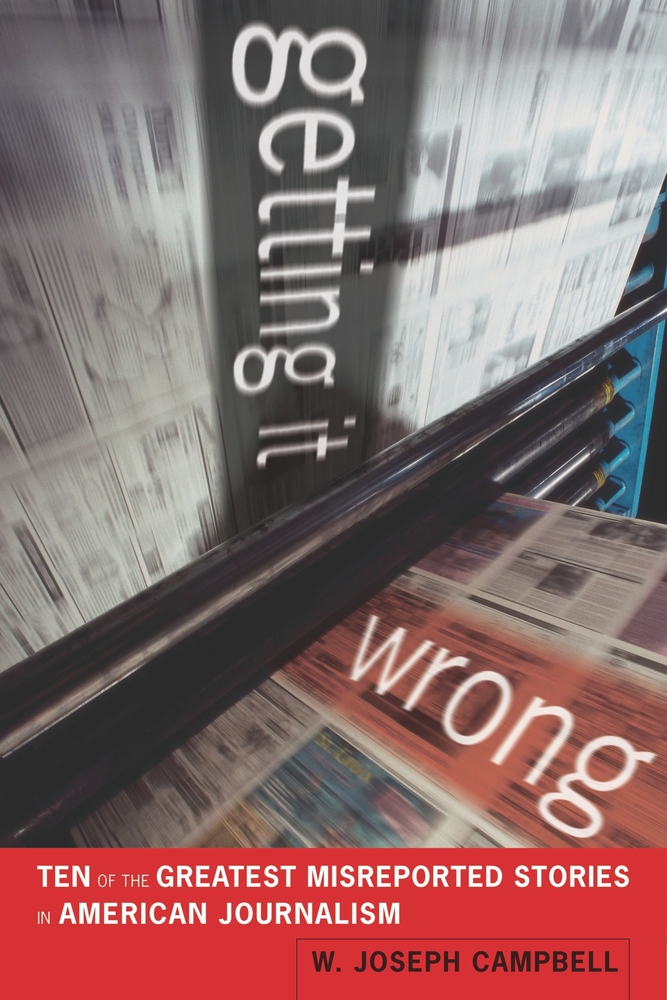
The Library is a special place, and more than 120 people were there as I reviewed three of the 10 media-driven myths that are addressed and debunked in my latest book, Getting It Wrong.

Two of the myths discussed possess a strong Washington, D.C., connections; the third was timely in a seasonal, late-October sort of way. Specifically, I discussed:

  • The heroic-journalist myth of Watergate: That is, the notion that the investigative reporting of Washington Post reporters Bob Woodward and Carl Bernstein brought down the corrupt presidency of Richard Nixon.
  • The so-called “Cronkite Moment” of February 1968: The belief President Lyndon Johnson realized the Vietnam Was was unwinnable following a dire, on-air assessment by CBS anchorman Walter Cronkite, who declared the U.S. military was “mired in stalemate” in Southeast Asia.
  • The War of the Worlds radio dramatization: The widely held view that Orson Welles’ clever adaptation of The War of the Worlds, a science fiction thriller about a deadly Martian invasion of Earth, touched widespread panic and mass hysteria on Halloween Even 1938.

Welles and 'War of Worlds'

The anniversary of Welles’ War of Worlds broadcast is Saturday.

In my talk at the Library of Congress, I pointed out how improbable it was that a radio show–even one as inspired as Welles’ adaptation–could have had the effect of sending tens of thousands, if not hundreds of thousands, of listeners into the streets in panic and hysteria.

There were many internal clues for listeners signaling that the show was just that–a radio show.

It aired Sundays, from 8-9 p.m., Eastern time, on CBS–in the usual time slot for Welles’ program, which he called the Mercury Theatre on the Air. Welles was the show’s star and director, and his distinctive voice would have been familiar to many listeners that long ago October night.

What’s more, events described in the show moved far too rapidly to be plausible or believable. In less than 30 minutes, for example, the Martians blasted off from their planet, traveled millions of miles to Earth, landed in rural New Jersey, set up lethal heat rays, wiped out units of American soldiers, and began a destructive march on New York City.

As I point out in Getting It Wrong, “Claims that the broadcast fomented mass panic and hysteria were dramatically overstated” by daily newspapers the following day.

Close reading of the contemporaneous newspaper accounts made it clear that they based their characterizations of widespread turmoil on relatively small numbers of anecdotal cases of people who were frightened or upset. These anecdotes, I write, “typically were not of broad scale but were small-bore. They described agitation and odd behavior among individuals, their families, or neighbors.”

But by no means did these accounts suggest fright that night reached the level of nationwide panic and mass hysteria.

For newspapers, however, the notion that The War of the Worlds show had caused great panic and alarm represented an irresistible opportunity to bash radio as an unreliable, untrustworthy upstart medium. And newspapers did so in overwhelmingly negative editorial commentary.

“Radio is new but it has adult responsibilities,” the New York Times declared about the show. “It has not mastered itself or the material it uses. It does many things which the newspapers learned long ago not to do, such as mixing its news and advertising.”

Such criticism was more than mildly self-serving. After all, radio by 1938 had become an increasingly important rival source for news, information, and advertising.

And that negative commentary helped to lock into place the mistaken notion that the radio show about Martian invaders had sown panic and hysteria across the country.

My talk was sponsored by the Library’s Center for the Book, which is directed by John Y. Cole. Library stalwarts in attendance today included Terri Sierra, Mark  Sweeney, Georgia Higley, and G. Travis Westly.

WJC

Recent and related:

Getting it right about Hearst, his newspapers, and war

In Debunking, Media myths, Newspapers, Spanish-American War, Yellow Journalism on October 27, 2010 at 7:30 am

It’s rather remarkable how William Randolph Hearst, the timeless bogeyman of American journalism, serves so readily as an exemplar of how awful the news media can be.

Hearst

Hearst and his newspapers, for example, are often blamed for having fomented the war with Spain over Cuba in 1898. They didn’t.

He’s also accused of having vowed to “furnish the war,” in an incendiary telegram to the artist Frederic Remington in 1897. I debunk that popular but thinly documented tale  in my new mythbusting book, Getting It Wrong.

A column yesterday in the Philadelphia Inquirer offered another charge against Hearst’s character and journalism. He was accused of having played on anti-Catholic sentiment to whip up popular sentiment against Spain at the end of the 19th century.

Here’s what the column said:

“Fox News and [Fox talk show host Bill] O’Reilly have been the leading TV gathering point for anti-Muslim sentiment following the attack on New York’s World Trade Center, most recently providing viewers with a rallying point against the so-called ground zero mosque.

“This sort of journalism is even older than what some people characterize as political correctness and others call public respect for minorities. In 1890, William Randolph Hearst helped boost profits for his New York Journal newspaper, stirring public sentiment to start the Spanish-American War, by exploiting antipathy for the Roman Catholic Spanish Empire.”

Let’s see: In 1890 Hearst wasn’t even in New York; he was in San Francisco, running the Examiner newspaper. He didn’t take control of the New York Journal until 1895.

And war was not profitable for Hearst’s newspapers .

As I wrote in my 2001 book, Yellow Journalism: Puncturing the Myths, Defining the Legacies, the Spanish-American War in 1898 generally boosted newspaper circulation. But advertising revenues fell, as advertisers feared the conflict would undercut a halting recovery from hard economic times of the 1890s.

Moreover, newsprint costs soared, as did news-gathering expenditures.

In 1899, the trade journal Fourth Estate estimated that Hearst’s New York Journal had spent $50,000 a week—the equivalent these days of more than $1 million—on cable tolls, reporters’ salaries, and dispatch boats that ferried correspondents’ reports from the war’s principal theater in Cuba to Jamaica and elsewhere for transmission to New York.

Hearst’s Journal scoffed at claims that it helped bring on the war as part of a cynical scheme to build circulation and boost profits.

Hearst's Evening Journal

“Would you like to know what effect the war had on the money-making feature of this particular newspaper? The wholesale price of paper was greatly increased. Advertising diminished, expenses increased enormously,” the Journal said, adding that its expenses related to covering the conflict exceeded $750,000—the equivalent these days of more than $20 million.

Close reading of the Journal in the run-up to the Spanish-American War makes it clear that Catholicism wasn’t much of a preoccupation for the newspaper. The Cubans, after all, were overwhelmingly Catholic, too, and the Journal sided unequivocally with their bid for political self-rule.

The human rights disaster that took hold in Cuba by 1898 was far more important to the Journal and to other newspapers in New York than “antipathy” to Spain’s Catholicism.

Spain, in a clumsy attempt to put down an island-wide rebellion against its colonial governance, forced thousands of Cubans, mostly old men, women, and children, into garrison towns where they could offer neither support nor supplies to the rebels, who controlled much of the countryside.

This policy was called “reconcentration,” and it gave rise to widespread malnutrition and disease: Unknown tens of thousands of Cuban non-combatants died from starvation and illness.

The human rights disaster on Cuba “inevitably stirred outrage and condemnation in the United States,” I wrote in Yellow Journalism . And conditions on Cuba were a frequent topic of reporting in the Journal and other newspapers.

A leading historian of that period, Ivan Musicant, has quite correctly observed that the reconcentration policy “did more to bring on the Spanish-American War than anything else the Spanish could have done.”

Hearst’s newspapers reported about, but certainly did not create, the devastating effects of Spain’s ill-considered and destructive policy.

WJC

Recent and related:

Suspicious Murrow quote reemerges

In Cinematic treatments, Debunking, Media myths, Murrow-McCarthy myth, Newspapers on October 25, 2010 at 10:06 am

A comment of uncertain authenticity but attributed to legendary broadcast journalist Edward R. Murrow resurfaced the other day, in an item posted at the online site of the Salem-News a news service in Oregon.

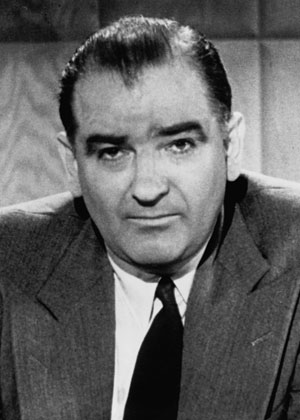
Witch-hunting senator

The item included this passage:

“As Edward R. Murrow noted, ‘We must not confuse dissent with disloyalty. When the loyal opposition dies, I think the soul of America dies with it.'”

The first portion of the quote–“We must not confuse dissent with disloyalty”–is genuine. Murrow uttered the line during the closing portion of his myth-enveloped television report in March 1954 about Senator Joseph R. McCarthy (above) and his witch-hunting ways.

The second part– “When the loyal opposition dies, I think the soul of America dies with it”–is highly suspect.

Murrow didn’t say it during his program about McCarthy, the mythical elements of which I address in my new book, Getting It Wrong.

Here’s what Murrow said on that occasion, immediately after his remark about not confusing “dissent with disloyalty”:

“We must remember always that accusation is not proof and that conviction depends upon evidence and due process of law.”

That’s not  even remotely suggestive of “When the loyal opposition dies, I think the soul of America dies with it.”

So it’s pretty certain that “We must not confuse dissent with disloyalty” was not followed by “When the loyal opposition dies, I think the soul of America dies with it.”

This dubious Murrow quotation has been the topic of a previous discussion at Media Myth Alert. I noted then that if the quotation were genuine–if Murrow really said it–then its derivation shouldn’t be too difficult to determine.

But its derivation remains unknown.

I’ve searched the “historical newspapers” database for the suspect quote. The database includes the New York Times, Washington Post, Chicago Tribune, and Los Angeles Times; no articles quoting “the loyal opposition” passage were returned.

As I’ve noted previously, a search of the LexisNexis database produced a few returns–and none dated before 2001. And none stated when and where Murrow supposedly made the comment.

Among the LexisNexis returns was a book review published in 2003 in the Washington Post. The review invoked “the loyal opposition” passage and said Murrow made the remark “half a century ago, at the height of the McCarthy era.” But exactly when and where was left unsaid.

I couldn’t find “the loyal opposition” passage in A.M. Sperber’s hefty biography of Murrow; nor could I locate it in Bob Edwards’ more recent and much thinner treatment.

The 2005 movie Good Night and Good Luck, which revisited the Murrow-McCarthy encounter, didn’t invoke the quote, either. The line is not to be found in the film’s script.

So why bother running this down? What’s the point?

Several reasons offer themselves.

As I point out in Getting It Wrong, there is intrinsic value in correcting the historical record, in insisting on “a demarcation between fact and fiction.” As is the case with many media-driven myths, the suspect quotation seems too neat, too tidy to be authentic.

Falsely attributing quotations is unsavory, off-putting, and distorts the historical record. The Murrow-McCarthy encounter is myth-choked as it is, in that it’s widely believed that the Murrow show in 1954 stopped the senator’s witch-hunt in its tracks.

What’s more, the dubious Murrow quote seems to possess particular relevance and resonance today. But to invoke without knowing its derivation is an abuse of history.

WJC

Recent and related:

Didn’t: A Watergate primer

In Debunking, Media myths, Newspapers, Washington Post, Watergate myth on October 23, 2010 at 5:10 pm

“Didn’t” can be a fairly effective way of understanding contributions of the Washington Post in the Watergate scandal, to which I devote a chapter in my new mythbusting book, Getting It Wrong.

Nixon resigns, 1974

The Post and its reporters Bob Woodward and Carl Bernstein didn’t bring down Richard Nixon’s corrupt presidency. Even principals of the Post have dismissed that notion, as note in Getting It Wrong.

They didn’t break open the cover-up that Nixon and his close aides plotted in June 1972, soon after the break-in of Democratic headquarters at the Watergate complex.

And they certainly didn’t expose the Watergate burglary, the scandal’s signal crime.

“Didn’t” as a way to consider Watergate occurred to me in reading an article posted online yesterday by the Worcester (Massachusetts) Telegram and Gazette; the article mistakenly asserted that Woodward “exposed the 1972 Watergate break-in with colleague Carl Bernstein.”

The Watergate break-in was thwarted by Washington, D.C., police and the story began circulating within hours.

In fact, the names of Woodward and Bernstein didn’t appear in the byline of the story the Post published June 18, 1972, about the foiled break-in. Woodward and Bernstein were listed among the eight reporters who contributed the report, which carried the byline of Alfred E. Lewis, a veteran police reporter for the Post.

“Didn’t” also characterizes another element of Watergate and the Post.

The secret, high-level source called “Deep Throat,” to whom Woodward periodically turned as the scandal unfolded, didn’t advise him to “follow the money”– or, in other words, to scrutinize the contributions to Nixon’s reelection campaign as a roadmap for understanding the scandal.

“Follow the money” is one of the most memorable phrases of Watergate-era American journalism, and it was uttered by the “Deep Throat” character in the cinema version of Woodward and Bernstein’s book, All the President’s Men.

But the “follow the money” didn’t appear in All the President’s Men, the book.

According to an item posted today at the online site of National Public Radio, the phrase was “kind of made up for the movie.”

The item discussed the variety of research conducted over the years by NPR’s research librarian, Kee Malesky. It noted that NPR reporters “have asked Malesky to look up some fairly obscure, though fascinating pieces of information.”

Malesky, who discusses her research in a new book titled All Facts Considered, recalled that Daniel Schorr once asked her “to find the phrase ‘follow the money’ in the book All The President’s Men.

She was quoted as saying that “because my policy was to go to any length to get Dan Schorr what he needed, I went through the book page by page, and that phrase does not appear there.

“And then in talking to Bob Woodward and the screenwriter, William Goldman, Dan discovered that [the phrase is] actually kind of made up for the movie.”

It’s a great anecdote, nicely retold.

Former Nixon speechwriter William Safire offered a somewhat more detailed version of the anecdote in 1997, writing in the New York Times Sunday Magazine that Woodward and Goldman blamed each other for having made up the line.

“The screenplay was written by William Goldman,” Safire wrote. “When Schorr called him, the famed screenwriter at first insisted that the line came from the book; when proved mistaken about that, he said: ‘I can’t believe I made it up. I was in constant contact with Woodward while writing the screenplay. I guess he made it up.”’

Safire wrote that Schorr “then called Woodward, who could not find the phrase in his exhaustive notes of Watergate interviews. The reporter told Schorr he could no longer rely on his memory as to whether Deep Throat had said the line and was inclined to believe that Goldman had invented it.”

This thin slice of Watergate arcana certainly is intriguing. And it testifies to how movies can propel media-driven myths.

The cinematic version of All the President’s Men is, I write in Getting It Wrong, an important reason why the heroic-journalist interpretation has become the dominant narrative of the Watergate scandal.

The movie version placed Woodward and Bernstein at the center of the unraveling of Watergate while downplaying or dismissing the efforts of investigative agencies such as the FBI.

“The effect,” I write in Getting It Wrong, “was to solidify and elevate the heroic-journalist myth, giving it dramatic power, and sustaining it in the collective memory.”

WJC

Recent and related:

If not for Edward R. Murrow

In Debunking, Media myths, Murrow-McCarthy myth, Newspapers on October 22, 2010 at 10:11 am

One of the especially savory myths in American journalism centers around Edward R. Murrow, the CBS newsman, and his takedown of Senator Joseph R. McCarthy.

As I discuss in Getting It Wrong, my new book that debunks 10 prominent media-driven myths, legend has it that Murrow “single-handedly confronted and took down the most feared and loathsome American political figure of the Cold War, Joseph R. McCarthy, the Red-baiting Republican senator from Wisconsin.

Murrow in 1954

“Murrow, it is often said, stood up to McCarthy when no one else would, or dared,” and did so March 9, 1954, on the half-hour CBS television program, See It Now.

The Murrow-McCarthy myth was repeated the other day in a commentary posted the other day at the online site of the News-Press of Falls Church, Virginia.

The commentary deceased that “the thuggery of Sen. Joe McCarthy in the early 1950s would not have ceased but for a determined effort by Murrow and CBS news to reveal the extent of the excess.”

Not only is the claim undocumented; it just isn’t true.

As I write in Getting It Wrong, “the evidence is overwhelming that Murrow’s famous program on McCarthy had no such decisive effect” as putting an abrupt end to McCarthy’s communists-in-government witch-hunt. Murrow, in fact, “was very late in confronting McCarthy,” I write, doing so “after other journalists had challenged the senator and his tactics for months, even years.”

What’s more, McCarthy’s favorability ratings had begun to slide months before the Murrow program.

I note in Getting It Wrong that “Gallup Poll data show that McCarthy’s appeal crested in December 1953, when 53 percent of Americans said they had a favorable view of him. McCarthy’s favorable rating had slipped to 40 percent by early January 1954, and to 39 percent in February 1954, when an almost identical number of Americans viewed him unfavorably.”

Interestingly, the Murrow-McCarthy media myth took hold despite the protestations of its central figures.

As I point out in Getting It Wrong:

“In the days and weeks after the See It Now program, Murrow said he recognized his accomplishments were modest, that at best he had reinforced what others had long said about McCarthy. Jay Nelson Tuck, the television critic for the New York Post, wrote that Murrow felt ‘almost a little shame faced at being saluted for his courage in the McCarthy matter. He said he had said nothing that … anyone might not have said without a raised eyebrow only a few years ago.'”

Fred Friendly, Murrow’s collaborator and co-producer, also rejected the notion that the See It Now program on McCarthy was pivotal in the senator’s decline. Friendly wrote in his memoir:

“To say that the Murrow broadcast of March 9, 1954, was the decisive blow against Senator McCarthy’s power is as inaccurate as it is to say that Joseph R. McCarthy … single-handedly gave birth to McCarthyism.”

McCarthy had no more persistent or implacable media foe than Drew Pearson, the muckraking, Washington-based syndicated columnist who wrote critically about the senator as early as February 1950–more than four years before Murrow’s program.

Pearson’s columns criticizing McCarthy began appearing soon after the senator launched his witch-hunt, in which he claimed that communists had infiltrated the U.S. State Department, the military, and the Democratic party.

So why was Murrow so late in confronting McCarthy? Why did Murrow wait until Pearson and other journalists had challenged McCarthy? Why did Murrow move only after McCarthy’s ratings had hit the skids?

Those are questions I pose in Getting It Wrong.

Among the explanations I offer is “the well-recognized tendency of television to follow the lead of print media.”

By the end of 1954, McCarthy had been censured by the Senate and his career had fallen into terminal decline.

WJC

Recent and related:

WaPo’s belated and puzzling Lynch correction

In Debunking, Jessica Lynch, Media myths, Newspapers, Washington Post on October 20, 2010 at 7:54 am

Private Lynch

Nearly seven weeks after I brought up the matter in a post at Media Myth Alert, the Washington Post yesterday published this odd correction about its misleading characterization of the Jessica Lynch case:

“A Sept. 3 Style review of the documentary ‘The Tillman Story,’ which included a reference to the 2003 rescue in Iraq of Pfc. Jessica Lynch, should not have attributed to the Pentagon the early reports of Lynch’s supposed actions before her capture. Sources of those accounts, which appeared in The Washington Post, were never named.”

The correction is confusing, and awkwardly worded (“should not have attributed to the Pentagon the early reports of Lynch’s supposed actions before her capture” is absolutely headache-inducing).

The correction is puzzling, too, in that is so belated. (Supposedly, it’s policy at the Post to correct errors promptly. “But too often,” the newspaper’s ombudsman noted late last year, “reporters and editors move at a snail’s pace to correct errors.”)

The Lynch correction also is puzzling in what it’s supposed to tell the reader. Just what are readers to take away from reading such a flabby statement is not at all clear.

In publishing the correction, the Post was addressing this passage in its review of the Tillman film:

“In a surreal coincidence [Pat] Tillman’s first Army tour was in Iraq, where he helped provide perimeter support for the stage-managed rescue of Pfc. Jessica Lynch. Lynch later debunked the Pentagon’s account of her own actions before being captured by Iraqi forces, accusing the military of using her in their propaganda efforts.” (Emphasis added.)

What the correction should have made clear was that the review erred in calling Lynch’s rescue “stage-managed” and in blaming the Pentagon for a botched story that the Post–alone–thrust into the public domain.

It did so on its front page of April 3, 2003, in an electrifying account that quoted “U.S. officials” as saying Lynch had been shot and stabbed but nonetheless “was fighting to the death” until she was subdued and taken prisoner during an ambush in Nasiriyah, in southern Iraq.

The hero-warrior tale was sensational and, as I note in my new book, Getting It Wrong, was picked up by news organizations around the world. The Times of London, for example, declared that “one thing is certain”–Lynch “has won a place in history as a gritty, all-American hero.”

Lynch, as it turned out, was no hero. She was a 19-year-old supply clerk with the 507th Maintenance Company, elements of which were ambushed on March 23, 2003, a few days after the war began.

As the Post only belatedly reported–in a rollback in June 2003 that one media critic called “the journalistic equivalent of Napoleon’s retreat from Moscow”–Lynch never fired a shot during the ambush. Her gun had jammed, she later said. She was neither shot nor stabbed; she suffered shattering injuries in the crash of a Humvee as it tried to flee the attack.

Lynch was knocked out in the crash, and lingered near death in an Iraqi hospital until she was rescued April 1, 2003, by a U.S. special forces team. The bogus “fighting to the death” report appeared in the Post two days later.

As I point out in Getting It Wrong, which debunks 10 prominent media-driven myths, one of the reporters who wrote the “fighting to the death” story “made clear in late 2003 that the Post‘s sources were not Pentagon officials.”

The reporter, Vernon Loeb, said on National Public Radio’s Fresh Air interview program:

“Our sources for that story were not Pentagon sources.

“And, in fact, I could never get anybody from the Pentagon to talk about those reports [about Lynch’s battlefield heroics] at all. I got indications that they had, in fact, received those intelligence reports, but the Pentagon was completely unwilling to comment on those reports at all. They wouldn’t say anything about Jessica Lynch.”

Loeb said in the interview that the Post had been “told by some really good intelligence sources here in Washington that, you know, there were indications that she had, you know, fired back and resisted her capture and actually been shot and possibly stabbed doing so.”

Loeb dismissed at the interviewer’s suggestion that the “fighting to the death” report was the upshot of clever manipulation by the Pentagon.

“I just didn’t see the Pentagon trying to create a hero where there was none,” Loeb said. “I mean …they never showed any interest in doing that, to me.”

More than seven years on, it’s time for the Post to resolve this lingering mess; it’s time to identify just who were its sources, who were the “U.S. officials” to whom it referred in reporting the botched hero-warrior tale about Jessica Lynch.

There’s no good reason to continue to guard the anonymity of sources who misled the newspaper, its readers, and media audiences around the world.

Anonymity ought not to be a cloak when error and deception persist. Identifying those sources, whoever they were, can help correct the erroneous dominant narrative that the Pentagon concocted the tale.

It’s time  for the Post to say who they were.

WJC

Recent and related:

Hearst pushed country into war? But how?

In Debunking, Media myths, Newspapers, Spanish-American War, Yellow Journalism on October 18, 2010 at 7:37 am

Hearst's 'Evening Journal'

That William Randolph Hearst was a war-monger, a feckless newspaper publisher who fomented the conflict with Spain in 1898, can be an irresistible notion.

It’s also a classic media-driven myth, one that ignores the failure of diplomacy that led to the Spanish-American War and offers a simplistic and misleading explanation instead.

The claim that Hearst brought on the war appeared the other day in a commentary published in the Press Gazette of Green Bay, Wisconsin. The commentary flatly asserted:

“William Randolph Hearst wielded tremendous power with his chain of newspapers, up to and including getting the United States involved in a war with Spain beginning in 1898.”

As is often the case, the claim about Hearst’s war-mongering is backed by no documentation, no supporting evidence. It’s as if the matter is settled, as if there’s no disputing that Hearst and his yellow press possessed such power.

It’s assumed Hearst was capable of thrusting the country into war.

But no recent biographer of Hearst, and no serious historian of the Spanish-American War, supports such an interpretation.

I addressed and knocked down such claims in my 2001 book Yellow Journalism: Puncturing the Myths, Defining the Legacies, in which I wrote:

“The yellow press is not to blame for the Spanish-American-War. It did not force—it could not have forced—the United States into hostilities with Spain over Cuba in 1898. The conflict was, rather, the result of a convergence of forces far beyond the control or direct influence of even the most aggressive of the yellow newspapers, William Randolph Hearst’s New York Journal.”

Hearst’s newspapers–which in 1898 included the Journal, the New York Evening Journal, and the San Francisco Examiner–wielded at best modest agenda-setting influence.

I wrote in Yellow Journalism:

“There is little evidence that the press beyond New York City, especially in small-town and rural America, was influenced by the content of the yellow journals, including their demands for war after the destruction of the Maine,” an American battleship that blew up in Havana harbor in February 1898.

The destruction of the Maine in a harbor under Spanish control was a trigger for war, which began in April 1898, after the United States and Spain reached an impasse in negotiations about extending self-rule to Cuba.

Conspicuously absent in argument that Hearst fomented the conflict are adequate or persuasive explanations as to how the often-erroneous, often-exaggerated contents of Hearst’s newspapers were transformed into policy and military action.

As I wrote in Yellow Journalism, if Hearst’s yellow press did bring on the war, then researchers should be able to find unambiguous references to such influence in the personal papers and the reminiscences of policymakers of the time.

“But neither the diary entries of cabinet officers nor the contemporaneous private exchanges among American diplomats indicate that the yellow newspapers exerted any influence at all,” I wrote in the book.

When the yellow press was discussed within the administration of President William McKinley it tended to be dismissed as a nuisance or scoffed at as a complicating factor.

Its content was regarded “neither as a source of insight into popular thinking in the United States nor as a useful guide in pursuing the delicate and ultimately futile negotiations with Spain,” I added.

So there is “almost no evidence that the demands of the yellow journals—especially during the critical weeks after the Maine’s destruction—penetrated the thinking of key White House officials, let alone influenced the Cuban policy of the McKinley administration,” I wrote.

So why is the notion so tenacious that Hearst’s yellow press brought on the war?

Blaming Hearst’s newspapers for the war is a convenient way to excoriate yellow journalism, a ready way of summarizing its excesses and defining its malevolent potential.

WJC

Recent and related:

Doing more than casting ‘doubt’ on Hearst’s famous vow

In 1897, Cinematic treatments, Debunking, Furnish the war, Media myths, Newspapers, Spanish-American War, Yellow Journalism on October 9, 2010 at 7:15 am

In a thoughtful essay posted the other day about “Hollywood and the Power of Myth,” the director of new media at the Wharton School invoked my research into William Randolph Hearst’s purported vow to “furnish the war” with Spain, saying that I’ve cast “doubt” on the often-repeated anecdote.

I like to think that I’ve pretty much demolished that tale.

The Wharton new media director is Kendall Whitehouse, who referred in his essay to my 2000 article in Journalism and Mass Communication Quarterly that challenges the Hearstian vow as improbable. In that article, I wrote that the anecdote deserved “relegation to the closet of historical imprecision.”

I revisited the tale in my latest book, Getting It Wrong, which debunks 10 prominent media-driven myths–dubious and improbable stories about the news media that masquerade as factual.

Chapter One in Getting It Wrong is devoted to the Hearstian tale, which I flatly describe as a media-driven myth, calling it “perhaps the hardiest myth in American journalism.”

I note:

“Hearst’s famous vow to ‘furnish the war’ has achieved unique status as an adaptable, hardy, all-purpose anecdote, useful in illustrating any number of media sins and shortcomings. It has been invoked to illustrate the media’s willingness to compromise impartiality, promote political agendas, and indulge in sensationalism. It has been used, more broadly, to suggest the media’s capacity to inject malign influence into international affairs.”

Its versatility and its pithiness are two of the reasons the Hearstian myth has lived on.

The anecdote stems from Hearst’s assigning Frederic Remington, the famous artist of the American West, to Cuba, to draw illustrations for the New York Journal of the island-wide rebellion against Spanish colonial rule. Remington and the writer Richard Harding Davis, who also was on Hearst’s payroll, reached Cuba in January 1897. (Both are shown in the front-page image above.)

Remington was in Cuba six days before returning to New York. He suffered in the tropical heat and didn’t along with the self-important Davis, who called the rotund Remington “a large, blundering bear.”

Before returning, the media myth has it, Remington sent Hearst a telegram stating:

“Everything is quiet. There is no trouble here. There will be no war. I wish to return.”

Hearst supposedly cabled the artist reply: “Please remain. You furnish the pictures, and I’ll furnish the war.”

In most tellings of the anecdote, Hearst supposedly made good on his promise and brought on the war with Spain, which was declared 15 months later.

The Remington-Hearst anecdote is riven with flaw and incongruity. For starters, Hearst at least twice denied ever having sent such a message. And Remington apparently never discussed the anecdote.

Moreover, as I write in Getting It Wrong, “the anecdote lives on despite a nearly complete absence of supporting documentation. It lives on even though telegrams supposedly exchanged by Remington and Hearst have never turned up.”

And it lives on despite what I call “an irreconcilable internal inconsistency.” That is, it would have been absurd for Hearst to have vowed to “furnish the war” because war—specifically, the Cuban rebellion against Spain’s colonial rule—was the very reason Hearst sent Remington and Davis to Cuba in the first place.

“Anyone reading U.S. newspapers in early 1897 would have been well aware that Cuba was a theater of a nasty war,” I write in Getting It Wrong. “By then, the Cuban rebellion had reached islandwide proportions and not a single province had been pacified by Spain’s armed forces.”

Despite those and other flaws, the tale lives on as too good to check out, too good not to be true.

And as I note in Getting It Wrong:

“What firmly and finally pressed Hearst’s purported vow to ‘furnish the war’ into the public’s consciousness was Citizen Kane, the 1941 motion picture that was based loosely on Hearst’s life and times.”

In a scene early in the film, Orson Welles in the role of Charles Foster Kane, a newspaper tycoon who readily invites comparisons to Hearst, paraphrases the purported Remington-Hearst exchange.

Whitehouse noted in his essay: “Rightly or wrongly, Orson Welles’s … Citizen Kane has largely shaped our popular perception of William Randolph Hearst.” True enough.

Kane certainly helped solidify a robust media-driven myth.

WJC

Recent and related:

1897 flashback: Committing ‘jailbreaking journalism’

In 1897, Anniversaries, Newspapers, Spanish-American War, Yellow Journalism on October 4, 2010 at 7:08 am

William Randolph Hearst‘s New York Journal pulled off one of the greatest coups in participatory journalism 113 years ago this week, in what a rival newspaper called the case of “jail-breaking journalism.”

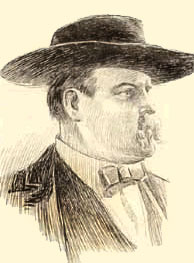
Decker

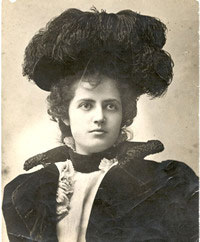
The episode centered around Karl Decker, a Journal reporter whom Hearst had sent to Cuba, and Evangelina Cisneros, a political prisoner jailed in Havana on suspicion of conspiring to kill a senior Spanish military officer.

Cisneros, who was 19, claimed the officer had made her the target of his unwelcome sexual advances.

She had been jailed more than a year, without trial, when Hearst’s Journal described her plight in a front-page article in August 1897.

The report claimed, incorrectly, that Cisneros already had been tried by a martial tribunal and was “in imminent danger” of being sentenced to 20 years’ imprisonment at Spain’s penal colony on Ceuta, off the north Africa coast.

As I wrote in my 2006 book, The Year That Defined American Journalism: 1897 and the Clash of Paradigms, the error mattered little to the Journal: “Far more important was that the prolonged imprisonment of Cisneros represented a brutish and unambiguous example of Spain’s cruel treatment of Cuban women—a topic of not infrequent attention in U.S. newspapers.”

In 1897, Spain still ruled Cuba, however tenuously. It had failed to put down an island-wide rebellion that began in 1895, despite having sent nearly 200,000 troops to Cuba. The Cuban rebellion was to give rise in 1898 to the Spanish-American War.

Following its disclosure about Cisneros’ jailing, the Journal organized a petition drive among American women, calling on the queen regent of Spain to release Cisneros. The newspaper claimed to have collected signatures from more than 10,000 women, but Spanish authorities were unmoved.

So in late summer 1897, Hearst sent Decker to Cuba, ostensibly as the Journal‘s correspondent in Havana. In reality, Decker was under orders to secure the release of Cisneros.

Evangelina Cisneros

With the quiet help of U.S. diplomatic personnel in Cuba–and with the crucial support of a clandestine smuggling network in Havana–Decker succeeded. In the early hours of October 7, 1897, Decker and two accomplices broke the bars of Cisneros’ cell and spirited her out of jail.

She was hidden for nearly three days at the home of one of the accomplices, Carlos F. Carbonell, an affluent, American-educated Cuban banker whom Cisneros later married.

Then, dressed as a boy, the diminutive Cisneros was smuggled aboard the Seneca, a passenger steamer bound for New York City, where Hearst organized a thunderous welcome for her.

Nearly 75,000 people turned out at New York’s Madison Square to welcome Cisneros and Decker, who had separately returned to the United States aboard a Spanish-flagged passenger vessel.

Cisneros “was rapturously received” in New York, I wrote in The Year That Defined American Journalism, “not because she was a daring and clever prison escapee, but because she was a frail and wily embodiment of the Cuban struggle for political independence from Spain.”

Some U.S. newspapers scoffed at the Journal‘s coup. “Jail-breaking journalism,” said the Chicago Times-Herald. But many other newspapers and trade journals cheered the exploit.

The Fourth Estate, for example, congratulated Decker and the Journal on an “international triumph” and saluted them for having “smashed journalistic records.”

For the Journal–which never was shy about self-promotion–the Cisneros jailbreak and rescue were “epochal,” the apogee of its brand of activist-oriented yellow journalism.

Interestingly, the Cisneros jailbreak fell quickly from the front pages of American newspapers–including those of the Journal. And the case was rarely mentioned in the American press, or by American political figures, as war loomed with Spain in the spring of 1898.

But “jail-breaking journalism” merits being recalled this week, as an episode unique in American journalism.

WJC

Recent and related:

<!–[if !mso]> the Journal, the Cisneros jailbreak and rescue was “epochal,”
/* Style Definitions */
table.MsoNormalTable
{mso-style-name:”Table Normal”;
mso-tstyle-rowband-size:0;
mso-tstyle-colband-size:0;
mso-style-noshow:yes;
mso-style-parent:””;
mso-padding-alt:0in 5.4pt 0in 5.4pt;
mso-para-margin:0in;
mso-para-margin-bottom:.0001pt;
mso-pagination:widow-orphan;
font-size:10.0pt;
font-family:”Times New Roman”;
mso-ansi-language:#0400;
mso-fareast-language:#0400;
mso-bidi-language:#0400;}
the Journal, the Cisneros jailbreak and rescue was “epochal,” the Journal, the Cisneros jailbreak and rescue was “epochal,”[i] a “supreme achievement of the journalism of action.”


[i]. Duval [Decker], “Evangelina Cisneros Rescued by the Journal,” New York Journal (10 October 1897).

On the high plateau of media distrust

In 1897, Debunking, Hurricane Katrina, Media myths, New York Times, Newspapers, Yellow Journalism on September 30, 2010 at 10:22 am

A Gallup poll released yesterday suggested that distrust of the news media has reached a high plateau among American adults.

Fifty-seven percent of Gallup’s respondents, the most ever, said they had little or no trust in the “mass media … when it comes to reporting the news fully, accurately, and fairly.” A year ago, the little-to-no trust response rate was 55 percent; in 2008 it was 56 percent.

As Andrew Malcolm noted at his engaging Top of the Ticket blog, the new “record high” in media distrust was reached “by one lousy percentage point.”

Even so, there’s little comfort in having reached such a plateau. And the factors accounting for a pronounced level of popular distrust are several–and hardly unfamiliar.

Surely one reason is that it’s commonplace to bad-mouth the news media as unreliable and unfair. Media-bashing has long been in fashion–and the news media are prone to beat up on themselves, and their rivals.

A commentary posted yesterday at the Atlantic blog put it well in saying that “media voices increasingly distinguish themselves by telling us not to trust the rest of the mainstream media. Think about all of the mass media today that tells us how stupid mass media is.”

True enough. That has to have an effect.

But the news media have long indulged in aiming brickbats and insults at one another. For the news media, media-bashing has long been an irresistible pasttime.

The ever-appealing and often-invoked epithet “yellow journalism” dates after all to 1897–and the efforts of a New York newspaper editor to find a pithy and imaginative way to denigrate what then was called the “new journalism” of William Randolph Hearst and Joseph Pulitzer.

Traditional and new, the media are everywhere these days and their ubiquity no doubt fosters some disdain and contempt. A hint of that contempt can be detected in the recent Pew Research Center’s news-consumption survey, which reported that 17 percent of American adults go newsless on a typical day.

Although the news media are everywhere, a sizable portion of the population has little use for them.

Going newsless can’t be easily accomplished, given the variety of readily accessible platforms by which news is delivered. But the going-newsless option is especially pronounced among American adults younger than 30: Pew’s report said 27 percent of that cohort gets no news on a typical day.

The prominent and well-documented fabrication scandals of several years ago doubt have contributed to the plateau of media distrust. The journalistic fraud committed by Jayson Blair of the New York Times and Jack Kelley of USA Today, among others, surely has left a bad taste for the media among many news consumers.

The inclination to distrust the media surely was reinforced by the highly exaggerated news coverage of Hurricane Katrina’s aftermath in New Orleans in 2005.

As I write in Getting It Wrong, my new book that debunks prominent media-driven myths, the Katrina coverage was “no high, heroic moment in American journalism. … On crucial details, journalists erred badly, and got it wrong. In the days following Katrina’s landfall, news reports described apocalyptic horror that the hurricane supposedly had unleashed.”

And that reporting was steeped in error.

The fifth anniversary of Katrina’s landfall was an occasion to revisit just how shoddy the news coverage was in the storm’s aftermath. And that anniversary fell shortly before Gallup conducted its annual media-trust survey.

Gallup said 1,019 adults were interviewed by telephone in a random survey conducted September 13-16. (The sampling error was plus or minus four percentage points, meaning the level of distrust could be as great as 61 percent, or as narrow as 53 percent.)

Mundane factors probably contribute to the plateau of distrust as well. Staff cuts at many U.S. newspaper, including the unsung heroes manning copy desks, have been blamed for an increase grammar, spelling, and factual errors.

It’s not that newspapers ever were mostly free of such lapses. Anecdotally at least, they seem more frequent and conspicuous. The ombudsman, or reader’s representative, at the Washington Post suggested as much last year in writing that growing numbers of readers were calling on him “to complain about typos and small errors” appearing in the newspaper.

And it’s become a cliché to say that such small-bore errors undermine credibility–or, perhaps more accurately, encourage media distrust.

And then there is the matter of limited viewpoint diversity in American newsrooms, a point I raise in Getting It Wrong.

Few journalists for mainstream national media “consider themselves politically conservative,” I note, referring to surveys conducted in 2004 and 2008 for the Washington-based Committee of Concerned Journalists. The surveys found that the overwhelming majority of national correspondents for U.S. news media considered themselves to be politically “moderate” or “liberal.”

Interestingly, Gallup reported that “Democrats and liberals remain far more likely than other political and ideological groups to trust the media and to perceive no bias.”

Viewpoint diversity in newsrooms “is an issue not much discussed in American journalism,” I write in Getting It Wrong. “But it is hardly irrelevant.”

Especially when distrust of the news media has found such a high plateau.

WJC

Recent and related: