W. Joseph Campbell

Archive for the ‘Spanish-American War’ Category

Going international: Media myths travel far, well

In Cinematic treatments, Debunking, Furnish the war, Media myths, Newspapers, Spanish-American War, Washington Post, Watergate myth on July 15, 2010 at 6:05 am

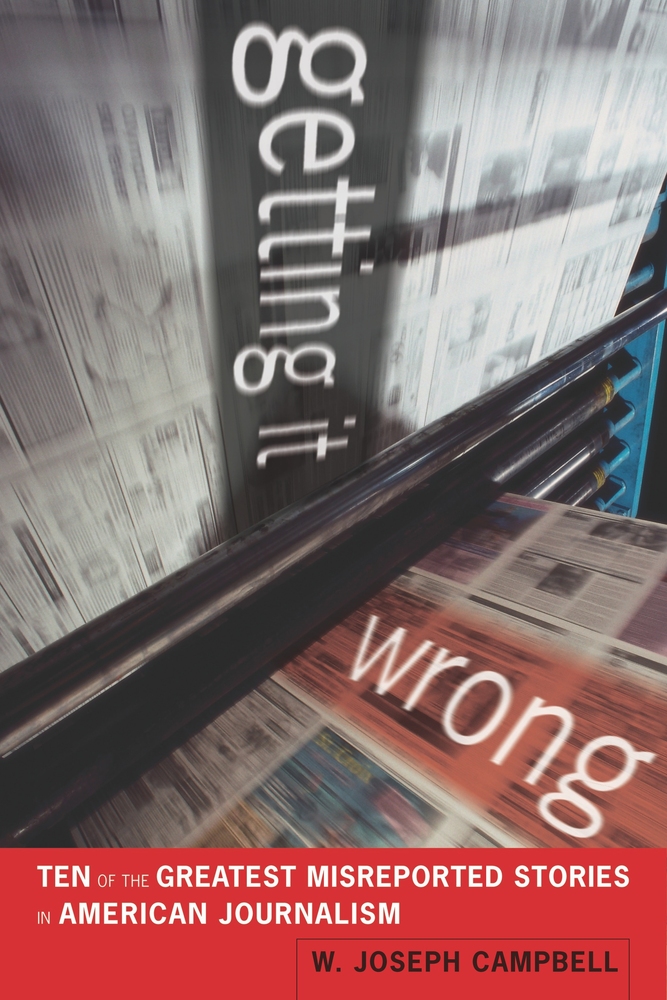
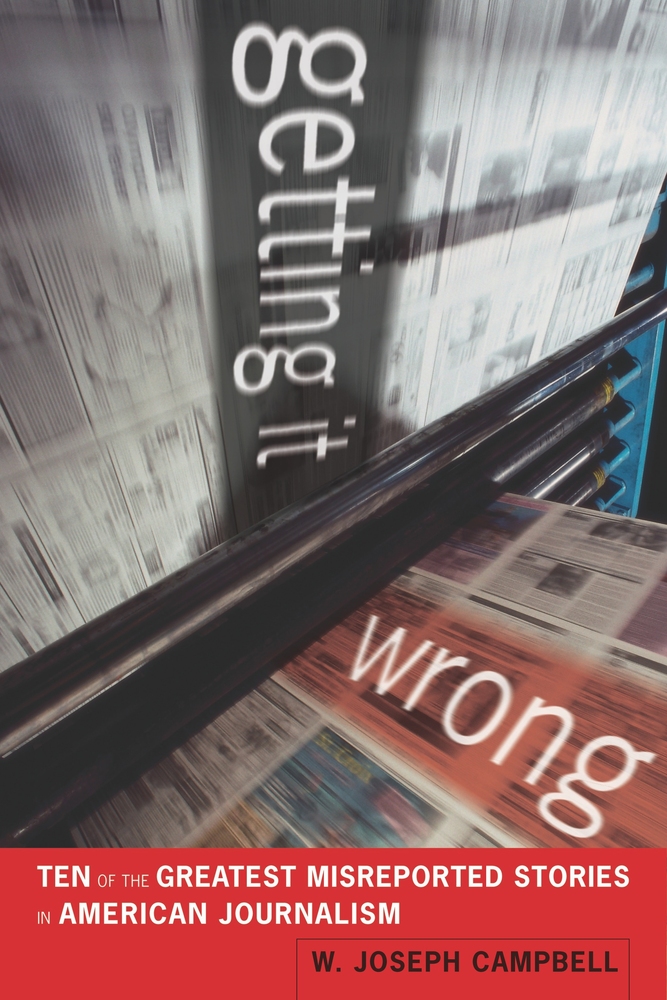
Prominent media-driven myths—the subject of my new book, Getting It Wrong—not only can be tenacious; some of them travel quite well, crossing linguistic and cultural borders with surprising ease.

Indeed, it’s a sign of hardy appeal when media-driven myths turn up in international contexts more often than just occasionally.

The heroic-journalist myth of Watergate–one of the 10 media myths I explore in Getting It Wrong—represents this phenomenon quite well. The heroic-journalist meme has it that the fearless investigative reporting by Bob Woodward and Carl Bernstein, then-young journalists for the Washington Post, brought down Richard Nixon’s corrupt presidency in the Watergate scandal.

Woodward

It’s a compelling tale that long ago became the scandal’s dominant popular narrative.

It’s also a simplistic interpretation of what was a complex and intricate web of misconduct that took down Nixon and landed nearly 20 of his top aides, associates, and cabinet officers in jail.

I note in Getting It Wrong that to roll up a scandal of such dimension required the collective, if not always the coordinated, efforts of special prosecutors, bipartisan congressional panels, federal judges, the FBI, and, ultimately, the U.S. Supreme Court, which ordered Nixon to surrender audiotapes that proved his complicity in the Watergate cover-up.

Against such a tableau, journalism’s contributions to unraveling Watergate were modest—certainly not decisive.

But because the heroic-journalist interpretation is so straightforward and unambiguous, it’s not surprising that it finds appeal across cultures and turns up fairly often in media reports outside the United States.

Simplicity propels the Watergate myth, enabling it to travel far and well.

Just the other day, for example, a commentary at Mediapart, a French online investigative reporting site, recalled Woodward and Bernstein as “the two journalists for the Washington Post who, thanks to their investigation, set in motion the resignation of President Richard Nixon, during Watergate.”

Another media myth that travels widely and well is that of William Randolph Hearst’s purported vow to “furnish the war” with Spain at the end of the 19th century. Hearst’s pledge supposedly was contained in a cable to the artist Frederic Remington, whom Hearst sent to draw illustrations of the Cuban rebellion, which preceded the Spanish-American War.

The anecdote lives on as one of the most famous and delicious in American journalism—even though it is buttressed by no supporting documentation and is improbable on its face.

It is, however, a tale almost too good to be disbelieved, given that it so effectively captures Hearst as warmonger . The anecdote turns up more than occasionally abroad, especially in Spanish-language media.

I note in Getting It Wrong that “Hearst’s famous vow to ‘furnish the war’ has achieved unique status as an adaptable, hardy, all-purpose anecdote, useful in illustrating any number of media sins and shortcomings. It has been invoked to illustrate the media’s willingness to compromise impartiality, promote political agendas, and indulge in sensationalism. It has been used, more broadly, to suggest the media’s capacity to inject malign influence into international affairs.”

With all that going for it, the step to adoption in international contexts is fairly small.

Beyond simplicity and deliciousness, the international appeal of prominent media myths also may be attributed to a keen and enduring curiosity abroad in American journalism. For all its faults and uncertainties, American journalism is a sprawling, robust, and intriguing profession. Such dynamism exerts appeal and interest beyond the United States.

American cinema is perhaps an even more powerful force: Hollywood treatments have helped solidify media myths. And Hollywood productions often travel well abroad.

The 1976 film All the President’s Men certainly helped propel the heroic-journalist myth of Watergate, for example. As I write in Getting It Wrong: “More than thirty-five years later, what remains most vivid, memorable, and accessible about Watergate is the cinematic version of All the President’s Men.”

The movie, I note, “helped ensure the [heroic-journalist] myth would live on by offering a neat, tidy, and vastly simplified account the Watergate scandal, one that allowed viewers to sidestep the scandal’s complexity while engaging in an entertaining storyline.”

Hollywood also was crucial to cementing Hearst’s purported vow into the popular consciousness. That vehicle was Citizen Kane, the 1941 motion picture based loosely on Hearst’s life and times.

Hearst’s purported vow is paraphrased in a scene early in Kane, which some critics regard as the best-ever American motion picture.

The Hearstian vow also is quoted in the 1997 James Bond movie, Tomorrow Never Dies. Or, as it was known in francophone countries, Demain ne meurt jamais.

WJC

A version of this post first appeared at the University of California Press blog.
‘Persuasive and entertaining’: WSJ reviews ‘Getting It Wrong’

In Cronkite Moment, Debunking, Furnish the war, Jessica Lynch, Media myths, Murrow-McCarthy myth, New York Times, Reviews, Spanish-American War, War of the Worlds, Washington Post, Watergate myth on July 12, 2010 at 6:05 am

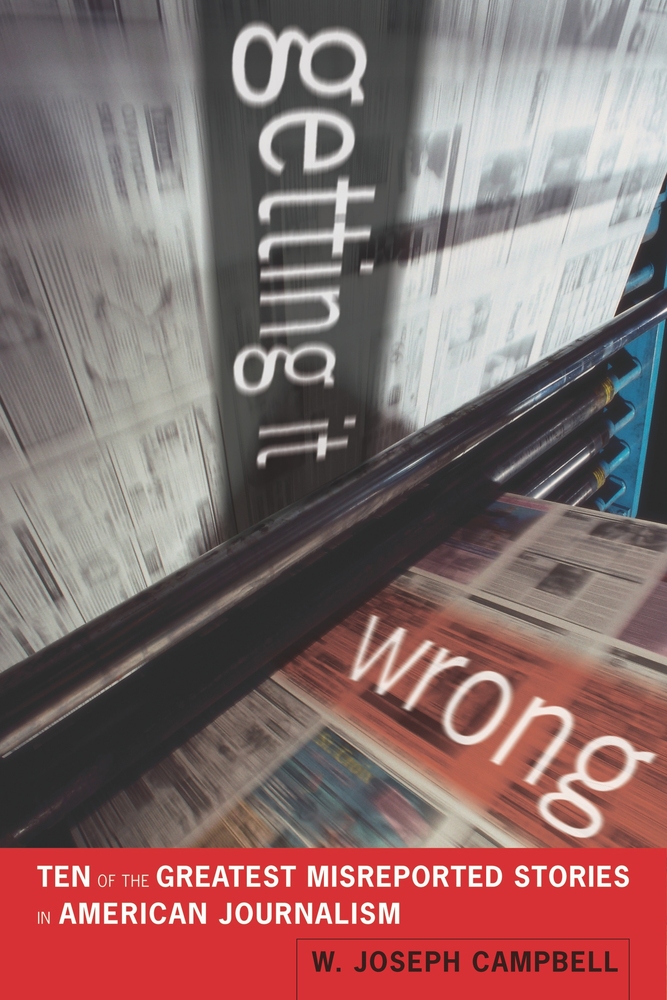
Today’s Wall Street Journal reviews Getting It Wrong, characterizing as “persuasive and entertaining” my new book debunking 10 prominent media-driven myths.

The review–which appears beneath the headline “Too good to check”–is clever and engaging, and opens this way:

“Hello, city desk, get me rewrite. Here’s the lead: Many of the landmark moments in American journalism are carefully nurtured myths—or, worse, outright fabrications.

“William Randolph Hearst never said, ‘You furnish the pictures, and I’ll furnish the war.’ Orson Welles’s ‘War of the Worlds’ radio broadcast didn’t panic America. Ed Murrow’s ‘See It Now’ TV show didn’t destroy Sen. Joseph McCarthy. JFK didn’t talk the New York Times into spiking its scoop on the Bay of Pigs invasion. Far from being the first hero of the Iraq War, captured Army Pvt. Jessica Lynch was caught sobbing ‘Oh, God help us’ and never fired a shot.

“These fables and more are lovingly undressed in W. Joseph Campbell’s persuasive and entertaining ‘Getting It Wrong.’ With old-school academic detachment, Mr. Campbell, a communications professor at American University, shows how the fog of war, the warp of ideology and muffled skepticism can transmute base journalism into golden legend.”

The reviewer, Edward Kosner, author of the memoir It’s News to Me, also discusses the myth of the “Cronkite Moment,” writing, “Television icons are central to two of Mr. Campbell’s dubious cases: Murrow and his successor as the patron saint of TV news, Walter Cronkite.”

Kosner notes–as I do in Getting It Wrong–that at least some of the myths confronted in the book will likely survive their debunking.

“For all Mr. Campbell’s earnest scholarship,” Kosner writes, “these media myths are certain to survive his efforts to slay them. Journalism can’t help itself—it loves and perpetuates its sacred legends of evil power-mongers, courageous underdogs, dread plagues and human folly.”

Well said.

And, alas, he may be right. Some of the myths almost certainly will live on. As I write in the introduction to Getting It Wrong, they “may prove resistant to debunking. They may still be widely believed despite the contrary evidence marshaled against them.

“The most resilient myths,” I further write, “may be those that can be distilled to a catchy, pithy phrase like: ‘If I’ve lost Cronkite, I’ve lost Middle America.’ Such quotations are neat, tidy, and easily remembered. Cinematic treatments influence how historical events are collectively remembered and can harden media-driven myths against debunking. The motion picture All the President’s Men, which cast Robert Redford and Dustin Hoffman in the lead roles of Washington Post reporters [B0b] Woodward and [Carl] Bernstein, has helped ensure that the journalists and their newspaper would be regarded as central to cracking the Watergate scandal.”

Kosner closes the review with a humorous observation, writing:

“At the end of the book, Mr. Campbell offers some remedies for media mythologizing, urging journalists, among other things, ‘to deepen their appreciation of complexity and ambiguity.’ Good luck with that, professor.'”

Heh, heh. Nice touch.

WJC

Related:

‘Getting It Wrong’ on the road in Oberlin, OH

In Cronkite Moment, Debunking, Furnish the war, Media myths, Murrow-McCarthy myth, Spanish-American War, War of the Worlds, Watergate myth, Yellow Journalism on June 27, 2010 at 8:40 am

I gave a talk yesterday about Getting It Wrong to an engaging audience at the college bookstore in Oberlin, Ohio.

The talk was facilitated quite well by Kira McGirr, the bookstore’s tradebook manager, and covered such topics as William Randolph Hearst’s purported vow to “furnish the war” with Spain at the end of the 19th century, the myth of the “Cronkite Moment” of February 1968, and the heroic-journalist myth of Watergate.

We also discussed the media-driven myth of “crack babies” and the famous 1938 radio dramatization of The War of the Worlds, which supposedly was so dramatic that tens of thousands of Americans were seized by panic and mass hysteria.

One of Kira’s questions was how long it may take before the myths discussed and debunked in Getting It Wrong to be excised from history books. It’s a very good question, and difficult to say for sure.

I responded by saying some of the myths–such as those of Watergate and the War of the Worldsare so appealing, delicious, and ingrained that they may never be totally uprooted.

The same probably goes for Hearst’s purported vow: That anecdote has been around since 1901 and likely is too appealing ever to be utterly debunked. What’s more, the “furnish the war” tale is a neat, tidy, reductive way of explaining the causes of the Spanish-American War:  Hearst, the war-mongering publisher, is to blame.

It’s far easier to blame Hearst than it is to grapple with the complexities of the diplomatic demarche in 1897-98 that failed to resolve differences among Spain, Cuba, and the United States: Failed diplomacy, not the contents of Hearst’s yellow press, led to the Spanish-American War.

We also discussed how high-quality cinematic treatments can press media myths into the public consciousness.

That certainly was the case with All the President’s Men, the most-viewed movie about Watergate, in which Robert Redford and Dustin Hoffman played the starring roles of Washington Post reporters Bob Woodward and Carl Bernstein.

The film depicted the reporters as central, indeed crucial, to cracking the Watergate scandal, I noted. For many Americans,  All the President’s Men is an important way of learning about Watergate. As I write in Getting It Wrong: “More than thirty-five years later, what remains most vivid, memorable, and accessible about Watergate is the cinematic version of All the President’s Men.”

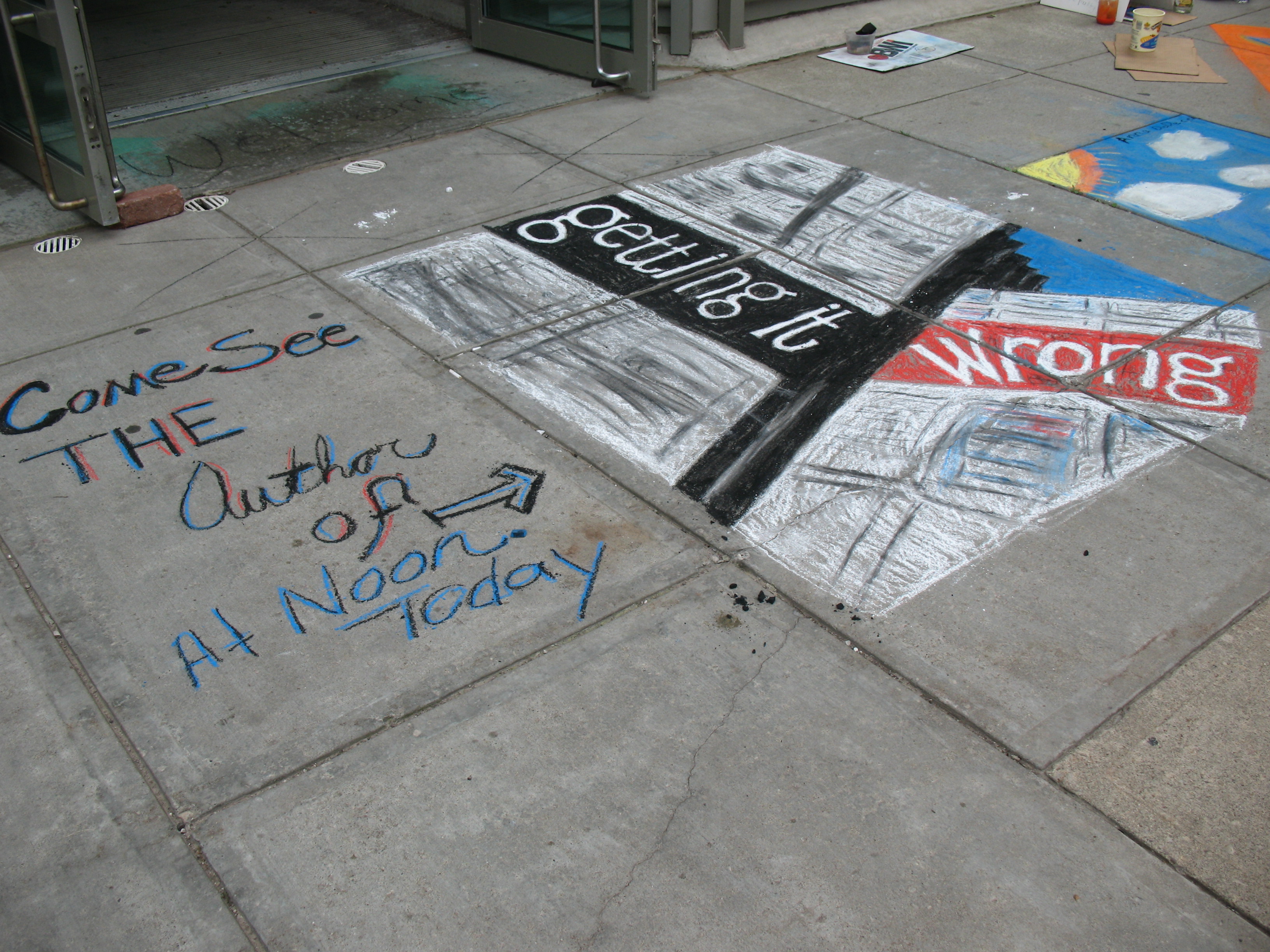
The book talk coincided with Oberlin’s fifth annual Chalk Walk event, at which artists and aspiring artists draw often-elaborate pastel images on the sidewalks in the heart of town.

One of Kira’s colleagues, Amanda Turner, drew a fine rendering of the cover of Getting It Wrong at the entrance to the bookstore (see photo).

Amanda, Kira, and I posed for the photo below.
Several former classmates of mine at Oberlin Firelands High School (class of 1970) also attended the book talk.

WJC

Related:

Photo credit: Ann-Marie C. Regan (Chalk Walk images)

‘Getting It Wrong’ launched at Newseum

In Cronkite Moment, Debunking, Furnish the war, Media myths, Murrow-McCarthy myth, Spanish-American War, Washington Post, Watergate myth on June 20, 2010 at 2:09 pm

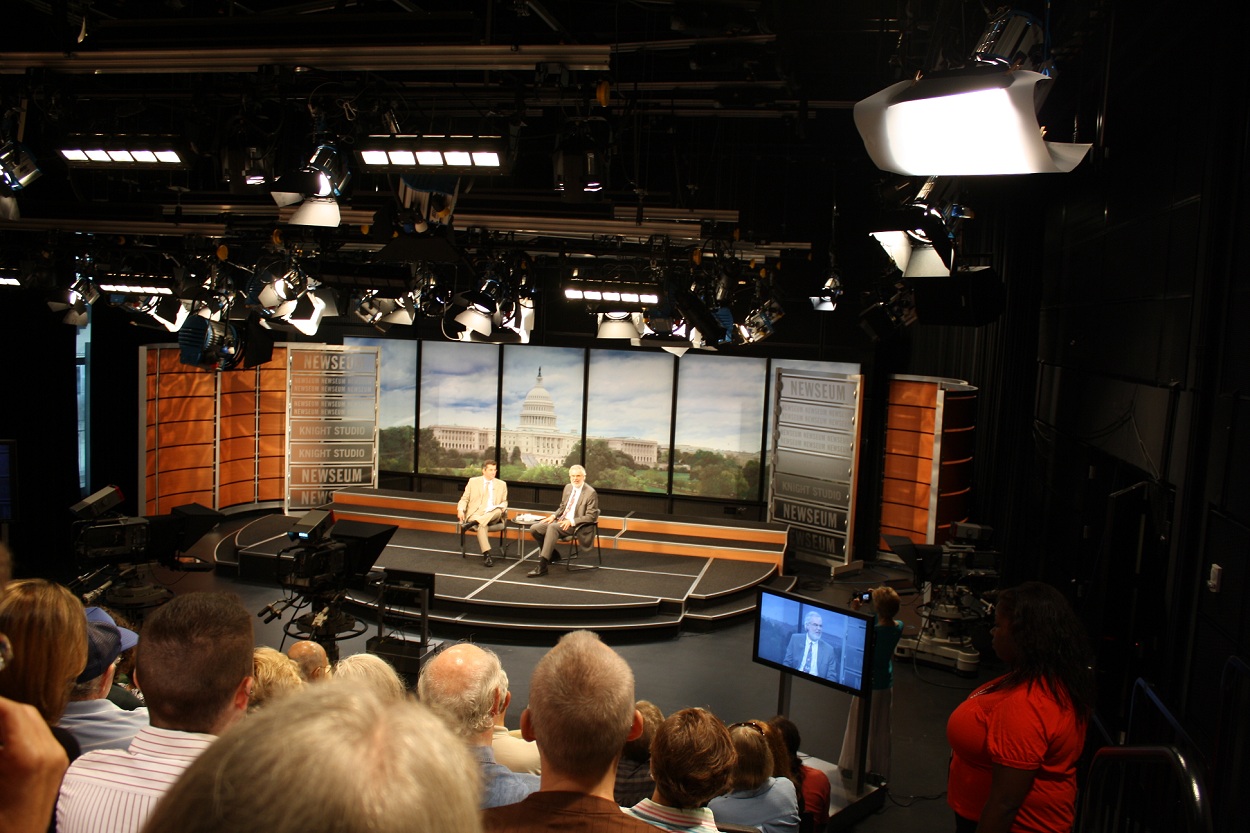
Newseum program, audience view

Getting It Wrong, my new book about media-driven myths, was launched at a terrific program yesterday at the Newseum, the $450 million museum of news in downtown Washington, D.C.

The Newseum’s John Maynard moderated a brisk “Inside Media” talk, during which I reviewed the myths of:

  • William Randolph Hearst’s purported vow to “furnish the war” with Spain,
  • Edward R. Murrow‘s  1954 See It Now television program that supposedly ended Senator Joseph R. McCarthy’s communists-in-government witch-hunt,
  • the so-called “Cronkite moment” of 1968,
  • the heroic-journalist of Watergate, and
  • the supposedly superlative reporting in the immediate aftermath of Hurricane Katrina‘s landfall in 2005.

The audience (see photo, above) posed several intriguing questions about the book. Among them was whether I thought the media myths confronted in Getting It Wrong would now be forever buried.

It’s probably too soon to say, given the book’s recent publication. But I mentioned in my reply that I’ve been struck by how dearly some myths are held.

The myth of the “Cronkite moment” is an example, I said: It seems quite difficult for some people to believe that Walter Cronkite’s program on Vietnam in February 1968 was not of decisive effect.

The “Cronkite moment” may live on, and continue to be embraced, despite the weight of the evidence that Cronkite’s television report about Vietnam was of scant importance in revising policy or in shaping the president’s thinking about reelection.

At the book launch

A question was posed about how media myths emerge, and I noted that they arise from several sources, including an urge to identify examples of media power. Another factor is  what I call “complexity-avoidance”–the appeal of simplified explanations for complex historical events.

It is, after all, far easier to believe that Hearst and his “yellow press” brought on the Spanish-American War in 1898, I said, than it is to grasp the complexities of the failed diplomacy among Spain, Cuba, and the United States that gave rise to that conflict. It is far easier to believe that the Washington Post brought down Richard Nixon’s corrupt presidency, I said, than it is to sort through tangled lines of investigation of the Watergate scandal that ultimately forced Nixon from office.

Even then, I said, Nixon may have served out his term if not for the tape-recordings he made of his private Oval Office conversations. Those tapes, which the U.S. Supreme Court forced Nixon to produce in 1974, revealed his guilty role in the Watergate coverup.

I also was asked whether there are other media myths to bust.

Indeed there are, I said.

Getting It Wrong may deserve a sequel and suggested as candidates for a follow-on book the dubious phenomenon of “Pharm Parties” and the question of whether Cronkite really was “the most trusted man in America.”

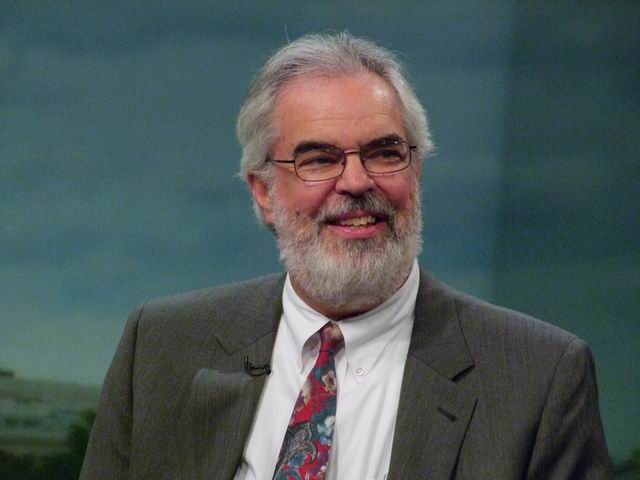
Book signing at Newseum

I signed copies of Getting It Wrong following the “Inside Media” program, and then toasted the book’s publication at a reception sponsored by the Newseum and American University’s School of Communication.

The School’s dean, Larry Kirkman, offered generous remarks in his toast at the reception, which was attended by AU colleagues, former students, past research assistants, and friends and family.

WJC

Related:

Photo credits:

  • Ruxandra Giura (audience view)
  • Bruce Guthrie

War, the ‘apex of yellow journalism’? Not so

In Debunking, Jessica Lynch, Media myths, Spanish-American War on June 10, 2010 at 11:52 am

I’ve noted from time to time how some media-driven myths–those false, dubious, improbable stories about the news media that masquerade as factual–travel quite well, crossing linguistic barriers with frequency and ease.

Hearst's New York Evening Journal, 1898

One of the more hearty, adaptable, and internationally appealing media myths is that of American “yellow journalism,” and how its sensational and exaggerated content supposedly brought about the Spanish-American War in 1898.

That myth was debunked in my 2001 study, Yellow Journalism: Puncturing the Myths, Defining the Legacies. But it is probably too deliciously appealing, too neat and tidy, ever to die away.

Indeed, it popped up in an international way yesterday, in a commentary in the English-language edition of China’s Global Times. The commentary appeared beneath the headline, “Yellow journalism creeping into Chinese media,” and declared:

“The term yellow journalism was coined during … late 19th century when media barons William Randolph Hearst and Joseph Pulitzer’s respective newspapers, the New York Journal and the New York World, were in cutthroat competition. …

“The apex of US yellow journalism came when the two newspapers’ fear mongering and sensationalism led to the Spanish-American War in 1898.”

As I wrote in Yellow Journalism, the notion that the yellow press of Hearst and Pulitzer brought on the war with Spain over Cuba rests on a narrow, decidedly media-centric interpretation of the conflict’s causes.

That interpretation ignores, I noted, the “more relevant and immediate factors that give rise to armed conflict.

“In the case of the Spanish-American War,” I wrote in Yellow Journalism, “the policy objectives between the United States and Spain ultimately proved irreconcilable. Months of intricate diplomatic efforts ultimately failed to resolve what had become an intolerable state of affairs in Cuba, dramatized by the destruction of the [U.S. warship] Maine in a harbor under Spanish control and supervision.

“To indict the yellow press for causing the Spanish-American War is to misread the evidence and to ignore the intricacies of the diplomatic quandary that culminated in the spring of 1898 in an impasse that led to war.”

Failed diplomacy gave rise to the Spanish-American War, not the content of the yellow press of Hearst and Pulitzer.

Even so, it is intriguing how wartime can and does give rise to media-driven myths.

Of the 10 prominent myths addressed and debunked in my new book, Getting It Wrong, five of them (including the case of Jessica Lynch in the Iraq War) are related to conflict and upheaval.

I consider the linkage of war and media myth in Getting It Wrong, writing:

“That war can be a breeding ground for myth is scarcely surprising. The stakes in war are quite high, and the shock of combat is alien and unfamiliar to most people. Given their limited first-hand experience with war, media audiences usually find themselves in no position to challenge reports from the battlefield.

“The confusion and intensity inherent in warfare can lead journalists to place fragmented information that emerges from conflict into recognizable if sometimes misleading frames.

“In the process, distortion can arise and media myths can flourish.”

But unfamiliarity with warfare only partly explains the tenacity and international appeal of the myth that yellow journalism fomented the Spanish-American War.

Another, perhaps more important factor is that the anecdote outlines the purported extremes–the malevolent extremes–of media influence. That is, the news media can be so powerful that they can lead the country into war, if we’re not mindful.

Which is absurd.

WJC

Related:

On Hearst, yellow journalism, and war

In Debunking, Furnish the war, Media myths, Newspapers, Spanish-American War, Yellow Journalism on June 5, 2010 at 10:04 am

The dubious linkage of William Randolph Hearst, late 19th century yellow journalism,  and the Spanish-American War was invoked yesterday in a post at the Breaking Media online site.

The item discussed the latest deal by Hearst Corp., noting the reported acquisition was “not a newspaper, a magazine or even a website, but [iCrossing Inc.,] a company specializing in buying search keywords and performing social media“—and suggested that William Randolph, the company’s founder who died in 1951, would have approved.

Hearst before the war

Inevitably, perhaps, the Breaking Media item offered an historically flabby slice of context, asserting that “the Hearst name will forever be associated with yellow journalism techniques that led to a war and mainstream acceptance of all kinds of crazy pseudoscience.”

I don’t know about the last bit, the “acceptance of all kinds of crazy pseudoscience.”

But the claim about Hearst, yellow journalism, and war is an exaggeration, a media-driven myth.

The reference to “war” is, of course, to the Spanish-American War of 1898, the 114-day conflict in which the United States routed Spanish forces in Cuba, Puerto Rico, and the Philippines. The myth is that Hearst and his flamboyant yellow journalism whipped American public opinion to such an extent that war with Spain (over its harsh colonial rule of Cuba) became inevitable.

The myth is addressed, and debunked, in my 2001 book, Yellow Journalism: Puncturing the Myths, Defining the Legacies. A slice of the myth–that notion that Hearst vowed to “furnish the war” with Spain–is discussed in a chapter my new book, Getting It Wrong.

In Yellow Journalism, I noted that the argument that Hearst fomented the war with Spain over Cuba rests on a decidedly narrow, media-centric interpretation of the conflict’s causes.

That interpretation ignores, I noted, the “more relevant and immediate factors that give rise to armed conflict.

“In the case of the Spanish-American War,” I wrote, “the policy objectives between the United States and Spain ultimately proved irreconcilable. Months of intricate diplomatic efforts ultimately failed to resolve what had become an intolerable state of affairs in Cuba, dramatized by the destruction of the [U.S. warship] Maine in a harbor under Spanish control and supervision.

“To indict the yellow press for causing the Spanish-American War is to misread the evidence and to ignore the intricacies of the diplomatic quandary that culminated in the spring of 1898 in an impasse that led to war.”

Failed diplomacy gave rise to the Spanish-American War, not the content of Hearst’s newspapers in New York and San Francisco.

I also pointed out in Yellow Journalism:

“The notion that the yellow press incited or fomented the Spanish-American War stands, moreover, as testimony to the supposedly powerful, even malevolent effects of the news media—that they can and sometimes do act in dangerous, devious, and manipulative ways.”

And that’s an important reason why the myth about Hearst, yellow journalism, and war has proved so tenacious. It offers a lesson, however misleading, about the extreme hazards of unchecked media power: Unscrupulous media moguls can take us into wars that otherwise we would not fight.

WJC

Related:

‘Getting It Wrong’ goes ‘On Point’

In Cinematic treatments, Cronkite Moment, Debunking, Furnish the war, Media myths, Media myths and radio, Spanish-American War, Washington Post, Watergate myth on June 3, 2010 at 8:52 pm

I was interviewed today by Tom Ashbrook, the engaging host of NPR’s On Point program, which is produced by WBUR in Boston.

We discussed Getting It Wrong, my new book about media-driven myths, and it was a fine show. (Audio is available here.)

As Ashbrook promised in his introduction, the conversation ranged over a variety of topics–or what he called “iconic media tales from the Spanish-American War to Hurricane Katrina.”

We were joined by Jack Beatty, the program’s news analyst, and discussed at some length the myth of the so-called “Cronkite Moment” of 1968, in which CBS News anchorman Walter Cronkite characterized the war in Vietnam as a stalemate, supposedly prompting President Lyndon Johnson to alter his policy on the conflict.

We also took up myth surrounding the famous anecdote about William Randolph Hearst’s purported vow to “furnish the war” with Spain at the end of the 19th century, the dubious notion that Orson Welles’ 1938 radio dramatization of the War of the Worlds set off nationwide panic and mass hysteria, and what I call the heroic-journalist myth of Watergate, in which Bob Woodward and Carl Bernstein of the Washington Post supposedly brought down Richard Nixon’s corrupt presidency.

On the latter topic, I mentioned how the cinematic version of All the President’s Men, Woodward and Bernstein’s book about their Watergate reporting, has become the vehicle by which people learn about and remember the scandal.

Watergate was, I noted, “so complex that people these days, many years removed from it, find it hard to keep it all straight. … The high-quality, cinematic treatment of the Watergate scandal, featuring Woodward and Bernstein and the Washington Post in All the President’s Men, does happen to be the way that many people remember the Watergate scandal. …

“The movie’s a great movie,” I added. “But it helped to solidify the notion that the Post, the Washington Post, and Woodward and Bernstein were at the center, were at the heart, of uncovering the scandal.”

On Point featured questions and comments from a few callers–including a guy named Phil in Bowling Green, Kentucky, who said about me:

“I think the professor has got too much time on his hands. ” I chuckled.

He added: “I lived through most of that–the Watergate and Vietnam War.  I think he’s underestimating the persuasive attitude that Walter Cronkite had on this country. … Everybody’s opinion turned on what Walter Cronkite thought.”

But another caller, Gary from Nashville, Tennessee, weighed in, saying he disagreed with Phil from Bowling Green, offered the thought that public opinion about Vietnam turned not on the views of one journalist but on “the unrelenting reporting on the war by the media.”

It was a lively, substantive program that has generated a few dozen or so comments at the On Point online site.

The discussion made me recognize anew how deeply embedded and tenaciously held some media-driven myths really are, and how an hour-long program is hardly enough to encourage people even to think about giving them up. As Jack Shafer noted in his review of Getting It Wrong, “a debunker’s work is never done.”

But perhaps the show’s content will entice some listeners to buy and read the book. Even then, though, I suspect some media myths will prove resistant to thorough debunking.

WJC

Related:

Media myths, the ‘junk food of journalism’

In Debunking, Furnish the war, Murrow-McCarthy myth, Spanish-American War, Washington Post, Watergate myth on May 26, 2010 at 9:14 pm

Media-driven myths, the subject of my soon-to-be-published book, Getting It Wrong, are prominent tales of doubtful authenticity—false, dubious, or improbable stories about the news media that masquerade as factual.

The  myths addressed and debunked in the book include the notion that two intrepid reporters for the Washington Post took down Richard Nixon’s corrupt presidency, that Edward R. Murrow’s See It Now television program brought an end to Senator Joseph McCarthy’s communists-in-government witch-hunt, and that newspaper magnate William Randolph Hearst vowed to “furnish the war” with Spain at the end of the 19th century.

“In a way,” I write in Getting It Wrong, media myths “are the junk food of journalism—alluring and delicious, perhaps, but not especially wholesome or nourishing.”

But why bother: Why devote a book to debunking media-driven myths?

It’s a question that, somewhat to my surprise, arises not infrequently.

Several answers offer themselves.

For one, there is inherent value is seeking to set straight the historical record. As I write in Getting It Wrong, “the effort to dismantle [media myths] is certainly worthy, if only to insist on a demarcation between fact and fiction.” That effort is aligned with a core objective of newsgathering—that of getting it right.

Media-driven myths, moreover, are neither trivial nor innocuous. They can have adverse consequences. They tend, for example, to minimize the nuance and complexity of historical events and offer simplistic and misleading interpretations instead. It’s effortless and undemanding to say the Washington Post brought down Nixon, that Murrow ended McCarthyism, or that Hearst plunged the United States into war with Spain. The historical reality in each of those cases is, of course, significantly more complex.

So media-driven myths distort popular understanding about the roles and functions of journalism in American society. They tend to confer on the news media far more power and influence than they typically wield.

Media influence, I write in the book, usually “is trumped by other forces” and further undercut by the traditional self-view of American journalists as messengers first, rather than as makers and shapers of news.

What’s more, the news media these days are too splintered and diverse—print, broadcast, cable, satellite, online—to exert much in the way of collective and sustained influence on policymakers or media audiences.

Thus, debunking media-driven myths can help to locate media influence in a more coherent context. Getting It Wrong offers the case that such influence tends to modest, nuanced, and situational.

There are occasions, though, when the splintered news media coalesce and devote exceptionally intense attention to a single topic—such as Hurricane Katrina’s rampage along the Gulf Coast nearly five years ago. The news media gave themselves high marks for their coverage of the disaster’s aftermath, especially of the federal government’s fitful response.

But as I discuss in Getting It Wrong, the coverage also was characterized by highly exaggerated reports of nightmarish violence and wanton criminality in New Orleans in the hurricane’s wake. The misreporting of the disaster’s aftermath, I write, effectively “defamed a battered city and impugned its residents at a time of their deep despair.”

Thus, another reason why debunking matters—media-driven myths can and do feed prejudices and stereotypes.

Finally, confronting media myths discourages the tendency to regard prominent journalists in extreme terms—as heroes or villains. Piercing the myth surrounding Murrow renders him somewhat less Olympian. Similarly, debunking the myth about Hearst and his purported vow to “furnish the war” with Spain makes him seem less manipulative, and less demonic.

Getting It Wrong is a work with a provocative edge. Given that it takes on some of the most treasured stories in American journalism, it could not be otherwise.

WJC

This post first appeared at the University of California Press blog.

In myth, a truism: Hearst’s vow ‘will forever live on’

In 1897, Debunking, Furnish the war, Media myths, Spanish-American War, Yellow Journalism on May 17, 2010 at 8:34 am

William Randolph Hearst’s purported vow to “furnish the war” with Spain “has achieved unique status as an adaptable, hardy, all-purpose anecdote,” I write in my forthcoming book about media-driven myths, Getting It Wrong.

The anecdote, I point out, “has been invoked to illustrate the media’s willingness to compromise impartiality, promote political agendas, and indulge in sensationalism. It has been used, more broadly, to suggest the media’s capacity to inject malign influence into international affairs.”

It is for such reasons the Hearstian anecdote endures, despite having been thoroughly debunked. The tale is revisited, and debunked anew, in the first chapter of Getting It Wrong.

But it may well be that Hearst’s purported vow “will forever live on in journalism history,” as a columnist for the Times of Northwest Indiana newspaper wrote in a commentary published yesterday.

Far from challenging or disputing the tale, the columnist embraced it, repeating as if factual the supposed exchange between Hearst and the artist Frederic Remington, in which Hearst reputedly asserted:

“You furnish the pictures, and I’ll furnish the war.”

Remington was in Cuba in January 1897, on assignment for Hearst’s New York Journal to draw sketches of the rebellion against Spanish colonial rule. If the exchange did take place, it would have been then, in early 1897.

As I write in Getting It Wrong,  the anecdote lives on despite a nearly complete absence of supporting documentation. It lives on even though the telegram that supposedly contained Hearst’s vow has never turned up. It lives on even though Hearst denied ever sending such a message.

And it lives on despite an irreconcilable internal inconsistency: It would have been absurd for Hearst to vow to “furnish the war” because war—specifically, the Cuban rebellion—was the reason he sent Remington to Cuba in the first place. (The rebellion gave rise in 1898 to the Spanish-American War.)

The sole source for the anecdote was a self-important journalist named James Creelman. He was neither in Cuba nor in New York at the time the exchange would have occurred. Creelman then was in Europe, as a correspondent for Hearst’s Journal.

That means Creelman learned about the tale second-hand.

Or made it up.

The durability of media myths such as the “furnish the war” anecdote is discussed in Getting It Wrong. I acknowledge that “some myths addressed [in the book] may prove resistant to debunking. They may still be widely believed despite the contrary evidence marshaled against them.”

I note that the “most resilient myths may be those that can be distilled to a catchy, pithy phrase.”

Quotations such as “You furnish the pictures, and I’ll furnish the war” are indeed neat, tidy, catchy, and delicious. They are easy to remember, fun to repeat, and too good not to be true.

Almost certainly, they will live on.

WJC

Check out new trailer for ‘Getting It Wrong’

In 1897, Debunking, Furnish the war, Media myths, Spanish-American War, War of the Worlds, Yellow Journalism on May 8, 2010 at 3:45 pm

Here’s the book trailer for Getting It Wrong, my forthcoming book that addresses, and debunks, 10 prominent media-driven myths.

Getting It Wrong will be published this summer by University of California Press.

WJC