W. Joseph Campbell

Archive for the ‘War of the Worlds’ Category

Discussing ‘Getting It Wrong’ at a special place

In Anniversaries, Debunking, Media myths, Media myths and radio, Newspapers, War of the Worlds on October 28, 2010 at 5:30 pm

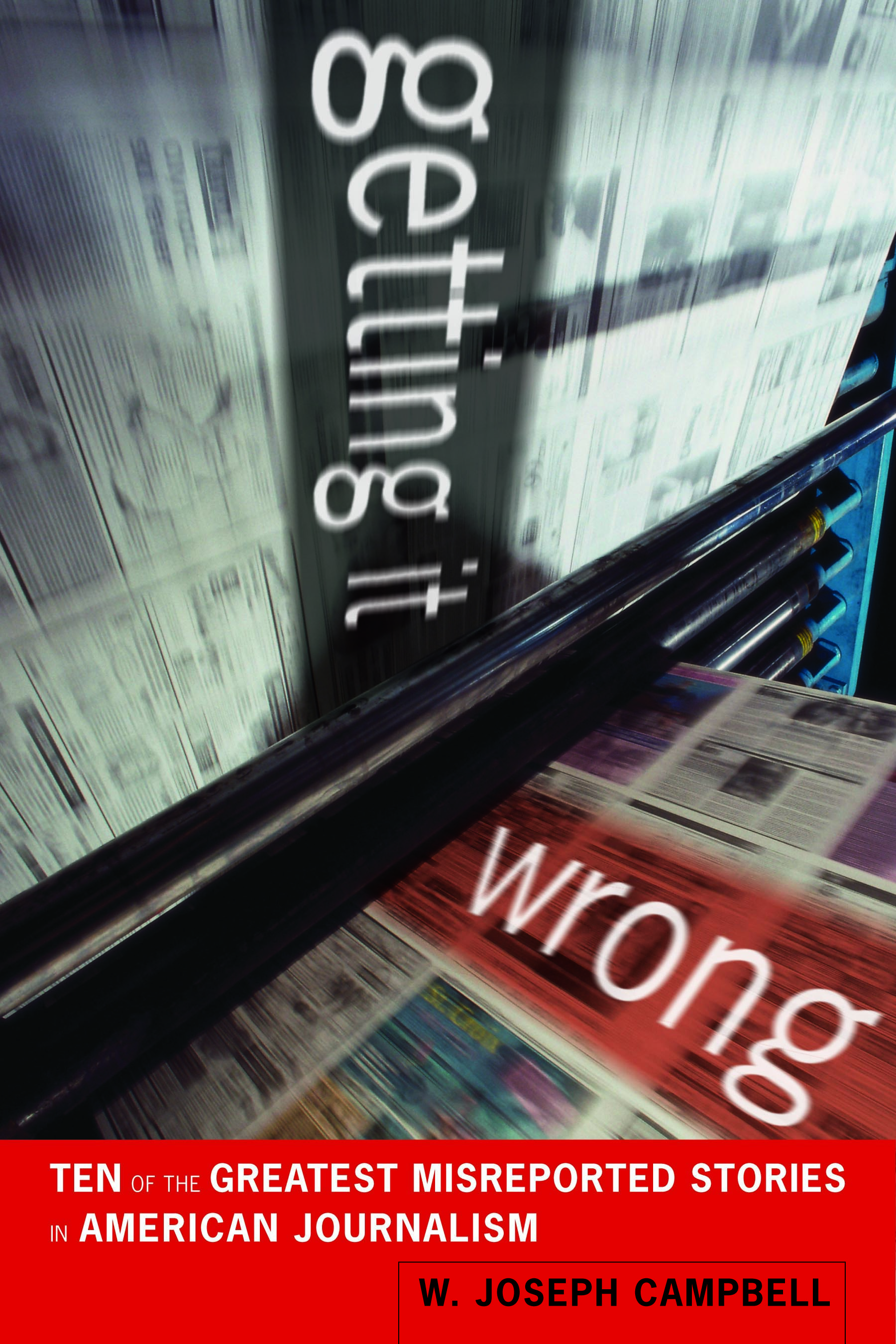
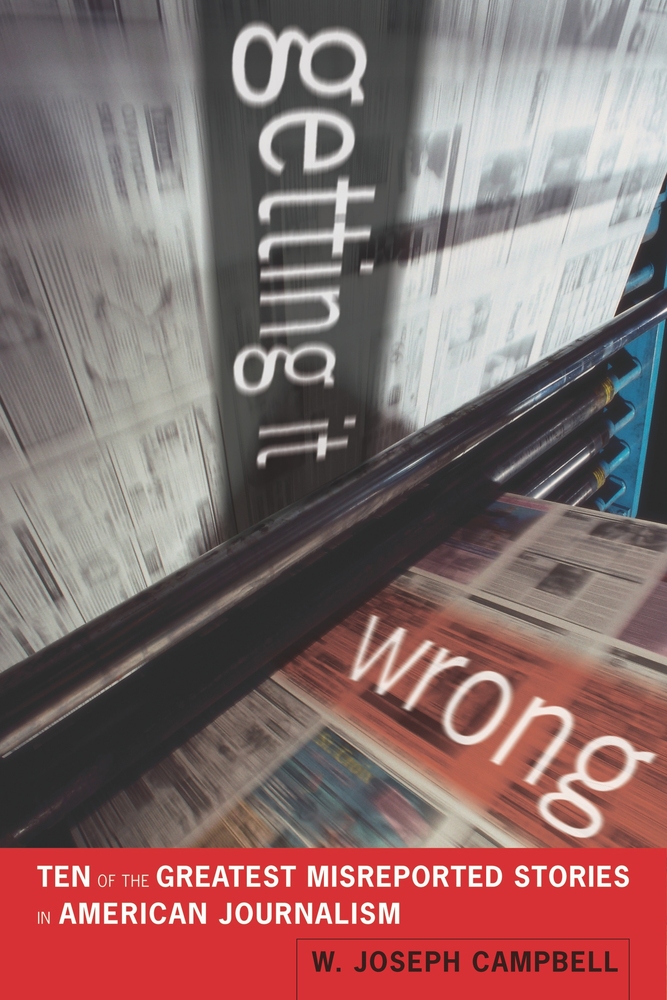
There was a fine turnout today for my book talk at the Library of Congress, the splendid institution where I have done a great deal of research over the past 12 years or so.

The Library is a special place, and more than 120 people were there as I reviewed three of the 10 media-driven myths that are addressed and debunked in my latest book, Getting It Wrong.

Two of the myths discussed possess a strong Washington, D.C., connections; the third was timely in a seasonal, late-October sort of way. Specifically, I discussed:

  • The heroic-journalist myth of Watergate: That is, the notion that the investigative reporting of Washington Post reporters Bob Woodward and Carl Bernstein brought down the corrupt presidency of Richard Nixon.
  • The so-called “Cronkite Moment” of February 1968: The belief President Lyndon Johnson realized the Vietnam Was was unwinnable following a dire, on-air assessment by CBS anchorman Walter Cronkite, who declared the U.S. military was “mired in stalemate” in Southeast Asia.
  • The War of the Worlds radio dramatization: The widely held view that Orson Welles’ clever adaptation of The War of the Worlds, a science fiction thriller about a deadly Martian invasion of Earth, touched widespread panic and mass hysteria on Halloween Even 1938.

Welles and 'War of Worlds'

The anniversary of Welles’ War of Worlds broadcast is Saturday.

In my talk at the Library of Congress, I pointed out how improbable it was that a radio show–even one as inspired as Welles’ adaptation–could have had the effect of sending tens of thousands, if not hundreds of thousands, of listeners into the streets in panic and hysteria.

There were many internal clues for listeners signaling that the show was just that–a radio show.

It aired Sundays, from 8-9 p.m., Eastern time, on CBS–in the usual time slot for Welles’ program, which he called the Mercury Theatre on the Air. Welles was the show’s star and director, and his distinctive voice would have been familiar to many listeners that long ago October night.

What’s more, events described in the show moved far too rapidly to be plausible or believable. In less than 30 minutes, for example, the Martians blasted off from their planet, traveled millions of miles to Earth, landed in rural New Jersey, set up lethal heat rays, wiped out units of American soldiers, and began a destructive march on New York City.

As I point out in Getting It Wrong, “Claims that the broadcast fomented mass panic and hysteria were dramatically overstated” by daily newspapers the following day.

Close reading of the contemporaneous newspaper accounts made it clear that they based their characterizations of widespread turmoil on relatively small numbers of anecdotal cases of people who were frightened or upset. These anecdotes, I write, “typically were not of broad scale but were small-bore. They described agitation and odd behavior among individuals, their families, or neighbors.”

But by no means did these accounts suggest fright that night reached the level of nationwide panic and mass hysteria.

For newspapers, however, the notion that The War of the Worlds show had caused great panic and alarm represented an irresistible opportunity to bash radio as an unreliable, untrustworthy upstart medium. And newspapers did so in overwhelmingly negative editorial commentary.

“Radio is new but it has adult responsibilities,” the New York Times declared about the show. “It has not mastered itself or the material it uses. It does many things which the newspapers learned long ago not to do, such as mixing its news and advertising.”

Such criticism was more than mildly self-serving. After all, radio by 1938 had become an increasingly important rival source for news, information, and advertising.

And that negative commentary helped to lock into place the mistaken notion that the radio show about Martian invaders had sown panic and hysteria across the country.

My talk was sponsored by the Library’s Center for the Book, which is directed by John Y. Cole. Library stalwarts in attendance today included Terri Sierra, Mark  Sweeney, Georgia Higley, and G. Travis Westly.

WJC

Recent and related:

Halloween’s greatest media myth

In Anniversaries, Debunking, Media myths, Media myths and radio, War of the Worlds on October 26, 2010 at 4:03 pm

My Q-and-A with Big Think blog was posted today. In it I discuss Halloween’s greatest media myth–Orson Welles’ famous War of the Worlds dramatization, which aired on CBS radio 72 years ago this week.

The War of the Worlds program was so clever, and made such effective use of simulated news bulletins reporting a Martian invasion of Earth, that tens of thousands–or even hundreds of thousands–of Americans were pitched into mass panic and hysteria.

Or so the media myth has it.

As I discuss in my new mythbusting book Getting It Wrong, “the panic and mass hysteria so readily associated with The War of The Worlds program did not occur on anything approaching nationwide dimension” on that long ago night in 1938.

While some Americans may have been briefly frightened or upset by Welles’ program, “most listeners, overwhelmingly, were not: They recognized it for what it was—an imaginative and entertaining show on the night before Halloween,” I point out in Getting It Wrong.

I discuss in the Q-and-A with Big Think just how improbable and unlikely it was that tens of thousands of people were panic-stricken by the radio show.

Think about it, I say: “Tens of thousands? Even hundreds of thousands? That sounded to me quite unlikely and highly improbable. Especially given that mass panic is such a rare phenomenon.”

I added that anecdotal news reports about reactions to the broadcast “simply did not rise to the level of nationwide panic and mass hysteria.”

I also pointed out that had there indeed been widespread panic and hysteria that night, “newspapers for days and even weeks afterward would have been expected to have published details about the upheaval and its repercussions. But as it was, newspapers dropped the story after only a day or two.”

No deaths, serious injuries, or even suicides were associated with the program. “Had there been widespread panic and hysteria,” I noted, “surely many people would have been badly injured and even killed in the resulting tumult.”

I discussed in some detail at Big Think what I call “the would-be Paul Revere effect,” which emerged as the The War of the Worlds show unfolded.

This effect occurred when well-intentioned people who had an incomplete understanding of The War of the Worlds broadcast set out to warn others of the sudden and terrible threat.

“These would-be Paul Reveres,” I noted, “burst into churches, theaters, taverns, and other public places, shouting that the country was being invaded or bombed, or that the end of the world was near. …

“The unsuspecting recipients of what were typically jumbled, second- and third-hand accounts had no immediate way of verifying the troubling news they had just received so unexpectedly. Unlike listeners of the radio show, they could not spin a dial to find out whether other networks were reporting an invasion. This second- and third-hand fright didn’t last long. It was evanescent.

“But it is interesting that the show caused some level of apprehension among many people who had not heard one word of the program.”

The “would-be Paul Revere effect” is a little-recognized subsidiary phenomenon of The War of the Worlds broadcast, a show that always is remembered at Halloween time.

WJC

Recent and related:

Check out new ‘War of Worlds’ mythbusting trailer

In Anniversaries, Media myths, Media myths and radio, War of the Worlds on October 21, 2010 at 9:17 am

No single program in American broadcasting has inspired more fear, controversy, and endless fascination than the radio dramatization of the War of The Worlds that aired on Halloween eve in 1938.

The program, which told of invading Martians wielding deadly heat rays, was the work of Orson Welles, a 23-year-old prodigy who directed and starred in the show.

As I write in my new mythbusting book, Getting It Wrong, Welles’ show supposedly was so alarming and made such effective use of simulated news bulletins that listeners by the tens of thousands—or even the hundreds of thousands—were convulsed in fear, panic, and mass hysteria, believing the Earth was under alien attack.

Fright beyond measure seized America that night more than 70 years ago.

Or so the media-driven myth has it.

Getting It Wrong offers compelling evidence that the fear, panic, and mass hysteria so readily associated with the War of The Worlds radio dramatization did not occur that night on anything approaching nationwide dimension.

I write that while some Americans may have been frightened by the program, the overwhelming number of listeners were not: They recognized it for what it was—an imaginative and entertaining radio show.

However, newspapers the day after Welles’ show suggested that mass panic had indeed swept the country.

Their reports were almost entirely anecdotal and based mostly on sketchy wire service roundups that emphasized breadth over depth. Newspapers, I write, “simply had no reliable way of ascertaining the validity of the sweeping claims” they made about the radio program.

“Inaccurate reporting,” I write, “gave rise to a misleading historical narrative and produced a savory and resilient media-driven myth.”

I further note in Getting It Wrong that the War of the Worlds show also offered American newspapers an “irresistible opportunity to rebuke radio—which in 1938 was an increasingly important rival source for news and advertising.”

Newspapers took delight in assailing radio as an unreliable, untrustworthy source of information. And this overwhelmingly negative commentary, I write, helped solidify the notion that the radio broadcast had sown mass panic and hysteria among Americans.

In short, the idea that the War of the Worlds program sent untold thousands of people into the streets in fear and panic, is a media-driven myth—one that offers a deceptive message about the influence of radio and about the media’s potential to cause panic and alarm.

I also note in Getting It Wrong that there can be “no disputing that the War of the Worlds dramatization was great entertainment”–worthy of distinction as perhaps the most famous radio show ever.

WJC

Recent and related:

Many thanks to Kathy Shaidle of fivefeetoffury for linking to this post.

Mythical ‘War of the Worlds’ radio show adapted to stage

In Debunking, Media myths, Media myths and radio, War of the Worlds on October 8, 2010 at 9:15 am

Orson Welles’ famous radio dramatization in 1938 of the War of the Worlds was an adaptation of the 1898 novel of the same title by H.G. Wells.

And Welles’ radio show–the source for what has become a delicious and tenacious media-driven myth, one debunked in my new book, Getting It Wrong–has been adapted to the stage. A run of the World of Wars, based on Welles’  radio adaptation, opened last night at a theater in Tampa. (The Tampa production, to be clear, is not the first stage adaptation of Welles’ version of War of the Worlds. There have been others.)

In publicizing the stage production, Tampa’s alternative newspaper, Creative Loafing, offered up the myth that Welles’ program in 1938 created mass panic and nationwide hysteria.

The Creative Loafing write-up said:

“Welles presented the first two-thirds of 1938 radio broadcast as a series of fake news bulletins, which listeners believed and in turn incited mass hysteria.

“People really thought that an alien invasion by Martians was really in progress.”

Both paragraphs are in error.

The War of the Worlds show, which aired on CBS radio on October 30, 1938, made clever and effective use of simulated news bulletins about an invasion of Earth by Martians wielding deadly heat rays. But “fake news bulletins” comprised nothing close to two-thirds of Welles’ hour-long program.

The program’s use of simulated bulletins was intermittent, and largely confined to the opening 20 minutes, by which time it sounded as if the Earth were under alien attack.

But as I write in Getting It Wrong, “Listeners who followed closely would have easily recognized that events moved far too quickly to be plausible.” It took the invaders less than a half an hour to blast off from Mars, crash-land on Earth, and launch their deadly onslaught.

Most listeners–in overwhelming numbers–recognized the show for what it was: Great entertainment on the eve of Halloween. Surveys taken in the days following the show found that a fraction of the radio audience was “frightened,” “disturbed,” or “excited” by what they heard.

The terms were those of Hadley Cantril, a Princeton University psychologist who investigated the aftermath of the War of the Worlds program. In his 1940 book, The Invasion From Mars, Cantril estimated the program attracted no fewer than 6 million listeners, of whom at least 1.2 million were “frightened,” “disturbed,” or “excited.”

Cantril did not explain what the terms meant; nor did he offer estimates about how many people acted on their fears.

In any case, being “frightened,” “disturbed,” or “excited” was far from being convulsed in panic or driven to hysteria.

Cantril’s estimates signal that most listeners were neither panic-stricken nor fear-struck. Even though his data indicate that comparatively few listeners were upset by the show, Cantril offered the inconsistent view that “[l]ong before the broadcast had ended people all over the United States were praying, crying, fleeing frantically to escape death from Martians.”

The Invasion From Mars became the cornerstone study of audience reaction to the War of the Worlds program. It has been recognized as something of an early landmark in mass communication research.

But over the past 20 years or so, Cantril’s findings about the War of the Worlds “have been challenged by sociologists and others who point out that mass hysteria and panic are rare and, given their transient nature, difficult to study,” as I note in Getting It Wrong. “Cantril, they say, failed to demonstrate that panicked reactions and flight were widespread among listeners to the show.”

I point out that Robert E. Bartholomew, “an authority on mass hysteria and social delusions, has said that ‘a growing consensus among sociologists that the extent of the panic, as described by Cantril, was greatly exaggerated.'”

Bartholomew also wrote that only “scant anecdotal evidence” exists “to suggest that many listeners actually took some action—such as packing belongings, grabbing guns, or fleeing in cars after hearing the broadcast.”

I also write in Getting It Wrong:

“Had mass panic and hysteria indeed swept the country that night, the trauma and turmoil surely would have resulted in many deaths and injuries. But the newspaper reports were notably silent on casualties.” Those reports, I write, “contained few references to injury or adverse health effects linked to the program.”

WJC

Recent and related:

‘War of the Worlds’ radio panic was overstated

In Anniversaries, Debunking, Media myths, Media myths and radio, War of the Worlds on October 3, 2010 at 8:02 am

Welles in bronze

October always brings frequent reminders about radio’s most memorable and myth-beclouded program–Orson Welles’ superb dramatization of the War of the Worlds that aired on Halloween eve 1938.

So realistic was Welles’ show, so alarming were its simulated news reports of invading Martians, that listeners by the tens of thousands—or more—were convulsed in panic and hysteria.

Fright beyond measure gripped the country that night; it was the night that panicked America.

Or so the media myth has it.

The delicious, ever-appealing tale of mass hysteria sown by the War of the Worlds program is one of the 10 prominent media-driven myths that I address and debunk in my new book, Getting It Wrong.

I note that some Americans were frightened by the program. But most listeners, in overwhelming numbers, were not. They recognized it for what it was—an imaginative and entertaining radio show that aired in its usual Sunday evening time slot.

Still, this media myth is just too well-known, too entrenched in the American consciousness, ever to fall into disuse.

That’s why October brings numerous references to the War of the Worlds show and the panic it supposedly caused. Indeed, just the other day, an item posted at examiner.com said the program fooled “over a million people into thinking the world was actually under attack by Martians.”

But there’s simply no data to support such claims.

Hadley Cantril, a psychologist at Princeton University who helped promote the notion that the Welles’ program caused widespread panic, drew on surveys to estimate that at least 6 million people listened to the hour-long program, which aired live over the CBS radio network.

Of those listeners, Cantril estimated, 1.2 million were “frightened,” “disturbed,” or “excited” by what they heard.

But as I note in Getting It Wrong, “Cantril left unclear the distinctions among ‘frightened,’ ‘disturbed,’ or ‘excited.’ Nor did Cantril not estimate how many listeners acted on their fears and excitement,” a critical element had there indeed been widespread panic that night.

I further note that “one can watch a horror movie and feel ‘frightened,’ ‘disturbed,’ or ‘excited,’ but such responses are hardly synonymous with panic or hysteria.” Far from it.

The notion that mass panic had accompanied the airing the War of the Worlds program spread quickly, mostly by U.S. newspapers which reported the day after the show that hysteria had swept the country.

Their reports, however, “were almost entirely anecdotal,” I note, “and largely based on sketchy wire service roundups that emphasized breadth over in-depth detail.”

Newspapers simply had no reliable way of testing or ascertaining the validity of the sweeping claims they made about the War of the Worlds program.

Here’s why.

The War of the Worlds dramatization aired from 8-9 on Sunday night in the East, a time when most newspaper newsrooms were thinly staffed.

Reporting on the reactions to The War of The Worlds broadcast represented no small challenge, especially for morning newspapers having late-night deadlines.

“Given the constraints of time and staffing,” I write in Getting It Wrong, “relying on wire services such as the Associated Press became essential. This dependency, in turn, had the effect of promoting and deepening the notion that panic was widespread that night: On a late-breaking story of uncertain dimension and severity, many newspapers took their lead from wire service dispatches.

“They had little choice.”

The AP’s reports about the program essentially were roundups of reactions culled from the agency’s bureaus across the country, I write. Typically, AP roundups emphasized sweep—pithy anecdotal reports from many places—over depth and detail.

The anecdotes about people frightened by the show tended to be sketchy, shallow, and small-bore. But their scope contributed to and confirmed the sense that widespread panic was afoot that night.

The reliance on wire service roundups helps explain the consensus among U.S. newspapers that the broadcast had created mass panic.

Interestingly, newspaper content also helps to undercut the notion that panic and hysteria  swept the country that night.  Had that happened, the resulting trauma and turmoil surely would have led to many deaths and serious injuries.

But newspaper reports were notably silent on extensive casualties.

No deaths were attributed to the War of the Worlds broadcast. And as Michael J. Socolow wrote in his fine essay about the program, no suicides could “be traced to the broadcast,” either.

WJC

Recent and related:

‘Getting It Wrong’ goes on Q-and-A

In Cronkite Moment, Debunking, Media myths, War of the Worlds, Watergate myth on August 4, 2010 at 8:47 am

My interview with Brian Lamb on C-SPAN’s Q&A program aired Sunday evening and early Monday–and the show looked better on the tube than I thought it would.

The interview was taped two weeks earlier and, afterward, I didn’t feel that it had gone all that well.

But I was mistaken.

Lamb, who is a real gentleman and is supported by a courteous and highly professional staff, led me through a brief discussion of each of the 10 prominent tales about American journalism which I address and debunk in my new book, Getting It Wrong.

We subsequently zeroed in on the myths of Watergate, Murrow-McCarthy, the Cronkite Moment, and the War of the Worlds radio dramatization.

Toward the end of the interview, which lasted nearly an hour, Lamb asked what might be next in my research. Maybe a sequel to Getting It Wrong, I replied, adding that universe of media-driven myths isn’t confined to the 10 addressed in the book.

Lamb

Lamb, who had read Getting It Wrong closely, surprised me a few times with his questions, including his query about this passage in the book’s closing chapter:

“American journalism loves giving prizes—to its own.”

That passage (which is true, of course) was a way of setting up the conclusion to the chapter discussing the highly exaggerated, over-the-top news coverage of Hurricane Katrina, which battered New Orleans and the Gulf Coast five years ago this month.

Among the many awards given for reporting about the hurricane was the Mongerson Prize for Investigative Reporting on the News. That award, I note in Getting It Wrong, “was initiated in 2001 to recognize journalists who set the record straight on inaccurate, incomplete, or misleading news stories. The Mongerson Prize was administered by Northwestern University and had a five-year run. It never attracted much attention, certainly nothing approaching the prominence of the Murrow Awards or the Pulitzer Prizes.”

The Mongerson Prize was given for the last time in 2006 and the winners that year were Brian Thevenot and Gordon Russell of the New Orleans Times-Picayune. They were honored for the report they prepared in late September 2005 that examined exaggerated accounts of mayhem in post-Katrina New Orleans.

“Four weeks after the storm,” Thevenot and Russell wrote, “few of the widely reported atrocities have been backed with evidence. The piles of murdered bodies never materialized, and soldiers, police officers and rescue personnel on the front lines assert that, while anarchy reigned at times and people suffered unimaginable indignities, most of the worst crimes reported at the time never happened.”

In announcing the winners, Northwestern said Thevenot and Russell had “exposed the dangers of pack journalism in a difficult reporting environment.”

A telling point.

I write in Getting It Wrong that Katrina’s aftermath “was no high, heroic moment in American journalism. The coverage was in important respects flawed and exaggerated. On crucial details, journalists erred badly, and got it wrong.

“In the days following Katrina’s landfall, news reports described apocalyptic horror that the hurricane supposedly had unleashed. They reported snipers firing at medical personnel. They reported that shots were fired at helicopters, halting evacuations from the Convention Center. They told of bodies being stacked there like cordwood. They reported roving gangs were preying on tourists and terrorizing the occupants of the Superdome, raping and killing. They said children were victims of sexual assault, that one seven-year-old was raped and her throat was slit. They reported that sharks were plying the flooded streets of New Orleans.

“None of those reports was verified or substantiated: No shots fired at rescue helicopters, no child rape victims, no bodies stacked like cordwood, no sharks.”

Thevenot’s candor about the Katrina coverage was refreshing, in measure because he acknowledged that he, too, had gotten it wrong in some of his reporting.

In an article for American Journalism Review titled “Mythmaking in New Orleans,” Thevenot wrote that “in the worst of the storm reporting, tales of violence, rapes, murders and other mayhem were simply stated as fact with no attribution at all.

“I am among those who committed this sin,” he conceded, referring to his description of the Convention Center in New Orleans, where many people dispossessed by the hurricane took refuge, as “a nightly scene of murders, rapes and regular stampedes.”

WJC

Related:

None of those reports was verified or substantiated: No shots fired at rescue helicopters,[i] no child rape victims, no bodies stacked like cordwood, no sharks


[i] See A Failure of Initiative, 169.

‘Persuasive and entertaining’: WSJ reviews ‘Getting It Wrong’

In Cronkite Moment, Debunking, Furnish the war, Jessica Lynch, Media myths, Murrow-McCarthy myth, New York Times, Reviews, Spanish-American War, War of the Worlds, Washington Post, Watergate myth on July 12, 2010 at 6:05 am

Today’s Wall Street Journal reviews Getting It Wrong, characterizing as “persuasive and entertaining” my new book debunking 10 prominent media-driven myths.

The review–which appears beneath the headline “Too good to check”–is clever and engaging, and opens this way:

“Hello, city desk, get me rewrite. Here’s the lead: Many of the landmark moments in American journalism are carefully nurtured myths—or, worse, outright fabrications.

“William Randolph Hearst never said, ‘You furnish the pictures, and I’ll furnish the war.’ Orson Welles’s ‘War of the Worlds’ radio broadcast didn’t panic America. Ed Murrow’s ‘See It Now’ TV show didn’t destroy Sen. Joseph McCarthy. JFK didn’t talk the New York Times into spiking its scoop on the Bay of Pigs invasion. Far from being the first hero of the Iraq War, captured Army Pvt. Jessica Lynch was caught sobbing ‘Oh, God help us’ and never fired a shot.

“These fables and more are lovingly undressed in W. Joseph Campbell’s persuasive and entertaining ‘Getting It Wrong.’ With old-school academic detachment, Mr. Campbell, a communications professor at American University, shows how the fog of war, the warp of ideology and muffled skepticism can transmute base journalism into golden legend.”

The reviewer, Edward Kosner, author of the memoir It’s News to Me, also discusses the myth of the “Cronkite Moment,” writing, “Television icons are central to two of Mr. Campbell’s dubious cases: Murrow and his successor as the patron saint of TV news, Walter Cronkite.”

Kosner notes–as I do in Getting It Wrong–that at least some of the myths confronted in the book will likely survive their debunking.

“For all Mr. Campbell’s earnest scholarship,” Kosner writes, “these media myths are certain to survive his efforts to slay them. Journalism can’t help itself—it loves and perpetuates its sacred legends of evil power-mongers, courageous underdogs, dread plagues and human folly.”

Well said.

And, alas, he may be right. Some of the myths almost certainly will live on. As I write in the introduction to Getting It Wrong, they “may prove resistant to debunking. They may still be widely believed despite the contrary evidence marshaled against them.

“The most resilient myths,” I further write, “may be those that can be distilled to a catchy, pithy phrase like: ‘If I’ve lost Cronkite, I’ve lost Middle America.’ Such quotations are neat, tidy, and easily remembered. Cinematic treatments influence how historical events are collectively remembered and can harden media-driven myths against debunking. The motion picture All the President’s Men, which cast Robert Redford and Dustin Hoffman in the lead roles of Washington Post reporters [B0b] Woodward and [Carl] Bernstein, has helped ensure that the journalists and their newspaper would be regarded as central to cracking the Watergate scandal.”

Kosner closes the review with a humorous observation, writing:

“At the end of the book, Mr. Campbell offers some remedies for media mythologizing, urging journalists, among other things, ‘to deepen their appreciation of complexity and ambiguity.’ Good luck with that, professor.'”

Heh, heh. Nice touch.

WJC

Related:

‘Getting It Wrong’ goes Majic

In Bay of Pigs, Bra-burning, Debunking, Furnish the war, Jessica Lynch, Media myths, Media myths and radio, New York Times, War of the Worlds, Washington Post, Watergate myth on July 1, 2010 at 11:34 am

I did an engaging and entertaining in-studio interview yesterday on the Lanigan & Malone show, one of the most popular radio programs in Cleveland, the gritty city where I cut my teeth, journalistically, years ago.

On the air with Lanigan (center) and Malone

The show airs on WMJI, Majic 105.7 FM, and I spoke with hosts John Lanigan and Jimmy Malone about several media-driven myths addressed and debunked in my new book, Getting It Wrong.

They included the case of Jessica Lynch, the waiflike Army private whom the Washington Post elevated to hero status in a sensational but utterly erroneous report early in the Iraq War in 2003.

The Post depicted Lynch as having “fought fiercely” in the Iraqi ambush at Nasiriyah of the Army’s 507th Maintenance Company. The newspaper said Lynch had “shot several enemy soldiers” and kept “firing her weapon until she ran out of ammunition.”

Walters

The Lynch case, I said during the Lanigan & Malone interview, appears to have centered around a case of mistaken identity. It wasn’t Lynch who had fought heroically at Nasiriyah. It was most likely Donald Walters, a cook-sergeant in Lynch’s unit who, after running out of ammunition, was captured by Iraqi irregulars and executed.

I pointed out during the interview how war and conflict can readily give rise to myth and misunderstanding. Indeed, half the chapters in Getting It Wrong are related to warfare, including the book’s first chapter, the myth of William Randolph Hearst’s infamous vow to “furnish the war” with Spain.

We moved on to discuss the myth that widespread panic and mass hysteria characterized the reactions to the 1938 radio dramatization of The War of the Worlds, then jumped to a discussion of the myth of superlative reporting of Hurricane Katrina’s aftermath in September 2005, and considered at some length about what I call the “nuanced myth” of bra-burning.

“Bra-smoldering,” I said, would be a more accurate characterization of what happened during the women’s liberation protest at Atlantic City in September 1968. My research shows that bras and other items were set afire, if briefly, during the demonstration against that year’s Miss America pageant.

“All these are ruined,” Lanigan said at one point about the myths debunked in Getting It Wrong.

We also discussed the Bay of Pigs-New York Times suppression myth. That myth centers around a telephone call President John F. Kennedy supposedly placed to the Times publisher or top editors in April 1961, asking that the newspaper hold off on reporting about the pending CIA-supported invasion of Cuba.

There is no evidence, I said, that Kennedy ever placed such a call. (Or even had time to place such a call.)

What appears to have happened is that the Bay of Pigs-suppression myth has become confounded with the 1962 Cuban missile crisis, during which Kennedy did call the Times to request a delay on a report about nuclear-tipped missiles the Soviets had deployed on the island.

As the interview wrapped up, Lanigan said he’s “sure there will be another” volume, a sequel, to Getting It Wrong.

“It’s a good book,” he said afterward. “I’m glad he did it.”

WJC

Related:

Discussing ‘Getting It Wrong’ with AU alums

In Cinematic treatments, Cronkite Moment, Debunking, Media myths, Media myths and radio, War of the Worlds, Washington Post, Watergate myth on June 30, 2010 at 10:35 pm

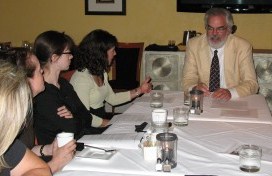
I met in Cleveland’s Little Italy neighborhood last night with a terrific group of American University alumni, at a program that featured a discussion of Getting It Wrong, my new book about media-driven myths.

With AU alums in Cleveland

The gathering was the second of the Cleveland area alumni chapter, which is ably led by Neil T. Young, Anthony Vacanti, and Antoinette Bacon. I was privileged to talk with the group about the book, which addresses and debunks 10 prominent media myths–those false, dubious, improbable stories about the news media that masquerade as factual.

We met at Michaelangelo’s, a fine Italian restaurant where the service is superb. Our discussion about Getting It Wrong was conducted seminar style and featured my fairly lengthy review of the heroic-journalist myth of Watergate–the notion that the intrepid investigative reporting by the Washington Post brought down Richard Nixon’s corrupt presidency.

I described how the book All the President’s Men and the cinematic version by the same title helped solidify the notion that the Post and its reporters Bob Woodward and Carl Bernstein were central to unraveling the Watergate scandal.

The book and the movie have had the effect of focusing on the Post reporters while ignoring or overlooking the far more significant contributions of federal prosecutors, federal judges, bipartisan congressional panels, and ultimately the U.S. Supreme Court in identifying Nixon’s efforts to obstruct justice in the scandal.

“Against that backdrop,” I said, “the news media were decidedly modest factors” in Watergate’s outcome.

Orson Welles

We also discussed the War of the Worlds myth–that Orson Welles’ 1938 radio dramatization of an invasion from Mars was so realistic that tens of thousands of Americans were convulsed in panic and fled their homes in hysteria. The program was imaginative entertainment–and was recognized as such by listeners in overwhelming numbers, I pointed out.

In addition, we talked about the so-called “Cronkite Moment” of February 1968, when CBS anchorman Walter Cronkite offered a downbeat analysis of the U.S. war effort in Vietnam, saying the military was “mired in stalemate.”

Supposedly, Cronkite’s assessment came as an epiphany to President Lyndon Johnson who, it is said, snapped off the television set upon hearing the anchorman’s “mired in stalemate” characterization and said, “If I’ve lost Cronkite, I’ve lost Middle America.”

Or words to that effect.

In reality, I pointed out, the president wasn’t in front of a television set that night.

He was in Austin, Texas, at the 51st birthday party of Governor John Connally. And even if Johnson had seen the Cronkite report on videotape, the anchorman’s assessment really was no epiphany, because the president in the days and weeks immediately afterward hewed to a hawkish line on Vietnam.

Questions from the alums were quite thoughtful. Among them was a query about the common threads may be found in the myths debunked in Getting It Wrong.

A thoughtful and perceptive question, that.

And indeed there are some shared characteristics of media myths.

Many myths are reductive, in that they offer simplistic explanations for complex historical events. That factor certainly helps explains the tenacity of the heroic-journalist myth of Watergate and the “Cronkite Moment.” It is far easier to characterize the news media as prime movers in the outcomes of Watergate and Vietnam than it is to grapple with the complexities and nuances of those landmark events, I said.

Additionally, media myths tend to be delicious stories–stories almost too good to be disbelieved. And that certainly holds for Watergate, the “Cronkite Moment,” and the War of the Worlds dramatization.

And media myths tend to be ways to assert the notion that the news media are powerful and influential forces in American society.

But as I write in Getting It Wrong, media power “tends to be modest, nuanced, diffused, and situational” and altogether “too often the ubiquitous presence of the news media is mistaken for power and influence.”

Moreover, I write, “The American media these days are far too splintered and diverse—print, broadcast, cable, satellite, online—to exert much in the way of collective and sustained influence on policymakers or media audiences.”

WJC

Related:

‘Getting It Wrong’ on the road in Oberlin, OH

In Cronkite Moment, Debunking, Furnish the war, Media myths, Murrow-McCarthy myth, Spanish-American War, War of the Worlds, Watergate myth, Yellow Journalism on June 27, 2010 at 8:40 am

I gave a talk yesterday about Getting It Wrong to an engaging audience at the college bookstore in Oberlin, Ohio.

The talk was facilitated quite well by Kira McGirr, the bookstore’s tradebook manager, and covered such topics as William Randolph Hearst’s purported vow to “furnish the war” with Spain at the end of the 19th century, the myth of the “Cronkite Moment” of February 1968, and the heroic-journalist myth of Watergate.

We also discussed the media-driven myth of “crack babies” and the famous 1938 radio dramatization of The War of the Worlds, which supposedly was so dramatic that tens of thousands of Americans were seized by panic and mass hysteria.

One of Kira’s questions was how long it may take before the myths discussed and debunked in Getting It Wrong to be excised from history books. It’s a very good question, and difficult to say for sure.

I responded by saying some of the myths–such as those of Watergate and the War of the Worldsare so appealing, delicious, and ingrained that they may never be totally uprooted.

The same probably goes for Hearst’s purported vow: That anecdote has been around since 1901 and likely is too appealing ever to be utterly debunked. What’s more, the “furnish the war” tale is a neat, tidy, reductive way of explaining the causes of the Spanish-American War:  Hearst, the war-mongering publisher, is to blame.

It’s far easier to blame Hearst than it is to grapple with the complexities of the diplomatic demarche in 1897-98 that failed to resolve differences among Spain, Cuba, and the United States: Failed diplomacy, not the contents of Hearst’s yellow press, led to the Spanish-American War.

We also discussed how high-quality cinematic treatments can press media myths into the public consciousness.

That certainly was the case with All the President’s Men, the most-viewed movie about Watergate, in which Robert Redford and Dustin Hoffman played the starring roles of Washington Post reporters Bob Woodward and Carl Bernstein.

The film depicted the reporters as central, indeed crucial, to cracking the Watergate scandal, I noted. For many Americans,  All the President’s Men is an important way of learning about Watergate. As I write in Getting It Wrong: “More than thirty-five years later, what remains most vivid, memorable, and accessible about Watergate is the cinematic version of All the President’s Men.”

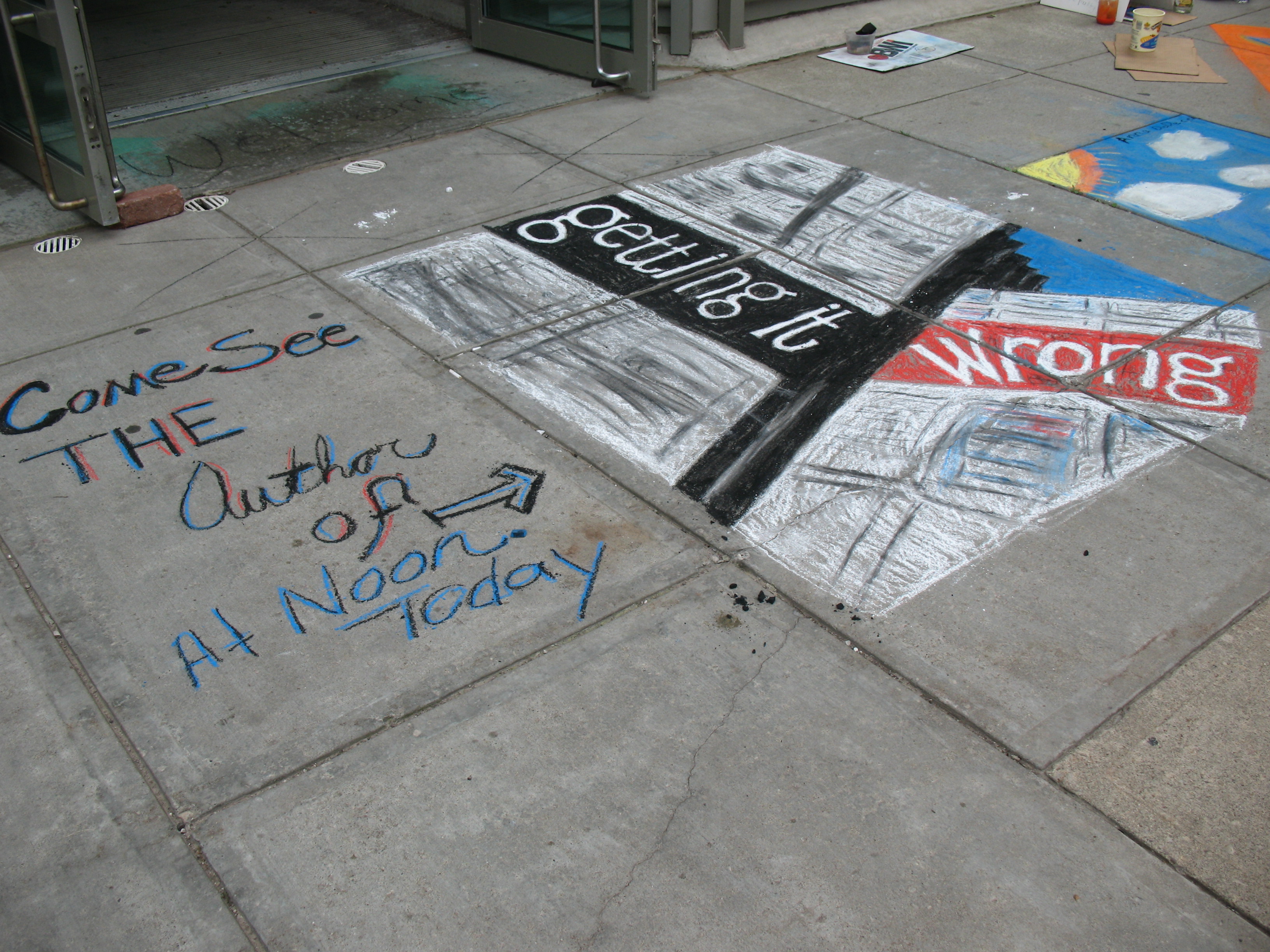
The book talk coincided with Oberlin’s fifth annual Chalk Walk event, at which artists and aspiring artists draw often-elaborate pastel images on the sidewalks in the heart of town.

One of Kira’s colleagues, Amanda Turner, drew a fine rendering of the cover of Getting It Wrong at the entrance to the bookstore (see photo).

Amanda, Kira, and I posed for the photo below.
Several former classmates of mine at Oberlin Firelands High School (class of 1970) also attended the book talk.

WJC

Related:

Photo credit: Ann-Marie C. Regan (Chalk Walk images)