W. Joseph Campbell

NYCity new mayor gushes over Bernstein, Woodward and their putative contributions to Watergate

In Debunking, Media myths, Newspapers, Washington Post, Watergate myth on January 8, 2014 at 12:56 pm

Bill de Blasio, New York’s recently inaugurated mayor, fairly gushed at a news conference yesterday about Carl Bernstein, Bob Woodward, and their putative roles in unraveling the Watergate scandal, saying the duo exerted a major influence on his life.

De Blasio credited Bernstein and Woodward, the Washington Post’s lead reporters on the scandal, for having “framed and, you know, created” conditions that gave rise to the Senate select committee’s hearings on Watergate during the summer of 1973. Those hearings are regarded as crucial in deepening public understanding about Watergate.

deBlasio

de Blasio

“I always say I’m a child of the Watergate summer,” de Blasio declared at the news conference. “And I had an extraordinary experience a year or two ago when I first met Carl Bernstein who’s, I think, one of the people … who had the biggest impact on my life, with Bob Woodward. Because for any of us who were deeply affected by that moment in history, those two individuals framed and, you know, created that moment so much and so deeply.”

The mayor’s soliloquy was prompted by a reporter’s question about whether de Blasio ever considered becoming a journalist. “I did, for a bit,” the mayor said, “never overly coherently.”

What most interests Media Myth Alert, though, was the mayor’s rubbing shoulders with the heroic-journalist myth of Watergate — the trope that Bernstein and Woodward’s reporting was decisive to the scandal’s outcome.

It wasn’t.

Indeed, it’s highly questionable whether Bernstein and Woodward much contributed to — let alone “framed” or “created” — conditions that gave rise to the 1973 Watergate hearings. By then, there were many other, more powerful and subpoena-wielding forces at work seeking to unravel the unfolding scandal.

As I write in my media-mythbusting book, Getting It Wrong, the contributions of Bernstein and Woodward to Watergate’s outcome — to the resignation in 1974 of President Richard Nixon — were minimal and certainly not decisive.

It’s instructive to note the decisive elements of the scandal that Bernstein and Woodward did not disclose.

They did not, for example, break the news about hush payments to the burglars who committed the signal crime of Watergate — the break-in at the headquarters of the Democratic National Committee in June 1972.

Nor did Bernstein and Woodward disclose that Nixon secretly made audiorecordings of most of his private conversations at the Oval Office. The White House tapes were pivotal to Watergate’s denouement, revealing that Nixon conspired to obstruct the FBI’s investigation of the break-in.

The existence of the tapes was revealed by the Senate Watergate committee in July 1973, in the midst of the “Watergate summer,” which de Blasio recalled yesterday as “one of the most riveting things that’s happened in the history of the republic.”

The hearings, the mayor said, represented “an affirmation of democracy. It was an affirmation of what good elected leaders can do, even if the face of tremendous odds. It certainly was an affirmation of the role of the media in our society.”

To the last claim — probably not.

De Blasio was not asked at the news conference to elaborate on his extravagant remarks about Bernstein, Woodward, and Watergate, remarks that all but embraced the myth of the heroic journalist.

Not to mention the “golden age” fallacy.

WJC

More from Media Myth Alert:

Embracing media myths — and the ‘golden age’ fallacy

In Cronkite Moment, Debunking, Media myths, Murrow-McCarthy myth, Television on January 3, 2014 at 12:29 pm

The “golden age” approach to media history — the notion that there really was a time when journalism and its practitioners were virtuous and inspiring — is flawed in at least three ways: It treats the past as little more than nostalgia; it elevates once-prominent journalists to heroic status, and it encourages the embrace of media-driven myths.

Outrage Industry_coverSuch shortcomings are evident in portions of The Outrage Industry, a new book that deplores the crude, offensive, and over-the-top commentary on some talk radio and cable news programs these days.

The authors, Jeffrey M. Berry and Sarah Sobieraj, are Tufts University professors who claim that “in the past twenty-five years this form of commentary has come into its own, as a new genre of political opinion media that we term outrage.”

Their book, though, embraces the “golden age” fallacy and invokes media myths about prominent broadcast journalists Walter Cronkite and Edward R. Murrow.

The authors write of “a golden age of journalism when the most visible voices in political television were known for their sobriety rather than their sensationalism.”

Berry and Sobieraj praise Cronkite as “a towering figure in American journalism, widely respected as a paragon of common sense and integrity. For 20 years he anchored the CBS evening news and narrated the live events that drew Americans to the program, helping them to make sense of turbulent times.”

The authors refer to a poll that “ranked him as the most trusted figure in America.” And they invoke the mythical “Cronkite Moment of 1968, writing:

“When Cronkite came to believe that the war in Vietnam was a mistake, President Lyndon Johnson told an aide, ‘If I’ve lost Cronkite, I’ve lost Middle America.'”

The putative “Cronkite Moment” is an irresistible anecdote, suggesting that prominent journalists once had the power to influence presidents and shape public policy.

Cronkite in Vietnam, 1968

Cronkite in Vietnam, 1968

Except there’s no first-hand evidence that Johnson ever made the remark about having “lost Cronkite.” (As for their evidence, Berry and Sobieraj cite an obituary about Cronkite published in 2009 in the Washington Post.) Johnson supposedly made the comment in an epiphanous moment on February 27, 1968, at the close of Cronkite’s special report that said the U.S. military was “mired in stalemate” in Vietnam.

But as I discuss in my media-mythbusting book, Getting It Wrong, Johnson did not see the Cronkite program when it aired; the president at the time was in Austin, Texas, attending a black-tie party marking Governor John Connally’s 51st birthday.

It is difficult to fathom how the president could have been much influenced by a program he did not watch.

And at about the moment when Johnson supposedly declared he had “lost Cronkite,” the president actually was making light of Connally’s age, saying:

“Today, you are 51, John. That is the magic number that every man of politics prays for — a simple majority.”

Evidence is scant, moreover, that Cronkite’s report had any influence on popular opinion. Indeed, Gallup surveys had detected shifts in public sentiment against Vietnam months before Cronkite’s special report. If anything, then, Cronkite can be said to have followed rather than have precipitated deepening popular disenchantment about the war.

And as for the poll that rated Cronkite “the most trusted figure in America” — it was hardly a fair assessment.

Oliver Quayle and Company in 1972 conducted a survey to measure public trust among then-prominent U.S. politicians. More than 8,700 respondents in 18 states were interviewed.

For reasons unclear, Cronkite was included in the poll, meaning he was compared to the likes of Richard Nixon, Edmund S. Muskie,  George McGovern, Edward Kennedy, and Spiro T. Agnew.

Not surprisingly, Cronkite led the poll, scoring a “trust index” of 73 percent. The generic “average senator” was next with 67 percent. Muskie was third with 61 percent.

As media critic Jack Shafer pointed out in 2009, Cronkite’s score seems impressive until you consider “the skunks polled alongside him.”

CBS publicists embraced the survey’s results, though. On Election Day in November 1972, the network took out prominent display advertisements in leading U.S. newspapers such as the Chicago Tribune, the New York Times, and the Washington Post.

The ads touted Cronkite as the “most trusted American in public life.”

Separately, a Phillips-Sindlinger survey conducted by telephone in 1973 rated Howard K. Smith of ABC News the most trusted and objective U.S. newscaster. Cronkite came in fourth.

But the year after that, the Phillips-Sindlinger survey had Cronkite in first place among newscasters, followed by John Chancellor of NBC.

So the “most trusted” characterization of Cronkite is a slippery one.

Berry and Sobieraj wax rhapsodic about Murrow, who sometimes is called the patron saint of American broadcast journalism.

Murrow

Murrow

They write that “TV news gained gravitas through the investigative journalism of CBS’s Edward R. Murrow who took on Senator Joseph McCarthy at the height of the senator’s power on Murrow’s program See It Now. The most critical episode, in which Murrow interviewed McCarthy himself, opened the senator up to national scrutiny and ultimately contributed to his censure.”

That’s one myth-packed claim.

Murrow did take on McCarthy, but belatedly — many months and even years after other journalists had pointedly called attention to the senator’s abusive tactics in investigating communists in government.

McCarthy had been the subject of considerable “national scrutiny” long before Murrow’s See It Now program of March 9, 1954, which Berry and Sobieraj refer to as the “most critical episode.”

Murrow made extensive  use during that half-hour show of film clips showing McCarthy at his odious worst. But Murrow did not interview the senator on the program, as Berry and Sobieraj write.

Moreover, it is unlikely the See It Now program much contributed to McCarthy’s downfall.

Murrow’s collaborator and co-producer, Fred Friendly, asserted in his memoir that what “made the real difference” in toppling McCarthy “wasn’t the Murrow program but the fact that ABC decided to run the Army-McCarthy hearings” in the spring of 1954. The hearings investigated allegations that McCarthy’s top aide had sought preferential treatment for a former staff member drafted into the Army.

In broadcasting the hearings, “ABC helped put the mirror up to Joe McCarthy,” Friendly wrote. The senator emerged badly wounded, due mostly to his bombastic ways. In late 1954, the Senate censured McCarthy for his conduct, signaling his political eclipse.

The “golden age” treatment of media history has another problem — the tendency to don blinkers.

Prominent journalists back when weren’t all that virtuous. Or “towering.” They weren’t paragons of integrity. Murrow, for example, privately counseled Adlai Stevenson, the Democratic candidate for the presidency in 1956, on the finer points of television appearance.

Murrow was no flawless white knight of American journalism. Nor, for that matter, was Walter Cronkite.

WJC

More from Media Myth Alert:

Taking stock: Top mythbusting posts of 2013

In 1897, Anniversaries, Cinematic treatments, Cronkite Moment, Debunking, Error, Jessica Lynch, Media myths, Media myths and radio, Newspapers, Television, War of the Worlds, Washington Post on December 29, 2013 at 10:09 am

Media Myth Alert reported in 2013 on the appearance of numerous and prominent media-driven myths and errors. Here are the five top writeups posted at the blog during 2013, followed by a roster of other mythbusting posts of note.

PBS squanders opportunity in tedious War of the Worlds documentary (posted October 29): The year brought the 75th anniversary of Orson Welles’ famous and clever War of the Worlds radio adaptation, which told of a deadly Martian invasion of Earth. Welles’ show aired October 30, 1938, and supposedly was so frightening that it pitched tens of thousands of Americans into panic and mass hysteria.

Orson Welles

Orson Welles

But as I discussed in my 2010 mythbusting book, Getting It Wrong,  the radio dramatization produced no such effects. Panic and hysteria were wildly overstated by newspapers of the time.

PBS took up The War of the Worlds program in a documentary that aired October 29, on the eve of the radio show’s 75th anniversary. The PBS program not only made The War of the Worlds seem tedious, it represented a missed opportunity to revisit the famous but much-misunderstood program in fresh and searching ways.

“PBS could have confronted head-on the question of whether the radio show … really did provoke hysteria and mass panic in the United States,” I wrote.

Instead, I added, “The documentary’s makers settled for a turgid program that was far less educational, informative, and inspiring than it could have been.” It failed to address the supposed effects of Welles’ radio dramatization in any meaningful way.

My critique was seconded by the PBS ombudsman, Michael Getler, who wrote in a column after the documentary was broadcast:

“I find myself in agreement with the judgment of W. Joseph Campbell, the well-known critic and author of ‘Getting It Wrong: Ten of the Greatest Misreported Stories in American Journalism’ who headlined his comment:  ‘PBS squanders opportunity to offer “content that educates” in “War of the Worlds” doc.’”

Obama’s ‘Cronkite Moment’? (posted May 14): The online news magazine Salon found great significance in liberal TV comedian Jon Stewart’s obscenity-laced tirade in May about the scandals battering the administration of President Barack Obama.

Stewart’s criticism, Salon declared, evoked “one of the most famed moments in broadcasting, when CBS News legend Walter Cronkite delivered an editorial opinion after the Tet Offensive in February 1968,” suggesting that negotiations could lead to a way out of Vietnam.Salon logo

Salon proceeded to step into media myth by describing how Cronkite’s commentary supposedly was received by President Lyndon Johnson:

“Apparently watching at the White House, President Johnson, who had lost the left long ago, reportedly turned to an aide and said, ‘If I’ve lost Cronkite, I’ve lost Middle America.’ Just a few weeks later, Johnson announced he would not seek reelection.”

Salon offered a muddled caveat by stating parenthetically: “Critics say the event has been widely misreported and overblown, but it still looms large in the American consciousness of the era, even if apocryphally.”

How’s that? It “looms large … even if apocryphally”? Simply put, the so-called “Cronkite Moment” is apocryphal.

Cronkite’s commentary about Vietnam was, as I discuss in Getting It Wrong, no epiphany for Johnson, and it had nothing to do with his deciding not to seek reelection in 1968.

In fact, Johnson did not see the Cronkite program when it aired on February 27, 1968. He wasn’t at the White House, either. He was in Austin, Texas, at a black-tie birthday party for Governor John Connally.

What’s more, there’s no evidence that Jon Stewart’s rant has figured at all in Obama’s fading popularity. Far more decisive has been the botched introduction of the Obama administration’s health-care plan.

London’s Independent invokes Jessica Lynch-Pentagon myth (posted January 28): The year brought the 10th anniversary of the Washington Post’s stunningly inaccurate tale of the supposed heroics of 19-year-old Jessica Lynch during an ambush in Iraq.

In the years since, news reports sometimes have claimed — without citing supporting evidence — that the  Pentagon concocted the story about Lynch. In January, for example, London’s Independent newspaper declared “the Pentagon exaggerated [Lynch’s] story as it waged a propaganda war, stating that she had fought back heroically against the enemy when in fact she had never fired her weapon.”
Lynch_headline_Post

Stunningly inaccurate

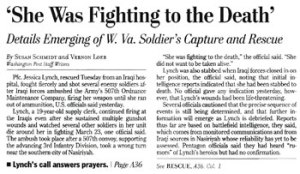
But that was not the Pentagon’s line. Not according to Vernon Loeb, the then-Post reporter who helped thrust the hero-warrior tale about Lynch into the public domain in a front-page story published April 3, 2003.

Loeb’s story, on which he shared a byline with Susan Schmidt, turned out to be wrong in every significant detail: Lynch never fired a shot in the ambush at Nasiriyah; her weapon jammed during the attack in which 11 American soldiers were killed. She was neither shot nor stabbed, as Loeb and Schmidt reported.

Although the newspaper has never disclosed the identities of the “U.S. officials” on which it based its botched story, Loeb said in an interview with NPR in December 2003 that the Post’s “sources for that story were not Pentagon sources.”

Loeb said he “could never get anybody from the Pentagon to talk about” the Lynch case, adding:

“I just didn’t see the Pentagon trying to create a hero where there was none. I mean … they never showed any interest in doing that, to me.”

The erroneous report about Lynch’s battlefield derring-do, by the way, did little damage to Loeb’s career. He left the Post in 2004 to become an investigations editor at the Los Angeles Times. Later, he moved to the Philadelphia Inquirer as deputy managing editor for news before returning to the Post in 2011 as metropolitan editor.

And next month Loeb will join the Houston Chronicle as managing editor.

WaPo refuses to correct clear error on Nixon’s mythical ‘secret plan’ (posted August 13):  Even in its clear decline, the Washington Post can be an arrogant news organization.

This tendency was on display last summer in its refusal to acknowledge and correct an inaccurate reference to Richard Nixon’s “secret plan” to end the war in Vietnam.

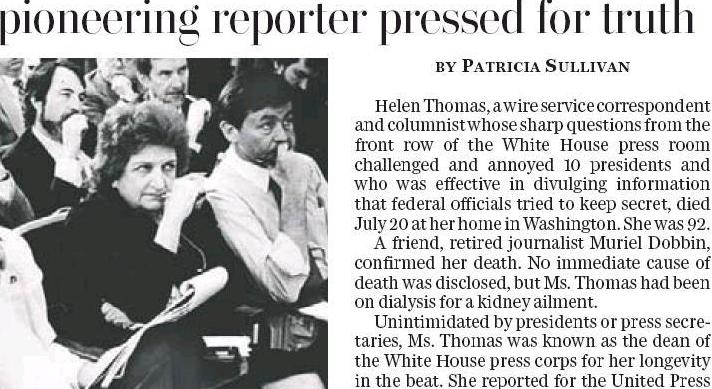
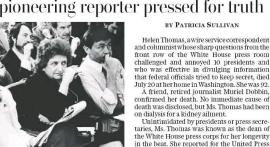
The reference was embedded in the Post’s front-page obituary about Helen Thomas, a querulous and overrated Washington journalist who covered the White House for years for United Press International.
WaPo_HThomas obit_2013

WaPo’s Thomas obit

The obituary, written by Patricia Sullivan, claimed that Thomas once “asked President Richard M. Nixon point-blank what his secret plan to end the Vietnam War was.”

But there is no evidence that Thomas ever posed such a question. The nearest approximation came at a news conference in late January 1969, when Thomas asked Nixon about his “peace plan” for Vietnam. Peace plan: She didn’t ask about a “secret plan.”

The Post’s error had broader dimension in that it suggested an embrace of the notion that Nixon ran for president in 1968 claiming to have a “secret plan” to end the war  in Vietnam.

Which is untrue. Nixon did not campaign for the White House touting a “secret plan.” The belief that he did, though, circulates still, as supposedly powerful evidence of Nixon’s devious and conniving ways.

The obituary’s writer, Sullivan, said as much, telling me by email:  “I recall the Nixon years and his promise during his candidacy that he had a plan to end the Vietnam War, which he would not explain in detail.”

In fact, Nixon was asked during the 1968 campaign about having a “secret plan” to end the war. And according to a report in the Los Angeles Times on March 28, 1968, he replied that he had “no gimmicks or secret plans.”

He also said: “If I had any way to end the war, I would pass it on to President [Lyndon] Johnson.”

I brought all this to the attention of the Post’s reader representative, Douglas Feaver, noting that if the newspaper can point to an occasion when Thomas asked Nixon about a “secret plan” on Vietnam — if it could back up Sullivan’s claim, in other words — then that would represent an intriguing though modest contribution to the understanding about Nixon’s campaign in 1968. It would indicate that journalists at the time suspected Nixon was less than forthcoming about his intended war policy.

If, on the other hand, the Post could not identify such an occasion, I wrote, then a correction was in order.

Feaver took more than 2 1/2 weeks to reply to my query and when he did, he absolved the Post of error, stating: “I see nothing here that deserves a correction.”

Coincidentally, not long after the Post published its flawed obituary, the newspaper was sold for $250 million to Jeff Bezos, founder of Amazon.com.  In an open letter to the newspaper’s employees soon after the sale was announced, Bezos stated:

“We will continue to follow the truth wherever it leads, and we’ll work hard not to make mistakes. When we do, we will own up to them quickly and completely.”

If that sentiment does become policy, it certainly will be none too soon.

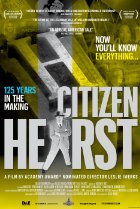
Hearst mostly elusive in ‘Citizen Hearst’ documentary (posted March 15): The Hearst Corp., founded in 1887 by William Randolph Hearst, commissioned a documentary about the company and its much-misunderstood founder that promised to tell “the wonderful Hearst story.”

At least that’s what the director, Leslie Iwerks, said in introducing the film at its Washington, D.C., debut in March.
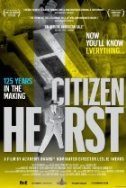
Citizen HearstThe documentary, titled Citizen Hearst, turned out to be something less than a revealing portrait. Its consideration of Hearst’s long career in journalism was  fast-paced but superficial.

The film notably avoided discussing young Hearst’s aggressive brand of participatory journalism — the “journalism of action” — which maintained that newspapers were obliged take a prominent and participatory roles in civic life, to swing into action when no other agency or entity was willing or able.

The zenith of the “journalism of action” came in 1897 in the jailbreak and escape of Evangelina Cisneros, a 19-year-old political prisoner held without charge in Spanish-ruled Cuba.

The Cisneros jailbreak, organized by a reporter for Hearst’s New York Journal, offered rich material for a documentary. But it received no mention in Citizen Hearst.

The film, moreover, only superficially considered Hearst’s mostly unfulfilled political ambitions of the early 20th century. It made no mention about how Hearst then turned his newspapers into platforms to support those goals.

WJC

Other memorable posts of 2013: