W. Joseph Campbell

Posts Tagged ‘1968’

Invoking the ‘Cronkite Moment’ in Canada

In Cronkite Moment, Debunking, Media myths on July 10, 2010 at 9:28 am

Media-driven myths not only can be remarkably hardy; they often find use and application in contexts well beyond their original incarnation.
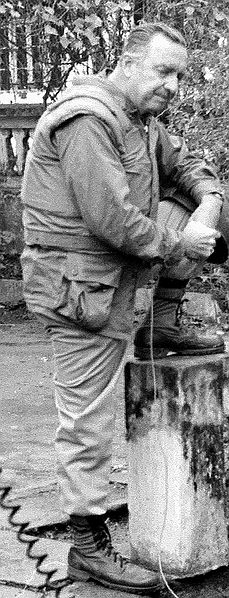
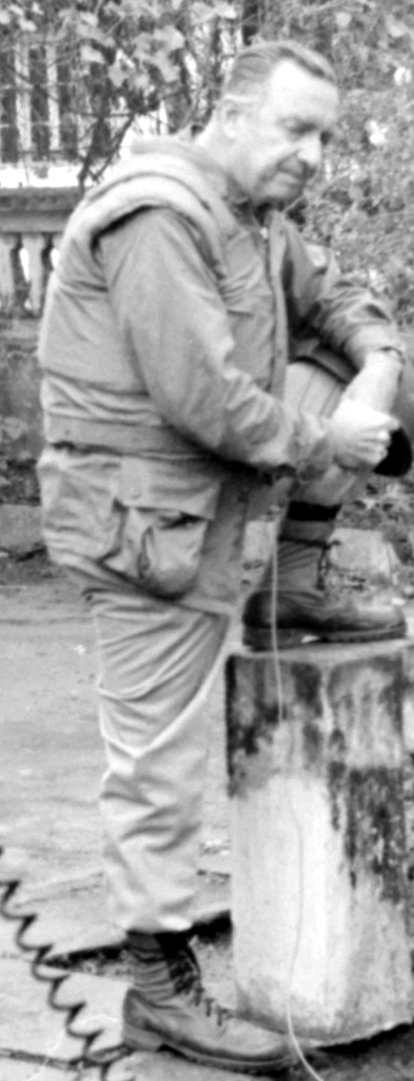
Cronkite in Vietnam, 1968

Evidence for that appears today in a column in Canada’s leading newspaper, the Globe and Mail. The column invokes the hoary myth of the “Cronkite Moment” to underscore how, in a splintered media landscape, no single television anchor projects exceptional influence.

(Or ever did, I would argue.)

In any case, the Globe and Mail column, which discusses the coming retirement of long-time Canadian TV news anchor Lloyd Robertson, declares:

“When venerable CBS broadcaster Walter Cronkite declared the Vietnam War could not be won, U.S. President Lyndon Johnson remarked. ‘If I’ve lost Cronkite, I’ve lost Middle America.'”

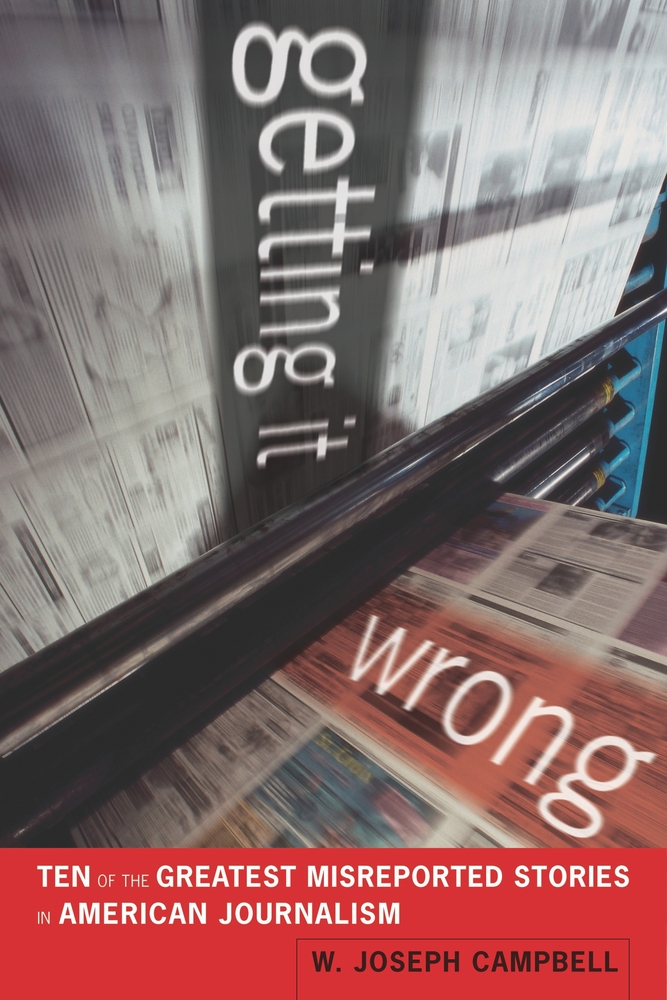
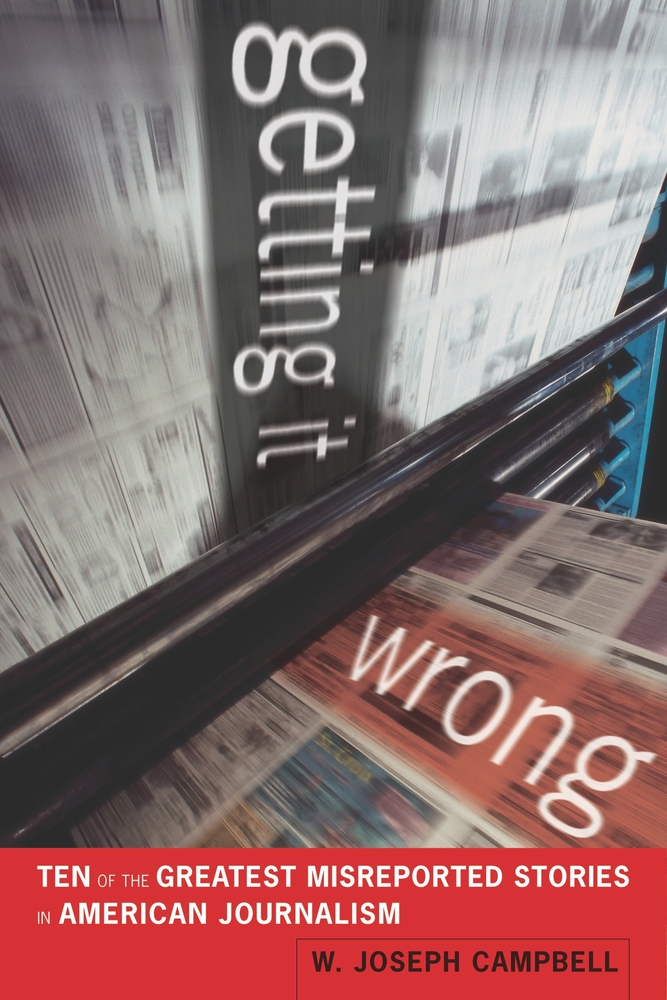
As I write in Getting It Wrong, my new book debunking 10 prominent media-driven myths:

“Scrutiny of the evidence associated with the program reveals that Johnson did not have—could not have had—the abrupt yet resigned reaction that so often has been attributed to him. That’s because Johnson did not see the program when it was aired.”

The Cronkite program about Vietnam was broadcast on the evening February 27, 1968, not long after the anchorman had returned from a visit to what then was South Vietnam.

Legend has it that Johnson was at the White House and watched the show. After Cronkite editorialized that the U.S. military effort in Vietnam was “mired in stalemate,” Johnson supposedly reached over, snapped off the television set, and exclaimed to an aide or aides:

“If I’ve lost Cronkite, I’ve lost Middle America.”

Or words to that effect. Versions vary.

In reality, Johnson was not at the White House that evening. He was not in front of a television set.

He was on the campus of the University of Texas at Austin, attending the 51st birthday party of a long-time political ally, Governor John Connally.

As I note in Getting It Wrong, at about the time Cronkite intoned his “mired in stalemate” assessment, Johnson was offering light-hearted banter about Connally’s age, saying:

“Today you are 51, John. That is the magic number that every man of politics prays for—a simple majority. Throughout the years we have worked long and hard—and I might say late—trying to maintain it, too.”

Even if Johnson later saw the Cronkite program on videotape, the president “gave no indication of having taken the anchorman’s message to heart,” I write in Getting It Wrong, adding:

“Just three days after the program aired, Johnson vowed in remarks at a testimonial dinner in Texas that the United States would ‘not cut and run’ from Vietnam. ‘We’re not going to be Quislings,’ the president said, invoking the surname of a Norwegian politician who helped the Nazis take over his country. ‘And we’re not going to be appeasers….'”

So in the days and even weeks following the Cronkite program, Johnson remained openly hawkish on the war.

The “Cronkite Moment” is a particularly delicious media myth in that it exerts enduring, and international, allure. But the notion that a sitting president would be suddenly and dramatically moved by the on-air assessment of a television anchorman is highly improbable.

“It is exceedingly rare for any news report to trigger a powerful, immediate and decisive reaction akin to” the “Cronkite Moment,” I write in Getting It Wrong. “Researchers long ago dismissed the notion the news media can create such profound and immediate effects, as if absorbing media messages were akin to receiving potent drugs via a hypodermic needle.”

It just doesn’t work that way.

WJC

Related:

Discussing ‘Getting It Wrong’ with AU alums

In Cinematic treatments, Cronkite Moment, Debunking, Media myths, Media myths and radio, War of the Worlds, Washington Post, Watergate myth on June 30, 2010 at 10:35 pm

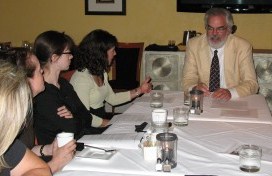
I met in Cleveland’s Little Italy neighborhood last night with a terrific group of American University alumni, at a program that featured a discussion of Getting It Wrong, my new book about media-driven myths.

With AU alums in Cleveland

The gathering was the second of the Cleveland area alumni chapter, which is ably led by Neil T. Young, Anthony Vacanti, and Antoinette Bacon. I was privileged to talk with the group about the book, which addresses and debunks 10 prominent media myths–those false, dubious, improbable stories about the news media that masquerade as factual.

We met at Michaelangelo’s, a fine Italian restaurant where the service is superb. Our discussion about Getting It Wrong was conducted seminar style and featured my fairly lengthy review of the heroic-journalist myth of Watergate–the notion that the intrepid investigative reporting by the Washington Post brought down Richard Nixon’s corrupt presidency.

I described how the book All the President’s Men and the cinematic version by the same title helped solidify the notion that the Post and its reporters Bob Woodward and Carl Bernstein were central to unraveling the Watergate scandal.

The book and the movie have had the effect of focusing on the Post reporters while ignoring or overlooking the far more significant contributions of federal prosecutors, federal judges, bipartisan congressional panels, and ultimately the U.S. Supreme Court in identifying Nixon’s efforts to obstruct justice in the scandal.

“Against that backdrop,” I said, “the news media were decidedly modest factors” in Watergate’s outcome.

Orson Welles

We also discussed the War of the Worlds myth–that Orson Welles’ 1938 radio dramatization of an invasion from Mars was so realistic that tens of thousands of Americans were convulsed in panic and fled their homes in hysteria. The program was imaginative entertainment–and was recognized as such by listeners in overwhelming numbers, I pointed out.

In addition, we talked about the so-called “Cronkite Moment” of February 1968, when CBS anchorman Walter Cronkite offered a downbeat analysis of the U.S. war effort in Vietnam, saying the military was “mired in stalemate.”

Supposedly, Cronkite’s assessment came as an epiphany to President Lyndon Johnson who, it is said, snapped off the television set upon hearing the anchorman’s “mired in stalemate” characterization and said, “If I’ve lost Cronkite, I’ve lost Middle America.”

Or words to that effect.

In reality, I pointed out, the president wasn’t in front of a television set that night.

He was in Austin, Texas, at the 51st birthday party of Governor John Connally. And even if Johnson had seen the Cronkite report on videotape, the anchorman’s assessment really was no epiphany, because the president in the days and weeks immediately afterward hewed to a hawkish line on Vietnam.

Questions from the alums were quite thoughtful. Among them was a query about the common threads may be found in the myths debunked in Getting It Wrong.

A thoughtful and perceptive question, that.

And indeed there are some shared characteristics of media myths.

Many myths are reductive, in that they offer simplistic explanations for complex historical events. That factor certainly helps explains the tenacity of the heroic-journalist myth of Watergate and the “Cronkite Moment.” It is far easier to characterize the news media as prime movers in the outcomes of Watergate and Vietnam than it is to grapple with the complexities and nuances of those landmark events, I said.

Additionally, media myths tend to be delicious stories–stories almost too good to be disbelieved. And that certainly holds for Watergate, the “Cronkite Moment,” and the War of the Worlds dramatization.

And media myths tend to be ways to assert the notion that the news media are powerful and influential forces in American society.

But as I write in Getting It Wrong, media power “tends to be modest, nuanced, diffused, and situational” and altogether “too often the ubiquitous presence of the news media is mistaken for power and influence.”

Moreover, I write, “The American media these days are far too splintered and diverse—print, broadcast, cable, satellite, online—to exert much in the way of collective and sustained influence on policymakers or media audiences.”

WJC

Related:

LBJ’s ‘Vietnam epiphany’ wasn’t Cronkite’s show

In Cronkite Moment, Debunking, Media myths on June 22, 2010 at 12:28 pm

The irresistible “Cronkite Moment” emerged again the other day, this time in a column in a Michigan newspaper claiming that “President Lyndon Baines Johnson had his Vietnam epiphany when he lost Walter Cronkite.”

The “Cronkite Moment” was a broadcast in February 1968 that supposedly was so potent  that it had the effect of prompting Johnson to realize the hopelessness of his war policy in Vietnam.

The story goes that Johnson at the White House watched Cronkite’s special report on Vietnam and, after hearing the anchorman say the U.S. military was “mired in stalemate” and might consider a negotiated settlement, snapped off the television set and exclaimed:

“If I’ve lost Cronkite, I’ve lost Middle America.”

Or words to that effect.

As is described in Getting It Wrong, my new book about media-driven myths, versions vary as to what the president supposedly said.

Getting It Wrong also points out that Johnson did not see the Cronkite program when it aired. The president at the time was in Austin, Texas, making light-hearted comments at the 51st birthday party of Governor John Connally.

As I write in Getting It Wrong, “Even if he later heard—or heard about— Cronkite’s assessment, it was no epiphany for Johnson. Not long after the program, Johnson gave a rousing, lectern-pounding speech in which he urged a ‘total national effort’ to win the war in Vietnam.”

Thus in the days and weeks immediately after the Cronkite program, Johnson remained hawkish on the war.

Johnson’s “epiphany,” as it were, came not in front of a television set in late February 1968 but in discussions a month later with informal advisers at the White House.

As I write in Getting It Wrong, “Johnson’s change of heart on Vietnam came about through a complex process in which Cronkite’s views counted for little. Among the forces and factors that influenced Johnson’s thinking … was the counsel of an influential and informal coterie of outside advisers known as the ‘Wise Men.’

“They included such foreign policy notables as Dean Acheson, a former secretary of state; McGeorge Bundy, a former National security adviser to Kennedy and Johnson; George Ball, a former under-secretary of state; Douglas Dillon, a former treasury secretary; General Omar Bradley, a former chairman of the joint chiefs of staff, and Abe Fortas, a U.S. Supreme Court justice and friend of Johnson.

“The ‘Wise Men’ had met in November 1967, and expressed their near-unanimous support for Johnson’s Vietnam policy. They met again, at the request of the White House, in late March 1968.”

Largely, though not unanimously, the “Wise Men,” expressed opposition to escalating the war in Vietnam.

“The theme that ran around the table was, ‘You’ve got to lower your sights,’” George Ball later recalled.

Johnson, he said, “was shaken by this kind of advice from people in whose judgment he necessarily had some confidence, because they’d had a lot of experience.”

The counsel of the Wise Men represented a tipping point in Johnson’s deciding to seek “peace through negotiations.” In a speech March 31, 1968, the president announced a limited halt to U.S. aerial bombing of North Vietnam as an inducement to the communist government in Hanoi to enter peace talks.

Johnson closed his speech with the stunning announcement that he would not seek reelection to the presidency.

WJC

Related:

<!–[if !mso]> .[i] In a nationally televised speech on March 31, Johnson announced that he had decided to seek “peace through negotiations.” He ordered a limited halt to U.S. aerial bombing of North Vietnam as an inducement to the Hanoi government to enter peace talks. Johnson closed the speech with the stunning announcement that he would not seek reelection to the presidency


[i] George C. Herring, LBJ and Vietnam: A Different Kind of War (Austin: University of Texas Press, 1994), 163.

Behind the ‘nuanced myth’: Bra-burning at Atlantic City

In Bra-burning, Debunking, Media myths on June 17, 2010 at 6:10 am

What I call the “nuanced myth” of bra-burning can be traced to September 7, 1968, and the women’s liberation protest on the boardwalk of Atlantic City, N.J., against the Miss America pageant.

Protesting Miss America, 1968

A centerpiece of the demonstration was the so-called Freedom Trash Can (see photo, right) into which the protesters consigned “instruments of torture,” such as brassieres, girdles, high-heeled shoes, false eyelashes, and copies of magazines such as Playboy and Cosmopolitan.

But the protest’s organizers have long insisted that nothing had been set ablaze at Atlantic City. The lead organizer, Robin Morgan, has asserted, for example:

“There were no bras burned. That’s a media myth.”

And yet the epithet “bra-burning” took hold, serving to denigrate and trivialize the objectives of the women’s liberation movement.

In researching bra-burning for Getting It Wrong, my new book about prominent media myths, I was inclined to accept the denials. They seemed insistent and solid—and no one had produced evidence to the contrary. Bra-burning certainly seemed to be a media-driven myth.

Still, I was curious about what the local newspaper, the Atlantic City Press, had written about the 1968 demonstration. I had never seen references to its reporting.

Microfilm of the Press for September 1968 proved impossible to obtain through inter-library loan, so I paid a visit to the public library in Atlantic City, to crank microfilm there.

I found that the Press published two articles about the protest, both on page 4. The lead article appeared beneath the intriguing headline:

“Bra-burners blitz boardwalk.”

The article conveyed a sense of astonishment that such a protest would take place at the venue of the Miss America pageant, then a revered tradition in Atlantic City.

The article’s ninth paragraph offered stunning detail, in a matter-of-fact sort of way.

“As the bras, girdles, falsies, curlers, and copies of popular women’s magazines burned in the ‘Freedom Trash Can,’” it said, “the demonstration reached the pinnacle of ridicule when the participants paraded a small lamb wearing a gold banner worded ‘Miss America.’”

“Whoa,” I said to myself in reading that paragraph. “Whoa.”

Here, after all, was a contemporaneous, eyewitness account—the first such account I had ever seen—that said that bras had indeed been burned during the protest.

The single mention of bra-burning was significant and striking. But it was a single mention, and I needed detail and corroboration.

The other article in the Press described the bewildered reactions of boardwalk-strollers who watched the protest; it made no mention of burning bras.

The author of the lead article, John L. Boucher, died in 1973.

Boucher, I learned, could be gruff and tough, in a old-school way. He was also an informal adviser to young reporters at the Atlantic City newspaper.

Among them was Jon Katz, who in 1968 was at the outset of a career that took him to the Philadelphia Inquirer and Boston Globe, and to the CBS Morning News as executive producer. After leaving daily journalism, Katz became a writer of mysteries and nonfiction.

Katz had been on the boardwalk that long-ago September day: He had written the other article about the protest for the Press.

I traced Katz to upstate New York. In interviews by email and phone, Katz said without hesitation that he recalled that bras and other items had been set afire during the demonstration against Miss America.

“I quite clearly remember the ‘Freedom Trash Can,’ and also remember some protestors putting their bras into it along with other articles of clothing, and some Pageant brochures, and setting the can on fire,” Katz said. “I am quite certain of this.”

He added:

“I recall and remember noting at the time that the fire was small, and quickly was extinguished, and didn’t pose a credible threat to the boardwalk. I noted this as a reporter in case a fire did erupt.”

Katz thus offered confirmation that bras and other items had been burned in the Freedom Trash Can.

I sought to interview with Robin Morgan about these new details. She replied to my inquiries through a spokeswoman, declaring:

“There were NO bras EVER burned at the 1968 protest.”

So how is all this treated in Getting It Wrong, which will be launched Saturday, June 19, at an “Inside Media” program at the Newseum in Washington, D.C.?

The account by Boucher and the recollections of Katz offer “fresh dimension to the bra-burning legend,” I write in the book. “They represent two witness accounts that bras and other items were burned, or at least smoldered, in the Freedom Trash Can. There is now evidence that bras and other items were set afire, if briefly, at the 1968 Miss America protest in Atlantic City. This evidence cannot be taken lightly, dismissed or ignored.”

But at the same time, their accounts lend no support to the more vivid popular imagery that many bras went up in flames in flamboyant protest on the boardwalk.

Boucher and Katz offered no endorsement for the central feature of the media-driven myth that angry women burned their bras in a fiery public spectacle.

At most, fire was a subtle, modest, and fleeting element of the protest that day.

And yet, “bra-burning” is an epithet not entirely misapplied to the demonstration at Atlantic City.

WJC

A version of this post first appeared at the University of California Press blog.

Many thanks to Jim Romenesko for linking to this post.

Launching ‘Getting It Wrong’ at Newseum

In Bay of Pigs, Bra-burning, Cronkite Moment, Debunking, Furnish the war, Jessica Lynch, Media myths, Murrow-McCarthy myth, War of the Worlds, Washington Post, Watergate myth on June 14, 2010 at 6:28 am

My new book, Getting It Wrong, will be launched Saturday, June 19, at an “Inside Media” program at the Newseum, the $450 million museum of news in downtown Washington, D.C.

The program will begin at 2:30 p.m. in the Knight TV Studio on the third level and will feature a discussion with the Newseum’s John Maynard, followed by audience Q-and-A.

I’ll be signing copies of Getting It Wrong afterward.

The book addresses, and debunks, 10 prominent media-driven myths–stories about and/or by the news media that are widely believed and often retold but which, on close inspection, proved to be apocryphal or wildly exaggerated.

Here is a brief description about each of the 10 myths:

  1. Remington-Hearst: William Randolph Hearst’s famous vow, “you furnish the pictures, I’ll furnish the war,” is almost certainly apocryphal.
  2. War of Worlds: The notion that the War of Worlds radio dramatization in 1938 caused nationwide panic and mass hysteria is exaggerated.
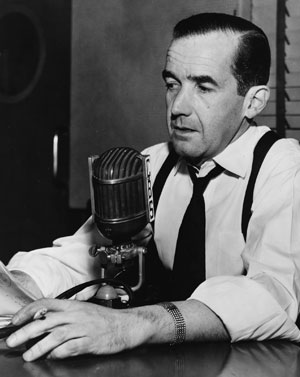
  3. Murrow-McCarthy: Edward R. Murrow’s famous See It Now program in March 1954 did not end Senator Joseph McCarthy’s communists-in-government witch-hunt; Murrow in fact was very late to take on McCarthy.

    Murrow in 1954

  4. Bay of Pigs: The New York Times did not suppress its reporting in the run-up to the ill-fated Bay of Pigs invasion in April 1961.
  5. Cronkite-Johnson: Walter Cronkite’s special report on Vietnam in February 1968 did not prompt an immediate reassessment of U.S. war policy.
  6. Bra-burning: Humor columnist Art Buchwald helped spread the notion that feminist demonstrators dramatically burned their bras at a Miss America protest in September 1968.
  7. Watergate: The Washington Post’s intrepid reporters, Carl Bernstein and Bob Woodward, did not bring down Richard Nixon’s corrupt presidency. That they did is a trope that knows few bounds.
  8. Crack babies: The much-feared “bio-underclass” of children born to women who smoked crack cocaine during their pregnancies never materialized.
  9. Jessica Lynch: The Washington Post’s erroneous reporting about Jessica Lynch early in the Iraq War gave rise to several myths about her capture and rescue.
  10. Hurricane Katrina: News coverage of Katrina’s aftermath in New Orleans in early September 2005 was marred by wild exaggerations of extreme, Mad Max-like violence.

As I write in Getting It Wrong, the myths debunked “are among American journalism’s best-known stories. Most of them are savory tales. And at least some of them seem almost too good to be false.”

I further write that because it “takes on some of the most treasured stories in American journalism,” Getting It Wrong is “a work with a provocative edge. It could not be otherwise.”

WJC

Related:

The wobbly components of the ‘Cronkite moment’

In Cronkite Moment, Debunking, Media myths on June 7, 2010 at 5:23 am

It’s often claimed that Walter Cronkite’s analysis in February 1968 that the U.S. military effort in Vietnam was “mired in stalemate” helped swing public opinion against the war.

Not to mention that Cronkite’s penetrating assessment brought President Lyndon Johnson face-to-face with the realization his war policy was a shambles.

And so incisive was Cronkite’s assessment that it supposedly was a factor in Johnson’s decision, announced a month later, not to seek reelection to the presidency.

Those are three components of an especially tenacious and popular media-driven myth, all of which I address in a chapter in my new book, Getting It Wrong.

The wide circulation of what I call the mythical “Cronkite moment” was evident in a commentary aired the other day on Vermont Public Radio, which asserted:

“In 1968, when CBS anchorman Walter Cronkite delivered a downbeat report on American progress in Vietnam, public opinion rapidly soured on the war. President Lyndon Johnson lamented, ‘If I’ve lost Cronkite, I’ve lost the country.’  Several weeks later, Johnson decided not to run for re-election.”

In fact, as I discuss in Getting It Wrong, public opinion had begun shifting against the war weeks and months before Cronkite’s special report about Vietnam, which aired February 27, 1968.

By October 1967, 47 percent of Americans, a plurality, maintained that U.S. military presence in Vietnam was a mistake, according to Gallup surveys.

Moreover, Cronkite’s “mired in stalemate” assessment was, I write in Getting It Wrong, “neither notable nor extraordinary,” pointing out that Mark Kurlansky in his study of the year 1968 stated that Cronkite’s view was “hardly a radical position” for the time.

Indeed, nearly seven months before the “Cronkite moment,” the New York Times published on its front page as analysis that said victory in Vietnam “is not close at hand. It may be beyond reach.” The analysis was published in August 1967 beneath the headline:

“Vietnam: The Signs of Stalemate.”

As has been noted many times at MediaMythAlert, Johnson did not see the Cronkite program when it aired. The president at the time was in Austin, Texas, at the 51st birthday party of Governor John Connally.

So he could not have had “the abrupt yet resigned reaction that so often has been attributed to him,” I write in the book.

There is, moreover, no evidence that Johnson ever watched the Cronkite program on videotape.

And as I note in Getting It Wrong:

“The power of the ‘Cronkite moment’ resides in the sudden, unexpected, and decisive effect it supposedly had on the president. Such an effect would have been absent, or greatly diminished, had Johnson had seen the program on videotape at some later date.”

As for Johnson’s decision not to seek reelection, which he announced at the end of March 1968: The “Cronkite moment” certainly was a non-factor.

There’s evidence that Johnson never intended to seek reelection, that he had privately decided in 1967 against another campaign.

Also important in Johnson’s decision was Senator Eugene McCarthy’s surprisingly potent bid for the Democratic nomination for president in early 1968.

Under scrutiny, then, the components of the “Cronkite moment” prove to be wobbly: They don’t hold up to inspection. And that’s “not so surprising,” I write in Getting It Wrong, adding:

“Seldom, if ever, do the news media exert truly decisive influences in decisions to go to war or to seek negotiated peace. Such decisions typically are driven by forces and factors well beyond the news media’s ability to shape, alter, or significantly influence.”

So it was with the often-misinterpreted “Cronkite moment” of 1968.

WJC

Related:

On version variability and the ‘Cronkite moment’

In Cronkite Moment, Debunking, Media myths on May 25, 2010 at 10:34 am

As I note in my soon-to-be-published book, Getting It Wrong, version variability–the imprecision that alters or distorts an anecdote in its retelling–can be a marker of media-driven myths.

Cronkite in Vietnam, 1968

So it is with the purported “Cronkite moment” of 1968, when CBS anchorman Walter Cronkite asserted in a special televised report that the U.S. military was “mired in stalemate” in Vietnam. President Lyndon Johnson supposedly saw the Cronkite program and promptly realized the war effort was doomed.

“If I’ve lost Cronkite,” the president is reputed to have said in reaction to Cronkite’s pronouncement, “I’ve lost Middle America.”

Or, as a columnist for Townhall.com wrote yesterday, Johnson “said to an aide, ‘If we’ve lost Walter, then we’ve lost the war.'”

Those are just two of many variations of Johnson’s supposed response to Cronkite’s downbeat assessment.

Other versions include:

“I’ve lost Cronkite, I’ve lost the country.”

“If I’ve lost Cronkite, I’ve lost the American people.”

“If I’ve lost Cronkite, I’ve lost the war.”

“If we lose Cronkite, we lose America.”

As I write in Getting It Wrong, “Version variability of that magnitude signals implausibility.”

I also note that version variability “suggests more than sloppiness in journalistic research or a reluctance to take time to trace the derivation of the popular anecdote. The varying accounts of Johnson’s purported reactions represent another, compelling reason for regarding the ‘Cronkite moment’ with doubt and skepticism.”

Moreover, as I write in Getting It Wrong, Johnson did not see the Cronkite program when it aired February 27, 1968. At the time, Johnson was in Austin, Texas, at the 51st birthday party of his longtime political ally, Governor John Connally.

Johnson teased Connally about his age, saying: “Today you are 51, John. That is the magic number that every man of politics prays for—a simple majority. Throughout the years we have worked long and hard—and I might say late—trying to maintain it, too.”

And even if Johnson later heard—or heard about—Cronkite’s assessment, it represented no epiphany for the president, no burst of clarity about a policy gone sour.

A few weeks after the Cronkite program, Johnson gave a rousing, lectern-thumping speech in Minneapolis, in which he urged a “total national effort” to win the war in Vietnam.

The speech was delivered March 18, 1968, and in it, the president declared:

“We love nothing more than peace, but we hate nothing worse than surrender and cowardice.”

So in the weeks immediately following the purported “Cronkite moment,” Johnson maintained an aggressive public stance on the war. He clearly wasn’t swayed by Cronkite’s “mired in stalemate” analysis.

WJC

Related:

Bra-burning and home luxuries lost: Whoa

In Bra-burning, Debunking, Media myths, New York Times on May 23, 2010 at 11:40 am

If I read this article correctly, bra-burning contributed to a decline in the late 20th century of a taste for small luxuries around the home.

Media-driven myths have been mistakenly credited with bringing on wars and bringing down presidents. But bringing about a decline in household luxuries?

This is a first.

The article recalls with praise Mrs. Beeton’s Book of Household Management, which came out in 1861 and offered hundreds of pointers on cooking, supervising servants, and choosing decor.

Says the article, which appeared the other day in the Seattle Times and elsewhere:

“The dang thing had 2,751 entries—from how to cut a side of lamb, to just when to put away the white summer curtains—spelled out across more than 1,680 pages. And back in 1861, millions of copies were sold. Millions.

“Then,” the article says, “came the bra-burning latter half of the 20th century, and along with it permanent-press sheets, the paper napkin, and Hamburger Helper served up on melamine plates.

“We say, Whoa. We might have ditched too much. Lost all hints of luxury in the household department.”

I say, Whoa.

What did bra-burning supposedly have to do with lost “hints of luxury” at home? The article doesn’t say. Nor does it say explain how bra-burning helped to define the “latter half of the 20th century.”

Bra-burning in fact was a dramatically overstated phenomenon, as I discuss in a chapter in Getting It Wrong, my forthcoming book about media-driven myths–well-known and often-told stories about the news media that are dubious, apocryphal, or wildly exaggerated.

As I write in Getting It Wrong, the notion of bra-burning took hold in the days after the Miss America pageant at Atlantic City, N.J., on September 7, 1968, and was promoted, probably unwittingly, by two syndicated columnists.

On that September afternoon, “about 100 women from New York City, New Jersey, Boston, Washington, D.C., and elsewhere arrived by bus at the Atlantic City boardwalk,” I write, adding:

“They were, according to the New York Times, ‘mostly middle-aged careerists and housewives’ and they set up a picket line … across from the Convention Center. They were there, as one participant declared, ‘to protest the degrading image of women perpetuated by the Miss America pageant,’ which took place that night inside the Convention Center.”

A highlight of their protest came when the demonstrators tossed into a barrel what they termed “instruments of torture,” including brassieres, girdles, high-heeled shoes, and magazines such as Playboy and Cosmopolitan.

The protesters dubbed the barrel the Freedom Trash Can.

The organizers of the daylong protest, who included the activist and former child actor Robin Morgan, have long insisted that bras and other contents of the Freedom Trash Can were not set afire during the protest.

But the notion that bra-burning was a dramatic element of the demonstration at Atlantic City was encouraged by syndicated columnists, including Harriett Van Horne.

Soon after the protest, Van Horne wrote that the demonstrators surely were frustrated– “scarred by consorting with the wrong men. Men who do not understand the way to a woman’s heart, i.e., to make her feel utterly feminine, desirable and almost too delicate for this hard world. … No wonder she goes to Atlantic City and burns her bra.”

Van Horne was not at the protest, however. Nor was Art Buchwald, then American journalism’s leading humorist, who nonetheless played on the bra-burning trope in a column published in the Washington Post and other newspapers.

With tongue firmly in cheek, Buchwald wrote that he had been “flabbergasted to read that about 100 women had picketed the Miss America pageant in Atlantic City against ‘ludicrous beauty standards that had enslaved the American woman.’”

He added: “The final and most tragic part of the protest took place when several of the women publicly burned their brassieres.”

As I note in Getting It Wrong, Buchwald’s slyly humorous “characterization of the protest at Atlantic City introduced the notion of flamboyant bra-burning to a national audience, conjuring as it did a powerful mental image of angry women setting fire to bras and twirling them, defiantly, for all … to see.”

But the dramatic burning of bras as a form of feminist protest wasn’t a defining feature of the second half of the 20th century. More than anything, it was an effect of a humor columnist’s satiric riff.

WJC

Myth resurfaces in Cronkite-collaborator report

In Cronkite Moment, Debunking, Media myths, Year studies on May 15, 2010 at 10:28 am

The Yahoo News report yesterday that venerable CBS anchorman Walter Cronkite may have quietly collaborated with antiwar activists in the late 1960s stirred a modest flurry of commentary in the blogosphere.

Cronkite in Vietnam, 1968

Few mainstream media outlets appear to have touched the story, which I find to be something of a stretch. An exception was Rupert Murdoch’s  New York Post, which carried a brief article, essentially a rewrite of the Yahoo report.

That report cited newly released FBI documents in saying that in late 1969, “Cronkite encouraged students at Rollins College in Winter Park, Fla., to invite Maine Sen. Edmund Muskie to address a protest [against the war] they were planning near Cape Kennedy (now known as Cape Canaveral). Cronkite told the group’s leader that Muskie would be nearby for a fundraiser on the day of the protest, and said that ‘CBS would rent [a] helicopter to take Muskie to and from site of rally.'”

Inevitably, the report recalled Cronkite’s famous on-air editorial comment delivered February 27, 1968, at the end of a special report on Vietnam. On that occasion, Cronkite declared the U.S. war effort in Vietnam was “mired in stalemate.”

A post yesterday at mediaite.com noted Cronkite’s 1968 commentary, saying it “is often credited with turning the tide of public opinion against the war.”

Cronkite’s commentary that night has become the stuff of legend. But it was scarcely so powerful or decisive as to much move public opinion.

As I discuss in Getting It Wrong, my forthcoming book about media-driven myths, public opinion had begun turning against the Vietnam War months before the Cronkite program.

In October 1967, a Gallup survey reported that the percentage of respondents saying that U.S. military presence in Vietnam was a mistake had reached a plurality—47 percent. That was 4½ months before Cronkite delivered his on-air commentary. (In August-September 1965, just 24 percent of Gallup poll respondents said sending troops to Vietnam was a mistake.)

In a Gallup poll completed in early February 1968, three weeks before the Cronkite program, the proportion saying the war was a mistake stood at 46 percent; 42 percent said it had not been a mistake.

Gallup asked the question again in a poll completed the day the Cronkite program aired, finding that 49 percent of the respondents said U.S. military intervention in Vietnam had been a mistake; 42 percent said it had not.

By late February 1968, Cronkite’s “mired in stalemate” assessment was, I write in Getting It Wrong, “neither notable nor extraordinary.”

I also note that Mark Kurlansky, author of a year-study about 1968, declared Cronkite’s view “hardly a radical position” for the time.

Cronkite’s remarks that night were fairly mild–certainly less emphatic than comments offered about two weeks later by Frank McGee of the rival NBC network.

“The war,” McGee declared on an NBC News program March 10, 1968, “is being lost by the administration’s definition.”

As I’ve noted previously, it is a bit surprising that McGee’s pointed editorial comments are not more often remembered.

WJC

Cronkite, secret antiwar collaborator? Seems a stretch

In Cronkite Moment, Debunking, Media myths on May 14, 2010 at 3:44 pm

Yahoo’s online news site has turned up FBI documents claiming that Walter Cronkite, the venerable CBS News anchorman often if mistakenly called America’s “most trusted” public figure, offered advice and suggestions in late 1969 to foes of the Vietnam War.

Redacted FBI document on Cronkite (Yahoo News)

The Yahoo report, posted this afternoon, says the documents indicate that Cronkite offered “advice on how to raise the public profile of protests and even pledging CBS News resources to help pull off events, according to FBI documents” obtained through the Freedom of Information Act.

Cronkite died 10 months ago.

He made clear his mild opposition to the war on February 27, 1968, in a famous editorial comment at the close of a special report on Vietnam.  Cronkite on that occasion declared:

To say that we are closer to victory today is to believe, in the face of the evidence, the optimists who have been wrong in the past. To suggest we are on the edge of defeat is to yield to unreasonable pessimism. To say that we are mired in stalemate seems the only realistic, yet unsatisfactory, conclusion.

Cronkite also suggested that negotiations eventually might prove to be America’s way out of the conflict.

The program that night became grist for a prominent media-driven myth, one of 10 that I discuss, and debunk, in my forthcoming book, Getting It Wrong.

Legend has it that at the White House, President Lyndon Johnson watched the Cronkite show and, upon hearing the anchorman’s dire assessment about Vietnam, snapped off the television set and exclaimed, “If I’ve lost Cronkite, I’ve lost Middle America.”

Or words to that effect. Versions vary.

But as I point out in Getting It Wrong, Johnson wasn’t at the White House that night. And he wasn’t in front of a television set to watch Cronkite’s special report.

The president was in Austin, Texas, offering light-hearted banter at the 51st birthday party of a longtime political ally, Governor John Connally.

Today’s Yahoo report, while certainly provocative, seem to stretch credulity in important respects.

Cronkite, the Yahoo report says, “encouraged students at Rollins College in Winter Park, Fla., to invite Maine Sen. Edmund Muskie to address a protest they were planning near Cape Kennedy (now known as Cape Canaveral). Cronkite told the group’s leader that Muskie would be nearby for a fundraiser on the day of the protest, and said that ‘CBS would rent [a] helicopter to take Muskie to and from site of rally,’ according to the [FBI] documents.”

That Cronkite would even contemplate going so far as to arrange for the network to pay for a helicopter to take Muskie to the rally seems improbable.

The Yahoo report further quotes the FBI documents as saying the leader of an antiwar group in Florida said he spent 45 minutes on the telephone with Cronkite, discussing activities related to antiwar demonstrations in November 1969.

That Cronkite would spent that much time on the phone, offering advice to an activist, also seems unlikely.

And a comment posted today at the popular Romenesko online media news site offers an important reminder:

“Many Yahoo readers may be unaware that [FBI] files were full of nonsense and falsehoods by people seeking to curry favor, damage enemies, collect money and who otherwise had no interest in the truth of matters.”

The Cronkite-as-secret-collaborator story is delicious in what it suggests. Given Cronkite’s public views about the war, it’s perhaps faintly plausible.

But by no means can it be considered authoritative.

WJC