W. Joseph Campbell

Posts Tagged ‘Cronkite Moment’

‘Junk food of jornalismo’: Diário writes up ‘Getting It Wrong’

In Bay of Pigs, Cronkite Moment, Debunking, Furnish the war, Media myths, Media myths and radio, Murrow-McCarthy myth, Reviews, Watergate myth on June 28, 2010 at 2:49 pm

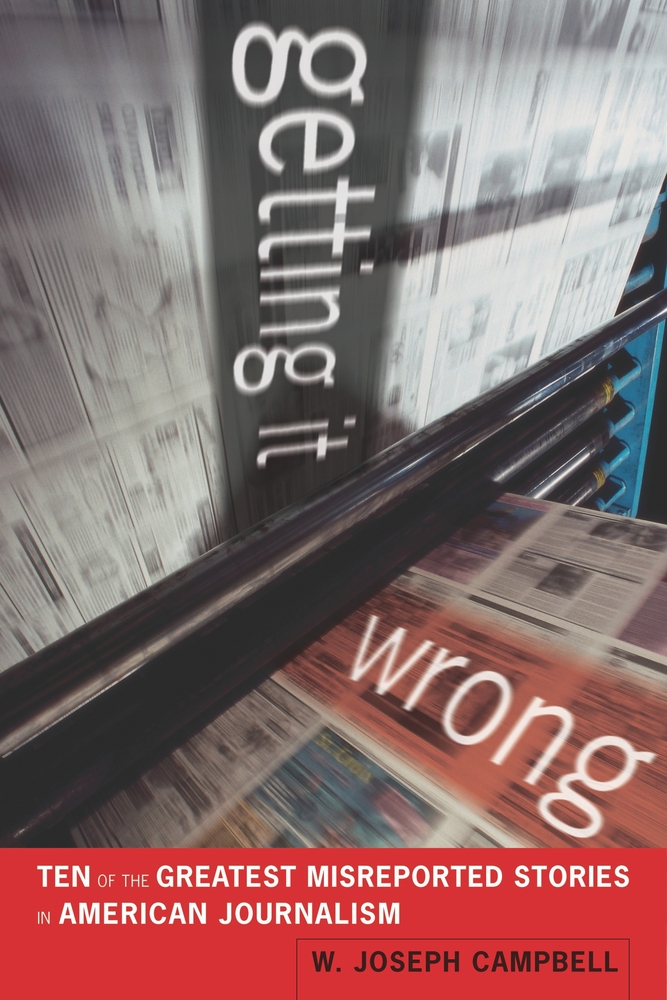
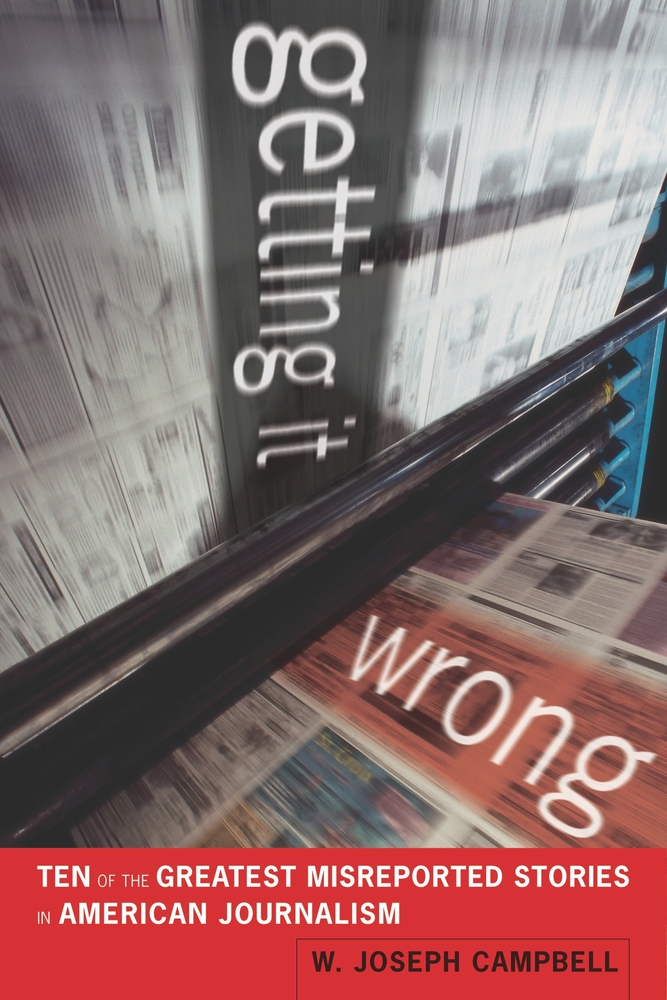
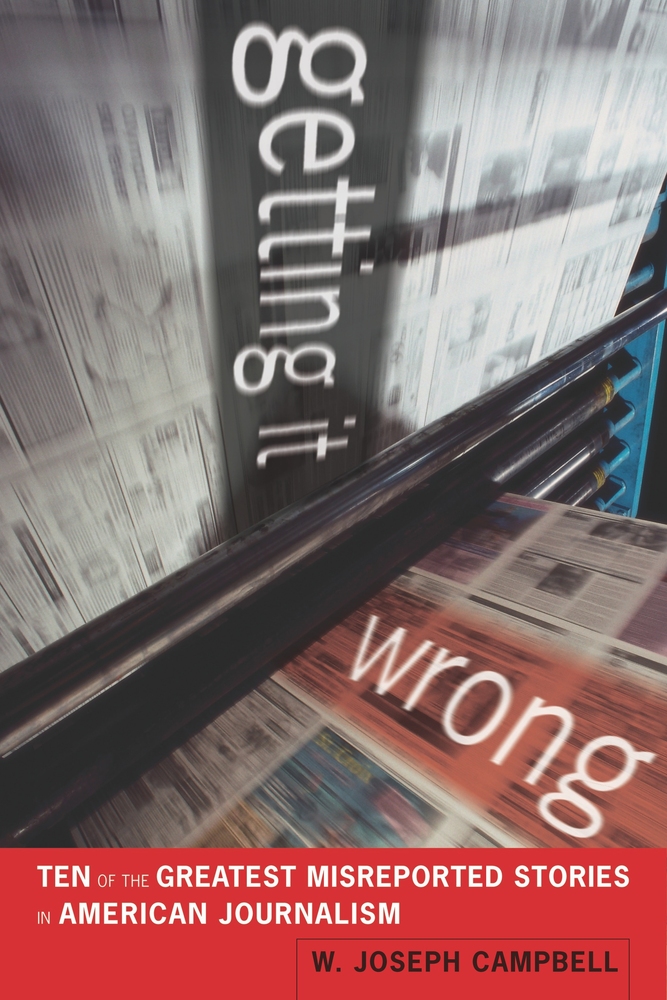
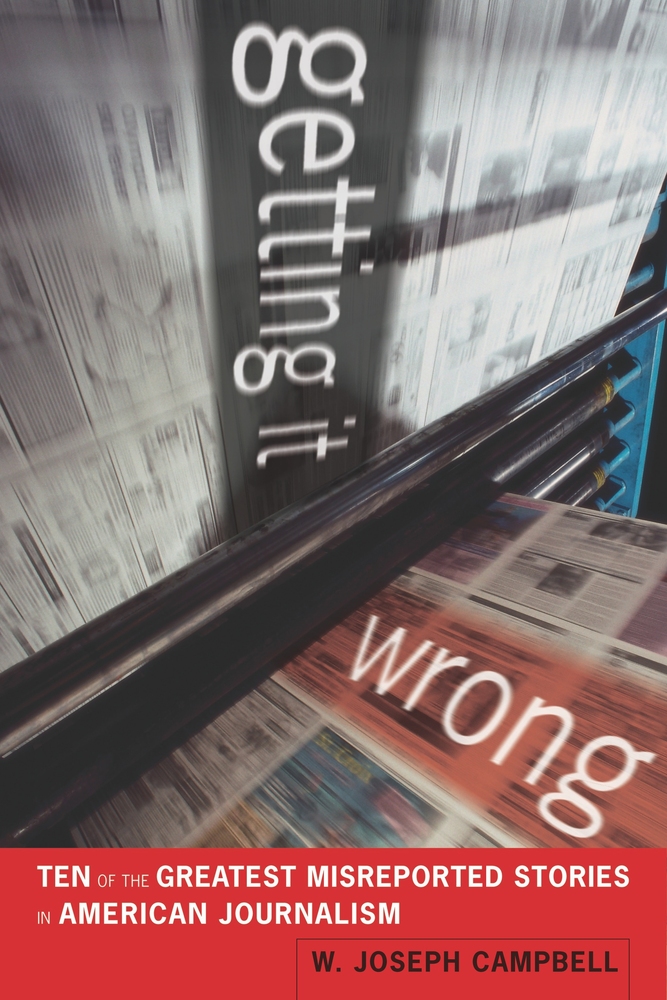
Today’s edition of the venerable  Portuguese newspaper Diário de Notícias includes a write up about Getting It Wrong, my new book about prominent media-driven myths–those false, dubious, improbable stories about the news media that masquerade as factual.

With the help of the online translation site Babelfish, I was able to make out a good deal of the Diário review, which says in part:

“W. Joseph Campbell in Getting it Wrong: Ten of the Greatest Misreported Stories in American Journalism, published the University of California Press, [says] these ‘myths can be thought as junk food of jornalismo.'”

The Diário article mentions several media myths addressed and debunked in Getting It Wrong, including those of William Randolph Hearst’s purported vow to “furnish the war” with Spain; the 1938 radio dramatization of the War of the Worlds which supposedly sowed panic across the United States; the notion that Edward R. Murrow’s 1954 See It Now television program abruptly halted Senator Joseph McCarthy’s communists-in-government witch-hunt, and the myth that the New York Times suppressed its coverage of the run-up to the Bay of Pigs invasion in 1961.

Diário characterizes as one of the book’s “more concrete” examples “the Watergate case,” in which reporters for the Washington Post are credited with having toppled the corrupt presidency of Richard Nixon.

Media myths, the articles notes, are not innocuous; ” they can distort the perception of the power and function of jornalismo” because “they tend to give the media” more power and influence than they rightly deserve. It also says that myths can “minimize the complexity of the historical events for simplistic interpretations.” Both of those are important points raised in Getting It Wrong.

The review closes by taking up the suggestion I offer in the conclusion of Getting It Wrong, namely that there are more media myths to debunk.

“By no means do the media myths examined on these pages represent a closed universe,” I write in the book’s closing passage. “Others surely will assert themselves. They may tell of great deeds by journalists, or of their woeful failings. They may well hold appeal across the political spectrum, offering something for almost everyone. They may be about war, or politics, or biomedical research.

“Predictably, they will be delicious tales, easy to remember, and perhaps immodest and self-congratulatory. They probably will offer vastly simplified accounts of history, and may be propelled by cinematic treatment.  They will be media-driven myths, all rich candidates for debunking.”

WJC

Related:

LBJ’s ‘Vietnam epiphany’ wasn’t Cronkite’s show

In Cronkite Moment, Debunking, Media myths on June 22, 2010 at 12:28 pm

The irresistible “Cronkite Moment” emerged again the other day, this time in a column in a Michigan newspaper claiming that “President Lyndon Baines Johnson had his Vietnam epiphany when he lost Walter Cronkite.”

The “Cronkite Moment” was a broadcast in February 1968 that supposedly was so potent  that it had the effect of prompting Johnson to realize the hopelessness of his war policy in Vietnam.

The story goes that Johnson at the White House watched Cronkite’s special report on Vietnam and, after hearing the anchorman say the U.S. military was “mired in stalemate” and might consider a negotiated settlement, snapped off the television set and exclaimed:

“If I’ve lost Cronkite, I’ve lost Middle America.”

Or words to that effect.

As is described in Getting It Wrong, my new book about media-driven myths, versions vary as to what the president supposedly said.

Getting It Wrong also points out that Johnson did not see the Cronkite program when it aired. The president at the time was in Austin, Texas, making light-hearted comments at the 51st birthday party of Governor John Connally.

As I write in Getting It Wrong, “Even if he later heard—or heard about— Cronkite’s assessment, it was no epiphany for Johnson. Not long after the program, Johnson gave a rousing, lectern-pounding speech in which he urged a ‘total national effort’ to win the war in Vietnam.”

Thus in the days and weeks immediately after the Cronkite program, Johnson remained hawkish on the war.

Johnson’s “epiphany,” as it were, came not in front of a television set in late February 1968 but in discussions a month later with informal advisers at the White House.

As I write in Getting It Wrong, “Johnson’s change of heart on Vietnam came about through a complex process in which Cronkite’s views counted for little. Among the forces and factors that influenced Johnson’s thinking … was the counsel of an influential and informal coterie of outside advisers known as the ‘Wise Men.’

“They included such foreign policy notables as Dean Acheson, a former secretary of state; McGeorge Bundy, a former National security adviser to Kennedy and Johnson; George Ball, a former under-secretary of state; Douglas Dillon, a former treasury secretary; General Omar Bradley, a former chairman of the joint chiefs of staff, and Abe Fortas, a U.S. Supreme Court justice and friend of Johnson.

“The ‘Wise Men’ had met in November 1967, and expressed their near-unanimous support for Johnson’s Vietnam policy. They met again, at the request of the White House, in late March 1968.”

Largely, though not unanimously, the “Wise Men,” expressed opposition to escalating the war in Vietnam.

“The theme that ran around the table was, ‘You’ve got to lower your sights,’” George Ball later recalled.

Johnson, he said, “was shaken by this kind of advice from people in whose judgment he necessarily had some confidence, because they’d had a lot of experience.”

The counsel of the Wise Men represented a tipping point in Johnson’s deciding to seek “peace through negotiations.” In a speech March 31, 1968, the president announced a limited halt to U.S. aerial bombing of North Vietnam as an inducement to the communist government in Hanoi to enter peace talks.

Johnson closed his speech with the stunning announcement that he would not seek reelection to the presidency.

WJC

Related:

<!–[if !mso]> .[i] In a nationally televised speech on March 31, Johnson announced that he had decided to seek “peace through negotiations.” He ordered a limited halt to U.S. aerial bombing of North Vietnam as an inducement to the Hanoi government to enter peace talks. Johnson closed the speech with the stunning announcement that he would not seek reelection to the presidency


[i] George C. Herring, LBJ and Vietnam: A Different Kind of War (Austin: University of Texas Press, 1994), 163.

‘Regret the Error’ considers ‘Getting It Wrong’

In Cronkite Moment, Debunking, Jessica Lynch, Media myths, Reviews, Watergate myth on June 18, 2010 at 6:41 pm

Craig Silverman’s latest “Regret the Error” column, posted today at the Columbia Journalism Review online site, offers a searching discussion of my new book, Getting It Wrong, and notes, insightfully:

“Every society needs heroes and villains, and stories that help forge identity and community. That’s why myths exist in the first place. But the press has the ability and means to shape and disseminate the tales of champions and villains, to create and propagate stories that reinforce role and identity. Media-driven myths are particularly powerful, which in turn makes them even harder to debunk.”

Silverman is the author of the well-received 2007 book, Regret the Error: How Media Mistakes Pollute the Press and Imperil Free Speech. His column discussing Getting It Wrong begins this way:

“Journalism is a profession built on storytelling, so it’s no surprise that its history is filled with some remarkable tales. Think Woodward and Bernstein bringing down a president. Or Walter Cronkite’s 1968 CBS News special about Vietnam that caused President Lyndon Johnson to exclaim, ‘If I’ve lost Cronkite, I’ve lost Middle America.’ Think of Edward R. Murrow demolishing Senator [Joe] McCarthy’s communist witch hunt on television, or William Randolph Hearst telling his correspondent in Cuba, ‘You furnish the pictures, I’ll furnish the war.’

McCarthy

“Great stories, all of them. If only they were built on facts—the other thing our profession is supposed to revere. W. Joseph Campbell, a professor at American University and respected journalism scholar, smashes the above media-driven myths, along with a few more, in his new book, Getting It Wrong: Ten of the Greatest Misreported Stories in American Journalism.”

About the emergence of media-driven myths, Silverman quotes me as saying:

“The notion of media power both for good, as in the Watergate example, or for bad, as in the William Randolph Hearst example, is one of the driving forces behind media myths.”

Indeed. Media myths, I write in Getting It Wrong, often stem from “an eagerness to find influence and lasting significance in what journalists do and tend to extend credit where credit is not entirely due.”

I further note in the book that media myths can “be self-flattering, offering heroes … to a profession more accustomed to criticism than applause.”

Silverman’s column wraps up by considering how to combat media-driven myths, quoting me as underscoring the importance of viewpoint diversity in American media newsrooms.

“There is room for a newsroom culture that embraces diverse viewpoints, and I think that will help encourage skepticism … and negate the groupthink that tends to take hold in newsroom culture,” he quotes me as saying.

“Challenging the dominant narrative and encouraging contrarian thinking is a good thing.”

On that point, I write in Getting It Wrong:

“It is certainly not inconceivable that a robust newsroom culture that embraces viewpoint diversity, encourages skepticism, invites challenges to dominant narratives, and rewards contrarian thinking would have helped thwart publication of embarrassing tales such as the Washington Post’s ‘fighting to the death‘ story about Jessica Lynch.”

WJC

Related:

Launching ‘Getting It Wrong’ at Newseum

In Bay of Pigs, Bra-burning, Cronkite Moment, Debunking, Furnish the war, Jessica Lynch, Media myths, Murrow-McCarthy myth, War of the Worlds, Washington Post, Watergate myth on June 14, 2010 at 6:28 am

My new book, Getting It Wrong, will be launched Saturday, June 19, at an “Inside Media” program at the Newseum, the $450 million museum of news in downtown Washington, D.C.

The program will begin at 2:30 p.m. in the Knight TV Studio on the third level and will feature a discussion with the Newseum’s John Maynard, followed by audience Q-and-A.

I’ll be signing copies of Getting It Wrong afterward.

The book addresses, and debunks, 10 prominent media-driven myths–stories about and/or by the news media that are widely believed and often retold but which, on close inspection, proved to be apocryphal or wildly exaggerated.

Here is a brief description about each of the 10 myths:

  1. Remington-Hearst: William Randolph Hearst’s famous vow, “you furnish the pictures, I’ll furnish the war,” is almost certainly apocryphal.
  2. War of Worlds: The notion that the War of Worlds radio dramatization in 1938 caused nationwide panic and mass hysteria is exaggerated.
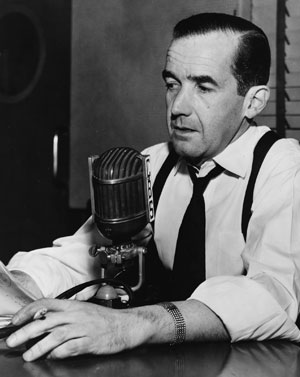
  3. Murrow-McCarthy: Edward R. Murrow’s famous See It Now program in March 1954 did not end Senator Joseph McCarthy’s communists-in-government witch-hunt; Murrow in fact was very late to take on McCarthy.

    Murrow in 1954

  4. Bay of Pigs: The New York Times did not suppress its reporting in the run-up to the ill-fated Bay of Pigs invasion in April 1961.
  5. Cronkite-Johnson: Walter Cronkite’s special report on Vietnam in February 1968 did not prompt an immediate reassessment of U.S. war policy.
  6. Bra-burning: Humor columnist Art Buchwald helped spread the notion that feminist demonstrators dramatically burned their bras at a Miss America protest in September 1968.
  7. Watergate: The Washington Post’s intrepid reporters, Carl Bernstein and Bob Woodward, did not bring down Richard Nixon’s corrupt presidency. That they did is a trope that knows few bounds.
  8. Crack babies: The much-feared “bio-underclass” of children born to women who smoked crack cocaine during their pregnancies never materialized.
  9. Jessica Lynch: The Washington Post’s erroneous reporting about Jessica Lynch early in the Iraq War gave rise to several myths about her capture and rescue.
  10. Hurricane Katrina: News coverage of Katrina’s aftermath in New Orleans in early September 2005 was marred by wild exaggerations of extreme, Mad Max-like violence.

As I write in Getting It Wrong, the myths debunked “are among American journalism’s best-known stories. Most of them are savory tales. And at least some of them seem almost too good to be false.”

I further write that because it “takes on some of the most treasured stories in American journalism,” Getting It Wrong is “a work with a provocative edge. It could not be otherwise.”

WJC

Related:

The wobbly components of the ‘Cronkite moment’

In Cronkite Moment, Debunking, Media myths on June 7, 2010 at 5:23 am

It’s often claimed that Walter Cronkite’s analysis in February 1968 that the U.S. military effort in Vietnam was “mired in stalemate” helped swing public opinion against the war.

Not to mention that Cronkite’s penetrating assessment brought President Lyndon Johnson face-to-face with the realization his war policy was a shambles.

And so incisive was Cronkite’s assessment that it supposedly was a factor in Johnson’s decision, announced a month later, not to seek reelection to the presidency.

Those are three components of an especially tenacious and popular media-driven myth, all of which I address in a chapter in my new book, Getting It Wrong.

The wide circulation of what I call the mythical “Cronkite moment” was evident in a commentary aired the other day on Vermont Public Radio, which asserted:

“In 1968, when CBS anchorman Walter Cronkite delivered a downbeat report on American progress in Vietnam, public opinion rapidly soured on the war. President Lyndon Johnson lamented, ‘If I’ve lost Cronkite, I’ve lost the country.’  Several weeks later, Johnson decided not to run for re-election.”

In fact, as I discuss in Getting It Wrong, public opinion had begun shifting against the war weeks and months before Cronkite’s special report about Vietnam, which aired February 27, 1968.

By October 1967, 47 percent of Americans, a plurality, maintained that U.S. military presence in Vietnam was a mistake, according to Gallup surveys.

Moreover, Cronkite’s “mired in stalemate” assessment was, I write in Getting It Wrong, “neither notable nor extraordinary,” pointing out that Mark Kurlansky in his study of the year 1968 stated that Cronkite’s view was “hardly a radical position” for the time.

Indeed, nearly seven months before the “Cronkite moment,” the New York Times published on its front page as analysis that said victory in Vietnam “is not close at hand. It may be beyond reach.” The analysis was published in August 1967 beneath the headline:

“Vietnam: The Signs of Stalemate.”

As has been noted many times at MediaMythAlert, Johnson did not see the Cronkite program when it aired. The president at the time was in Austin, Texas, at the 51st birthday party of Governor John Connally.

So he could not have had “the abrupt yet resigned reaction that so often has been attributed to him,” I write in the book.

There is, moreover, no evidence that Johnson ever watched the Cronkite program on videotape.

And as I note in Getting It Wrong:

“The power of the ‘Cronkite moment’ resides in the sudden, unexpected, and decisive effect it supposedly had on the president. Such an effect would have been absent, or greatly diminished, had Johnson had seen the program on videotape at some later date.”

As for Johnson’s decision not to seek reelection, which he announced at the end of March 1968: The “Cronkite moment” certainly was a non-factor.

There’s evidence that Johnson never intended to seek reelection, that he had privately decided in 1967 against another campaign.

Also important in Johnson’s decision was Senator Eugene McCarthy’s surprisingly potent bid for the Democratic nomination for president in early 1968.

Under scrutiny, then, the components of the “Cronkite moment” prove to be wobbly: They don’t hold up to inspection. And that’s “not so surprising,” I write in Getting It Wrong, adding:

“Seldom, if ever, do the news media exert truly decisive influences in decisions to go to war or to seek negotiated peace. Such decisions typically are driven by forces and factors well beyond the news media’s ability to shape, alter, or significantly influence.”

So it was with the often-misinterpreted “Cronkite moment” of 1968.

WJC

Related:

A funny thing about media myths

In Cronkite Moment, Debunking, Media myths, Washington Post, Watergate myth on June 2, 2010 at 6:03 pm

Media-driven myths are prominent tales of doubtful authenticity—false, dubious, or improbable stories about the news media that masquerade as factual.

A funny thing about media-driven myths is that some of them live on despite having been pooh-poohed by figures who were central to the story.

The heroic-journalist myth of Watergate offers a telling example of this peculiar feature of some media myths.

The Watergate myth—one of 10 that I debunk in my soon-to-be-published book, Getting It Wrong—maintains that the intrepid investigative reporting of Bob Woodward and Carl Bernstein of the Washington Post brought down Richard Nixon’s corrupt presidency in the Watergate scandal.

“That Woodward and Bernstein exposed Nixon’s corruption is a favored theme in textbooks of journalism and mass communication,” I write in Getting It Wrong, noting how the tale has become “deeply ingrained in American journalism as one of the field’s most important and self-reverential stories.”

But leading figures at the Washington Post have sought periodically over the years to dismiss the notion that their newspaper took down a president.

Katharine Graham, the newspaper’s publisher during the Watergate years, insisted the Post did not topple Nixon. “Sometimes people accuse us of bringing down a president, which of course we didn’t do,” Graham said in 1997, at a program marking the scandal’s twenty-fifth anniversary. “The processes that caused [Nixon’s] resignation were constitutional.”

And Woodward has been quoted as saying, “To say that the press brought down Nixon, that’s horseshit.”

As I note in Getting It Wrong, to roll up a scandal of Watergate’s dimension and complexity “required the collective if not always the coordinated forces of special prosecutors, federal judges, both houses of Congress, the Supreme Court, as well as the Justice Department and the FBI.

“Even then,” I write, “Nixon likely would have served out his term if not for the audiotape recordings he secretly made of most conversations in the Oval Office of the White House. Only when compelled by the Supreme Court did Nixon surrender those recordings, which captured him plotting the cover-up and authorizing payments of thousands of dollars in hush money.”

Similarly, Walter Cronkite long dismissed claims that his televised report in February 1968 about the Vietnam War had a powerful influence on President Lyndon Johnson.

In an editorial comment at the close of that report, Cronkite said the war effort in Vietnam was “mired in stalemate” and suggested that negotiations eventually might offer a way out for the United States.

Upon hearing Cronkite’s dire assessment, Johnson supposedly snapped off the television set and exclaimed: “If I’ve lost Cronkite, I’ve lost Middle America.”

Or something to that effect. Versions vary.

The program and Johnson’s despairing response have become the stuff of legend—another media-driven myth.

Interestingly, Cronkite scoffed at the suggestion his report on Vietnam had a great effect on Johnson. For years, he characterized the program in modest terms, writing in his 1997 memoir that the “mired in stalemate” assessment was for Johnson “just one more straw in the increasing burden of Vietnam.”

But in what may have been tacit acknowledgement of the appeal of media-driven myths, Cronkite late in his life came to embrace the view that the program on Vietnam was a significant moment.

For example, he told Esquire magazine in 2006, about three years before his death:

“To be honest, I was rather amazed that my reporting from Vietnam had such an effect on history.”

But as is discussed in Getting It Wrong, Johnson did not see the Cronkite program when it aired. The president at the time was in Austin, Texas, making an appearance at the 51st birthday of a longtime political ally, Governor John Connally.

“Today you are 51, John,” the president said at about the time Cronkite was offering his “mired in stalemate” commentary. “That,” Johnson said, “is the magic number that every man of politics prays for—a simple majority.”

WJC

An earlier version of this post first appeared at the University of California Press blog.

On version variability and the ‘Cronkite moment’

In Cronkite Moment, Debunking, Media myths on May 25, 2010 at 10:34 am

As I note in my soon-to-be-published book, Getting It Wrong, version variability–the imprecision that alters or distorts an anecdote in its retelling–can be a marker of media-driven myths.

Cronkite in Vietnam, 1968

So it is with the purported “Cronkite moment” of 1968, when CBS anchorman Walter Cronkite asserted in a special televised report that the U.S. military was “mired in stalemate” in Vietnam. President Lyndon Johnson supposedly saw the Cronkite program and promptly realized the war effort was doomed.

“If I’ve lost Cronkite,” the president is reputed to have said in reaction to Cronkite’s pronouncement, “I’ve lost Middle America.”

Or, as a columnist for Townhall.com wrote yesterday, Johnson “said to an aide, ‘If we’ve lost Walter, then we’ve lost the war.'”

Those are just two of many variations of Johnson’s supposed response to Cronkite’s downbeat assessment.

Other versions include:

“I’ve lost Cronkite, I’ve lost the country.”

“If I’ve lost Cronkite, I’ve lost the American people.”

“If I’ve lost Cronkite, I’ve lost the war.”

“If we lose Cronkite, we lose America.”

As I write in Getting It Wrong, “Version variability of that magnitude signals implausibility.”

I also note that version variability “suggests more than sloppiness in journalistic research or a reluctance to take time to trace the derivation of the popular anecdote. The varying accounts of Johnson’s purported reactions represent another, compelling reason for regarding the ‘Cronkite moment’ with doubt and skepticism.”

Moreover, as I write in Getting It Wrong, Johnson did not see the Cronkite program when it aired February 27, 1968. At the time, Johnson was in Austin, Texas, at the 51st birthday party of his longtime political ally, Governor John Connally.

Johnson teased Connally about his age, saying: “Today you are 51, John. That is the magic number that every man of politics prays for—a simple majority. Throughout the years we have worked long and hard—and I might say late—trying to maintain it, too.”

And even if Johnson later heard—or heard about—Cronkite’s assessment, it represented no epiphany for the president, no burst of clarity about a policy gone sour.

A few weeks after the Cronkite program, Johnson gave a rousing, lectern-thumping speech in Minneapolis, in which he urged a “total national effort” to win the war in Vietnam.

The speech was delivered March 18, 1968, and in it, the president declared:

“We love nothing more than peace, but we hate nothing worse than surrender and cowardice.”

So in the weeks immediately following the purported “Cronkite moment,” Johnson maintained an aggressive public stance on the war. He clearly wasn’t swayed by Cronkite’s “mired in stalemate” analysis.

WJC

Related:

At HuffPo books

In Cronkite Moment, Debunking, Media myths, Washington Post, Watergate myth on May 22, 2010 at 8:27 am

Check out my guest post at the Huffington Post books page about Getting It Wrong, my forthcoming book about media-driven myths.

I discuss the book, which will be published soon by University of California Press, and address reasons that help explain the tenacity and enduring appeal of media-driven myths.

I write:

“They are, first of all, deliciously good stories–too good, almost, to be disbelieved.

“They also are appealingly reductive, in that they minimize complexity of historical events and offer simplistic and misleading interpretations instead. The Washington Post no more brought down [President Richard] Nixon than Walter Cronkite swayed [President Lyndon] Johnson’s views about the war in Vietnam. Yet those and other media myths endure because they present unambiguous, easy-to-remember explanations for complex historic events.

“Some media-driven myths can be self-flattering, offering up heroes in a profession more accustomed to scorn and criticism than applause.

“More important, though, is that media-driven myths often emerge from an eagerness to find influence and significance in what journalists do. These myths affirm the centrality of the news media in public life and ratify the notion the media are powerful, even decisive actors.

“To identify these tales as media-driven myths is to confront the reality that the news media are not the powerful agents they, and so many others, assume them to be.”

That’s often the case: Because the media are everywhere, it is easy, as Robert J. Samuelson once wrote, to confound their presence with power.

And as the sociologist Herbert J. Gans has observed:

“If news audiences had to respond to all the news to which they are exposed, they would not have time to live their own lives. In fact, people screen out many things, including the news, that could interfere with their own lives.”

WJC

‘A debunker’s work is never done’

In Bay of Pigs, Bra-burning, Cronkite Moment, Debunking, Furnish the war, Media myths, Murrow-McCarthy myth, New York Times, Reviews, War of the Worlds, Washington Post, Watergate myth, Yellow Journalism on May 21, 2010 at 6:14 pm

So notes the inestimable media critic Jack Shafer in his review of my forthcoming book, Getting It Wrong, posted today at slate.com.

And what a generous, engaging, and insightful review it is.

Under the headline “The Master of Debunk,” Shafer notes that “the only way to debunk an enshrined falsehood is with maximum reportorial firepower.

“Toting big guns and an itchy trigger-finger is American University professor W. Joseph Campbell, whose new book Getting It Wrong: Ten of the Greatest Misreported Stories in American Journalism flattens established myths that you were brought up to believe were true.”

Shafer’s review specifically discusses a variety of media-driven myths, including William Randolph Hearst’s purported vow to “furnish the war” with Spain; the so-called “Cronkite moment” that supposedly altered President Lyndon Johnson’s Vietnam policy; the Bay of Pigs suppression myth that erroneously says President John F. Kennedy persuaded the New York Times to spike a story about the pending U.S.-backed invasion of Cuba, and the heroic-journalist myth of Watergate.

Shafer rightly points out that “a debunker’s work is never done” and to that end notes my recent post at Media Myth Alert about Evan Thomas’ new book, The War Lovers. The book embraces myths of the yellow press period in American journalism, including the Hearst vow.

Shafer thoughtfully considers the tenacity of media-driven myths, writing:

“Some myths endure because the stories are so compelling, like the Hearst tale and the alleged mayhem caused by Orson Welles’ [War of the Worlds] broadcast. Others survive because our prejudices nourish them (“crack babies,” bra burners) or because pure repetition has drummed them into our heads, smothering the truth in the process.

“The best tonic for the brain fever caused by media myths is an open mind and a free inquiry,” he writes.

Shafer wraps up the review by invoking this observation, by Jonathan Rauch:

“It is the error we punish, not the errant.”

Shafers adds:

“Of course when you do such a good job punishing the error, as Campbell does, you don’t need to bother with the errant.”

WJC

Related:

Myth resurfaces in Cronkite-collaborator report

In Cronkite Moment, Debunking, Media myths, Year studies on May 15, 2010 at 10:28 am

The Yahoo News report yesterday that venerable CBS anchorman Walter Cronkite may have quietly collaborated with antiwar activists in the late 1960s stirred a modest flurry of commentary in the blogosphere.

Cronkite in Vietnam, 1968

Few mainstream media outlets appear to have touched the story, which I find to be something of a stretch. An exception was Rupert Murdoch’s  New York Post, which carried a brief article, essentially a rewrite of the Yahoo report.

That report cited newly released FBI documents in saying that in late 1969, “Cronkite encouraged students at Rollins College in Winter Park, Fla., to invite Maine Sen. Edmund Muskie to address a protest [against the war] they were planning near Cape Kennedy (now known as Cape Canaveral). Cronkite told the group’s leader that Muskie would be nearby for a fundraiser on the day of the protest, and said that ‘CBS would rent [a] helicopter to take Muskie to and from site of rally.'”

Inevitably, the report recalled Cronkite’s famous on-air editorial comment delivered February 27, 1968, at the end of a special report on Vietnam. On that occasion, Cronkite declared the U.S. war effort in Vietnam was “mired in stalemate.”

A post yesterday at mediaite.com noted Cronkite’s 1968 commentary, saying it “is often credited with turning the tide of public opinion against the war.”

Cronkite’s commentary that night has become the stuff of legend. But it was scarcely so powerful or decisive as to much move public opinion.

As I discuss in Getting It Wrong, my forthcoming book about media-driven myths, public opinion had begun turning against the Vietnam War months before the Cronkite program.

In October 1967, a Gallup survey reported that the percentage of respondents saying that U.S. military presence in Vietnam was a mistake had reached a plurality—47 percent. That was 4½ months before Cronkite delivered his on-air commentary. (In August-September 1965, just 24 percent of Gallup poll respondents said sending troops to Vietnam was a mistake.)

In a Gallup poll completed in early February 1968, three weeks before the Cronkite program, the proportion saying the war was a mistake stood at 46 percent; 42 percent said it had not been a mistake.

Gallup asked the question again in a poll completed the day the Cronkite program aired, finding that 49 percent of the respondents said U.S. military intervention in Vietnam had been a mistake; 42 percent said it had not.

By late February 1968, Cronkite’s “mired in stalemate” assessment was, I write in Getting It Wrong, “neither notable nor extraordinary.”

I also note that Mark Kurlansky, author of a year-study about 1968, declared Cronkite’s view “hardly a radical position” for the time.

Cronkite’s remarks that night were fairly mild–certainly less emphatic than comments offered about two weeks later by Frank McGee of the rival NBC network.

“The war,” McGee declared on an NBC News program March 10, 1968, “is being lost by the administration’s definition.”

As I’ve noted previously, it is a bit surprising that McGee’s pointed editorial comments are not more often remembered.

WJC