W. Joseph Campbell

Posts Tagged ‘Cronkite Moment’

Taking stock: Top mythbusting posts of 2013

In 1897, Anniversaries, Cinematic treatments, Cronkite Moment, Debunking, Error, Jessica Lynch, Media myths, Media myths and radio, Newspapers, Television, War of the Worlds, Washington Post on December 29, 2013 at 10:09 am

Media Myth Alert reported in 2013 on the appearance of numerous and prominent media-driven myths and errors. Here are the five top writeups posted at the blog during 2013, followed by a roster of other mythbusting posts of note.

PBS squanders opportunity in tedious War of the Worlds documentary (posted October 29): The year brought the 75th anniversary of Orson Welles’ famous and clever War of the Worlds radio adaptation, which told of a deadly Martian invasion of Earth. Welles’ show aired October 30, 1938, and supposedly was so frightening that it pitched tens of thousands of Americans into panic and mass hysteria.

Orson Welles

Orson Welles

But as I discussed in my 2010 mythbusting book, Getting It Wrong,  the radio dramatization produced no such effects. Panic and hysteria were wildly overstated by newspapers of the time.

PBS took up The War of the Worlds program in a documentary that aired October 29, on the eve of the radio show’s 75th anniversary. The PBS program not only made The War of the Worlds seem tedious, it represented a missed opportunity to revisit the famous but much-misunderstood program in fresh and searching ways.

“PBS could have confronted head-on the question of whether the radio show … really did provoke hysteria and mass panic in the United States,” I wrote.

Instead, I added, “The documentary’s makers settled for a turgid program that was far less educational, informative, and inspiring than it could have been.” It failed to address the supposed effects of Welles’ radio dramatization in any meaningful way.

My critique was seconded by the PBS ombudsman, Michael Getler, who wrote in a column after the documentary was broadcast:

“I find myself in agreement with the judgment of W. Joseph Campbell, the well-known critic and author of ‘Getting It Wrong: Ten of the Greatest Misreported Stories in American Journalism’ who headlined his comment:  ‘PBS squanders opportunity to offer “content that educates” in “War of the Worlds” doc.’”

Obama’s ‘Cronkite Moment’? (posted May 14): The online news magazine Salon found great significance in liberal TV comedian Jon Stewart’s obscenity-laced tirade in May about the scandals battering the administration of President Barack Obama.

Stewart’s criticism, Salon declared, evoked “one of the most famed moments in broadcasting, when CBS News legend Walter Cronkite delivered an editorial opinion after the Tet Offensive in February 1968,” suggesting that negotiations could lead to a way out of Vietnam.Salon logo

Salon proceeded to step into media myth by describing how Cronkite’s commentary supposedly was received by President Lyndon Johnson:

“Apparently watching at the White House, President Johnson, who had lost the left long ago, reportedly turned to an aide and said, ‘If I’ve lost Cronkite, I’ve lost Middle America.’ Just a few weeks later, Johnson announced he would not seek reelection.”

Salon offered a muddled caveat by stating parenthetically: “Critics say the event has been widely misreported and overblown, but it still looms large in the American consciousness of the era, even if apocryphally.”

How’s that? It “looms large … even if apocryphally”? Simply put, the so-called “Cronkite Moment” is apocryphal.

Cronkite’s commentary about Vietnam was, as I discuss in Getting It Wrong, no epiphany for Johnson, and it had nothing to do with his deciding not to seek reelection in 1968.

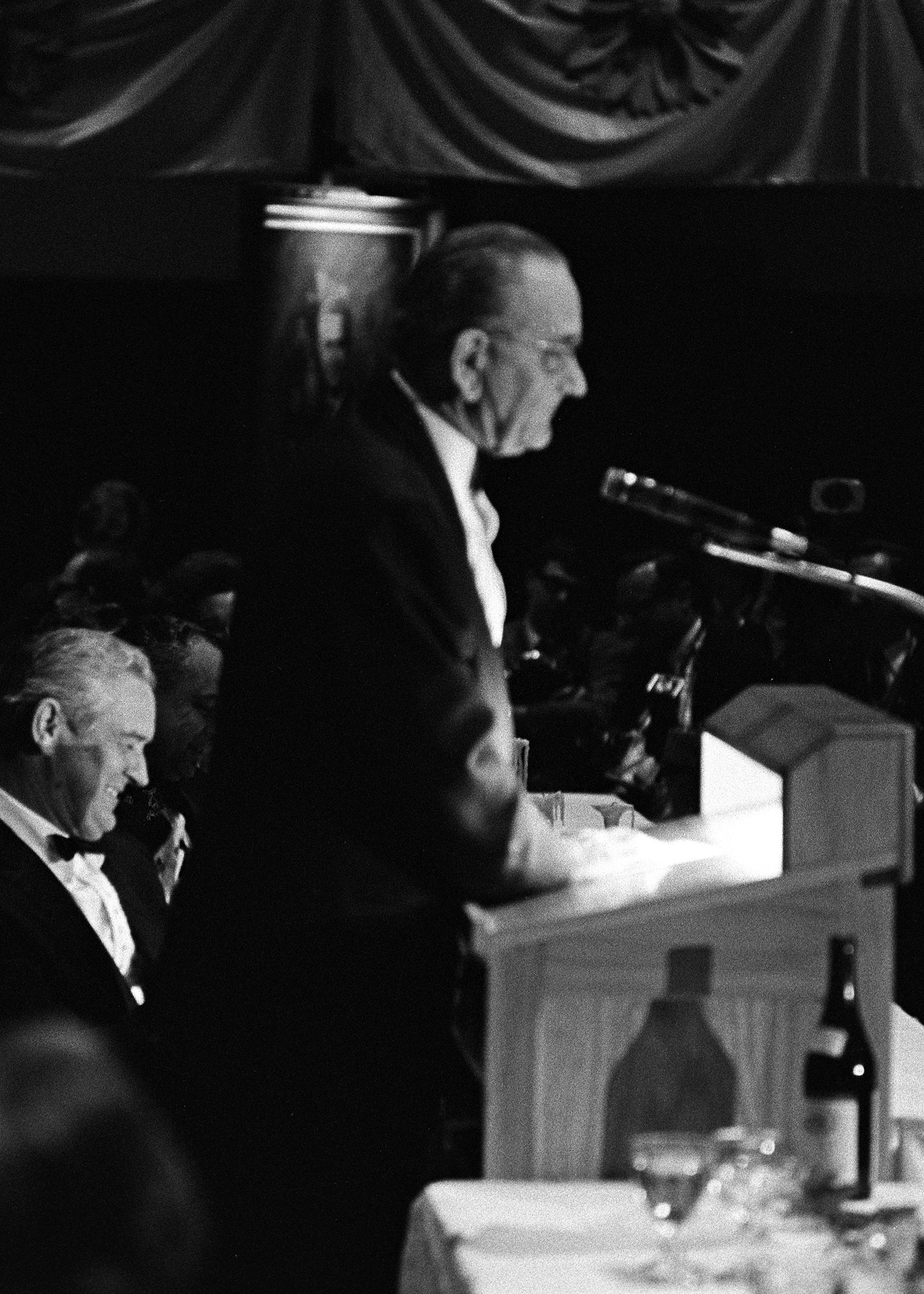
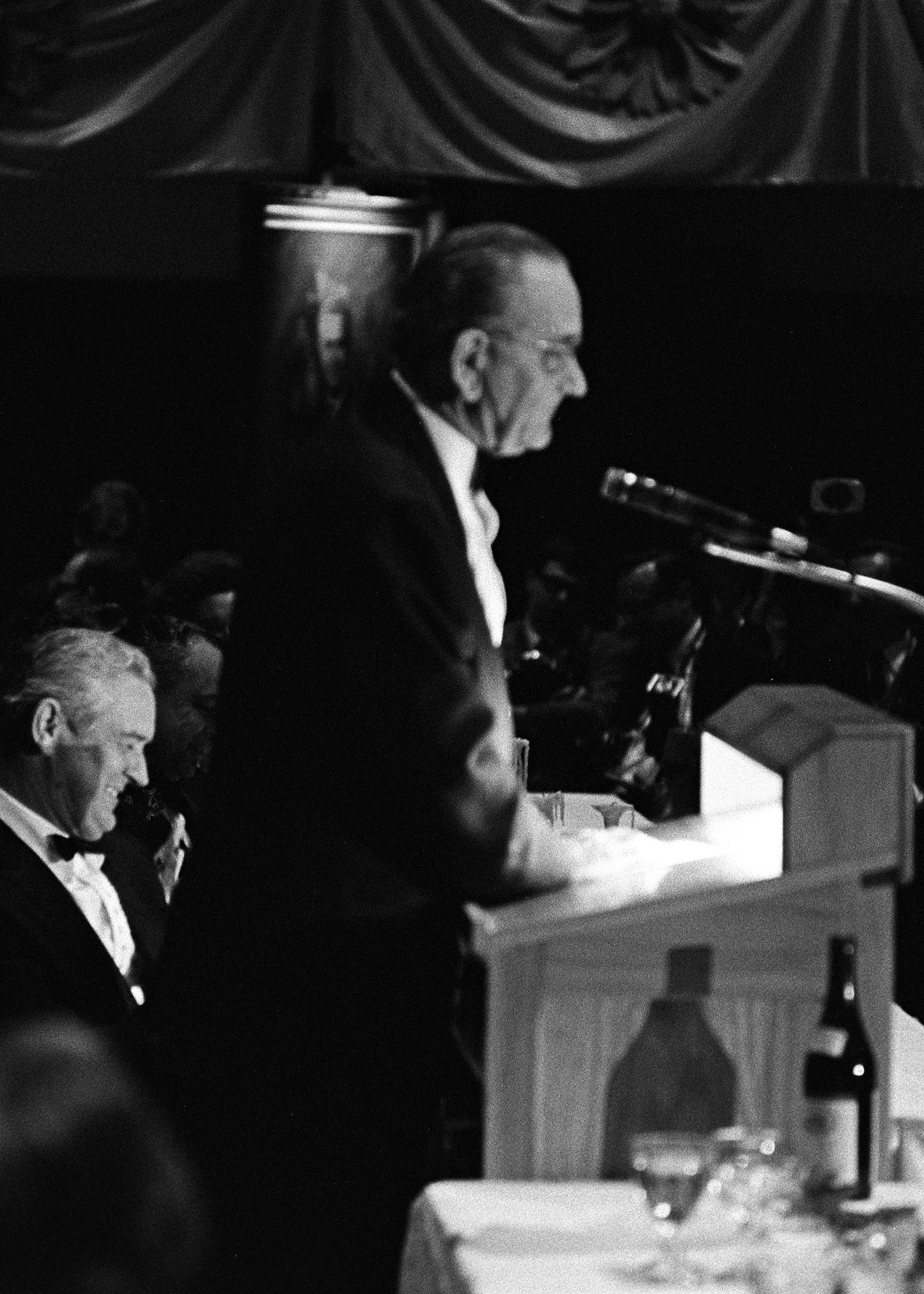
In fact, Johnson did not see the Cronkite program when it aired on February 27, 1968. He wasn’t at the White House, either. He was in Austin, Texas, at a black-tie birthday party for Governor John Connally.

What’s more, there’s no evidence that Jon Stewart’s rant has figured at all in Obama’s fading popularity. Far more decisive has been the botched introduction of the Obama administration’s health-care plan.

London’s Independent invokes Jessica Lynch-Pentagon myth (posted January 28): The year brought the 10th anniversary of the Washington Post’s stunningly inaccurate tale of the supposed heroics of 19-year-old Jessica Lynch during an ambush in Iraq.

In the years since, news reports sometimes have claimed — without citing supporting evidence — that the  Pentagon concocted the story about Lynch. In January, for example, London’s Independent newspaper declared “the Pentagon exaggerated [Lynch’s] story as it waged a propaganda war, stating that she had fought back heroically against the enemy when in fact she had never fired her weapon.”
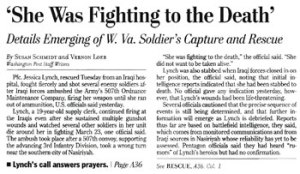
Lynch_headline_Post

Stunningly inaccurate

But that was not the Pentagon’s line. Not according to Vernon Loeb, the then-Post reporter who helped thrust the hero-warrior tale about Lynch into the public domain in a front-page story published April 3, 2003.

Loeb’s story, on which he shared a byline with Susan Schmidt, turned out to be wrong in every significant detail: Lynch never fired a shot in the ambush at Nasiriyah; her weapon jammed during the attack in which 11 American soldiers were killed. She was neither shot nor stabbed, as Loeb and Schmidt reported.

Although the newspaper has never disclosed the identities of the “U.S. officials” on which it based its botched story, Loeb said in an interview with NPR in December 2003 that the Post’s “sources for that story were not Pentagon sources.”

Loeb said he “could never get anybody from the Pentagon to talk about” the Lynch case, adding:

“I just didn’t see the Pentagon trying to create a hero where there was none. I mean … they never showed any interest in doing that, to me.”

The erroneous report about Lynch’s battlefield derring-do, by the way, did little damage to Loeb’s career. He left the Post in 2004 to become an investigations editor at the Los Angeles Times. Later, he moved to the Philadelphia Inquirer as deputy managing editor for news before returning to the Post in 2011 as metropolitan editor.

And next month Loeb will join the Houston Chronicle as managing editor.

WaPo refuses to correct clear error on Nixon’s mythical ‘secret plan’ (posted August 13):  Even in its clear decline, the Washington Post can be an arrogant news organization.

This tendency was on display last summer in its refusal to acknowledge and correct an inaccurate reference to Richard Nixon’s “secret plan” to end the war in Vietnam.

The reference was embedded in the Post’s front-page obituary about Helen Thomas, a querulous and overrated Washington journalist who covered the White House for years for United Press International.
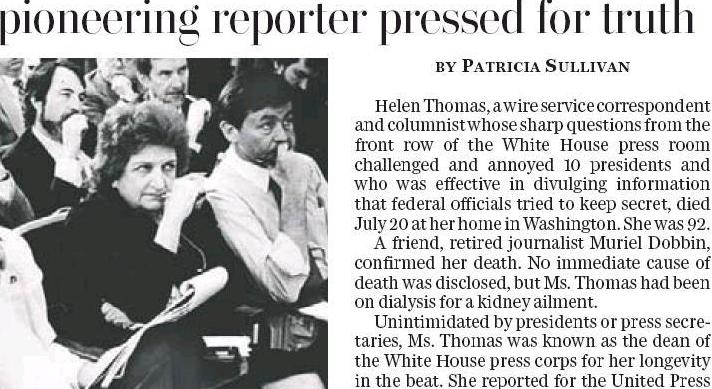
WaPo_HThomas obit_2013

WaPo’s Thomas obit

The obituary, written by Patricia Sullivan, claimed that Thomas once “asked President Richard M. Nixon point-blank what his secret plan to end the Vietnam War was.”

But there is no evidence that Thomas ever posed such a question. The nearest approximation came at a news conference in late January 1969, when Thomas asked Nixon about his “peace plan” for Vietnam. Peace plan: She didn’t ask about a “secret plan.”

The Post’s error had broader dimension in that it suggested an embrace of the notion that Nixon ran for president in 1968 claiming to have a “secret plan” to end the war  in Vietnam.

Which is untrue. Nixon did not campaign for the White House touting a “secret plan.” The belief that he did, though, circulates still, as supposedly powerful evidence of Nixon’s devious and conniving ways.

The obituary’s writer, Sullivan, said as much, telling me by email:  “I recall the Nixon years and his promise during his candidacy that he had a plan to end the Vietnam War, which he would not explain in detail.”

In fact, Nixon was asked during the 1968 campaign about having a “secret plan” to end the war. And according to a report in the Los Angeles Times on March 28, 1968, he replied that he had “no gimmicks or secret plans.”

He also said: “If I had any way to end the war, I would pass it on to President [Lyndon] Johnson.”

I brought all this to the attention of the Post’s reader representative, Douglas Feaver, noting that if the newspaper can point to an occasion when Thomas asked Nixon about a “secret plan” on Vietnam — if it could back up Sullivan’s claim, in other words — then that would represent an intriguing though modest contribution to the understanding about Nixon’s campaign in 1968. It would indicate that journalists at the time suspected Nixon was less than forthcoming about his intended war policy.

If, on the other hand, the Post could not identify such an occasion, I wrote, then a correction was in order.

Feaver took more than 2 1/2 weeks to reply to my query and when he did, he absolved the Post of error, stating: “I see nothing here that deserves a correction.”

Coincidentally, not long after the Post published its flawed obituary, the newspaper was sold for $250 million to Jeff Bezos, founder of Amazon.com.  In an open letter to the newspaper’s employees soon after the sale was announced, Bezos stated:

“We will continue to follow the truth wherever it leads, and we’ll work hard not to make mistakes. When we do, we will own up to them quickly and completely.”

If that sentiment does become policy, it certainly will be none too soon.

Hearst mostly elusive in ‘Citizen Hearst’ documentary (posted March 15): The Hearst Corp., founded in 1887 by William Randolph Hearst, commissioned a documentary about the company and its much-misunderstood founder that promised to tell “the wonderful Hearst story.”

At least that’s what the director, Leslie Iwerks, said in introducing the film at its Washington, D.C., debut in March.

Citizen HearstThe documentary, titled Citizen Hearst, turned out to be something less than a revealing portrait. Its consideration of Hearst’s long career in journalism was  fast-paced but superficial.

The film notably avoided discussing young Hearst’s aggressive brand of participatory journalism — the “journalism of action” — which maintained that newspapers were obliged take a prominent and participatory roles in civic life, to swing into action when no other agency or entity was willing or able.

The zenith of the “journalism of action” came in 1897 in the jailbreak and escape of Evangelina Cisneros, a 19-year-old political prisoner held without charge in Spanish-ruled Cuba.

The Cisneros jailbreak, organized by a reporter for Hearst’s New York Journal, offered rich material for a documentary. But it received no mention in Citizen Hearst.

The film, moreover, only superficially considered Hearst’s mostly unfulfilled political ambitions of the early 20th century. It made no mention about how Hearst then turned his newspapers into platforms to support those goals.

WJC

Other memorable posts of 2013:

Cronkite report on Vietnam was ‘most influential TV show ever’?

In Cronkite Moment, Debunking, Error, Hurricane Katrina, Media myths, Television on June 18, 2013 at 10:41 am

The most influential TV show ever?

Cronkite in Vietnam, 1968

Cronkite in Vietnam, 1968

It’s rather a thumbsucker, but it’s the topic of the “Big Question” feature in the June number of the Atlantic. And the responses, culled from TV executives, producers, and show creators, range from All in the Family, to the Simpson’s, to Saturday Night Light, to Walter Cronkite’s special report about Vietnam.

I always thought All in the Family was grating and repetitive; the Simpson’s predictable, and Saturday Night Light ever-erratic. But the Cronkite report about Vietnam, which aired February 27, 1968?

The most influential?

That’s just wrong. Factually wrong.

The Cronkite program was proposed as “most influential” by John Langley, co-creator of the series Cops, who wrote in explaining his choice:

“Public opinion followed Cronkite’s assessment, leading President Johnson to observe, ‘If I’ve lost Cronkite, I’ve lost Middle America.'”

That assessment includes a couple of important errors, to be addressed in moment.

Some background, first: Walter Cronkite, the anchor of the CBS Evening News, went to Vietnam in February 1968, shortly after the communist North Vietnamese and their Viet Cong allies launched a surprisingly extensive but ultimately failed offensive across South Vietnam.

Upon returning to New York, Cronkite prepared a report about Vietnam, describing the U.S. war effort there as “mired in stalemate” and suggesting that negotiations could offer a way out.

In the supposed reactions to Cronkite’s report lurks one the most popular and enduring myths of American journalism.

As Langley writes, American public opinion supposedly followed Cronkite: Americans were swayed, supposedly, by the assessment of someone as trusted as Cronkite, and they likewise turned against the war. President Lyndon B. Johnson, after watching Cronkite’s special report, knew his war policy was in tatters and purportedly uttered something to the effect of:

“If I’ve lost Cronkite, I’ve lost Middle America.”

In fact, public opinion had begun turning against the Vietnam War months before the Cronkite program: Cronkite followed rather than precipitated deepening doubts about the wisdom of fighting in Vietnam.

As I discuss in my media-mythbusting book, Getting It Wrong, a plurality of Americans (47 percent) told pollsters for Gallup in October 1967 that sending U.S. troops to Vietnam had been a mistake. That plurality edged upward to 49 percent in a Gallup Poll completed the day of Cronkite’s program about Vietnam.

Journalists, moreover, had detected a softening of popular support for the war.

In December 1967, for example, Don Oberdorfer, a national correspondent for Knight newspapers, reported that the “summer and fall of 1967 [had] been a time of switching, when millions of American voters — along with many religious leaders, editorial writers and elected officials — appeared to be changing their views about the war.”

LBJ: Wasn't watching Cronkite

LBJ: Wasn’t watching Cronkite

As for Johnson, he didn’t see the Cronkite report on Vietnam when it aired. He wasn’t in front a television set that night; he was in Austin, Texas, at a black-tie party marking the 51st birthday party of Governor John Connally.

And about the time Cronkite was intoning his pessimistic, “mired in stalemate” editorial comment about the war, Johnson was offering light-hearted remarks about Connally’s age.

“Today, you are 51, John,” the president said. “That is the magic number that every man of politics prays for — a simple majority.”

Cronkite’s “mired in stalemate” was an appraisal that was neither stunning nor novel in late February 1968. U.S. news organizations had been invoking “stalemate” to describe the war effort for months before the Cronkite program.

For example, the New York Times asserted in an analysis published August 7, 1967,  that “the war is not going well. Victory is not close at hand.”

The Times analysis, filed from Saigon, further declared:

“‘Stalemate’ is a fighting word in Washington. President Johnson rejects it as a description of the situation in Vietnam. But it is the word used by almost all Americans here, except the top officials, to characterize what is happening.”

The Times’ assessment appeared on its front page, beneath the headline:

Vietnam: The Signs of Stalemate.

While the Atlantic’s “Big Question” had the intended effect of stirring debate and discussion, it wasn’t nearly as intriguing as the rankings issued last year of the “most impactful moments” on U.S. television of the past 50 years. Notably, none of the top 20 was an entertainment program.

The rankings were prepared from a survey conducted by Nielsen and Sony Electronics, and topping that list was coverage of the terrorist attacks of September 11, 2001, followed by the reporting of the Hurricane Katrina disaster in 2005 and of the O.J. Simpson not-guilty verdicts in 1995.

While dramatic, the Katrina coverage, was no high, heroic moment in American journalism.

As I discuss in Getting It Wrong, the reporting on TV and in print “was in important respects flawed and exaggerated. On crucial details, journalists erred badly, and got it wrong. In the days following Katrina’s landfall, news reports described apocalyptic horror that the hurricane supposedly had unleashed.”

But few if any of the nightmarish accounts of violence, anarchy, and mayhem proved true.

WJC

More from Media Myth Alert:

Obama’s ‘Cronkite Moment’? ‘Salon’ dials up a media myth

In Cronkite Moment, Debunking, Error, Media myths, Quotes, Scandal, Television on May 14, 2013 at 6:48 pm

The online news and commentary site Salon today invokes the mythical “Cronkite Moment” of 1968 in mulling TV comedian Jon Stewart’s obscenity-laced criticism last night about the scandals battering the administration of President Barack Obama.

Salon logoStewart’s remarks on his Daily Show are evocative, Salon declares, of “one of the most famed moments in broadcasting, when CBS News legend Walter Cronkite delivered an editorial opinion after the Tet Offensive in February 1968,” in which he suggested that negotiations could offer a way out of Vietnam.

Salon adds the media myth, stating:

“Apparently watching at the White House, President Johnson, who had lost the left long ago, reportedly turned to an aide and said, ‘If I’ve lost Cronkite, I’ve lost Middle America.’ Just a few weeks later, Johnson announced he would not seek reelection.”

Salon then injects a muddled caveat, stated parenthetically: “Critics say the event has been widely misreported and overblown, but it still looms large in the American consciousness of the era, even if apocryphally.”

How’s that? It “looms large … even if apocryphally”?

Simply put, the “Cronkite Moment” is apocryphal.

And here are a few of the reasons why:

  • Johnson did not see the Cronkite program when it aired on February 27, 1968. He wasn’t at the White House, either. He was in Austin, Texas, at a black-tie party marking the 51st birthday of a longtime political ally, Governor John Connally. About the time Cronkite was intoning his commentary about Vietnam, Johnson was making light of Connally’s age, saying: “Today, you are 51, John. That is the magic number that every man of politics prays for — a simple majority.”
  • Cronkite’s on-air remarks had little to do with Johnson’s decision, announced at the end of March 1968, not to seek reelection. Far more decisive was Johnson’s eroding political support: By mid-March 1968, the president was confronting intra-party challenges from Democratic senators Eugene McCarthy and Robert F. Kennedy. And Johnson may have decided well before then against another term. He wrote in his 1971 memoir, The Vantage Point, that well before March 1968, he “had told a number of people” of his “intention not to run again.”
  • Cronkite for years rejected the notion that his on-air comments about Vietnam had had much effect on Johnson. The anchorman characterized his observations as akin to “another straw on the back of a crippled camel.” Evidence is scant, moreover, that Cronkite’s commentary had much influence on popular opinion, either. Polls had detected shifts in public sentiment against Vietnam months before Cronkite’s on-air remarks. Which means the anchorman can be said to have followed rather than have precipitated deepening disenchantment about the war.

What’s more, as I discuss in my media-mythbusting book, Getting It Wrong, Cronkite’s commentary — he also said the U.S. war effort was “mired in stalemate” — was far less emphatic than the on-air remarks not long afterward by a rival network newsman, Frank McGee of NBC News.

On March 10, 1968, McGee declared: “The war is being lost by the administration’s definition.”

Lost: No hedging there about a stalemate.

Not only does Salon indulge in media myth, its commentary probably overstates the impact of Stewart’s segment about the scandals.

The comedian was hardly direct or unrelenting in criticizing Obama. His frustration was aimed primarily at IRS and the agency’s stunning recent acknowledgement that it had singled out conservative organizations for detailed scrutiny.

As such, Stewart’s remarks are unlikely to be remembered as much of a turning point in popular views about the Obama administration.

WJC

More from Media Myth Alert:

A ‘Cronkite Moment’ in the war on terror? There never was a ‘Cronkite Moment’

In Cronkite Moment, Debunking, Error, Media myths, Quotes, Television, Year studies on April 27, 2013 at 12:56 pm

When Walter Cronkite of CBS News called the Vietnam War a stalemate in 1968, he supposedly set a standard of courage that some journalists yearn desperately to find in contemporary practice.

Did he inspire a 'Brokaw Moment'?

Did he inspire a ‘Brokaw Moment’?

The latest example of such nostalgic longing appeared yesterday, in a column praising Tom Brokaw’s remarks during Sunday’s Meet the Press program about the terrorist bombings at this month’s Boston Marathon.

The surviving of the two suspected bombers reportedly has said the attack was motivated by U.S.-led wars in Afghanistan and Iraq.

To David Sirota, that signals retributive blowback in America’s war on terror. And in a column posted at the In These Times site (also posted at Salon.com), Sirota lavished praise on Brokaw for having said on Meet the Press:

“But we’ve got to look at the roots of all of this. Because it exists across the whole [Asian] subcontinent and the Islamic world around the world. And I think we also have to examine the use of drones that the United States is involved in. And there are a lot of civilians who are innocently killed in a drone attack in Pakistan, in Afghanistan, and in Iraq.

“And I can tell you, having spent a lot of time over there, young people will come up to me on the streets and say, ‘We love America. But if you harm one hair on the head of my sister, I will fight you forever.’ And there is this enormous rage against what they see in that part of the world as a presumptuousness of the United States.”

While not particularly pithy or eloquent, such sentiments qualify Brokaw as “a Walter Cronkite of his age,” Sirota wrote in his column, adding that Brokaw’s “declaration recalls Cronkite’s seminal moment 45 years ago.

“Back in 1968,” Sirota went on, “opponents of the Vietnam War were being marginalized in much the same way critics of today’s wars now are. But when such a revered voice as Cronkite took to television to declare the conflict an unwinnable ‘stalemate,’ he helped create a tipping point whereby Americans began to reconsider their assumptions.

“In similarly making such an assumption-challenging statement, Brokaw has followed in Cronkite’s heroic footsteps,” Sirota declared. His commentary carried the headline, “A Cronkite Moment for the War on Terror.”

Whether media historians one day will refer to the “Brokaw Moment” in the war on terror is questionable: I doubt whether Brokaw’s remarks on Meet the Press will prove very memorable.

But what most interests Media Myth Alert is embellishing the so-called “Cronkite Moment” as a kind of lofty and inspiring standard of journalistic conduct, as a singular moment of memorable courage.

It wasn’t.

Now, there is no doubt that Walter Cronkite declared that the U.S. military was “mired in stalemate” in Vietnam. He said so on February 27, 1968, in a special report that aired on CBS television.

But over time, the effects of Cronkite’s “stalemate” observation have been inflated out of proportion to the decidedly modest impact it had in 1968. Sirota’s column is emblematic of that tendency to inflate.

After all, it was scarcely original or provocative to describe the Vietnam War as a “stalemate” in early 1968. In his well-regarded study of that year, Mark Kurlansky wrote that Cronkite’s view was “hardly a radical position” at the time.

News organizations such as the New York Times had invoked “stalemate” as early as the summer of 1967 in reporting and commenting about Vietnam.

Indeed, a front-page new analysis about the war, published in the Times in August 1967,  carried the headline:

Vietnam: The Signs of Stalemate.”

The evidence is scant, moreover, that Cronkite’s “mired in stalemate” comment “helped create a tipping point” in U.S. public opinion about the war.

The “tipping point” had been reached months before.

As I point out in my media-mythbusting book, Getting It Wrong, opinion polling had detected shifts in views about the war long before Cronkite’s program. In a very real sense, Cronkite followed rather than precipitated deepening popular doubts about the wisdom of the war.

For example, a Gallup Poll conducted in early October 1967 — 4½ months before Cronkite’s “mired in stalemate” observation — reported that 47 percent of respondents, a plurality, said it was a mistake to have sent U.S. troops to fight in Vietnam. A little more that two years earlier, Gallup had reported that only 24 percent of respondents felt that way.

Journalists detected other evidence in late 1967 of a shift in views about the war. Don Oberdorfer, then a national correspondent for the Knight newspapers, wrote in December 1967 that the previous five or six months had been “a time of switching, when millions of American voters — along with many religious leaders, editorial writers and elected officials — appeared to be changing their views about the war.”

Opponents of the war hardly “were being marginalized” in early 1968. They were increasingly outspoken, and prominent.

As for Cronkite, he pooh-poohed for years the notion his “mired in stalemate” observation was of much consequence.

In his 1997 memoir, Cronkite said his “stalemate” assessment was for President Lyndon Johnson “just one more straw in the increasing burden of Vietnam.” Cronkite repeated the analogy in the years immediately afterward, saying on a CNN program in 1999:

“I think our broadcast simply was another straw on the back of a crippled camel.”

The presumed power of the “Cronkite Moment” lies in the immediate and visceral effects Cronkite’s “stalemate” comment supposedly had on Johnson.

It often has been said that Johnson watched the Cronkite program at the White House and, upon hearing the “mired in stalemate” remark, turned to an aide or aides and said something along these lines:

“If I’ve lost Cronkite, I’ve lost Middle America.”

Johnson: Not in front of a TV

Johnson: Not in front of a television set

But as I discuss in Getting It Wrong, Johnson wasn’t at the White House when the Cronkite program aired. He wasn’t in front of a television set, either.

Johnson was in Austin, Texas, at the 51st birthday party of Governor John Connally.

About the time Cronkite was uttering his “mired in stalemate” opinion, Johnson wasn’t bemoaning the loss of Cronkite. He was making light of Connally’s age.

“Today, you are 51, John,” the president said. “That is the magic number that every man of politics prays for — a simple majority.”

WJC

Many thanks to Instapundit
Glenn Reynolds
for linking to this post.

More from Media Myth Alert:

If Obama loses AP: Rush Limbaugh embraces media myths two days running

In Anniversaries, Cronkite Moment, Debunking, Error, Media myths, Media myths and radio, Washington Post, Watergate myth on February 26, 2013 at 6:53 pm

Rush Limbaugh attracts the largest talk-show audiences on radio. Which is why it’s troubling when he indulges in media myths, as he’s done the past two days.

THUMB_RushLimbaugh

Limbaugh

Program transcripts show that Limbaugh made clear if passing references to the “Cronkite Moment,” the 45th anniversary of which falls tomorrow, and to the hero-journalist myth that the Washington Post’s reporting of the Watergate scandal brought down Richard Nixon’s presidency.

Limbaugh on today’s program called attention to an Associated Press report that skeptically considered President Barack Obama’s claims of great disruption should federal government spending cuts, collectively known as the sequester, take effect beginning Friday.

Limbaugh, according to the program transcript, declared that “if Obama is losing AP on this, it’d be like Lyndon Johnson losing Cronkite on the war in Vietnam.”

The reference was to President Lyndon Johnson’s purported reaction to Walter Cronkite’s on-air assessment, delivered February 27, 1968, that the U.S. military was “mired in stalemate” in Vietnam.

Cronkite

Cronkite

Upon hearing Cronkite’s comment, Johnson supposedly understood that his war policy was in tatters and declared: “If I’ve lost Cronkite, I’ve lost Middle America.”

Or something to that effect. Versions of what the president supposedly said vary markedly.

But as I discuss in my media-mythbusting book, Getting It Wrong, Johnson didn’t see Cronkite’s program when it aired.

Johnson at the time was in Austin, Texas, attending the 51st birthday party of a long-time political ally, Governor John Connally. And at the time Cronkite intoned his “mired in stalemate” assessment, the president was making light-hearted remarks about Connally’s age.

“Today you are 51, John,” he said. “That is the magic number that every man of politics prays for—a simple majority.”

So it’s hard to believe that the president could have been much moved by a program he did not see.

The importance of the debunking the “Cronkite Moment” goes beyond whether Johnson saw the program; far more significant is the anecdote’s deceptive message that a prominent journalist can profoundly alter policy.

Altering war policy certainly wasn’t the effect of Cronkite’s program 45 years ago. Even Cronkite likened the program’s influence to that of a straw placed on the back of a crippled camel.

Johnson did announce at the end of March 1968 that he was not seeking reelection to the presidency. But that decision had far more to do with his health and the prospect that Democrats would not renominate him than with Cronkite’s fairly tame and unoriginal commentary about Vietnam.

Limbaugh invoked Watergate’s hero-journalist trope in discussing the sequester during his program yesterday, stating flatly:

“Woodward brought down Nixon.”

He was referring to the supposed effects of the Watergate reporting of Bob Woodward of the Washington Post.

But that’s a myth not even Woodward embraces.

Woodward: 'Horseshit'

Woodward

In 2004, for example, Woodward told American Journalism Review, “To say the press brought down Nixon, that’s horse shit.”

And on another occasion, in an interview with the PBS “Frontline” program, Woodward said “the mythologizing of our role in Watergate has gone to the point of absurdity, where journalists write … that I, single-handedly, brought down Richard Nixon. Totally absurd.”

Other principals at the Post have over the years similarly dismissed such outsize claims.

If not Woodward and his reporting sidekick Carl Bernstein, then who, or what, brought down Richard Nixon?

The best answer is that unraveling a scandal of the reach and complexity of Watergate “required the collective if not always the coordinated forces of special prosecutors, federal judges, both houses of Congress, the Supreme Court, as well as the Justice Department and the FBI,” as I write in Getting It Wrong.

“Even then,” I add, “Nixon likely would have served out his term if not for the audiotape recordings he secretly made of most conversations in the Oval Office of the White House. Only when compelled by the Supreme Court did Nixon surrender those recordings” in 1974, making inevitable an early end to his presidency.

In the end, the reporting of Woodward and Bernstein was of faint consequence to Watergate’s dramatic outcome.

It merits mentioning that there’s no small irony in Limbaugh’s giving voice to these media myths.

He is, after all, a prominent conservative commentator and the “Cronkite Moment” and the Watergate myth center around journalists and news organizations commonly associated with liberal views.

WJC

More from Media Myth Alert:

Media myth outbreak abroad; ‘Cronkite Moment’ goes viral

In Cronkite Moment, Debunking, Media myths, Newspapers, Quotes, Television on February 9, 2013 at 8:38 am

It’s well-known that media myths — those tall tales about the purported feats of American journalists — can go viral, internationally.

Seldom, though, has there been an outbreak as such yesterday’s, when leading newspapers in Canada, Britain, and Belgium separately indulged in the  “Cronkite Moment” media myth.

Johnson: Not in front of a TV

Johnson on February 27, 1968: Not watching Cronkite

The “Cronkite Moment” was in 1968, when on-air editorializing by CBS News anchorman Walter Cronkite supposedly produced a moment of stunning clarity and insight for President Lyndon B. Johnson and altered the course of the war in Vietnam.

Such effects are wildly overstated, but they make for an irresistible tale of powerful media influence, and that’s like so much catnip to contemporary journalists and columnists.

It helps explains yesterday’s outbreak, which was abundantly seasoned with hagiographic praise for Cronkite, who died in 2009:

  • Rick Salutin, in a column for the Toronto Star about a Canadian news anchor, wrote that Cronkite set the “gold standard for anchors” and “was solid as the bronze statue of the American revolutionary minuteman” at Concord, Massachusetts. Salutin further wrote: “When president Lyndon Johnson heard Cronkite turn against the Vietnam War, he said, ‘If I’ve lost Cronkite, I’ve lost the country.'”
  • Michael McCarthy, the environment editor for London’s Independent newspaper, wrote in a column about filmmaker David Attenborough that Cronkite “was a world figure as America’s most celebrated broadcaster.”Independent masthead McCarthy declared: “Such was his aura and influence that when, on his return from a Vietnam trip in 1968, he pronounced that the US could not win the war, President Lyndon Johnson is said to have exclaimed: ‘If I’ve lost Cronkite, I’ve lost Middle America!’ and shortly afterwards announced he would not seek re-election.”
  • Jean-Paul Marthoz, in a blog commentary for the French-language Le Soir of Brussels, wrote that Cronkite was America’s “most trusted man” and added: “In 1968, on his return from a reporting assignment to Vietnam, a conflict that he covered with rigorous impartiality, he declared that the war couldn’t be won, which led President Lyndon Johnson to declare:  ‘If I’ve lost Walter Cronkite, I’ve lost America.'”

It’s true that Cronkite, on February 27, 1968, pronounced the U.S. war effort in Vietnam was “mired in stalemate.” And he suggested that negotiations might prove to be the way out.

But the effects of Cronkite’s commentary were dramatically more modest than the characterizations of Salutin, McCarthy, and Marthoz.

As I discuss in my media-mythbusting book, Getting It Wrong, Lyndon Johnson did not see the Cronkite program when it aired, and there’s no certain evidence he ever saw it later, on videotape.

Johnson was not at the White House on February 27, 1968. He was not in front of a television set when Cronkite’s special report aired.

The president then was in Austin, Texas, at a black-tie event marking the 51st birthday party of Governor John Connally, one of Johnson’s long-time political allies.

About the time Cronkite was intoning his “mired in stalemate” assessment, Johnson was engaging in light-hearted banter about Connally’s age. Johnson hardly was bemoaning the loss of an anchorman’s support.

“Today,” the president said, “you are 51, John. That is the magic number that every man of politics prays for — a simple majority.”

What’s more, Cronkite’s “mired in stalemate” assessment was neither profound nor exceptional in early 1968.

For months before Cronkite’s program, U.S. news organizations had been invoking “stalemate” to characterize the war effort.

The New York Times, in an analysis published August 7, 1967,  declared “the war is not going well. Victory is not close at hand.”

The analysis, filed from Saigon, further stated:

“‘Stalemate’ is a fighting word in Washington. President Johnson rejects it as a description of the situation in Vietnam. But it is the word used by almost all Americans here, except the top officials, to characterize what is happening.”

The Times’ assessment appeared on its front page, beneath the headline:

Vietnam: The Signs of Stalemate.

Not only was Cronkite’s “mired in stalemate” assessment belated; it was mild compared to other commentary at the time.

The Wall Street Journal in an editorial published four days before Cronkite’s report, said the U.S. war effort in Vietnam “may be doomed” and that “everyone had better be prepared for the bitter taste of defeat beyond America’s power to prevent.”

Strong stuff.

Interestingly, Cronkite in his memoir dismissed the supposedly powerful effects of his report on Vietnam. He wrote in memoir, titled A Reporters’ Life and published in 1997, that the “mired in stalemate” assessment represented for Johnson “just one more straw in the increasing burden of Vietnam.”

Cronkite repeated the analogy in promoting the book, telling CNBC that he doubted whether the program “had a huge significance. I think it was a very small straw on a very heavy load [Johnson] was already carrying.”

WJC

More from Media Myth Alert:

Oprah as ‘this generation’s Walter Cronkite’?

In Cronkite Moment, Debunking, Error, Media myths, Television on January 13, 2013 at 3:26 pm

Here’s a good one: Oprah Winfrey is a latter-day Walter Cronkite, a television personality “capable of massively shifting public sentiment.”

LBJ in Austin

Lyndon Johnson in Austin, February 27, 1968

So writes a sports columnist for the Detroit Free Press.

It’s a ridiculous claim, but not for reasons that may immediately come to mind.

Walter Cronkite was the avuncular anchorman on the CBS Evening News from 1962-81. Oprah Winfrey is an iconic talk-show host, whose appeal may or may not be ebbing.

Her clout is formidable. Cronkite’s was overstated.

But to return to the columnist’s claim:

Drew Sharp, writing in the Free Press about Oprah’s upcoming interview with disgraced international cycling star Lance Armstrong, notes that it’ll be an occasion for “staged news.”

Armstrong, he observes, “made the smart move, agreeing to a 90-minute taped interview with Oprah, which will air on her OWN cable network Thursday. It no doubt will be well watched.”

Sharp also declares, in a passage of particular interest to Media Myth Alert, that Oprah “has become this generation’s Walter Cronkite, capable of massively shifting public sentiment.

“It was,” Sharp adds, “the late CBS anchorman’s pointed commentary 45 years [ago,] following the North Vietnamese’s Tet Offensive in which he argued in a rare editorial that the U.S. couldn’t win the Vietnam War. President Lyndon B. Johnson famously said afterward that if he lost Cronkite, he lost Middle America.

“Not long afterward, LBJ opted not to run for reelection in the 1968 presidential campaign.”

In his claims about the effects of Cronkite’s report about Vietnam, the columnist indulges in one of American journalism’s most prominent and tenacious media myths.

As I discuss in my mythbusting book, Getting It Wrong, there is no evidence that Johnson saw the Cronkite program when it aired on the night of February 27, 1968, or that he viewed it afterward on videotape.

So it’s hard to argue that Johnson could have been much moved by a television report he didn’t see.

The president wasn’t in front of a television set that night. He was in Austin, Texas, at a black-tie party (see photo, above) to mark the 51st birthday of Governor John Connally, a longtime political ally.

About the time Cronkite was offering his pessimistic, on-air assessment about the war in Vietnam — that the U.S. military was “mired in stalemate” — Johnson wasn’t bemoaning a loss of Cronkite’s support; he was saying:

“Today you are 51, John. That is the magic number that every man of politics prays for — a simple majority.”

Johnson did announce, a month later, that he was not running for reelection to the presidency. But his reasons had little, if anything, to do with Cronkite and the anchorman’s comments about Vietnam.

More significant to Johnson’s decision was his eroding political strength. By late March 1968, he was facing insurgent challenges within his own party from senators Eugene McCarthy and Robert F. Kennedy.

Not only that, but Johnson may have decided long before March 1968 not to seek reelection.

“Long before I settled on the proper forum to make my announcement,” Johnson wrote in his memoir, The Vantage Point, “I had told a number of people of my intention not to run again.”

The memoir, by the way, has nothing to say about the Cronkite program of February 1968.

What’s more, there’s no evidence that Cronkite’s “mired in stalemate” comment influenced public opinion “massively” or otherwise.

Indeed, as I point out in Getting It Wrong, polls signaled shifts in public opinion against Vietnam months before Cronkite’s program. The anchorman followed rather than led deepening popular doubts about the wisdom of the war.

And until late in his life, Cronkite pooh-poohed the notion that his assessment of the war had much effect, saying it was akin to “another straw on the back of a crippled camel.”

To liken Oprah to Cronkite is, of course, more than a little incongruous. But it has been done before.

In a commentary published at Huffington Post in 2007 and titled “Oprah is to Iraq what Cronkite was to Vietnam,” Marty Kaplan asserted that “Oprah may actually be the twenty-first century’s de facto national anchor.”

A more frequent if similarly imprecise comparison is to identify Jon Stewart as a latter-day Cronkite.

But both comparisons are strained and feeble: They seek to reapportion to contemporary contexts influence the legendary Cronkite never really possessed. As such, they succeed only in promoting a media-driven myth.

WJC

More from Media Myth Alert:

Taking stock: Top mythbusting posts of 2012

In Anniversaries, Cronkite Moment, Debunking, Error, Jessica Lynch, Media myths, New York Times, New Yorker, Photographs, Television, Washington Post on December 30, 2012 at 6:25 am

Media Myth Alert reported in 2012 on the appearance of many prominent media-driven myths and errors. Here are the year’s five top writeups, followed by a roster of other mythbusting posts of note.

Calling out the New York Times on ‘napalm girl’ photo error (posted June 3): The 40th anniversary of the famous “napalm girl” photograph — one of the most memorable images of the Vietnam War — fell in early June.

NapalmGirl photo_AP

Nick Ut/Associated Press

In an obituary a few weeks before, the New York Times had referred to the photograph of terror-stricken Vietnamese children and claimed, erroneously, that it showed “the aftermath of one of the thousands of bombings in the countryside by American planes.”

That passage suggested U.S. forces were responsible for the aerial napalm attack that gave rise to the photograph, taken by Nick Ut of the Associated Press. I pointed this out in an email to the Times, noting that the bombing was a misdirected attack by the South Vietnamese Air Force, as news reports at the time had made clear.

The newspaper’s assistant obituary editor, Peter Keepnews, replied, and offered some baffling logic in doing so:

“You are correct that the bombing in question was conducted by the South Vietnamese Air Force. However, the obituary referred only to ‘American planes,’ and there does not seem to be any doubt that this plane was American –- a Douglas A-1 Skyraider, to be precise.”

As if the aircraft’s manufacturer was at all relevant in the attack.

Independent of my efforts, two former Associated Press journalists also called on the Times to correct its error about “American planes.”

The Times resisted doing so until late August, when it issued a sort-of correction that embraced Keepnews’ tortured reasoning and stated:

“While the planes that carried out that attack were ‘American planes’ in the sense that they were made in the United States, they were flown by the South Vietnamese Air Force, not by American forces.”

It was, I noted, a begrudging and less-than-forthright acknowledgement of error. It hardly was in keeping with the declaration by the newspaper’s then-executive editor, Bill Keller. He asserted in a column in 2011 that “when we get it wrong, we correct ourselves as quickly and forthrightly as possible.”

hagiographic treatment of the “Cronkite Moment” (posted May 31): Few media-driven myths are as tenacious and desperately held as the so-called “Cronkite Moment” of 1968, when CBS News anchorman Walter Cronkite declared on air that the U.S. military was “mired in stalemate” in Vietnam.

Cronkite in Vietnam, 1968

Cronkite in Vietnam, 1968

For years, journalists have sought to attach great significance to Cronkite’s assessment, even though it was thoroughly unoriginal and was, as I discuss in my latest book, Getting It Wrong, of little demonstrable impact. Even Cronkite, until late in his life, pooh-poohed its importance.

But all that scarcely deterred Douglas Brinkley from presenting in a hefty biography about Cronkite a decidedly hagiographic — and misleading — interpretation of the “Cronkite Moment.”

Brinkley offered little persuasive evidence in asserting that the “aftershock” of Cronkite’s report about Vietnam, which aired February 27, 1968, “was seismic” and “signaled a major shift in the public’s view of the war.”

In discussing the supposed “seismic” effects of Cronkite’s assessment, Brinkley wrote:

“Even the conservative Wall Street Journal editorial page said, ‘The whole Vietnam effort may be doomed.’”

But the Journal editorial that  said so was published four days before Cronkite’s broadcast. To cite the editorial as evidence of a “seismic” effect of the “Cronkite Moment” was certainly misleading.

What’s more, Cronkite’s characterization of stalemate in Vietnam hardly “signaled a major shift in the public’s view of the war.”  Public opinion polls indicated that the shift had begun several months earlier.

If anything, Cronkite followed rather than led public opinion on Vietnam.

Uneven availability of WaPo’s online content about Jessica Lynch (posted April 27): On April 4, 2003, the Washington Post published a front-page report about an Iraqi lawyer who helped set in motion the rescue from captivity of Jessica Lynch, a wounded, 19-year-old Army private.

That report ran to 1,500 words and is freely available at the Post’s online site.

The day before that article appeared, the Post published an electrifying but far more problematic story about Jessica Lynch — an account that claimed she had fought fiercely against Iraqi attackers and had suffered gunshot and stab wounds before running out of ammunition and being taken prisoner.

Lynch_headline_Post

That article was published on the Post’s front page beneath the headline:

“‘She was fighting to the death.'”

It was a stunning report that proved wrong in all important details: Lynch was neither shot nor stabbed; she did not fire a shot in the attack in Iraq. She was badly injured in the crash of her Humvee in attempting to flee.

But try finding the “fighting to the death” story at the Post’s online site.

Unlike the far less embarrassing report of April 4, 2003, the “fighting to the death” story is not freely available online. Clicking on the story’s URL opens what essentially is an empty link.

Also unavailable online are the scathing reviews of the hero-warrior tale published by the newspaper’s then-ombudsman in April and June 2003.

Such inconsistencies suggest a digital scrubbing of embarrassing content. I asked the newspaper’s incumbent ombudsman, Patrick Pexton, about this matter.

He took several weeks to reply, finally stating in an email in August that he had found “nothing nefarious about this.” He added that the Post since 2003 “has gone through several changes of content management systems,” by which articles are posted online.

He further noted that the “fighting to the death” story about Lynch and related content are available in the Post’s fee-based archive.

So why not make the “fighting to the death” story freely available? Why not remove the fee to access a singularly memorable article about the Iraq War, a mistaken report that made Jessica Lynch something of a celebrity and gave rise to misguided suspicions that the U.S. military concocted the hero-warrior tale and somehow fed it to the Post?

“Restoring the digital version of the article of April 3, 2003, would represent a contribution to the record about the case of Jessica Lynch, which the Post is solely responsible for having placed in the public domain,” I wrote in an email to Pexton in mid-August.

He has not replied.

Kennedy-Nixon debate myth lives on (posted September 30): The run-up to the televised presidential campaign debates in October prompted numerous references to the purported lesson of the first such encounter, between John F. Kennedy and Richard M. Nixon in late September 1960.

That lesson is about the presumptive power of the televised image: Supposedly, television viewers thought Kennedy won the first debate in 1960 while radio listeners felt Nixon got the better of it.

This notion of viewer-listener disagreement has become an enduring media myth, even though it was thoroughly dismantled 25 years ago by scholars David L. Vancil and Sue D. Pendell.

Dismantling, though, hasn’t destroyed the myth. The notion of viewer-listener disagreement remains hardy and irresistible.

For example, in the runup to the debates in October between President Barack Obama and his Republican challenger, Mitt Romney, the founder of USA Today, Al Neuharth, wrote a column that recalled the first Kennedy-Nixon debate.

“Listeners,” Neuharth said, “generally gave Nixon the nod. But TV viewers strongly favored Kennedy.”

And the Chicago Tribune declared that “not everyone thought Kennedy had won the debate. Pollsters found that those who heard the radio broadcast thought Nixon won. … Television viewers experienced a different debate from radio listeners.”

Only one polling organization, Sindlinger & Company, had conducted a survey of any size that included a sub-sample of radio listeners. The Sindlinger survey, taken the day after the first Kennedy-Nixon debate, indicated that radio listeners felt Nixon prevailed, by a margin of 2-to-1.

But Vancil and Pendell, in their article in Central States Speech Journal in 1987, noted that the Sindlinger survey included more than 2,100 respondents, of whom just 282 had listened to the debate on radio.

They noted that “a subordinate group of 282 interviews is below the threshold normally required for a national sample.” Not only that, but only 178 of the 282 respondents “expressed an opinion on the debate winner,” Vancil and Pendell wrote.

Given the shortcomings of the unrepresentative Sindlinger sample, Nixon’s supposedly decisive margin among radio listeners dissolves as meaningless — and renders viewer-listener disagreement a media myth.

George Romney’s “brainwashing” — and Gene McCarthy’s retort (posted September 4): Mitt Romney’s ill-fated run for the presidency prompted reminders of his father’s failed presidential campaign in 1968 — a campaign done in by a memorably clumsy gaffe.

The gaffe, in turn, is said to have inspired one of the most devastating putdowns in American political history. But as my research has found, the context of the supposed putdown is unclear at best.

The gaffe was committed in late August 1967 by George Romney, then governor of Michigan and a presumptive leading candidate for the Republican presidential nomination in 1968.

In an interview with a Detroit television reporter, Romney referred to his visit to South Vietnam in 1965 and said:

“You know, when I came back from Vietnam, I’d just had the greatest brainwashing that anybody could get. … Well, not only by the generals but by the diplomatic corps over there. They do a very thorough job.”

Romney’s claim that he had been duped into supporting America’s war effort in Vietnam suggested muddled thinking, gullibility, and an uncertain command of foreign policy. His abbreviated presidential campaign never recovered from the self-inflicted wound; he ended his  run for the presidency at the end of February 1968.

Sealing the gaffe’s unforgettable quality was the supposed witty putdown by Democratic Senator Eugene McCarthy. Rather than a “brainwashing,” McCarthy supposedly said, a “light rinse” would have sufficed for Romney.

So telling was McCarthy’s “light rinse” quip that it “essentially finished Romney.”

But when, or even whether, McCarthy made the “light rinse” comment is unclear.

A database search of leading U.S. newspapers — including the New York Times, the Washington PostChicago Tribune, Los Angeles Times, and Baltimore Sun — turned up no published reference to the “light rinse” quip in 1967 or 1968. Or for years afterward.

The first reference was in 1983, a column in the Baltimore Sun that did not say when, where, or to whom McCarthy uttered the remark.

It seems improbable that journalists in 1967 or 1968 would have failed to report a retort as delicious as McCarthy’s.

But that’s what An American Melodrama: The Presidential Campaign of 1968, a hefty book published in 1969 would have us believe.

American Melodrama described McCarthy’s remark as off-handed and said the senator’s aides persuaded reporters to hush it up.

While intriguing, American Melodrama doesn’t say when McCarthy made the comment, where, or specifically to whom.

WJC

Many thanks to Instapundit
Glenn Reynolds for linking to this post

Other memorable posts of 2012:

Lessons unlearned: Indulging in the ‘Cronkite Moment’ myth

In Cronkite Moment, Debunking, Media myths, Quotes, Television on December 6, 2012 at 4:50 am
Johnson: Not in front of a TV

Johnson: Not at the White House

The wide applicability of the mythical “Cronkite Moment” — that occasion in 1968 when Walter Cronkite’s observations about the Vietnam War supposedly altered opinions of the president and the American public — is nothing less than astonishing.

The myth’s resistance to debunking is similarly impressive.

Just yesterday, for example, two media outlets in the American heartland invoked elements of the “Cronkite Moment” as if they were genuine, as if they were instructive.

The sports director of WHO TV in Des Moines, Iowa, asserted in a blog post that “Walter Cronkite didn’t oppose the Vietnam War initially, but when he started questioning what we were doing over there, public opinion turned – correctly – against the war.”

And an item posted yesterday at the online site of the Oklahoma Gazette  arts and entertainment weekly declared: “Lyndon Johnson once remarked that he knew he’d lost Middle America’s support for the Vietnam War when he lost the support of CBS news anchor Walter Cronkite.”

Both are inaccurate elements of the larger, mythical interpretation of what Cronkite, the CBS News anchor, said about Vietnam and what President Lyndon Johnson said in reaction.

The “Cronkite Moment”  is the short-hand phrase for Cronkite’s editorial comment, offered February 27, 1968, at the end of a special report about the Vietnam War.

Cronkite said that the U.S. military had become “mired in stalemate” in Vietnam and suggested that negotiations eventually might offer to be a way out.

At the White House, Johnson supposedly watched the Cronkite report and, upon hearing the “mired in stalemate” assessment, suddenly realized his war policy had received a devastating blow. “If I’ve lost Cronkite,” the president is said to have told an aide, or aides, “I’ve lost Middle America.”

Or something to that effect.

Versions vary markedly.

In reality, Johnson did not see the Cronkite program when it aired. Nor is there any persuasive evidence that he watched the show on videotape at some later date.

As I discuss in my latest book, Getting It Wrong, Johnson was not at the White House but in Austin, Texas, at a black-tie affair marking the 51st birthday of his longtime political ally, Governor John Connally (see photo, above).

At the time Cronkite was intoning “mired in stalemate,” Johnson wasn’t lamenting the loss of the anchorman’s support. He wasn’t wringing his hands or bemoaning that he had “lost Middle America.”

The president was making lighthearted comments about Connally’s age, saying:

“Today you are 51, John. That is the magic number that every man of politics prays for— a simple majority.”

As for Cronkite’s assessment being so powerful as to shift public opinion — that, too, is mistaken: Popular views about the war had begun shifting months before the “Cronkite Moment.”

By October 1967, 47 percent of Americans, a plurality, maintained that U.S. military presence in Vietnam was a mistake, according to Gallup surveys. The plurality climbed to 49 percent, according to a Gallup Poll completed the day of Cronkite’s program about Vietnam.

So not only that, but Cronkite’s “mired in stalemate” observation was scarcely  remarkable.

Or novel. Journalists had been using the term “stalemate” for months in commentaries, analyses, and news reports about the war.

For example, syndicated columnist James J. Kilpatrick wrote in August 1967:

“So long as the present ground rules obtain in Vietnam, this war will drag along its indecisive way. … [T]he condition is stalemate.”

Also in August 1967, the New York Times said in a news analysis that the war in Vietnam “is not going well.”

U.S. victory, the Times said, “is not close at hand. It may be beyond reach.”

The analysis was published on the front page, beneath the headline: “Vietnam: The Signs of Stalemate.”

Not only did Cronkite’s views of the war lag public opinion, they trailed those offered by rival news organizations.

What, then, accounts for the tenacity of the mythical “Cronkite Moment”?

It’s an accessible tale, easily told and readily understood. It has broad applicability, as the myth’s appearance at WHO TV and in the Oklahoma Gazette suggest.

And it’s unreservedly media-centric: In a period of declining audience share and declining perceived influence, it’s reassuring to media practitioners that there were better, more powerful times when the likes of Cronkite supposedly told truth to power — and supposedly altered policy as a result.

WJC

Recent and related:

‘Cronkite Moment’ morphing ‘into a general civic belief’? Why should it?

In Cronkite Moment, Debunking, Media myths, Reviews, Television on September 9, 2012 at 4:06 pm

Robert MacNeil writes in today’s Washington Post that the presumptive power and influence of  Walter Cronkite, the former CBS News anchorman, “has morphed into a general civic belief.”

Let’s hope not.

Let’s hope the opposite effect is becoming more pronounced — that Cronkite’s presumed influence is slowly being recognized for the myth that it is.

MacNeil, the former co-anchor of the PBS News Hour program, takes up the notion of Cronkite’s power to move national events in a review of the Cronkite biography that came out at the end of May.

The biography, written by Douglas Brinkley and titled Cronkite, appeared for a short time on the New York Times list of non-fiction best-sellers.  I found the book hagiographic, especially its treatment of the so-called “Cronkite Moment” of late February 1968.

That was when Cronkite declared on the air that the U.S. military was “mired in stalemate” in Vietnam and suggested that negotiations might lead to a way out.

But as I pointed out in my 2010 book, Getting It Wrong, Cronkite’s “stalemate” characterization was hardly novel and exerted little demonstrable effect on the policy or decisions of the administration of President Lyndon B. Johnson. The myth also has it that Cronkite’s “mired in stalemate” commentary prompted Johnson not to seek reelection in 1968.

MacNeil in his review notes the doubts about whether Cronkite’s assessment exerted much influence on Johnson but asserts nonetheless the “idea [that it did] has morphed into a general civic belief.”

It’s regrettable that MacNeil didn’t pause to consider the implications of the morphing, or reflect on why the myth of the “Cronkite Moment” is so appealing and so eagerly retold, despite the considerable evidence that can be arrayed in debunking it.

Cronkite himself (until late in his life) rejected the notion that his “mired in stalemate” assessment was all that influential, likening the effect to that merely of a “straw on the back of a crippled camel.”

Indeed, other news organizations in February 1968 were offering assessments far more pointed that Cronkite’s. For example, the Wall Street Journal said a few days before Cronkite’s “mired in stalemate” commentary that the U.S. war effort in Vietnam “may be doomed.”

National political figures likewise were expressing downbeat opinions about the war that month. George Romney, then a long-shot Republican candidate for president, declared in mid-February 1968:

“We haven’t been told the truth about Vietnam. They’re winning; we’re not winning: we’re losing, thus far.”

Such observations obviously were more emphatic than Cronkite’s tentative “mired in stalemate” assessment.

And yet, MacNeil in his review favorably notes a passage from Cronkite, that “America asked for truth about Vietnam, and Cronkite dutifully delivered.”

Americans in February 1968 had many sources other than Cronkite for analysis about Vietnam — analysis that was far sharper and far less equivocal.

WJC

Recent or related: