W. Joseph Campbell

Posts Tagged ‘Fact-checking’

Joe McGinniss, ‘Deep Throat,’ and anonymous sources

In Debunking, Washington Post, Watergate myth on October 11, 2011 at 1:02 am

Joe McGinniss, author of a scathing biography about Sarah Palin, yesterday defended using anonymous sources in the book, asserting in a commentary in USA Today that “without Deep Throat, there wouldn’t have been any Watergate hearings, and Richard Nixon would never have resigned.”
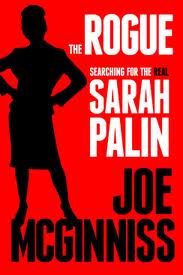
'The Rogue,' by McGinniss

Deep Throat” was the anonymous, high-level source who conferred periodically in 1972 and 1973 with Bob Woodward of the Washington Post as the Watergate scandal unfolded.

As memorable as “Deep Throat” may be, his contributions to Watergate’s outcome were hardly as sweeping or decisive as McGinniss claimed.

As Woodward and his reporting colleague Carl Bernstein wrote in the book about their Watergate reporting, All the President’s Men, the principal role of “Deep Throat” was to “confirm information that had been obtained elsewhere and to add some perspective.”

Not only that, but “Deep Throat” and his conversations with Woodward were scarcely pivotal in the U.S. Senate’s decision to empanel a select committee and convene hearings in 1973 about the Watergate scandal.

In The Whole Truth, his memoir about the hearings, Sam Ervin Jr., the Democratic senator who chaired the select committee, saluted a lengthy roster of people who contributed to unwinding Watergate.

The roster included several journalists and news publications. But Ervin made no mention of Woodward’s shadowy “Deep Throat” source, who had been introduced in some detail in 1974, with publication of All the President’s Men.

“One shudders to think,” Ervin wrote in his memoir, “that the Watergate conspirators might have been effectively concealed … had it not been for the courage and penetrating understanding of [U.S. District] Judge [John] Sirica, the thoroughness of the investigative reporting of Carl Bernstein, Bob Woodward, Seymour Hersh, Clark Mollenhoff, and other representatives of a free press, the devotion to their First Amendment responsibilities of the Washington Post, The New York Times, Time magazine, Newsweek, and other publications, the labors of the Senate Select Committee, and the dedication and diligence of Special Prosecutors Archibald Cox and Leon Jaworski and their associates.”

No mention of “Deep Throat,” though.

The shadowy source was self-revealed in 2005 to have been W. Mark Felt Jr., formerly second in command at the FBI. Felt left the agency in 1973 — many months before Watergate reached its denouement in August 1974 with the resignation of Nixon.

All the President’s Men, and the like-titled 1976 movie version, touched off a years-long guessing about the identity of “Deep Throat” — speculation that surely inflated his importance in popular understanding about how Watergate was rolled up.

As I write in my latest book, Getting It Wrong, the speculation about “Deep Throat” brought “periodic and powerful reminders about the Post and its Watergate coverage, serving to keep Woodward and Bernstein in the public eye far longer than they otherwise would have been.

“They and the mysterious ‘Deep Throat’ source became central figures” in what the Philadelphia Inquirer once called “the parlor game that would not die.”

It’s important to keep in mind, too, that Felt hardly was a heroic figure, even though “Deep Throat” is portrayed that way in the cinematic version of All the President’s Men.

Felt in his senior position at the FBI authorized illegal burglaries in the early 1970s as part of the agency’s investigations into leftists linked to the radical Weather Underground.

Felt was convicted in 1980 on felony charges related to the break-ins, but was pardoned by President Ronald Reagan.

WJC

Many thanks to Instapundit
Glenn Reynolds for linking to this post

Recent and related:

NYTimes errs, claims Woodward, Bernstein ‘unraveled’ Watergate

In Debunking, Media myths, Washington Post, Watergate myth on October 10, 2011 at 1:55 am

The New York Times inaccurately declared over the weekend that Bob Woodward and Carl Bernstein, in their reporting for the Washington Post, “unraveled the Watergate affair.”

The Times’ erroneous assertion was made in an obituary published Saturday about a minor figure in the Watergate scandal, Kenneth H. Dahlberg, who died last week. Watergate led to the resignation in 1974 of President Richard M. Nixon.

The obituary noted that Dahlberg was an “unwitting link between the Nixon re-election campaign and the five men … charged with breaking into the Democratic National Committee headquarters at the Watergate complex in Washington,” the scandal’s signal crime.

Dahlberg, the Times added, “had been a fund-raiser for Nixon’s re-election campaign, and his name was on a $25,000 cashier’s check that had been deposited in the bank account of one of the burglars, Bernard L. Barker. The money was to help cover the burglars’ expenses, and Mr. Barker had withdrawn that amount in $100 bills. He was carrying more than $5,000” when arrested at the DNC headquarters June 17, 1972.

The Times then asserted:

“Bob Woodward, a young reporter for The Washington Post who with Carl Bernstein unraveled the Watergate affair, has called the Dahlberg check the ‘connective tissue’ that turned what they thought was a story about a common crime into one of historic dimensions.”

That may be, but the Dahlberg connection was only a small, early step in unwinding the scandal. Interestingly, Dahlberg receives one, passing mention in Stanley I. Kutler’s exhaustive, single-volume work, The Wars of Watergate.

What’s more, Woodward and Bernstein scarcely can be credited with having “unraveled” Watergate — and the Times offered no evidence to support its exaggerated claim.

Rather, the Times effectively sidled up to the beguiling “heroic-journalist myth,”  which, as I write in my latest book,  Getting It Wrong, has become “the most familiar storyline of Watergate.”

What unraveled Nixon’s presidency wasn’t the reporting of Woodward and Bernstein for the Post but the incontrovertible evidence of his culpability in the crimes of Watergate — evidence captured on audiotapes that he secretly made of his conversations at the White House.

The decisive evidence — known as the “Smoking Gun” tape — revealed that Nixon at a meeting with his top aide, H.R. Haldemann, on June 23, 1972, sought to deflect or derail the FBI investigation into the Watergate burglary.

Woodward and Bernstein didn’t reveal the contents of that tape, which Watergate prosecutors had subpoenaed and which Nixon had refused to surrender until 1974, after the U.S. Supreme Court ordered him to do so.

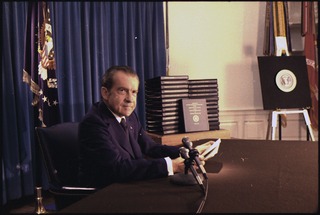
Nixon with tape transcripts, 1974

Nor did Woodward and Bernstein disclose the existence of Nixon’s secret audiotaping system, which proved so crucial to Watergate’s outcome.

The taping system was revealed in July 1973, during hearings of the U.S. Senate Select Committee on Watergate.

In All the President’s Men, their book about their Watergate reporting, Woodward and Bernstein said they had received a tip about the taping system a few days before its existence was made public.

According to All the President’s Men, Ben Bradlee, then the Post‘s executive editor, suggested not expending much energy pursuing the tip. And Woodward and Bernstein didn’t.

What really “unraveled” Watergate, I write in Getting It Wrong, “was the collective if not always the coordinated forces of special prosecutors, federal judges, both houses of Congress, the Supreme Court, as well as the Justice Department and the FBI.

Even then, despite all that scrutiny and pressure, Nixon, I argue, “likely would have served out his term if not for the audiotape recordings he secretly made of most conversations in the Oval Office of the White House.”

WJC

Many thanks to Jack Shafer for linking
to this post

Recent and related:

Made-up Watergate line, ‘follow the money,’ crosses into the news

In Cinematic treatments, Debunking, Washington Post, Watergate myth on October 6, 2011 at 4:38 am

Kenneth H. Dahlberg, a minor Watergate figure, died the other day and Minnesota Public Radio recalled his role in the scandal by turning to the famous made-up line, “follow the money” — advice supposedly given to Washington Post reporters working the story.

The public radio station’s “News Cut” feature noted yesterday that “Dahlberg was the Midwest finance chairman for the Committee to Re-elect the President during President Richard M. Nixon’s 1972 campaign.

“A mysterious check, which later would be determined to be from the CEO of Archer Daniels Midland, was given to Dahlberg, who converted it to a cashier’s check. It was money from the campaign, destined for the Watergate burglars.”

The Minnesota Public Radio report added that when the stealthy, high-level “Deep Throat” source told Post reporters Bob Woodward and Carl Bernstein “to ‘follow the money,’ that was the money. And when Woodward called Dahlberg to confirm he handled the check, Dahlberg didn’t lie. … It ended up a critical part of the movie All The President’s Men.”

That last bit is true. Woodward’s telephone interview with Dahlberg became a memorable scene in the 1976 movie.

Otherwise, though, there’s a fair amount of wayward information in the “News Cut” report.

For starters, “Deep Throat” never met with Bernstein during Watergate.

More important, “Deep Throat” (self-revealed in 2005 to have been former FBI official W. Mark Felt) never advised Woodward to “follow the money.”

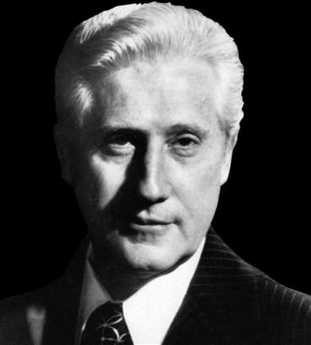
Felt: Never said it

That line appears nowhere in All the President’s Men, Woodward and Bernstein’s 1974 book about their Watergate reporting — reporting that did not, as I discuss in my latest work, Getting It Wrong, take down Nixon’s corrupt presidency.

Moreover, “follow the money” appeared in no Watergate-related article or editorial in the Washington Post  before 1981 — or long after Nixon resigned the presidency in disgrace.

Rather, “follow the money” was written into the screenplay of the cinematic version of All the President’s Men; the line was memorably uttered not by Felt, the real-life “Deep Throat,” but by Hal Holbrook, the actor who played him in the movie.

As I’ve noted at Media Myth Alert, Holbrook turned in an outstanding performance as a tormented and conflicted “Deep Throat.”

And he delivered his “follow the money” line with such steely assurance that it did seem to offer a way through the labyrinth that was the Watergate scandal.

But even if Woodward had been counseled to “follow the money,” such advice certainly would neither have unraveled Watergate nor led him to Nixon.

What forced Nixon from office in 1974 was not the grubby misuse of campaign funds but, rather, his active role in seeking to obstruct justice by covering up the signal crime of the Watergate scandal, the break-in at the headquarters of the Democratic National Committee in June 1972.

Rolling up the scandal of Watergate’s complexity and dimension was scarcely as straightforward as pursuing misused campaign contributions.

As I write in Getting It Wrong, unraveling Watergate required “the collective if not always the coordinated forces of special prosecutors, federal judges, both houses of Congress, the Supreme Court, as well as the Justice Department and the FBI.

“Even then,” I note “Nixon likely would have served out his term if not for the audiotape recordings he secretly made of most conversations in the Oval Office of the White House.

“Only when compelled by the Supreme Court did Nixon surrender those recordings, which captured him plotting the cover-up” and cost him the presidency.

WJC

Recent and related:

Carl Bernstein, at it again

In Debunking, Washington Post, Watergate myth on October 1, 2011 at 11:25 am

Carl Bernstein, he of Watergate fame, was in London the other day, waxing indignant about the phone-hacking scandal that shook Rupert Murdoch’s media operations in Britain over the summer and forced the closure of the raunchy News of the World tabloid.

Mentions reporters' ethical lapses

As he has in the past, Bernstein conveniently avoided reference to his own suspect conduct as a Washington Post reporter covering Watergate, the scandal that brought down Richard Nixon’s corrupt presidency in 1974.

Bernstein, who comes across as something of a sanctimonious windbag, sounded aghast in London, telling a panel convened by the Guardian newspaper that he was stunned by the notion of “criminals working for a newspaper, being a substitute for reporters” at the News of the World.

“Gathering news through criminal acts — it’s absolutely stunning,” Bernstein declared.

Bernstein, though, is an odd, curious choice to criticize such conduct, given his own ethical lapses in reporting Watergate.

It’s not often recalled these days, but Bernstein and his Washington Post colleague, Bob Woodward, sought out federal grand jurors in December 1972, inviting them to break their oaths of secrecy and discuss Watergate-related testimony that they had heard.

The reporters were that desperate for leads in what was a slowly unfolding scandal.

The private entreaties to grand jurors nearly landed Bernstein and Woodward in jail for contempt.

As recounted in All the President’s Men, Bernstein and Woodward’s book about their Watergate reporting, none of the grand jurors was cooperative and the overtures soon were made known to John J. Sirica, chief judge of U.S. District Court in the District of Columbia.

The judge was livid.

According to All the President’s Men, Edward Bennett Williams, the Post’s  lawyer and well-known Washington insider, went to lengths to persuade Sirica — known as “Maximum John” for the severe sentences he often imposed — not to punish Bernstein and Woodward.

“John Sirica is some kind of pissed at you fellas,” Williams was quoted as saying in the book. “We had to do a lot of convincing to keep your asses out of jail.”

The reporters wrote in All the President’s Men, which came out in 1974 just as Watergate was nearing its climax, that in seeking out grand jurors, they “had chosen expediency over principle and, caught in the act, their role had been covered up.” That is, they managed to dodge media scrutiny of their misconduct.

All the President’s Men also described how Bernstein sought, and obtained, information from private telephone records of Bernard Barker, one of the men who in June 1972 broke into headquarters of the Democratic National Committee, the signal crime of Watergate.

Seeking Barker’s records was another case of choosing “expediency over principle” — not to mention a bit of phone-hacking, 1970s style.

WJC

Recent and related:

More treat than trick: Recalling the ‘War of the Worlds’ radio ‘panic’

In Debunking, Media myths, Media myths and radio, War of the Worlds on September 23, 2011 at 4:12 am

The autumnal equinox inevitably signals an uptick in media references to the famous radio adaptation in 1938 of The War of the Worlds, the show that gave rise to Halloween’s greatest media myth.

The program’s accounts of invading Martians wielding deadly heat rays supposedly were so realistic and unnerving that they set off nationwide panic and mass hysteria.

That’s the media myth, anyway. Like many media myths, it’s a good yarn but thinly documented. There’s scant evidence that the radio show — the work of Orson Welles and his Mercury Theatre on the Air troupe — left millions of Americans panic-stricken that night.

It is a delicious tale, one inevitably recited this time of year — as suggested by a theatrical review posted yesterday at the Berkshire Eagle.

“It was trick and it was treat,” the newspaper said about Welles’ radio adaptation of the 1898 science fiction work, The War of the Worlds.

“On Oct. 30, 1938, millions of radio listeners were thrown into near hysteria when a radio broadcast by Mercury Theatre was interrupted by eyewitness, live-from-the-field reports of an alien invasion from Mars.

“By the time it was all over about an hour later, it became clear to everyone who had missed the advisory at the top of the show that this was make-believe; the clever invention of a brash, wildly creative 22-year-old force of artistic nature named Orson Welles who had taken H.G. Wells’ novel, ‘War of the Worlds,’ and, capitalizing on the power of the radio to catch our imagination in ways that only radio could, gave it chilling immediacy.”

Except that panic and “near hysteria” were not at all widespread. Fright that night certainly did not reach nationwide dimension, as I discuss in my latest book Getting It Wrong.

While some Americans may have been briefly disturbed or upset by Welles’ program, I write, “most listeners, overwhelmingly, were not: They recognized it for what it was — an imaginative and entertaining show on the night before Halloween.”

I also point out in Getting It Wrong that Hadley Cantril, a psychologist at Princeton University who promoted the notion that the radio show caused widespread panic, drew on surveys to estimate that at least 6 million people listened to the hour-long program, which aired live over the CBS radio network.

Of those listeners, Cantril estimated, 1.2 million were “frightened,” “disturbed,” or “excited” by what they heard.

But as I point out in Getting It Wrong, “Cantril left unclear the distinctions among ‘frightened,’ ‘disturbed,’ or ‘excited.’ Nor did Cantril not estimate how many listeners acted on their fears and excitement”  — a crucial element had there indeed been widespread panic that night.

Being “frightened,” “disturbed,” or “excited” is hardly akin to being panic-stricken. Or pitched into hysteria.

Cantril’s estimates, moreover, signal that an overwhelming majority of listeners recognized Welles’ program for what it was — imaginative radio entertainment.

It was for them more treat than trick.

Had the War of the Worlds show created nationwide panic and mass hysteria, the related turmoil surely would have resulted in deaths and serious injuries.

But newspaper reports in the program’s aftermath were notably silent on extensive casualties.

Not only that, but American newspapers quickly dropped the story from their pages after a day or two.

“Had there truly been mass panic and hysteria across the country that night, newspapers for days and even weeks afterward could have been expected to have published detailed reports about the dimensions and repercussions of such an extraordinary event,” I note in Getting It Wrong.

But newspapers gave little sustained attention to The War of the Worlds broadcast and the reactions it supposedly stirred.

WJC

As if it were toxic: Media ignore exculpatory Jefferson-paternity study

In Debunking, Media myths on September 17, 2011 at 5:49 am

More than two weeks have passed since publication of a hefty scholarly study disputing that Thomas Jefferson sired children by one of his slaves, and America’s mainstream news media have shunned the work as if it were toxic.

The work, after all, does pose an acute threat to the dominant narrative that Jefferson had an intimate relationship with slave Sally Hemings.

But rather than engage and scrutinize the study — the collective work of a dozen Jefferson scholars that’s titled The Jefferson-Hemings Controversy: Report of the Scholars Commission and was released September 1 — the mainstream media have resolutely ignored it.

When they have had opportunities recently to address the Jefferson-Hemings tale, news outlets have turned blithely to what amounts to defamation of the third president.

The day before the scholars commission study was released, for example, the Atlanta Journal-Constitution observed:

“The descendants of slavery-era unions were often consigned to a shadowy middle-ground, as the black descendants of Thomas Jefferson and Sally Hemings will attest.”

The Washington Post flatly asserted recently that Jefferson “fathered children with his slave Sally Hemings.”

And the Huffington Post the other day published a commentary that declared:

“It wasn’t until the late ’90s when new biographies of the founding fathers — like American Sphinx by Joseph Ellis, which revealed that Thomas Jefferson had a sexual relationship with his slave Sally Hemings that bore him six children — suddenly brought them to life in full color, foibles and all.”

There is, quite simply, no persuasive or compelling evidence — from Ellis or anyone else — that Jefferson fathered any of Hemings’ children, let alone six.

Indeed, the weight of available evidence favors the exculpatory interpretation offered by the new book, which states:

“Trying to prove a negative is usually difficult. But we have found most of the arguments used to point suspicion toward Thomas Jefferson to be unpersuasive and often factually erroneous. Not a single member of our group, after an investigation lasting roughly one year, finds the case against Thomas Jefferson to be highly compelling, and the overwhelming majority of us believe that it is very unlikely that he fathered any children by Sally Hemings.”

The scholars reported that had Jefferson carried on such a sexual relationship, it is “very difficult to believe that he would have selected as his companion the teenaged maid to his young daughters. … We … think it highly unlikely that Thomas Jefferson would have placed at risk the love and respect of his young children in this manner.”

The scholars’ work also notes that the DNA testing conducted in 1998 was widely misinterpreted as identifying Jefferson the father of Hemings’ children. (Ellis in American Sphinx incorrectly wrote that the testing “demonstrated a match between Jefferson” and the youngest son of Hemings.)

The DNA tests, the study points out, “were never designed to prove, and in fact could not have proven, that Thomas Jefferson was the father of any of Sally Hemings’ children.

“The tests merely establish a strong probability that Sally Hemings’ youngest son, Eston, was fathered by one of the more than two dozen Jefferson men in Virginia at the time, seven of whom there is documentary evidence to believe may well have been at Monticello when Eston was conceived.”

What’s more, the book says there’s no “clear evidence that Sally Hemings or any of her children ever alleged that Thomas Jefferson was her lover or their father, save for the statement attributed to an aging and clearly bitter Madison Hemings [another son] nearly five decades after Thomas Jefferson’s death.

“Surely, if they believed the famous President to be their father, they would have found it to their benefit to make this fact known to others before 1873.”

The Jefferson-Hemings Controversy is rich material and certainly worthy of thorough and frank consideration by the news media.

Instead they demur, fearful perhaps of what scrutiny of the evidence will reveal.

WJC

Recent and related:

Misreading the ‘Cronkite Moment’ — and media power

In Cronkite Moment, Debunking, Media myths on September 13, 2011 at 7:27 am

LBJ wasn't watching Cronkite

The mythical “Cronkite Moment” — that heady occasion in 1968 when an editorial comment by CBS News anchor Walter Cronkite purportedly altered the course of the war in Vietnam — lives on as an irresistible parable about the power of the news media.

The parable is timeless and often invoked — most recently in a commentary posted yesterday at the online sports site, Bleacher Report.

The commentary declared:

“The flashy columnist, opinionated radio host, or aggressive TV interviewer that pushes the needle and ultimately helps get those in charge to make a move for fear of public ridicule and backlash.

“A great example of this came in 1968 in the time of the Vietnam War when a story by broadcasting legend Walter Cronkite called the war unwinnable and un-American, then-president Lyndon B. Johnson was reported to have said ‘If I’ve lost Cronkite, I have lost middle America.’

“That is the kind of power that a strong media personality can have: the power to affect change.”

Except Cronkite didn’t cause such change.

As I discuss in my latest book, Getting It Wrong, Johnson wasn’t in front of a television when Cronkite’s special report aired on February 27, 1968. The president wasn’t lamenting the loss of Cronkite’s support, either.

Rather, Johnson was on the campus of the University of Texas at Austin, offering light-hearted banter at the 51st birthday party of Governor John Connally, a longtime political ally.

At about the time Cronkite was offering his downbeat assessment about the U.S. war effort, Johnson was quipping:

“Today you are 51, John. That is the magic number that every man of politics prays for — a simple majority.”

Not only was the president not watching, but Cronkite’s editorial comment wasn’t especially dramatic or incisive. His comment, offered at the close of his special report, was quite mild.

Most certainly Cronkite did not say the war was “unwinnable” or “un-American,” as the Bleacher Report commentary asserts. He said the U.S. military was “mired in stalemate” in Vietnam and that negotiations eventually might offer America a way out.

The “mired in stalemate” comment was hardly an original assessment.

Leading U.S. news outlets such as the New York Times had turned to “stalemate” for months before the Cronkite program.

For example, in a news analysis published July 4, 1967, the Times said of the war effort:

“Many officers believe that despite the commitment of 466,000 United States troops now in South Vietnam … the military situation there has developed into a virtual stalemate.”

In a report from Saigon that was published August 7, 1967, the Times noted:

“‘Stalemate’ is a fighting word in Washington. President Johnson rejects it as a description of the situation in Vietnam. But it is the word used by almost all Americans here, except the top officials, to characterize what is happening. They use the word for many reasons ….”

Far more assertive than the “mired in stalemate” assessment was a Wall Street Journal editorial, published four days before Cronkite’s special report aired.

The Journal said the U.S. war effort in Vietnam “may be doomed” and that “everyone had better be prepared for the bitter taste of defeat beyond America’s power to prevent.”

As I note in Getting It Wrong, the “Cronkite Moment,” when scrutinized, dissolves as illusory — a chimera, a media-driven myth.

“That it does is not so surprising,” I write. “Seldom, if ever, do the news media exert truly decisive influences in decisions to go to war or to seek negotiated peace. Such decisions typically are driven by forces and factors well beyond the news media’s ability to shape, alter, or significantly influence.

“So it was in Vietnam, where the war ground on for years after the ‘Cronkite moment.’”

WJC

Recent and related:

A counter-narrative: 9/11 did not ‘change everything’

In Anniversaries, Debunking, Media myths, New York Times, Newspapers, Washington Post on September 11, 2011 at 10:26 am

America’s news media have focused for days and more on the 10th anniversary of the terror attacks of September 11, 2001. The dominant, inevitable, yet misleading theme of the coverage: 9/11 “changed everything.”

“When Everything Changed,” the Washington Post declares on its front page today.

“The Day Everything Changed,” says the Star-Telegram of Fort Worth, Texas.

“A Decade of Change,” declares the Press of Atlantic City.

“Forever changed?” asks the lead headline in today’s Chattanooga Times Free Press.

That interrogative is inadvertently perceptive, suggesting as it does an important if largely ignored counter-narrative about 9/11:

It is striking how little, fundamentally, has changed in American life because of the attacks that killed nearly 3,000 people in lower Manhattan, at the Pentagon, and near Shanksville, Pennsylvania.

Airport check-ins, to be sure, are more imposing, grating, and intrusive than they were 10 years ago — suggestive of a broader if low-level and intermittent preoccupation with security matters.

But the hyperbolic, anniversary-driven coverage notwithstanding, the lives of most Americans seem not to have been dramatically or markedly altered by the vivid terror assaults 10 years ago.

Remember how the attacks were supposed to lead to a surge in patriotic sentiment? To a renewed commitment to religion and the spiritual side of life? To a deeper interest in news of the world? To a constant looking over one’s shoulder in anticipation of the next attack?

Polling data indicate that none of those responses to 9/11 was sustained or profound:

  • In June 2010, 59% of respondents to a Pew Research survey said they displayed the American flag at home, in the office, or on the car. That compares to 75% of the respondents  who said they did so in August 2002.
  • Pew Research data say that 36% of Americans attend religious services at least once a week, down from 42% in mid-November 2001.
  • In 2002, 48% of respondents to a Pew survey said they enjoyed keeping up with the news “a lot.”  In 2010, that response rate had ebbed to 45%.
  • Today’s Washington Post embeds revealing bits of survey data in its 16-page section devoted to the 9/11 anniversary. Particularly revealing was that 83% of residents in metropolitan Washington said no, they have not avoided a public event in recent years “because of concerns about terrorism.”

While the counter-narrative that 9/11 didn’t change everything has been obscure this year, it was somewhat in greater evidence at less-celebrated anniversaries of the attacks.

Two years ago, for example, the New York Times revisited predictions about how 9/11 would forever change Manhattan, and found them mostly empty and unfulfilled.

The Times article, “A Fortress City That Didn’t Come to Be,” recalled the expectations that emerged in the immediate aftermath of 9/11, writing:

“New York would become a fortress city, choked by apprehension and resignation, forever patrolled by soldiers and submarines. Another attack was coming. And soon.

“Tourists? Well, who would ever come again? Work in one of the city’s skyscrapers? Not likely. The Fire Department, gutted by 343 deaths, could never recuperate. …

“Eight years later, those presumptions are cobwebbed memories that never came to pass. Indeed, glimpses into a few aspects of the city help measure the gap between what was predicted and what actually came to be.”

“Cobwebbed memories that never came to pass.” A well-crafted passage, that — and an antidote, in a way, to the clichéd, “everything changed” coverage that has clouded the 10th anniversary of a terrible and infamous day.

After all, as columnist George Will wrote at the fifth anniversary of 9/11:

Nothing changes everything.”

WJC

Recent and related:

‘Kane’ at 70: ‘More relevant than ever’?

In Anniversaries, Cinematic treatments on September 10, 2011 at 9:53 am

In the year of its 70th anniversary, Orson Welles’ cinematic masterpiece Citizen Kane “is more relevant than ever,” says a polished, thoughtful essay posted yesterday at TechCentral, a South African site devoted to technology news and reviews.

Orson Welles in 'Kane'

In pressing the point about Kane’s relevance, the essay argues:

“Newspaper magnate Charles Foster Kane, sitting in his already-crumbling but unfinished Xanadu, is Colonel Gaddafi railing at the Libyan rebels from his exile or a doddering Rupert Murdoch stumbling over his words in front of the commission investigating the News of the World scandal.”

Those are telling observations, particularly the reference to the 80-year-old Murdoch and his excruciating, hapless performance before a Parliamentary commission hearing in July in London.

“Today,” the TechCentral essay adds, “you’ll see Citizen Kane’s influence in the strangest places,” including parodies in The Simpsons” television show.

As superb and influential as it was, Kane took liberties and in doing so helped popularize a powerful media-driven myth.

The movie was released in 1941 and was based loosely on the life and times of American media magnate William Randolph Hearst.

A rollicking scene early in Kane offers clear evidence that Hearst was the movie’s principal inspiration; the scene paraphrased Hearst’s purported vow, which he supposedly cabled to an artist in Cuba months before the Spanish-American War:

You furnish the pictures, and I’ll furnish the war.”

As I note in my latest book, Getting It Wrong, that scene in Kane “firmly and finally pressed Hearst’s purported vow to ‘furnish the war’ into the public’s consciousness.”

I also point out in Getting It Wrong that the anecdote about Hearst’s vow “is almost too good not to be true” and note that the “furnish the war” line “has made its way into countless textbooks of journalism.

“It [also] has figured in innumerable discussions about Hearst and about the news media and war. It has been repeated over the years by no small number of journalists, scholars, and critics of the news media such as Ben Bagdikian, Helen Thomas, Nicholas Lemann, and the late David Halberstam.”

Interestingly, “furnish the war” endures despite a near-total absence of supporting documentation. It lives on even though cable containing Hearst’s purported vow has never turned up.

It lives on even though Hearst denied ever sending such a message.

It lives on despite of what I call “an irreconcilable internal inconsistency”: It would have been absurd for Hearst to vow to “furnish the war” because war — specifically, the Cuban rebellion against Spanish rule — was the very reason Hearst sent the artist, Frederic Remington, to Cuba in the first place.

And Remington’s trip to Cuba came in January 1897 — more than 15 months before the start of the Spanish-American War.

Kane is no faithful portrait of Hearst.

As David Nasaw pointed out in The Chief, his admirably even-handed biographyof Hearst:

“Welles’ Kane is a cartoon-like caricature of a man who is hollowed out on the inside, forlorn, defeated, solitary because he cannot command the total obedience … of those around him. Hearst, to the contrary, never regarded himself as a failure, never recognized defeat, never stopped loving Marion [his mistress] or his wife.

“He did not, at the end of his life, run away from the world to entomb himself in a vast, gloomy, art-choked hermitage,” as portrayed in Citizen Kane.

WJC

Recent and related:

Recalling the 1960s ‘bra-burning days of women’s lib’

In Bra-burning, Debunking, Media myths on September 6, 2011 at 4:33 am

Ah, yes: “the 60s bra-burning days of women’s lib.”

Those “bra-burning days” can be traced to the boardwalk at Atlantic City, NJ, 43 years ago, when about 100 women’s liberation demonstrators protested the Miss America pageant at the city’s Convention Center.

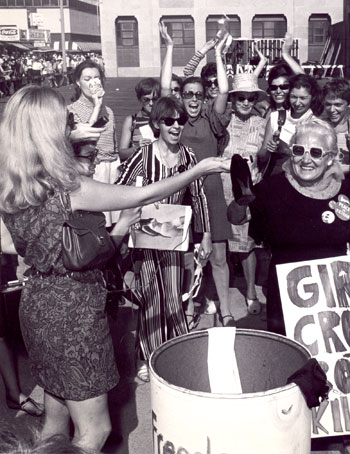
At the 'Freedom Trash Can,' 1968

A centerpiece of the protest was what the demonstrators called the “freedom trash can,” into which they consigned such “instruments of torture” as brassieres, girdles, high-heeled shoes, false eyelashes, copies of  Playboy and Cosmopolitan magazines.

The protesters have long insisted that, contrary to legend, bras and other items were not set afire that long ago September day.

The protest’s principal organizer, Robin Morgan, has asserted:

“There were no bras burned” at Atlantic City. “That’s a media myth.”

But in my latest book, Getting It Wrong, I offer evidence that bras were set afire, briefly, during the protest at Atlantic City. It was perhaps more akin to bra-smoldering.

The evidence is from separate witness accounts — one of them published in the local newspaper, the Press of Atlantic City, on September 8, 1968, the day after the protest.

That account appeared beneath the byline of a veteran reporter named John L. Boucher and carried the headline:

Bra burners blitz Boardwalk.”

The article’s key passage stated:

“As the bras, girdles, falsies, curlers, and copies of popular women’s magazines burned in the ‘Freedom Trash Can,’ the demonstration reached the pinnacle of ridicule when the participants paraded a small lamb wearing a gold banner worded ‘Miss America.’”

Boucher’s account, as I note in Getting It Wrong, “did not elaborate about the fire and the articles burning in the Freedom Trash Can, nor did it suggest the fire was all that important. Rather, the article conveyed a sense of astonishment that an event such as the women’s liberation protest could take place near the venue of the pageant.”

Boucher’s contemporaneous account was buttressed by the recollections of Jon Katz, a prolific writer who in 1968 was a young reporter for the Atlantic City Press.

He was on the boardwalk the day of the protest, gathering material for a sidebar article about reactions to the demonstration.

Katz’s article did not mention the burning bras. But in correspondence with me, Katz stated:

“I quite clearly remember the ‘Freedom Trash Can,’ and also remember some protestors putting their bras into it along with other articles of clothing, and some Pageant brochures, and setting the can on fire. I am quite certain of this.”

He added: “I recall and remember noting at the time that the fire was small, and quickly was extinguished, and didn’t pose a credible threat to the Boardwalk. I noted this as a reporter in case a fire did erupt ….”

Boucher’s long-overlooked article and Katz’s more recent recollections represent strong evidence that bras and other items were burned at the 1968 protest.

As I write in Getting It Wrong,  “This evidence cannot be taken lightly, dismissed or ignored.

“But it must be said as well,” I add, “that the witness accounts of Boucher and Katz lend no support to the far more vivid and popular imagery that many bras went up in flames in flamboyant protest that September day.”

Still, the notion that bra burnings were numerous during the late 1960s and 1970s became well-ingrained in American popular culture — as the recent reference in the Australian newspaper to “the 60s bra-burning days of women’s lib” suggests.

The phrase “bra-burning,” as I note in Getting It Wrong, became a sneering, off-hand way “of ridiculing feminists and mocking their sometimes-militant efforts to confront gender-based discrimination in the home and the work place.”

Bra-burning was hardly a common element of women’s liberation protests of the late 1960s and 1970s. Evidence is scant at best of feminist protesters during those years setting fire to bras and tossing the flaming undergarments into spectacular bonfires.

WJC

Recent and related: