W. Joseph Campbell

Posts Tagged ‘Fact-checking’

In myth, a truism: Hearst’s vow ‘will forever live on’

In 1897, Debunking, Furnish the war, Media myths, Spanish-American War, Yellow Journalism on May 17, 2010 at 8:34 am

William Randolph Hearst’s purported vow to “furnish the war” with Spain “has achieved unique status as an adaptable, hardy, all-purpose anecdote,” I write in my forthcoming book about media-driven myths, Getting It Wrong.
The anecdote, I point out, “has been invoked to illustrate the media’s willingness to compromise impartiality, promote political agendas, and indulge in sensationalism. It has been used, more broadly, to suggest the media’s capacity to inject malign influence into international affairs.”

It is for such reasons the Hearstian anecdote endures, despite having been thoroughly debunked. The tale is revisited, and debunked anew, in the first chapter of Getting It Wrong.

But it may well be that Hearst’s purported vow “will forever live on in journalism history,” as a columnist for the Times of Northwest Indiana newspaper wrote in a commentary published yesterday.

Far from challenging or disputing the tale, the columnist embraced it, repeating as if factual the supposed exchange between Hearst and the artist Frederic Remington, in which Hearst reputedly asserted:

“You furnish the pictures, and I’ll furnish the war.”

Remington was in Cuba in January 1897, on assignment for Hearst’s New York Journal to draw sketches of the rebellion against Spanish colonial rule. If the exchange did take place, it would have been then, in early 1897.

As I write in Getting It Wrong,  the anecdote lives on despite a nearly complete absence of supporting documentation. It lives on even though the telegram that supposedly contained Hearst’s vow has never turned up. It lives on even though Hearst denied ever sending such a message.

And it lives on despite an irreconcilable internal inconsistency: It would have been absurd for Hearst to vow to “furnish the war” because war—specifically, the Cuban rebellion—was the reason he sent Remington to Cuba in the first place. (The rebellion gave rise in 1898 to the Spanish-American War.)

The sole source for the anecdote was a self-important journalist named James Creelman. He was neither in Cuba nor in New York at the time the exchange would have occurred. Creelman then was in Europe, as a correspondent for Hearst’s Journal.

That means Creelman learned about the tale second-hand.

Or made it up.

The durability of media myths such as the “furnish the war” anecdote is discussed in Getting It Wrong. I acknowledge that “some myths addressed [in the book] may prove resistant to debunking. They may still be widely believed despite the contrary evidence marshaled against them.”

I note that the “most resilient myths may be those that can be distilled to a catchy, pithy phrase.”

Quotations such as “You furnish the pictures, and I’ll furnish the war” are indeed neat, tidy, catchy, and delicious. They are easy to remember, fun to repeat, and too good not to be true.

Almost certainly, they will live on.

WJC

Woodward’s reporting ‘changed course of American history’?

In Debunking, Media myths, Washington Post, Watergate myth on May 16, 2010 at 12:10 pm

Bob Woodward’s “investigative reporting of Watergate changed the course of American history.”

So asserted a column in yesterday’s St. Petersburg Times.

Woodward (Library of Congress)

The author didn’t elaborate, or offer supporting evidence for such an exuberant claim. Presumably, he meant that reporting by Woodward and his Washington Post colleague, Carl Bernstein, brought down Richard Nixon’s corrupt presidency in the Watergate scandal of the early 1970s.

That, of course, is among the most appealing and enduring of the many media-driven myths–stories about and or by the news media that are widely believed and often retold but which, under scrutiny, prove apocryphal or wildly exaggerated.

I address, and debunk, 10 prominent media-driven myths in my forthcoming book, Getting It Wrong. Among them is what I call the heroic-journalist myth of Watergate–a trope that knows few bounds.

As I note in Getting It Wrong, even Washington Post officials over the years have scoffed at such claims.

Notable among them was Katherine Graham, the publisher during the Watergate period.

“Sometimes people accuse us of bringing down a president, which of course we didn’t do,” Graham said in 1997, at a program marking the scandal’s twenty-fifth anniversary. “The processes that caused [Nixon’s] resignation were constitutional,” she insisted.

Indeed, I write in Getting It Wrong, “Nixon’s fall was the consequence of his criminal conduct, which was exposed in the convergence of many forces, newspaper reporting being among the least decisive.”

Still, the heroic-journalist myth endures.

An important reason why Woodward and Bernstein are given so much credit is the need for heroes in a business that is much derided and little trusted. As I note in Getting It Wrong, which will be out next month, “media myths can be self-flattering, offering heroes like Woodward and Bernstein to a profession more accustomed to criticism than applause.”

I further write:

“Similarly, media myths invite indulgence in the ‘golden age fallacy,’ the flawed but enticing belief that there really was a time when journalism and its practitioners were respected and inspiring—the time, say, of Murrow or Cronkite, or Woodward and Bernstein.”

Such misplaced nostalgia has helped embed these myths firmly and decisively in media history.

WJC

Myth resurfaces in Cronkite-collaborator report

In Cronkite Moment, Debunking, Media myths, Year studies on May 15, 2010 at 10:28 am

The Yahoo News report yesterday that venerable CBS anchorman Walter Cronkite may have quietly collaborated with antiwar activists in the late 1960s stirred a modest flurry of commentary in the blogosphere.

Cronkite in Vietnam, 1968

Few mainstream media outlets appear to have touched the story, which I find to be something of a stretch. An exception was Rupert Murdoch’s  New York Post, which carried a brief article, essentially a rewrite of the Yahoo report.

That report cited newly released FBI documents in saying that in late 1969, “Cronkite encouraged students at Rollins College in Winter Park, Fla., to invite Maine Sen. Edmund Muskie to address a protest [against the war] they were planning near Cape Kennedy (now known as Cape Canaveral). Cronkite told the group’s leader that Muskie would be nearby for a fundraiser on the day of the protest, and said that ‘CBS would rent [a] helicopter to take Muskie to and from site of rally.'”

Inevitably, the report recalled Cronkite’s famous on-air editorial comment delivered February 27, 1968, at the end of a special report on Vietnam. On that occasion, Cronkite declared the U.S. war effort in Vietnam was “mired in stalemate.”

A post yesterday at mediaite.com noted Cronkite’s 1968 commentary, saying it “is often credited with turning the tide of public opinion against the war.”

Cronkite’s commentary that night has become the stuff of legend. But it was scarcely so powerful or decisive as to much move public opinion.

As I discuss in Getting It Wrong, my forthcoming book about media-driven myths, public opinion had begun turning against the Vietnam War months before the Cronkite program.

In October 1967, a Gallup survey reported that the percentage of respondents saying that U.S. military presence in Vietnam was a mistake had reached a plurality—47 percent. That was 4½ months before Cronkite delivered his on-air commentary. (In August-September 1965, just 24 percent of Gallup poll respondents said sending troops to Vietnam was a mistake.)

In a Gallup poll completed in early February 1968, three weeks before the Cronkite program, the proportion saying the war was a mistake stood at 46 percent; 42 percent said it had not been a mistake.

Gallup asked the question again in a poll completed the day the Cronkite program aired, finding that 49 percent of the respondents said U.S. military intervention in Vietnam had been a mistake; 42 percent said it had not.

By late February 1968, Cronkite’s “mired in stalemate” assessment was, I write in Getting It Wrong, “neither notable nor extraordinary.”

I also note that Mark Kurlansky, author of a year-study about 1968, declared Cronkite’s view “hardly a radical position” for the time.

Cronkite’s remarks that night were fairly mild–certainly less emphatic than comments offered about two weeks later by Frank McGee of the rival NBC network.

“The war,” McGee declared on an NBC News program March 10, 1968, “is being lost by the administration’s definition.”

As I’ve noted previously, it is a bit surprising that McGee’s pointed editorial comments are not more often remembered.

WJC

Cronkite, secret antiwar collaborator? Seems a stretch

In Cronkite Moment, Debunking, Media myths on May 14, 2010 at 3:44 pm

Yahoo’s online news site has turned up FBI documents claiming that Walter Cronkite, the venerable CBS News anchorman often if mistakenly called America’s “most trusted” public figure, offered advice and suggestions in late 1969 to foes of the Vietnam War.

Redacted FBI document on Cronkite (Yahoo News)

The Yahoo report, posted this afternoon, says the documents indicate that Cronkite offered “advice on how to raise the public profile of protests and even pledging CBS News resources to help pull off events, according to FBI documents” obtained through the Freedom of Information Act.

Cronkite died 10 months ago.

He made clear his mild opposition to the war on February 27, 1968, in a famous editorial comment at the close of a special report on Vietnam.  Cronkite on that occasion declared:

To say that we are closer to victory today is to believe, in the face of the evidence, the optimists who have been wrong in the past. To suggest we are on the edge of defeat is to yield to unreasonable pessimism. To say that we are mired in stalemate seems the only realistic, yet unsatisfactory, conclusion.

Cronkite also suggested that negotiations eventually might prove to be America’s way out of the conflict.

The program that night became grist for a prominent media-driven myth, one of 10 that I discuss, and debunk, in my forthcoming book, Getting It Wrong.

Legend has it that at the White House, President Lyndon Johnson watched the Cronkite show and, upon hearing the anchorman’s dire assessment about Vietnam, snapped off the television set and exclaimed, “If I’ve lost Cronkite, I’ve lost Middle America.”

Or words to that effect. Versions vary.

But as I point out in Getting It Wrong, Johnson wasn’t at the White House that night. And he wasn’t in front of a television set to watch Cronkite’s special report.

The president was in Austin, Texas, offering light-hearted banter at the 51st birthday party of a longtime political ally, Governor John Connally.

Today’s Yahoo report, while certainly provocative, seem to stretch credulity in important respects.

Cronkite, the Yahoo report says, “encouraged students at Rollins College in Winter Park, Fla., to invite Maine Sen. Edmund Muskie to address a protest they were planning near Cape Kennedy (now known as Cape Canaveral). Cronkite told the group’s leader that Muskie would be nearby for a fundraiser on the day of the protest, and said that ‘CBS would rent [a] helicopter to take Muskie to and from site of rally,’ according to the [FBI] documents.”

That Cronkite would even contemplate going so far as to arrange for the network to pay for a helicopter to take Muskie to the rally seems improbable.

The Yahoo report further quotes the FBI documents as saying the leader of an antiwar group in Florida said he spent 45 minutes on the telephone with Cronkite, discussing activities related to antiwar demonstrations in November 1969.

That Cronkite would spent that much time on the phone, offering advice to an activist, also seems unlikely.

And a comment posted today at the popular Romenesko online media news site offers an important reminder:

“Many Yahoo readers may be unaware that [FBI] files were full of nonsense and falsehoods by people seeking to curry favor, damage enemies, collect money and who otherwise had no interest in the truth of matters.”

The Cronkite-as-secret-collaborator story is delicious in what it suggests. Given Cronkite’s public views about the war, it’s perhaps faintly plausible.

But by no means can it be considered authoritative.

WJC

Johnson was ‘panicked’ by Cronkite show on Vietnam?

In Cronkite Moment, Debunking, Media myths on May 11, 2010 at 1:28 pm

The flexibility and wide applicability of prominent media-driven myths is little short of astonishing sometimes.

Cronkite in Vietnam, 1968

Take, for example, the column in today’s Jerusalem Post, which invoked the often-told anecdote about the supposed effects of Walter Cronkite’s special report in 1968 about the Vietnam War.

As I discuss in Getting It Wrong, my forthcoming book about media-driven myths, it is widely believed that President Lyndon Johnson essentially threw up his hands in dismay upon hearing Cronkite’s pessimistic assessment about the war.

Cronkite, the CBS News anchorman, said the U.S. military was “mired in stalemate” in Vietnam and suggested that negotiations might be a way out.

Johnson supposedly realized the war effort was now hopeless, telling an aide or aides, “If I’ve lost Cronkite, I’ve lost Middle America.”

Or something along those lines. Versions of what the president supposedly said vary markedly.

Today’s Jerusalem Post column offered another variation, saying that Johnson “panicked when he lost Walter Cronkite over Vietnam….”

Panicked?

What? How so?

As I discuss in Getting It Wrong, Johnson didn’t even see the Cronkite report when it aired late in the evening of February 27, 1968.

Johnson then was in Austin, Texas, at the 51st birthday party of Governor John Connally, one of his long-time political allies.

About the time Cronkite was intoning his downbeat assessment on Vietnam, Johnson was offering light-hearted remarks about Connally’s age, saying:

“Today you are 51, John. That is the magic number that every man of politics prays for—a simple majority. Throughout the years we have worked long and hard—and I might say late—trying to maintain it, too.”

No panic there.

Nor was there any in the days that followed.

I note in Getting It Wrong that even if Johnson saw the Cronkite program on videotape, the anchorman’s assessment represented no epiphany for the president.

About three weeks after the Cronkite program, I write, “Johnson gave a rousing, lectern-pounding speech in which he urged a ‘total national effort’ to win the war in Vietnam.”

So no panic there, either.

And on the day of the Cronkite program, Johnson offered a forceful defense of his war policy, vowing in a midday speech in Dallas there would be “no retreat from the responsibilities of the hour of the day.”

Johnson declared: “We are living in a dangerous world and we must understand it. We must be prepared to stand up when we need to. There must be no failing our fighting sons” in Vietnam.

“It seems inconceivable,” I write in Getting It Wrong, “that Johnson’s views [on Vietnam] would have pivoted so swiftly and dramatically, upon hearing the opinion of a television news anchor, even one as esteemed as Cronkite.”

It’s quite improbable.

So, no, Johnson wasn’t “panicked” by Cronkite’s assessment on Vietnam.

Not at all.

WJC

<!–[if !mso]> <!– st1\:*{behavior:url(#ieooui) } –> Johnson’s speech, the newspaper said, was “perhaps his strongest public call yet for unity in pushing the Vietnam war.”[i]


[i] Sell, “No Viet Retreat,” Los Angeles Times, 1.

Too good to be disbelieved: The military, myth, and Jessica Lynch

In Jessica Lynch, Washington Post on May 10, 2010 at 2:01 pm

I blogged last week about how the international spotlight periodically lands on Jessica Lynch, even though seven years have passed since a sensational but erroneous report in the Washington Post vaulted her to unsought fame and celebrity.

The spotlight has dimmed considerably in the years since the Post article about the Army private’s supposed heroics in an ambush in Nasiriyah in southern Iraq in 2003.

But when the spotlight does find Lynch, the dubious notion that the military promoted the fictional account of her battlefield derring-do inevitably seems to reemerge.

Such was the case yesterday in an article about Lynch in the Pittsburgh Post-Gazette.

The article asserted, without attribution, that “military officials, in widely circulated reports early in the war, initially described her as a female Rambo who fought back fiercely after the ambush. Ms. Lynch has maintained she never fired her weapon and was knocked unconscious during the attack.”

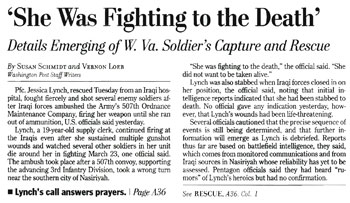
My forthcoming book on media-driven myths, titled Getting It Wrong, revisits the Lynch case, recalling how the Washington Post reported that Lynch had “fought fiercely” when her unit, the 507th Maintenance Company, was ambushed at Nasiriyah, that she had “shot several enemy soldiers” and had kept “firing her weapon until she ran out of ammunition.”

News organizations “around the world,” I write, “followed the Post’s lead by prominently reporting the supposed heroics of young Jessica Lynch and contemplating their significance.”

These outlets included the Pittsburgh Post-Gazette which at the time predicted Lynch “appears headed for life as an American icon, regardless of whether she likes it.”

Lynch is no icon, and her battlefield heroics were misattributed:  It wasn’t Lynch who had fought heroically at Nasiriyah, it was most likely Donald Walters, a cook-sergeant in Lynch’s unit who, after running out of ammunition, was captured by Iraqi irregulars, and executed.

Walters’ selfless deeds at Nasiriyah have received nothing akin to the attention bestowed upon Lynch, who suffered shattering injuries in the crash of a Humvee as she and others tried to flee the ambush.

Lynch, then 19, was taken prisoner and treated at by Iraqis a hospital in Nasiriyah, from where she was rescued on April 1, 2003, by a U.S. special operations team.

The Post's botched story

The Post has never disclosed the sources of its botched report about Lynch. The article, which was published on the front page on April 3, 2003, vaguely cited “U.S. officials.”

But as I note in Getting It Wrong, the newspaper’s then defense writer, Vernon Loeb, went on an NPR program in late 2003 and said he “could never get anybody from the Pentagon to talk about” the raw, battlefield intelligence reports that hinted of Lynch’s heroism.

“I got indications that they had, in fact, received those intelligence reports, but the Pentagon was completely unwilling to comment on those reports at all,” Loeb said in an interview on the “Fresh Air” show. “They wouldn’t say anything about Jessica Lynch.”

Loeb added:

“I just didn’t see the Pentagon trying to create a hero where there was none. I mean …they never showed any interest in doing that, to me.”

Like many media-driven myths, the notion that the Pentagon pushed the phony hero-warrior story of Jessica Lynch has proven irresistible–too good and delicious, almost, to be disbelieved.

Despite substantial evidence to the contrary.

WJC

Check out new trailer for ‘Getting It Wrong’

In 1897, Debunking, Furnish the war, Media myths, Spanish-American War, War of the Worlds, Yellow Journalism on May 8, 2010 at 3:45 pm

Here’s the book trailer for Getting It Wrong, my forthcoming book that addresses, and debunks, 10 prominent media-driven myths.

Getting It Wrong will be published this summer by University of California Press.

WJC

Advance copies arrive

In 1897, Furnish the war, Media myths, Spanish-American War on May 7, 2010 at 4:11 pm

I received two advance copies of Getting It Wrong this afternoon. My wife says they look great, so that’s got to be the final word on that matter.

They do look very good.

I had a feeling the advances were being delivered when the UPS truck rolled up in front of the house.

Getting It Wrong–which addresses and debunks 10 prominent media-driven myths–is being published by University of California Press. Reed Malcolm, the acquisition editor with whom I worked, enclosed a generous note, saying copies of the book are en route to warehouses on the East and West coasts.

Getting It Wrong should be on sale next month.

The book‘s opening chapter,  which revisits William Randolph Hearst’s purported vow to “furnish the war” with Spain in the late 19th century, is available here.

Getting It Wrong has already attracted a measure of attention. I guest-blogged about the book at the Washington Post‘s “Political Bookworm” site and the newspaper’s “Outlook” section carried a short writeup about last month about three myths the book debunks.

WJC

Turning a spotlight again on Jessica Lynch

In Debunking, Jessica Lynch, Media myths, Washington Post on May 6, 2010 at 3:54 pm

It’s striking how a measure of fame still attaches to Jessica Lynch, the Army private thrust into the international spotlight seven years ago by an erroneous report in the Washington Post about her heroism in Iraq.

The Post's erroneous story

As I write in Getting It Wrong, my forthcoming book about media-driven myths, the “international spotlight … has never fully receded” from Lynch, a waif-like 19-year-old whom the Post misidentified as having fought fiercely after supposedly being shot and stabbed.

As it turned out, Lynch never fired a shot in anger in Iraq. She suffered neither gunshot nor stab wounds. She was severely injured, in the crash of a fleeing Humvee.

Lynch was taken captive by Iraqis and placed in a hospital, from where she was rescued by a U.S. special operation team.

The Post‘s botched report about her derring-do on the battlefield appears to have been a case of mistaken identity: It wasn’t Lynch who had fought heroically; it was most likely Sergeant Donald Walters, who was in Lynch’s unit and who was captured by Iraqi irregulars, and executed.

Walters never received anything near to the attention that was bestowed upon Lynch.

Further evidence of that came yesterday, with reports of a new show on cable’s Bio Channel that will feature William Shatner of Star Trek fame catching up with people who had won sudden fame and attention. (Bio formerly was the Biography Channel.)

Lynch was mentioned by name in writeups about the program, to be called Shatner’s Aftermath and to premiere in the fall. TV Guide said today that six episodes of Shatner’s Aftermath have been ordered.

The Post’s erroneous article about Lynch was published in early April 2003—and was picked up by news organizations around the world.

Lynch’s photograph appeared on the cover of Time and Newsweek magazines.

She insisted she was no hero. But no matter.

She accepted a book deal estimated at $1 million, half of which reportedly went to her biographer, Rick Bragg, a former New York Times correspondent. She went on morning and evening  television shows to promote the book, I Am a Soldier, Too, which Bragg completed in time for publication on November 11, 2003—Veterans Day.

Lynch inspired a television movie, Saving Jessica Lynch. She was offered tuition-free education at West Virginia University. And she was named “West Virginian of the year” in 2003.

Although the frenzy long ago subsided, Lynch still pops up in the news from time to time. She still attracts a spotlight.

For example, NBC’s Today show in December 2009 featured the Lynch as one of the “buzziest” people in the news during the first decade of the 21st century.

In 2007, Lynch testified at a much-publicized hearing of the House Committee on Oversight and Government Reform. And she later wrote a first-person article for Glamour magazine.

She said in the Glamour article: “I don’t know why the military and the media tried to make me a legend.”

As I point out in Getting It Wrong, the story of Lynch’s heroics was a media-driven myth. The U.S. military was loath to promote the case. In fact, one of the Post reporters who worked on the erroneous article told NPR’s Fresh Air program in late 2003:

“I could never get anybody from the Pentagon to talk about those reports [of Lynch’s supposed heroism] at all. I got indications that they had, in fact, received those intelligence reports, but the Pentagon was completely unwilling to comment on those reports at all. They wouldn’t say anything about Jessica Lynch.”

WJC

NPR revisits ‘crack baby’ panic, ignores media role

In Debunking, Media myths, Media myths and radio, Washington Post on May 4, 2010 at 1:21 pm

NPR’s “Tell Me More” program yesterday became the latest national news outlet to revisit the “crack baby” scare of the late 1980s and 1990s, and pronounce it all had been overblown.

As in the recent Washington Post retrospective about “crack babies,” NPR failed to confront the news media’s central role in promoting and spreading what one leading researcher has called a “fantasy panic.”

Washington Post, 1989

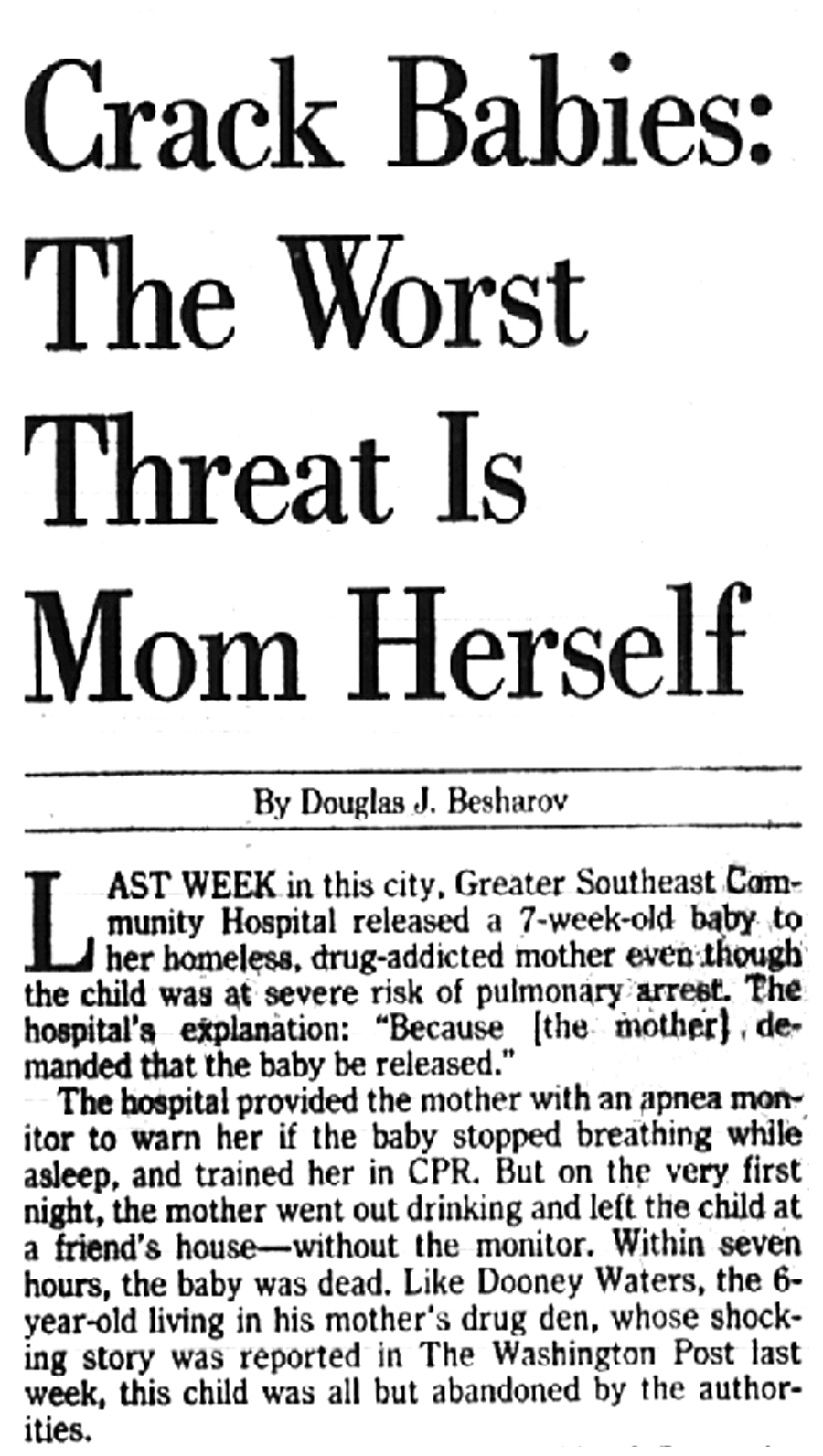
That turn of phrase inspired the title of the chapter about “crack babies” in Getting It Wrong, my forthcoming book that confronts and debunks 10 media-driven myths.

Getting It Wrong is being published this summer by University of California Press.

The crack-baby myth centers around the notion that women who took cocaine during pregnancy would give birth to children so mentally and physically deficient that they would constitute a helpless, dependent “bio-underclass,” as syndicated columnist Charles Krauthammer put it in 1989.

In Getting It Wrong,  I call attention “to the risks of anecdote-driven reporting, which characterized news coverage of the crack baby phenomenon.

“Disturbing images and heart-wrenching descriptions of helpless newborns supposedly damaged by their mothers’ toxic indulgence were,” I write, “frequent and irresistible elements of the coverage. Anecdotes were fuel for a powerful but misleading storyline.”

Yesterday’s “Tell Me More” segment on “crack babies” overlooked all that, referring vaguely to “all manner of pronouncements about how children who were exposed to crack in utero were destined to a life of physical and mental disability.”

The program’s description at the “Tell Me More” online site ignored the news coverage, saying instead that “the nation’s health specialists panicked over the growing number of so-called ‘crack babies’—children exposed to crack cocaine in utero. These children were said to be doomed to lives of physical and mental disability.”

The panic, though, was largely media-driven, as I discuss in Getting It Wrong.

The “Tell Me More” segment–which noted that “children who [had been] exposed to crack cocaine before birth are proving these worst case scenarios were all wrong”–did include an intriguing, media-related passage.

That came late in the show, when Dr. Carl Bell, a clinical professor of psychiatry and public health at the University of Illinois-Chicago, spoke of “media epidemiology.”

He said:

“I think it’s important for society to move away from what I refer to as media epidemiology and media hypotheses and making all these generalizations about things because frequently they’re flat out wrong, as it shows.”

I asked Bell by email to elaborate on “media epidemiology.”

He replied, stating:

“‘Media epidemiology’ is a term I began using about two years ago to describe how the public gets its understanding about epidemiology of various public health issues from the media, which of course is the absolutely wrong place to get such information as the media does not report on the common but on the uncommon which is defined as news.

“For example, ten years ago the homicide rates in Chicago were 1,000 but because of a lot of work done in public health in the city the homicide rates are down to 500, but the media keeps referring to the ‘homicide epidemic’ in Chicago; thereby misleading the public with their ‘media epidemiology.'”

It, too, is’ an interesting turn-of-phrase–and may help explain why the news media sometimes get it wrong in reporting on issues of science and public health.

WJC