W. Joseph Campbell

Posts Tagged ‘Furnish the war’

‘Getting It Wrong’ goes on ‘PJM Political’

In Cronkite Moment, Debunking, Furnish the war, Hurricane Katrina, Media myths on October 10, 2010 at 10:24 am

I had a fine interview recently with Silicon Valley blogger Ed Driscoll for the Pajamas Media radio show, PJM Political.

The interview aired yesterday on Sirus-XM radio’s POTUS channel.

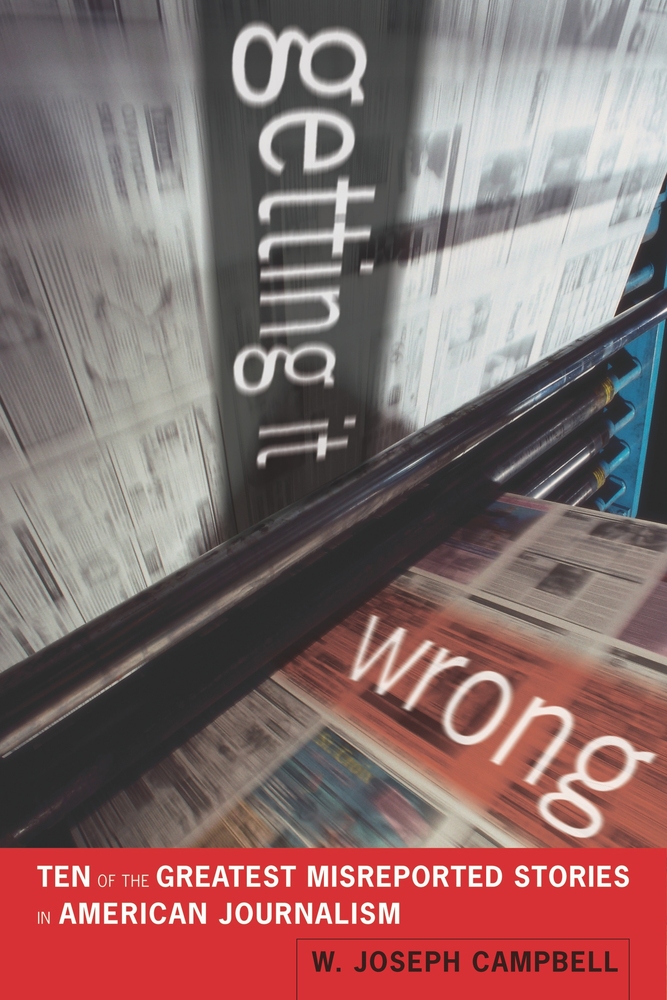
Topic: My new book, Getting It Wrong, which debunks 10 prominent media-driven myths, those dubious and improbable tales about the news media that masquerade as factual.

Driscoll, who conducts a thoughtful and well-prepared interview, led me through a discussion of several myths addressed in Getting It Wrong, including the Cronkite Moment” of 1968.

That was when, supposedly, the on-air analysis of CBS anchorman Walter Cronkite prompted President Lyndon Johnson to change his thinking about the Vietnam War and led him to decide against seeking reelection.

“That’s simply not true,” I pointed out. “Lyndon Johnson didn’t even see the [Cronkite] program when it aired in February 1968. And his decision not to seek reelection was driven by other forces and factors. Cronkite really was irrelevant to that equation, to that decision.

“But yet it lives on, as an example of media power, the media telling truth to power. And it’s a misleading interpretation, it’s a misreading of history.”

Driscoll said that the chapters of Getting It Wrong “have a sort of curious” set of bookends, in that they begin with a discussion of William Randolph Hearst’s famous vow to “furnish the war” with Spain and end with a look at the exaggerated, over-the-top coverage of Hurricane Katrina’s aftermath.

“Was this sort of book-ending intentional?” Driscoll asked.

It was an insightful question–and the first time an interviewer had asked about the book’s conceptual component.

I noted that the “original framework of the book had it organized more thematically, by ‘media and war’ and ‘media and government,'” and so on.

That framework was discarded, I said, “for a more chronological approach. So the bookends were driven more by chronology than anything else.”

We discussed how Orson Welles‘ cinematic masterpiece, Citizen Kane, helped cement the “furnish the war” myth in the public’s consciousness. Kane includes a scene that paraphrases Hearst’s purported vow.

The “furnish-the-war” anecdote about Hearst is dubious in many respects, I said, adding:

“Yet it lives on as an example of Hearst as the war-monger, as an example of the media–at its most malignant, in an extreme–can bring about a war that the country otherwise wouldn’t have fought.”

I mentioned how media-driven myths can be thought of as the “junk food of journalism,” which prompted Driscoll to ask:

What’s wrong with the American people being fed a little junk food? What’s wrong with being fed a few media myths?

There are several reasons, I replied.

Notably, “these myths tend to misrepresent the role of the news media in American society. They tend to grant the news media far more power and far more influence than they really do exert in American life.”

I added:

“Most people believe the media are powerful agents and powerful entities and often refer to some of the myths that I address, and debunk, in Getting It Wrong. They refer to them in support of this mistaken notion.”

In wrapping up the interview, Driscoll referred to Media Myth Alert as “a nifty blog.”

It was a generous plug that was much appreciated.

WJC

Recent and related:

Doing more than casting ‘doubt’ on Hearst’s famous vow

In 1897, Cinematic treatments, Debunking, Furnish the war, Media myths, Newspapers, Spanish-American War, Yellow Journalism on October 9, 2010 at 7:15 am

In a thoughtful essay posted the other day about “Hollywood and the Power of Myth,” the director of new media at the Wharton School invoked my research into William Randolph Hearst’s purported vow to “furnish the war” with Spain, saying that I’ve cast “doubt” on the often-repeated anecdote.

I like to think that I’ve pretty much demolished that tale.

The Wharton new media director is Kendall Whitehouse, who referred in his essay to my 2000 article in Journalism and Mass Communication Quarterly that challenges the Hearstian vow as improbable. In that article, I wrote that the anecdote deserved “relegation to the closet of historical imprecision.”

I revisited the tale in my latest book, Getting It Wrong, which debunks 10 prominent media-driven myths–dubious and improbable stories about the news media that masquerade as factual.

Chapter One in Getting It Wrong is devoted to the Hearstian tale, which I flatly describe as a media-driven myth, calling it “perhaps the hardiest myth in American journalism.”

I note:

“Hearst’s famous vow to ‘furnish the war’ has achieved unique status as an adaptable, hardy, all-purpose anecdote, useful in illustrating any number of media sins and shortcomings. It has been invoked to illustrate the media’s willingness to compromise impartiality, promote political agendas, and indulge in sensationalism. It has been used, more broadly, to suggest the media’s capacity to inject malign influence into international affairs.”

Its versatility and its pithiness are two of the reasons the Hearstian myth has lived on.

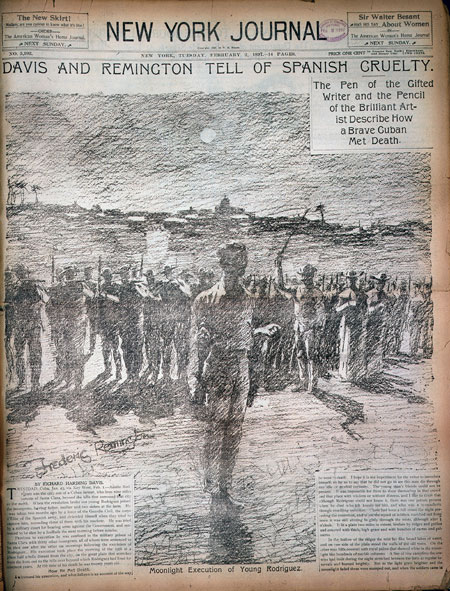
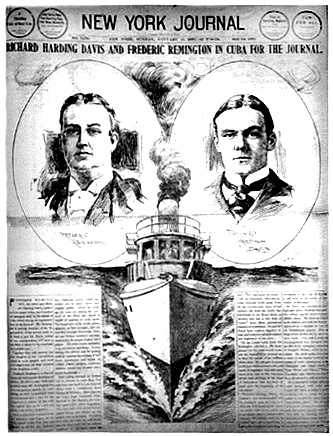
The anecdote stems from Hearst’s assigning Frederic Remington, the famous artist of the American West, to Cuba, to draw illustrations for the New York Journal of the island-wide rebellion against Spanish colonial rule. Remington and the writer Richard Harding Davis, who also was on Hearst’s payroll, reached Cuba in January 1897. (Both are shown in the front-page image above.)

Remington was in Cuba six days before returning to New York. He suffered in the tropical heat and didn’t along with the self-important Davis, who called the rotund Remington “a large, blundering bear.”

Before returning, the media myth has it, Remington sent Hearst a telegram stating:

“Everything is quiet. There is no trouble here. There will be no war. I wish to return.”

Hearst supposedly cabled the artist reply: “Please remain. You furnish the pictures, and I’ll furnish the war.”

In most tellings of the anecdote, Hearst supposedly made good on his promise and brought on the war with Spain, which was declared 15 months later.

The Remington-Hearst anecdote is riven with flaw and incongruity. For starters, Hearst at least twice denied ever having sent such a message. And Remington apparently never discussed the anecdote.

Moreover, as I write in Getting It Wrong, “the anecdote lives on despite a nearly complete absence of supporting documentation. It lives on even though telegrams supposedly exchanged by Remington and Hearst have never turned up.”

And it lives on despite what I call “an irreconcilable internal inconsistency.” That is, it would have been absurd for Hearst to have vowed to “furnish the war” because war—specifically, the Cuban rebellion against Spain’s colonial rule—was the very reason Hearst sent Remington and Davis to Cuba in the first place.

“Anyone reading U.S. newspapers in early 1897 would have been well aware that Cuba was a theater of a nasty war,” I write in Getting It Wrong. “By then, the Cuban rebellion had reached islandwide proportions and not a single province had been pacified by Spain’s armed forces.”

Despite those and other flaws, the tale lives on as too good to check out, too good not to be true.

And as I note in Getting It Wrong:

“What firmly and finally pressed Hearst’s purported vow to ‘furnish the war’ into the public’s consciousness was Citizen Kane, the 1941 motion picture that was based loosely on Hearst’s life and times.”

In a scene early in the film, Orson Welles in the role of Charles Foster Kane, a newspaper tycoon who readily invites comparisons to Hearst, paraphrases the purported Remington-Hearst exchange.

Whitehouse noted in his essay: “Rightly or wrongly, Orson Welles’s … Citizen Kane has largely shaped our popular perception of William Randolph Hearst.” True enough.

Kane certainly helped solidify a robust media-driven myth.

WJC

Recent and related:

Myth appeal runs deep abroad; Watergate a case in point

In 1897, Debunking, Furnish the war, Media myths, Spanish-American War, Washington Post, Watergate myth, Yellow Journalism on October 7, 2010 at 10:20 am

I  spoke about my new book, Getting It Wrong, at a superbly organized American University alumni event last night, at a venue commanding spectacular views of Seattle, Puget Sound, and the Olympic Mountains.

Following my talk, which focused on three of the 10 media-driven myths debunked in Getting It Wrong, I was asked by one of the people in attendance whether myths have similarly emerged about the media in other countries.

A very good question, I replied: I really don’t think so.

Maybe in Britain, I suggested, given the robust media scene there. But I couldn’t say for sure.

While I had to hedge a bit on the question, there’s no doubt that myth appeal runs deep from the United States to other countries. That is, news organizations outside the United States not infrequently repeat what are American media myths.

Media-driven myths, I have noted, can and do travel far, and well.  Take, for example, the heroic-journalist myth of Watergate.

The notion is often embraced in news media in the United States and overseas that the investigative reporting of Bob Woodward and Carl Bernstein, then-young reporters for the Washington Post, took down Richard Nixon and his corrupt presidency.

A measure of the myth’s international appeal can found in a report that aired today on Australia’s ABC radio network, which described Woodward as “one of the Washington Post journalists who brought down a U.S. President.”

Not even Woodward embraces that claim. He said in an interview in 2005:

“To say the press brought down Nixon, that’s horseshit.”

And he’s right. Earthy, perhaps, but right.

I discuss the heroic-journalist myth in Getting It Wrong, noting that it’s a simplistic and misleading interpretation of what was a sprawling and complex scandal. Watergate’s web of misconduct forced Nixon from office and landed nearly 20 of his top aides, associates, and cabinet officers in jail.

To roll up a scandal of such dimension, I write,  required the collective, if not always the coordinated, efforts of special prosecutors, bipartisan congressional panels, federal judges, the FBI, and, ultimately, the U.S. Supreme Court, which ordered Nixon to surrender audiotapes that proved his complicity in the Watergate cover-up.

Against that tableau, journalism’s contributions to unraveling Watergate were modest—certainly not decisive.

But because the heroic-journalist interpretation is such an unambiguous assertion of the media’s presumed power, it tends to travel well.

The same holds for the purported vow of William Randolph Hearst to “furnish the war” with Spain.

Hearst supposedly made the pledge in a cable to the artist Frederic Remington, who was in Cuba in early 1897, on assignment for Hearst’s New York Journal to draw illustrations of the rebellion against Spanish colonial rule.

The anecdote lives on as one of the most famous and delicious in American journalism—even though it is buttressed by no supporting documentation. And Hearst denied ever having made such statement.

It is, however, a tale almost too good to be disbelieved, given that it so effectively represents Hearst as warmonger. The tale’s sheer deliciousness is another reason why the anecdote turns up more than infrequently in news outlets abroad, especially in Spanish-language media.

The media myths associated with Watergate, the so-called “Cronkite Moment” of 1968, and the War of the Worlds radio dramatization of 1938 were the principal elements of my talk last night.

Those myths live on, I said, in part because “they are appealing reductive, in that they minimize the complexity of historical events and offer simplistic and misleading interpretations instead. The Washington Post no more brought down Nixon that Walter Cronkite swayed [Lyndon] Johnson’s views about Vietnam.

“Yet those and other media myths endure because they present unambiguous, easy-to-remember explanations for complex historic events.”

WJC

Recent and related:

‘Getting It Wrong’ plays the Tattered Cover

In Debunking, Furnish the war, Jessica Lynch, Media myths, Washington Post, Watergate myth on August 7, 2010 at 7:28 pm

Denver’s well-known Tattered Cover bookstore was the venue last night for a fine discussion about Getting It Wrong, my new book that addresses and debunks 10 prominent, media-driven myths.

At the Tattered Cover

About 60 people attended the book event, at least a few of whom had learned about it in listening to my in-studio interview Friday morning with David Sirota on KKZN, AM 760, Denver’s progressive talk radio station.

At the Tattered Cover, one of the country’s top independent bookstores, I discussed the myths of Watergate, of the “Cronkite Moment,” of William Randolph Hearst’s purported vow to “furnish the war” with Spain, and of the famous War of Worlds radio dramatization of  1938.

Those stories, I noted, are “all well-known—they are often taught in schools, colleges, and universities. They’re all delicious tales about the power of the news media to bring about change, for good or ill.”

And I proceeded to explain why all of them are media-driven myths–dubious and improbable tales about the news media that masquerade as factual. “They can be thought of as the junk food of journalism,” I noted. “Tasty and alluring, perhaps, but in the end, not terribly healthy or nutritious.”

The surprise of the evening came in discussing the mythical “Cronkite Moment,” in which President Lyndon Johnson supposedly realized U.S. policy in Vietnam was doomed, given the on-air assessment by CBS anchorman Walter Cronkite that the war was “mired in stalemate.”

Among the reasons the “Cronkite Moment” is a media myth, I said, is that Johnson did not see the Cronkite program on Vietnam when it aired on February 27,  1968.

Johnson was not in Washington; he was not in front of a television set. He was in Austin, Texas, making light-hearted comments at a black-tie birthday party for Governor John Connally, who that day turned 51.

“At about the time Cronkite was intoning his ‘mired in stalemate’ commentary,” I said at the Tattered Cover, “Johnson was at the podium at Connally’s birthday party, saying: ‘Today you are 51, John. That is the magic number that every man of politics prays for—a simple majority.'”

And with that, the audience burst into laughter.

Never before had the line prompted so many laughs. For some reason last night, it did.

The audience was attentive and inquisitive. Questions were raised about the media myth associated with coverage of the Jessica Lynch case and of the aftermath of Hurricane Katrina, which battered the Gulf Coast five years ago this month.

Another question was about the cinema’s capacity to promote and propel media myths. It was a good observation, one that I wished I had emphasized earlier in my talk.

A telling example of the how cinematic can solidify media myths is to be found in the 1976 film All the President’s Men, an adaptation of the book by the same name by Carl Bernstein and Bob Woodward about their Watergate reporting.

As I write in Getting It Wrong the cinematic version of All the President’s Men “helped ensure the [heroic-journalist] myth would live on by offering a neat, tidy, and vastly simplified account the Watergate scandal, one that allowed viewers to sidestep the scandal’s complexity while engaging in an entertaining storyline.”

I noted in my talk that Bernstein and Woodward did not uncover the defining and decisive elements of the Watergate scandal—the cover-up and the payment of hush money to the burglars arrested at Democratic national headquarters in June 1972, the signal crime of Watergate. Nor did Woodward and Bernstein uncover the existence of the audiotaping system that Nixon had installed in the Oval Office, which proved decisive in forcing the president’s resignation.

The Tattered Cover was a wonderful venue–comfortable, inviting. Its staff is exceptionally courteous and professional, and the hour-and-a-half went by extremely quickly.

WJC

Related:

Photo credit: Ann-Marie C. Regan

Silly season arrives? ‘Furnish the war’ sightings suggest as much

In 1897, Debunking, Furnish the war, Spanish-American War, Yellow Journalism on July 24, 2010 at 10:01 am

It must be the onset of summer’s silly season, the period from mid-July to the end of August when news content becomes noticeably lighter and fluff-filled.

How else to explain the recent sightings in the news, in the United States and abroad, of William Randolph Hearst’s mythical vow to “furnish the war” with Spain?

The purported Hearstian vow–which, as I describe in Chapter One of my new book, Getting It Wrong, is surely a media myth–appeared yesterday in a breezy travel piece posted at the Christian Science Monitor‘s online site.

The writer, Ruth Walker, tells of a recent cross-country road trip during which she turned often to Tippecanoe and Tyler Too: Famous Slogans and Catchphrases in American History, a 2008 book by Jan R. Van Meter.

The book, Walker writes, “is essentially a retelling of various chapters of American history through the catchphrases and slogans that emerged from them.”

She notes that a visit to the Hearst Castle in California “recalled William Randolph Hearst, the newspaper publisher who called for war with Spain after the USS Maine sank mysteriously in Havana Harbor.”

A memorable Hearstian line, Walker writes, was his “instruction to the artist Frederic Remington, whom he had sent to Cuba to ‘cover,’ as an illustrator, the anticipated war: ‘You furnish the pictures and I’ll furnish the war.'”

As is discussed in Getting It Wrong, reasons for doubting the veracity of the anecdote are many and include the significant fact that the purported telegram containing Hearst’s “furnish the war” vow has never surfaced.

Hearst, moreover, denied having sent such a message, and Remington apparently never discussed such an exchange.

Additionally, Hearst’s purported message is incongruous and illogical on its face: It would have made no sense for Hearst to have pledged to “furnish the war” because war–the Cuban rebellion against Spanish rule–was the reason he assigned Remington to Cuba in the first place.

The artist was on the island for six days in January 1897–15 months before the start of the Spanish-American War. The war was not “anticipated” in early 1897.

I further note in Getting It Wrong that Remington’s work from Cuba impugns the anecdote, too. His sketches for Hearst’s New York Journal depicted unmistakable (if unremarkable) scenes of the rebellion, which had begun in 1895.

Remington’s work for the Journal showed a scouting party of Spanish cavalry with rifles at the ready; a cluster of Cuban non-combatant captives being herded into Spanish lines; a scruffy Cuban rebel kneeling to fire at a small Spanish fort, and a knot of Spanish soldiers dressing a comrade’s wounded leg.

The sketches appeared in the Journal beneath headlines such as “Cuban War Sketches Gathered in the Field by Frederic Remington” and “Frederic Remington Sketches A Familiar Incident of the Cuban War.”

Remington clearly had seen many signs of war in Cuba.

For those and other reasons, the anecdote about Hearst’s vow is assuredly a media-driven myth, a dubious and improbable tale that deserves relegation to the closet of historical imprecision.

And that closet need not be opened at any time of year, not even during summer’s silly season when indulgence in the lighter side of the news becomes conspicuous.

WJC

Related:

Invoking media myths to score points

In 1897, Debunking, Furnish the war, Media myths, Spanish-American War, Yellow Journalism on July 23, 2010 at 8:25 am

Media-driven myths, those improbable tales about the news media that masquerade as factual, endure for a number of reasons–not the least of which is their value in scoring points about contemporary American journalism.

Evidence of that impulse appears today in a commentary posted at the Moderate Voice blog. The commentary assails conservative publisher Andrew Breitbart as a latter-day practitioner of “yellow journalism” and invokes what are media myths in making that claim.

“At the turn of the 19th century,” the commentary says, “Joseph Pulitzer and William Randolph Hearst ‘created a frenzy’ among the U.S. citizenry that pushed us into the Spanish-American War. Historians accuse Hearst of trying to boost his circulation by advocating war.”

In support of that dubious claim–most historians scoff at the notion that Pulitzer and Hearst “pushed us into” war with Spain–the Moderate Voice commentary offers the hoary tale of Hearst’s purported vow, supposedly contained in a telegram to the artist Frederic Remington, that stated:

“You furnish the pictures and I’ll furnish the war.”

Well, where to begin in unpacking the errors in such sweeping claims?

For starters, Hearst and Pulitzer were prominent in the 1880s and 1890s, not at “the turn of the 19th century.”

More significant, there is little evidence that the newspapers of Hearst and Pulitzer–the New York Journal and New York World, specifically–“created a frenzy” in the run-up to the Spanish-American War in 1898.

As I wrote in my 2001 book, Yellow Journalism: Puncturing the Myths, Defining the Legacies, Hearst and Pulitzer exerted no more than limited agenda-setting influence on the U.S. press in the run-up to the war.

As I noted in Yellow Journalism:

“A significant body of research indicates that newspapers in small-town and rural America scoffed at, condemned, and ignored the exaggerated and fanciful reports appearing in New York City’s yellow journals before and after the Maine’s destruction” in Havana harbor in mid-February 1898.

The mysterious destruction of the battleship U.S.S. Maine killed more than 260 Navy sailors and officers, and helped propel the war with Spain.

Moreover, I noted, “claims that the yellow press fomented the Spanish-American War contain almost no discussion about how, specifically, that influence was brought to bear” inside the administration of President William McKinley.

“There is,” I wrote in Yellow Journalism, “almost no evidence that the content of the yellow press, especially during the decisive weeks following the Maine’s destruction, shaped the thinking, influenced the policy formulation, or informed the conduct of key White House officials.”

The pithy “furnish the war” vow is almost certainly apocryphal, as I discuss in Getting It Wrong, my new book debunking 10 media-driven myths.

I note in Getting It Wrong that the purported vow has gained “unique status as an adaptable, hardy, all-purpose anecdote, useful in illustrating any number of media sins and shortcomings.

“It has been invoked to illustrate the media’s willingness to compromise impartiality, promote political agendas, and indulge in sensationalism.” The Moderate Voice commentary accomplishes all three.

I further note in Getting It Wrong that the tale about Hearst’s vow lives on “despite a nearly complete absence of supporting documentation. It lives on even though the telegram that supposedly contained Hearst’s vow has never turned up. It lives on even though Hearst denied ever sending such a message.”

Additionally, the tale endures in the face of what I call “an irreconcilable internal inconsistency.” It would have been illogical and absurd for Hearst to vow to “furnish the war” because war—specifically, the islandwide Cuban rebellion against Spain’s colonial rule—was the very reason Hearst sent Remington to Cuba in the first place.

Remington was in Cuba in early 1897, at a time when anyone reading U.S. newspapers would have been well aware that Cuba was a theater of a nasty war. By then, Spain had sent nearly 200,000 soldiers in a failed attempt to put down the rebellion, which gave rise in April 1898 to the Spanish-American War.

WJC

Related:

‘Famously rumored’: Hearst and his reputed vow

In 1897, Debunking, Furnish the war, Media myths, Spanish-American War on July 22, 2010 at 9:26 am

Media-driven myths are propelled by many forces, among them the reality that the tales sometimes are just too good, too delicious, to check out.

Hearst's Evening Journal, April 1898

So it was with a commentary posted yesterday at the “Unleashed” blog of the Australian Broadcasting Corporation.

The commentary invoked the well-known and often-repeated anecdote about William Randolph Hearst’s purported vow to “furnish the war” with Spain, stating:

“Hearst is famously rumored to have declared in writing to artist Frederic Remington: ‘I’ll furnish the war,’ referring, of course, to the Spanish-American War in 1898, henceforth referred to as ‘Mr Hearst’s War’….”

“Famously rumored,” eh? A flimsy construct, that, for making a point or building an argument.

It takes but a few minutes spent online to find evidence that the Hearstian vow is almost certainly a media-driven myth–a dubious, improbable tale masquerading as fact.

Chapter One in Getting It Wrong, my new book debunking 10 prominent media-driven myths, takes up and dismantles the Hearstian vow, and that chapter is readily accessible online.

Still, it’s clear that the anecdote’s simplistic directness have helped make it resistant to debunking. As I note in Getting It Wrong, media myths that can be reduced to a memorably pithy phrase are most likely to withstand debunking.

So it is with “furnish the war.”

The anecdote also is impressively flexible. It is useful, I write, “in illustrating any number of media sins and shortcomings. It has been invoked to illustrate the media’s willingness to compromise impartiality, promote political agendas, and indulge in sensationalism. It has been used, more broadly, to suggest the media’s capacity to inject malign influence into international affairs.”

Even more impressive, perhaps, is that the anecdote endures despite the near-complete absence of supporting documentation.

Hearst

“It lives on,” I write in Getting It Wrong, “even though the telegrams supposedly exchanged by Remington and Hearst have never turned up. It lives on even though Hearst denied ever sending such a message. It lives on despite an irreconcilable internal inconsistency: It would have been absurd for Hearst to vow to ‘furnish the war’ because war—specifically, the Cuban rebellion against Spain’s colonial rule—was the very reason Hearst sent Remington to Cuba in the first place. Anyone reading U.S. newspapers in early 1897 would have been well aware that Cuba was a theater of a nasty war.”

Hearst assigned Remington to Cuba 15 months before the Spanish-American War broke out. In early 1897, no one, including Hearst, could have known the United States would take up arms against Spain over Cuba.

WJC

Related:

Going international: Media myths travel far, well

In Cinematic treatments, Debunking, Furnish the war, Media myths, Newspapers, Spanish-American War, Washington Post, Watergate myth on July 15, 2010 at 6:05 am

Prominent media-driven myths—the subject of my new book, Getting It Wrong—not only can be tenacious; some of them travel quite well, crossing linguistic and cultural borders with surprising ease.

Indeed, it’s a sign of hardy appeal when media-driven myths turn up in international contexts more often than just occasionally.

The heroic-journalist myth of Watergate–one of the 10 media myths I explore in Getting It Wrong—represents this phenomenon quite well. The heroic-journalist meme has it that the fearless investigative reporting by Bob Woodward and Carl Bernstein, then-young journalists for the Washington Post, brought down Richard Nixon’s corrupt presidency in the Watergate scandal.

Woodward

It’s a compelling tale that long ago became the scandal’s dominant popular narrative.

It’s also a simplistic interpretation of what was a complex and intricate web of misconduct that took down Nixon and landed nearly 20 of his top aides, associates, and cabinet officers in jail.

I note in Getting It Wrong that to roll up a scandal of such dimension required the collective, if not always the coordinated, efforts of special prosecutors, bipartisan congressional panels, federal judges, the FBI, and, ultimately, the U.S. Supreme Court, which ordered Nixon to surrender audiotapes that proved his complicity in the Watergate cover-up.

Against such a tableau, journalism’s contributions to unraveling Watergate were modest—certainly not decisive.

But because the heroic-journalist interpretation is so straightforward and unambiguous, it’s not surprising that it finds appeal across cultures and turns up fairly often in media reports outside the United States.

Simplicity propels the Watergate myth, enabling it to travel far and well.

Just the other day, for example, a commentary at Mediapart, a French online investigative reporting site, recalled Woodward and Bernstein as “the two journalists for the Washington Post who, thanks to their investigation, set in motion the resignation of President Richard Nixon, during Watergate.”

Another media myth that travels widely and well is that of William Randolph Hearst’s purported vow to “furnish the war” with Spain at the end of the 19th century. Hearst’s pledge supposedly was contained in a cable to the artist Frederic Remington, whom Hearst sent to draw illustrations of the Cuban rebellion, which preceded the Spanish-American War.

The anecdote lives on as one of the most famous and delicious in American journalism—even though it is buttressed by no supporting documentation and is improbable on its face.

It is, however, a tale almost too good to be disbelieved, given that it so effectively captures Hearst as warmonger . The anecdote turns up more than occasionally abroad, especially in Spanish-language media.

I note in Getting It Wrong that “Hearst’s famous vow to ‘furnish the war’ has achieved unique status as an adaptable, hardy, all-purpose anecdote, useful in illustrating any number of media sins and shortcomings. It has been invoked to illustrate the media’s willingness to compromise impartiality, promote political agendas, and indulge in sensationalism. It has been used, more broadly, to suggest the media’s capacity to inject malign influence into international affairs.”

With all that going for it, the step to adoption in international contexts is fairly small.

Beyond simplicity and deliciousness, the international appeal of prominent media myths also may be attributed to a keen and enduring curiosity abroad in American journalism. For all its faults and uncertainties, American journalism is a sprawling, robust, and intriguing profession. Such dynamism exerts appeal and interest beyond the United States.

American cinema is perhaps an even more powerful force: Hollywood treatments have helped solidify media myths. And Hollywood productions often travel well abroad.

The 1976 film All the President’s Men certainly helped propel the heroic-journalist myth of Watergate, for example. As I write in Getting It Wrong: “More than thirty-five years later, what remains most vivid, memorable, and accessible about Watergate is the cinematic version of All the President’s Men.”

The movie, I note, “helped ensure the [heroic-journalist] myth would live on by offering a neat, tidy, and vastly simplified account the Watergate scandal, one that allowed viewers to sidestep the scandal’s complexity while engaging in an entertaining storyline.”

Hollywood also was crucial to cementing Hearst’s purported vow into the popular consciousness. That vehicle was Citizen Kane, the 1941 motion picture based loosely on Hearst’s life and times.

Hearst’s purported vow is paraphrased in a scene early in Kane, which some critics regard as the best-ever American motion picture.

The Hearstian vow also is quoted in the 1997 James Bond movie, Tomorrow Never Dies. Or, as it was known in francophone countries, Demain ne meurt jamais.

WJC

A version of this post first appeared at the University of California Press blog.

‘Persuasive and entertaining’: WSJ reviews ‘Getting It Wrong’

In Cronkite Moment, Debunking, Furnish the war, Jessica Lynch, Media myths, Murrow-McCarthy myth, New York Times, Reviews, Spanish-American War, War of the Worlds, Washington Post, Watergate myth on July 12, 2010 at 6:05 am

Today’s Wall Street Journal reviews Getting It Wrong, characterizing as “persuasive and entertaining” my new book debunking 10 prominent media-driven myths.

The review–which appears beneath the headline “Too good to check”–is clever and engaging, and opens this way:

“Hello, city desk, get me rewrite. Here’s the lead: Many of the landmark moments in American journalism are carefully nurtured myths—or, worse, outright fabrications.

“William Randolph Hearst never said, ‘You furnish the pictures, and I’ll furnish the war.’ Orson Welles’s ‘War of the Worlds’ radio broadcast didn’t panic America. Ed Murrow’s ‘See It Now’ TV show didn’t destroy Sen. Joseph McCarthy. JFK didn’t talk the New York Times into spiking its scoop on the Bay of Pigs invasion. Far from being the first hero of the Iraq War, captured Army Pvt. Jessica Lynch was caught sobbing ‘Oh, God help us’ and never fired a shot.

“These fables and more are lovingly undressed in W. Joseph Campbell’s persuasive and entertaining ‘Getting It Wrong.’ With old-school academic detachment, Mr. Campbell, a communications professor at American University, shows how the fog of war, the warp of ideology and muffled skepticism can transmute base journalism into golden legend.”

The reviewer, Edward Kosner, author of the memoir It’s News to Me, also discusses the myth of the “Cronkite Moment,” writing, “Television icons are central to two of Mr. Campbell’s dubious cases: Murrow and his successor as the patron saint of TV news, Walter Cronkite.”

Kosner notes–as I do in Getting It Wrong–that at least some of the myths confronted in the book will likely survive their debunking.

“For all Mr. Campbell’s earnest scholarship,” Kosner writes, “these media myths are certain to survive his efforts to slay them. Journalism can’t help itself—it loves and perpetuates its sacred legends of evil power-mongers, courageous underdogs, dread plagues and human folly.”

Well said.

And, alas, he may be right. Some of the myths almost certainly will live on. As I write in the introduction to Getting It Wrong, they “may prove resistant to debunking. They may still be widely believed despite the contrary evidence marshaled against them.

“The most resilient myths,” I further write, “may be those that can be distilled to a catchy, pithy phrase like: ‘If I’ve lost Cronkite, I’ve lost Middle America.’ Such quotations are neat, tidy, and easily remembered. Cinematic treatments influence how historical events are collectively remembered and can harden media-driven myths against debunking. The motion picture All the President’s Men, which cast Robert Redford and Dustin Hoffman in the lead roles of Washington Post reporters [B0b] Woodward and [Carl] Bernstein, has helped ensure that the journalists and their newspaper would be regarded as central to cracking the Watergate scandal.”

Kosner closes the review with a humorous observation, writing:

“At the end of the book, Mr. Campbell offers some remedies for media mythologizing, urging journalists, among other things, ‘to deepen their appreciation of complexity and ambiguity.’ Good luck with that, professor.'”

Heh, heh. Nice touch.

WJC

Related:

Seeking antidotes to journalism’s ‘junk food’

In Bra-burning, Debunking, Furnish the war, Jessica Lynch, Media myths, Murrow-McCarthy myth on July 2, 2010 at 12:31 am

Media-driven myths—those false, dubious yet prominent stories about the news media that masquerade as factual—can be thought of as the junk food of journalism. They’re alluring and delicious, but neither especially wholesome nor healthy.

As I note in Getting It Wrong, media-driven myths can spring from many sources. War is an especially fertile breeding ground for media myths, partly because the shock of combat is alien and unfamiliar to most people. Given their limited first-hand experience with war, media audiences generally are in no position to challenge reports from the battlefield.

“The confusion and intensity inherent in warfare can lead journalists to place fragmented information that emerges from conflict into recognizable if sometimes misleading frames,” I write.

An example of that came early in the Iraq War in 2003, with the Washington Post’s erroneous report about the battlefield heroics of Jessica Lynch, a topic discussed in Getting It Wrong. The Post’s characterization of Lynch as a female Rambo, pouring lead into attacking Iraqis, did not seem entirely implausible. It was, after all, a story picked up by news organizations around the world.

Hurried and sloppy reporting, which certainly figured in the sensational report about Lynch, also contributes to the rise to media myths. The myth of “crack babies” of the late 1980s and 1990s was certainly propelled by hurried reporting, by over-eager journalism and by premature medical findings.

Reporters and columnists pushed too eagerly on preliminary and inconclusive research about children born to women who took crack cocaine during pregnancy. The horrors that many journalists predicted—that “crack babies” would grow up to be a vast, permanently dependent class, a so-called “bio-underclass” of staggering dimension—proved quite wrong.

So are there antidotes to media-driven myths?

I argue in Getting It Wrong that while “they spring from multiple sources, it is not as if media-driven myths are beyond being tamed.”

To slow or thwart the spread of media myths, journalists might start by applying a measure of skepticism to pithy, telling quotes such as William Randolph Hearst’s vow to “furnish the war” with Spain at the end of the 19th century.

Turns of phrase that sound too neat and too tidy often are too good to be true.

Journalists also would do well to cultivate greater recognition of their fallibility. Too often they seem faintly concerned with correcting the record they tarnish. They tend not to like revisiting major flaws and errors. As Jack Shafer, media critic for the online magazine Slate, has written:

“The rotten truth is that media organizations are better at correcting trivial errors of fact—proper spellings of last names, for example—than they are at fixing a botched story.”

Not surprisingly, there was no sustained effort by the news media to set straight the record about the chimerical scourge of “crack babies.” Not surprisingly, there was little sustained effort to explore and explain the distorted and badly flawed reporting from New Orleans in 2005, in the aftermath of Hurricane Katrina’s landfall.

Encouraging a culture of skepticism and tolerance for viewpoint diversity in American newsrooms also would help curb the rise and dissemination of media-driven myths. Newsrooms can seem like bastions of group-think. Michael Kelly, the former editor of National Journal and the Atlantic once observed:

“Reporters like to picture themselves as independent thinkers. In truth, with the exception of 13-year-old girls, there is no social subspecies more slavish to fashion, more terrified of originality and more devoted to group-think.”

Group-think and viewpoint diversity are not topics often discussed in American newsrooms. But they’re hardly irrelevant. It is not inconceivable that a robust newsroom culture that embraces encourages skepticism, invites challenges to dominant narratives, and rewards contrarian thinking would have helped thwart publication of embarrassingly mistaken tales such as the Post’s account about Jessica Lynch.

Another antidote to media-driven myths is offered by the digitization of newspapers and other media content.

Digitization has made it easier than ever to consult and scrutinize source material from the past. Never has journalism’s record been more readily accessible, through such databases as ProQuest and LexisNexis.

Reading what was written makes it clear that radio dramatization of the War of the Worlds in 1938 created nothing approaching nationwide panic and hysteria. Reading what was written makes clear that Edward R. Murrow’s televised critique of Senator Joseph McCarthy in 1954 was belated and quite unremarkable.

Reading what was written can be a straightforward and effective antidote to media-driven myths.

WJC

A version of this post first appeared at the University of California Press blog.