W. Joseph Campbell

Posts Tagged ‘Getting It Wrong’

‘War of the Worlds’ radio panic was overstated

In Anniversaries, Debunking, Media myths, Media myths and radio, War of the Worlds on October 3, 2010 at 8:02 am

Welles in bronze

October always brings frequent reminders about radio’s most memorable and myth-beclouded program–Orson Welles’ superb dramatization of the War of the Worlds that aired on Halloween eve 1938.

So realistic was Welles’ show, so alarming were its simulated news reports of invading Martians, that listeners by the tens of thousands—or more—were convulsed in panic and hysteria.

Fright beyond measure gripped the country that night; it was the night that panicked America.

Or so the media myth has it.

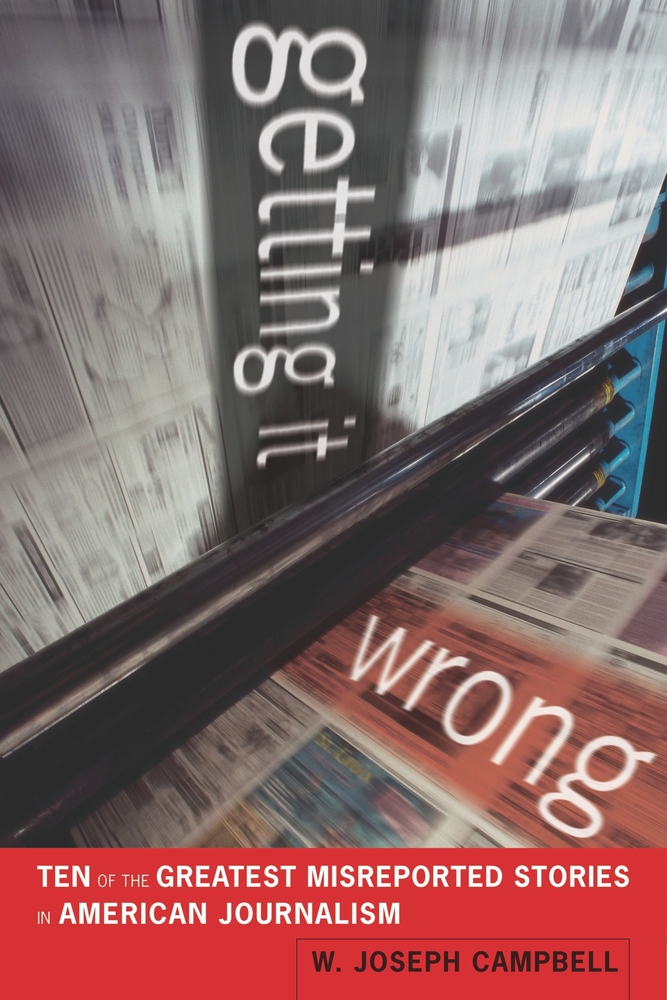
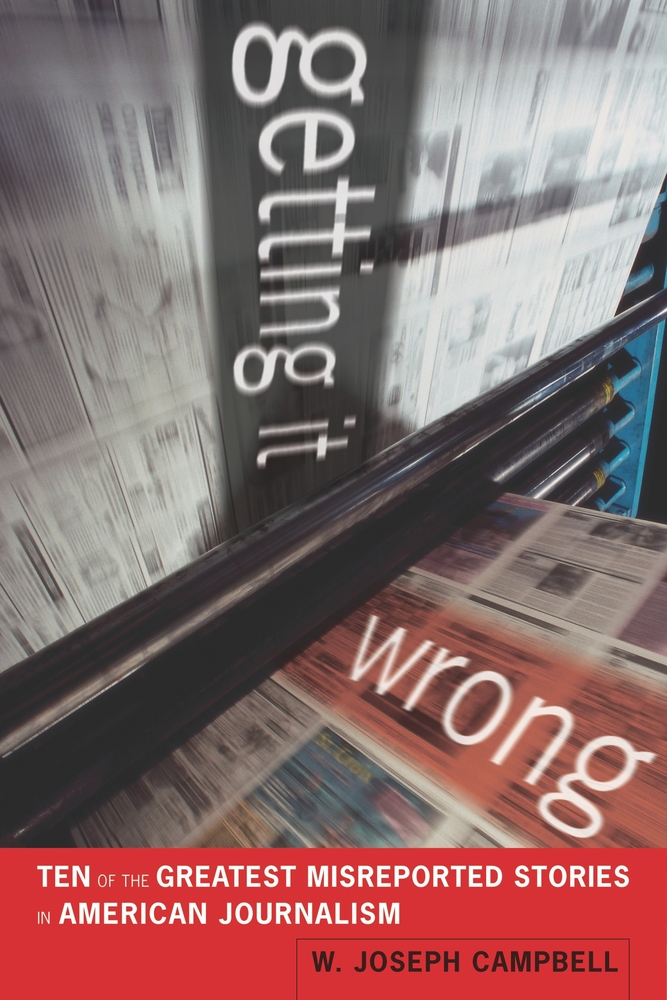
The delicious, ever-appealing tale of mass hysteria sown by the War of the Worlds program is one of the 10 prominent media-driven myths that I address and debunk in my new book, Getting It Wrong.

I note that some Americans were frightened by the program. But most listeners, in overwhelming numbers, were not. They recognized it for what it was—an imaginative and entertaining radio show that aired in its usual Sunday evening time slot.

Still, this media myth is just too well-known, too entrenched in the American consciousness, ever to fall into disuse.

That’s why October brings numerous references to the War of the Worlds show and the panic it supposedly caused. Indeed, just the other day, an item posted at examiner.com said the program fooled “over a million people into thinking the world was actually under attack by Martians.”

But there’s simply no data to support such claims.

Hadley Cantril, a psychologist at Princeton University who helped promote the notion that the Welles’ program caused widespread panic, drew on surveys to estimate that at least 6 million people listened to the hour-long program, which aired live over the CBS radio network.

Of those listeners, Cantril estimated, 1.2 million were “frightened,” “disturbed,” or “excited” by what they heard.

But as I note in Getting It Wrong, “Cantril left unclear the distinctions among ‘frightened,’ ‘disturbed,’ or ‘excited.’ Nor did Cantril not estimate how many listeners acted on their fears and excitement,” a critical element had there indeed been widespread panic that night.

I further note that “one can watch a horror movie and feel ‘frightened,’ ‘disturbed,’ or ‘excited,’ but such responses are hardly synonymous with panic or hysteria.” Far from it.

The notion that mass panic had accompanied the airing the War of the Worlds program spread quickly, mostly by U.S. newspapers which reported the day after the show that hysteria had swept the country.

Their reports, however, “were almost entirely anecdotal,” I note, “and largely based on sketchy wire service roundups that emphasized breadth over in-depth detail.”

Newspapers simply had no reliable way of testing or ascertaining the validity of the sweeping claims they made about the War of the Worlds program.

Here’s why.

The War of the Worlds dramatization aired from 8-9 on Sunday night in the East, a time when most newspaper newsrooms were thinly staffed.

Reporting on the reactions to The War of The Worlds broadcast represented no small challenge, especially for morning newspapers having late-night deadlines.

“Given the constraints of time and staffing,” I write in Getting It Wrong, “relying on wire services such as the Associated Press became essential. This dependency, in turn, had the effect of promoting and deepening the notion that panic was widespread that night: On a late-breaking story of uncertain dimension and severity, many newspapers took their lead from wire service dispatches.

“They had little choice.”

The AP’s reports about the program essentially were roundups of reactions culled from the agency’s bureaus across the country, I write. Typically, AP roundups emphasized sweep—pithy anecdotal reports from many places—over depth and detail.

The anecdotes about people frightened by the show tended to be sketchy, shallow, and small-bore. But their scope contributed to and confirmed the sense that widespread panic was afoot that night.

The reliance on wire service roundups helps explain the consensus among U.S. newspapers that the broadcast had created mass panic.

Interestingly, newspaper content also helps to undercut the notion that panic and hysteria  swept the country that night.  Had that happened, the resulting trauma and turmoil surely would have led to many deaths and serious injuries.

But newspaper reports were notably silent on extensive casualties.

No deaths were attributed to the War of the Worlds broadcast. And as Michael J. Socolow wrote in his fine essay about the program, no suicides could “be traced to the broadcast,” either.

WJC

Recent and related:

Pew: Woodward, Bernstein ‘unraveled Watergate cover-up’

In Debunking, Media myths, Washington Post, Watergate myth on October 1, 2010 at 8:27 am

Bob  Woodward’s new book, Obama’s Wars, was the single most-discussed topic in news links posted at Web logs Monday through Friday last week,  the Pew Research Center’s Project for Excellence in Journalism said yesterday.

Woodward (Library of Congress)

Pew said that 35 percent of news links at blogs during the period September 20-24 were about the book, which has received mostly so-so reviews. (For example, the Wall Street Journal said in its critique yesterday, “To read ‘Obama’s Wars’ is to feel trapped in a daylong meeting in an airless room. That’s because much of the book consists of a near-verbatim account of meetings—specifically the National Security Council meetings last fall where the administration hashed out its Afghanistan policy.”)

The book and blog posts about it are of mild interest to Media Myth Alert.

What caught this blog’s attention was assertion in Pew’s news release–duplicated in a separate release by the Project for Excellence in Journalism–that referred to Woodward as “a Washington Post associate editor and half of the famous reporting duo that unraveled the Watergate cover-up.”

That last bit, about having “unraveled the Watergate cover-up,” is in error.

As I discuss in Getting It Wrong, my new book that debunks 10 prominent media-driven myths, Woodward and his Post colleague Carl Bernstein, “did not uncover defining and decisive elements” of Watergate—including the cover-up of the break-in at offices of the Democratic National Committee, the scandal’s signal crime.

The Watergate cover-up was exposed incrementally in 1973 and 1974 by the combined forces of such subpoena-wielding entities as federal prosecutors, federal grand juries, and U.S. Senate investigators. Ultimately the U.S. Supreme Court ordered President Richard Nixon to hand over audiotapes of secretly recorded conversations at the White House that unequivocally demonstrated Nixon’s guilty role in the cover-up.

The Supreme Court decision was handed down in July 1974. Nixon resigned soon after.

Woodward and Bernstein’s award-winning reporting on Watergate was published in summer and fall 1972, as the scandal slowly unfolded during the weeks and months following the break-in at Democratic headquarters.

By late October 1972, I note in Getting It Wrong, “the Post’s investigation into Watergate ‘ran out of gas,’ as Barry Sussman, then the newspaper’s city editor, acknowledged.”

Edward Jay Epstein pointed out in his classic essay about the press and Watergate that “it was not because of the reporting of Woodward and Bernstein, but because of the pressures put on the conspirators by Judge John Sirica, the grand jury, and Congressional committees that the cover-up was unraveled.”

Sirica, a federal judge, presided at the trial of the Watergate burglars that ended in guilty pleas in January 1973. Afterward, the judge “made it abundantly clear,” Epstein wrote, that the convicted burglars “could expect long prison sentences unless they cooperated with the investigation” of the Senate select committee on Watergate.

One of the burglars, James McCord, soon wrote to Sirica, saying that “perjury had been committed at the trial and the defendants had been induced by ‘higher-ups’ to remain silent,” Epstein pointed out.

McCord’s letter thus began the unraveling of the Watergate cover-up.

I discuss in Getting It Wrong factors that help account for the tenacity of the “heroic-journalist” interpretation of Watergate–the erroneous notion that the reporting of Woodward and Bernstein brought down Nixon’s corrupt presidency.

“Media myths,” I write, “often emerge from an eagerness to find influence and lasting significance in what journalists do and tend to extend credit where credit is not entirely due.

“The heroic-journalist myth of Watergate is a telling example. The myth holds that the reporting of Bob Woodward and Carl Bernstein in the Washington Post brought down Richard Nixon. In reality, the Post and other news organizations were marginal factors in unraveling the Watergate scandal.”

Media myths thus can be self-flattering; they offer heroes like Woodward and Bernstein to a profession that is more used to criticism than applause.

Besides, claiming that Woodward and Bernstein brought down Nixon, or that they “unraveled the Watergate cover-up,” long ago became a ready if misleading way for journalists to distill what was a sprawling scandal.

WJC

Recent and related:

On the high plateau of media distrust

In 1897, Debunking, Hurricane Katrina, Media myths, New York Times, Newspapers, Yellow Journalism on September 30, 2010 at 10:22 am

A Gallup poll released yesterday suggested that distrust of the news media has reached a high plateau among American adults.

Fifty-seven percent of Gallup’s respondents, the most ever, said they had little or no trust in the “mass media … when it comes to reporting the news fully, accurately, and fairly.” A year ago, the little-to-no trust response rate was 55 percent; in 2008 it was 56 percent.

As Andrew Malcolm noted at his engaging Top of the Ticket blog, the new “record high” in media distrust was reached “by one lousy percentage point.”

Even so, there’s little comfort in having reached such a plateau. And the factors accounting for a pronounced level of popular distrust are several–and hardly unfamiliar.

Surely one reason is that it’s commonplace to bad-mouth the news media as unreliable and unfair. Media-bashing has long been in fashion–and the news media are prone to beat up on themselves, and their rivals.

A commentary posted yesterday at the Atlantic blog put it well in saying that “media voices increasingly distinguish themselves by telling us not to trust the rest of the mainstream media. Think about all of the mass media today that tells us how stupid mass media is.”

True enough. That has to have an effect.

But the news media have long indulged in aiming brickbats and insults at one another. For the news media, media-bashing has long been an irresistible pasttime.

The ever-appealing and often-invoked epithet “yellow journalism” dates after all to 1897–and the efforts of a New York newspaper editor to find a pithy and imaginative way to denigrate what then was called the “new journalism” of William Randolph Hearst and Joseph Pulitzer.

Traditional and new, the media are everywhere these days and their ubiquity no doubt fosters some disdain and contempt. A hint of that contempt can be detected in the recent Pew Research Center’s news-consumption survey, which reported that 17 percent of American adults go newsless on a typical day.

Although the news media are everywhere, a sizable portion of the population has little use for them.

Going newsless can’t be easily accomplished, given the variety of readily accessible platforms by which news is delivered. But the going-newsless option is especially pronounced among American adults younger than 30: Pew’s report said 27 percent of that cohort gets no news on a typical day.

The prominent and well-documented fabrication scandals of several years ago doubt have contributed to the plateau of media distrust. The journalistic fraud committed by Jayson Blair of the New York Times and Jack Kelley of USA Today, among others, surely has left a bad taste for the media among many news consumers.

The inclination to distrust the media surely was reinforced by the highly exaggerated news coverage of Hurricane Katrina’s aftermath in New Orleans in 2005.

As I write in Getting It Wrong, my new book that debunks prominent media-driven myths, the Katrina coverage was “no high, heroic moment in American journalism. … On crucial details, journalists erred badly, and got it wrong. In the days following Katrina’s landfall, news reports described apocalyptic horror that the hurricane supposedly had unleashed.”

And that reporting was steeped in error.

The fifth anniversary of Katrina’s landfall was an occasion to revisit just how shoddy the news coverage was in the storm’s aftermath. And that anniversary fell shortly before Gallup conducted its annual media-trust survey.

Gallup said 1,019 adults were interviewed by telephone in a random survey conducted September 13-16. (The sampling error was plus or minus four percentage points, meaning the level of distrust could be as great as 61 percent, or as narrow as 53 percent.)

Mundane factors probably contribute to the plateau of distrust as well. Staff cuts at many U.S. newspaper, including the unsung heroes manning copy desks, have been blamed for an increase grammar, spelling, and factual errors.

It’s not that newspapers ever were mostly free of such lapses. Anecdotally at least, they seem more frequent and conspicuous. The ombudsman, or reader’s representative, at the Washington Post suggested as much last year in writing that growing numbers of readers were calling on him “to complain about typos and small errors” appearing in the newspaper.

And it’s become a cliché to say that such small-bore errors undermine credibility–or, perhaps more accurately, encourage media distrust.

And then there is the matter of limited viewpoint diversity in American newsrooms, a point I raise in Getting It Wrong.

Few journalists for mainstream national media “consider themselves politically conservative,” I note, referring to surveys conducted in 2004 and 2008 for the Washington-based Committee of Concerned Journalists. The surveys found that the overwhelming majority of national correspondents for U.S. news media considered themselves to be politically “moderate” or “liberal.”

Interestingly, Gallup reported that “Democrats and liberals remain far more likely than other political and ideological groups to trust the media and to perceive no bias.”

Viewpoint diversity in newsrooms “is an issue not much discussed in American journalism,” I write in Getting It Wrong. “But it is hardly irrelevant.”

Especially when distrust of the news media has found such a high plateau.

WJC

Recent and related:

Obama, journalism history, and ‘folks like Hearst’

In 1897, Debunking, Media myths, Yellow Journalism on September 29, 2010 at 9:45 am

President Obama stirred a fair amount of comment and criticism by declaring in a recent interview with Rolling Stone magazine that Fox News pursues a point of view that’s “ultimately destructive” to the country’s “long-term growth.”

As if Fox News, or any news organization, had such power.

And Obama offered another comment that signaled a less-than-profound grasp of American journalism history.

Media baron W.R. Hearst

That came when he invoked William Randolph Hearst, the much-misunderstood practitioner of activist yellow journalism who came to prominence in the 1890s. Obama said:

“We’ve got a tradition in this country of a press that oftentimes is opinionated. The golden age of an objective press was a pretty narrow span of time in our history. Before that, you had folks like Hearst who used their newspapers very intentionally to promote their viewpoints.”

Hearst, though, was something of an exception among newspaper publishers; there haven’t been many “folks like Hearst” in American journalism. Certainly not in the late 19th and early 20th centuries, the most innovative period of Hearst’s years as a press baron.

Hearst arrived in New York City from San Francisco in 1895 and promptly shook a media landscape dominated by the likes of James Gordon Bennett Jr., the often-absent owner of the New York Herald; Joseph Pulitzer, the ailing and churlish proprietor of the New York World, and Charles A. Dana, the prickly force behind the New York Sun.

They all were past their prime, and their newspapers were in decline.

As I discussed in my 2006 book, The Year That Defined American Journalism: 1897 and the Clash of Paradigms, Hearst’s entry into New York City journalism was something of “a seismic event.”

By late 1897, he had developed and began pursuing a robust and fairly progressive view of journalism, maintaining that newspapers had a duty and obligation to inject themselves conspicuously into public life, to fill the void left by government inaction and incompetence.

Hearst called this the “journalism of action” or the “journalism that acts.” It was journalism with a social conscience.

His New York Journal insisted in editorials that a newspaper’s duty should not be “confined to exhortation.”

Instead, the Journal declared, when “things are going wrong” the newspaper should step in and “set them right, if possible.”

Hearst’s “journalism of action” embraced an element of what we would recognize as consumer protection. In the aftermath of a snowstorm that swept New York late in January 1897, the Journal set up a relief effort, saying, “The time has come to help the poor who starve, who freeze. Charity’s hand is almost empty.”

There was no more stunning manifestation of Hearst’s activist vision of journalism than the jailbreak his Journal pulled off in Havana in October 1897, freeing a 19-year-old political prisoner named Evangelina Cisneros.

She had been jailed without trial for more than a year in a prison for women. Spanish authorities who then ruled Cuba spurned Hearst’s editorial campaign for Cisneros’ release.

In late August 1897 he sent Karl Decker, a reporter in the Journal‘s Washington bureau, to Havana, with instructions to win Cisneros’ freedom. And with the quiet help of U.S. diplomats in Cuba, and the vital assistance of a clandestine smuggling network in Havana, Decker broke Cisneros from prison.

Cisneros

She soon was smuggled out of Cuba and welcomed to New York City in a delirious reception organized by Hearst and the Journal.

It was American journalism’s greatest escape narrative. And it demonstrated the breathtaking scope and potential of the “journalism of action.”

Freeing Cisneros, the Journal declared, was “epochal” and a “supreme achievement of the journalism of action.” (Illicit “jail-breaking journalism” was more like it, scoffed the Chicago Times-Herald.)

Eventually, though, Hearst’s interest in developing the “journalism of action” was supplanted by his soaring, and mostly unfulfilled, political ambitions.

In 1902, Hearst was elected to the first of two terms in Congress.

He sought, but lost, the Democratic nomination for president in 1904. He lost the New York gubernatorial race in 1906. And he twice ran unsuccessfully for New York City mayor.

What’s more, I write in The Year That Defined American Journalism, “Hearst never completely shook the reputation of a spoiled little rich kid, and the ‘journalism of action’ surely suffered because of his personality.”

In his comment about “folks like Hearst,” Obama also seemed to embrace a version of the “golden age” fallacy, that there was a time in American journalism when newspapers were paragons of objectivity.

That’s a myth, really.

“Objectivity”–or what Richard Taflinger of Washington State University has succinctly termed “the detached and unprejudiced gathering and dissemination of news”–is a normative value or ambition in American journalism.

But it has never been practiced on anything approaching a sustained basis.

WJC

Recent and related:

My many thanks to fivefeetoffury and to Jim Romenesko for linking to this post.

How late was Ed Murrow in taking on Joe McCarthy?

In Cinematic treatments, Media myths, Murrow-McCarthy myth on September 28, 2010 at 4:25 pm

Murrow in 1954

Edward R. Murrow, the “white knight” of American broadcasting, is often credited with having ended the communists-in-government witch-hunt of Senator Joseph McCarthy at the height of the Cold War.

Murrow supposedly demolished the McCarthy scourge in a 30-minute television program, See It Now, that aired on CBS on March 9, 1954. The show made notably effective use of footage of the senator’s words, actions, and sometimes-bizarre conduct.

By doing that show, it is said, Murrow stood up to McCarthy when no one else would–or dared.

That, however, is a media-driven myth–a dubious tale about the news media that masquerades as factual.

As I write in my new myth-busting book, Getting It Wrong, Murrow was very late in confronting McCarthy, doing so long after other journalists–among them muckraking columnist Drew Pearson–had become persistent and searching critics of the senator, his record, and his tactics.

Pearson wrote critically about McCarthy as early as February 1950–just days after the senator first raised claims about communists having infiltrated the U.S. State Department.

Pearson also raised searching questions years before Murrow’s program about McCarthy’s tax troubles, his accepting suspicious campaign contributions, and his taking a $10,000 payment from a U.S. government contractor for a 7,000 word article.

McCarthy, I write, “had no more relentless, implacable, or scathing foe in the news media than Drew Pearson.”

And there were other journalists, too, who challenged McCarthy and his ways long before Murrow’s See It Now program in 1954.

So undeniably, Murrow’s on-air takedown of McCarthy was belated.

But it wasn’t quite as late as historian Alan Brinkley suggested in a post yesterday at the Speakeasy blog, sponsored by the Wall Street Journal.

Brinkley wrote:

“Anyone who saw the George Clooney film ‘Good Night, and Good Luck,’ about Edward R. Murrow’s decision to attack Joe McCarthy in 1954, will remember the pervasive fear, indeed terror, of employees of CBS who have hidden their leftist political views. (Even Murrow waited until after the Army-McCarthy hearings began before he took on McCarthy.)”

That last bit isn’t correct.

The Army-McCarthy hearings were convened in April 1954, six or so weeks after Murrow’s program, and ran until June 1954. The Museum of Broadcast Communications in Chicago has called the hearings “the first nationally televised congressional inquiry.” And they led to McCarthy’s censure by the Senate in late 1954.

“What made the real difference” in toppling McCarthy, Fred Friendly, Murrow’s producer, later wrote, “wasn’t the Murrow program but the fact that ABC decided to run the Army-McCarthy hearings. People saw the evil right there on the tube. ABC helped put the mirror up to Joe McCarthy.”

The Clooney film that Brinkley mentioned, Good Night, and Good Luck, was an imaginative and clever cinematic treatment of Murrow’s See It Now program about McCarthy. The film came out in 2005 and included archival footage from Murrow’s show.

“While the movie never explicitly said as much,” I write in Getting It Wrong, “it left an inescapable impression that Murrow courageously and single-handedly stopped McCarthy. Many reviewers saw it that way, too.”

For example, the film critic for the Chicago Sun-Times, Roger Ebert, said Good Night, and Good Luck was about “a group of professional newsmen who with surgical precision remove a cancer from the body politic. They believe in the fundamental American freedoms, and in Sen. Joseph McCarthy they see a man who would destroy those freedoms in the name of defending them. … The instrument of his destruction is Edward R. Murrow, a television journalist above reproach.”

But Murrow wasn’t such a “white knight.”

As I note in Getting It Wrong, Murrow claimed a master’s degree he never earned, added five years to his age in his employment application at CBS, and in 1956 privately counseled Adlai Stevenson, the Democratic presidential candidate, on techniques of speaking before a television camera.

Such lapses today, I write in Getting It Wrong, would “almost surely disqualify Murrow, or any journalist, from prominent positions in America’s mainstream news media.”

WJC

Recent and related:

Indulging in myth on debate’s 50th anniversary

In Anniversaries, Debunking, Media myths, Washington Post, Watergate myth on September 27, 2010 at 7:12 am

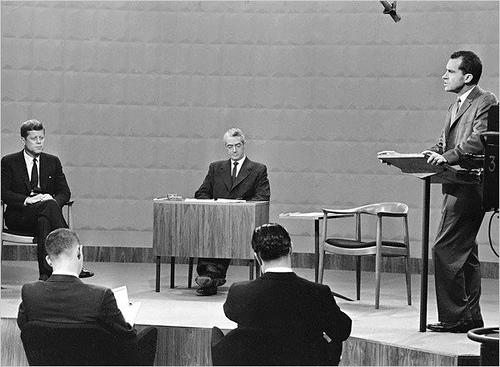
News outlets indulged in the myth of viewer-listener disagreement right through the 50th anniversary yesterday of the first Kennedy-Nixon debate.

The myth holds that people who watched the debate on television thought that Senator John F. Kennedy won; those who listened on radio thought Vice President Richard Nixon had the best of it.

The myth was long ago debunked by scholars David L. Vancil and Sue D. Pendell, in an article in Central States Speech Journal. They noted that reports of viewer-listener disagreement typically were anecdotal, and the few surveys that hinted at a viewer-listener disconnect were too small and unrepresentative by which to make confident judgments.

While it has been thoroughly dismantled, the myth lives on as irresistible testimony about the power of television and the importance of image in presidential politics.

An item posted yesterday at Andrew Breitbart’s Big Journalism online site said as much, declaring:

“The face of TV and politics changed forever on this date in history. …

“Those who watched the broadcast of the first ever televised presidential debate declared Kennedy the winner, those who listened on the radio gave the nod to Nixon. Thus, the political world changed forever.”

WLS-TV in Chicago, the city where the debate took place on September 26, 1960, said at its online site yesterday: “Most of the 70 million people who watched the event on television were convinced Kennedy won, and they voted for him in the presidential election of 1960.

“Surveys showed, though, that most of the people who listened on the radio thought Nixon won. It was the first time a nominee’s appearance may have affected voters.”

In addition, CBS Channel 2 in Chicago declared at its online site:

“Some listening on radio said it seemed like Nixon won. But as many as 74 million Americans were watching on television, and the medium became an overnight unexpected game-changer in our political system.”

As I’ve noted, specific evidence almost never is cited to support such claims about the debate. It’s as if the notion of viewer-listener disagreement is just too good, too delicious to check out–a factor that often characterizes the telling of media-driven myths. It’s a point I make in Getting it Wrong, my new book that debunks 10 prominent media myths. (While certainly prominent, the 1960 debate myth is not included in Getting It Wrong.)

There is evidence that a plurality of registered voters thought Kennedy fared better than Nixon in the debate 50 years ago.

But such impressions did not alter the campaign’s dynamic: The race remained a toss-up to Election Day.

Here’s what the evidence shows: A Gallup poll released in October 1960 reported that 43 percent of voters thought Kennedy “did the better job” in the first debate (of four debates during the campaign). Twenty-three percent thought Nixon was better; 29 percent said both candidates were about the same. Five percent offered no opinion.

The same survey reported Kennedy was narrowly ahead in the race, by 49 percent to 46 percent, with 5 percent undecided.

That result represented a slight change from Gallup’s survey taken just before the debate, which reported Nixon leading narrowly, by 47 percent to 46 percent.

Gallup called the post-debate shift too slight to be meaningful.

“The prudent reader can see,” George Gallup, head of the polling organization, wrote in reporting the results, “that polling accuracy has not reached the degree of accuracy required to say with certainty which candidate is ahead in a close race such as the present one.”

So, no: The debate 50 years ago didn’t change the “political world … forever.” Television wasn’t an “overnight … game-changer” in presidential campaigns. Nothing of the sort.

Media-driven myths are known to give rise to spin-off or subsidiary myths, a phenomenon I discuss in Getting It Wrong.

An example is the heroic-journalist myth of Watergate, which holds that the investigative reporting of Washington Post reporters Bob Woodward and Carl Bernstein brought down Nixon’s presidency in the 1970s. The spin-off or subsidiary myth is that Woodward and Bernstein’s work was so widely appealing that it prompted a surge in college students majoring in journalism.

But that wasn’t so: The surge in enrollments in journalism programs predated the Watergate scandal and was due in measure to young women entering the field.

A spin-off of the Kennedy-Nixon debate myth is that the widely watched televised encounter helped Kennedy become better known among Americans. Before then, the argument goes, Kennedy lacked much national recognition. Nixon, on the other hand, was well-known, having been vice president for almost eight years.

But in fact Kennedy had become nationally prominent long before the first debate.

So well-known that he ran well ahead of Nixon in many of the presidential trial heats that Gallup conducted nationally in late 1958 and 1959.

These matchups, while volatile, were seen by Gallup as early tests of a prospective candidate’s political strength.

The Gallup trial heat in December 1958 had Kennedy leading Nixon by 59 percent to 41 percent.

Kennedy was favored over Nixon by a larger margin, 61 percent to 39 percent, in the trial heat reported in July 1959.

To have polled as well as he did so long before the 1960 campaign, Kennedy simply could not have been an unknown in national politics.

WJC

Recent and related:

My many thanks to fivefeetoffury and Ed Driscoll for linking to this post.

Woodward’s new book stirs retelling of Watergate myth

In Debunking, Media myths, Newspapers, Washington Post, Watergate myth on September 25, 2010 at 10:33 am

The pre-publication publicity and reviews about Bob Woodward‘s new book, Obama’s Wars, have inevitably stirred fresh retellings of the heroic-journalist myth of Watergate, in which Woodward figures prominently.

Nixon resigns, 1974

The heroic-journalist meme can be distilled to a single sentence–as CNN commentator Jack Cafferty demonstrated in a blog post the other day.

“In 1974,” Cafferty wrote, “Bob Woodward and Carl Bernstein brought down the presidency of Richard Nixon with their reporting on Watergate.”

And demonstrating anew that media-driven myths can travel far and well, the Daily Telegraph in London declared the other day in a profile of Woodward that his collaboration with Bernstein brought them “global fame” for “breaking the Watergate scandal and forcing Richard Nixon’s resignation in the early 1970s.”

The venerable BBC, in its profile, said of Woodward:

“The veteran journalist was at the heart of the scandal that rocked the White House and brought down U.S. President Richard Nixon in 1974.

“Along with Carl Bernstein, his colleague at the Washington Post, Woodward was instrumental in uncovering a series of abuses of power that reached the highest level of the administration.”

I address, and debunk, the heroic-journalist myth of Watergate in my new book, Getting It Wrong.

Among the many elements of the myth’s debunking, I note that principals at the Washington Post have sought periodically over the years to dismiss the notion the newspaper was central to Nixon’s fall.

Katharine Graham, the newspaper’s publisher during the Watergate period and beyond, said in 1997, at the 25th anniversary of the scandal’s seminal crime, the foiled burglary at Democratic national headquarters at the Watergate complex in Washington, D.C.:

“Sometimes people accuse us of bringing down a president, which of course we didn’t do. The processes that caused [Nixon’s] resignation were constitutional.”

And Woodward, himself, has concurred, albeit in earthier terms.  “To say that the press brought down Nixon, that’s horseshit,” he said in 2004 in an interview with American Journalism Review.

Complexity-avoidance, I write in Getting It Wrong, also helps explain the tenacity of the heroic-journalist interpretation of Watergate. Like many media myths, the heroic-journalist meme minimizes the intricacy of historical events in favor of simplistic and misleading interpretations.

In the case of Watergate, it is far easier to focus on the purported exploits of Woodward and Bernstein than it is to try to grapple with the intricacies and complexities of what was a sprawling scandal.

Far more significant and decisive to Watergate’s outcome were the contributions of federal prosecutors, federal judges, bipartisan congressional panels, and, ultimately, the U.S. Supreme Court. They were the forces in that succeeded in identifying Nixon’s criminal attempt to obstruct justice in the Watergate scandal–the misconduct that led to his resignation.

Against the tableau of prosecutors, courts, and bipartisan congressional panels, I write in Getting It Wrong, “the contributions of Woodward and Bernstein were modest, and certainly not decisive.”

I further write:

“This is not to say the Post’s reporting on Watergate was without distinction.” Indeed, the newspaper won the Pulitzer Prize for public service in 1973, for its reporting about the scandal in the summer and fall of 1972–during the four months following the foiled breakin at the Watergate.

But by late October 1972, the Post’s investigation into Watergate had run “out of gas,” as Barry Sussman, then the newspaper’s city editor, later acknowledged.

As earnest as their reporting was, “Woodward and Bernstein did not uncover defining and decisive elements of the Watergate scandal—the cover-up and the payment of hush money to the Watergate burglars,” I note in Getting It Wrong.

Nor did they disclose the existence of the White House audiotaping system that proved so critical to Nixon’s fate.

Nixon, I write, “likely would have served out his term if not for the audiotape recordings he secretly made of most conversations in the Oval Office of the White House.

“Only when compelled by the Supreme Court did Nixon surrender those recordings, which captured him plotting the cover-up and authorizing payments of thousands of dollars in hush money.”

Now that’s what “brought down the presidency of Richard Nixon.”

Related:

Encore: Sighting the mythical ‘Cronkite Moment’

In Cronkite Moment, Debunking, Media myths, New York Times on September 23, 2010 at 5:43 am

Cronkite in Vietnam

Sighting the “Cronkite Moment” is fairly easy game.

After all, few media-driven myths are invoked as routinely or as matter-of-factly as the legendary occasion when CBS anchorman Walter Cronkite altered U.S. policy with his downbeat, on-air assessment of the war in Vietnam.

The “Cronkite Moment” stems from a special report that aired February 27, 1968. At the end of the half-hour show, Cronkite intoned that the U.S. war effort was “mired in stalemate” and suggested that negotiations might eventually offer a way out for American forces.

The myth–which is debunked in my new book, Getting It Wrong–lies in the purported reaction to Cronkite’s assessment.

At the White House, President Lyndon Johnson supposedly watched the program and, upon hearing the anchorman’s closing remarks, reached over and snapped off the television set, declaring:

“If I’ve lost Cronkite, I’ve lost Middle America.”

Or words to that effect: Versions vary as to what the president purportedly said.

“If I’ve lost Cronkite, I’ve lost Middle America” was the version invoked the other day in a commentary posted at the Daily Caller online site, in a recent sighting of the myth.

The commentary–which discussed former Secretary of State Colin Powell’s recent criticism of President Barack Obama–opened by invoking the “Cronkite Moment,” stating:

“‘If I’ve lost Walter Cronkite, I’ve lost Middle America,’ said President Lyndon B. Johnson at the time of the Communist Tet Offensive in Vietnam in 1968. Walter Cronkite was then the CBS News anchor man, often described as ‘the most trusted man in America.’ Just a few weeks after he said that, LBJ withdrew from his party’s nomination contest.”
But as I note in Getting It Wrong, Johnson did not see the Cronkite program when it aired. Nor was the president at the White House.

He was in Austin, Texas, on the campus of the University of Texas, attending the 51st birthday party of a longtime political ally, Governor John Connally.

About the time Cronkite offered his “mired in stalemate” assessment, Johnson was joking about Connally’s age, saying:

“Today you are 51, John. That is the magic number that every man of politics prays for—a simple majority.”

It wasn’t the most humorous joke ever told by a president. But Johnson clearly wasn’t throwing his hands up in despair about his failed war policy.

He wasn’t lamenting “If I’ve lost Cronkite….”

There is, moreover, no evidence that Johnson later saw the Cronkite program on videotape.

“The power of the ‘Cronkite moment,'” I write in Getting It Wrong, “resides in the sudden, unexpected, and decisive effect it supposedly had on the president:  Such an effect would have been absent, or greatly diminished, had Johnson seen the program on videotape at some later date.”

But even if Johnson later heard—or heard about— Cronkite’s assessment, it represented no epiphany for him.

Not long after the program, Johnson gave a rousing, lectern-pounding speech in which he urged a “total national effort” to win the war in Vietnam. So in the days and even weeks immediately after the Cronkite program, Johnson remained publicly hawkish on the war.

What’s more, Cronkite’s assessment about the U.S. predicament in Vietnam was scarcely original or exceptional in early 1968.

Jack Gould, the New York Times’ television critic, noted in a review of the Cronkite’s program that the anchorman’s assessment “did not contain striking revelations” but served instead “to underscore afresh the limitless difficulties lying ahead and the mounting problems attending United States involvement.”

It’s revealing to note that nearly seven months before the “Cronkite Moment,” the New York Times published on its front page as analysis that said victory in Vietnam “is not close at hand. It may be beyond reach.” The Times analysis was published in August 1967 beneath the headline:

Vietnam: The Signs of Stalemate.”

As for Johnson’s announcing he would not seek reelection, Cronkite’s program was a non-factor in that decision.

Johnson’s announcement came at the end of March 1968, a month after Cronkite’s program–and a couple of weeks after the president’s poor showing as a write-in candidate in the Democratic primary in New Hampshire.

What’s more, there’s strong evidence that Johnson never intended to seek reelection, that he had privately decided in 1967, or even not sooner, against another campaign for the presidency.

<!–[if !mso]> The power of the “Cronkite moment” resides in the sudden, unexpected, and decisive effect it supposedly had on the president:[i] Such an effect would have been absent, or greatly diminished, had Johnson had seen the program on videotape at some later date


[i] See, for example, Jeffrey Lord, who wrote at the American Spectator’s online site: “The effect was almost immediate. In the White House, the President of the United States looked grimly at his television and in a remark that would become famous said, ‘If I’ve lost Cronkite, I’ve lost middle America.’” Lord, “The Limbaugh-Hannity Administration,” American Spectator (3 February 2009), posted at: http://spectator.org/archives/2009/02/03/the-limbaugh-hannity-administr.

Kennedy-Nixon debate myth certain to circulate anew

In Anniversaries, Debunking, Media myths on September 20, 2010 at 7:50 am

With the 50th anniversary of the first Kennedy-Nixon presidential debate just days away, it’s a fair bet that a particularly hardy media myth will make frequent appearances in news reports recalling the 1960 encounter.

And that’s the myth of viewer-listener disconnect, which holds that the debate’s television viewers mostly thought Senator John F. Kennedy won the encounter; those who heard the debate only on radio thought Vice President Richard M. Nixon had prevailed.
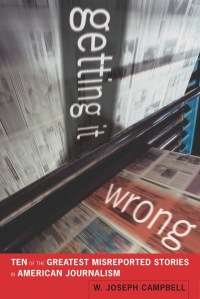
The debate myth lives on because it suggests that television–and how candidates look on the air–can be decisive in presidential elections. Like many of the media-driven myths debunked in my new book, Getting It Wrong, the debate myth also is appealing in that it offers a simplistic explanation for a complex historical event.

The viewer-listener disconnect in the 1960 debate isn’t discussed in Getting It Wrong. But I do admire the surgical dismantling of the myth that David L. Vancil and Sue D. Pendell presented in 1987 in the Central States Speech Journal.

They found scant support for a viewer-listener disconnect in the debate, which took place September 26, 1960.

In their article, Vancil and Pendell pointed to serious flaws in the anecdotal reports and the limited surveys that suggested disagreement among viewers and listeners in assessing what was the first televised debate between U.S. presidential candidates.

Central to the notion that radio audiences thought Nixon won the debate was a survey conducted by Sindlinger & Company. The survey indicated that by a 2-to-1 margin, radio audiences thought Nixon had prevailed.

But Vancil and Pendell pointed out that the Sindlinger survey, conducted the day after the debate, included more than 2,100 respondents–of whom only 282 had listened on radio.

Of that number, 178 (or fewer than four people per state) “expressed an opinion about the debate winner,” they wrote.

Further, Vancil and Pendell noted, “the critical characteristics of the 282 listeners surveyed are unknown. …Crucial information, such as the relative numbers of Republicans and Democrats in the sample” was not captured, rendering meaningless any generalizations about the debate’s radio audience.

Vancil and Pendell also wrote that the survey’s finding that an overwhelming number of radio listeners thought Nixon won ran contrary to the tendency of debates to “reinforce pre-debate candidate preferences.” And a Gallup survey showed the electorate nearly split on the eve of the debate: 47 percent favored Nixon, 46 percent favored Kennedy, and 7 percent were undecided.

Kennedy during the debate committed no gaffes or blunders that would have swung radio listeners to Nixon. “The available evidence,” they wrote, “suggests … that Kennedy’s supporters and potential supporters were delighted with his arguments and responses to questions during the debate….”

Indeed, anecdotal evidence gathered immediately afterward–including an informal survey conducted by Associated Press correspondents of 100 people in 10 cities–indicated that the debate changed few minds.

And James Reston, then a leading Washington-based columnist for the New York Times, wrote the day after the debate:

“This TV program did not do any of the dramatic things predicted for it. It did not make or break either candidate.”

Vancil and Pendell also challenged the notion that Nixon’s haggard appearance and sweaty brow contributed greatly to viewer perceptions about the debate.

“Appearance problems, such as Nixon’s perspiring brow, could have had a negative impact on viewer perceptions,” Vancil and Pendell wrote, “but it is also possible for viewers to be sympathetic to such problems, or to interpret them as evidence of attractive or desirable qualities.”

They added: “Even if viewers disliked Nixon’s physical appearance, the relative importance of this factor is a matter of conjecture.”

Not all observers thought Nixon’s performance was especially dismaying. In its post-debate editorial, the Washington Post even said:

“Of the two performances Mr. Nixon’s probably was the smoother.”

It is interesting to show undergraduate students portions of the first 1960 debate, as I sometimes do in journalism history classes. For many students, it’s their initial exposure to the debate’s televised record.

Invariably, some of them say they were surprised that Nixon didn’t look worse, given the received wisdom about his appearance that night.

They’re right: Nixon was fatigued, but he didn’t look awful debating Kennedy in what was the first of four presidential debates that fall.

What stands out, though, is how often during the first debate Nixon said he agreed with Kennedy’s views.

Not necessarily the most effective debate strategy, that.

WJC

Related:

‘Exquisitely researched and lively’

In Cronkite Moment, Debunking, Hurricane Katrina, Media myths, Reviews on September 16, 2010 at 9:40 am

That’s the Denver Post‘s take on Getting It Wrong, my new book on media-driven myths which the newspaper recently reviewed.

The Post offers a discerning summary of the book, noting that it “takes a critical look at 10 stories that were either total fabrications or blown way out of proportion and yet became part of our popular culture.”

It also says Getting It Wrong offers “an exquisitely researched and lively look at an industry that too often shines the light on itself more than it does on events and public figures.”

And it notes, quite correctly:

“Much of the ‘wrong’ coverage through the years comes from the media’s self-congratulatory preening.”

The review points out that the sternest criticism in Getting It Wrong is reserved “for coverage, mainly by television, of the chaotic aftermath of Hurricane Katrina in New Orleans in 2005.

“Hyperactive reporters told tales of snipers roaming the streets, ‘hundreds’ of bodies stacked up in the Super Dome and babies being raped and murdered, none of which could be verified.

The upshot of the exaggerated coverage of the storm’s aftermath, the review notes, “was that rescue operations were hindered by fear, and prejudices of a watching public against poor people and minorities were confirmed.”

The review was written by Dick Kreck, a former reporter and columnist for the Post who has written three books. Kreck is an engaging storyteller and the go-to source for details about the lusty history of Denver journalism. (Full disclosure: Kreck spoke at a program at the Denver Post during last month’s convention of the Association for Education in Journalism and Mass Convention. I helped organize the program.)

Kreck opens the review of Getting It Wrong by declaring:

“Memo to media: Get over yourself. You’re not that important.”

He later cites a passage in Getting It Wrong quoting Robert Samuelson, a columnist who writes on economic issues for the Washington Post:

“Because the media are everywhere—and inspire much resentment—their influence is routinely exaggerated. The mistake is confusing visibility with power and the media are often complicit in the confusion. We [in the news media] embrace the mythology, because it flatters our self-importance.”

Getting It Wrong indeed offers a brief for modest media effects.

To bust media myths, I write in the book, “is to confront the reality that the news media are not the powerful agents they, and many others, assume them to be.

“It is exceedingly rare for any news report to trigger a powerful, immediate and decisive reaction akin to President Lyndon Johnson’s purported response to [Walter] Cronkite’s televised assessment about Vietnam: ‘If I’ve lost Cronkite ….’

“Researchers long ago dismissed the notion the news media can create such profound and immediate effects, as if absorbing media messages were akin to receiving potent drugs via a hypodermic needle,” I note, adding:

“Media power tends to be modest, nuanced, diffused, and situational.” And typically trumped by other, more powerful forces and factors.

WJC

Related: