W. Joseph Campbell

Posts Tagged ‘History’

Social-media triumphalism and its myth-busting limits

In Anniversaries, Debunking, Error, Media myths, Media myths and radio, War of the Worlds on October 31, 2012 at 3:50 pm

Social media’s capacity to demolish media myths soon after they emerge was impressively on display this week as megastorm Sandy swept ashore in New Jersey and disrupted life throughout the Northeast and Mid-Atlantic.

Got it notably wrong

Erroneous reports were many as the storm reached the East Coast on Monday. As the Guardian of London noted today, “the spread of such misinformation was abetted by journalists, who were once taught the importance of verifying every source.”

Notably wrong was the report on CNN’s “Piers Morgan Tonight” news program Monday that Sandy had breached the heart of American capitalism and covered the floor of the New York Stock Exchange in Manhattan with three feet of water.

But that account and a similar report on the hype-prone Weather Channel were promptly disputed, and soon repudiated, in a barrage of posts on Twitter.

In demolishing the bogus reports, Twitter demonstrated a capacity for “savage self-correction,” as John Herrman declared in a post yesterday at the BuzzFeed online site.

Herrman wrote:

“In response to thousands of retweets of erroneous Weather Channel and CNN reports that the New York Stock Exchange had been flooded with ‘three feet’ of water, Twitter users, some reporters and many not, were relentless: photos of the outside of the building, flood-free, were posted. Knowledgeable parties weighed in.”

And the misreporting soon was corrected.

Herrman hailed Twitter as “a fact-processing machine on a grand scale, propagating then destroying rumors at a neck-snapping pace. To dwell on the obnoxiousness of the noise is to miss the result: that we end up with more facts, sooner, with less ambiguity.”

His point is well-taken. On more than a few occasions, Twitter has demonstrated a striking capacity to debunk embryonic media myths — including those myths it helped set loose.

The bogus quotation attributed to the Rev. Dr. Martin Luther King after the slaying last year of terrorist leader Osama bin Laden comes to mind. The made-up passage — “I will mourn the loss of thousands of precious lives, but I will not rejoice in the death of one, not even an enemy” — circulated widely on Facebook and Twitter before their corrective forces effectively demolished it.

But limits to social-media triumphalism must be noted.  The corrective power of platforms such as Twitter reaches only so far.

Once established, media myths are exceedingly difficult to uproot. These myths have amply demonstrated that they can withstand the power of social media.
Welles and ‘War of the Worlds’

Take, for example, Halloween’s most famous media myth — the notion that Orson Welles’ War of the Worlds radio dramatization in 1938 touched off nationwide panic and mass hysteria. It’s a hoary media myth that’s just too embedded — and too delicious — to be destroyed.

No amount of Tweeting is likely to dismantle this myth, one of 10 that I debunk in my latest book, Getting It Wrong. It’s too engrained in popular culture — and in the news media — to go the way of CNN’s botched report about the flooded stock exchange floor.

The 74th anniversary of the original broadcast of The War of the Worlds was yesterday and Twitter percolated with reminders about the program and references to the panic it supposedly created. Tweets challenging the narrative of panic and hysteria were in a distinct minority.

Linked to more than a few Tweets yesterday was a tip sheet describing seven lessons that The War of the Worlds dramatization holds for social media.

The tip sheet seems more than a little convoluted, though. Among its observations was this:

“If you are lucky, the publicity often exceeds the actual event  …. The panic [of The War of the Worlds program] has become legendary, even though there is quite a bit of evidence to suggest it wasn’t nearly as widespread as reported at the time. But, it put the program on the map, and launched a relatively unknown 23-year old name[d] Orson Welles into the public eye.”

Even that’s not quite true. Although he was 23 at the time of the broadcast, Welles’ had already made the cover of Time magazine.

WJC

Recent and related:

Debates are over, media myth lives on

In Debunking, Media myths on October 28, 2012 at 12:05 pm

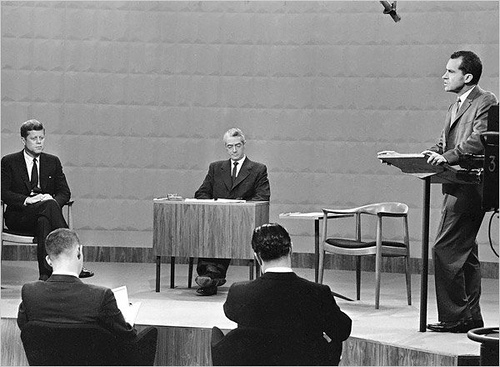
The runup to the three presidential debates this month inevitably was accompanied by references to the 1960 encounter between John F. Kennedy and Richard M. Nixon — and to references to the media myth distorts understanding of the historic confrontation 52 years ago.

Debates are over, myth lives on

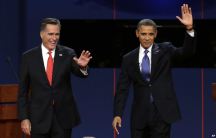
Even days after the final debate between President Barack Obama and Republican challenger Mitt Romney, the 1960 debate myth still swirls.

The myth has it that television viewers thought Kennedy won the first debate of that campaign while radio listeners believed Nixon prevailed.

It’s a dubious bit of political lore that long ago became a defining feature of that debate. And it lives on as a reminder about how appearances supposedly trump substance in American presidential politics.

The notion of viewer-listener disagreement in the first Kennedy-Nixon debate is implausible for several reasons, including the absence of representative polling data that confirmed such a disparity.

What likely was more decisive than appearance in that debate was Nixon’s willingness to be conciliatory, to concur with Kennedy. In his opening statement, Nixon seemed to second the points raised by Kennedy, who had spoken first.

Nixon said:

“The things that Senator Kennedy has said many of us can agree with. … There is no question but that this nation cannot stand still; because we are in a deadly competition, a competition not only with the men in the Kremlin, but the men in Peking. We’re ahead in this competition, as Senator Kennedy, I think, has implied. But when you’re in a race, the only way to stay ahead is to move ahead. And I subscribe completely to the spirit that Senator Kennedy has expressed tonight, the spirit that the United States should move ahead.”

But in discussing the debate more than 50 years later, it’s far easier to reach for the myth of viewer-listener disagreement than it is to recall Nixon’s ill-advised tactics.

This was suggested in a lengthy commentary about the Obama-Romney debates, posted the other day at the online site of the liberal American Prospect political magazine.

The commentary invoked the first Kennedy-Nixon debate in stating:

“As for wishing these suckers were serious policy discussions, I can’t think of a single presidential debate that’s ever been decided on those grounds. Even in 1960, when the jousting between Kennedy and Nixon was relatively substantive, JFK triumphed purely on image, one proof being that people who only heard their confrontations on radio famously thought Nixon had cleaned his clock.”

The commentary offered no evidence to support the claim of clock-cleaning-on-the-radio.

That’s because there is no persuasive, contemporaneous evidence to that effect.

The notion of viewer-listener disagreement was demolished in a journal article published 25 years ago by scholars David L. Vancil and Sue D. Pendell.

Their article, published in Central States Speech Journal, noted that accounts of viewer-listener disagreement about the Kennedy-Nixon debate invariably were anecdotal and impressionistic — and hardly representative of the American electorate in 1960.

The polling organization Sindlinger & Co. did report that its survey respondents who listened to the debate on radio thought Nixon won, by a 2-to-1 margin.

But as  Vancil and Pendell pointed out, Sindlinger’s sample of radio listeners included just 282 respondents — of whom 178 offered an opinion about the debate winner. The numbers were far too few to permit meaningful generalizations or conclusions.

Like many media myths, the notion of listener-viewer disagreement is so delicious that it must have been true.

The New Republic hinted at such sentiment on Monday, the day of the final Obama-Romney debate, in an essay that stated: “[P]erhaps it’s safe to say that 1960 was the year we learned that looks and demeanor, as seen on TV, were just as important as speech when it came to winning over voters.”

In making the claim, the New Republic essay cited an intriguing experiment, reported in 2003, in which 171 summer students at the University of Minnesota either viewed a video of the first Kennedy-Nixon debate or listened to an audio recording of the encounter.

None of the participants had prior knowledge about the Kennedy-Nixon debate, according to the researcher, James Druckman.

He reported finding that television viewers in his experiment “were significantly more likely to believe Kennedy won the debate than audio listeners.”

This, he declared, represented “the first clear empirical evidence consistent with the widespread assertion of viewer-listener disagreement in the first Kennedy-Nixon debate.”

But in a footnote, Druckman reported that 81 percent of the viewers in his experiment thought Kennedy won; so did 60 percent of listeners.

That finding is inconsistent with the central element of alleged viewer-listener disagreement — that Kennedy won among television viewers while Nixon won among radio listeners.

What’s more, participants in Druckman’s experiment skewed Democratic: The “sample did underrepresent Republicans,” he wrote in another footnote. As such, participants may have been more readily sympathetic to Kennedy, the Democratic candidate, than to Nixon, the Republican.

Druckman also acknowledged that “younger people”  in the early 21st century may have processed “televised information differently” from viewers in 1960. To be sure, applying the experiment’s results to viewers and listeners of the presidential debate in 1960 is impossible.

WJC

Recent and related:

1960 myth ricochets around the media in advance of Obama-Romney debate

In Debunking, Error, Media myths, Media myths and radio, Television on October 3, 2012 at 1:58 pm

Kennedy, Nixon at their mythical debate

In the hours before tonight’s encounter between President Barack Obama and Republican challenger Mitt Romney, the beguiling myth of the first-ever presidential debate — the notion that image trumped spoken word — has ricocheted across the U.S. news media.

News organizations of all types have been invoking the myth, which has it that television viewers overwhelmingly felt John F. Kennedy won the first televised debate in 1960 while radio listeners thought Richard M. Nixon had the best of it.

Here are a few examples of media indulgence in that fable:

  • The Boston Globe:  “According to those listening on the radio, Nixon won the debate or it was a draw. But most Americans watched it on TV, and they overwhelmingly were impressed by the … collected performance” of Kennedy.
  • The Hartford (Connecticut) Courant:  “Famously, those who listened to the radio thought that Nixon had defeated Kennedy in their famous first debate in 1960. By contrast, those watching on television thought that the dapper and cool Kennedy had won.”
  • Entertainment Weekly: “Radio audiences thought Nixon won the debate, but those who watched on television were convinced that Kennedy dominated.”
  • Huffington Post: “Richard Nixon’s haggard appearance vs. John F. Kennedy’s vigor is widely cited as contributing to a Kennedy victory in the first 1960 debate. But polls showed that was true mostly for those who watched it on TV, while those listening to the radio generally picked Nixon as victor.”
  • NBC Channel 5 in Chicago: “Pollsters found that people who listened to this debate on the radio thought that Nixon, the vice president, beat Kennedy. But those who followed on television … sided with Kennedy, who won the election.”
  • A blog of the Voice of America, the U.S. government’s voice abroad: ” Nixon’s refusal to wear makeup did not hurt him with those listening on the radio. They gave him the edge.  But Kennedy had the advantage with TV viewers and the rest, as they say, is history.”

Make that bad history.

There is quite simply no persuasive evidence to support the notion that television viewers and radio listeners decisively disagreed about the outcome of the first Kennedy-Nixon debate, which took place in Chicago on September 26, 1960.

That such an effect did occur — or must have occurred — is attractive for a number of reasons: It acknowledges the presumptive power of the televised image. It renders uncomplicated the intricacies of an important political moment of long ago. And it offers an enduring though misguided lesson that content matters less than appearance.

Significantly, the broad media embrace of the debate myth ignores the powerful dismantling published 25 years ago by scholars David L. Vancil and Sue D. Pendell.

In their article in Central States Speech Journal, Vancil and Pendell noted that one “of the most perplexing legacies of the first Kennedy-Nixon debate is the claim that radio listeners and television viewers came to opposite conclusions about the debate winners.”

They proceeded to explode that notion, pointing out that accounts of viewer-listener disagreement about the debate typically were anecdotal and impressionistic — hardly representative of the American electorate in 1960.

They also called attention to “a false impression” that “major polling organizations, such as Gallup, concentrated part of their attention on the reactions of radio listeners.” That hardly was the case.

The one polling organization that did identify radio listeners in a post-debate survey was Sindlinger & Co.

Sindlinger reported that poll respondents who listened to the debate on radio thought Nixon won, by a 2-to-1 margin.

But the Sindlinger sub-sample of radio listeners included 282 respondents — of whom only 178 offered an opinion about the debate winner, far too few to permit meaningful generalizations or conclusions.

Not only was the sub-sample unrepresentative, it did not identify from where the sub-sample of radio listeners was drawn. “A location bias in the radio sample,” Vancil and Pendell pointed out, “could have caused dramatic effects on the selection of a debate winner. A rural bias, quite possible because of the relatively limited access of rural areas to television in 1960, would have favored Nixon.”

Those and several other defects render the Sindlinger result meaningless.

It should be noted that the run-up to tonight’s debate has brought some faint recognition about the mythical character of viewer-listener disagreement in the 1960 debate.

For example, the latest Washington Examiner column of political commentator Michael Barone reads as if he had consulted recent posts at Media Myth Alert.

Barone wrote:

“It is generally held that television viewers felt Kennedy won the first debate, while those listening on radio, unaware of Nixon’s improvised makeup, felt Nixon won. That’s probably overstated. Contemporary [news] accounts suggest most viewers felt both candidates did well, while the single poll of radio listeners had a small sample possibly tilted toward pro-Nixon rural areas lacking TV reception.”

Such observations, however well-reasoned, likely are to be of scant effect in countering the present contagion of the 1960 debate myth.

Like many media-driven myths, it is after all almost too delicious not to be true.

WJC

Recent or related:

USA Today invokes Kennedy-Nixon debate myth

In Anniversaries, Debunking, Error, Media myths on September 21, 2012 at 9:17 am

I noted yesterday how the myth of viewer-listener disagreement — that television viewers and radio listeners had clashing interpretations of the outcome of the Kennedy-Nixon debate in September 1960 — tends to surface at the approach of anniversaries of the historic encounter.

And so it does.

In his latest column, Al Neuharth, the founder of USA Today, unreservedly embraces the myth.

He writes that John F. Kennedy “looked relaxed and at ease” during the debate while Richard M. Nixon did not. “The hot TV lights appeared to give him a heavy beard,” Neuharth adds, “even though he had closely shaved before the TV appearance.”

Neuharth further asserts:

“The debate was also broadcast by radio. Listeners generally gave Nixon the nod. But TV viewers strongly favored Kennedy.”

That’s an enticing interpretation, suggesting the decisiveness of televised images in political communication.

But there’s little support for the notion of listener-viewer disagreement.

That notion, in fact, was exploded 25 years ago in an impressive dismantling published by scholars David L. Vancil and Sue D. Pendell.

Writing in Central States Speech Journal, Vancil and Pendell reviewed and dissected the few surveys that hinted at a viewer-listener disconnect in the Kennedy-Nixon debate, the first of four during that campaign.

Vancil and Pendel described how survey samples were too small to be representative — too small to allow confident or sweeping judgments about sharp disagreements among television and radio audiences.

Central to the claim that radio audiences believed Nixon won the debate was a survey conducted by Sindlinger & Company. The survey indicated that radio listeners, by a margin of 2-to-1, thought Nixon had prevailed in the debate, which took place September 26, 1960.

Vancil and Pendell pointed out that the Sindlinger survey, conducted the day after the debate, included more than 2,100 respondents — of whom only 282 had listened on radio.

Of that number, 178 (or fewer than four people per state) “expressed an opinion on the debate winner,” they wrote.

Vancil and Pendell also challenged the claim that Nixon’s appearance was decisive to the debate’s outcome.

They wrote in their article in Central States Speech Journal:

“Media experts, campaign professionals, and the viewing public almost unanimously agree that Nixon had a number of appearance problems in the first debate. His grey suit, perspiring brow, loose fitting shirt, and general sense of discomfort seemed to provoke sympathetic responses from even the most enthusiastic Kennedy supporters.

“However,” they added, “the inference that appearance problems caused Nixon’s loss, or Kennedy’s victory [in the debate], is classic post hoc fallacy.”

They noted that appearance problems such as Nixon’s sweaty brow, “could have had a negative impact on viewer perceptions, but it is also possible for viewers to be sympathetic to such problems ….

“Even if viewers disliked Nixon’s appearance,” they further wrote, “the relative importance of this factor in viewers’ selection of a debate winner is a matter of conjecture.”

Vancil and Pendell identified six factors or criteria which, they said, audiences were apt to rely on in determining the winner of a presidential debate. Those factors were:

Pre-debate preferences; views on issues; candidate advocacy skills; candidate personality (“including image”); blunders, and media labeling.

“Some viewers” in the Kennedy-Nixon debate, they wrote, “may have ignored appearance in favor of an evaluation of advocacy skills.”

That appears to have been the case, at least with the Washington Post, which declared in a post-debate editorial:

“Of the two performances Mr. Nixon’s probably was the smoother.

“He is an accomplished debater with a professional polish, and he managed to convey a slightly patronizing air of a master instructing a pupil.”

Nixon’s advocacy skills, at least for the Post, trumped the ashen, uncomfortable appearance he cut during the debate.

The Vancil-Pendell debunking is thorough and impressive. And it’s a bit surprising that their article is so infrequently recalled these days.

But, then, perhaps it’s not so surprising at all. Not given the appeal of media-driven myths, those prominent tales about and/or by the news media that are widely believed and often retold but which, under scrutiny, dissolve as apocryphal or wildly exaggerated.

Media myths, I wrote in my 2010 book, Getting It Wrong, often seem “almost too good to be false.”

Typically, I noted, media myths “tend to minimize or negate complexity in historical events and offer simplistic and misleading interpretations instead.” Such as the notion that viewer-listener disagreement was prominent in the first-ever televised presidential debate.

WJC

Recent or related:

Some dubious election history from Al Jazeera English

In Anniversaries, Debunking, Error, Media myths, Television on September 20, 2012 at 12:12 pm

First televised presidential debate

The first televised presidential debate in 1960 gave rise to an enduring media myth — the notion that television viewers and radio listeners interpreted the encounter quite differently.

The myth of viewer-listener disagreement lives on despite its thorough dismantling 25 years ago, in an article in Central States Speech Journal by scholars David L. Vancil and Sue D. Pendell.

Vancil and Pendell noted that reports of viewer-listener disagreement in the first of four debates between John F. Kennedy and Richard M. Nixon in 1960 typically were impressionistic and anecdotal.

Moreover, they wrote, the few surveys that hinted at a viewer-listener disconnect were too small and unrepresentative to allow confident or sweeping judgments.

Vancil and Pendell also challenged the notion that Nixon’s haggard appearance and sweaty brow contributed powerfully to television viewers’ perceptions about the debate, which took place September 26, 1960.

“Appearance problems, such as Nixon’s perspiring brow, could have had a negative impact on viewer perceptions,” Vancil and Pendell wrote, “but it is also possible for viewers to be sympathetic to such problems, or to interpret them as evidence of attractive or desirable qualities.”

They also wrote that “the inference that appearance problems caused Nixon’s loss, or Kennedy’s victory [in the debate] is classic post hoc fallacy.”

Their debunking notwithstanding, the myth of viewer-listener disagreement tends to resurface at or near the anniversaries of the first Kennedy-Nixon debate.

Take, for example, a commentary posted today at the English-language online site of Al Jazeera, the Qatar-based Arabic television network.

The commentary describes the first Kennedy-Nixon debate as “a bellwether” and asserts that “listeners tuning in via radio considered the debate a draw or even a slight win for Nixon. But the 65 million who tuned in by TV saw something very different. Kennedy appeared vigorous yet relaxed, while Nixon looked pale and nervous. … Those viewing the debate on television judged Kennedy as the clear winner.”

But as Vancil and Pendell reported years ago, there is no persuasive, compelling evidence to support such claims.

Not only that, but contemporaneous evidence, including public opinion polls, offer scant support for the notion that television audiences “judged Kennedy as the clear winner.”

To be sure, not all observers saw it that way in late September 1960. In its post-debate editorial, the Washington Post declared, for example:

“Of the two performances Mr. Nixon’s probably was the smoother.

“He is an accomplished debater with a professional polish, and he managed to convey a slightly patronizing air of a master instructing a pupil.”

And the Los Angeles Times said in an editorial (beneath the headline “A slow fight to a draw”) that most television viewers of the debate probably “felt as we did: they were disappointed because (a) they could not pick a winner and (b) they could not find that any single issue had been sharpened up by the abrasives of debate.”

The nationally prominent columnist, James Reston, wrote in the New York Times after the debate:

“This TV program did not do any of the dramatic things predicted for it. It did not make or break either candidate. … Who took the first round is a matter of individual opinion. My own view is that Kennedy gained more than Nixon, but it was a fielder’s choice, settling nothing.”

A Gallup poll released in October 1960 reported that 43 percent of the debate’s viewers and listeners thought Kennedy “did the better job.” Twenty-three percent thought Nixon’s performance was better, and 29 percent said the candidates were about the same. Five percent offered no opinion.

But opinions about the debate did not translate into a decisive advantage for Kennedy. The same survey reported Kennedy was narrowly ahead in the race, by 49 percent to 46 percent, with 5 percent undecided.

That result represented a modest change from Gallup’s poll taken just before the debate, which reported Nixon leading narrowly, by 47 percent to 46 percent.

But Gallup described the post-debate shift as too slight to be meaningful.

“The prudent reader can see,” George Gallup, head of the polling organization, wrote in describing the results, “that polling accuracy has not reached the degree of accuracy required to say with certainty which candidate is ahead in a close race such as the present one.”

WJC

Recent or related:

Recalling George Romney’s ‘brainwashing’ — and Gene McCarthy’s ‘light rinse’ retort

In Anniversaries, Cronkite Moment, Debunking, Media myths, Newspapers, Quotes on September 4, 2012 at 3:38 pm

It’s been 45 years since George Romney committed one of the greatest gaffes in American political history — a misstep that supposedly inspired one of the most devastating putdowns in American political history.

Interestingly, though, crucial details about the devastating putdown remain rather murky.

Romney’s gaffe, which effectively destroyed his run for the presidency before it officially began, came in an interview taped on August 31, 1967, and aired September 4, 1967, on a Detroit television station.

In the interview, Romney, then governor of Michigan and a presumptive Republican candidate for president, referred to his visit to South Vietnam in 1965 and declared:

“You know, when I came back from Vietnam, I’d just had the greatest brainwashing that anybody could get. … Well, not only by the generals but by the diplomatic corps over there. They do a very thorough job.”

The assertion that he had been duped into supporting America’s war effort in Vietnam revealed Romney’s muddled thinking and an uncertain command of foreign policy. (“Could the country afford a President who was so easily deceived?” the New York Times wondered.)

Forty-five years on, Romney’s comment remains striking both for clumsiness and self-destructiveness. And it’s been recalled not infrequently in recent months as Romney’s son, Mitt, has campaigned for the presidency.

When it is recalled, the “brainwashing” gaffe often is coupled with the stiletto-like rejoinder attributed to Eugene McCarthy, then a second-term U.S. senator from Minnesota.

McCarthy supposedly said that rather than brainwashing, “a light rinse” would have sufficed in Romney’s case.

There is no question about Romney’s having made the “brainwashing” claim; this YouTube video cuts to the money quote:

The anecdote’s memorable quality lies not only in Romney’s befuddled claim but also in McCarthy’s “light rinse” quip. Indeed, McCarthy’s retort is said to have been so powerful that it “essentially finished Romney.”

But the precise context of McCarthy’s “light rinse” zinger is at best unclear. My research has turned up no unambiguous documentation about when McCarthy made the comment, where, and specifically to whom.

(And why does this matter? Getting it right matters a lot, especially about an insult so piercing and effective that it lives on like few others in American political lore.)

A database search of leading U.S. newspapers — including the New York Times, the Washington PostChicago Tribune, Los Angeles Times, and Baltimore Sun — turned up no published reference to McCarthy’s “light rinse” remark in 1967 or 1968, or for many years afterward.

The nearest contemporaneous hint to a “light rinse” came in a commentary published in mid-September 1967 in the Los Angeles Times, in which conservative columnist James J. Kilpatrick said of Romney:

“Brainwashed, was he? It couldn’t have been much of a laundry bill.”

Kilpatrick’s column did not mention McCarthy, who wasn’t prominently in the news in September 1967. McCarthy did not announce his candidacy for president until November that year.

The first reference found in the database search to the “light rinse” comment  was in a commentary written by Fred Barnes and published in Baltimore Sun in April 1983. Barnes’ commentary, however, did not say when, where, or to whom McCarthy uttered the “light rinse” line.

The “light rinse” anecdote notably has been afflicted with version variability — my term for the shifting of important details as a story is retold over the years. As I point out in my 2010 book,  Getting It Wrong, version variability can be a marker of a media-driven myth.

Here are a few examples of the shifting versions of the “light rinse” remark:

  • Maureen Dowd of the New York Times, writing in her column in January 2012, quoted McCarthy as having said: “All that was needed in the case of George Romney was a light rinse.”
  • Syndicated columnist Jules Witcover wrote in 2007 that McCarthy “quipped that he ‘would have thought a light rinse would have done it.'”
  • Mark Shields, writing in the Washington Post in 1988, quoted McCarthy’s one-liner this way: “I don’t know why Romney was brainwashed; in his case, a light rinse would have been sufficient.”

And as further evidence of version variability, the “light rinse” quip has even been attributed to Daniel Patrick Moynihan.

Such imprecision invites suspicion about the “light rinse” quip. (It also sounds almost too perfect to be true — not unlike, say, William Randolph Hearst’s purported vow to “furnish the war” with Spain or Lyndon B. Johnson’s supposed epiphany on the Vietnam War: “If I’ve lost Cronkite, I’ve lost Middle America.”)

Among the first accounts  — if not the first account — of McCarthy’s quip appeared in An American Melodrama: The Presidential Campaign of 1968, a hefty book published in 1969.

American Melodrama, which was written by Lewis Chester, Godfrey Hodgson, and Bruce Page, described McCarthy’s remark as off-handed and said his aides persuaded journalists to hush it up.

According to American Melodrama, McCarthy was asked “by reporters whether he thought Romney’s ‘brainwashed’ gaffe had dealt the death blow to his chances.”

McCarthy was quoted as saying in reply:

“Well . . . er no, not really. Anyway, I think in that case a light rinse would have been sufficient.”

The book further stated:

“McCarthy’s press aides, appalled at the possible effects of this remark on Republicans, who, bereft of a dove candidate in their own party, might write-in McCarthy’s name, pleaded with reporters not to use it. They dutifully complied; though few would have done the same for Romney.”

While intriguing, American Melodrama doesn’t say when McCarthy made the comment, where, or specifically to whom.

Although self-censorship could account for the absence of contemporaneous references to McCarthy’s quip in leading U.S. newspapers, it seems implausible that an insult so delicious and devastating would have remained hushed up, even by compliant reporters, for very long.

Another version was offered by British journalist David Frost in an interview the aired on C-SPAN in 2007. Frost recalled having heard McCarthy’s comment, and said it was made in New Hampshire not long after Romney’s “brainwashing” statement.

But Frost’s recollection is faulty in a crucial respect: He said in the interview that “within a week or so” after making the “brainwashing” comment, Romney “was out of the race.”

Not so. Romney’s ended his campaign for the presidency on February 28, 1968 — six months after uttering the “brainwashing” remark and 3½ months after officially entering the race.

During the week Romney dropped out, Frost said in the C-SPAN interview, “I was interviewing Eugene McCarthy in New Hampshire, and, as we came out, there were three or four people who … wanted a sound bite. And one of them said, ‘What do you think about George Romney being brainwashed?’

“And McCarthy said, ‘I would have thought a light rinse would have been sufficient.’ Killer line. Fantastic line, I thought.”

But left unclear in Frost’s version is why journalists would have been asking McCarthy in late February or early March 1968 about a claim that Romney had made months before. Why would it have been newsworthy then?

Puzzling.

Not only that, but Frost did not say whether, or when, he reported McCarthy’s “killer line.” Or whether McCarthy’s “press aides” pleaded with him not to use it.

WJC

Recent or related:

A sort-of correction from the NYTimes

In Debunking, Error, New York Times, Photographs on August 28, 2012 at 9:09 pm

‘Napalm girl,’ 1972 (Nick Ut/AP)

It has taken more than three months, but the New York Times today published a sort-of correction of its erroneous description about the napalm attack in Vietnam in June 1972 that preceded the famous photograph of children terrified and wounded by the bombing.

The photograph, taken by Nick Ut of the Associated Press, won a Pulitzer Prize in 1973. It is colloquially known as the “napalm girl” image.

The Times’ error appeared in an obituary, published May 14, about Horst Faas, an award-winning AP photographer and editor who spent years in Vietnam.

The obituary said the photograph showed “the aftermath of one of the thousands of bombings in the countryside by American planes: a group of terror-stricken children fleeing the scene, a girl in the middle of the group screaming and naked, her clothes incinerated by burning napalm.”

But as I, and others, pointed out to the Times, the napalm was not dropped by the American military but by the South Vietnamese Air Force.

In response to my email sent in May about that lapse, the Times’ correction expert on its obituary staff, Peter Keepnews, wrote:

“You are correct that the bombing in question was conducted by the South Vietnamese Air Force. However, the obituary referred only to ‘American planes,’ and there does not seem to be any doubt that this plane was American –- a Douglas A-1 Skyraider, to be precise.”

Of course, the aircraft’s manufacturer was hardly at issue. And in the sort-of correction published today, the Times removed the reference to “American planes” in the digital version of the obituary but otherwise embraced Keepnews’ convoluted reasoning, stating:

“While the planes that carried out that attack were ‘American planes’ in the sense that they were made in the United States, they were flown by the South Vietnamese Air Force, not by American forces.”

Which makes for a less-than-clean correction.

Indeed, the correction seems begrudging, half-hearted.

And less than sincere.

It’s as if the Times were saying the South Vietnamese Air Force was doing the dirty work for the American military — which by June 1972 was decidedly winding down its war effort in Vietnam.

Richard Pyle, a retired veteran AP correspondent who was the news agency’s Saigon bureau chief from 1970-73, characterized the Times’ correction this way:

“[T]he phrasing — ‘while the planes that carried out the attack were “American planes” in the sense that they were made in the United States, they were flown by the South Vietnamese Air Force, not American forces’ — makes it sound like a bunch of teenagers borrowing daddy’s car.”

Indeed.

Pyle, who retired from AP in 2009, also had petitioned the Times for a correction in the Faas obituary. So had Hal Buell, a retired AP vice president who for years directed the news agency’s photo service.

In July, they sent a joint letter by email to the Times, pointing to the very real prospect that the error, if left uncorrected, could solidify into wide acceptance.

They wrote: “Our larger concern, beyond amending the immediate record, is that if left standing, this error will be repeated in future by the Times and any publications that might rely on it as a source, in effect causing a significant piece of misinformation to be cast in journalistic stone.”

The Times’ sort-of correction muddies rather than clarifies or fully corrects. The concerns that Pyle and Buell addressed are hardly set to rest.

The sort-of correction is disappointing, too, in light of the praise that the Times’ outgoing public editor, Arthur Brisbane, offered Sunday about the newspaper’s corrections staff.

Brisbane extolled the Times’ corrections desk as “a powerful engine of accountability” unmatched by similar operations at other U.S. news organizations.

The sort-of correction published today mocks such extravagant praise.

WJC

Many thanks to Instapundit
Glenn Reynolds for linking to this post

Recent or related:

NYTimes ignores senior former AP journalists seeking correction on ‘napalm girl’ context

In Debunking, New York Times, Photographs on August 17, 2012 at 10:35 am

‘Napalm girl,’ 1972 (Nick Ut/AP)

The New York Times has ignored written requests by two senior former Associated Press journalists seeking the correction of an unambiguous error published in a Times obituary three months ago.

The journalists are Richard Pyle, a Vietnam War correspondent for nearly five years and the news agency’s Saigon bureau chief from 1970-73, and Hal Buell, a retired AP vice president who for years directed the agency’s photo service.

At issue is the Times’  mischaracterization of the attack that gave rise to one of the Vietnam War’s most memorable photographs — the “napalm girl” image of June 1972.

Update: The Times publishes a sort-of correction.

The centerpiece of the photograph, taken by AP photographer Nick Ut, shows a naked child, screaming in pain as she fled an aerial napalm attack near a village in South Vietnam.

In an obituary published in May about Horst Faas — an award-winning AP photographer and editor who helped make sure Ut’s photograph moved across the agency’s wires — the Times described the image as “the aftermath of one of the thousands of bombings in the countryside by American planes: a group of terror-stricken children fleeing the scene, a girl in the middle of the group screaming and naked, her clothes incinerated by burning napalm.”

But as I pointed out in an email sent to the Times soon after the obituary was published, the aircraft that dropped the napalm wasn’t American; it was South Vietnamese.

The newspaper’s assistant obituary editor, Peter Keepnews, replied to me on May 22, stating in an email:

“You are correct that the bombing in question was conducted by the South Vietnamese Air Force. However, the obituary referred only to ‘American planes,’ and there does not seem to be any doubt that this plane was American –- a Douglas A-1 Skyraider, to be precise.”

As if the aircraft’s manufacturer were a crucial element in the napalm strike by the South Vietnamese.

I wrote about the Times’ error — and Keepnews’ illogical response — in a post in early June at Media Myth Alert.

Quite independently of my efforts, Pyle and Buell also called the Times’ attention to the error about the napalm attack.

Their requests for a correction have been ignored, Pyle said.

Pyle shared the contents of a letter he sent by email to the Times in mid-June, in which he noted that the Faas obituary “included a serious error, asserting … that the napalm bombs were dropped by U.S. aircraft.  In fact the planes were A-1 Skyraiders of the South Vietnamese Air Force (VNAF), supporting a ground operation by South Vietnamese troops, in which there was no U.S. involvement.”

Pyle, a correspondent for AP from 1960 until retiring in 2009, also wrote that he was “dismayed to see the inclusion of an error that had first cropped up in a report about Nick Ut’s photo more than a decade ago, and which has required correction on several occasions since.

“It’s a classic example of how an error in print can be ‘killed’ repeatedly but never die.”

In a joint letter sent by email to the Times on July 22 and subsequently shared with me, Pyle and Buell reiterated that the error, if left uncorrected, may harden into wide acceptance.

They wrote:

“Our larger concern, beyond amending the immediate record, is that if left standing, this error will be repeated in future by the Times and any publications that might rely on it as a source, in effect causing a significant piece of misinformation to be cast in journalistic stone.”

They pointed out that they had separately sent letters by email to the Times but those letters “were simply ignored.” (The Times has not replied to an email I sent Wednesday, seeking comment about this matter.)

In their letter, Pyle and Buell also noted the Times’ earnest efforts to correct even minor errors and trivial lapses that creep into its columns, stating:

“Given the Times’ demonstrated commitment to correcting middle initials, transposed letters and other Lilliputian errata, it shouldn’t be asking too much for it to repair a factual error of greater magnitude.

“By clarifying this for the current record, you can also assure that it won’t be mindlessly recycled in future references to one of the Vietnam’s war’s most oft-published photo images.”

“Napalm girl” won the Pulitzer Prize in 1973 for spot news photography.

(Full disclosure: I reported from Europe and West Africa for the Associated Press in the early 1980s but have never met Pyle or Buell.)

The Times’reluctance to address and correct this error evokes a couple of telling observations offered by media critic Jack Shafer, in a column for Slate in 2004.

Shafer wrote: “The rotten truth is that media organizations are better at correcting trivial errors of fact — proper spellings of last names, for example — than they are at fixing a botched story.”

He further stated:

“Individual journalists are a lot like doctors, lawyers, and pilots in that they hate to admit they were wrong no matter what the facts are.”

The Times’ unwillingness to acknowledge and correct its error about the context of the “napalm girl” image also brings to mind a sanctimonious pledge last year by the newspaper’s then-executive editor, Bill Keller.

He declared in a column in March 2011 that at the Times, “[w]e put a higher premium on accuracy than on speed or sensation. When we report information, we look hard to see if it stands up to scrutiny.”

Keller further declared that “when we get it wrong, we correct ourselves as quickly and forthrightly as possible.”

That sure sounds good. Admirable, even.

But in fulfilling those high-sounding virtues, the Times fails utterly, at least in this case. And it is arrogant and dismissive in its failure.

WJC

Many thanks to Instapundit
Glenn Reynolds for linking to this post

Recent or related:

‘Not Likely Sent’ article about Hearst’s ‘vow’ a top 50 selection in AEJMC flagship journal

In 1897, Debunking, Furnish the war, Media myths, Newspapers, Quotes, Spanish-American War, Yellow Journalism on August 10, 2012 at 12:45 pm

AEJMC, the journalism educators organization, announced yesterday the 50 top articles to have appeared in its flagship journal — and among the selections was “Not Likely Sent,” my 2000 myth-busting study about William Randolph Hearst and his purported vow to “furnish the war” with Spain.

Hearst

“Not Likely Sent” was published in the summer 2000 issue of the peer-reviewed Journalism & Mass Communication Quarterly.

The article challenged as implausible the often-retold anecdote about Hearst’s supposed exchange of telegrams with the artist Frederic Remington, in which Hearst is said to have declared:

You furnish the pictures, and I’ll furnish the war.”

Remington at the time of purported exchange was in Cuba, on assignment for Hearst’s New York Journal. Remington spent six days on the island in January 1897, preparing sketches to illustrate aspects of the Cuban insurrection against Spain’s colonial rule.

Among the reasons for dismissing the famous anecdote — which has been invoked over the decades by scores of journalists and historians — is Hearst’s denial, and the implausibility of the supposed exchange.

That is, Spanish censors who controlled all incoming and outgoing telegraphic traffic surely would have intercepted and called attention to Hearst’s message to Remington, had it been sent.

I also pointed out in “Not Likely Sent” that Hearst’s supposed vow ran counter “to the Journals editorial positions in January 1897. The newspaper in editorials at the time expected the collapse of the Spanish war effort and resulting independence for Cuban insurgents. The Journal was neither anticipating nor campaigning for U.S. military intervention to end the conflict.”

The Cuban rebellion, however, ground on and became a stalemate. In April 1898, the United States entered the conflict, principally to end a human rights disaster that was festering in Cuba.

The editor of Journalism and Mass Communication Quarterly, Daniel Riffe, said in a statement that selecting the journal’s top 50 articles was “a piece of research in itself.” The process included tapping the advice of his predecessors as editor, as well as consulting citation guides and Google Scholar.

“I finally assembled a list of 50 articles that I hope our members agree have been influential in our field,” Riffe said.

The top 50 articles were selected and announced as part of the centennial celebration of AEJMC — the Association for Education in Journalism and Mass Communication.

Predecessor titles of Journalism and Mass Communication Quarterly were Journalism Quarterly and The Journalism Bulletin.

An elaboration of “Not Likely Sent” appeared as a chapter in my 2001 book, Yellow Journalism: Puncturing the Myths, Defining the Legacies. Separately, a chapter in my latest book, Getting It Wrong, described how Hearst’s purported vow came to be embedded in the lore of American journalism.

Despite the repeated debunkings, however, the anecdote about “furnish the war” lives on — a timeless, pithy, and easily recalled example of the news media at their supposed worst.

As I wrote in the article:

“The Remington-Hearst anecdote is indeed ‘a beautiful story,’ a succinct and delicious tale, one rich in hubris and in swaggering recklessness. It is, however, a story altogether dubious and misleading.

“It suggests a power that the press, including Hearst’s Journal, did not possess, that of propelling the country into a war that it did not want.”

WJC

Recent or related:

The Internet’s uneven capacity to expose media fakes

In Debunking, Media myths, Media myths and radio, Newspapers, War of the Worlds on July 30, 2012 at 10:35 am

Glenn Greenwald, a columnist for the online magazine Salon, hailed yesterday the corrective capacity of the Internet, noting how quickly a purported column by Bill Keller, one-time executive editor of the New York Times, was exposed over the weekend as an imaginative fake.

In pressing the argument, though, Greenwald offered up a hoary media myth that has survived quite well in the age of the Internet.

Greenwald wrote: “For anyone who still believes that traditional journalism is inherently more reliable than the Internet, just … compare the duration and seriousness of the frauds and fakes enabled by the model of traditional journalism.

“Long before the Internet — in 1938 — a dramatized radio broadcast by Orson Wells [sic] (“The War of the Worlds”) of Martians landing on Earth spawned mass panic.”

The notion that The War of the Worlds radio dramatization set off “mass panic” is a delicious tale.

But as I discuss in my latest book, Getting It Wrong, it’s also a tenacious media-driven myth “that offers a deceptive message about the influence radio wielded over listeners in its early days and, more broadly, about the media’s potential to sow fright, panic, and alarm.”

I point out that “the panic and mass hysteria so readily associated with The War of The Worlds program did not occur on anything approaching nationwide dimension.”

Some people who listened to the show in 1938 were frightened or disturbed by what they heard. But there is no evidence their fright rose to anything approaching “mass panic” or nationwide hysteria.

Indeed, most listeners recognized Welles’ program for what it was— an imaginative and entertaining show on the night before Halloween.

But newspaper reports the following day advanced the notion that “mass panic” had swept the country.

“These reports,” I point out, “were almost entirely anecdotal and largely based on sketchy wire service roundups that emphasized breadth over in-depth detail.”

But newspapers in 1938 “simply had no reliable way of testing or ascertaining the validity of the sweeping claims they made about the radio show,” I write.

Nonetheless, the purported “panic-broadcast” offered U.S. newspapers “an exceptional and irresistible opportunity to rebuke radio — then an increasingly important rival source for news and advertising — as unreliable and untrustworthy,” I write.

The overwhelmingly negative commentary in the American press, helped frame and solidify the erroneous impression that The War of the Worlds dramatization had sown mass panic and hysteria.

The debunking of the myth is told not only in Getting It WrongI’ve blogged about the dubious “panic broadcast,” too, as posts here, here, here, and here indicate. I’ve also written about The War of the Worlds myth for the BBC online. Others have discussed the myth in blog posts as well, notably Michael Socolow in a fine dissection in 2008.

So why does the myth live on in the digital age? Why is it resistant to the Internet’s capacity, which Greenwald extols, to detect errors and swiftly banish them?

Obviously, the notion of the “panic broadcast” became entrenched in media lore long before the digital age. Indeed, it began taking dimension the day after Welles’ clever show.

Once a myth becomes thoroughly entrenched, it may be beyond the Internet’s power ever  to dismantle. (See also, William Randolph Hearst’s purported vow to “furnish the war” with Spain; the supposed “Cronkite Moment” of 1968, and the misleading dominant narrative of Watergate.)

What’s more, the notion that tens of thousands of Americans were abruptly pitched into “mass panic” one night long ago remains a perversely appealing and irresistible tale. Its retelling affirms in a way the reassuring view that Americans these days are hardly the gullible rubes their ancestors were, back when broadcast media was emergent.

The mythical “panic broadcast” also offers a timeless anecdote with which to bash the media. The tale, after all, does suggest that when circumstances are just so, the media can spread fear and disruption, profoundly and unexpectedly.

WJC

Many thanks to Instapundit
Glenn Reynolds for linking to this post

Recent or related: